Editorial 2 : India releases provisional GDP estimates: What the data show
Context
The Ministry of Statistics and Programme Implementation (MoSPI) on Friday released two interrelated data sets on India’s national income and the size of its economy.
How is national income measured?
- Economic growth is measured using two metrics.
- Gross Domestic Product (GDP) is calculated by adding up all the expenditures made in the economy, including expenditures by Indians in their individual capacity, expenditures by governments, expenditures by private businesses, etc. This provides a picture of the demand side of the economy.
- Gross Value Added (GVA) looks at the supply side. It effectively measures the contribution of each sector of the economy by calculating and summing the value added (or income) at each stage of production.
Both GDP and GVA are linked
- They measure the same economic performance but through different routes. Their relationship can be spelled out using the following equation:
- GDP = (GVA) + (taxes earned by government) — (subsidies provided by government)
- MoSPI provides GDP and GVA data both in nominal terms (in present day prices) and real terms (after taking away the effect of inflation).
- Both nominal and real data have their own analytical significance.
What are the key takeaways?
- There are four key takeaways from the data released on Friday.
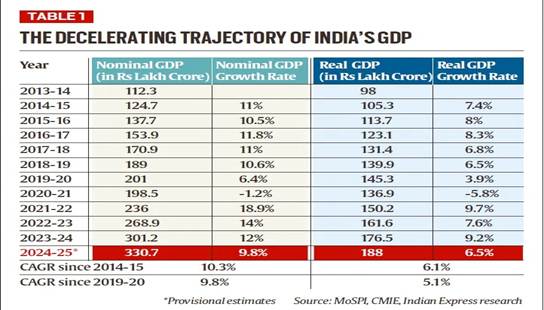
- Nominal GDP & its growth: India’s nominal GDP grew to 9.8% by the end of March 2025 over the GDP in FY24.
- When converted into US dollar terms, the size of India’s economy was $3.87 trillion.
- It is noteworthy that the growth of the nominal GDP is less than 10%: at 9.8%, FY25’s growth was the third-slowest since the current government took charge in 2014, and the sixth slowest growth rate in nominal GDP since India liberalised its economy in 1991.
- It also shows how the nominal GDP growth rate has been decelerating. The Compounded Annual Growth Rate (CAGR) since 2014-15 stands at 10.3% while the CAGR since the start of the second term of the NDA government in 2019 stands at 9.8%
Real GDP & its growth
- While the size of the economy uses nominal GDP data, international comparisons of growth rate are done based on the growth rate of real GDP.
- This is because inflation differs from country to country, and only real GDP provides a genuine understanding about how many actual new goods and services were produced in a particular year.
- India’s real GDP grew by 6.5% in FY25 to reach a level of Rs 188 trillion. The deceleration in the pace of real GDP growth — compared to FY24, when the growth rate was 9.2% — is even more stark than in the case of nominal GDP growth.
- The gap between the real and nominal GDP shows the effect of inflation in prices of goods and services.
GVA & sectoral health of economy
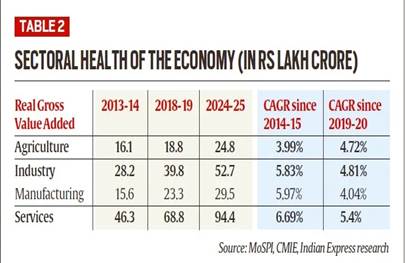
- The real GVA across the three main sectors of the Indian economy: Agriculture and allied activities (such as forestry, etc.); Industry (including sub-sectors such as manufacturing, construction etc.); and Services (including fields like financial services, trade, and hotels etc.)
- For FY 25, the real GVA grew by 6.4%, losing a step over the 8.6% growth in FY24. But notably, none of the sectors have grown at a CAGR anywhere close to 6% since 2019-20.
Manufacturing growth slower than agriculture
- Since 2019-20, manufacturing GVA has registered a slower growth rate (CAGR of 4.04%) than even agriculture and allied activities (4.72%).
- This explains, to some extent, the high urban — in particular, youth — unemployment in India.
- It also provides an understanding of why labour has been moving back to Indian villages, and joining agriculture and allied activities.
Conclusion
Boosting manufacturing growth has been a cornerstone for all governments, none more than the current one, which started the Make in India initiative in 2016. The weakness in the Indian manufacturing sector is the most important and worrisome takeaway from the latest economic growth data.