EDITORIAL 2: Rise of the herbicides
Introduction
Crop protection chemicals are commonly known as “pesticides”. These are basically substances sprayed on crops to protect against insects (“pests”) that cause damage, whether directly (by feeding on them) or indirectly (by transmitting disease).
The pesticides
- Take the white-backed plant hopper, a pest that both feeds on rice plants and also spreads the Fiji virus disease, resulting in their stunted growth.
- This “dwarfing” disease has been reported by many paddy farmers in Punjab and Haryana during the current kharif growing season. The vector insect here injects the virus while sucking the sap from mostly young plants.
- But crop protection chemicals aren’t limited to insecticides. They also include fungicides (to control fungal diseases such as blast and sheath blight in rice or powdery mildew and rusts in wheat) and herbicides (to kill or inhibit the growth of weeds).
The fastest-growing segment
- India’s organised domestic crop protection chemicals market is valued at roughly Rs 24,500 crore.
- The largest segment within that is insecticides, followed by herbicides and fungicides.
- As the accompanying chart shows, it is the market for herbicides that’s growing at the highest rate – over 10% annually.
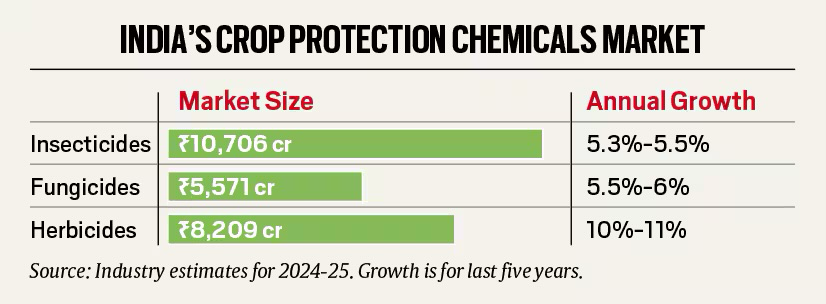
Crop protection chemicals market
- Much of that is controlled by multinational companies: Bayer AG (which has an estimated 15% market share), Syngenta (12%), ADAMA (10%), Corteva Agriscience (7%) and Sumitomo Chemical (6%).
- However, the herbicide segment has Indian players, too, such as Dhanuka Agritech (estimated 6% share) and Crystal Crop Protection Ltd (CCPL: 4%).
- CCPL recently purchased the rights to Ethoxysulfuron, a herbicide used against broad-leaved weeds and sedges in rice and sugarcane, from Bayer AG for sales in India, Pakistan, Bangladesh and Southeast Asian countries.
- Earlier, in December 2023, CCPL had acquired ‘Gramoxone’, a broad-spectrum herbicide containing the active ingredient Paraquat, from Syngenta for sale in India.
The growth driver – farm labour shortage
- Weeds, unlike insect pests and disease-causing pathogens, don’t directly damage or destroy crops.
- Instead, they compete with them for nutrients, water and sunlight. Yield losses happen because the crops are deprived of these essential resources.
- Besides growing at their expense, weeds sometimes even harbour pests and pathogens inflicting further harm.
- By keeping their fields free from weeds, farmers can ensure that the benefits of the fertilisers and irrigation water they give go to the crops and not these unwanted plants.
- Weed control has traditionally been through manual removal by hand or simple lightweight short-handled tools with flat blades such as khurpi.
- There are also power weeders with 3-10 horsepower engine capacity that can be run between rows of standing crops to remove weeds in and around those spaces.
- But manual weeding is time-consuming, with a labourer taking 8-10 hours to cover one acre.
- And since the weeds regrow, the process has to often be repeated during the crop’s lifecycle.
- According to the Labour Bureau’s data, the all-India daily wage rate for plant protection workers averaged Rs 447.6 in December 2024, as against Rs 326.2 five years ago.
- More than the cost though, labour isn’t available when required by the farmer. Power weeders take only 2-3 hours per acre, but aren’t effective in pulling out weeds with deep roots or growing within densely planted crop areas.
- That’s where herbicides come in. The demand for these chemicals is growing mainly on the back of rising agricultural labour scarcity; the number of people in rural India prepared to do this work of bending, digging and uprooting plants for long hours are getting fewer by the day.
- In other words, herbicides have become more like tractors and other labour-saving farm machinery – a substitute for manual weeding.
How the market is evolving
- Farmers generally spray insecticides and fungicides only when they physical observe and assess the pest population or disease incidence to be significant enough to impact crop yield and quality/marketability.
- There’s a certain so-called economic threshold level, where the cost of controlling the pest/disease using chemicals is justified by the extent of anticipated crop loss. In herbicides, too, farmers tend to mostly spray only after the weeds appear and are seen, i.e. “post-emergence”.
- In recent times, farmers have also been resorting to prophylactic application of “pre-emergent” herbicides around or just after crop sowing.
- Alternatively, they may use “early post-emergent” herbicides to control weeds at the crop’s initial sensitive growth stage.
- In both cases, the spraying is preventive, as opposed to being reactive. Out of the estimated Rs 1,500-crore paddy herbicide market, the “pre-emergent” sub-segment accounts for roughly Rs 550 crore.
- The “pre-emergent” and “early post-emergent” spaces are clearly the ones leading the growth, as farmers increasingly opt for timely and smart weed control amid rising labour shortages.
Conclusion
Unlike seeds and fertilisers – where there are enough Indian public as well as private sector players – the crop protection chemicals industry is practically a multinational monopoly. There are some Indian companies, nevertheless, that are attempting to break through, by acquiring the rights to active ingredients and brands from big global majors or even introducing innovative formulations.