Article 2: Asola Bhatti Wildlife Sanctuary
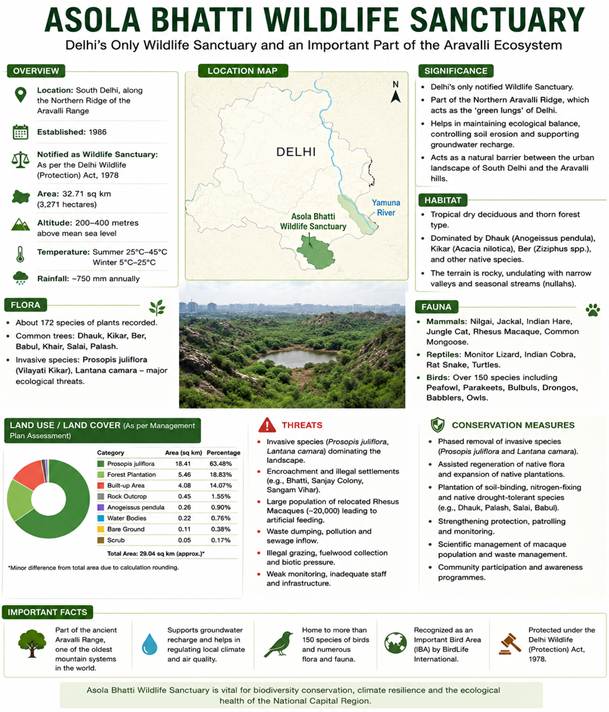
Why in News: A new 10-year management plan prepared by the Wildlife Institute of India has revealed that invasive tree species Prosopis Juliflora covers nearly 63.48% of the landscape in the Asola Bhatti Wildlife Sanctuary, posing a serious ecological threat to the fragile Aravalli ecosystem.
Key Details
- The management plan identifies Prosopis Juliflora and Lantana Camara as the biggest ecological pressures in the sanctuary. These invasive alien species suppress native vegetation and alter the ecological balance of the Aravalli landscape.
- According to the assessment, Prosopis Juliflora occupies around 18.41 sq km of the sanctuary area. This accounts for nearly two-thirds of the total landscape, indicating extensive monoculture formation.
- The plan also highlights encroachment, pollution, illegal grazing, waste dumping, and habitat degradation as major threats. These pressures are reducing the ecological carrying capacity of the sanctuary and affecting biodiversity conservation.
- The sanctuary faces increasing stress due to relocation of nearly 20,000 Rhesus Macaques over the years. The tropical thorn forest ecosystem lacks sufficient natural food resources to sustain such a large primate population.
About Asola Bhatti Wildlife Sanctuary
- The Asola Bhatti Wildlife Sanctuary is Delhi’s only notified wildlife sanctuary. It lies along the ecologically sensitive northern extension of the Aravalli Range.
- The sanctuary forms an important part of the Delhi Ridge ecosystem, often referred to as the “green lungs” of Delhi. It plays a crucial role in regulating local climate, controlling dust storms, and supporting groundwater recharge.
- It represents a tropical thorn forest ecosystem with species adapted to semi-arid conditions. Such ecosystems are highly fragile and vulnerable to anthropogenic disturbances and invasive species.
- The sanctuary also acts as an ecological buffer between urban settlements and degraded mining landscapes. This makes its conservation important for both biodiversity protection and urban environmental security.
Invasive Alien Species
- An invasive alien species is a non-native organism that spreads rapidly and negatively impacts ecosystems. These species often outcompete native flora and fauna for nutrients, water, and habitat space.
- Prosopis Juliflora, commonly known as Vilayati Kikar, was introduced during colonial afforestation programmes. It was initially promoted for fuelwood generation and desertification control in arid regions.
- Over time, the species spread aggressively and formed dense monocultures across large areas. This has reduced biodiversity and altered the natural structure of ecosystems in many parts of India.
- Similarly, Lantana Camara is another invasive shrub affecting forests across India. It restricts regeneration of native plants and increases forest fire vulnerability in dry landscapes.
Ecological Impacts of Prosopis Juliflora
- Prosopis suppresses native species such as Dhauk (Anogeissus pendula) through aggressive root systems and dense canopy cover. This reduces sunlight penetration and limits growth of indigenous vegetation.
- The species alters soil chemistry and groundwater availability in semi-arid ecosystems. It negatively affects long-term ecological sustainability and hydrological balance.
- Dense Prosopis growth modifies habitat structure and reduces habitat suitability for native wildlife. Although some animals temporarily use it for shelter, it cannot replace natural biodiversity-rich habitats.
- The spread of invasive species reduces ecological resilience against climate change and desertification. Healthy native ecosystems are more adaptive and resilient compared to invasive monocultures.
Aravalli Ecosystem and Environmental Importance
- The Aravalli Range is one of the oldest fold mountain systems in the world. It acts as a natural barrier against desert expansion from the Thar Desert towards northern India.
- The Aravallis support groundwater recharge and maintain ecological stability in northwestern India. Their degradation can intensify dust storms, heatwaves, and water scarcity in urban centres like Delhi.
- The Delhi Ridge, a northern extension of the Aravallis, significantly influences Delhi’s air quality and microclimate. Loss of vegetation cover in this region directly impacts environmental health and urban sustainability.
- The Supreme Court and environmental bodies have repeatedly stressed protection of the Aravalli ecosystem. Illegal mining, encroachment, and unregulated urbanisation remain persistent challenges in the region.
Human-Wildlife Conflict and Macaque Relocation
- The management plan notes that around 20,000 Rhesus Macaques have been relocated to the sanctuary over time. This was done to reduce monkey-related conflict in urban areas of Delhi.
- However, the sanctuary lacks adequate natural resources to sustain such a large macaque population. This has led to continued artificial feeding at multiple designated points.
- The artificial feeding system reportedly costs nearly ₹1 crore annually. It also creates behavioural dependency and disrupts natural ecological processes.
- The plan highlights absence of scientific protocols for animal relocation and post-release monitoring. This reflects broader institutional gaps in wildlife management and conservation governance.
Urbanisation and Anthropogenic Pressures
- Encroachment from settlements such as Sangam Vihar and nearby colonies has intensified ecological stress. Illegal construction fragments habitats and increases human-wildlife interactions.
- Waste dumping and untreated greywater inflow are degrading soil and water quality within the sanctuary. This affects both vegetation health and wildlife habitats.
- Illegal grazing and fuelwood collection continue despite protection measures. These activities accelerate habitat degradation and reduce regeneration of native flora.
- Poor coordination among agencies and inadequate staff training weaken conservation effectiveness. This highlights the need for integrated and science-based ecosystem management.
Ecological Restoration Measures Suggested
- The management plan recommends phased removal of Prosopis Juliflora instead of immediate large-scale clearance. Sudden removal may destabilise soil and create additional ecological disturbances.
- It proposes restoration using native drought-resistant species such as Dhauk, Palash, Salai, Babul, and Siris. Native species are better adapted to local climatic and ecological conditions.
- Soil-binding grasses like Vetiver and Munja have been recommended to prevent erosion. These species also help improve soil moisture retention and ecosystem recovery.
- The plan stresses long-term ecological monitoring and assisted natural regeneration. Continuous monitoring is necessary to ensure sustainable restoration outcomes.
Conservation Challenges in Urban Protected Areas
- Urban wildlife sanctuaries face dual pressure from ecological degradation and expanding human settlements. Their conservation requires balancing biodiversity protection with urban development needs.
- Protected areas within cities are critical for climate resilience and environmental sustainability. They help reduce urban heat island effects and improve air quality.
- Weak enforcement and fragmented governance reduce the effectiveness of conservation policies. Coordination between forest departments, urban authorities, and local communities is essential.
- Climate change is further increasing stress on fragile ecosystems through erratic rainfall and heat extremes. This makes ecological restoration even more urgent and necessary.
Way Forward
- Strengthen invasive species management through scientific and phased ecological restoration programmes. This should prioritise native biodiversity and ecosystem resilience.
- Improve protection of the Aravalli ecosystem through stricter regulation of encroachment and pollution. Long-term conservation planning must integrate urban environmental concerns.
- Develop scientific protocols for wildlife relocation, rescue, and rehabilitation. This will reduce ecological imbalance and improve animal welfare outcomes.
- Promote community participation and inter-agency coordination in conservation efforts. Public awareness and local involvement are essential for sustainable ecosystem management.
Conclusion
The ecological crisis at Asola Bhatti Wildlife Sanctuary highlights the growing challenge of invasive species and urban environmental degradation in India. Protecting the Aravalli ecosystem requires scientific restoration, stronger governance, and long-term ecological planning. Sustainable conservation of urban protected areas is crucial for biodiversity, climate resilience, and environmental security.
EXPECTED QUESTION FOR UPSC CSE
Prelims MCQ
Q. With reference to invasive alien species in India, consider the following statements:
- Prosopis Juliflora is a native species of the Indian Aravalli region.
- Invasive alien species can negatively affect biodiversity and ecosystem stability.
- Lantana Camara is considered an invasive species in several Indian forest ecosystems.
How many of the above statements are correct?
(a) Only one
(b) Only two
(c) All three
(d) None
Answer: (b)
Descriptive Question
Q. “Invasive alien species have emerged as a major ecological challenge for India’s fragile ecosystems.” Discuss with special reference to the Aravalli ecosystem and urban wildlife sanctuaries. (250 words, 15 marks)