With reference to India, the terms 'Halbi, Ho and Kui' Pertain to
Correct Answer:
(D) Tribal languages
Halbi, Ho and Kui are the languages of the tribes. The Halbi language is mainly of Bastar, Chhattisgarh, its speakers are the Rajmuria, Halba, Mahar, Parja, Lohra tribes spread from Odisha to Maharashtra. Ho is the language of the Munda family, which is spoken by tribe like Ho, Munda, Koi etc. Its main area is West Singhbhum, Jharkhand, while the speakers spred from Odisha to Maharashtra. Kui is the language to the Dravidian family. It is mainly spoken by the Kui tribe in Kandhamal, Odisha.
Ques: 2
Most widely spoken language after Hindi, in the Indian sub-continent, is –
Correct Answer:
(B) Bengali
Bengali is the most spoken language in the Indian subcontinent after Hindi.
Ques: 3
Which of the following was given the classical language status in 2014?
Correct Answer:
(A) Odiya
Odiya became the sixth language of the country to get classical language status on 20 Feb, 2014. Classical language status was given to Tamil in 2004, Sanskrit in 2005, Telugu and Kannada in 2008 and Malayalam in 2013.
Ques: 4
Which one of the following languages belongs to the Austric group?
Correct Answer:
(C) Khasi
Languages Family wise grouping of Indian languages and percentage of total population who receive the languages as their mother tongue -
Languages
Languages population
Percentage
Families
to total
1. Indo-
1. Assamese, Bengali,
76.86%
European
(a) Indo-
Bhili/Bhilodi, Bishnupuriya,
Aryan
Dogri, Gujarati, Halabi,
Hindi, Kashmiri, Khandeshi,
Konkani, Lahnda, Maithili,
Marathi, Nepali, Odiya
Punjabi, Sanskrit, Shina,
Sindhi, Urdu,
(b) Iranian
Afghani/Kabuli/Pashto,
0.0022%
Persian
(c) European
English
0.02%
2. Dravidian
Coorgi/Kodagu, Gondi,
20.82%
Jatayu, Kannada, Khond/
Kondh, Kisan, Kolami,
Konda, Koya Kui, Kurukh/
Oraon, Malayalam, Malto,
Parji, Tamil, Telugu, Tulu.
3.Austro-
Bhumij, Gadaba, Ho, Juang,
1.11%
Asiatic
Kharia, Khasi, Koda/Kora,
Korku, Korwa, Munda,
Mundari, Nicobarese, Santhali,
Savara.
4. Tibeto-
Adi, Guda, Angami, Ao, Balti,
1.0%
Burmese
Bhotia, Bodo, Chakesang,
Chakru/Chokri, Chang, Deori,
Dimasa, Gangte, Garo, Halam,
Hmar, Kabui, Karbi/Mikir,
Khezha, Khiemnungan,
Kinnauri, Koch, Kom, Konyak,
Kuki, Ladakhi, Lahauli, Lakher,
Lalung, Lepcha, Liangmei,
Limbu, Lotha, Lushai/Mizo,
Manipuri, Maram, Maring,
Miri/Mishing, Mishmi, Mogh,
Monpa, Nissi/Dafla, Nocte,
Paite, Pawi, Phom, Pochury,
Rabha, Rai, Rengma, Sangtam,
Sema, Sherpa, Simte, Tamang,
Tangkhul, Tangsa, Thado,
Tibetan, Tripuri, Vaiphei,
Wancho, Yimchungre, Zeliang,
Zemi, Zou.
5. Semito-
Arabic/Arb
0.01%
Hamitic
Ques: 5
Which one of the following is the largest linguistic group of India?
Correct Answer:
(B) Indo-Aryan
The largest linguistic group of India is Indo-Aryan. This is most important family of Indian languages and comprises of all the principal languages including Hindi, Bengali, Gujarati, Marathi, Punjabi, Sindhi, Rajasthani, Assamese, Odiya, Kashmiri, Urdu, and Sanskrit. It is related to 76.87% of the total Indian population.
Ques: 6
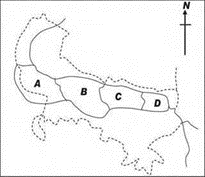
Consider the map given below:
The predominant languages spoken in the areas marked A, B, C and D are respectively:
Correct Answer:
(C) Brajbhasha, Awadhi, Bhojpuri and Maithili
In the area marked as ‘A’, Brajbhasha is spoken. In the area marked ‘B’, Awadhi is spoken. In the area marked ‘C’ Bhojpuri is spoken, and in area marked as ‘D’, Maithili is spoken which is the area of North Bihar.