Introduction & National Income Accounting MCQ Questions
Ques:
1
The term National Income represents:
Correct Answer:
(C)
Gross National Product at market prices minus depreciation and indirect taxes plus subsidies
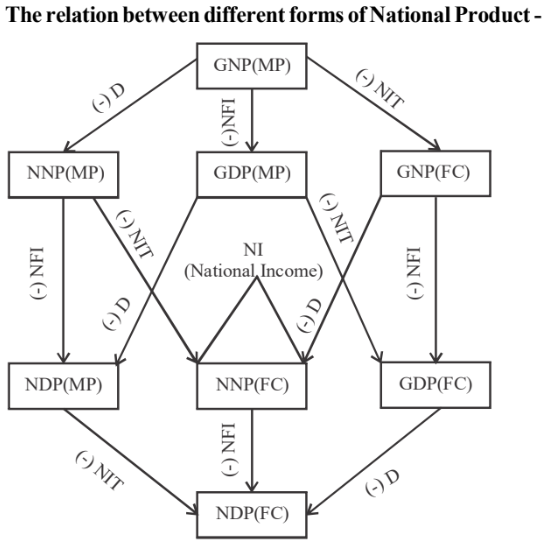
The term National Income (NI) represents Gross National Product at market prices MP (GNP) minus depreciation and indirect taxes plus subsidies. Net National Product at Factor Cost FC (NNPFC) is known as national Income (NI).
NNPMP = GNPMP – Depreciation
NNIFC (NI) = NNPMP – Indirect Taxes + Subsidies (or)
NNPMP – Net Product Taxes – Net Production Taxes (or)
GNPMP – Depreciation – Indirect Taxes + Subsidies
The relation between different forms of National Product -
Net Indirect Taxes (NIT) = Indirect Taxes – Subsidy,
GNP = Gross National product, NNP = Net National product,
GDP = Gross Domestic product, NDP = Net Domestic Product,
MP = Market Prices, FC = Factor Cost,
D = Depreciation, NFI = Net Factor Income from Abroad
Ques:
2
The National income of a country for a given period is equal to the:
Correct Answer:
(D)
Money value of final goods and services produced
National income refers to the total monetary value of all the finals goods and services produced by the normal residents of a country in a specific time period (generally one year). In other words, National Income of a country is defined as the sum of total factor incomes accruing to the normal residents of that country from the production activity performed by them both within and outside the national boundaries in a year. In India computation of National Income is the responsibility of National Statistical Office (NSO), Government of India.
Ques:
3
Which of the following is not a method to calculate the Gross Domestic Product (GDP)?
Correct Answer:
(B)
Diminishing cost method
enditure method
Ans. (b)
Exp: The 3 methods which are used for calculating the Gross Domestic Product (GDP) are as follows :
1. Product method
2. Income method
3. Expenditure method
The diminishing cost method is not used to calculate the GDP.
Ques:
4
'Base year' in National Income accounting means:
Correct Answer:
(C)
The year whose prices are being used to calculate the real GDP
'Base year' in National Income accounting means – the year whose prices are being used as reference prices to calculate the real GDP or real National Income. At present, the base year for National Income accounting is 2011-12. For example– if goods and services produced during the year 2021-22 are valued at the prices of the base year (i.e. 2011-12), it will be called National Income at constant prices.
Ques:
5
Read the following statements and choose the correct option :
Statement I : Net Domestic Product = Gross Domestic Product + Depreciation.
Statement II : Per Capita Income = Net Domestic Product ÷ Total Population of the Nation.
Statement III : Net Domestic Product is not considered a better metrics than Gross Domestic Product for comparing the economies of the world.
Codes:
Correct Answer:
(D)
None of the above options is true
Net Domestic Product (NDP) is an annual measure of the economic output of a nation that is calculated by subtracting depreciation from Gross Domestic Product (GDP). It means,
Net Domestic Product = Gross Domestic Product – Depreciation.
Hence, Statement I is incorrect while Statement II is also not true. Per Capita Income is the average income earned per person in a nation or geographic region in a specified year. It can be calculated by dividing National Income (Net National Product) from the total population of the nation. Statement III is also incorrect as Net Domestic Product is the better metrics than Gross Domestic Product for comparing the economies of the world, since the former also reveals the amount of investment spent on improving the obsolete equipment’s to maintain the production level. An increase in depreciation alone can push up the GDP level, but it does not indicate improvements in that country's social and economic well-being.
Ques:
6
Theoretically, if economic growth is conceptualized, which one of the following is not usually taken into consideration?
Correct Answer:
(B)
Growth in financial aid from World Bank
Growth in Gross Domestic Product (GDP), Gross National Product (GNP) and Per Capita Gross National Product are considered in the Economic Development. Growth in World Bank's financial aid is not included in this.
Ques:
7
Indian Economy is:
Correct Answer:
(A)
Mixed economy
Indian economy is a prominent example of mixed economy. A mixed economic system is a system that combines aspects of both capitalism and socialism. A mixed economic system protects private property and allows a level of economic freedom in the use of capital, but also allows for governments to interfere in economic activities in order to achieve social aims. Mixed economies typically maintain private ownership and control of most of the means of production, but often under government regulation and socialize selected industries that are deemed essential or that produce public goods. Gandhian socialist economy is based on decentralization and equal distribution of resources without any exploitation and violence. Self-employment and self-reliance are key features of Gandhian self-sufficient economy.
Ques:
8
It will be true to classify India as:
Correct Answer:
(B)
A labour-surplus economy
India is classified as a labour-surplus economy because of its large population and with an unlimited number of workers willing to work at a subsistence wage. India is projected to have a skilled-labour surplus of around 245.3 million workers by 2030, owing mainly to its vast supply of working-age citizens and government programmes to boost worker's skills.
Ques:
9
Which of the following correctly explains that India is an underdeveloped economy?
Inequitable distribution of income
High dependency ratio
Slower rate of increase in national income
Change in banking and financial sector
Select the correct answer using the codes given below.
Correct Answer:
(B)
1, 2 and 4
An under-developed country is a country that has a low real per capita income as compared to the present-day per capita income of rich countries like USA, Canada.
Reasons for India being an underdeveloped economy:
Low per capita income.
Low levels of living.
Technological backwardness and inefficient banking sector.
Unequal distribution of Income.
Low productivity.
Excessive dependence upon agriculture.
The rapid growth of the population
Existence of unemployment and disguised unemployment.
Poor quality of human capital.
Dualistic economy.
High dependency ratio.
Change in banking and financial sector.
Ques:
10
Which of the following features indicates that Indian economy is in a developing category?
Occupation is mainly agriculture
Disguised unemployment
Poor quality of human capital
High per capita intake of proteins
Select the correct answer from the codes given below :
Codes :
Correct Answer:
(D)
1, 2 & 3
Indian economy is characterized as a developing economy. The following features indicates that Indian economy is in a developing category–
Low per capita income;
Excessive dependence on agriculture (Occupation is mainly agriculture);
High rate of population growth and over population;
Existence of chronic unemployment and disguised unemployment;
Poor rate of capital formation;
Low level of technology;
Poor quality of human capital;
Lack of infrastructure;
High level of poverty and inequality;
Low industrial development;
Market imperfections;
Low level of living of an average Indian etc.