Consider the following budget deficits of Central Government :
Primary deficit
Fiscal deficit
Revenue deficit
The correct descending order of their values is :
Code :
Correct Answer:
(A)
2, 3, 1
The correct descending order of the values of given deficits is as follows :
Fiscal deficit > Revenue deficit > Primary deficit
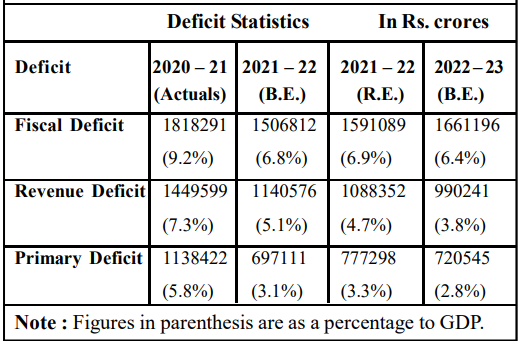
The recent trends of deficits in the Union Budget are presented in the following table :
Fiscal deficit is the largest, encompassing both revenue and capital expenditure.
Revenue deficit is a part of the fiscal deficit, representing only the shortfall in revenue-based spending.
Primary deficit is the smallest, as it excludes interest payments from the fiscal deficit.
Deficit Type
Actuals 2022-23
Budgeted 2023-24
Actuals 2023-24
Budgeted 2024-25
% change (2023-24 Actuals to 2024-25 BE)
Revenue Deficit
10,69,926
8,69,855
7,65,624
5,80,201
-24.2%
% of GDP
3.9%
2.9%
2.6%
1.8%
Fiscal Deficit
17,37,755
17,86,816
16,53,670
16,13,312
-2.4%
% of GDP
6.4%
5.9%
5.6%
4.9%
Primary Deficit
8,09,238
7,06,845
5,89,799
4,50,372
-23.6%
% of GDP
3.0%
2.3%
2.0%
1.4%
Ques:
2
Match List I with List II and select the correct answer using the codes given below the lists :
List I (Term) List II (Explanation)
A. Fiscal deficit 1. Excess of Total Expenditure over Total Receipts
B. Budget deficit 2. Excess of Revenue Expenditure over Revenue Receipts
C. Revenue deficit 3. Excess of Total Expenditure over Total Receipts less borrowings
D. Primary deficit 4. Excess of Total Expenditure over Total Receipts less borrowings and Interest Payments
Codes :
A B C D
Correct Answer:
(A)
3 1 2 4
The excess of Government's total expenditure (both revenue and capital) over total receipts (both revenue and capital) constitutes budget deficit. From the 1997-98 Budget, the practice of showing budget deficit has been discontinued in India. The excess of Government's revenue expenditure over revenue receipts constitutes revenue deficit. The difference between the total expenditure of Government by way of revenue, capital and loans net of repayments on the one hand and revenue receipts of Government and capital receipts which are not in the nature of borrowing but which accrue to Government on the other, constitutes gross fiscal deficit. Gross primary deficit is gross fiscal deficit reduced by the gross interest payments. Note : In the Budget documents 'gross fiscal deficit' and 'gross primary deficit' have been referred to in abbreviated form 'fiscal deficit' and 'primary deficit', respectively.
In short,
Budget deficit = Total expenditure – Total receipts
Revenue deficit = Revenue expenditure – Revenue receipts
Fiscal deficit = Total expenditure – Total income / revenue (Revenue receipts + Non-debt creating capital receipt)
= Total expenditure – [Total receipts less borrowings (debt and other liabilities)]
= Budget deficit + Internal and external borrowings
Primary deficit = Fiscal deficit – Interest payments
Ques:
3
If interest payments are subtracted from gross fiscal deficit, the remainder will be :
Correct Answer:
(A)
Gross primary deficit
The borrowing requirement of the government includes interest obligations on accumulated debt. The goal of measuring primary deficit is to focus on present fiscal imbalances. To obtain an estimate of borrowing on account of current expenditures exceeding revenues, we need to determine what has been called the primary deficit.
Primary deficit = Fiscal deficit – Interest payments or,
Primary deficit = Fiscal deficit – Net interest liabilities
Net interest liabilities consist of interest payments minus interest receipts by the government on net domestic lending.
Ques:
4
After deducting grants for the creation of capital assets from revenue deficit, we arrive at :
Correct Answer:
(D)
Effective Revenue Deficit
Effective revenue deficit is defined as the difference between revenue deficit and grants for creation of capital assets. Effective revenue deficit signifies that amount of capital receipts that are being used for actual consumption expenditure of the Government. The concept of effective revenue deficit has been initiated from Union Budget for the financial year 2011-12. The main objective to introduce this type of deficit concept is to denote constructive imbalances of revenue account. It included in the Fiscal Responsibility and Budget Management Act, 2003 through an amendment in 2012. In Budget Estimates 2023-24 the effective Revenue deficit is revised estimated at 1.8 percent of GDP whereas in estimates of 2024-25 it was at 0.8 percent of GDP.
Ques:
5
There has been a persistent deficit budget year after year. Which action/actions of the following can be taken by the Government to reduce the deficit?
Reducing revenue expenditure
Introducing new welfare schemes
Rationalizing subsidies
Reducing import duties
Select the correct answer using the code given below :
Correct Answer:
(C)
1 and 3 only
Ques:
6
'Budget' is an instrument of-
Correct Answer:
(C)
fiscal policy of the government
Budget is an instrument of fiscal policy of the government. Under Article 112 of the Constitution, a statement of the estimated receipts and expenditure of the Government of India has to be laid before both the Houses of Parliament in respect of every financial year. This statement titled 'Annual Financial Statement' is the main Budget document.
Ques:
7
Consider the following statements:
The Base Erosion and Profit Shifting (BEPS) is an Organisation for Economic Co-operation and Development (OECD) initiative.
BEPS refers to tax strategies exploiting differences in tax rules across countries to minimise overall corporate tax payments.
Which of the statements given above is/are correct?
Correct Answer:
(C)
Both 1 and 2
The BEPS initiative is an OECD initiative, approved by the G20, to identify ways of providing more standardised tax rules globally.
BEPS refers to tax strategies exploiting differences in tax rules across countries to minimise overall corporate tax payments.
This strategy aims to reduce overall corporate tax liability by making profits seem to vanish or by moving them to low-tax regions with minimal real economic activity.
While often not illegal, BEPS tactics capitalise on variations in international tax regulations.
Developing countries are particularly vulnerable to BEPS due to their strong dependence on corporate income tax, especially from multinational corporations.
Ques:
8
Consider the following statements regarding Organisation for Economic Co-operation and Development (OECD):
It is an intergovernmental economic organisation, founded in 1951 with its Headquarters in Paris, France.
It has a total membership of 48 countries.
Which of the statements given above is/are correct?
Correct Answer:
(D)
Neither 1 Nor 2
It is an intergovernmental economic organisation, founded in 1961 with its Headquarters in Paris, France.
It has a total membership of 38 countries.
India is not a member but a key partner of the OECD.
It aims to stimulate economic progress and world trade.
Most OECD members are high-income economies and are regarded as developed countries.
Ques:
9
With reference to Base Erosion and Profit Shifting (BEPS), consider the following statements:
1. It involves tax avoidance by exploiting loopholes in taxation system of the countries
2. BEPS has been deemed illegal globally.
Which of the above statements is/are correct?
Correct Answer:
(A)
1 only
Statement 1 is correct: BEPS refers to “tax planning strategies that exploit gaps and mismatches in tax rules to make profits ‘disappear’ for tax purposes or to shift profits to locations where there is little or no real activity but the taxes are low resulting in little or no overall corporate tax being paid
Statement 2 is incorrect: As per OECD, in most cases BEPS strategies are not illegal. Largely they just take advantage of current rules that are still grounded in a bricks and mortar economic environment rather than today’s environment of global players which is characterized by the increasing importance of intangibles and risk management. That said, some of the schemes used are illegal and tax administrations are fighting them.
Ques:
10
Consider the following statements regarding Base Erosion and Profit Shifting (BEPS):
It refers to tax planning strategies used by multinational enterprises that exploit gaps and mismatches in tax rules.
The developing suffer disproportionately due to BEPS.
Which of the statements given above is/are correct?
Correct Answer:
(C)
Both 1 and 2
BEPS refers to tax planning strategies used by multinational enterprises that exploit gaps and mismatches in tax rules to avoid paying tax. Developing countries higher reliance on corporate income tax means they suffer from BEPS disproportionately.
BEPS practices cost countries USD 100-240 billion in lost revenue annually. Working together within OECD/G20 inclusive framework on BEPS, over 135 countries and jurisdictions are collaborating on the implementation of 15 measures to tackle tax avoidance, improve the coherence of international tax rules and ensure a more transparent tax environment.