Beginning of Regional Kingdoms Sunga Dynasty
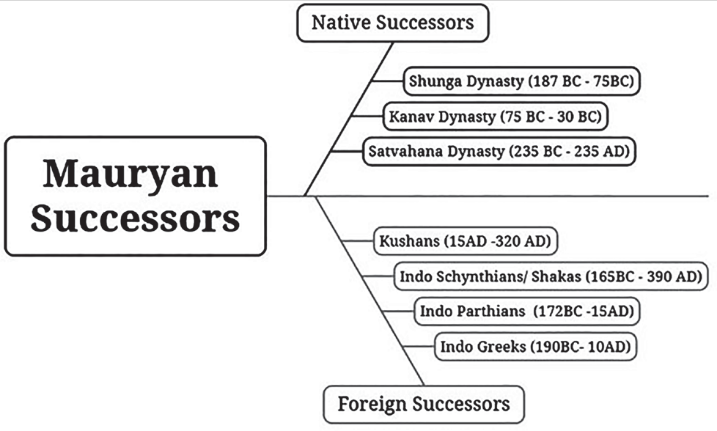
Introduction: Beginning of Regional Kingdoms and Cultures
• The period between approximately 200 BCE and 300 CE did not witness the rise of large empires like the Mauryas, but it was marked by significant historical, political, and cultural developments.
• During this time, the political focus shifted from Magadha to north-western India, leading to the emergence of regional kingdoms and new forms of governance, such as joint rule and subordinate rule.
• In the East, Central India and the Deccan, the Mauryas were succeeded by the Sungas, the Kanvas and the Satavahanas.
• Urbanization and the expansion of cities became prominent, with specialized crafts and extensive trade networks growing.
• The use of currency increased in the economy.
• This era was characterized by cultural interactions, doctrinal debates, the rise of image-based devotional worship, and the institutionalization of religious activities.
• It also saw the development of sophisticated sculptural and architectural styles. In summary, this period contributed significantly to the diverse and rich heritage of the Indian subcontinent as we know it today.
Sunga Dynasty
• The Maurya dynasty came to an end in 187 BCE when its last king, Brihadartha, was assassinated by his own commander-in-chief, Pushyamitra Sunga, establishing the Sunga Dynasty as the rulers of Magadha.
• The Sunga rulers were of Brahmin caste origin and are mentioned in various texts, both Buddhist and Brahminical, including the Harshacharita, the Brihadaranyaka Upanishad,Panini’s Ashtadhyayi,Kalidasa’s Malavikaagnimitram, Divyavadana, and Tarantha’s historical account.
• There were ten Shunga rulers. However, after the death of Agnimitra, the second king of the dynasty, the empire rapidly disintegrated.
• The dynasty is noted for its numerous wars with both foreign and indigenous powers. They fought the Kalinga, the Satavahana dynasty, the Indo-Greek Kingdom and possibly the Panchalas and Mitras of Mathura.
• According to Patanjali’s Mahabhasya, there were Greek attacks during Sunga’s rule
| Empero | Reign |
| Pushyamitra | 185–149 BCE |
| Agnimitra | 149–141 BCE |
| Vasujyeshtha | 141–131 BCE |
| Vasumitra | 131–124 BCE |
| Bhadraka | 124–122 BCE |
| Pulindaka | 122–119 BCE |
| Ghosha or Vajramitra | 119-114 BCE |
| Bhagabhadra | 114-83 BCE |
| Devabhuti | 83–73 BCE |
Period and Territories:
• The Sunga Dynasty saw ten kings reigning for a total of approximately 112 years.
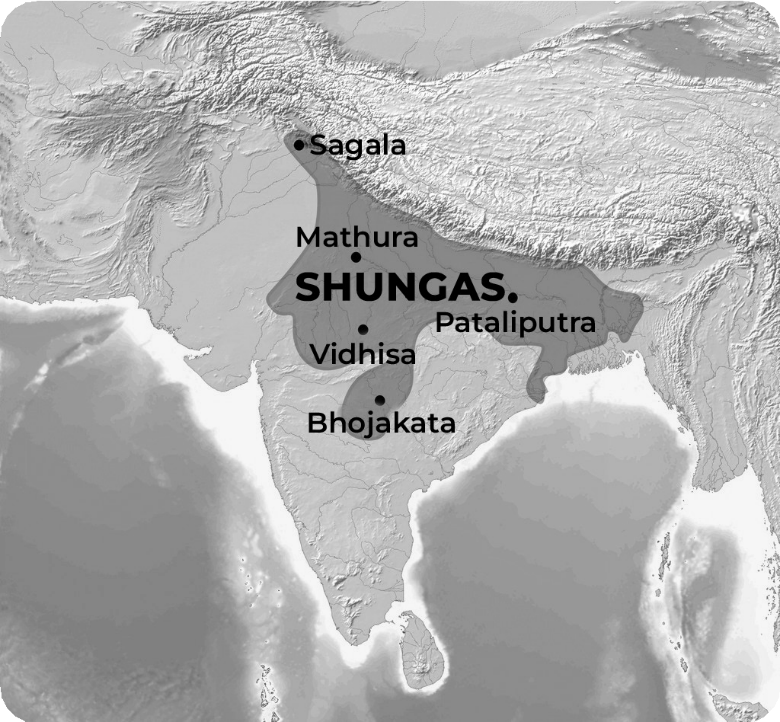
• The capital city was Pataliputra and later Vidisha.
• Pushyamitra’s domain covered only a portion of the former Maurya empire, including Pataliputra, Ayodhya, Vidisha, and certain areas in modern-day Punjab, such as Jalandhar and Sakala (now known as Sialkot).
• Major cities include Ujjain, Mathura, Saket, Sanchi and Kapilavastu.
Bhagabhadra or Bhagavata
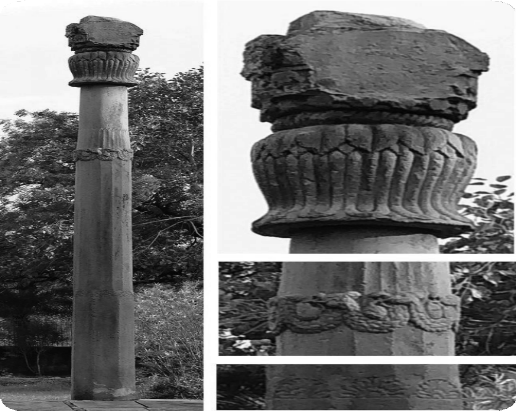
• Bhagavata could refer to either the fifth king Kasiputa Bhagabhadra or the ninth king Bhagavata, as suggested by the significant Besnagar Pillar inscription by Heliodorus.
Pushyamitra Sunga
• He was the former Mauryan Army’s commander-in-chief who assassinated Brihadratha and founded the Shunga Dynasty.
• He conducted two Ashvamedha sacrifices, as confirmed by King Dhana’s Ayodhya stone inscription.
• His rule stretched from the Narmada River in the south to cities like Pataliputra, Ayodhya, and Vidisha.
Kaildasa’s “Malavikaagnimitram” recounts his conflict with Vidarbha’s king, Yajnasena, and the Sungas’ victory. It also details the challenge to Pushyamitra’s Ashvamedha horse by foreign yavanas, leading to a clash with Prince Vasumitra.
• He also defeated the Bactrian Greek king, Demetrius, as mentioned in Patanjali’s works.
• Patanjali, a prominent grammarian, lived during Pushyamitra Sunga’s time.
• The “Divyavadana” chronicles Pushyamitra’s cruelty towards Buddhists and his hostility towards Buddhism.
• Pushyamitra ruled for 36 years and was succeeded by his son Agnimitra.
Agnimitra
• Son of Pushyamitra Shunga.
• Vidarbha became independent during this period.
• His son Vasumitra succeeded after him.
Vasumitra
• Malavikagnimitram (“Love story of Malavika and Agnimitra, son of Pushyamitra”), a play by Kalidasa, mentions the defeat of the Yavanas (Bactrian Greeks) at the hands of Vasumitra, the grandson of Pushyamitra Sunga.
Devabhuti
• Devabhuti (Devabhumi) is the final ruler of the Sunga Dynasty.
• According to the Harschcharita, he met his demise at the hands of his Brahmana minister Vasudeva Kanva, who subsequently established the Kanva dynasty.
• The Satavahanas took over the remnants of the Sunga empire.
The Sunga State: Polity & Culture Administration:
• The King was assisted by a Council of Ministers and
Bureaucrats, and his empire was divided into provinces.
• The provinces were put under the charge of Governors of royal blood.


• A council assisted the Governor.
• Certain tribal regions having autonomous power were also integrated.
Art and Architecture:
• The period saw the flowering of visual arts including small terracotta images, larger stone sculptures and architectural monuments like the chaitya hall at Bhaja, the stupa at Bharhut and the Great Stupa at Sanchi.
• The Shunga rulers helped to establish the tradition of royal sponsorship of learning and art. The script used by the empire was a variant of Brahmi script and was used to write Sanskrit.
• The gates and railings of the Bharhut stupa and the fine gateway railings that surround the Sanchi stupa are said to have been built during the Sunga period.

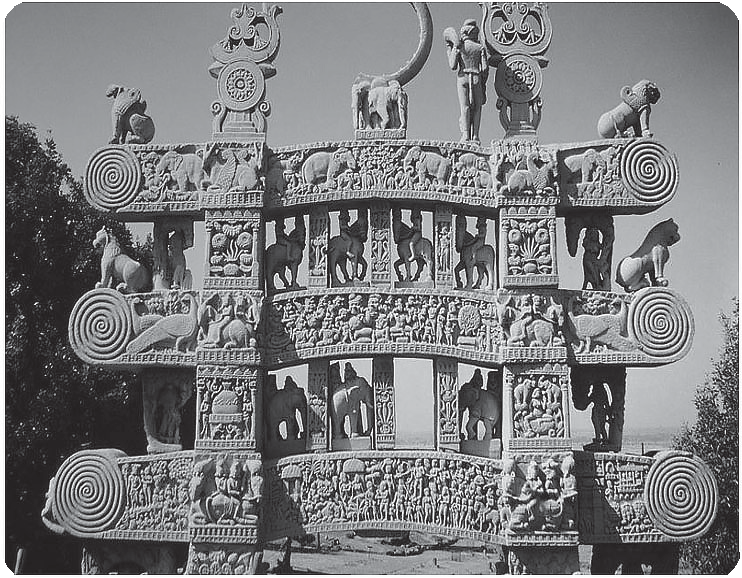
North Torana (Gateway) (Sunga period) of Sanchi Stupa
• Human figures in the reliefs illustrate episodes from the life of the Buddha and incidents that give us an idea of contemporary life.
• The Sungas adapted the Bharhut stupa, which was originally erected by Ashoka.
• Some sculptures of Bharhut, Bodhgaya and Sanchi represent the first organized art activity which was opposite to the court art of the Mauryas. It reflects for the first time the results of the ethnic, social and religious fusion and integration.
• Unlike the Mauryas’ imperial art, the reliefs and figures in the Bharhut stupa were provided by laypeople, monks, and nuns, according to inscriptions on the railings.
• As a result, it is considered one of the earliest instances of Maurya’s popular art.
• Artistry also progressed with the rise of the Mathura art style.
• The Shunga art style differed somewhat from imperial Mauryan art, which was influenced by
Persian art. In both, continuing elements of folk art and cults of the mother goddess appear in popular art but are now produced with more skill in more monumental forms.
• The Shunga style was thus seen as ‘more Indian’ and is often described as the more indigenous.
• Patanjali lived during this period sometime between 2nd and 4th Century CE.
• The author of the Mahābhāṣya, an ancient treatise on Sanskrit grammar and linguistics, based on the Aṣṭ dhy y of P ṇini.
• The compiler of the Yogasutras, a classical text on Yoga theory and practice.
• A notable scholar of Samkhya school of Hindu philosophy.
• Author of a medical text called Patanjalatantra.
• He is not to be confused with another author Patanjali, who likely lived in 8th-century CE and wrote a commentary on Charaka Samhita and this text is called Charakavarttika.
• The script used by the Shunga was a variant of Brahmi and was used to write the Sanskrit language.
Religion:
• After Ashoka’s tryst with liberal Dhamma and Buddhism, the Sungas reverted to Brahmanical orthodoxy to augment royal power and ensure divine reverence for the king.
• In the Ayodhya inscription of Dhanadeva, Pushyamitra Sunga is credited with the performance of two Asvamedha sacrifices.
• Buddhist sources claim that he persecuted the Buddhists. Divyavadana depicts Pushyamitra as a destroyer of Buddhist monasteries and places of worship, particularly those constructed by Ashoka.
Decline of Sungas
• The last Sunga king, Devabhuti, was killed by his Brahmana minister Vasudeva. Thus, the Sunga line came to an end by 75 BCE.
Kanva Dynasty
Kanva Dynasty
After usurping from Sungas, Vasudeva Kanva, a Brahmana, established the Kanva or Kanvayana dynasty.
Most information about this dynasty comes from its coins.
Also described as the Sungabhrityas (literally meaning ‘servants of the Sungas’).
They made way for the Mitras in c. 30 BCE, who were eventually dislodged by the Shakas in Magadha.

Period and Territories:

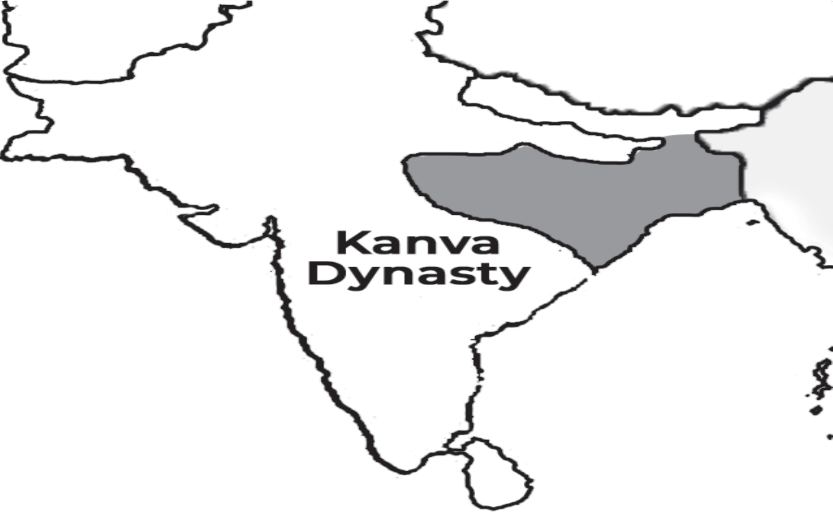
It lasted from 73 BCE to 28 BCE.
The empire was extended into parts of eastern India i.e., Magadha and central India.
The Kanva dynasty had claimed Vidisha (Madhya Pradesh) as their capital.
Rulers of the Kanva Dynasty:
• The major rulers were:
• Vasudeva Kanva
• Bhumimitra
• Narayana
• Susarman
• Kanvas ruled for only 45 years.
End
The Satavahana dynasty overthrew the Kanva dynasty and established their own empire. The final Kanva king, Susarman, was defeated and killed by King Simuka of the Satavahana (Andhra) dynasty.
Satavahana Dynasty
Satavahana Dynasty:
Introduction:
The Satavahana dynasty was founded by Simuka, who
killed the last Kanva king, Susarman.
The dynasty was also known as the Satkarnis and Andhras.
Following the decline of the Mauryas, the Satavahanas succeeded them in the Deccan and central India, ruling over several smaller political territories.
The Satavahanas are often linked with the 'Andhras' mentioned in the Puranas and ruled for 300 years, with their capital at Pratishthana (modern-day Paithan) on the Godavari River. Their second capital was Dhanyakataka, near Bezwada, on the Krishna River.

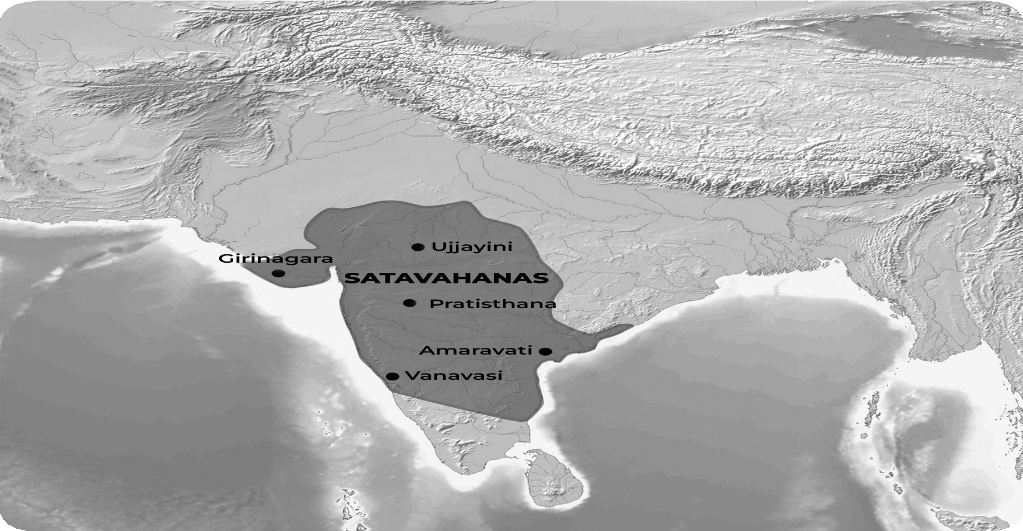
The earliest Satavahana inscriptions date back to the 1st century BCE when they defeated the Kanvas and established control over parts of central India.
They also used matronyms such as Gautamiputra and Vashishthiputra, despite not being matriarchal.
They held the title of Dakshinapathapati (Lord of the Dakshinapatha) and were known for granting land to Brahmanas and Buddhist monks, often with tax exemptions.
Gautamiputra Satkarni’s inscription specified that the granted land was free from royal interference, salt digging, and state control, and enjoyed various immunities.
Origins
The early Satavahana rulers emerged in north Maharashtra, particularly the upper Godavari valley, before extending their influence over Karnataka and Andhra.
They faced competition from the Shaka Kshatrapas in western India and the upper Deccan, especially in controlling important seaports like Bhrigukachcha, Kalyan, and Suparaka.
The Satavahanas claimed Brahmana lineage and conducted Vedic rituals, worshipping deities like Krishna and Vasudeva, as evident in Naganika’s Naneghat cave inscription (1st century BCE).
Important Rulers and their Contributions:
| Simuka | 271-248 BCE |
| Kanha | 248-230 BCE |
| Satakarni I | 230-220 BCE |
| Satakarni II | 184-128 BCE |
| Hala | 6-7 AD |
| Gautamiputra Satakarni | 62-86 AD |
| Vasishthiputra Pulumavi | 86-114 AD |
| Vashishtiputra Satakarni | 114-121 AD |
| Shivaskanda Satakarni | 121-128 AD |
| Yajna Sri Satakarni | 128-157 AD |
Simuka:
Founder of the Satavahana Dynasty and was immediately active after Ashoka’s death.
Built Jain and Buddhist temples.
Conquered western Malwa, Vidarbha and Anupa.
Sri Satkarni-I:
• Narmada Valley and Berar regions were won by him.
• He performed two Ashvamedha sacrifices and one Rajasuya sacrifice.
• He used to give donations to priests known as Karshapanas.
• Nanaghatinscription describesSatakarni-1 as Dakshinapatha-pati (Lord of the Dakshinapatha)


Sri Satkarni-II:
• He was the longest ruler of the Empire.
• Fought with the Kharavela.
Hala:
• His period brought great prosperity.
• Hala was also a renowned poet known for composing the ‘Gatha Sattasai’, a collection of 700 erotic poems in the Maharashtri Prakrit dialect.
Gautamiputra Satkarni:
• He was the greatest of the Satavahana kings.
• He defeated the Shaka ruler Nahapana and reissued the silver coins of Nahapana with his own royal insignia.
• He also captured Malwa and Kathiawar from the Shakas.
• He is also said to have performed the prestigious Vedic
Asvamedha sacrifice.
• Nasik Prashasti: His achievements were described by his mother Gautami Balasari. This inscription mentions him as the conqueror of the Shakas, Pahlavas, and Yavanas as well as the vanquisher of the Kshaharatas. This inscription described him as Eka Brahman/Ekabahamana (peerless Brahmana).
• He made Paithan his capital which was near Godavari.
• He generously donated land to Buddhist monks of the Mahasamghikas at Karle and Nashik, as recorded in Karle inscriptions.
• He adopted titles like Rajaraja and Maharaja.
• Issued a large number of silver coins.
Yagnashri Satakarni:
• He was another famous ruler who issued coins with a
ship motif, indicating the importance of overseas trade
during his reign.
• He was likely the 17th king in the lineage.
Politico-Administrative Structure of Satvahana’s Kingdom:
• They adopted an administrative structure similar to Ashokan times.
• The empire was divided into Janapadas, Aharas
(provinces), and Gramas (villages).
• Aharas were headed by Amatya.
• Satavahana kingdom had three grades of feudatories:
• Raja (king who had the right to strike coins)
• Mahabhoja: Prominent military official.
• Senapati: He was the provincial governor.
• Some important functionaries were – Mahatarakas (great chamberlains), Bhandagaiikas (storekeepers), Heranikas (treasurers), and Nibandhakaras (officers in charge of registration of documents).
• Gaumika: Administrator of the rural village and was commander of the military unit comprising nine chariots, nine elephants, 25 horses, and 45-foot soldiers.
• Kataka and Skandhavaras: Military grade officials in Satvahana rule.
Societal and Religious Aspects of Satavahana’s Kingdom:
• The Varna system and Brahmanism were dominant.
• Gautamiputra Satkarni established a four-fold varna system.
• Satvahanas were the first rulers to make land grants to Brahmanas.
• Among the artisans, the Gandhikas or the perfumers are repeatedly mentioned as donors.
• The matrilineal social structure was prominent.
• Kings practiced Vedic sacrifices (Ashvamedha and Vajapeya sacrifices), worshipped Vaishnava gods like Krishna and Vasudeva, and supported Buddhism by granting land to Buddhist monks in Nagarjunakonda, Amravati, Nashik, and Junar.
• Mahayana Buddhism was also practiced and was not entirely side-lined.
• They paid special attention to Amravati and Nagarjunikonda Stupa.
• Karle Chaitya Caves were made and patronized.
• Merchants and artisans were prominent due to the flourishing trade and supported Buddhism through donations.
Economic Aspects of Satavahana’s Kingdom
• Agriculture was well developed.
• Megalithic burials were also found. They were practiced by those tribes which resided during this reign.
• They used coins from lead.
• Coins were made of alloys using lead, silver and copper.
• They were the first Bilingual coins and the first one to issue coins with the King’s portrait.
• Prakrit, Telugu and Kannada were used.
• Ancient gold usage has been found in Kolar fields.
• Crops like Paddy and Cotton were popular.
• Burnt brick usage was popular. Roof tiles evidence was also seen.
• The important ports on the (eastern Deccan) were Kantakossyla (Kantakasela), Koddura (modem Gudur), and Aliosynge. On (western Deccan the important points were Kalyana, the Calliena of the Periplus near Bombay, Barygaza and Sopara.
Cultural-Literary aspects of Satvahana’s Kingdom:
• The official language was Prakrit.
• Brahmi script was used in the kingdom.
• ‘Hala’s text ‘Gathasaptashati’ was written in Prakrit language.
• Gunady, the most celebrated poet of Prakrit had written
‘Brihat Katha’ in the Prakrit language.
• Inscriptions
• Nanaghat- about Satkarni I’s wife.


• Nasik: about Gautamiputra by Pulumayi II.
• Karle: about Pulumayi II.
Architectural aspects of Satvahana’s Kingdom:
• Chaityas and Viharas were made during this time period.
• Chaitya was a large hall, with a number of columns, for worship. Karle Chaitya was the most prominent structure.
• Viharas were used for staying. They act as residences of monks in the rainy season.
• Vihara consisted of a central hall entered by a doorway from a verandah in front.
• Viharas in Nasik were made during this era.
• Nagarjunikonda and Amravati stupa were also patronized by Satavahanas.
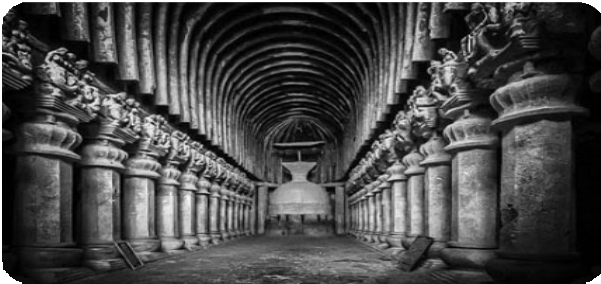
Figure: Karle caves
Amravati School of Sculpture:
• It was also developed during this period under the patronage of Satavahanas and later by the Ikshavaku.
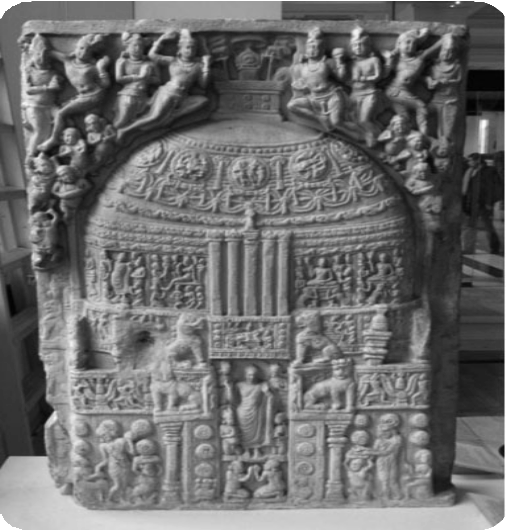
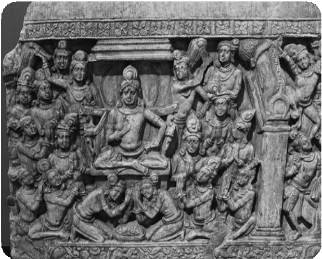
• It was an indigenous art tradition. Amravati, Nagarjunikonda, Goli, Ghantasala, and Vengi are notable locales where this style flourished.
• The Amravati stupas are made of striking white marble.
• The ‘narrative art’ is a prominent feature of the Amaravati school.
• The medallions were carved in such a way that they depicted a natural occurrence. For instance, the medallion displays an entire story about the Buddha taming an elephant.
• In human, animal, and floral forms, Amaravati sculptures have a sense of movement and vitality, as well as profound and serene naturalism.
• The Amaravati Stupa, like the Sanchi Stupa, has a Pradakshina Patha contained by a vedika on which various narrative stories from the life of Buddha and bodhisattva predominate, but their structural anatomy is more intricate.
• This style included both religious and secular images.
Other important aspects of the Satavahana Kingdom:
• Land grants became a significant development during the Satavahana period, primarily benefiting Buddhists and Brahmins.
• The Naneghat inscription mentions tax exemptions granted on lands given to Buddhist monks.
• This period marked the rise of priestly groups to higher social status, as these land donations led to the creation of landowners who did not engage in cultivation.
• As a result, a land-based social hierarchy and societal divisions began to emerge.
• The Satavahanas established a large state, covering much of the Deccan for the first time.
• Numerous rock-cut caves dedicated to the Buddha sangha, located along trade routes connecting the interior to the coastal Konkan region, reflect the importance of these areas.
• The era also saw vibrant Indo-Roman trade activities.


Other Important Kingdom
Other Important Kingdom: Chedis
Kharvela was a prominent ruler of this kingdom.
The Hathigumpha inscription in the Udayagiri Khandagiri hill, near Bhubaneswar, belongs to Kharvela.
Kharvela followed Jainism. He set up residential chambers on the top of Udayagiri hills for Jaina monks