Indo- Greek
Indo-Greeks
The Indian word for coin Karsa is of Persian origin. The coins might have been inspired by the Persian coins.
• The presence of coins from this period indicates active trade connections between India and Persia.
• Mauryan art and architecture exhibit clear Persian influences, with the Ashokan Pillars resembling columns from the Achaemenid Empire.
• The bell-shaped capitals of the columns, such as the lion capital of the Sarnath pillar and the bell capital of the Rampurva pillar, share similarities with designs found in Achaemenid columns.
• Additionally, the pillared remains of the palace in Pataliputra bear a striking resemblance to the pillared halls of the Achaemenid capital. Despite these influences, Indian craftsmen infused their work with distinct local characteristics, blending Persian designs with Indian styles.

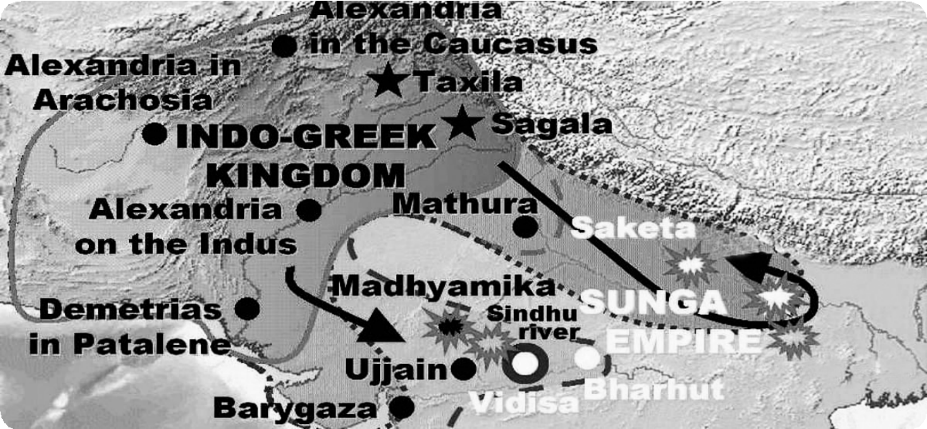
• After Alexander’s death in 323 BCE, Greek settlers moved to the north-western border of India near Bactria (now northern Afghanistan, south of the Oxus River, and northwest of the Hindu Kush mountains).
Beginning of Bactrian Rule
• These Bactrian Greeks descended from Hellenistic ancestry and were originally subordinate rulers of the Seleucid Empire.
• Around the 3rd century BCE, Diodotus I rebelled against the Seleucid king and founded an independent Bactrian Greek kingdom.
• By around 145 BCE, due to pressure from Scythian tribes, the Bactrian Greeks lost Bactria but continued to rule part of north-western India between the 2nd century BCE and the early 1st century BCE, known as the Indo-
Greeks.
• Since the successors of Ashoka were too weak to hold ground, a series of invasions on the north-western border of India started.

• Facing Scythian threats at the beginning of the 2nd century BCE, the Indo-Greeks were the first to invade India and expanded as far as Ayodhya and Pataliputra and occupied a large part of north-western India, much larger than that conquered by Alexander.
Significance of Coins
• They were the first to mint gold coins, and their history is primarily documented through coins, including silver, copper, and nickel.
• Out of 42 Indo-Greek kings, 34 are only known through their coins, suggesting concurrent rule, possibly by two Greek dynasties in north-western India.
Rulers of the Indo-Greek kingdom:
Antiochus II
• Governor of Bactria.
• Defeated king Subhagsena of Kabul.
Demetrius (King of Bactria):
• He invaded India around 190 BCE and likely clashed with Pushyamitra Shunga.
• He successfully captured a significant portion of the Mauryan Empire in north-western India, expanding Bactrian rule south of the Hindu Kush.
Menander /Milinda/Minedra (165 BCE – 145 BCE):
• His kingdom's capital was Sakala, modern-day Sialkot in Punjab.
• His empire spanned parts of both Bactria and northwestern India, including southern Afghanistan and Gandhara, located west of the River Indus.
• He invaded the Ganga-Yamuna Doab but was unable to hold it for long.
• He embraced Buddhism after learning from a Buddhist
monk named Nagasena, also known as Nagarjuna.
• He is likely the same King Minedra mentioned in a fragmented Kharosthi inscription found on a casket at Bajaur (now in Pakistan's North-West Frontier Province), which commemorates the enshrinement of Buddha's relics, possibly in a stupa, during his reign.
• His coins feature the Dharmachakra symbol.
Hermaius:
• He was the last ruler of this dynasty, defeated by the
Parthians at the end of the 2nd century BCE.
• Their north-western Gandhara region was also lost to Parthians, Shakasand, and Kshatrapas.
Impact of Indo-Greek Rule on Indian Subcontinent:
• First rulers to issue gold coins in India. Also issued silver, copper, and nickel coins.
• IndoGreek coins indicate that Shaiva and Bhagvata sects were prominent in their kingdom.
•
The contact between Greek and Central Asian cultures gave rise to a fusion of Hellenistic art and literature with Indian art, particularly seen in Gandhara art in northwestern India. E.g. Besnagar Pillar inscription of Heliodorus.
• Hellenistic Greeks are renowned for their grand structures and intricate artifacts. Excavations at Ai- Khanoum, Antioch, and Sirkap in Taxila display their impressive urban planning skills.
• The Indo-Greeks introduced the practice of military governorship, with governors known as strategos or satraps.
Persian and Macedonian Invasions
Persian and Macedonian Invasions
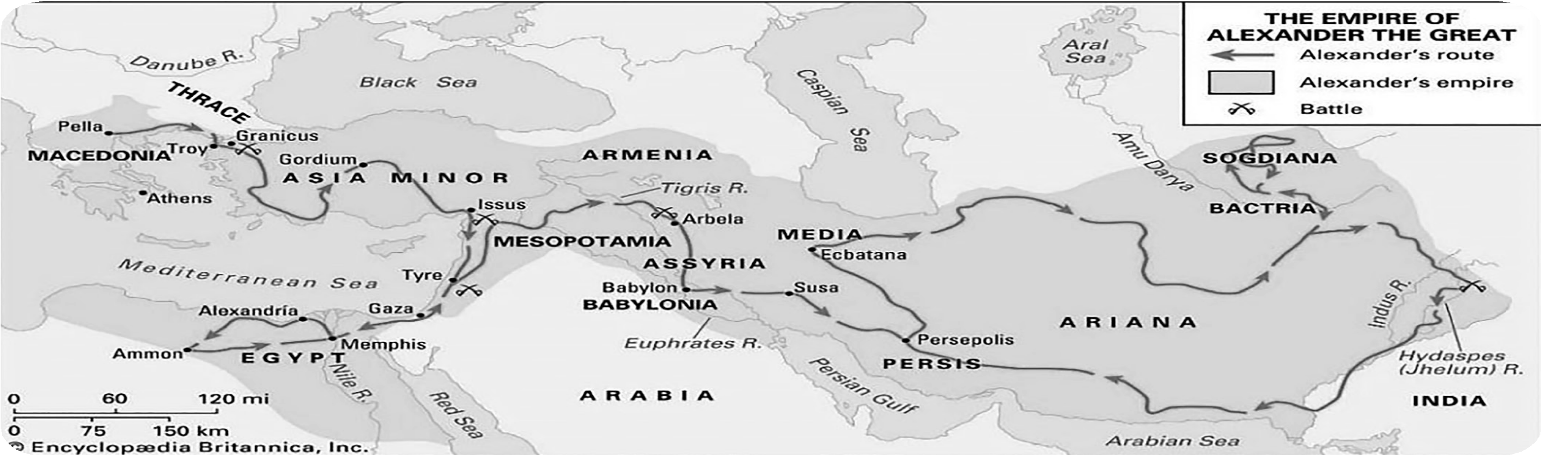
The sixth century BCE saw significant cultural exchanges between north-west India, Persia, and Greece.
Around 530 BCE, Cyrus, the Persian emperor, invaded
India and destroyed the city of Kapisha.
Subsequently, Gandhara and the surrounding regions along the Indus River became part of the Achaemenid Persian Empire.
The region remained under Persian control until Alexander, the king of the Greek kingdom of Macedonia, invaded.
Inscriptions from Darius I reference the presence of Persians in the Indus region, listing "the people of Gandhara, Haravati, and Maka" as subjects of the Achaemenid Empire.
• Greek historian Herodotus notes that Gandhara was the twentieth and wealthiest satrapy of the Achaemenid Empire.
Takshashila or Taxila University
• Takshashila or Taxila is situated in present-day Pakistan. Between the fifth century and fourth century BCE, it was part of the Achaemenid Empire of Persia.
• Takshashila was an early Buddhist center of learning. According to available references, it is dated back to at least the 5th century BCE.
• The university was funded by almost all the great kings and rulers of the ancient past. Taxila is considered “one of the greatest intellectual achievements of any ancient civilization”.
• Due to its strategic position along the trade route connecting the East and West, Taxila became a prominent hub for learning and culture.
• Students traveled from distant lands to Taxila in pursuit of knowledge. The city was rediscovered through excavations conducted in the 1940s by Sir John Marshall.
• Taxila University is regarded as the oldest educational institution in ancient India and may have been the first organized center of learning. However, some scholars debate its classification as a university in the modern sense because:
•
Takshashila operated informally, lacking the modern infrastructure such as lecture halls, and did not provide residential accommodations for its teachers or students.
• There was no centralized educational system or standardized curriculum at Taxila. The institution did not follow a system of examinations or grant degrees. Instead, the educational approach was flexible, tailored to the individual capabilities of each student.
• Teachers at Taxila enjoyed complete autonomy, establishing their own schools of thought with unique rules and teaching methods.
• Takshashila holds significant religious and historical importance for both Hindus and Buddhists.
• Hindus revere it not only for its role as a center of Vedic learning but also because the renowned strategist Chanakya, who played a pivotal role in Emperor Chandragupta Maurya’s empire, was a senior teacher at this institution.
• In Buddhist tradition, Takshashila is of great importance as it is believed to be where the Mahayana sect of Buddhism originated.
The curriculum at Taxila included a wide range of subjects, such as the Vedas, Vedanta, Grammar (Vyakaran), Ayurveda, Surgery, eighteen crafts (Sippas), military education including warfare and archery, astronomy, agriculture, commerce, politics, and more.
As the capital of the Gandhara Kingdom, Taxila attracted students from all over India, as well as from distant lands like Greece, Arabia, and China, offering free education to all.
The only group excluded from studying at the university were the Chandalas.
• Panini is believed to have compiled his renowned work,
Ashtadhyayi, at Taxila.
• Renowned scholars like Nagarjuna, Prasenajit, Charaka, and Jivaka studied at Taxila before rising to prominence in Indian history.
• Alexander took some scholars from Taxila to Greece.
• According to Hiuen Tsang, Kumaralata, the founder of the Sautrantika school, was also an exceptional teacher at Takshila University and drew students from as far as China.
• Several of the Buddha’s contemporaries and close followers are reported to have studied at Takshila, including:
• Jivaka, Rajagriha’s court doctor and the Buddha’s personal doctor.
• Charaka, the Indian “father of medicine” who authored the Charak Samhita and one of the foremost Ayurvedic gurus, is also reported to have studied and practiced at Takshila.
• The Hun ruler, Toramana, attacked and demolished the university campus. During that time, most of the records were burnt or destroyed.
Impact of Alexander’s Invasion:
• Alexander's invasion resulted in the formation of Greek satrapies in the north-western part of the Indian subcontinent.
• This also opened new trade routes with the West.
• Four major trade routes facilitated the movement of Greek merchants and craftsmen into India, fostering direct contact between India and Greece. As trade flourished, many Greek settlements were established in north-west India.
• Notable Greek settlements included Alexandria near Kabul, Boukephala near Peshawar (Pakistan), and Alexandria in Sindh.
• Greek accounts of India offer valuable insights, though they tend to be somewhat exaggerated.
• Following Alexander’s death, the power vacuum in the northwest allowed Chandragupta Maurya to rise to the throne of Magadha. This situation also enabled him to conquer numerous small chiefdoms in the region, eventually incorporating them into his empire.
Impact of Alexander
Impact of Alexander’s Invasion:
Alexander's invasion resulted in the formation of Greek satrapies in the north-western part of the Indian subcontinent.
This also opened new trade routes with the West.
Four major trade routes facilitated the movement of Greek merchants and craftsmen into India, fostering direct contact between India and Greece. As trade flourished, many Greek settlements were established in north-west India.
Notable Greek settlements included Alexandria near Kabul, Boukephala near Peshawar (Pakistan), and Alexandria in Sindh.
Greek accounts of India offer valuable insights, though they tend to be somewhat exaggerated.
Following Alexander’s death, the power vacuum in the northwest allowed Chandragupta Maurya to rise to the throne of Magadha. This situation also enabled him to conquer numerous small chiefdoms in the region, eventually incorporating them into his empire.
Indo Greek Contact
Indo-Greek Relations:
In 327-325 BCE, Alexander invaded north-western India.
• Indians came into contact with the Greeks with this invasion and the term ‘Yavana’ was used for Greeks, which was used throughout India.
• Alexander did not cross the Beas River because his soldiers refused to fight a vast army of Dhana Nanda.
• Chandragupta defeated the Selucus Nicator and made a peace treaty.
• Megasthenes was an ambassador of Selucus Nicator who visited Chandragupta Maurya’s reign.
• Bindusara (son of Chandragupta Maurya) maintained friendly relations with the Greeks.
• Ashoka’s 13th rock edict also mentioned the relations with the Greeks and the regular interchange of ambassadors that used to happen between both countries.
• Pataliputra monuments and sculptures showed the influence of the Greeks.
• The detailed administrative structure of the Mauryan empire including monuments and sculpture was also influenced by the Greeks.
• Diodotus and Demetrius were prominent Indo- Greek kings. In their era, trade between the two countries became enhanced.
• Menander was another Indo-Greek king. He ruled in the northwest region of the country. His coins were found all over India. He attacked Patliputra successfully but retracted later.
• ‘Milinda Panha’: The text contained a question-and- answer discussion on Buddhism between Meander or Milind and his teacher Nagasena or Nagarjuna.
• Menander became Buddhist and promoted Buddhism.


113
Impact of Persian Contact
Impact of Persian contact:
From the mid-sixth century BCE, as the north-western region of India came under Persian control, it became a hub for the fusion of Persian and Indian cultures.
Persian influence left a lasting impact on various aspects of ancient India, including art, architecture, economy, and administration, with the Gandhara region experiencing the most significant cultural changes.
One of the most notable outcomes was the development of the Kharosthi script, which was used in the north-western part of India, including by Ashoka in his inscriptions in the Gandhara region.
The Kharosthi script was derived from Aramaic and became widespread throughout the Achaemenid Empire of Persia.
Like Aramaic, Kharosthi was written from right to left.
• Persian sigloi (silver coins) were also introduced, which were adopted and imitated in the region.
• The earliest coins in India are traced to the period of the mahajanapadas
Kushanas
Kushanas:

The Kushanas (Yueh-Chis or Tocharians) were a nomadic tribal people originating from Yue-chi tribe from the steppes of north Central Asia.
Initially, they occupied Bactria (north Afghanistan), displacing the Shakas, and gradually took control of Gandhara, replacing Indo-Greeks and Parthians rule.
Their empire extended from the Oxus River to the Ganga River, covering the vast area from Khorasan in Central Asia to Varanasi in Uttar Pradesh, encompassing approximately the territory of nine modern countries.
They controlled the entire Silk Route.
Rulers:
| Kujula Kadphises | 15-64 CE |
| Vima Kadphises | 54 -78 CE |
| Kanishka I | 78-101 CE |
| Vasudeva I | 190-230 CE |
Kujula Kadphises (Kadphises I):
He ruled from 15 CE to 64 CE.
He achieved the unification of the five clans within the Yue-chi tribe, laying the foundation for the Kushana empire.
Defeated the Greeks to establish the Kingdom.
Occupied Kabul and Kashmir.
He introduced copper coins to facilitate trade.
These coins have been discovered south of the Hindu Kush, indicating the Kushanas’ expansion into the Indian sub-continent during his reign.
His coins also suggest a connection to Buddhism, as he adopted the epithets ‘Dharmathida’ and ‘Sachadharmathida.’
Vima Kadphises:
He is also known as Wema Kadphises II, ruled from 64 CE to 78 CE.
His reign was marked by significant achievements:
Conquest of Gandhara: Vima Kadphises successfully conquered the region of Gandhara from the Parthians.
Expansion to the East: He expanded his kingdom eastward, extending control over territories east of the Indus River, including the Mathura region.
Cultural Integration: Vima Kadphises played a crucial role in integrating Central Asia with North India, fostering the exchange of cultures and boosting inter-regional trade.
Coinage: He was first to issue a substantial number of gold coins during his rule, prominently featuring the symbol of Shiva with his trident and bull.
Devotion to Shiva: Vima Kadphises was a devout follower of Shiva, proclaiming himself as ‘Mahishvara’ on his coins, further highlighting his religious affiliation.
Vasudeva I:
He was the last of the “Great Kushans.”
Vasudeva-I adopted the title Shaono Shao Vasudevo
Koshano, indicating the Indianization of the Kushanas.
The decline of the Kushana empire began during Vasudeva-I’s reign.
• Hunza Inscription: Names of these rulers and various Kshtatrapas and Mahakshtrapas are found on Kharoshthi inscriptions on a massive rock at Hunza (located between the Karakoram highway and the Hunza river).
Kanishka (78CE – 101 CE):
• He was the son of Kadphises II.
• Kanishka adopted the title of ‘Devputra’.


Post-Mauryan International Kingdoms; Early Central Asian contacts & their Results 117
• Some of his coins depict him wearing a ‘peaked helmet’.

• He is the most famous Kushana king, and his reign marked the zenith of the Kushana empire.
• Geographical spread- His empire expanded significantly, from Central Asia to Afghanistan, East into the Ganga valley and Southwards into the Malwa region.
• Included important cities like Varanasi, Kaushambi, Shravasti, and Sanchi.
• The empire’s center was Bactria, evident from the use of the Bactrian language on Kanishka’s coins and inscriptions.
• The Rabatak Inscription in modern Baghran province, Afghanistan, provides valuable information on Kanishka.
• He has two capital cities: Purushapura (present day Peshawar) and Mathura. Taxila and Begram were also regional capitals.
• Kanishka is remembered for two major reasons:
• He started the Shaka era in 78 CE, now used by the Government of India for its calendar.
• He held the fourth Buddhist council at Kundalavana,
near Srinagar in Jammu and Kashmir.
• The council was presided over by Vasumitra.
• It resulted in the split of Buddhism into two schools: Hinayana and Mahayana.
• Mahayana Buddhism became the dominant sect.
• Kanishka sent emissaries to China to propagate Buddhism.
• He patronised great scholars and eminent personalities of that era such as:
• Ashvagosha: Buddhist scholar, wrote Buddhacharita and Saundarananda.
• Charaka: Father of Ayurveda wrote Charaksamhita and Sasruta.
• Vasumitra:Philosophe r,autho red Mahavibhasa encyclopedia of Buddhist philosophy.
• Nagarjuna: Proposed Theory of Relativity in Prajna Parimata Sutra, Mahayana exponent.
• Mathara: Minister known for unusual intelligence.
• Agesilaus: Greek engineer believed to have overseen the construction of the Purushapura stupa.
• He was a patron of the Gandhara and Mathura schools of sculpture. E.g., Headless statue of Kanishka.
• He controlled the famous Silk Route in Central Asia.
• Kanishka was tolerant toward various religions. His coinage, featuring motifs from various traditions:
• Indian motifs: Shiva and Buddha.
• Greek motifs: Helios and Selene.
• West Asian motifs: Persian gods Atash and Mithra.
• Towards the end of his reign, Kanishka led an unsuccessful military expedition into Central Asia against the Chinese. He was defeated by General Pan-chao and had to pay tribute to the Chinese emperor Ho-ti.
Art Religion and Literature
Art, Literature and Religion
Gandhara Art
This area of sculpture developed during this era under the patronage of Sakas and Kushanas.
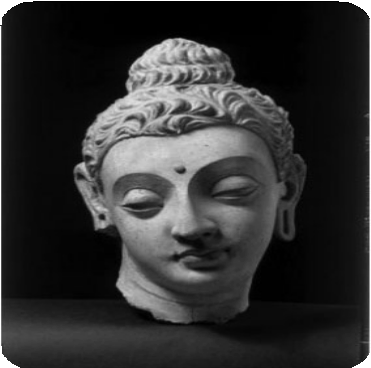


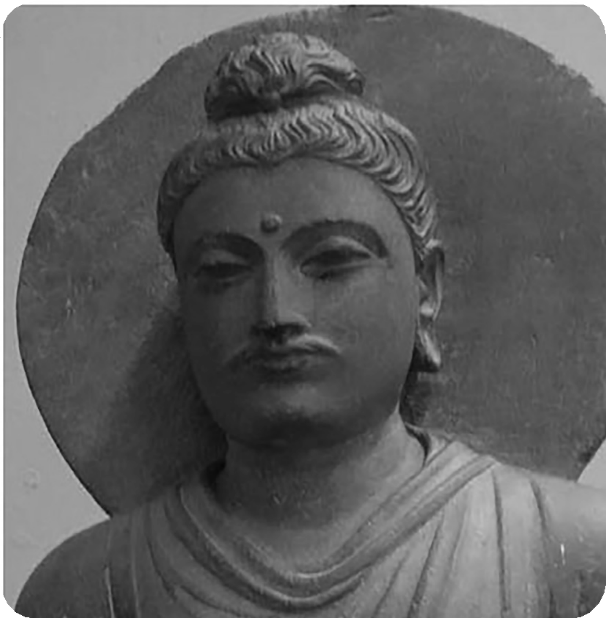
Originally inspired by Mathura Art and influenced by Greco-Roman traditions.
Vine scrolls, cherubs with garlands, tritons, and centaurs are of Roman influence.
Greek architectural influence: Sometimes Buddha is shown on Corinthian (capitals crowning columns or pilasters).
Sculptures were made of bluish-grey sandstone.
The human body is sculpted in a realistic manner in these sculptures, with considerable attention to realism and physical details, particularly in the depiction of muscles, mustaches, and other facial features.
The portrayal of the broad bold fold lines is a unique trait.
They generally consist of Buddha images and relief sculptures depicting scenes from Buddhist literature.
Buddha is shown in a spiritual state. The eyes were half-closed signifying meditation position.
In all the Buddha depicted in the Gandhara Art is shown making four types of hand gestures:
• Abahayamudra: Don’t fear
• Dhyanamudra: Meditation
• Dharmachakramudra: A preaching mudra
• Bhumisparshamudra: Touching the Earth
• Buddha is often seen under the protection of Greek god Hercules or Vajrapani.
• Artistic beauty: The Buddha’s face, resembling that of Apollo, exhibits natural realism, with wavy hair similar to the Hellenistic Greek style seen in Gandhara sculptures.
• Intellectual affinity: The halo and bun of Gandhara Buddha signify intellectual imbibitions of Buddha from Greek.
• These statues were majorly located in Taxila, and
Bamiyan regions.
Mathura Art also developed during this time.
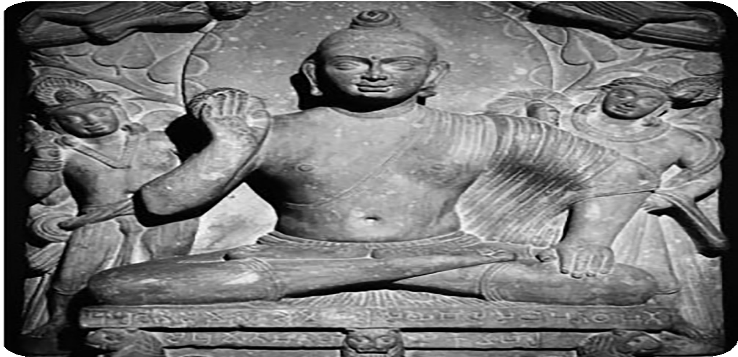
It was an indigenous art tradition.
• Spotted Red sandstone was used in Mathura art for depicting images of Buddha.
• The shoulders are broad, the chest expands, and the legs are planted firmly with feet split apart.
• Images were more sensuous and fleshier in the second century AD, with increasing rotundness.
• The shaved head, the protuberance on the top of the head indicated by a tiered spiral, a round smiling face, the right arm raised in abhaya-mudra (reassurance gesture),


the left arm akimbo or resting on the thigh, the drapery closely moulding the body and arranged in folds over the left arm, leaving the right shoulder bare, and the presence of the lion throne rather than the lotus throne.
• The halo around Buddha›s head was lavishly adorned.
• The Mathura school etched out both the sitting and standing postures of Buddha and Bodhisattvas.
• The Shravasti, Sarnath and Kaushambi Standing Buddhas are the best examples of Buddha images under this style.
• Vaishnava and Shaiva faiths can also be seen, but Buddhist ones predominate.
Religion:
• Mahayana tradition flourished during this time.
• Hinayana-the other sect of Buddhism was also called a small wheel.
• Kanishka organized the fourth council of Buddhism in Kashmir. In this council, Mahayana tradition flourished.
• Chaityas and Viharas were made.
• Kanishka gave patronage to Buddhist philosophers. Persons like Ashvaghosha, Parsva, Nagarjuna and Vasumitra were promoted by Kanishka.
Literature:
• ‘Buddha Charita’: Written by Ashvaghosha.
• ‘Sariputraprakarana’: It was the first play written in Sanskrit. This was also written by Ashvaghosha.
• Dramatist Bhasa also belonged to this period.
• ‘Manu smriti’ was written in this period.
• ‘Kamasutra’ of Vatsyayana also belonged to this period.
Pottery:
• Redware pottery was being used.
• Brick wells and burnt bricks usage was again a noted development
Army Polity and Science
Army:
They introduced cavalry and the art of horse riding.
They introduced the usage of reins and saddles.
They introduced a turban, tunic, and a long coat.
They brought caps, helmets and boots which were used by warriors.
India received gold from Altai mountains.
Silk route was controlled by the Kushanas due to which the Indian economy also flourished.
Development in Polity:
• Feudalism originated in this period.
• Kushanas strengthened the idea of the divine origin of Kingship.
• The Kushan kings were called sons of God.
• They introduced a satrap system of administration.
• Satrap was a region which was governed by a governor.
Science and Technology:
• Practice of making Leather shoes started.
• Practice of Horoscopes started.
• Working with glass technology started.