Jainism
Jainism
In its early phase, Jainism was known as the Nirgrantha tradition (meaning “free from all bonds or attachments”).
Tirthankars
• Yajur Veda mentioned three tirthankaras: Rishabh, Ajitnatha and Aristanemi.
• Rishabhdeva was the founder of this sect. He is considered the first tirthankara.
• There were 24 tirthankara’s. Vardhman Mahavira was 24th Tirthankara.
• Vardhaman Mahavira led this sect which blossomed into a new religion.
• The teachings of the Tirthankaras before Mahavir are known as Purva. There was total 14 Purvas (Drishtivad) which were memorized over the ages but lost later.
Life of Mahavira:
• He was born in Vaishali around 540 BC. He was a member of the ruling family of Gana-Sangha. His father’s name was Siddhartha. His mother Trishala was Lichhavi Princess.
• He left his home at the age of 30 and wandered for 12 years in search of true knowledge.
• In 13th year, he attained Nirvana or enlightenment.
• He died around 468 BC near Rajgriha. He fasted unto death according to Jain literature.
• Jainism was confined to the trading and money lending community. Jainism’s insistence on non-violence doesn’t attract people from occupations like agriculture.
• After the death of Mahavira, two different sects emerged in Jain religion called as Digambara and Shvetambara.
• Mahavira was known as Jina (conqueror) of the soul.
Reasons for the decline of Jainism in India:
• Absence of royal patronage.
• Split amongst Jains as Digambars and Swetambars.
• Lack of missionary zeal.


• Factionalism.
• The severity of practices.
• Spread of Buddhism as a rival faith.
Jain Councils:
• Sthulbhadra, founder of Shvetambars, held the First Great Council at Patliputra around 300 BC, which compiled the Jaina canon. It consisted of 12 Angas like Acaranga Sutra (oldest), Sutrakrtanga (code of conduct), Sthananga, Samavayanga (essence of Jaininsm, astronomy, mathematics), Vyakhyaprajnapti or Bhagavati sutra, Jnatrdharmakathah, Upasakadasah, Antakrddaasah, Anuttaraupapatikadasah, Prasnavyakaranani (explains Sins), Vipakasruta (stories and illustrations) and Drstivada (included 14 Purvas, disappeared later).
•
Jainism was split into two factions at this council:Svetambara and Digambara.
• The second Jain Council was held simultaneously in Valabhi (Gujarat) and Mathura in 512 AD. It was presided over by Devaradhi Kshama Sramana, a Shvetambar scholar, in Valabhi. This council’s major goal was to continue the collection of sacred scriptures. It added 12 Upangas. Secular Jaina literature like ‘Acharrangasutra’, ‘Sutrakritanga’, and ‘Kalpasutra’ were also written.
Jain Sects:
• Jains are primarily divided into two major sects: the Digambara (meaning "sky-clad") and the Svetambara (meaning "white-clad"). Each sect has its own subgroups. While both sects agree on the core teachings of Jainism, they differ in specific details, especially regarding the life of Mahavira.


• Digambara:
• Monks of this sect believe in complete nudity. Male monks do not wear clothes while female monks wear unstitched plain white sarees.
• They travelled to the south to avoid hunger.
• Follow all five vows (Satya, Ahimsa, Asteya, Aparigraha and Brahmacharya).
•
Believed women cannot achieve liberation.
• Bhadrabahu was an exponent of this sect.
• Major Sub-Sects:
• Mula Sangh
• Bisapantha
• Terapantha
• Taranpantha or Samaiyapantha

Rise of Territorial Kingdoms and New Religious Sects 69
• Minor Sub-Sets:
• Gumanapantha
• Totapantha
• Svetambara:
• Monks wear white clothes.
• Follow only 4 vows (except brahmacharya).
• Believe that women can achieve liberation.
• Sthulabhadra was an exponent of this sect.
• They stayed in Magadha under the leadership of Sthulbhadra (White-clad).
• Major Sub-Sects
• Murtipujaka
• Sthanakvasi
• Terapanthi
Tenets of Jainism:
• Central tenet is non-violence.
• They did not deny existence of God but kept it below Jin (The Conquerer), according to Mahavira.
• Salvation cannot be attained by worshipping God.
• One can escape miseries only by performing austerities.
• Mahavira rejected Vedic authority.
• They did not reject the caste system.
• The world has no beginning or end. It is maintained by
Universal Natural Law.
• Each and every particle has a soul.
• They advocated dualism: The world is made of soul and matter, which are eternal.
• They believe in the theory of Karma and transmigration of the soul.
• The coming together of soul and matter brings Karma.
• To free oneself from Karma, one has to go through severe austerities or penance.
Triratnas:
• Three principles are need to be followed in Jainism:
• Right faith (samyag-darshana).
• Right knowledge (samyag-jnana).
• Right conduct (samyag-mahavrata).
Five Great Vows:
• The monks have to undertake five great vows (Panch- mahavrata):
• Not to kill (Ahimsa)
• Not to steal (Asteya)
• Not to lie (Satya)
• Celibacy (Brahmacharya)
• Not to possess property (Aparigraha)
| Jain Philosophy |
| All judgements are conditional. Absolute affirmation and absolute negation are wrong. Anekantvaad – Matter (Pudgala) and Spirit (Jiva) are regarded as separate and independent entities. It is also known as Doctrine of Manyness of reality. Instruments of Knowledge – Main instruments of knowledge according to Jain philosophy are: Matigyaan Shrutigyaan Avadhigyaan Manahparyayagyaan Kevalagyaan |
Jaina Literature:
• Canonical or religious books, known as Jain Agamas or Agam, and non-canonical literary works can be broadly separated into two categories known as Niryuktis and Samhitas.
• Agamas are sacred books having Jain tirthankaras’ teachings, compiled by the Gandharas, Mahavira’s direct disciples.
• The languages used were: Prakrit and Ardha Magadhi were in the early period. Later During the Sangam Age in south India, they wrote in Tamil. In addition to Tamil, they wrote in Sanskrit, Shauraseni, Gujarati, and Marathi.
• 12 Angas in total having 46 texts. They are canonical and important for Svetambars.
• 2 Upanga Agams: Upanga Agamas are explanations to Angas.
• 6 Chedasutras: These are texts related to behavior of Monks and Nuns.
• 4 Mulasutras: These are texts which provide a base in the earlier stages of the monkhood.
• 10 Prakirnaka sutras: These are texts on Independent or miscellaneous subjects.
• 2 Culikasutras: These are texts which further enhance or decorate the meaning of Angas.
• The Karmaprabhrita (debate on Karma) or Shatkhandagama and the Kashayaprabhrita were canonical and important for Digambaras.
• Other Digambar texts include Adi puraṇa, Ratnakaranda sravakacara, Pancastikayasara, Puruşarthasiddhyupaya, Satkhandagama, Sarvarthasiddhi, Siribhoovalaya, Niyamasara, Mahapurana (by Jinasena), Mulachara, Tiloya Panatti
• Other Important Jaina Texts:
• Samayasara (Digambara)
• Parishishtaparvan
• Pravachanasara (Digambara)
• Tattvartha Sutra


• Dravyasamgraha (Digambara)
• Uttaradhyayana (Shwetambara)
• Civaka Cintamaṇi
• Silppadikaram
• Valayapathi
• Yogasastra
• Siddha-Hema-Sabdanusasana
• Trishashthi-Shalaka-Purusha-Charitra
• Bhadrabahu Samhita
• Jnanarnava or the Yogapradipadhikara
• Pramana-mimansa
Introduction
Introduction
• Archaeologically, 6th century BCE is marked by the beginning of Northern Black Polished Ware (NBPW) phase and the second urbanisation in India (after the Harappan Civilisation).
• Urbanisation:
• This period witnessed increasing use of iron in eastern Uttar Pradesh and western Bihar creating conditions for the formation of large territorial states called as Mahajanapadas.
• Armed with iron weapons, the warrior class played an important role.
• Aryans started migrating eastwards around 1000 BC where they encountered thick forests.
• Iron played a significant role in cleaning thick forests and improvement in agriculture which enabled peasants to produce more grains than they required for consumption.
• Craft production such as pottery, carpentry and metal working were also improved.
• This led to the rise of urbanization.
• Rise of New Religions:
• In the meantime, a spirit of scepticism began to pervade questioning every custom and orthodoxy in the belief system in the society leading to rise of new ideas and faiths.
• Of the several competing alternate beliefs, only Jainism and Buddhism touched the hearts of the people.
Views of Historians on Spread of Indo-Aryans
• The movement of the Indo-Aryans towards the east was aimed at accessing the iron ore of south Bihar and gaining a near monopoly over it. The iron ore was responsible for the political dominance attained by the state of Magadha.
-D.D. Kosambi.
• Iron axes and iron ploughs led to the expansion of the area under cultivation in the Ganges valley. -R.S. Sharma.
• That the use of iron axe and iron plough facilitated clearing of forests and generation of agricultural surplus
is a myth because even as late as 16th and 17th centuries the Gangetic plain was heavily forested. -Makkhan Lal.
• The forests of the Ganges region could have been cleared by means of fire. -A. Ghosh and Niharranjan Ray.
Sources
• Texts:
• Epics like Mahabharata and Ramayana.
• The dharma shastras.
• Buddhist texts such as Tripitakas and Jatakas.
• Jaina texts.
• Iron objects like hoes, sickles, knives, hooks, nails etc.
• Craft: Textiles, beads, pottery, ivory objects, ceramics etc.
• A large number of Terracotta artefacts.
• North Black Polished Ware (NBPW) pottery showed urban hallmark.
• Town planning: Towns like Rajgriha, Kausambi were fortified.
• Houses were built with burnt bricks.
• Facilities such as drains, ring wells and soak-pits are also found.
New Regional Centres
• In mid Gangetic plains, agriculture was well developed with the arrival of the iron tools such as Iron axe and Iron ploughshare.
• Wet rice cultivation began to yield surplus production of rice.
• Handicrafts flourished due to technical knowledge.
• This led to an increase in trade.
• All these developments led to emergence of Second Urbanization in India. (First Urbanization was seen during Harappan Civilization).
• Political and administrative centres: such as Rajgriha, Shravasti, Kausambi and Champa were developed.
• Trade and Commerce Centres: Ujjain and Taxila developed.
• Holy and Religious centers: like VAISHALI came up.


Janapadas to Mahajanpadas:
• In the Later Vedic period, Janapadas started emerging.
• The Janas who migrated eastwards began to settle down in various regions.
Ties to Land over people: Loyalty of people shifted from Jana (tribe or clan) to Janapadas (territories).
• Around 450 BC, over forty Janapadas covering even Afghanistan and south-eastern Central Asia are mentioned by Panini.
• However, a major part of southern India was excluded
Mahajanpads and Its Polity
Mahajanpads
• Janapadas fought with one another for resources and political dominance.
• Pali texts show that some janapadas extended their territories and brought other janas into their territories. This led to the emergence of Mahajanpada.
• In the age of the Buddha, we find the existance of the sixteen Mahajanapadas.
Sixteen Mahajanpadas
• The majority of the Mahajanapadas emerged in the upper and middle Gangetic plains, including the Doab region between the Ganges, Yamuna and their tributaries.
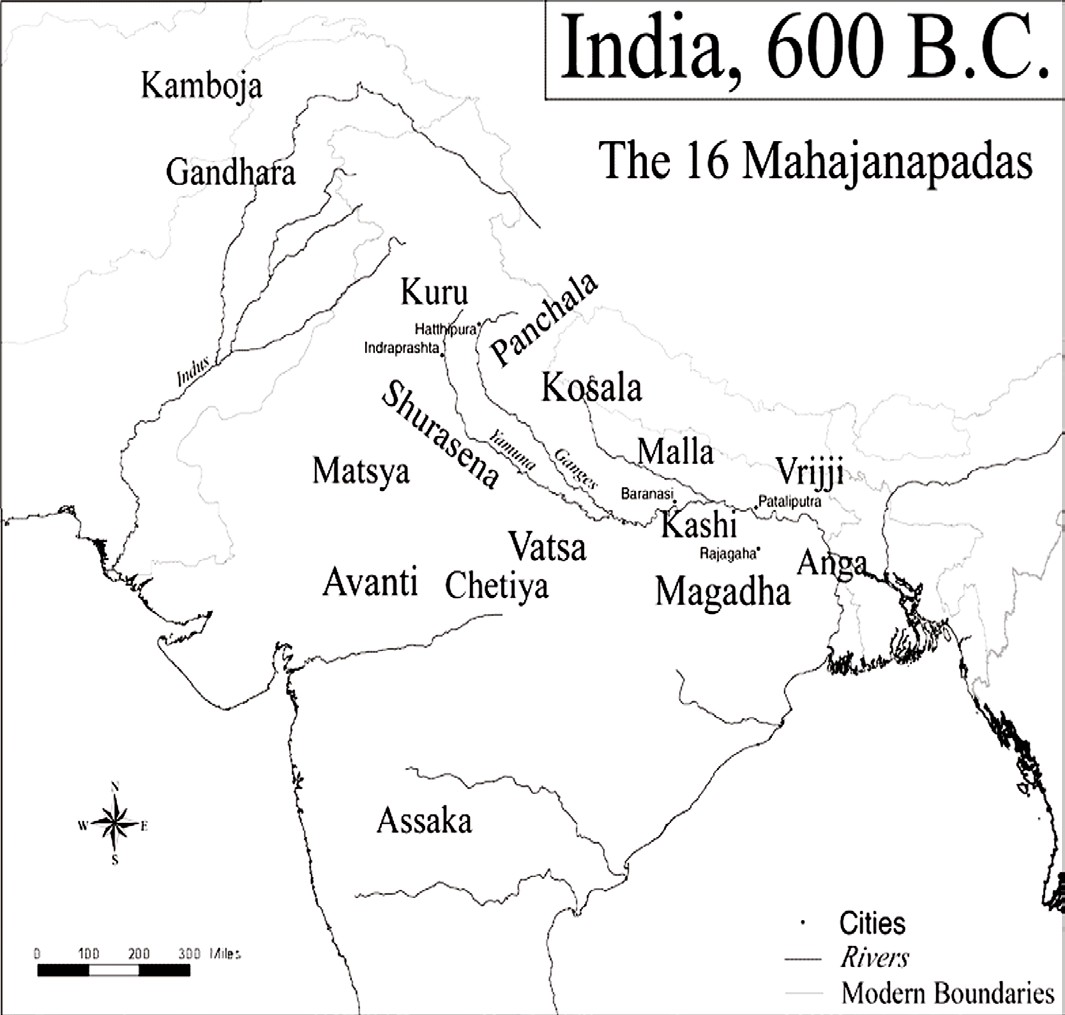
• They were situated north of the Vindhyas and extended from the north-west frontier to Bihar.

Administration of the Mahajanpadas:
• King: Head of the administration,
• Parishad: Sabha and Samiti almost disappeared, and Parishad, consisting exclusively of the Brahmanas, served as an advisory council to the king,
• Mantrin: Minister,
• Mahamatras/Amatyas: Higher officials having executive, judicial, and military functions,
• Senanayaka: Army commander,
•
Ayuktas: Assistant of Senanayaka,
• Kammikas: Custom officials,
• Dasa and karmakaras were laboureres,
• Shaulkika/Shulkadhyaksha: Toll officials levied taxes on merchandise,
• Rajabhatas were special royal officials deputed to safeguard the lives and property of travellers,
• Grihapatis: Rich landowners,

• Kassaks were smaller landowners,
• Rajdhani referred to capital city,
• Nagarka was a small town,
• Mahanagara was a big city,
• Judicial Systems: This period marks the origin of the Indian legal and judiciary systems in which the civil and criminal law was based on the varna division.
Polity of Janpads
• Mahajanpadas are classified into Gana Sanghas (republics), and Chiefdoms (monarchies) based on their polity.

• Gana-Sanghas (republics):
• An assembly of Gana, those who claim to be of equal status.
• The Gana-Sanghas had a government by assembly and had Oligarchies within the assembly. Decision was not taken by King like authority, but together by group of people who were heads of different clans.
• Malla, Vajji (capital Vaishali), Kamboja, Panchal, Kuru, Shakya, Koliyas, Moriya were Gana Sanghas.
• The chief office was not hereditary.
• The Gana-Sanghas had only two strata:
• Kshatriya rajakula (ruling families)
• Dasa-karmakara (slaves and labourers)
• The names of Gana Sanghas including Ikshvaku and Vrishni are mentioned in Ramayana and Mahabharata.
• Tolerant: Gana-Sanghas were more ready to tolerate unorthodox views and more open to individualistic or independent opinion than the kingdoms. This tolerance was the major reason that two of the most venerated gurus of the heterodox sects, i.e., Mahavira (Jainism, belonged to Vajji confederacy) and Buddha (Buddhism, belonged to Shakya clan) were able to propagate their philosophy.
• Chiefdoms (monarchies):
• Kingdoms registered a centralised government with king as Sovereign and all the power was vested in him and ruling family.
• The Mahajanapadas on the Gangetic plains were all monarchies.
• Magadha, Kosala, Vatsa, Avanti, Anga, Kashi, Gandhara, Shursena, Chedi and Matsya were Chiefdoms.
• Vedic orthodoxy was well established practice in these kingdoms.
• Political power was concentrated in the king who was advised and assisted by ministers, advisory councils such as Parishad and Sabha.
• The kingship was hereditary, and the succession was in most cases based on the law of primogeniture (firstborn legitimate child to inherit the throne) which was patriarchal.
• The Brahmana priests provided legitimacy to the king through various rituals.
Society
Society:
Vedic orthodoxy was the established practice.
• Extended kin groups were referred as Nati and Nati- kulani.
• Kula denoted extended the patrilineal family, while Natakas included relatives on both mother and father’s side.
• The strengthening of patriarchal control within the household led to the increased subordination of women.
• Priests enjoyed important positions in Mahajanpadas unlike in Gana-sangha.
• The Varna system was in place, with society being stratified based on Varna, becoming a key marker of status.
• Cultivators and artisans were classified as Shudras.
• The category of untouchables emerged during this period, placed even lower than the Shudras.
• Untouchables were forced to live on the outskirts of settlements, relying on hunting and gathering for survival.
• As urbanization grew, they were marginalized and relegated to menial tasks. They spoke a language distinct from that of the Indo-Aryans.
Economy
Emergence of Hetrodox Thinkers:
• North Indiaunderwent remarkable intellectual awakening in 6th and 5th centuries BC.
• The impact felt not only in India, but also across South Asia.
• Ascetics were frequently seen traversing the Gangetic plains, sharing new ideas.
• Their teachings responded to the needs of a rapidly changing society, which witnessed the rise of new political structures, the growth of urban centers, the development of crafts, and an increase in long-distance trade.
• Heterodox thinkers like Gosala, Gautam Buddha, Mahavira, Ajita Kesakamblin questioned the orthodox traditional elements leading to new religious awakening.
• These thinkers renounced the world and wandered across the Gangetic plains, contemplating and reflecting on the social and cultural scenario of their times. They were called Parivrajaka.
• These thinkers questioned the Vedic ideas of thinking and rituals.
• Shramana - refers to the ascetics and renouncers of ancient India. The shramans included a variety of ascetics, as well as the monks and lay followers of various sects - Buddhist, Jaina, Ajivika, and others.
• Buddhism and Jainism became popular during this time.
| Significant Persons during 6th Century B.C |
| Buddha (India) – Founder of Buddhism. Mahavir (India) – 24th Tirthankara and founder of Jainism. Selone (Greece) – Philosopher. Lao Tse (China) – Philosopher. Confucius (China) – Philosopher. Zoraster (Persia) – Founder of Zoroastrianism. Isaiah (Palestine) – Preacher. |
Causes of Intellectual Awakening: Freedom & Improved
Status
Vedic religion constrained the thought of liberty and action. Heterodox sects revolted against these orthodox elements of Vedic religion.
• Weaker sections like Women and Shudras also wanted to challenge Vedic traditions. So, they supported the new Intellectual Awakening.
• Traders, merchants and their guild supported new Heterodox elements, because they wanted higher social status appropriate to their economic status.
• Kshatriyas, who ultimately became King, also wanted better social status compared to Brahmins. Thus, they also supported new thinkers.
Heterodox Sects:
• Ascetic wanderers, known as Parivrajakas, and teachers attracted followers, forming various sects.
• Their philosophies included antinomian views (the belief that divine grace eliminates the need to follow moral laws), materialist beliefs, and fatalist perspectives.
• The Buddhist text Samannaphala Sutta mentions Ajatashatru of Magadha meeting Gautama Buddha. Before their meeting, Ajatashatru had engaged in philosophical discussions with leaders of several sects, such as Purana Kassapa, Makkhali Gosala, Ajita Kesakambalin, Pakudha Kachchayana, Sanjaya Belatthiputta, and Nigantha Nathaputta (Mahavira). Eventually, Ajatashatru embraced Buddhism.
• These ascetics are described as "homeless wanderers" (chira-pabbajito), founders of sects (tithakaro), and leaders of their communities (ganachariyo).
Ajivikas:
• Nanda Vaccha was considered the founder of the Ajivikas sect.
• Kisa Samkicca was the second leader of this sect.
• Makkhali Ghosala was the third leader and greatest of the Ajivikas.
• Gosala met Mahavira for the first time in Nalanda and their friendship lasted for six years. They separated due to doctrinal differences. Gosala then went to Sravasti, where he was patronised by a rich potter woman called Halahala.


• Gosala believed in the doctrine of reanimation, and criticized and ridiculed the severe austerities of the Vedic ascetics.
• Ajivikas were a rival of Jaina and Buddhist sect.
• Being rival sects, both the Buddhist and Jaina accounts portray Gosala as a person of vicious character.
• Shravasti was their headquarters.
• They were naked ascetics.
• Their basic principle was Niyati or Fate.
• They believed that nothing in this world can be changed as everything is pre-determined.
• There were six inevitable factors in life: gain and loss, joy and sorrow, and life and death.
• Purana Kassapa and Pakudha Kacchayana were another important leader of this sect.
• They preached that action does not have any merit or demerit.
• They also preached that no evil is caused by torture, hurting and killing others.
• No merit is acquired by generosity, self-control and truthful speech.
• Non-action is the way out of life according to them.
• This sect spread across the length and breadth of the country.
• Their influence was much lesser than Buddhism and Jainism.
Lokayata and Charvaka:
• The term “lokayata” signifies materialist thought. Indian materialism has also been named Charvaka after one of the two founders of the school.
• It was called Lokayata because it was prevalent (ayatah) among the people (lokesu) and meant the world-outlook of the people.
• Charvaka holds direct perception, empiricism, and conditional inference as proper sources of knowledge, embraces philosophical skepticism and rejects ritualism.
• It believed in pursuit of knowledge and questioned the authority of Vedas.
• Brihaspati, a philosopher, is traditionally referred to as the founder of Charvaka or Lokāyata philosophy.
• Ajita Kesakambali was an ancient Indian philosopher in the 6th century BC. He is considered to be the first known proponent of Indian materialism, and forerunner to the Charvaka school.
Rivalry among Heterodox Sects
• There was intense rivalry among the various heterodox sects.
• This is evident from the various religious accounts of the period. Buddhist and Jaina texts not only mention other heterodox sects but also belittle them.
• Bhagavatisutra:
• A Jaina text provides a poor account of Makkhali Gosala (the Ajivika sect leader). He is described as born to a poor mendicant in a cowshed.
• It accuses Gosala becoming a disciple of Mahavira for material comfort as the latter had many wealthy patrons.
• It describes “the greatest Ajivika teacher as a person of most contemptible character, a man of low parentage, and of low profession”.
• Buddhagosa also ridicules Gosala in his commentaries. He describes Gosala as a servant fleeing naked from his master on committing a mistake even disregarding the fact that his garment had fallen.
• A Buddhist Jataka story “compares the heretics with the fireflies, whose faint light faded before the rising glory of the Sun, i.e., the Buddha”.
Emergence of Thinkers
Emergence of Hetrodox Thinkers:
• North Indiaunderwent remarkable intellectual awakening in 6th and 5th centuries BC.
• The impact felt not only in India, but also across South Asia.
• Ascetics were frequently seen traversing the Gangetic plains, sharing new ideas.
• Their teachings responded to the needs of a rapidly changing society, which witnessed the rise of new political structures, the growth of urban centers, the development of crafts, and an increase in long-distance trade.
• Heterodox thinkers like Gosala, Gautam Buddha, Mahavira, Ajita Kesakamblin questioned the orthodox traditional elements leading to new religious awakening.
• These thinkers renounced the world and wandered across the Gangetic plains, contemplating and reflecting on the social and cultural scenario of their times. They were called Parivrajaka.
• These thinkers questioned the Vedic ideas of thinking and rituals.
• Shramana - refers to the ascetics and renouncers of ancient India. The shramans included a variety of ascetics, as well as the monks and lay followers of various sects - Buddhist, Jaina, Ajivika, and others.
• Buddhism and Jainism became popular during this time.
| Significant Persons during 6th Century B.C |
| Buddha (India) – Founder of Buddhism. Mahavir (India) – 24th Tirthankara and founder of Jainism. Selone (Greece) – Philosopher. Lao Tse (China) – Philosopher. Confucius (China) – Philosopher. Zoraster (Persia) – Founder of Zoroastrianism. Isaiah (Palestine) – Preacher. |
Causes of Intellectual Awakening: Freedom & Improved
Status
Vedic religion constrained the thought of liberty and action. Heterodox sects revolted against these orthodox elements of Vedic religion.
• Weaker sections like Women and Shudras also wanted to challenge Vedic traditions. So, they supported the new Intellectual Awakening.
• Traders, merchants and their guild supported new Heterodox elements, because they wanted higher social status appropriate to their economic status.
• Kshatriyas, who ultimately became King, also wanted better social status compared to Brahmins. Thus, they also supported new thinkers.
Heterodox Sects:
• Ascetic wanderers, known as Parivrajakas, and teachers attracted followers, forming various sects.
• Their philosophies included antinomian views (the belief that divine grace eliminates the need to follow moral laws), materialist beliefs, and fatalist perspectives.
• The Buddhist text Samannaphala Sutta mentions Ajatashatru of Magadha meeting Gautama Buddha. Before their meeting, Ajatashatru had engaged in philosophical discussions with leaders of several sects, such as Purana Kassapa, Makkhali Gosala, Ajita Kesakambalin, Pakudha Kachchayana, Sanjaya Belatthiputta, and Nigantha Nathaputta (Mahavira). Eventually, Ajatashatru embraced Buddhism.
• These ascetics are described as "homeless wanderers" (chira-pabbajito), founders of sects (tithakaro), and leaders of their communities (ganachariyo).
Ajivikas:
• Nanda Vaccha was considered the founder of the Ajivikas sect.
• Kisa Samkicca was the second leader of this sect.
• Makkhali Ghosala was the third leader and greatest of the Ajivikas.
• Gosala met Mahavira for the first time in Nalanda and their friendship lasted for six years. They separated due to doctrinal differences. Gosala then went to Sravasti, where he was patronised by a rich potter woman called Halahala.


• Gosala believed in the doctrine of reanimation, and criticized and ridiculed the severe austerities of the Vedic ascetics.
• Ajivikas were a rival of Jaina and Buddhist sect.
• Being rival sects, both the Buddhist and Jaina accounts portray Gosala as a person of vicious character.
• Shravasti was their headquarters.
• They were naked ascetics.
• Their basic principle was Niyati or Fate.
• They believed that nothing in this world can be changed as everything is pre-determined.
• There were six inevitable factors in life: gain and loss, joy and sorrow, and life and death.
• Purana Kassapa and Pakudha Kacchayana were another important leader of this sect.
• They preached that action does not have any merit or demerit.
• They also preached that no evil is caused by torture, hurting and killing others.
• No merit is acquired by generosity, self-control and truthful speech.
• Non-action is the way out of life according to them.
• This sect spread across the length and breadth of the country.
• Their influence was much lesser than Buddhism and Jainism.
Lokayata and Charvaka:
• The term “lokayata” signifies materialist thought. Indian materialism has also been named Charvaka after one of the two founders of the school.
• It was called Lokayata because it was prevalent (ayatah) among the people (lokesu) and meant the world-outlook of the people.
• Charvaka holds direct perception, empiricism, and conditional inference as proper sources of knowledge, embraces philosophical skepticism and rejects ritualism.
• It believed in pursuit of knowledge and questioned the authority of Vedas.
• Brihaspati, a philosopher, is traditionally referred to as the founder of Charvaka or Lokāyata philosophy.
• Ajita Kesakambali was an ancient Indian philosopher in the 6th century BC. He is considered to be the first known proponent of Indian materialism, and forerunner to the Charvaka school.
Rivalry among Heterodox Sects
• There was intense rivalry among the various heterodox sects.
• This is evident from the various religious accounts of the period. Buddhist and Jaina texts not only mention other heterodox sects but also belittle them.
• Bhagavatisutra:
• A Jaina text provides a poor account of Makkhali Gosala (the Ajivika sect leader). He is described as born to a poor mendicant in a cowshed.
• It accuses Gosala becoming a disciple of Mahavira for material comfort as the latter had many wealthy patrons.
• It describes “the greatest Ajivika teacher as a person of most contemptible character, a man of low parentage, and of low profession”.
• Buddhagosa also ridicules Gosala in his commentaries. He describes Gosala as a servant fleeing naked from his master on committing a mistake even disregarding the fact that his garment had fallen.
• A Buddhist Jataka story “compares the heretics with the fireflies, whose faint light faded before the rising glory of the Sun, i.e., the Buddha”.
Buddhism
Buddhism:
• Among the heterodox sects, Buddhism was the most
popular. It went on to emerge as a powerful religion patronised by various rulers.
• Ashoka also adopted Buddhism as state policy.
• Dr. B.R. Ambedkar also followed this religion.
• Upasaka - Lay follower of Buddhism.
• Some important sites are:
• Tabo monastery and temple complex Spiti Valley,
• Lhotsava Lhakhang temple, Nako Kinnaur Valley,
• Alchi temple complex Ladakh.
Extent of Buddhism
It is widespread in Southeast Asia
Outside India, Buddhist influence reached Sri Lanka, Myanmar, Thailand, Cambodia, Laos, Vietnam, Central Asia, Tibet, China, Korea, Japan, and Mongolia.


Life of Buddha:
Gautam Buddha was born as Siddhartha in Sakya clan. His father was Suddhodana and Mother was Mahamaya. He was born in Lumbini near Kapilavastu.
He married Yashodhara and had a son named Rahul.
While he was riding Chariot with charioteer Channa, he saw an old man, sick man and a corpse and a poor person. After seeing this, he was overcome with remorse and left his royal life.
He Left home at the age of 29 and became a Parivarjaka (Renunciant and wanderer).
He discarded all the world’s belongings, and this is called
Mahabhiraskarmana or the Great Going Forth.
He attained enlightenment at the age of 35.
He delivered his first sermon in Sarnath near Varanasi. This is called as Dharmachakrapravartana.
He established Sangha and spread his ideas far and wide.

71
At the age of 80, he passed away in Kusinagara. This is known as Mahaparinirvana.
Prominent disciples were Sariputta, Maha-mogallanna,
Mahakaccayana and Ananda.
Eight important holy locations related to the life of Buddha are known as Astamahasthanas. Lumbini (Birth), Bodhgaya (Enlightenment), Sarnath (first Teaching), and Kushinagara (Death) are among the four pilgrimage sites associated with Gautama Buddha’s life, as are Sravasti (Kosala Kingdom capital), Sankasya, Rajgir, and Vaishali.
Buddha traveled to the kingdoms of Kosala and Magadha. Kapilvastu, Kosambi, Nalanda, Mathura, Varanasi, Saket
Buddhist Councils:
and Champapuri were among other places he visited during his lifetime.
| 5 Events of Buddha’s Life | |
| Event | Symbol |
| Birth | Lotus and Bull |
| Great Renunciation | Horse |
| Nirvan or Attainment of Knowledge | Bodhi Tree |
| First Sermon | Wheel(Dharma Chakra) |
| Parinirvan or Death | Stupa |

Decline of Buddhism
Buddhism in India started declining with onset of Bhakti movement.
Divisions into sects like ‘Mahayana’, ‘Vajrayana’, and ‘Hinayana’.
Adoption of Sanskrit language, thus their connection with the people started declining.
Lost royal patronage after Harshvardhana.
Shungas and Guptas gave patronage to Vedic religion.
Invasion of Huns.

Invasion of Arabs and Turks led Buddhist monks to flee from India and seek asylum in Nepal, Tibet and Ceylon.
Buddhist Sects:
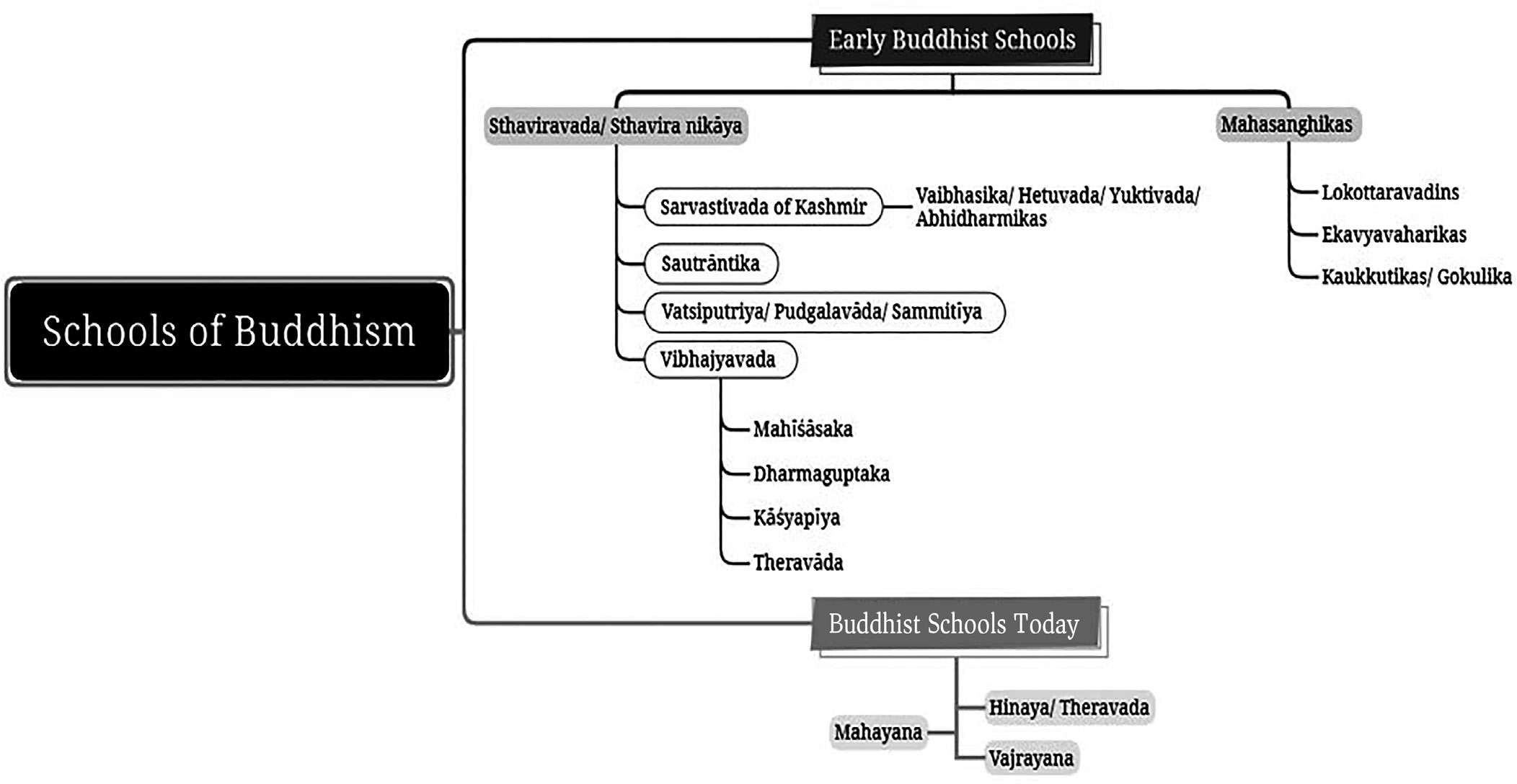
The early Buddhist schools refer to the various branches into which the Buddhist monastic saṅgha divided in the early history of Buddhism. These divisions initially arose from differences in Vinaya (monastic discipline) and later expanded due to doctrinal disagreements and the geographical separation of monastic communities.
Mahasanghikas:
From Sanskrit mahāsaṅgha meaning“great order of monks”, was an early Buddhist school formed during the second Buddhist Council of 383CE when it separated from Sthaviravada. The deification of Buddha by Mahasanghikas fostered the Mahayana Buddhism. Further subdivisions of the Mahasanghikas over the next seven centuries based upon the relative manner and degree to which they accepted the authority of these Mahāyāna texts, included:
• Lokottaravadins: Accepted the Mahāyāna sūtras as the words of the Buddha. They are described in the Mahavastu text written in Sansrikt part of Vinaya Pitaka.
• Ekavyavaharikas: They emphasized the transcendence of the Buddha, asserting that he was eternally enlightened and essentially non-physical.
• Kaukkutikas, also called Gokulika propounded the doctrine that all conditioned phenomena necessarily involve suffering, and that they are like an “inferno of ashes.”
Sthaviravada/ Sthavira nikāya
In Sanskrit means “Sect of the Elders”, was a minority who sought to add rules to the Vinaya which were rejected by Majority Mahasanghikas. The Sthaviras later divided into other schools such as:
•
Pudgalavāda
• Vibhajyavada
• Sarvastivada
• Sautantrika
Pudgalavāda/ Vatsiputriya/ Sammatiyas (from Sanskrit ‘Personalism’) in 3rd century BC- popular during Harsha’s reign. It asserted that while there is no ātman, there exists a pudgala (person) or sattva (being) which is neither a conditioned dharma nor an unconditioned dharma. They relied on the Bharaharasutta.
Vibhajyavada (from Sanskrit vibhajya, loosely meaning “dividing”, “analyzing” and vāda meaning “doctrine”, “teachings”). They were those who made distinctions as they rejected Sarvastivada and instead made a distinction between dhammas that “exist” and dhammas that do not exist. Essentially meaning that there was no future dhamma and past dhamma, to the extent that it had borne fruit, was also extinguished.
• Mahīśāsaka: held that everything exists, but only in the present and the Four Noble Truths were to be meditated upon simultaneously.
• Dharmaguptaka: split from Maisasakas and spread in China. Distinguished between disciples of Buddha and Buddha. They placed Buddha on a higher pedestal.
• Kāśyapīya: Believed that arhats (one who has achieved Nirvana) were fallible and imperfect. They held that arhats have not fully eliminated desires, that their “perfection” is incomplete, and that it is possible for them to relapse.
• Tāmraparnīya, later called Theravāda- Pali form of Sthaviravadins spread over Sri Lanka and Southeast
Asia.

73
Sarvastivada is a Sanskrit term meaning “the theory of all that exists”. It argued that all dharmas exist in the past, present and future. Sarvastivadins consider everything empirical to be impermanent, they maintain that the dharma factors are eternally existing realities. The dharmas are thought to function momentarily, producing the empirical phenomena of the world, which is illusory, but to exist outside the empirical world. It is also called:
• Vaibhasika: Vaibhasika or Abhidharmikas was formed during the council of Kashmir. They have orthodox adherence to the doctrines found in the ‘Great Commentary’ Mahāvibhāṣa or Abhidharma.
• Hetuvada comes from hetu – ‘cause’, which indicates
their emphasis on causation and conditionality.
• Yuktivada comes from yukti – ‘reason’ or even ‘logic’, which echoes their use of rational argument and syllogism.
Sautrantikas literally means “those who rely upon the sutras”. They maintained that the dharma factors are not eternal but momentary, and the only actually existing dharmas are the ones presently functioning. They hold the sutras, but not the Abhidharma commentaries (sastras), as authoritative.
Prominent Buddhist Sects Today:
With the exception of the Theravāda, none of these early schools survived beyond the late medieval period. The origins of specifically Mahāyāna doctrines may be discerned in the teachings of some of these early schools, in particular in the Mahāsānghika and the Sarvāstivāda.
• Hinayana meaning ‘Small Vehicle’ in Sanskrit, also called Sthaviravadin or Theravada.
• They did not believe in the divinity of the Buddha or Buddha’s reincarnation.
• It stressed individual salvation through self- discipline and mediation.
• They follow Arhat through the Eight-fold path.
• They favoured the Pali language.
• It was patronised by Ashoka.
• It became popular in Sri Lanka, Burma, Thailand and other south-east Asian countries.
• It encompasses eighteen schools. Important sub-sects include Sarvastivada and Theravada.
• Mahayana which means ‘Great Vehicle’ in Sanskrit.
• They believed in the divinity of the Buddha and believed that Buddha will be born again.
• They sought salvation of all through the grace of Buddha and Bodhisattva.
• The sect encouraged idol worship in Buddhism.
• They promoted Sanskrit language.
• It was promoted by Kanishka and Harsha.
• It spread to China and Japan.
• Importantsub-sects include Madhyamaka/ Sunyavada and Yogachara/Vijnanavada.
• “Paramita” or “Prajnanaparamitas” is a Sanskrit term, which means perfection of wisdom. In the Mahayana tradition, bodhisattva is described in terms of six paramitas:
• Dana paramita: to cultivate the attitude of giving;
• Sila paramita: refraining from harm;
• Kshanti paramita: the ability not to be perturbed by anything;
• Virya paramita: to find joy in what is virtuous, positive or wholesome;
• Dhyana paramita: not to be distracted and
• Prajna paramita: the perfect discrimination of phenomena.
• Vajrayana: By the end of Gupta period, Vajrayana sect emerged.
• Vajrayana (Sanskrit for “thunderbolt vehicle” or “diamond vehicle”), or Tantric Buddhism, said to have started in the Mahayana school.
• It is founded on a complicated intellectual and ceremonial framework that aims to lead to enlightenment.
• It entailed merging Brahmanical (Veda-based) rites with Buddhist concepts.
• The major goddess is Tara (a woman).
• It was popular in Bengal and Bihar. Vajrayana also reached Tibet.
• Vikramshila University was famous for Vajrayana teachings.
Bodhisattva
• Frequently associated with Mahayana Buddhism.
• Bodhisattva is a compassionate one on his way to enlightenment, who delays achieving his own salvation to help all sentient beings on their path to it.
• Major Bodhisattvas include Avalokitesvara, Manjusri, Samantabhadra, Ksitigarbha, Maitreya, Vajrapani, Sadaparibhuta and Akasagarbha.
• Vajrapani (Buddha’s Power): He is described as one of the 3 protective deities around Buddha, others are Manjusri and Avlokiteshwara. Vajrapani represents Buddha’s power while Buddha’s wisdom is symbolised by Manjushri, and Avalokiteshwara manifests as Buddha’s compassion.
• Avalokitesvara (Buddha’sCompassion): Avalokiteshwara means ‘one who can see all’. He represents infinite compassion and mercy. He is depicted as holding a lotus flower. He is depicted as female also. A cave wall painting of Avalokitesvara is devoted in Ajanta Caves as Padmapani.
• Manjusri (Buddha’s Wisdom): Literally means ‘Gentle Glory’. He represents Pragya or transcendental wisdom at a very early age. Manjusri is depicted as


a male bodhisattva wielding a flaming sword in his right hand.
• Maitreya (Buddha’s Activity): He is also known as Ajita Bodhisattva. It is believed that he will
come when people forget the right path. He is seen as the future Buddha, after Gautama Buddha. In Buddhism, he is respected as someone who will become fully enlightened and teach people the right way to live.

• Samantabhadra (Buddha’s Aspirations): Literal meaning is ‘Universal Worthy’ and he is associated with practice and meditation. He made ten vows to fulfil his journey of becoming a Buddha. His manifestation is ‘Action’ and he is a key figure in Flower Garland Sutra.
• Ksitigarbha (Buddha’s Merit): He is popular as a Buddhist monk in the mostly East Asia. While the name literally means Earth Womb, he is revered as the guardian of children and patron deity of deceased children. He carries a staff.
•
Akasagarbha (Buddha’s Blessings): He is boundless as space. He was the twin brother of Ksitigarbha. He manifests as a blessing.
• Sarvanivarana-Vishkambhin (Buddha’s Qualities): He is invoked to remove or eliminate all the obstacles to insure a successful meditation.
Buddhist Literature
• Buddhist texts were compiled in Pali.
• Tripitakas were written in Pali.


75
• ‘Vinaya Pitaka’ deals with monastic rules. It includes three books namely Suttavibhanga, Khandhaka and Parivara.
• ‘Sutta Pitaka’ deals with teachings of Buddha. It includes Nikayas which contained ‘Theragatha’ and ‘Therigatha’ (Hymns of the elder monks and nuns respectively) and Jataka poetic tales of previous births of Buddha.
• Five Nikayas are namely Digha Nikaya (long discourses), Anguttara Nikaya (numerical), Majjhima Nikaya (middle length), Khuddaka Nikaya (minor discourses) and Samyutta Nikaya (connected discourses of Buddha).
• ‘Abhidhama Pitaka’ expounds Buddhist philosophy. It includes seven books namely Dhammasangani, Dhatukatha, Kathavatthu, Patthana, Puggalapannatui, Vibhanga and Yamaka.
Text and Tenets of Buddhism
Non- Canonical Texts include:
Dipavamsa (Chronicle of Island): It is historical record of
Sri Lanka in Pali language.
Mahavamsa (Great Chronicle): It is the most important Pali epic poem. Its tone is historical, and it describes the kings of Sri Lanka.
Milinda Panha (Questions of Milinda): It is written in Pali. It is a conversation of Indo-Greek King Menander I or Milinda of Bactria and sage Nagasena or Nagarjuna (founder of Madhyamika School). It is part of Khuddaka Nikaya of Sutta Pitaka. It is written by an unknown author in the first and second century AD.
Buddha Charita by Ashavaghosa in Sanskrit language. It depicts primarily the life of Buddha.
Other Buddhists Texts include:
By Ashwaghosha- Buddha Charita, Saundarananda, Sutralankara, Sariputra Prakarana and Vajra Suchi.
He was a poet, dramatist, musician, scholar and was contemporary to Kanishk.
By Nagarjuna or Nagsena Madhyamika Siddhanta, Madhyamika Sutralankara, Saddharma Pundarika, Subhalekha and Rasaratnakara.
He propounded the Madhyamika Buddhist philosophy popularly known as Shunyavaad. He was a contemporary of Satvahan ruler Yagyashri Gautamiputra.
Amarakosa, the first dictionary in Sanskrit by Amar Simha.
Abhidharmakosa, first dictionary on Buddhist philosophy by Vasubandhu.
Asand and Vasubandhu – They were brothers who existed during 4th century A.D. Asand was the most important teacher of Vigyaanvaad.
Visuddhimagga or Vishuddhimarga, Sumangalvasini, and Atthakathayen by Buddhaghosh who lived during 5th Century AD.
Pramanasmuchaya (Theory of Logic) by Dignaga.
Dignanga created the first system of Buddhist logic and epistemology.
• Nyaya Bindu by Dharmkirti.
• Catuhsataka (four hundred verses) by Aryadeva become an important source for Madhyamaka (centrism) philosophy also called Sunyavada. It is a school of Mahayana Buddhism.
• Avadanasatak ““Century of Noble Deeds” is an anthology in Sanskrit of one hundred Buddhist legends, approximately dating to the same time as the Ashokavadana.
• Ashokavadana is an Indian Sanskrit-language text that describes the birth and reign of the third Mauryan Emperor Ashoka.
• Nettipakaran written in Pali is a mythological test of Burmese Theravada tradition.
Eight-Fold Path:

Tenets of Budhhism
• The ultimate goal of Buddha’s teaching was the attainment of Nibbana or Nirvana (i.e., ending the flame of desire) which was not a place but an experience, and could be attained in this life.
• To avoid extremes of life, whether it is addiction to worldly pleasures or a life of painful asceticism and self-mortification.
• Buddhism does not concern itself with metaphysical
controversies.
• Buddha emphasized on moral progress which was independent of any creator of the universe.
• The essence of Buddhism lies in the realization that life is transient.
• Buddhism’s take on Vedic Tenets:
• Buddha seems to have accepted the idea of Transmigration and theory of Karma.


• Buddhists do not believe in any kind of omnipotent creator God or permanent unchanging Soul.
• They clearly rejected the caste system and rejected the authority of the Vedas.
• They opposed elaborate rituals in achieving liberation.
Similarities between Jainism and Buddhism
• Both are compassionate for living entities.
• Both believe in transmigration of soul.
• Both aim at liberation or salvation and deliverance from
human anxieties.
• Both attach importance to karma.
• Both emanated from Hinduism.
• Both originated in the same region during the same period
• Both deny the authority of Vedas.
Differences between Jainism and Buddhism
• Jains acknowledge caste but Buddhists reject it.
• Jains follow Tirthankars while Buddhists follow Buddha.
• Jains have faith in Hindu pantheon of gods while Buddhists completely reject it.
• Jainism is confined in India only while Buddhism is a global religion
Four Noble truths of Buddha:

