Rise of Magadha Under the Haryanaka Dynasty
Rise of Magadha under the Haryanaka Dynasty
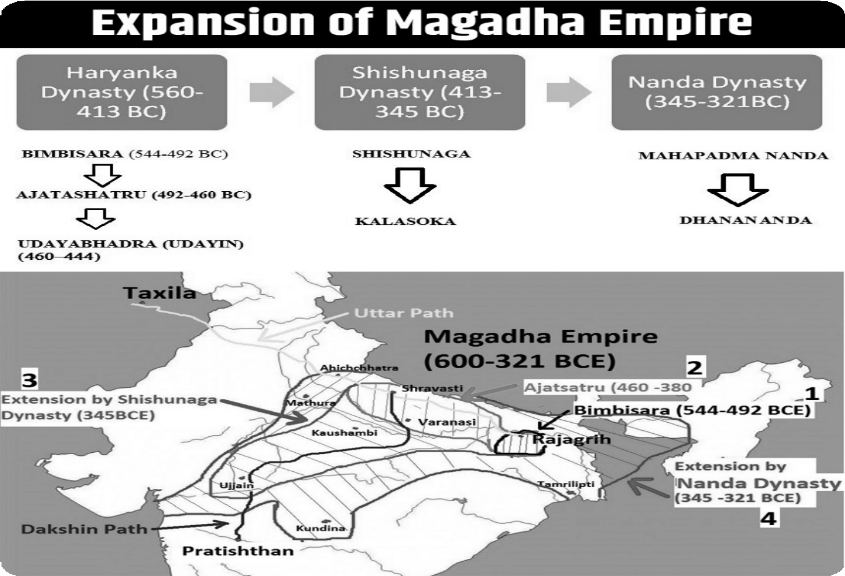
Bimbisara:
Bimbisara ruled from 544 to 492 BCE, and used a strategic approach of marriages, alliances, and conquests to elevate Magadha to a dominant political position. Bimbisara’s diplomatic and military endeavours solidified Magadha’s supremacy.
He was a contemporary of Buddha and Mahavira, ruled from the fortified capital city of Rajgriha, nestled among five hills and protected by stone walls.
Initially, he had a rivalry with Avanti’s King Pradyota but later became friends, even sending his royal physician Jivaka to treat Pradyota’s jaundice in Ujjain.
He began the policy of conquest and aggression which ended with the Kalinga war of Ashoka.
• He deployed the war engine, resembling a 'Catapult' (Mahashilakantaka), to launch stones with precision in battle.
• Bimbisara expanded his empire by conquering Anga (modern-day East Bihar), a key region for both inland and maritime trade.
• He solidified his position through marriage alliances with prominent royal families, boosting his diplomatic influence and paving the way for Magadha's growth.
• His first wife, Mahakoshala from Kosala (sister of Prasenjit), brought the territory of Kashi as part of her dowry, significantly boosting his revenue.
• He married Princess Chellana of the Lichchhavi clan from Vaishali, who later gave birth to Ajatashatru.
• He also married the daughter of the chief of the Madra clan (Punjab).
Ajatashatru:
• Ajatashatru, Bimbisara's son, eager to claim the throne of Magadha, is said to have murdered his father to seize power.
• As the most formidable and ambitious ruler of the Haryanka dynasty, he carried forward his father's expansionist policies, pursuing military conquests to extend his empire.
• Deafeating Parsenjit of Kosala: Ajatashatru annexed Kosala, ruled by his maternal uncle Prasenjit. Tensions arose between them when Prasenjit, angered by the treatment of Bimbisara, demanded the return of Kashi, which had been part of his sister's dowry. Ajatashatru refused, resulting in a fierce conflict, during which Prasenjit was ultimately forced to relinquish his claim to Kashi, leaving it under Magadha's control.
• Annexing Vaishali: Similarly, Ajatashatru waged a 16- year war against his maternal grandfather, Chetak, the chief of Vaishali. Eventually, he succeeded in breaking the might of Vaishali, adding it to Magadha’s territory.
• Ajatashatru was innovative in his military strategies, using war engines like Catapults (Mahashilakantaka) and chariots with maces for mass killings (Rathamusala).
• The Buddha passed away during his reign.
• Ajatashatru arranged the first Buddhist Council.
Udayin:
• He established the capital city of Pataliputra, strategically located at the confluence of the Ganga and Son rivers, at the heart of the Magadhan kingdom, which spanned from the Himalayas in the north to the Chhotanagpur Hills in the south.
• He likely met his demise through assassination, possibly orchestrated by Palaka, the king of Avanti.
Last Rulers of Haryanka Dynasty
Puranas mention Nandivardhana and Mahanandin as successors of Udayin. According to Buddhist tradition, Anurudhha, Munda and Nagadarshaka were his successors:
• Anuruddha (444–440 BCE)
• Munda (440–437 BCE)
• N gad saka (437–413 BCE): he was deposed by the people.

Sources Causes and the Dynasties That Ruled Magadha
Introduction:
Empire Formation: North India underwent major political changes during 600 BCE – 300 BCE which resulted in the rise of the empire due to the merger of kingdoms and the sixteen Mahajanapadas as a result of the rivalry and fierce battle among them.
Rise of Magadha: The period of 544-323 BCE is marked by the expansion of Magadha and its emergence as the first empire in the Indian subcontinent due to its successful victory over the other kingdoms and Mahajanapadas. Magadha’s rise to political supremacy began with Bimbisara, who belonged to the Haryanka dynasty.
Buddhism and Jainism emerged as prominent religions during this period, due to their appeal and the changes they brought about in the social order. It led to the emergence of new structures and traditions in socio- political domains.
Sources:
Literary Texts:
‘Mahavamsa’: The historical chronicle from Sri Lanka. It is written in Pali.
‘Mudra Rakshasa’ by Vishakhadatta: It was written during the Gupta period. It narrates the story of Chandragupta Maurya accession to the throne.
‘Indica’ by Megasthenes.
‘Arthashastra’ by Kautilya (Chanakya or Vishnugupta).
• Archaeological evidence in Gangetic regions.
• Rock and Pillar edicts of Ashoka.
Causes for the Rise of Magadha Empire
Various combined factors enabled Magadha to assert its dominance over other Mahajanapadas.
Some of the key factors are as follows:
Strategic geographical location:
The capitals, Rajgriha and Patliputra, were strategically situated.
Rajagriha was naturally fortified by surrounding
hills, making it nearly impregnable.
Patliputra’s location at the at the confluence of the Ganges, Ghandak and Son with another tributary Ghaggar joining the Ganges on outskitrts of the Patliputra enhanced the connectivity to the capital city via waterway. It also turned it into a water fort.
Resource Rich:
Magadha had easy access to rich iron deposits in southern Bihar, giving it an edge in producing superior weapons and iron tools for clearing up the forest for agricultural purposes.
Magadha occupied a central position in the fertile middle Gangetic plain, blessed with abundant alluvial soil and ample rainfall. This fertile region yielded a surplus of agricultural produce, crucial for maintaining a large standing army.
The southern forests provided timber and elephants, giving Magadha a military advantage, as elephants were used extensively in warfare.
Trade Centre: Enhanced agricultural production gave rise to trade, urban centers, and the use of metal currency which further brought additional revenue through tolls, bolstering the treasury and supporting the upkeep of a massive army.
Adept Leaders: Magadha became a powerful empire under the military might and ambitions of the Bimbisara, Ajatashatru, and Mahapadma Nanda and afterward Mauryas who employed various strategies to expand their territories and resisted external threats, including Alexander’s invasions.
Cultural Factors: Magadha’s unorthodox society fostered enthusiasm for expansion which was unmatched by other kingdoms.
The Dynasties that Ruled Magadha

| Dynasty | Rule | Feature |
| Haryanaka Dynasty (544 – 412 BCE) | Bimbisara (544 – 492 BCE) | Started the expansion of Magadha Mahajanpada. |
| Ajatshatru (492 – 460 BCE) | Defeated Lichhavis of the Vaishali Republic, Vajji Mahajanpada, Prasenjeet, the king of Kosala. Convened the 1st Buddhist council immediately after the death of Buddha. | |
| Udayin (460 – 444 BCE) | Shifted capital from Vaishali to the Patliputra. | |
| Shishunaaga Dynasty (412 – 344 BCE) | Shishunaaga (413 – 395 BCE) | He destroyed the army of Chand Pradhyot, dissolved Avanti Mahajanpada in the Magadh empire, captured Vatsa and captured Kosala mahajanpada. He moved the capital to Vaishali. |
| Kaalashoka (395-367 BCE) | Convened the second Buddhist council. | |
| Nanda Dynasty (344 – 321 BCE) | Mahapadma Nanda (345-329 BCE) | He ended the Shishunaag dynasty. He adopted the title of “Ekchattra” and “Ekraat”. |
| Dhana Nanda (329-321 BCE) | He was the 8th son of Mahapadma Nand. He was the ruler of the Magadha empire when Alexander had attacked India. | |
| Mauryas (324/321 – 185 BCE) | Chandragupta Maurya (321 – 297 BCE) | Established Maurya rule over the Magadh with the help of Brahmana mentor called Kautilya/Vishnugupta/ Chanakya. |
| Bindusara (297 – 273 BCE) | Ruled almost the entire sub-continent (as far south as Karnataka). | |
| Ashoka (268 – 232 BCE) | Due to the devastation in Kalilnga war embraced Buddhism, a religion that advocated non-violence (ahimsa), compassion, and moral living. He became a patron of Buddhism and worked to promote its principles. | |
| Brihadratha | Last king of the Maurya dynasty. |
Shishunaga Dynasty
Shishunaga dynasty: A short stint
• Despite the large Magadha territories, Udayin and later kings were unable to effectively rule and were ultimately overthrown by the people of Magadha.
• Shishunaga, a viceroy at Benaras, was enthroned in 413 BCE.
• The rule of the Shishunaga dynasty was short, giving way to the Nanda dynasty under the usurper Mahapadma Nanda.
Shishunaga:
Shishunaga, a former high-ranking official in Varanasi, became the ruler of Magadha due to public outrage over the series of murders among Udayin’s successors.
He moved the capital to Vaishali.
His most significant accomplishment was defeating 21. Avanti’s Chanda Pradyota dynasty and incorporating it into Magadha, finally ending the century-old rivalry between the two kingdoms.
Kalasoka
Son and successor of Shishunaga.
• Second Buddhist Council was held at Vaishali during his rule.
Nandas
Nandas: The first empire builder of India (345 BCE – 321
BCE)
Nandas came to power in 345 BCE under the leadership
of the Mahapadmananda.
• This dynasty was the first non-Kshatriya dynasty.
• The Magadha empire became strong and wealthy under their rule.
• Hathigumpha inscription near Udayagiri Khandgiri caves also mentions their dynasty.
Mahapadmananda:
• He is the founder of the Nanda dynasty and is also known as Ugrasena in Pali texts due to his formidable army.
• The pioneer of India’s first empire, he proclaimed himself as Ekarat, the sole ruler who eliminated all other princely contenders, and Sarva-kshatrantaka, the conqueror of Kshatriyas.
• He expanded Magadha by annexing Kalinga and likely suppressing a rebellion in Kosala.
• According to Brahmanical texts, he hailed from a lower caste, possibly non-Kshatriya, and the Puranas claim he was born to a Shishunaga dynasty king and a Shudra woman, marking the Nandas as Adharmika (deviating from Dharma norms).
• Buddhist texts refer to them as Annatakula (of unknown lineage).
• He implemented a systematic tax collection system through appointed officials and undertook extensive canal and irrigation projects.
• He also brought back an image of Jina as a victory symbol.
• The Jina is the central figure in Jainism and is revered as a perfected being who has achieved liberation from the cycle of birth and death.
• Mahapadma Nanda was succeeded by his son Dhana Nanda.
Dhanananda:
• He is the last significant ruler of the Nanda dynasty, who commanded a vast army that halted Alexander’s advance into Magadha when he invaded Punjab.


85
• He is also credited with inventing the Nandopakramani,
a specific measuring standard.
• Nanda is remembered as an oppressive and greedy ruler who burdened the common people with heavy taxes.
• His exploitation and unpopularity paved the way for Chandragupta Maurya, guided by Kautilya, to overthrow the Nanda dynasty and establish the Mauryan empire.
Foreign Invasions
Foreign Invasions
Persian Invasions
The political disunity and constant conflicts between the
Mahajanapadas in the north-western frontier (Kamboja, Madra, and Gandhara) offered an opportunity to the Persian King Cyrus in the 6th century BCE, to invade north-western India.
Cyrus conducted a military campaign that resulted in the destruction of Kapisha (located on southeast of the Hindu Kush mountains) and collection of tribute from the people of Kamboja and Gandhara.
Subsequently, in 516 BCE, Persian King Darius incorporated Punjab, the western regions of the Indus, and Sindh into the empire.
• Indian provinces also supplied mercenaries for Persian armies engaged in conflicts against the Greeks in the 5th century BCE.
Alexander Macedonian Invasion:
• During Dhana Nanda’s reign, Alexander invaded north-
west India (327–325 BCE).
• Alexander defeats Darius: Alexander (356–326 BCE), son of Philip of Macedonia, launched a campaign into India in 326 BCE during the intense global struggle for dominance between the Greeks and Persians in the 4th century BCE. After defeating the Persian army led by Darius, Alexander continued his conquest into the Indian provinces.
• Alexander Conquers Punjab:
• In 326 BCE, he entered India through the Khyber Pass.
• Except for Porus, who engaged in the renowned Battle of Hydaspas (on the Jhelum River), most other kings surrendered without much resistance because numerous small independent states like Taxila, the Punjab (ruled by King Porus), Gandhara, etc., lacked a united and formidable resistance to Alexander’s advance.
• After his conquests in the Punjab region, Alexander expressed his desire to march further east to attack the Magadha Empire.
• Alexander Returns:
• Upon reaching the Beas River his already tired troops had heard about the great emperor in the east (Dhana Nanda) and his formidable army, refused to be engaged in a war against such a powerful adversary and forced him to retreat.
• He erected 12 large stone altars on the northern bank of the Beas River and eventually passed away in Babylon in 323 BCE.
• Reversals & Greek Governors:
• Due to the limited time available to consolidate his Indian conquests, most of the conquered states were returned to their original rulers who had submitted to his authority.
• His territorial empire was divided into three regions,
each overseen by a Greek governor.
• Consequences of the Alexander’s Invasion in India:
• In many ways, the invasion by Alexander is a watershed in Indian history.
• Trade: Alexander’s campaign had enduring consequences on India, notably by connecting it to Europe through multiple communication routes: three overland passages and one by sea, where Alexander dispatched Admiral Nearchus to Iran. This facilitated trade between Greek merchants and Indian craftsmen.
• Cultural development: A significant cultural development occurred with the establishment of a cosmopolitan arts school in Gandhara.
• Unifying the North: Indirectly, Alexander’s invasion contributed to the unification of northern India under Chandragupta Maurya
Mauryan Empire
Mauryan Empire:
Origins of Mauryas and Defeat of the Nandas
Chandragupta was born into a family left destitute by the death of his father, chief of the migrant Mauryas, in a border fray. Later he was sold to a hunter to tend cattle. Purchased by a Brahman politician, Kautilya (also called Chanakya), and was taken to Taxila (now in Pakistan), where he received an education in military tactics and the aesthetic arts.
Upon Kautilya’s advice, he collected mercenary soldiers, secured public support, and ended the autocracy of the Dhananand in a bloody battle against forces led by their commander-in-chief, Bhaddasala. He became emperor in 321 BCE.
Contemporary accounts by Greek historians show that Chandragupta was a youth living in Taxila when Alexander invaded India.
Chandragupta:
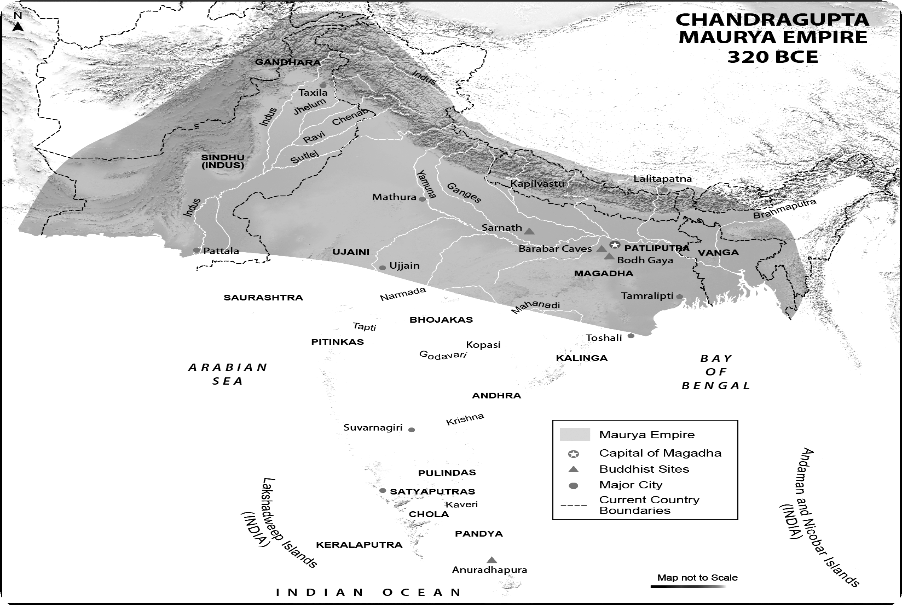
• Geographical Spread: Chandragupta’s empire spanned today’s Bihar, Nepal, western and northwestern India, as well as the Deccan. The Junagadh inscription showed that his empire expanded to Gujarat.
• Defeating Greeks: One of his great achievements, according to local accounts, was that he waged war against the Greek prefects (military officials) left behind by Alexander and destroyed them so that the way was cleared to carry out his ambitious plan of expanding the territories.
• After Alexander's death, Seleucus established his kingdom, extending into Punjab. However,


Chandragupta defeated him in battle before 301 BCE and expelled him from the region.
• The final agreement between the two was likely
amicable, as Chandragupta offered Seleucus 500 war elephants, and Seleucus, in turn, sent Megasthenes as an ambassador to Chandragupta's court.


Megasthenes wrote “Indica”. The original work has been lost, but many Greek historians cited it to describe Chandragupta's court and administration. Greek historians recorded his name as "Sandrakottus" or "Sandrakoptus," which are clearly altered versions of Chandragupta.
According to Megasthenes, the Mauryan military administration was managed by a board of 30 officers, organized into 6 committees, each consisting of 5 members. These committees were:
i. Infantryii. Cavalry
iii. Elephantsiv. Chariots
v. Navyvi. Transport

Megasthenes
• ‘Mudra Rakshasa’ also showed the coming of Chandragupta to the throne. It was written by Vishakhadatta.
• Sallekhahana: According to Jain texts and tradition, Chandragupta embraced Jainism later in life. Accompanied by Bhadrabahu, he traveled to the hills of Shravana Belagola near Mysore. There, he undertook Sallekhana, a practice of voluntary and gradual fasting leading to death.
Kautilya/Chanakya/Vishnugupta:
• He guided, advised, and mentored Chandragupta.
• Kautilya was the author of ‘Arthashastra’.
• Chanakya is credited with formulating the strategy to overthrow the Nandas and assist Chandragupta in rising to power as the emperor of Magadha.
Ashoka:
• Chandragupta was a remarkable ruler who had to establish a robust administrative system to effectively govern his vast empire.
Bindusara:
• Bindusara, the son of Chandragupta, peacefully succeeded his father as emperor in 297 BCE, ensuring a smooth transition of power.
• The Greeks referred to him as Amitrochates. Bindusara maintained diplomatic relations with the Seleucid Syrian king Antiochus I, who sent Deimachus as an ambassador to his court. Bindusara also embraced the Ajivika religion.
• Bindusara ruled for 25 years before his death in 272 BCE.
• Ashoka was not initially his chosen successor, and since he ascended the throne only four years later in 268 BCE, it suggests that a struggle for succession occurred among Bindusara's sons.


• He was the most famous ruler of this kingdom.
• Ashoka fought the war of succession which lasted four years.‘Sumana’ was among the 99 stepbrothers Ashoka is claimed to have killed, according to the canon.
• Legend has it that only ‘Vitashoka’ (Tissa), Ashoka's own brother, was spared.
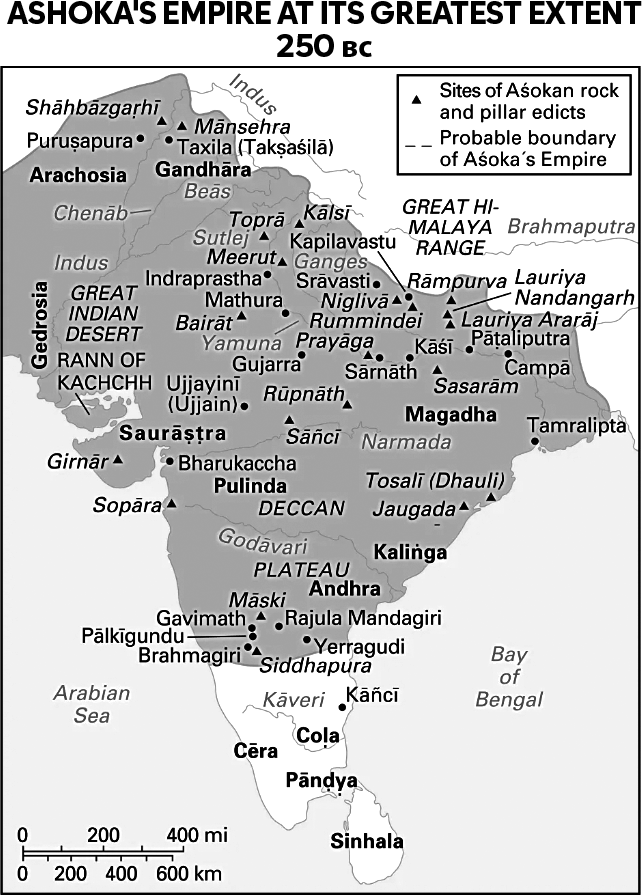
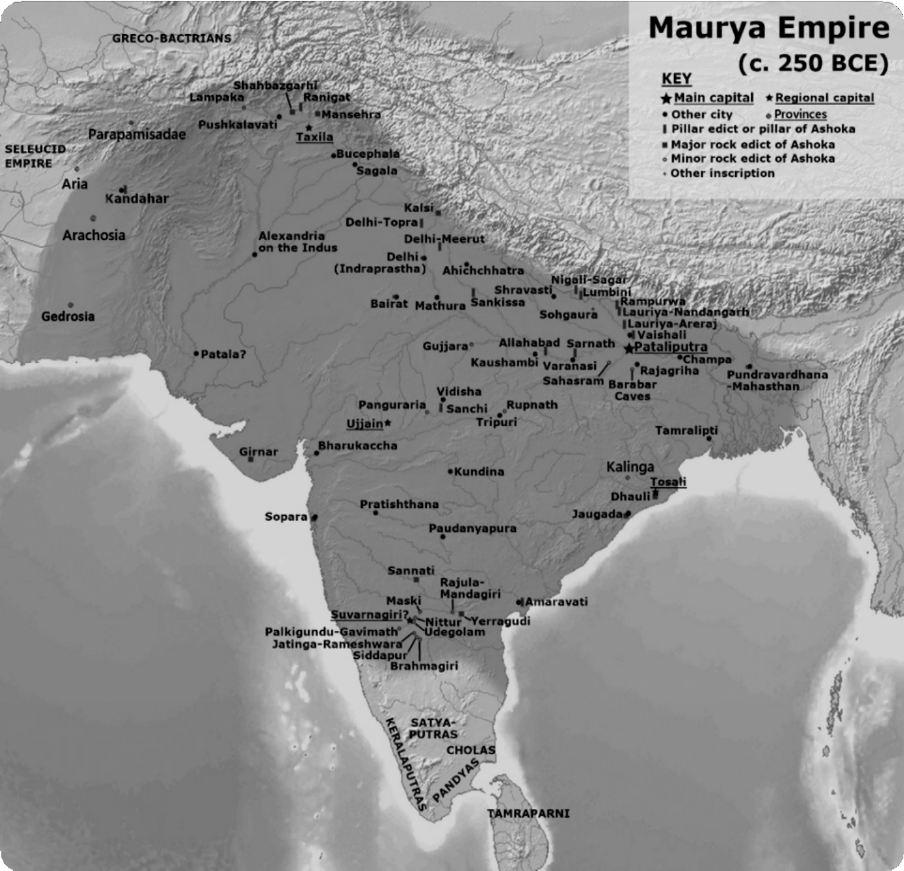
• Geographical Spread: Ashoka’s empire encompassed the entire region from Hindukush to Bengal, stretching across Afghanistan, Balochistan, and the entirety of India, including Kashmir and Nepal’s valleys. His empire even extended to Sri Lanka. With only a small southern region remaining outside his rule, inhabited by the Cholas, Pandyas (as per rock edict 13), Keralaputras, and Satiyaputras (as per rock edict 2).
• Early Triumphs: Ashoka had been the viceroy of Taxila when he put down a revolt against the local officials by the people of Taxila and was later the viceroy of Ujjain, the capital of Avanti and a major city and commercial center during Bindusara’s reign.
• Buddhism & Dhamma:
• The devastating aftermath of the Kalinga war deeply affected him, leading to his adoption of the policy of Dhamma and his promotion of Buddhism.
• During his reign, Buddhism spread beyond India’s borders for the first time, with his son Mahendra and daughter Sanghamitra being sent as Buddhist missionaries to Sri Lanka (Ceylon).
• He appointed Dharma Mahamattas to promote dharma across various social groups, including women.
• He organized the Third Buddhist Council at Pataliputra.
• He sent Buddhist missionaries to Ceylon and Suvarnabhumi.
• He prohibited animal sacrifice, regulated the slaughter of animals for food, and established dharmashalas, hospitals, and sarais (rest houses).
Edicts of Ashoka:
• The history of Ashoka is reconstructed through his thirty- nine inscriptions, which are categorized into Major Rock Edicts, Minor Rock Edicts, Separate Rock Edicts, Major
Pillar Edicts, and Minor Pillar Edicts.
• James Prinsep, an English scholar, orientalist, antiquarian, and administrator of the East India Company, was the first to decipher the Brahmi and Kharoshthi scripts of the Ashokan inscriptions in 1837.
Dating the Edicts:
• In terms of chronology, the smaller inscriptions generally precede the larger ones, with rock inscriptions typically being created earlier than pillar inscriptions.
• The edicts from the early part of Ashoka's reign are written in Prakrit, Greek, and Aramaic.
Languages of Edicts:
• The inscriptions found in the central and eastern part of India were written in Magadhi Prakrit using the Brahmi script. These were mostly used in rock edicts.
• Kharosthi script was used in north-western inscriptions.
• Kandhar inscriptions are in Greek and Aramaic.
Significance of the Edicts:
The edicts reflect Ashoka’s commitment to peace, righteousness, justice, and his deep concern for the welfare of his people.
The geographical distribution of the edicts outlines the vast extent of the empire Ashoka ruled.
• One inscription mentions territories beyond his borders: “the Chodas (Cholas), the Pandyas, the Satiyaputas, the Keralaputas (Cheras), even Tamraparni, the Yona king Antiyoka (Antiochus), and the neighboring kings of this Antiochus.”
• Ashoka uses his name only in four of these places namely:
• Maski
• Brahmagiri (Karnataka)
• Gujjara (Madhya Pradesh)
• Nettur (Andhra Pradesh)
• By rejecting violence and war, and promoting peace and the pursuit of Dhamma, Ashoka challenged the prevailing belief that an emperor must expand and solidify his empire through warfare and military conquests.
Minor Rock Edicts:
• Minor rock edicts are found on 15 rocks across the Indian
subcontinent and in Afghanistan.
• Minor Rock Edict 1, known as the Maski edict in Karnataka, indicates that Ashoka's turn towards Buddhism was gradual rather than sudden.
• In Minor Rock Edict 3, located in Rajasthan, Ashoka greets the Sangha, expresses his deep faith in the Buddha, Dhamma, and Sangha, and recommends six Buddhist texts for monks, nuns, and the general public.
• The rock edicts at Brahmagiri, Karnataka, discuss aspects of local administration.
Major Rock Edicts:
• 14 Edicts (termed 1st to14th) and 2 separate ones found in Odisha in Prakrit and Greek.
• These are at:
• Kandahar, Afghanistan
• Shahbazgarhi, Pakistan- in Kharoshthi script
• Mansehra, Pakistan- in Kharoshthi script
• Khalsi, Dehradun
• Junagadh Girnar, Gujarat
• Jaugada, Ganjam, Odisha
• Dhauli, Odisha – shaped as an Elephant.


89
• Sopara, Maharashtra
• Yerragudi, Andhra Pradesh
• Sannati Karnataka In Brahmi Script mentions “Ranyo Ashoka” (King Ashoka) and has his sculpture.
.
Ashokan Pillars
Ashokan Pillars
• The Ashokan pillars have the following features:
• The pillars are mostly uniform in shape and size, constructed from Chunar sandstone.
• They are predominantly monolithic, hewn from a single stone block, boasting a glossy, polished surface.
• These pillars lack a base and instead feature a plain, smooth cylindrical shaft that gently narrows upwards to a height of 12-14 meters.
• A cylindrical bolt connects the top of the shaft to the capital, which is shaped like an inverted lotus, known as a bell capital.
• Resting on the bell capital is a platform called an abacus, designed to support a crowned animal figure.
• In earlier pillars, the abacus is square and plain, while in later ones, it becomes circular and curved.
• Notably, all components of these pillars are intricately carved on all sides, making them intended for viewing from every angle.
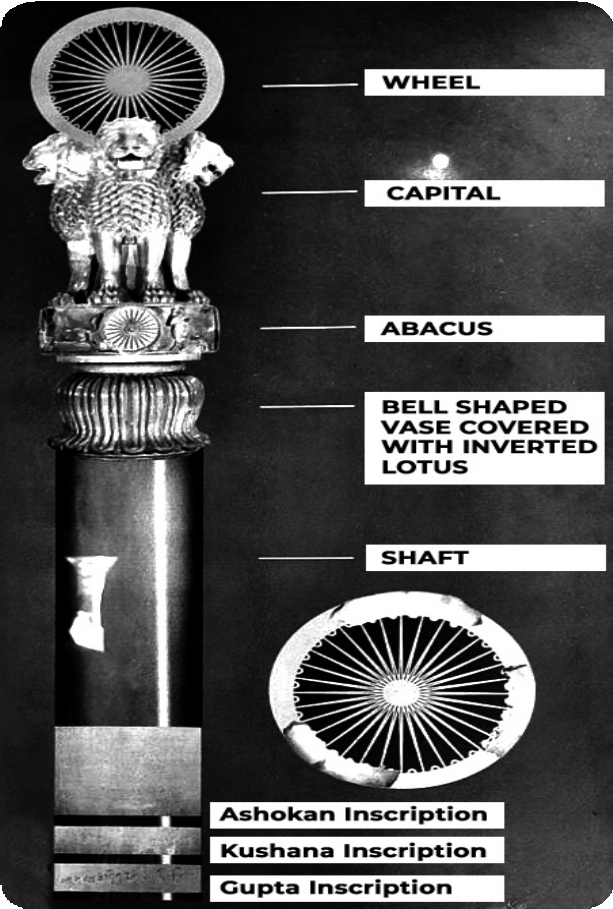
• The Ashokan pillars bear rich symbolism rooted in Indian religious traditions. These motifs include the lotus (symbolizing purity and fertility), lion (representing both the sun and the Buddha, known as Sakyasimha), bull (a fertility symbol), elephant (associated with the Buddha’s conception as a white elephant), spoked wheel (representing the wheel of dharma and sovereignty), and horse (symbolizing Siddhartha’s departure from home).
Minor Pillar Edicts:
• Asoka’s Minor Pillar Edicts are exclusively inscribed on several of the Pillars of Ashoka, at Sarnath, Sanchi, Allahabad (a pillar initially located in Kosambi).
• Schism Edicts - Asoka’s injunction against shism in the Samgha,
• Queen’s edict - Queen Karuwaki should be credited for her gifts in Allahabad Pillar,
• Rummindei Edict, on Lumbini Pillar,
• Nigali Sagar Edict in Prakrit language and Brahmi script.
Major Pillar Edicts:
• The free-standing Ashokan pillars probably signify the axis of the world (axis mundi) that separated heaven and the Earth.
• Pillar edicts have been found at Lauriya-Araraj, Lauriya Nandangarh, Rampurva, Nigali Sagar, Sarnath, Topra, and Meerut.
• There are pillars without inscriptions such as the bull capital pillar at Rampurva, the pillar with the lion capital at Vaishali, and the Kolam pillar
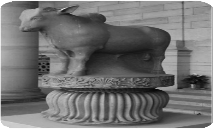
Figure: Bull capital of Rampurva and Delhi-Topra pillar edicts
Key pillar edicts highlight these symbols:
1st Pillar Edict: Social code,
2nd Pillar Edict: Describes dhamma as consisting of least amount of sin, performing virtuous deeds, having compassion, purity, and truthfulness,
3rd Pillar Edict: Soul and sin,
4th Pillar Edict: Rajukas,

91
5th Pillar Edict: Popularly known as the Delhi-Topra pillar edict, it features prohibitions regarding animal killing,
6th Pillar Edict: Welfare of people,
7th Pillar Edict: Dhamma Mahamattas.
Quotes from the 14 Major Rock Edicts of Ashoka
Edict I: Beloved-of-the-Gods, King Piyadasi, has ordered this Dhamma edict to be written. In my realm, no living beings shall be slaughtered or offered in sacrifice, as animal sacrifice is strictly prohibited.
Edict II: For both my citizens and those beyond my borders, Beloved-of-the-Gods, King Piyadasi, has made arrangements for two types of medical care: one for humans and one for animals. Along the roads, I have had wells dug and trees planted for the benefit of both humans and animals.
Edict III: A decree regarding the inspection tours conducted by Ashoka’s officials, such as Yuktas, Pradeshikas, and Rajukas, to teach the people about Dhamma and the principles of non-violence and benevolence toward all.
Edict IV: A decree on non-violence, promoting Dhammaghosha (the sound of Dhamma/righteousness) over Bherighosha (the sound of war). It highlights the importance of Dhamma and right conduct toward all and instructs his successors to follow Dhamma and uphold Ashoka's vision.
Edict V: Beloved-of-the-Gods, King Piyadasi, says: "To do good is difficult. One who does good is undertaking something hard to accomplish. Indeed, it is easy to do evil." This edict discusses the compassion of Dhamma Mahamatras toward convicts and their families and the proper practice and teaching of Dhamma.
Edict VI: This edict emphasizes Ashoka’s availability to all, his intention to resolve debates quickly in council chambers, and his dedication to the welfare of all his subjects. It also mentions the role of the Mantri Parishad and officers such as Pulisani and Pativedakas (reporters).
Edict VII: Beloved-of-the-Gods, King Piyadasi, desires that all religions should reside everywhere, for all of them desire self-control and purity of heart, gratitude, and firm devotion.
Edict VIII: The First Dhamma Tour to Sambodhi i.e., the Bodhi tree. Visits and gifts to Brahmans and ascetics, gold to the aged, visits to people in the countryside, instructing them in dhamma. Hence, royal pleasure tours (Vihara-yatras) were replaced by dhamma tours (Dhamma Yatras).
Edict IX: Decree concerning proper and improper ceremonies, proper behavior towards servants and employees, respect for teachers, restraint towards living beings, and generosity as well as right behavior toward relatives, friends, and neighbors. Dhamma does good in both this life and the one to come. Criticism of the
uselessness of various ceremonies, instead lays stress on dhamma and moral conduct.
Edict X: Mentions that all efforts are being made only for the welfare of the people.
Edict XI: There is no gift greater than the gift of Dhamma, no bond more meaningful than the bond with Dhamma, no act of giving more significant than the giving of Dhamma, and no kinship stronger than kinship through Dhamma. It involves: showing proper behavior towards servants and employees, respecting mother and father, being generous to friends, companions, relatives, Brahmins, and ascetics, and refraining from killing any living beings.
Edict XII: A decree promoting religious tolerance and mutual respect among followers of different faiths: "Anyone who excessively praises their own religion while condemning others with the intention of glorifying their own, only damages their own religion." The decree also addresses the Mahamattas responsible for women’s welfare and the Ithijika Mahamatta.
Edict XIII: A famous decree regarding the Kalinga War (eight years after his coronation in 261 B.C.), expressing his deep remorse, and how he now "conquers" people through Dhamma. This decree compares his approach to that of Greek kings such as Antiochus of Syria (Amtiyoko), Ptolemy of Egypt (Turamaye), Magas of Cyrene (Maka), Antigonus of Macedon (Amtikini), and Alexander of Epirus (Alikasudaro). It also mentions the Pandyas, Cholas, and others. The concept of Digvijay (victory through war) was replaced by Dhamma Vijay (victory through Dhamma), with the sword giving way to Dhamma, and the war drum (Bheri Ghosha) being replaced by the sound of Dhamma (Dhamma Ghosha).
Edict XIV: Mentions the purpose of the rock edicts.
In the separate Major Kalinga Rock Edicts, Ashoka articulated his renowned doctrine of governance: "All men are my children. Just as I wish for my own children to experience bliss and happiness in this world and the next, I also desire the same for all my subjects."
Other Relevant Inscriptions and Important Edicts
• Allahabad – Kosam/Queen’s Edict / Kausambi or Schism Edict:
• Ashoka advises members of the Sangha to avoid causing divisions within their ranks.
• Samudragupta’s inscription is included in this very edict.
• It is likely that Jahangir was responsible for relocating the inscription to the fort at Allahabad.
• Girnar Rock Inscription of Rudradaman (Kathiawar):
• The inscription mentions the Sudarshan Lake, constructed by Pushyagupta, a provincial governor (Rashtriya) of Saurashtra, during Chandragupta Maurya's reign.


• Nigali Sagar Inscription (Nepal):
• To commemorate the first expansion of the stupa, 14 years after his consecration, and Ashoka's subsequent visit to the site, 20 years after his consecration.
• Rummindei Inscription (Nepal):
• To commemorate the birthplace of the Buddha, Ashoka visited Lumbini, worshiped here, and gave tax concessions to the villagers. It records that the village of Lumbini was exempted from Bali and was to pay only one-eighth of Bhaga.
• Sannati Inscription (Karnataka)
• Site of all 14 Major Rock Edicts as well as two separate Kalinga edicts.
• A Sohgaura Copper Plate Inscription and Mahasthan:
Inscription of Chandragupta Maurya.
• Mentions relief measures adopted during famine in Magadha.
• Inscriptions at Shahbazgarhi and Mansehra written in Kharosthi script.
The Mauryan State and Polity
The Mauryan State and Polity:
• Megasthenes described the Mauryan state as a centralized state.
• Perhaps the most detailed account of the administration is to be found in the Arthasastra. However, it must be remembered that the Arthasastra was a prescriptive text, which laid down the guidelines for good administration.
• Bureaucracy was very strong and efficient.
• The key priorities for the Mauryan state included collecting taxes as state revenue, administering justice, and ensuring internal security, along with defending against external threats.
• Achieving these objectives necessitated a large and complex administrative system and institutions.
• The bureaucratic structure spanned a hierarchy of settlements, ranging from villages to towns, provincial capitals, and major cities.
• Efficient Taxation
• The bureaucracy required and enabled an efficient system of revenue collection since it needed to be paid out of taxes collected.
• Equally, the very large army of the Mauryan Empire could be maintained only with the revenue raised through taxation.
• Rulers
• King was the head of the administration. The king was assisted by Purohita, who was a person of great importance.
• Samaharta: Revenue collection was his responsibility.
Saptanga Rajya
In the Arthashastra, Kautilya outlines the concept of Saptanga Rajya, which defines the state as consisting of seven interrelated and interconnected elements, known as angas or Prakriti.
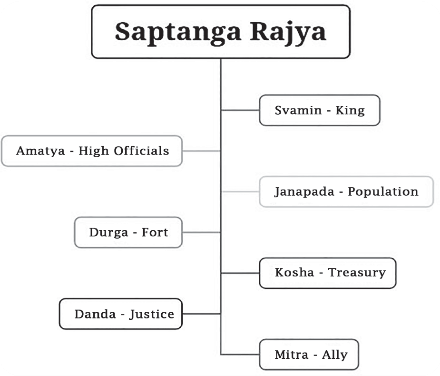
Svamin (king): Soul of all the seven elements and called Dharmapravakta. The King was assisted by a council of ministers. Pativedakas and Pulisani functioned as special reporters of the king and kept him informed of public opinion.
Amatya (all high officials, counselors, and executive heads of departments/ ministers):
• Council of ministers: An advisory body to support the king in daily administration, this council was larger than the Mantraparishad, which was a smaller consultative group of ministers.
• MahaMantrins: The high-ranking ministers.
• Nikayas (trained officials) who looked after ordinary affairs.
• Tirthas: Highest functionaries at the center chaired by Mantrin (chief minister), Purohita (high priest), Yuvaraja (heir-apparent), and Senapati (commander-in-chief).
• Adhyakshas: Superintendents, high-ranking officials next to the Tirthas, concerned mostly with economic functions and some military duties.
• Amatyas: Officials filled the highest administrative and judicial appointments.
• Nagaradhyaksha: The magistrates who looked after towns and cities.
• Baladhyakshas: Officials looking after the military.
• Samahartri:Chief collector of revenue. Superintendents functioned on his orders.
• Samnidhatri: Treasurer.
• Akshapatala: Records-cum-audit office.
• Dauvarika: Chief of the palace attendants.


Janapada (territory and population): The Mauryan Empire was divided into four other provinces, with capitals at Taxila (north-western India), Suvarnagiri (southern India), Tosali (eastern India), and Ujjain (western India). During Ashoka’s reign, a fifth province of Kalinga was added.
• The head of the provincial administration was viceroy, who was in charge of law and order, and collection of taxes for the center.
• The provinces were further divided into divisions headed by Pradeshikas, who had no advisory council.
| State | Capital |
| Uttarapatha | Taxila |
| Dakshinapatha | Suvarnagiri |
| Eastern India | Tosali |
| Avantiratha | Ujjain |
| Kalinga | Tasali/Dhauli |
Durga (Fortified capital): Higher officers called Anta- Mahamattas were responsible for the security of frontier forts. Kautilya gave detailed directions for the construction of the main fort in the capital city. Experts in different branches of military art and science were divided into six boards of five members each:
• The Board of Admiralty: In charge of the navy, though
interestingly Kautilya does not mention the navy,
• The Board of Infantry: Headed by Padadhyaksha ,
• The Board of Cavalry: Headed by Asvadhyaksha,
• TheBoa rdof WarChariots: Headed by
Rathadhyaksha,
• TheBoa rdof WarElephants: Headed by
Hastyadhyaksha,
• The Board of Transport and Supervision of Equipment.
Kosha: Treasury,
Danda/Bala: Justice or force,
Mitra means ally.
• The diplomatic posts mentioned in Arthashastra:
• Nisriharthaduta: Full-fledged ambassador,
• Parimitarthaduta: Officer under Nisriharthaduta,
• Sasanharaduta: messenger.
District and Village Administration:
• At the next level of administration came the districts, villages, and towns.
• Agriculture was then, as it remained down the centuries, the most important contributor to the economy, and the tax on agricultural produce constituted the most important source of revenue.
• Usually, the king was entitled to one-sixth of the produce. In reality, it was often much higher, usually about one- fourth of the produce.
Rajukas: Divisions were divided into districts under officials called Rajukas (derived from Rajju, meaning rope, and probably referring to the measurement of land using ropes). He was assisted by Yuktas (clerks) in accounting, secretarial, and other miscellaneous work.
Sthanika: The District was under their command.
Gopas: They were in charge of 5-10 villages.
Nagarika: Urban administrator.
Gramini: Village administrator.
Administrative policing units were organized at differentlevels:
Sthaniya – Established for a group of about 800 villages.
Dronamukha – Functioned at the level of around 400 villages.
Kharvatika – Operated for about 200 villages.
Sangrahana – Served a smaller cluster of around 10 villages.
• Police centre were found at the following intervals- There was a Sthaniya in the midst of 800 villages, a Dronamukha in 400 villages, a Kharvatika in 200 villages and a Sangrahana in 10 villages.
| Sthaniya | Drona Mukha | Kharvatika | Samgrahana |
| 800 villages | 400 villages | 200 villages | 10 villages |
Source of Revenue
Source of Revenue:
Agriculture was the backbone of the economy.
• The Arthasastra recommended comprehensive state control over agricultural production and marketing, with warehouses to store agricultural products and regulated markets, in order to maximize the revenues from this most important sector of the economy.
• Sugarcane, and cotton like cash crops were also grown.
• Svaviryopajivins: Sharecropping in which peasants kept one-fourth or one-fifth of the produce.
• It should be noted that there is no reference in any text to taking away the land of the farmers in case of non-
payment of taxes.
Textile & Crafts:
• The main centres of textile manufacturing were Varanasi, Mathura, Bengal, Gandhara, and Ujjain.
• The state also functioned as entrepreneur and state-run textile workshops were placed under Sutradhyaksha, and chariot workshops under a Rathadhyaksha.
• Mining and metallurgy were another important economic activity and the mine officer was called Akaradhyaksha.
• Kautilya describes forests, pastures, and mines as state property.
• Loha-adyaksha: Administrator of production of iron.
Labour:
• Visthi: Forced labour,
• Karamakara: Wage labour,
• Dasas and Ahitakas: Bonded labour and Slave labour.
Trade:
• Traders and artisans were organised in corporate associations called shrenis or guilds or puga to protect their rights. The guilds were headed by Jesthaka.
• Tamralipti (Tamluk in West Bengal) in the east and Broach in the west were important seaports.
• Trade activities with Sri Lanka, China, and Greece was also present.
• Export items like textiles, woolens, silks, aromatic woods, animal skins, and gems went from India to other parts of the world.
• Taxes on Irrigation, Urban houses, Taxes on customs, and tolls on Goods were also present.
• Tax on irrigated land known as Udaka-bhaga (water rate, and generally levied at one-fifth to one-third of the produce).
• Pranaya were additional levies that the state could impose if the treasury got depleted.
• Urban taxes included Shulka (duties on imported and exported goods) and excise duties on local manufactures.
• The philosophers, i.e., the Brahmanas and the Shramanas, received unused land as royal gifts but such land could not be sold or mortgaged by the beneficiaries.
Certain important officials were:
• Panyadhyaksha (Officer in charge of trade, price fixation, and sale of goods produced by state-run manufacturing units).
• Sansthadhyaksha: Superintendent of markets.
• Rupadarshaka: Inspector of coins.
• Pautavadhyaksha: In charge of standardised weights
and measures.
• Sitadhyaksha: Superintendent of agriculture.
• Agranomoi: collection of land tax.
Coins and Currency:
• Pana: Punch-marked silver coins in the Mauryan empire show that the economy was flourishing.
• Karshapana: Silver coin,
• Mashaka: Copper coin,
• Niskha: Gold coin.
• Punch-marked silver coins which carried the symbol of peacock, hill, and regent are the result of Indo–Greek culture mix.


Process of Urbanization and Society
Process of Urbanization:
Trade and Agriculture was well developed leading to development of the economy and new urban centres because an agricultural surplus was present.
Trade centers and thus cities emerged. Major cities were the center of merchants and traders.
Patliputra, Kasi, Vanga, and Kamarupa were major cities.
Kausambi, Bhitta, Vaisali, Rajgriha were prominent urban places.
•
Towns were made of burnt bricks. Vedic-era houses were made up of mud. Thus, after the Harappan age, burnt bricks were being used in the Mauryan era.
• Iron technology was well developed.
• Cities had ring wells and soak pits.
Judicial Administration:
• King was the supreme authority. He personally adjudicated the cases that came before him. Judging cases consumed a great part of his time in the court.
• Judges were called Dharmasthas (though Ashokan inscriptions mention city Mahamattas who were also given judicial functions).
• The Dharmasthiya court maintained civil law.
• Kanthakshodhan was another court dealing in Criminal laws.
• Generally, the Dvija/higher varnas were given lighter punishment than the lower ones, though in Pillar Edict 4 Ashoka claims that he had introduced samata (fairness) in judicial procedures.
• Police headquarters were present in all principal centres and Bandhanagara meant proper jail while Charka refers to police lock up.
• Pradeshtris were the officers responsible for the suppression of criminals.
• Amatyas were secretaries. They were involved in the maintenance of law and order.
• Four sources of law are mentioned by Kautilya:
• Dharma (Sacred law)
• Vyavahara (Usage)
• Charitam (custom and precedents)
• Rajasasana (royal proclamations)
Society:
• The Varna system continued to exist and Brahmanas and Kshatriyas dominated the social hierarchy. However, there is no mention of either Varna or Sati in the Ashokan edicts.
Social Mobility:
• The growth of trade and commerce led to an improvement in the social status of Vaishyas, trading communities, and Shudras.
• Shudras became more involved in agricultural and artisanal work.
• This period also witnessed an increase in the number of untouchables, including Chandalas and Shvapakas (dog breeders), who were also referred to as Antavasayin, meaning "those living at the end."
Slavery existed:
• Ashokan inscriptions reference the dasas (slaves), emphasizing the need for respectful treatment of both dasas and Bhatakas/Bhritakas (servants).
• Kautilya outlines various rules and penalties for the treatment of male and female slaves. For instance, punishments were prescribed for selling or mortgaging


95
a pregnant slave without ensuring proper care for her maternity.
• There were also cases where slaves were granted freedom, such as when a female slave bore her master a son, with the child being recognized as the legitimate child of the father.

Ashoka Dharmic State
Ashoka’s Dharmic State:
Ashoka’s rule was righteousness.
• Yuktas, Rajukas, and Pradesikas were the officials who preached Dhamma policy.
Rock edict 6 mentioned that he must be informed about all the happenings around the kingdom.
Rock edicts 7 and 12 mentioned that all religions must maintain harmony.
Rock edict 2 mentioned that animal care must be taken properly.
During the Mauryan period in ancient India, the Mauryan rulers demonstrated their power through monumental stone sculptures and architectural structures.
Ashoka played a pivotal role in promoting the worship of stupas and patronised various art forms, including stone sculptures, ring stones, disc stones, terracotta figurines, and stupa architecture. E.g., Lomasha Risi cave, Barabara hills near Gaya, Dhauli caves near Bhubaneswar, etc.
Stupa Construction:
• Sanchi Stupa is the most famous of the Ashokan stupas.
Piprahwa Stupa is the oldest one.
• Location of 9 Stupa built after the death of Buddha: Rajagriha, Vaishali, Kapilavastu, Allakappa, Ramagrama, Vethapida, Pava, Kushinagar and Pippalivana. Hence these were commerative and votive structures built to store relics.
• While they were popularized by the Buddhist tradition, they had pre-Buddhist existence.

• There are two types of Stupa architecture: 1. Built up and
• Rock cut (Chaitya)
• Stupa was one of the main features of propagating and establishing Buddhism.
• It endured the split between Hinayana and Mahayana and became a significant symbol representing Buddhist ideals. The stupa embodies the teachings of Buddhism and encapsulates its core characteristics.
Art and Culture:
•
Torana: Positioned at the East, West, North, and

South, these gateways feature motifs and stories (Jatakas) from the Buddha’s life and other significant events. They help individuals focus and enter a meditative state.
• Circumambulatory Path: Shaped to symbolize the Earth's orbit around the sun, this path allows devotees to walk around the stupa in a meditative process.
• Anda: The hemispherical dome represents the infinite dome of the heavens, symbolizing a connection to the eternal.
• Garbhagriha: This sacred space within the stupa, located inside the Harmika atop the Anda, preserves the relics of revered sadhus or nuns. The altar-like structure signifies the need to relinquish worldly attachments to attain higher spiritual states.

• Chatri: The three Chatris in Sanchi are said to represent the three most important things of Buddhism 1. Buddha 2. Dhamma 3. Sangha
• Thus, the Stupa’s while depicting folk motifs and narratives successfully expound Buddhist ideals.
Rock Cut Caves:

by black paint and a highly lustrous finish and were generally used as luxury items. Kosambi and Patliputra indicate NBPW pottery.
• This period saw the emergence of Rock-cut cave architectures, often used as Viharas, i.e., living quarters, by the Jain and Buddhist monks.
• Barabar caves at Gaya, Bihar (called the Sudama and Lomas Rishi Caves) were used by the Ajivika sect, as a Chaitya i.e., worshiping place, later, they became popular as Buddhist monasteries. They had a highly polished finish on the interior walls and decorative gateways.
• The Sudama Cave was dedicated by the emperor Ashoka in 261 BC and consists of a circular vaulted chamber with a rectangular mandapa.
• The Lomas Rishi Cave was carved out of a huge, rounded granite rock and has an arch-like shape façade imitating the contemporary timber architecture. The internal surface is highly polished.
Sculptures, Pottery:
• Stone and terracotta sculptures were primarily used for the decoration of stupas, in the Torana and Medhi, and as a form of religious expression. E.g., Didarganj Yakshini, a polished stone sculpture of a female figure.

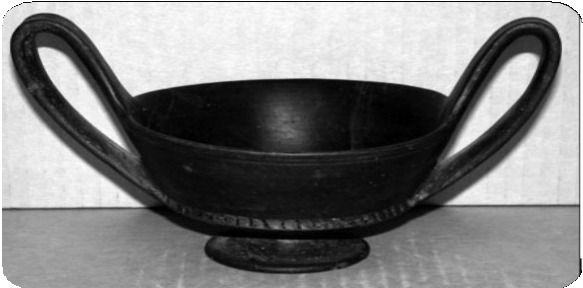
• Mauryan Pottery is also known as Northern Black Polished Ware (NBPW).
Literature
Literature & Language:
Taxila, Ujjain, and Varanasi were the centres of the educational and literary activity e.g., Kalpasutra by Bhadrabahu’s.
Sanskrit was well developed. Many texts were written in Sanskrit. Upper-class people in society used Sanskrit for communication.
Panini was a Sanskrit philologist, grammarian, and revered scholar in ancient India, variously dated between the 6th and 4th century BCE. He wrote Sanskrit grammar, ‘Ashtadhyayi’.
Pali was used in Buddhist and Jain texts. This was the language of the masses. It’s because of this, these new religions became popular.
Kautilya wrote ‘Arthashastra’. This book gave the intricate details of running an administration. It throws light on Chandragupta’s administration.
The Arthashastra (‘the science of statecraft’) by Kautilya (Chanakya or Vishnugupta) is a highly detailed and sophisticated treatise from India, often referred to as the science of material well-being or statecraft.
It summarizes the political ideas of Kautilya, an advisor to Chandragupta Maurya, often compared to Machiavelli.
This work is divided into 15 books (Adhikaranas), with the first five focusing on tantra (internal administration) and the next eight on avapa (interstate relations).
It prioritizes material well-being (Artha) over spiritual well-being (dharma) and sensual pleasures (kama).
The book covers a wide range of topics relevant to effective governance, including diplomacy, warfare, law, taxation, agriculture, and even controversial subjects like assassinations and espionage.
Kautilya summarizes the duty of a ruler, saying, “The happiness of the subjects is the happiness of the king; their welfare is his welfare.


Decline of the Mauryan Empire
Decline of the Mauryan Empire:
• Mauryan rule was the first experiment in imperial government in India. The imperial authority of the Mauryas began to weaken with the death of Ashoka (232 BCE) and finally collapsed in 180 BCE.
Major Reasons:
• Centralised Mauryan Administration with loyalty to the King could not be handled by Ashoka’s successors who changed very quickly which gave them less time to take care of administration.
• The successors were weak and inefficient, leading local powers to rise. So, the empire soon became weak and fragmented.
• Financial constraints on the Mauryan economy:
• The State took excessive measures to increase the taxes on a variety of things.
• The burden of expenditure had also increased under Ashoka for public works.
• Also, tours by Ashoka and his officials used up the surplus available.
The punch-marked coins of this period show evidence of debasement of the currency as seen in the fall in the share of silver in the coins and high inflation.
Needs to expand the agrarian economy could no longer be met by Magadha alone and the sourcing of Iron.
The expansion in cultivation, extensive use of forest wood, and deforestation led to floods and famines like big famine in north Bengal during the Mauryan period.
Invasions from the Northwest part of India by the Bactrian Greeks.
• It is suggested that unabated economic expansion invariably leads to the problem of organization and control of its resources and not a lack of them.
• The last ruler Brihadratha was killed by his commander- in-chief Pushyamitra Sunga.