Administrative System Under Guptas
Administrative System under Guptas
• Maharajadhiraja, Parama – Bhattaraka and Parmeshvara:
These were the titles of the King.
• In the Allahabad Inscription, Samudragupta was compared to Purusha (Supreme Being).
Kings were assisted by a council of ministers.
Civil and criminal laws were clearly demarcated.
Officials
• Kumaramatya: Post of high-ranking officer.
• Mantrins: Minister.
• Sandhivigrahaka: Minister of war and peace.
• Dandanayakas: Police officials.
• Mahadanadanayakas: Judicial or Military officials.
• Agraharika: Superintendent of Agrahara land.
• Baladhikrita: Military commander.
• RanaBhandagar-adhikarana: It is the office of a military storehouse.
• Dutakas: Spies.
• Ayukatakas: High ranking officers.
Administrative Units
• Administration was divided into Bhukti (administered by Uparikas). This is described in the Eran pillar inscription.
• Bhukti was divided into Visayas (administered by Vishayapati).
• Visayas were divided into Vithi, Bhumi, Pathaka and Peta.
Different Land Tenures
• Nivi Dharma: A type of land holding.
• Nivi Dharma Akasyana: A perpetual endowment.
• Aprada Dharma: This land can’t be gifted to anyone.
• Bhumichchi-Dranyaya: Making barren land to cultivable land. This was free of any rent.
• Agrahara Grants: Given to Brahmins.
• Devagrahara Grants: Land given to temples.
• Secular Grants: Grants made to feudatories.
• Units of land measurement used in production of crops.
• Smaller area measurement from smaller to larger


• Angul (size of thumb)
• Dhanu
• Vitasti Arati
• Dand
• Naal
• Patak
• Pratratvapa and
• Padaavart
• Larger land measurement: Adhavapa (3/8-1/2 acres), Dronavapa (1/2-2 acres), Kulyavapa (12-16 acres) in Adhak, Drona and Kulya quantity respectively.
• Other methods for measuring land were also in vogue, Nivartana and Bhumi in Central India, Nivartana and Padavart in Western India.
Different Kind of taxes
• Bhaga: One- sixth of the cultivator tax goes to the king.
• Bhoga: Periodic supply of fruits to the King.
• Kara: Tax on villagers.
• Bali: Oppressive tax.
• Udianga: A form of police tax.
• Uparikara: An extra tax.
• Hiranya: King’s share of certain crops paid in kind.
• Vata-Bhuta: A kind of cess.
• Halivakara: Plough tax.
• Sulka: Royal share of merchandise.
• Klipta and Upakilpta: Related to sale and purchase of land.
Introduction
Introduction:
After the decline of the Mauryan Empire, several small kingdoms rose and fell.
From c. 300 to 700 CE, a classical model of imperial rule developed, leading to the formation of states across various regions.
• Unified Empire
• The Gupta Empire rose to prominence during this time, becoming a major power and achieving political unification across much of the Indian subcontinent.
• It was characterized by a strong central government, which brought numerous kingdoms under its control.
• Economy
• Feudalism as an institution began to take root during this period.
• With an effective guild system and overseas trade, the Gupta economy boomed.
• Society at Beginning of Gupta Empire
• The upper classes enjoyed a peak in living standards, with advancements in education, art, and science. However, the feudal system of governance led to some hardships for the general populace.
• Golden Age
• The period saw the creation of significant works in Sanskrit, and it marked a high point in cultural development, particularly in fine arts sculpture, and architecture.
• While some historians consider the Gupta period a golden age, this characterization is not entirely precise.
• However, many scholars would agree that this era represented a flourishing of culture and a classical age for the arts.
Origin
• Around 300 to 700 CE, the Gupta empire emerged.
• Evidence on the origin and antecedents of the Gupta dynasty is limited.
• The Gupta kings seem to have risen from modest origins. They are thought to be feudatories of Kushanas.
• Chandragupta I, the third ruler of the Gupta dynasty, married Kumaradevi, a princess from the Lichchavi clan. This union is proudly mentioned in the records of his successors, suggesting that the royal alliance played a significant role in the rise of the Gupta dynasty. The Lichchavis were an ancient and well-established gana- sangha, with their territory situated between the Ganges and the Nepal Terai.
Geographical Spread
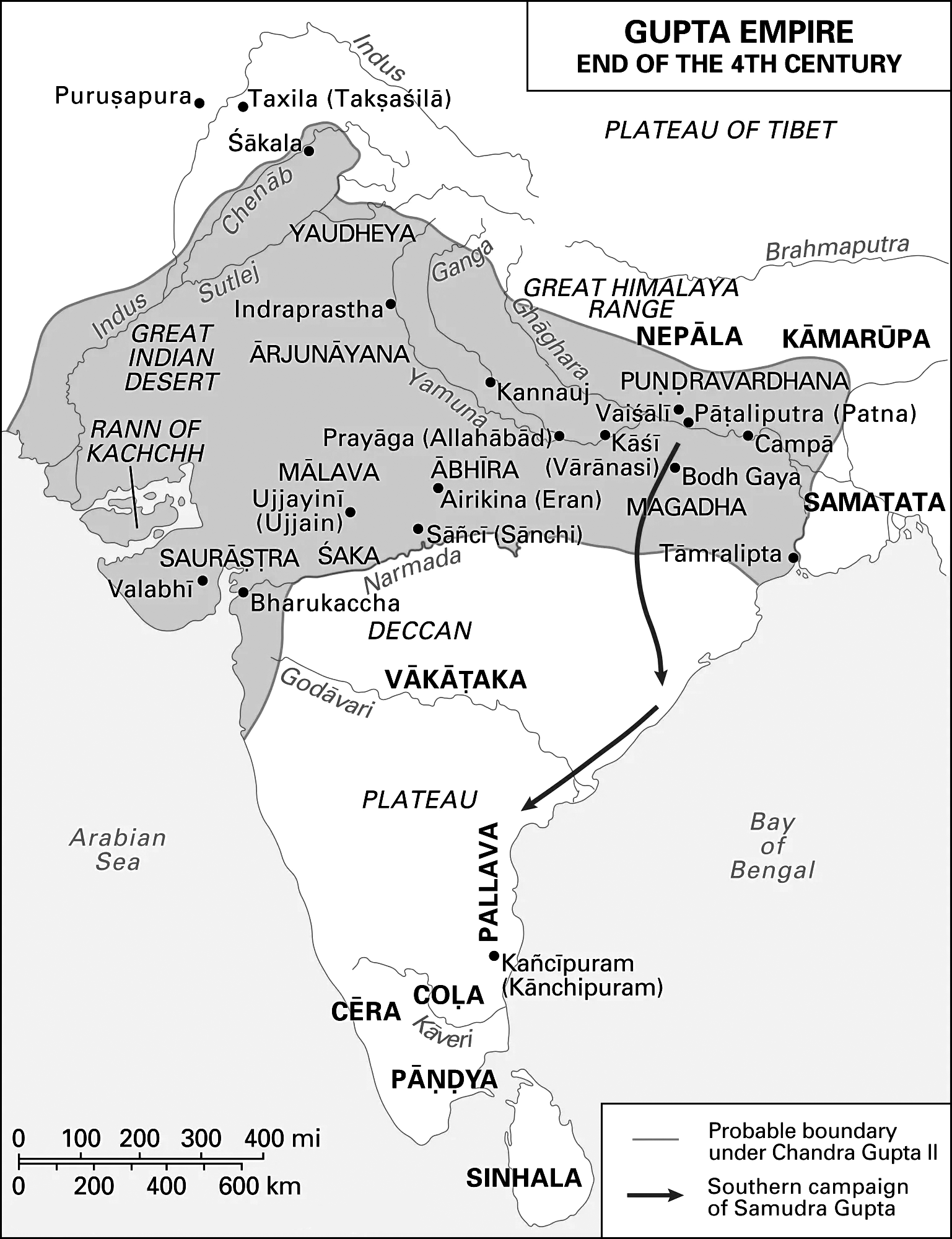
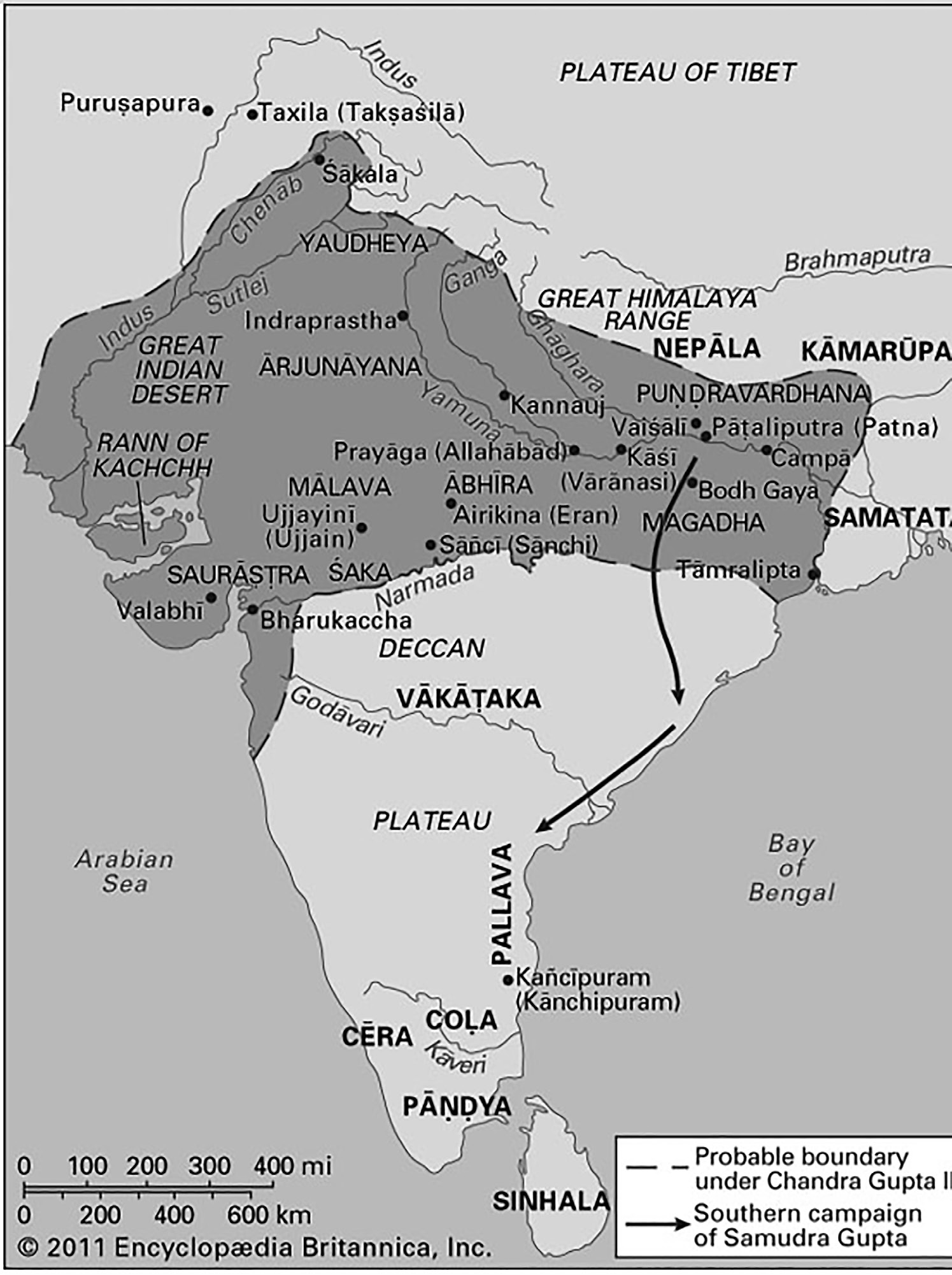
• According to Allahabad pillar inscription Samudragupta, the illustrious son of Chandragupta I, had conquered the whole fertile plains west of Prayag to Mathura and launched a spectacular raid through Kalinga into the south as far as Kanchipuram, the Pallava capital.
• The Puranas mention Magadha, Allahabad and Oudh as the Gupta dominions
Gupta Dynasty Rulers
Gupta Dynasty Rulers
| List of Gupta Emperors | |
| Shri Gupta 240 - 290 A.D. | He is mentioned as the first ruler of this dynasty in Prayag Prashasti, Vilsad and Bhitri inscriptions of Samudra Gupta, Kumar Gupta and Skand Gupta respectively. Chinese traveller I-Tsing (671-695) mentioned that Shri Gupta had built temples for Chinese travellers even 4 centuries before his visit to India. |
| Ghatotkachha Gupta 290 - 305 A.D. | He was the first ruler of this dynasty who adopted the title of Maharaja. However, both Shri Gupta and Ghatotkachha were not independent rulers yet. |
| ChandraGupta Vikramaditya I 305 - 335 A.D. | 1st important ruler of this dynasty. He was first to adopt the title Maharajadhiraj (king of kings). He strengthened his position through marriage alliances. He married Lichhavi princess Kumardevi and also circulated coins bearing the images of his queen with him. He was the first Gupta ruler who started the circulation of gold coins. He started the Gupta Era (Gupt Samvat) in 320 AD on his corondation. According to Puranas, by the end of his reign, his kingdom probably extended west to the present-day city of Prayagraj, Ayodhya and southern Bihar. |
| Samudra Gupta 335 - 370 A.D. | The real expansionist of this dynasty through war. Historian VA smith, called him Napoleon of India, because his empire extended to Malay peninsula as he possessed a strong Navy He practiced Vaishnavism; however, he gave patronage to Buddhist scholar Vasubandhu also and allowed building of a Buddhist monastery in Gaya by Meghavarman, ruler of Sri Lanka. Harisena was his court poet who gave accounts of military conquests of Samudra Gupta inscribed on the Allahabad pillar of Ashoka known as Prayag Prashasti. However, this inscription does not provide chronological order of his conquests. Samudra Gupta had conquered territories down to Kanchi, Tamil Nadu. He adopted titles like Parakramank, Apratirath, Vyaghra Parakram. He was also a great musician and was called Kaviraja. His coins potray his images as holding a bow, holding an axe, slaying a tiger and playing a veena. Some other types of coins were also obtained which display a garuda flag with an image of the king and coins with images of Ashwamedha yagya. Geographical Extent Northern lands were annexed by Gupta empire- Rajasthan paid tribute however Punjab was outside the limits of his authority. He directly controlled the Ganges valley only since Sakas dominated the west. Foreign Kings- Assam, Bengal, Sakas, Kushans and Lankans paid tribute. Forest tribal Kings of Deccan and Central India along with Southern Kings paid tribute. |
| Ram Gupta 370 - 380 A.D. | His sources of information are “Devichandraguptam” written by Vishakhdutt and Erand inscription. |
| ChandraGupta Vikramaditya II 380 - 415 A.D. | He took this dynasty to its highest glory. Growth and prosperity of India reached to highest level during his reign. He adopted the titles like - Devraj, Vikrama Devagupta, Devshri Vikramank, Param Bhagwat, Simhavikrama, Vikramaditya, Ganari, Shakari. Expansion He strengthened his position through marriage alliances and conquests. He married a Naga princess Kubernaag. He married his daughter Prabhavati to Rudrasen II, a Vakataka king. After the death of her husband, Prabhavati became the regent and through her Vikramadita II exerted his influence over the Vakataka kingdom. As a result, this gave him the opportunity to conquer Malwa and Gujarat from the Shakas who were ruling in these areas for the past 4 centuries. Vanquishing the Shakas was his greatest achievement. He adopted the title of Vikramaditya to commemorate his victory over the Shakas. He also issued silver coins with dates to celebrate this event. 5 types of coins attributed to him were obtained. These coins portray him as an archer, rider, slayer of a lion etc. Ujjain became the second capital of the Gupta empire. Defeated northern rulers like the Huns, Kambojas and Kiratas Now the Guptas had access to the seaport of Gujarat which enormously increased their economy. Had trade links with the Roman Empire. His exploits are mentioned in the iron pillar of Mehrauli, located in the Qutub Minar complex. Culture His court included many notable scholars ‘navratnas’ - Kalidas, Amarsimha, Dhanvantri, Harisen, Kshapanak, Shanku, Varahmihir, Vararuchi, Vetalbhatt. He was trained by Buddhist scholar Vasubandhu who was appointed by Samudra Gupta. Chinese traveller Fa-Hien visited India during his reign (399-414) and stated that various types of punishment were used, people did not register their households and welfare assistance was provided to weaker sections. |
| Kumar Gupta I 415 - 455 A.D. | The highest number of inscriptions of this dynasty belongs to Kumar Gupta I. Apart from inscriptions, several copper plate inscriptions were also obtained bearing his name. He adopted the title of Mahendraditya. His gold coins read him as Guptkulamal Chandra and Guptkul Vyomshashi. Huien-Tsang mentions him as Shakraditya. KumarGupta I built the Nalanda Buddhist university Several coins of gold, silver and copper attributed to him were also obtained. His gold coins had images of a peacock instead of garuda. His coins potray him as a rider, archer, riding a peacock, riding an elephant. Other images inscribed in his coin were horse of Ashvamedha Yagya with Ashwa Mahendra written on it back side. He is also shown slaying a tiger with Vyaghrabal Parakram written on the back. He is even shown slaying a rhino. Inscriptions The Garhwa inscription mentions him as Param Bhagwat. The Mandsaur inscription made by Vatsabhatti gives an account of the organized administration of Kumar Gupta I. This inscription also mentions his governor Bandhu Varman who had built a Sun temple. Bilasgarh inscription, Etah, U.P was made in Gupta Samvat 96 (416 A.D). This inscription also gives names of Gupta emperors until Kumar Gupta I. His Karmdand inscription, Faizabad, U.P is made on a statue of Lord Shiva. It was made by his minister Prithvi Sen. His Mankunwar inscription, Prayagraj, U.P is made on a statue of Lord Buddha. It was made by a Buddhist monk Buddhmitra. Other significant inscriptions of Kumar Gupt I are - Sanchi inscription, Udayagiri cave inscription, Tummain inscription (Guna, M.P). |
| Skand Gupta 455 - 467 A.D. | He was the last great emperor of this dynasty. He had fought and defeated the White Hunas (Eastern Hunas) who had invaded India from Central Asia. He had inflicted great damage to the Huns and as a result they did not invaded India for next 50 years. His victory is mentioned in a book named Chandragarbh Pariprichya. The Junagarh inscription provides for the beginning of his reign from Gupta Samvat 136 (455 A.D). This inscription also gives information about Parndutt and Chakrapalit. Parndutt was governor of Saurashtra and father of Chakrapalit. Chakrapalit was appointed as commander of a fort in Girnar. He had revived the old Sudarshan Lake that had been in existence since the times of Mauryas. Bhitri inscription (Ghazipur, U.P) mentions his triumph over attacks of the Hunas and Pushyamitras. The Pushyamitras lived on the banks of river Narmada. Patna inscription, Kahom inscription (Gorakhpur, U.P), and Garhwa inscription (Prayagraj) also provide significant information of this emperor. His gold and silver coins are inscribed with his archer image and on their opposite side goddess Lakshmi is shown sitting in Padmasan with Shri Skand Gupta written below. Some of his coins also bore images of Garuda, Nandi etc. Quality of coins declined due to wars with the Hunas. Buddhist text Aryamanjushri Mulakalpa mentioned him as a wise and righteous emperor. The mighty Gupta empire started declining after the death of Skand Gupta. |
| Kumar Gupta II 467 - 477 A.D. | He was also known as Puru Gupta and was a follower of Buddhism. His inscription was made on a Buddha statue dating to Gupta Samvat 154 (473 A.D.). |
| Buddha Gupta 477 - 496 A.D. | He was son of Kumar Gupta II as proven from his seal obtained from Nalanda. His sources of information come from inscriptions of Sarnath and Erand. His silver coins give the ending date of his reign on Gupta Samvat 175 (494 A.D.). He was the last emperor to rule an undivided Gupta empire. |
| Chandra Gupta Vikramaditya III |496 - 500 A.D. | |
| Vainya Gupta |500 - 515 A.D. |
| Narsimha Gupta 515 - 530 A.D. | He was also known as Baladitya. The Gupta empire broke into three parts during his reign - Magadh region, Malwa region and Bengal region. His greatest achievement was defeating and imprisoning Huna king Mihirakul. However, he later released Mihirakula on the advice of his mother Mahadevi Chandra. He was a follower of Buddhism and a disciple of Buddhist monk Vasubandhu. His coins display him as an archer. |
| Kumar Gupta III |530 - 540 A.D. | |
| Vishnu Gupta I | 540 - 550 A.D. |
Contemporary Dynasties of the Guptas
Contemporary Dynasties of the Guptas

| Kushans | Sindh, Sakastan (Iran, Pakistan, Afghanistan), Bactria |
| Shakas | Sindh, Sakastan (Iran, Pakistan, Afghanistan), Bactria |
| Madra | Lahore, Sialkot |
| Yaudheyas | Ludhiyana, Saharanpu |
127
Decline of the Gupta Empire
Decline of the Gupta Empire
Vishnugupta, the last recognized ruler of the Gupta
dynasty, reigned from 540 to 550 CE.
• The decline of the Gupta dynasty was caused by internal conflicts and dissensions within the royal family.
• During the reign of Gupta King Budhagupta, the Vakataka ruler Narendrasena from the western Deccan launched attacks on Malwa, Mekala, and Kosala.
• Later, another Vakataka king, Harishena, successfully captured Malwa and Gujarat from the Guptas.
• During the reign of Skanda Gupta, the grandson of Chandragupta II, the Huns invaded northwest India. Although he successfully repelled the Huns, this victory drained the empire’s financial resources. By the sixth century CE, the Huns had occupied regions like Malwa, Gujarat, Punjab, and Gandhara.
• The Hun invasion severely weakened the Gupta Empire’s control over the subcontinent, allowing independent rulers to rise across the north. Notable among them were Yasodharman of Malwa, the Maukharis of Uttar Pradesh, the Maitrakas in Saurashtra, and other regional powers in Bengal.
• Over time, the Gupta Empire was reduced to just Magadha.
• The Gupta rulers did not prioritize expanding their empire or pursuing military conquests.
• Consequently, weak leadership, combined with continuous invasions from both foreign and local forces, led to the decline of the Gupta Empire.
• By the early sixth century, the empire had fragmented, with control shifting to various regional chieftains.
Social Conditions
SOCIAL CONDITIONS:
Fedualism
• The social formation of feudalism was the characteristic of medieval society in India.
• Feudal features listed by historian R.S. Sharma are: royal grants of land; transfer of fiscal and judicial rights to the beneficiaries; the grant of their rights over peasants, artisans and merchants; an increased incidence of forced labour; appropriation of surplus by the state; a decline in trade and coinage; payment of officials through land revenue assignments; and the growth of the obligations of the samantas (subordinate or feudatory rulers).
Rigid Caste System
• During the Gupta period, the caste system became rigid. Brahmanas occupied the top ladder of society. They were getting large-scale land grants not only from the rulers but from other people also. The land was given along with administrative rights and tax exemptions.
• According to Fa Hien, ‘Chandalas’ were separated from the mainstream society and treated like untouchables.
• Devotion and meditation were preferred over sacrifice.
• Bhakti tradition was growing rapidly.
Women’s Position deteriorated during the Gupta period.
• Women were not permitted to study religious texts such as the Puranas nor own property.
• The practice of ‘Swyamvara’ was abandoned.
• Manusmriti called for early marriage of girls. Sati system appeared.
Economic Conditions
ECONOMIC CONDITIONS:
Agriculture
Agriculture flourished in this region. Crops cultivated: paddy, wheat, barley, peas, lentils, pulses, sugarcane etc.
Paharpur copper plate inscription: It described that kingis the owner of the lands.
Ustapala: Official for maintenance of Land records.
Khila: A type of waste land.
Aprahata: Jungle or waste land.
Vasti: Habitable land.
Gapata Saraha: It was pastoral land.
Amarsimha described that a canal was built, and the irrigation system was good.
Oppressive Practices
Klipta, Bali, Udranga, Uparikara, Iranyavesti: terms used to describe forced labour.
Usury: Lending of money at an exorbitant Interest rate.
Trade
Akshapataldhikrita: Official in-charge of the maintenance of royal treasury.
Sresti and Sarthavaha: Different types of traders.
‘Brihaspati Smriti’ describes the different types of guilds.
Various ports for trade: Calliena (Kalyan), Chaul port, Mabar (Malabar), Mangarouth (Mangalore), Salopatana, Nalopatana and Pandopatana on Malabar coast.
• Chief of Guilds was called Nagaseths. Guilds were formed by trading and artisan communities.
• Ujjain became a commercial centre.
• Trade was established with Rome.
• Silk, pearls, leather goods, jewellery, ivory and spices formed a major part of the trade.
| Fa-hien’s account on Mathura and Patliputra At Mathura, the people are numerous and happy; they do not have to register their household. Only those who cultivate the royal land have to pay a portion of the grain from it. Criminals are fined both lightly and heavily depending on the circumstances. In the case of repeated rebellion, their right hands are cut off. Throughout the whole country, the people do not kill any living creatures or drink any intoxicant. |


| The people of Pataliputra are wealthy and thriving, competing with one another in their acts of generosity. In the cities, Vaisya families set up homes dedicated to offering charity and medical assistance. The poor, destitute, orphans, widows, childless individuals, as well as the maimed and disabled, are given comprehensive support and care. |
Art and Cultural Contributions
ART AND CULTURAL CONTRIBUTIONS:
Golden Age of India
The “Golden Period of Indian Architecture” is typically referred to as the beginning of the Gupta Empire in the 4th century A.D.
While the older Gupta monarchs were Buddhists who preserved Buddhist architectural traditions, temple building rose to prominence under the patronage of the later Gupta rulers who were Hindus.
Similarly, during the Gupta period, Buddhist and Jain art achieved their pinnacle.
• Red ware pottery was made during this age.
Six Schools of Philosophy
• Yoga
• Propounded by Patanjali in Yogasutra.
• Belive that salvation can be achieved through
meditation and yoga asanas.
• Nyaya
• Founded by Gautama who wrote Nyaya Sutra.
• Believe that to achieve salvation, one must use the technique of logical thinking.
• Stressed on systematic reasoning and use of logical tools to verify the truth of a proposition.
• Vaishesika
• Founded by Maharishi Kanada.
• Believe that everything in the world was created by the material elements called Dravya (fire, earth, water, air, sky)
• It believes in atomic theory i.e.; all material objects are made of atoms.
• Responsible for beginning of physics in India.
• Believe that God reviews karmas and decides if a person goes to heaven or hell.
• Sankhya
• Propounded by Kapil Muni in Samkhya Sutra.
• Belive that salvation can be achieved through acquisition of knowledge.
• Believe in dualism/ dvaitavada i.e., the soul and matter are separate entities.
• Use scientific system of enquiry and stated that real knowledge can be acquired through:
• Pratyaksha: Perception
• Anumana: Inference
• Shabda: Hearing
• Vedanta
• Propounded in Brahmasutra of Badrayana.
• Believe that Brahm and atma are the reality of life and everything else is unreal or Maya. They are indestructible and eternal.
• Upholds Upanishads.
• Shankaracharya propounded Advaita Vedanta in 9th Century AD and stated that knowledge is the means to attain salvation.
• Believe in cycle of rebirth and karma.
• Mimansa
• Propounded in Sutras of Jamini and later furthered by Sabar Swami and Kumarila Bhatta.
• Believe that Vedas contain the eternal truth, and they are the repositories of all knowledge.
• To achieve salvation, one has to perform Vedic rituals. However, use of reasoning, interpretation and application is necessary to understand the meaning behind the rituals and truly achieve salvation.
Temples
• Guptas were the first dynasty to build permanent free-standing Hindu temples and so they began a long tradition of Indian temple architecture.
• The Gupta style was influenced by Kushana, Mathura, and Gandhara and borrowed the common features of T-shaped doorways, decorated door jambs, sculpted panels with high-relief figures, and laurel-wreath and acanthus motifs.
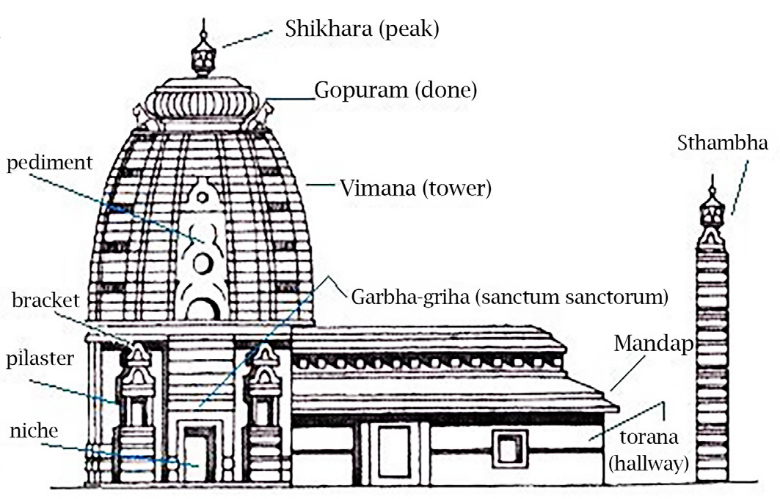
• It started with the development of a square sanctum and a pillared portico during the Gupta period. There was a gradual progression from the flat-roofed, monolithic


temples in the initial stages to the sculptured ‘shikhara’ in the later years.
• Built from sandstone, granite, and brick, temples from the Gupta period contributed to the region's architectural legacy, featuring horseshoe-shaped gavaksha arches and uniquely curved shikhara towers, often crowned with a ribbed disk ornament known as an amalaka.
• Most Gupta temples follow a square layout, with a single cubical garbhagriha at the center.
• These temples were dedicated to a wide array of Hindu gods, rather than focusing on a single deity.
Important Gupta Temples:
• The Parvati temple at Nachna Kuthara, dating to the late 5th century CE, is notable for its well-preserved second- story shrine room.
• Starting in the 6th century CE, Gupta temples began to be constructed on platforms (jagatis), with the Dashavatara temple at Deogarh in Madhya Pradesh serving as a prime example, featuring depictions from the Ramayana.
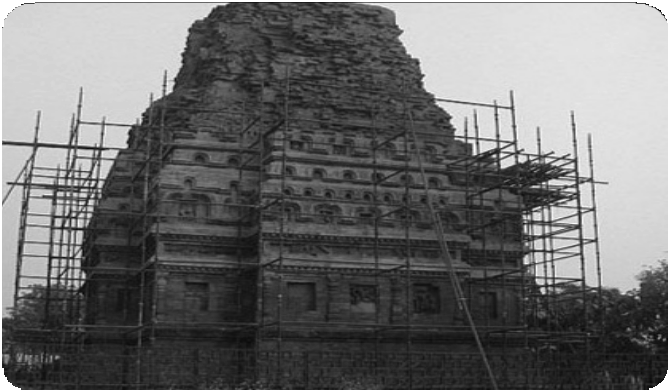
• The temple at Bhitargaon in Uttar Pradesh is one of the most intact surviving Gupta temples. It stands as a rare and early example of a Hindu temple built entirely from brick, dating to the late 5th century CE.
• Copper metal statues: Sultanganj Buddha.


Buddhist Stupas & Scupltures
Stupas were found at Samat (UP), Ratnagiri (Odisha) and Mirpur Khas (Sind). Dhamek Stupa at Sarnath near Varanasi is marked as a spot where Buddha gave his first sermon.
Sculptures: During the Gupta period, a new school of sculpture developed around Sarnath. It was characterised by the use of cream coloured sandstone and the use of metal. The sculptures of this school were immaculately dressed and lacked any form of nakedness. The halo around the head of Buddha was intricately decorated.
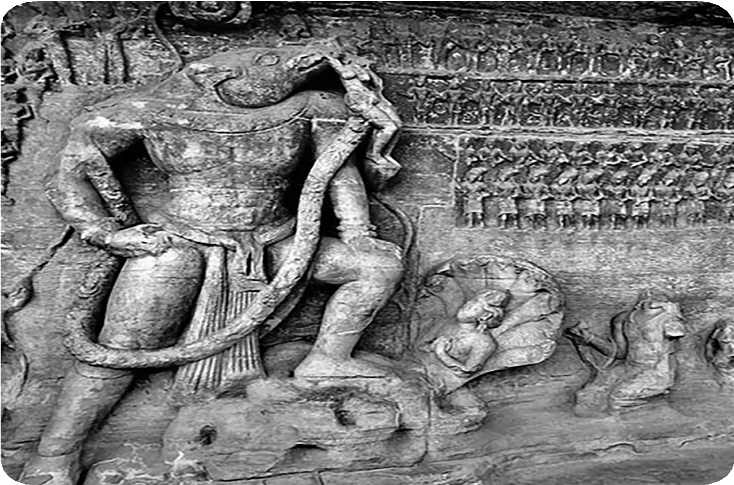
• Varaha sculpture at Udayagiri was prominent sculpture.
Rock Cut Temples
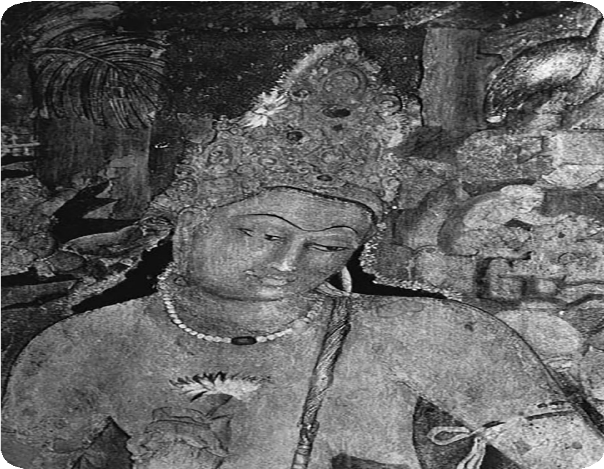
Guptas established the temples of Buddhist rock-cut at Bagh, Madhya Pradesh, and Ajanta, Maharashtra.
The Ajanta caves
• They are situated at a distance of about 100 km north of Aurangabad in Maharashtra. Totally 30 caves have been scooped out of volcanic rocks. Though chiefly famous for mural paintings, there are some sculptures too. They lie in the gorge of Waghora River.

131
• The Ajanta caves were inscribed by the Buddhist monks, under the patronage of the Vakataka kings – Harishena being a prominent one.
• Architecturally, the Ajanta caves are divided into two categories: Chaityas and Viharas. The chaityas feature vaulted ceilings and long halls, with a statue of Buddha placed at the rear end of the hall. The Buddha sculpture in the garbhagriha follows the classical style, embodying benevolence.
• The first phase of the caves dates from around 200 BCE to 200 CE, while the second phase spans from approximately 200 CE to 400 CE.
• The figures in these caves were created using the fresco painting technique, showcasing a high degree of naturalism.
• The pigments were derived from local vegetation and minerals. The outlines of the paintings were initially drawn in red, and the inner portions were filled with color. Notably, blue is absent from the paintings.
• The themes of the paintings are primarily centered on Buddhism, depicting the life of Buddha and various Jataka tales.

Ellora Caves:
These caves were developed between the 5th and 11th centuries AD, making them more recent than the Ajanta Caves. They were created by various guilds from Vidarbha, Karnataka, and Tamil Nadu, resulting in a rich diversity in both thematic elements and architectural styles.
• Caves 1–12: Buddhist
• Caves 13–29: Hindu
• Caves 30–34: Jain (Digambara sect)
The Hindu and Buddhist Caves were predominantly constructed by Rashtrakuta dynasty and Jain Caves by Yadava dynasty.
• Cave No. 10 is a Buddhist Chaitya cave known as Visvakarma Cave or Carpenter’s Cave. Buddha is seated in Dharmachakra Mudra here with the Bodhi tree carved at his back.
Bagh Caves:
Situated on the banks of the Baghni River in Madhya Pradesh, this group of nine Buddhist caves dates back to the 5th-6th centuries AD. Architecturally, they closely resemble the Ajanta caves. The most notable cave in the complex is the Rang Mahal. The paintings in the Bagh caves are more focused on material themes than spiritual ones.
Literature and Coins
LITERATURE:
Sanskrit was the official language.
• The period saw the last phase of Smriti literature.
• Smritis: Religious texts covering ethics, politics, culture and art.
• Yajnavalkyasmriti is regarded as the official lawbook of Guptas.
• Naradsmriti was also written during this time.
• ‘Mahabhashya’ by Patanjali. Ramayana also took its final shape.
• ‘Amarkosa’ by Amarsimha consists of the vocabulary of Sanskrit. It is also called the Trikanda.
• Buddhist texts on Vasubandhu.
• Kalidasa authored the following books
• ‘Malvikagnimitram’, the story of a maid falling in love with Agnimitra,
• Abhigyan Shakuntalam, the story of Dusyhanta and Shakuntala,
• ‘Vikramurvashiyam’, the love story of Puruvas and Urvashi,
• Raghuvamsa, a narration of genealogy of Ragh Vamsa,
• Kumarasambhava, is the story of Lord Karthikeya,
• Ritusamhara, is the poems on feelings and emotions of lovers during six seasons.
• Meghaduta, cloud delivers a message to his love.
• Vishakhadatta wrote ‘Mudra rakshasa’ and ‘Devichandraguptam’.
• Varahamihira wrote Panchasiddhantika, Brihat Samihta
and Brihat Jataka.
• Vararuchi wrote Prakrit Prakasha, the first grammar book on Prakrit.
• Vatsyayana wrote Kamasutra and Nyaya Sutra Bhasya.
• Bharavi wrote Kiratarjunya whichwas Shiva’s conversation with Arjuna.
• Bhatti wrote Bhattikavya.
• Magha wrote ‘Sisupalavadha’.

• Sudraka wrote ‘Mrichkatika’.
• Dandin wrote Dasakumaracharita and Kavyadarshana.
• Bhatrihari wrote Vakyapadiya and Satakatraya.
NUMISMATICS
• The prosperous state of the economy is evident from the large number of gold and silver coins. However, coins made of copper, bronze, or other alloy metals are relatively rare.
• The Gupta gold coins, known as Dinars, are remarkable examples of both numismatic and artistic excellence. Typically, these coins featured the ruling monarch on the obverse, accompanied by inscriptions, while the reverse often depicted the image of a goddess.
• Gupta coinage initially drew inspiration from the coins of the powerful Kushan Empire but quickly developed its own distinct identity, which influenced subsequent dynasties and kingdoms.
• Gupta coinage represents the peak of both metallurgy and iconography.


Samudra Gupta: He is credited to have issued only gold coins (Dinar) during his reign in seven different types (‘Lichhaviya’ type included).
• Standard types of coins: the king wearing cap, carrying a Garuda Dhvaja in his left hand. The reverse side of the coin portrays the goddess, Laxmi.
• The Archer types of coins: king holding the bow.
• Battle Axe types of coins: holding battle axe, bow, arrow and swords. His battle axe type has the legend “Kritantparashuh” on them.
• Lichchavi types of coins: King Chandragupta-I with his queen Kumaradevi of Lichchavi family, issued by Samudragupta in memory of his father.
• Kacha types of coins bear the legend “Kacha, having conquered the earth, wins heaven by the highest works”. The obverse reads “Exterminator of all the kings”.
• The tiger slayer types of coins of the king show him trampling a tiger as while shooting it with a bow. The obverse reads “Vyagraparakramah”.
•
The Lyrist types of coins and has the king playing the Veena which rests on his knees. The legend “Maharajadhiraja – Sri Samudragupta” decorates the obverse.
• Asvamedha types of coins are unique, we find a horse standing before a yupa or a sacrificial post with legend around that decorates the King as the conqueror of heaven, earth, and the oceans.
Chandragupta-II: He is known to have issued a total of eight types of gold coins (Dinars). Known through his coins as “Vikramaditya”, Chandragupta II also issued silver (Denaree) and copper (Daler) coins.
• Archer Type: Unlike his father, who issued many Standard Type coins, Chandragupta II produced a large number of Archer Type coins. These coins bear the legend "Deva Sri Maharajadhiraja Sri Chandraguptah."
• Couch Type: The rarest of Chandragupta II’s coins, only two varieties are known, both of which differ in several details. These coins carry the legends "Roopkrti" and "Vikrama."
• Chhatra Type: This type features the image of an attendant holding a royal parasol over Chandragupta II.
• Lion Slayer Type: Depicting the king standing and shooting a lion with a bow, this coin carries the legend "Simhavikrama."
• Horse Man Type: Introduced by Chandragupta II, this coin shows the king riding a horse.
• Standard Type: These coins are similar in design to those of Chandragupta.
• Chakarvikrama Type: An extremely rare variety, this coin features a wheel (Chakra) on the obverse and the legend "Chakravikramah."
• Kalasha Type: Depicting a Kalasha (water pot), this type adds to the diversity of Chandragupta II’s coinage.
Kumaragupta-I: Kumaragupta-I, often inscribed on coins as “Mahendraditya”, issued 14 different types of gold (Dinar) and silver (Denaree) coins. The financial crunch led Kumaragupta to issue silver-plated copper coins (Daler).
• Archer type, Swordsman Type, Ashvamedha Type, Horseman Type, Lion Slayer, Tiger Slayer, Peacock or the Kartikeya type, Pratapa Type, Elephant Rider Type, and Ashavamedha Type.
Decline of Gupta Coin Art
• The Gupta period, once renowned for its creativity in art, literature, and architecture, began to decline during the reign of Skandagupta. This decline was triggered by invasions from the Pushyamitras and the Hunas, along with internal upheavals, which significantly weakened the empire’s imperial authority.
• The financial strain caused by continuous warfare drained the royal treasury and had a detrimental impact

133
on the empire's trade and commerce.
• The Gupta gold coins now began to lose their lustre.
• They were increasingly struck in base metals with
very little gold or silver content.
• Furthermore, the plethora of artistic coin designs of the earlier kings soon was reduced to a standard Archer Type coin of the later rulers.
• The calligraphy of the legend and the execution of the coin design suffered too.
• There was also a general paucity of coinage caused by the declining internal trade and weakening of a powerful centre.
• The newly emerging independent and self-sufficient local units or ‘Shrenis’ too contributed to a sharp decline in the number and purity of later Gupta coins.
• Interestingly, the post-Gupta coins too became monotonous with slight or no creative changes at all. For instance, Rajputs, Sultanate, Mughals focused more on the functional aspect of coins.

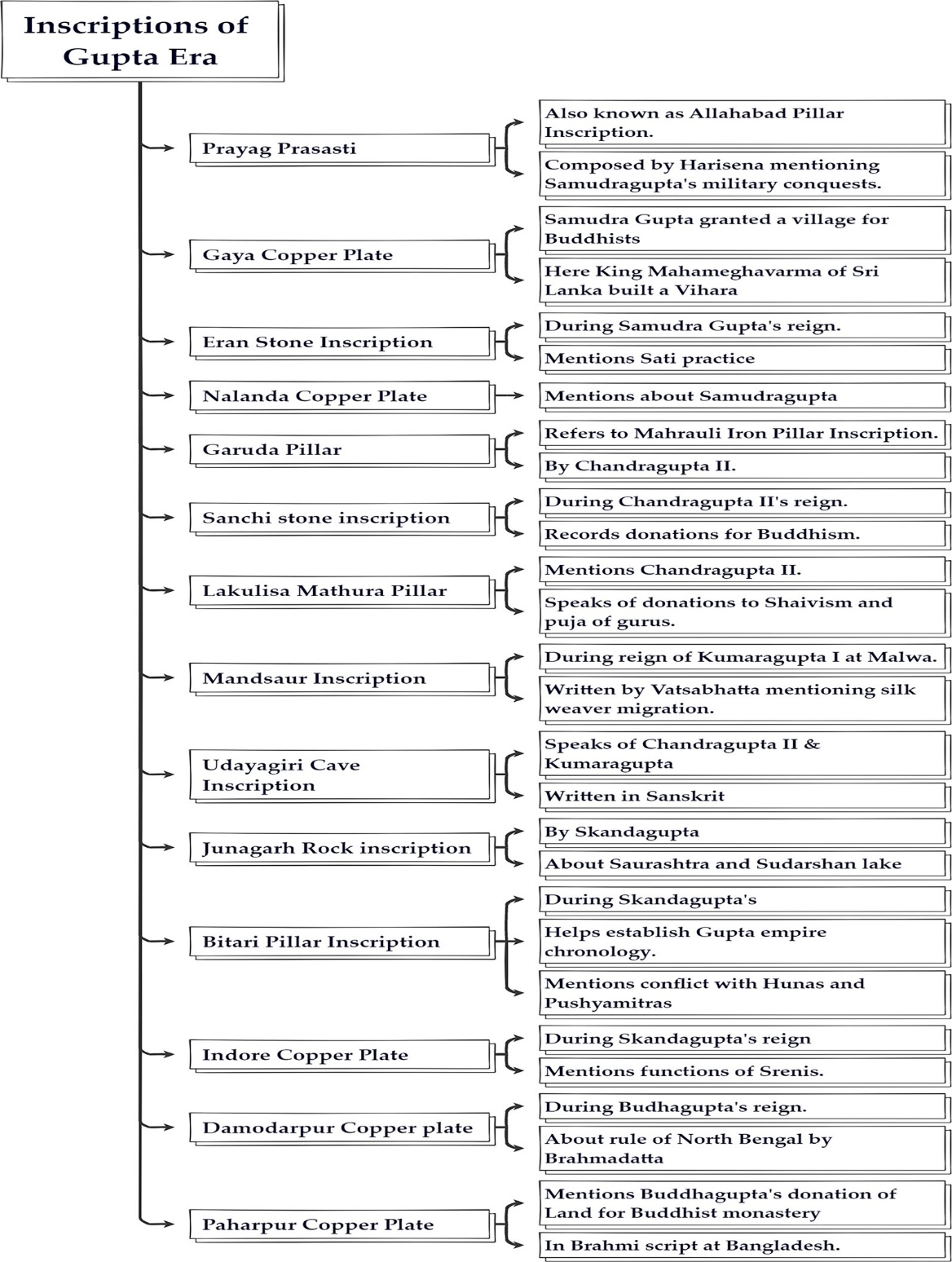
Inscriptions of Gupta Era
Inscriptions of Gupta Era

Navratnas of Chandragupta Ii
Navratnas of Chandragupta II
Amarsimha: Amarsimha was a Sanskrit lexicographer and a poet and his Amarkosha is a vocabulary of Sanskrit roots, homonyms and synonyms. It is also called Trikanda as it has 3 parts viz. Kanda 1, Kanda 2 and Kanda 3. It has 10 thousand words in it.
Dhanvantri was a great Physician.
Harisena: Harisena is known to have composed the Prayag Prasasti Kavya or Allahabad Pillar Inscription. The title of this inscription of Kavya, but it has both prose and verse. Harisena describes Chandragupta as Noble and asks him “You protect all this earth”.
Kalidasa: Kalidasa is the immortal poet and playwright of India and a peerless genius whose works became famous worldwide in modern world ranking among the top poets of all times.
Dramas: Abhijnanasakuntalam (“The Recognition of Shakuntala”), Vikramorvasiyam (“Urvashi Won by Valour”) and Malavikagnimitram (“Love story of Malavika and Agnimitra”).
Epic poems: Raghuvansam (“Dynasty of Raghu”),
Kumarasambhavam (“Birth of the War God”).
Short poems: Meghadutam (“Cloud the Messenger”) and Rtusamharam (“The cycle of the seasons”).
Kahapanaka was an astrologer.
Sanku was in the field of architecture.
Varahamihira (died 587) lived in Ujjain, and he wrote three important books namely Panchasiddhantika, Brihat Samhita, and Brihat Jataka.
The Panchasiddhantaka is a summary of five early astronomical systems, including the Surya Siddhanta. Another system he describes, the Paitamaha Siddhanta, shares many similarities with the ancient Vedanga Jyotisha of Sage Lagadha.
Brihat Samhita is a comprehensive compilation covering a wide range of topics, offering fascinating insights into the beliefs of that era.
Brihat Jataka is an astrology text that seems to be heavily influenced by Greek astrology.
Vararuchi was a grammarian and Sanskrit scholar. Some historians have identified him with Katyayana. Vararuchi is said to be the author of Prakrit Prakasha, which is first Grammar of Prakrit Language.
Vetalbhatta was a magician.
Mathematics Astronomy and Medical Sciences
Mathematics, Astronomy and Medical Sciences:
Aryabhata wrote ‘Surya Siddhanta’ and ‘Aryabhattiyam’.
He also calculated the value of Pi, length of the solar system, and problems in trigonometry.
He developed the Chakra yantra, Gola yantra and shadow devices
Varahmihira wrote ‘Brihat Samhita’, ‘Panch Siddhantika’
(the five treatises on Astronomy) and ‘Brihat Jataka’.
•
Brahmagupta wrote ‘Brhamasaputa Siddhanta’ and ‘Khandakhadhyaka’.
• ‘Navanitakam’ was a medical work.
• Palakapya wrote ‘Hastyayurveda’ which is a work on veterinary sciences.
Nalanda University:
• Kumar Gupta, I founded this university.
• Nalanda enjoyed royal patronage under various dynasties including the Guptas and the Palas.
• Nalanda University was considered as a university in the modern sense, unlike Takshashila University, because:
• Nalanda boasted nearly all the infrastructure we associate with a modern university today, including multiple classrooms, an extensive library, dormitories for students, and accommodation for professors.
• The university had eight separate compounds, 10 temples, meditation halls, classrooms, lakes, and parks. Its nine-story library housed a vast collection of books, and monks carefully copied documents so that individual scholars could build their own collections.
• At its peak, according to Fa-Hein, Nalanda University, one of the world’s earliest residential universities, was home to 10,000 students and 2,000 teachers. Hiuen Tsang also provides a detailed description of the university.
• Nalanda operated under a centralized system of education, with a structured syllabus, regular examinations, and the awarding of degrees to its students.
• Nalanda University attracted pupils and scholars from Korea, Japan, China, Tibet, Indonesia, Persia and Turkey.
• The famous Chinese pilgrims Hieun Tsang, Fi Hien and I’Tsing spend time studying at the university. Hieun Tsang had been a teacher too, in this university and received the Indian title ‘Mokshadeva’. He stayed at this place for more than twelve years and wrote in detail about this university.
Shilabhadra was an expert on ‘Yogacara’ teachings and was the personal tutor of Xuanzang. Shilabhadra lived for over a hundred years and is believed to be the only one to study all the major collections of ‘Sutras’ and ‘Shastras’ at Nalanda.
• Another revered scholar of Nalanda is Nagarjuna, a Mahayana Buddhist philosopher, who studied in the Nalanda University and formaliser of the concept of ‘Shunyata’ or ‘Emptiness’ and founded the Madhyamaka School of Mahayana Buddhism.
• Many of the texts composed at Nalanda played an important role in the development of Mahayana and Vajrayana Buddhism including the Mahavairocana Tantra and the Bodhisattvacaryavatara of Shantideva.


135


• Aryabhata is believed to have been the head of the Nalanda University and is also known to have set up an astronomical observatory for his work.
• Bakhtiyar Khilji of Mamluk dynasty destroyed it in 1200 CE.
• It is a UNESCO world heritage site