Social Conditions
Social Conditions:
It also mentions the varna society and social hierarchy between Arashar (Kings), Brahmanas (Priests who performed yagna before wars), Vaishiyars (traders) and Velalars (farmers who even held civil and military posts)
Agam poems as part of Sangam literature celebrated love
Puram part is the war poems and celebrating war heroes and indicates war ethics and morals.
The poems beautifully combine idealism with realism.
It also talks about secular matters like indigenous industries, government, charity, trade, war etc
It also talks about belief in magical forces (called ananku) sacred rites and rituals and worshipping sacrificial fire in Manimekalai, which is written by Sattanar.
Priests, poets and bards (Panar): respected by society and patronized by the ruling elite.
Women were allowed to choose their partners. Love marriage was common. However, widows' life's were miserable.
Sati practice was also prevalent in the upper caste.
Tribal customs, totem worship was prevalent. People wore amulets to ward off evil, bring rain and luck.
Earliest Kingdoms in Southern India
Earliest Kingdoms in Southern India:
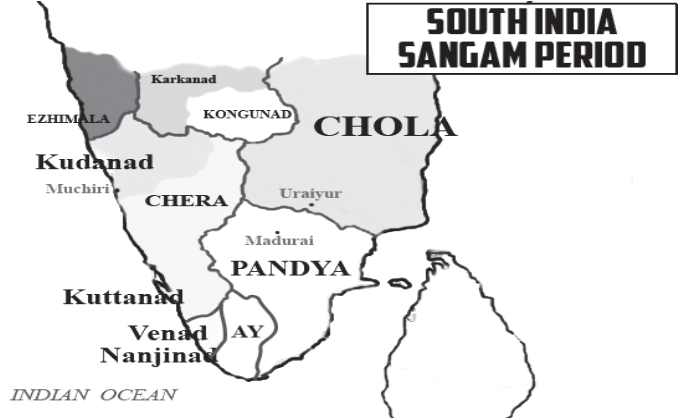
During the Sangam Age (300 BC to 300 A.D.), the southern part of the Indian peninsula, located south of the Krishna River called Tamilakam was divided among three major kingdoms namely:
the Pandyas in the Tamrapani and Vaigai valleys (present day Tamil Nadu and some parts of Sri Lanka),
the Cholas in the lower Krishna valley (present day Tamil Nadu and Andhra Pradesh), and
the Cheras along the Kerala coast.
These kings called Vendar (Crowned Kings), had distinct royal symbols like special umbrellas, drums, and staffs.
Additionally, they had several subordinate chieftains called Velirs (Chieftains), who regularly paid tribute to the kings.
These rulers and chieftains often formed alliances and engaged in conflicts with each other.
Internal strife was common during this period, providing ample inspiration for Sangam poets to compose poems about warfare.
Sources
• Ashoka, in his inscriptions, refers to Cholas, Cheras,
Pandyas and Satyaputras as peoples of South India.
Pandyas
Pandyas
Pandyas were one of the dynasties that ruled the southern part of India, though intermittently, until the pre-modern times.
Their flag bears a fish symbol.

• Capital: Korkai, a town historically known for its pearl fisheries, is believed to have been the early capital and port of the Pandyas. Later, Madurai became the capital.
• Numerous early Tamil inscriptions of the Pandyas have been found in and around Madurai. In these inscriptions, Madurai is referred to as Matirai, while Tamil classics call the city Kudal, meaning "assemblage."
• A recently discovered Tamil inscription from Puliman Kompai, a village in Pandya territory, also mentions Kudal.
• Both Pattinappalai and Maduraikkanchi refer to Koodal as the capital city of the Pandyas.
• Sources:
• It finds mention in Ettuthogai (Eight Anthologies) also.
• Travelers like Megasthenes, Marco Polo, Wassef and
Ibn-Battuta have mentioned Pandyas.
• Megasthenes said that Pandyas rule was famous for pearls.
• Sangam Literature was compiled during this era.


• The famous story of Silppadikaram took place during the reign of Nedunjeliyan.
• Trade: Pandyas had trade relations with the Roman empire during the reign of Augustus.
• The early Pandya rulers were Nediyon, Palshalai Mudukudumi and Nedunjeliyan.
• Sadayivarman Sundarapandyan was an illustrious ruler of Pandyan kingdom. He brought all the Tamil Nadu within his kingdom.
• Maravarman Kulashekran was another important ruler.
• Battle of Talayilanganam: Here Chola’s defeated Pandyas and took Chera king as the prisoner.
• After the disappearance of Kalabhras, Pandya’s revival
happened around 600 - 920 A.D.
• The third revival of Pandya’s happened when Chola power became weakened around 1190 - 1310 A.D.
Pandya Dynasty during Sangam Age (Early Pandya Dynasty):
The Pandyas established their supremacy in South Tamil Nadu by the end of the 600 A.D.

Sources of Pandya Dynasty
• The history of the Pandyas during the Sangam period, from around 300 BC to 300 AD, has been reconstructed through various sources, including megalithic burials, Tamil Brahmi inscriptions, and the Tamil poems of Sangam literature.
• Copper plates provide valuable information about royal decrees, genealogies of the kings, their victories over enemies, and the endowments and donations they made to temples and Brahmins.
• The Velvikkudi grant of Nedunjadayan is considered one of the most important among these.
• Rock inscriptions offer insights into the authors of rock- cut cave temples, as well as details about irrigation tanks and canals.
• Accounts from travelers such as Marco Polo, Wassaf, and Ibn Battuta shed light on the political and socio- cultural developments of this period.
•
Madurai Tala Varalaru, Pandik Kovai and Madurai Tiruppanimalai provide information about the Pandyas of Madurai of later period.
Territorial Extent:
• The region ruled by the Pandyas was known as Pandymandalam, Thenmandalam, or Pandynadu. It was characterized by rocky, hilly terrains and mountain ranges, with the exception of the areas nourished by the Vaigai and Tamiraparni rivers. The Vellar River, flowing through the Pudukkottai region, marked the northern boundary of the Pandya territory, while the Indian Ocean served as its southern border.
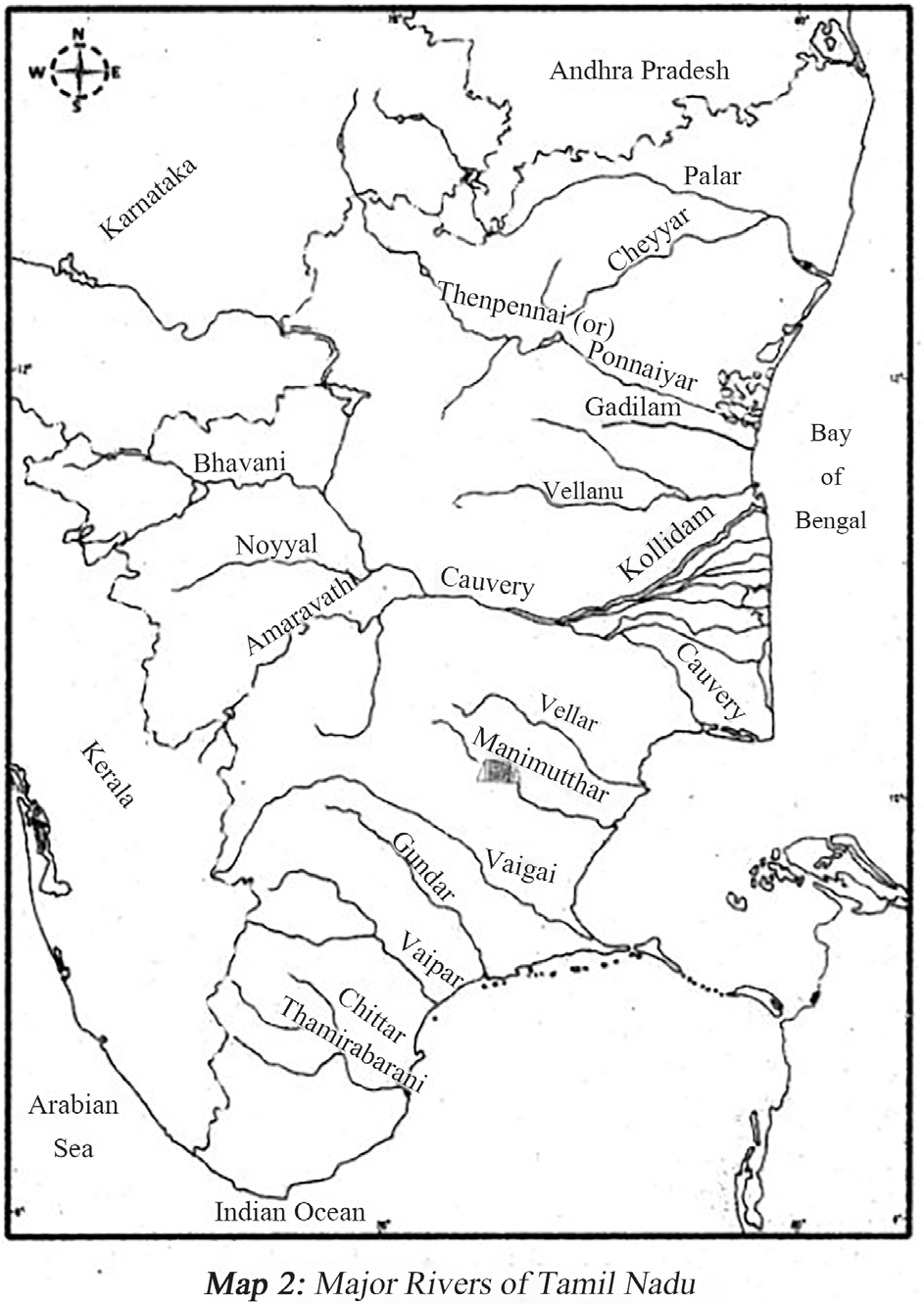
• The Western Ghats remained the border of the west while the Bay of Bengal formed the eastern border.
• Korkai: A famous fishing town in Pandyan kingdom.
• Madurai: the capital was established on the Banks of river Vaigai
• Meenakshi temple was built here.
Sangam Literature
Sangam Literature
• Sangam literally means congregation. It is an assemblage of poets. It happened during Pandya’s reign between 300 BC and 300 AD and mostly composed between 100 CE and 250 CE.
Three Sangams
• It concluded under the royal patronage of Pandya kings.
First Sangam: It happened in Madurai. All the work was destroyed in an arson.

149
Second Sangam: It happened in Kapatpuram. Only a single work ‘Tolkappiyam’ written by Tolkappiar, which deals with grammar and poetics, has survived.
Third Sangam: It happened in Madurai. All the known Tamil classics belong to the third Sangam. It is classified as anthologies and epics. Of the anthologies, the three are important (i) ‘Pattupattu’ (ii) ‘Ettutogoi’ (eight collections), and (iii) ‘Padinenkikanakku’ (eighteen minor didactic poems).
• Ettuthogai and Pathupattu collections have about 2400 poems. These poems, varying in length from 3 to 800 lines, were composed by Panar, the wandering bards and Pulavar, the poets.
• The Eight Anthologies are 1. Natrinai; 2. Kurunthogai; Aingurunuru; 4. Patitruppathu; 5. Paripadal; 6.Kalithogai; 7. Akananuru; 8. Purananuru
Pathupattu (ten long songs): 1. Thirumurugatrupatai;
2. Porunaratrupatai;3. Sirupanatruppatai;
4. Perumpanatruppatai; 5. Mullaipattu; 6. Maduraikanchi; 7. Nedunalvadai; 8. Kurinjipattu; 9. Pattinappalai; 10. Malaipadukadam.
• Silppadikaram and Manimekalai are the two important epics useful for insights into cultural and religious history.
• Vattakirutal is a practice mentioned in Sangam poems which was a Tamil ritual of fasting till death
• Female Poets: Of the over 450 poets, about 30 poets are women. They composed more than 150 poems. The most prominent are Kaakkaipadiniyar, Kavarpendu, Kavarpendu, Nalveliyaar, Okkur Masaathiyar and Parimakalir.
• The Five Great Epics are-
• Civaka Cintamani, Cilappatikaram, and Valayapathi were written by Tamil Jains.
• Manimekalai and Kuntalakeci were authored by Buddhist
Sangam literature mentions
• It talks about Chera, Chola and Pandya kingdoms of the time.
• All three kingdoms wanted to subjugate lesser chieftains, hence war, raid and plunder were frequent leading to destruction of resources and manpower.
• It talks about Jains, Buddhists, Brahmins missionaries as well.
Post Sangam Literature
Patinen Kilkanakku texts, which are post-Sangam works, include eighteen texts, which mostly deal with ethics and moral codes. The most important of them are Thirukkural, and Naladiyar
Economic Conditions of Pandya Empire Described in Sangam Texts
Economic Conditions of Pandya Empire described in Sangam Texts
• There were five economic zones (Tinai), each supporting a different economic activity (hills, drylands, jungle, plains and coast).
• No Regular Taxation: While the kings received income from trade, tributes and plunder, but regular system of taxation was not seen.
• Trade: It tells us about the brisk Indo Roman trade. It tells us we used to import gold, wine, pottery, slaves and export spices, textiles, silk.
• Traders were prosperous- dealt with salt, corn, textile and gold.
• It tells us of the important ports of the age - Muchiri, Arikamedu, important city - Kanchivaram, important economic activities - textile making, agriculture, etc.
Economic activities included Barley), hunting, gathering, (cattle raids mentioned).
Agriculture (Rice and fishing and pastoralism
Tools were mainly used for hunting and raids. But crafting specialization was rudimentary, only serving as a secondary source of income.


Women actively involved in planting, weeding, husking and winnowing of paddy. Spinning, weaving, basket making, garland making and flower selling were among other occupations pursued by women.
The material culture like farming of land, etc. was mentioned.
It tells us that economic decline had set in by the end of 3rd century as the poets don’t praise the then kings highly.
Limitations of Sangam Literature
Limitations of Sangam Literature
Since poets were patronized by ruling elites there are exaggerations about the victories, territorial influence. Even a cattle raid on village would be narrated as a war.
More focus on Hero-worship rather than how they shaped power balance and foreign relation with other states.
Some of the names, titles, dynasties, territories, wars and like mentioned these poems are imaginary.
No archeological evidence to corroborate certain settlements mentioned in Sangam Poems. e.g. Kaveripattanam.
Many of these poems are erotic / romantic in nature.
Much of the work is still untranslated. Thorough study yet to be done.
Age of Kalabhras
Age of Kalabhras - Post Sangam Age
The Kalabhras are called evil rulers who overthrew innumerable kings and established their hold on the Tami land. They put an end to the Brhamadeyas rights granted te the brahmanas in numerous villages.
Second and Third Pandya Age
Second Pandya Age (600-920 A.D.) The First Revival
Early Medieval Pandya Dynasty:
• Kadungon (590-620 A.D)
• Avani Sullamani (620-645 A.D)
• Jayant Varman (645-670 A.D)
• Ari Kesari (670-700 A.D)
• Kochhaddiyan (700-730 A.D)
• Raj Simha I (735-765 A.D)
• Jatil Prantak (765-815 A.D)
• Maravarman Rajsimha II (815-817 A.D)
• Vara Guna I (817-835 A.D)
• Sri Vallabha (835-862 A.D)
• Vara Guna II (862-885 A.D)
• Prantak Veer Narayanan (885-905 A.D)
• Maravarman Rajasimha II (905-920 A.D)
The revival of the Pandyas seems to have taken place after the disappearance of the Kalabhras.
Kadunkon, who recovered Pandya territory from the Kalabhras according to copper plates, was succeeded by two others.
Of them, Sendan possessed warlike qualities and his title Vanavan is suggestive of his conquest of Cheras.
The next one, Arikesari Maravarman (624-674 A.D.), an illustrious early Pandya, ascended the throne in 642 A.D., according to a Vaigai riverbed inscription.
➤ He was a contemporary of Mahendravarman I and Narsimahvarman I. Inscriptions and copper plates. praise his victory over his counterparts such as Cheras, Cholas, Pallavas and Sinhalese.
➤ Arikesari is identified with Kun Pandian, the persecutor of Jains.
Rajasimha II was the last Pandyan king who was defeated by Parantaka Chola I.
Third Pandyan Rule | Second Revival of the Pandyas (1190-1310 A.D.):
Later Medieval Pandya Dynasty:
• Under Chola Domination (920-1216 A.D)
• Parakram Pandyan II (1212-1216 A.D)
• Sundar Pandyan I (1216-1238 A.D)
• Kula Shekharan II (1238-1240 A.D)
• Sundar Pandyan II (1240-1251 A.D)
• Jata Varman (1251-1268 A.D)
• Maravarman Kulashekhran Pandyan I (1268-1310 A.D)
• Sundar Pandyan IV (1310-1327 A.D)
In 1190, Sadayavarman Srivallabhan, at the behest of Kulotunga I, started ruling the Pandya territory. He was anointed in Madurai with sceptre and throne. To commemorate his coronation, he converted a peasant settlement Sundaracholapuram as Sundarachol Chaturvedimangalam, a tax exempted village for Brahmins.
In the wake of the power vacuum in Chola state in the last quarter of 12th century after the demise of Adhi Rajendra, Chola viceroyalty became weak in the Pandyan kingdom.
Jata Varman Kulasekaran I captured Madurai from Cholas, however, was defeated.
Administrative Structure
Administrative Structure:
An inscription from Manur (Tirunelveli district), dating to 800, provides an account of village administration. It looks similar to Chola’s local governance, which included village assemblies and committees. Both civil and military powers were vested in the same person. The Pandya kings of the period supported and promoted Tamil and Sanskrit.
A centralised system was in place. King has most of the powers. Most administrative posts were filled with hereditary positions. However, many of them were also filled with merit too.
Kings, seated on a royal couch, exercised their power. The naming of couches after the local chiefs attests to the legitimacy of overlordship of the kings. The prominent names of such couches are Munaiya Daraiyan, Pandiya Daraiyan and Kalinkat Traiyan.
• Kudalkon: It is the title for King,
• Tirumaligai: Royal palaces,
• Tirumantira Olai: Royal scribes,
• Uttarmantri: Prime minister,
• Kulaciraiyar: Minister,
• Eluttu Mandapam: Royal secretariat,
• Akaparrivara Mudalikal: Personal attendants of the kings,
• Maran Eyinan: High Officials.
Political Divisions:
• State was divided into
• Nadu
• Valnadus
• Kurrams
• Magalam
• Nagaram
• Urs
• Kulakkil: Area under irrigation tank.
• Salabogam land: Assigned to Brahmans.
Economy in the Second and Third Pandyan Phase
Economy in the Second and Third Pandyan Phase
Trade was well developed. In the inscriptions, the traders are referred to as Nikamattor, Nanadesi, Ticai-ayiratu- ainutruvar, Ainutruvar, Manikiramattar and Patinen- vishyattar.
They founded the trade guilds in Kodumpalur and Periyakulam.
The goods traded were spices, pearls, precious stones, horses, elephants and birds. In the thirteenth and fourteenth centuries, the horse trade was brisk.
• Marco Polo and Wassaff state that the kings invested in horses as there was a need for horses for ceremonial purposes and for fighting wars.
• Those who were trading in horses were called Kudirai- chetti. They were active in maritime trade also.
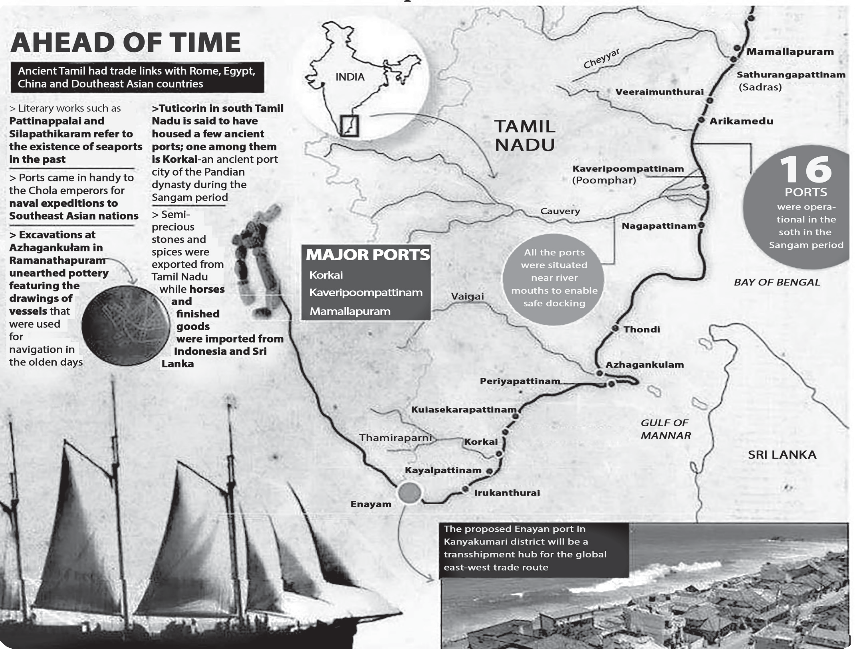
• In the Andhra region, Kadura and Ghantasala, Kaveripattanam (Puhar also known as Poompuhar) and Tondail were the ports of the Pandya region. Kayal was a famous port.
• The busiest port town under the Pandyas was Kayalpattinam (now in Thoothukudi district) on the east coast.
• The Ports of the East coast:
• Ghantasala - Andhra Pradesh
• Tamralipti - Odisha
• Arikamedu - Puducherry
• The Ports of the West coast:
• Bharuch - Gujarat
• Kalyan - Maharashtra
• Sopara - Maharashtra
• Cambay – Gujarat
• Gold coins were commonly used in trade, which was primarily conducted through gold as the medium of exchange.
• Gold was referred to by various names such as kasu, palankasu, anradunarpalankasu, kanam, kalancu, and pon. The patron gods of traders were Ayirattu Aynurruvaar Udaiyar and Sokka Nayaki Amman. The
periodic fairs held for trading were called Tavalamin,
and the settlements where traders resided were known as Teru.
• Irrigation tanks were named Tirumaleri, Maraneri, Kaliyaneri, and Kadaneri.
• The title Irruppaikkuti-Kilavan referred to a local chief who oversaw the irrigation tanks.
• Busy coastal trading centers such as Cintamani, Mylapore, Tiruvotriyur, Tiruvadanai, and Mahabalipuram are mentioned in inscriptions.


Religion
Religion:
The great Saiva and Vaishnava saints played a significant role in the development of Tamil literature during this period, which was also marked by intense religious conflicts.
The emergence of the Bhakti movement led to debates with heterodox scholars, with numerous accounts in Bhakti literature describing the defeat of Buddhism and Jainism in these discussions.
While the Pandyas were initially followers of Jainism, they later embraced Shaivism.
• Jain sculptures have been discovered in Kalugumalai.

Architecture Coins and Society
Architecture
• Pandyas built different models of temples. They are:
• sepulchral temples (e.g. Sundarapandisvaram),
• rock-cut cave temples in Anaimalai along with
Sittanvasal caves, and
• structural temples.
• Vimana, mandapa and shikhara were built in early temples.
• The development of Vimanas also progressed during this period.
• Gopurams gained greater significance than Shikharas.
• The Meenakshi Temple in Madurai and the Nellaiappa Temple were constructed.
• The Medieval Pandyas and later Pandyas did not build new temples but focused on maintaining and expanding existing ones, adding gopurams, mandapas, and circumambulatory paths.
Rock Cut Cave Temples
• The early Pandyas are known for their prominent rock- cut cave temples, which can be found in locations such as Pillayarpatti, Tirumeyyam, Kuntrakkudi, Tiruchendur, Kalugumalai, Kanyakumari, and Sittannavasal.
• A 9th-century inscription from the Sittannavasal cave temple reveals that it was created by Ilam Kautamar, while another inscription from the same period mentions that Sri Maran Srivallaban renovated the temple.
• The fresco paintings adorning the walls, ceilings, and pillars of the Sittannavasal Temple are remarkable examples of art. These paintings feature depictions of dancing girls, a king and queen, as well as scenes of a water pool with aquatic creatures, flowers, birds, and mammals.
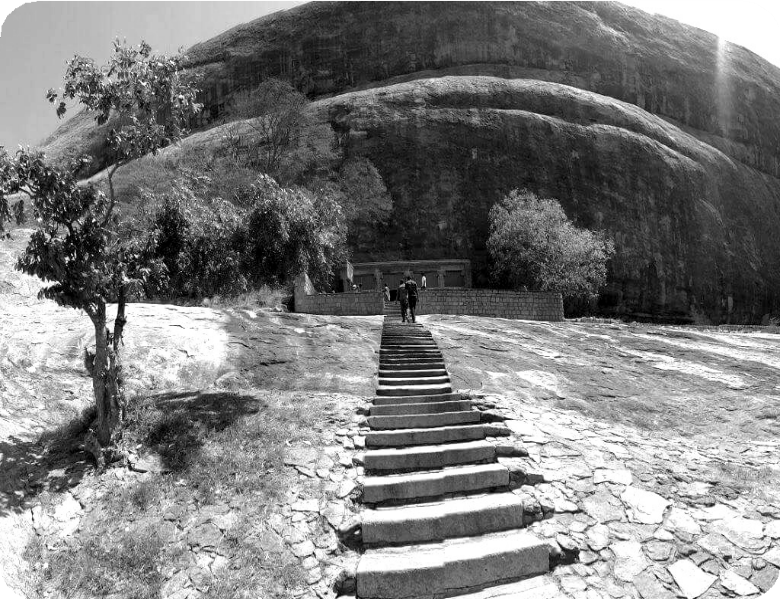
Sittannavasal Rock cut Jain Temple
Pandyan Coins
• Issued silver punch marked (in Sanskrit mostly) and die struck copper (in Tamil) coins.
• They bear the legend of different Pandyan rulers along with image of fish, bow, conch, etc.
• Coins were basically square.
Society:
Kings and local chiefs established Brahmin settlements known as Mangalam or Chaturvedimangalam, which were equipped with irrigation facilities.
These settlements were often named after royal figures or deities. Prominent Brahmins in these areas were bestowed with honorific titles such as Brahmmadhi Rajan and Brahmmaraiyan
Satyaputras
Satyaputras
Satyaputra was a small kingdom located in the eastern valley of the Malaya Mountains, part of the Western Ghats (Anamala, Palani, and Nilgiri) in Tamil Nadu.
• The Satyaputras governed regions of the Kongu country and were bordered by the Cheras to the west and the Pandyas and Cholas to the east.
• Sources: They are referenced in the Puranas, ancient Tamil texts, and Sangam literature, as well as in the Edicts of Ashoka.
• The Gummireddipura plates clearly indicate that Satyaputra is none other than the renowned Adigaman dynasty.
Cheras
Cheras
The Cheras governed regions of present-day Kerala.
Their capital was Vanji, with significant seaports at Tondi and Musiri.
Positioned to the west and north of the Pandyas, the Chera kingdom thrived through trade with the Romans.
Chera history is marked by frequent conflicts with the Cholas and the Pandyas.
The Pugalur inscription from the first century A.D. references three generations of Chera rulers.
The Padirruppattu also sheds light on the reigns of the Chera kings.
• Notable rulers of the Chera dynasty include Perum Sorru Udhiyan Cheralathan, Imayavaramban Nedum Cheralathan, and Cheran Senguttuvan.
• Cheran Senguttuvan belonged to 2nd century A.D.
• Among his military achievements, his expedition to the Himalayas was remarkable.
• He defeated many north Indian monarchs.
• Senguttuvan introduced the Pattini cult or the worship of Kannagi as the ideal wife in Tamil Nadu.

