Schools of Buddhism and Bodhisattva
SCHOOLS OF BUDDHISM
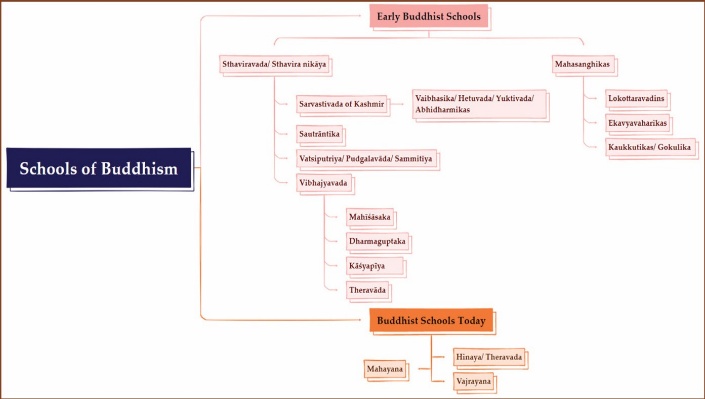
The early Buddhist schools are those schools into which the Buddhist monastic saṅgha split early in the history of Buddhism. The divisions were originally due to differences in Vinaya (monastic discipline) and later also due to doctrinal differences and geographical separation of groups of monks.
Mahasanghikas
From Sanskrit mahāsaṅgha meaning “great order of monks”, was an early Buddhist school formed during the second Buddhist Council of 383CE when it separated from Sthaviravada. The deification of Buddha by Mahasanghikas fostered the Mahayana Buddhism. Further subdivisions of the Mahasanghikas over the next seven centuries based upon the relative manner and degree to which they accepted the authority of these Mahāyāna texts, included the -
Lokottaravadins: accepted the Mahāyāna sūtras as the words of the Buddha. They are described in the Mahavastu text written in Sansrikt part of Vinaya Pitaka.
Ekavyavaharikas: They emphasized the transcendence of the Buddha, asserting that he was eternally enlightened and essentially non-physical.
Kaukkutikas, also called Gokulika propounded the doctrine that all conditioned phenomena necessarily involve suffering and that they are like an “inferno of ashes.”
Sthaviravada/ Sthavira nikāya
In Sanskrit, "Sect of the Elders" refers to a minority group that sought to impose additional rules on the Vinaya, which were rejected by the majority, the Mahasanghikas. The Sthaviras later divided into other schools such as:
• Pudgalavāda
• Vibhajyavada
• Sarvastivada
• Sautantrika
Pudgalavāda/ Vatsiputriya/ Sammatiyas (from Sanskrit ‘Personalism’) in 3rd century BC- popular during Harsha’s reign. It asserted that while there is no ātman, there exists a pudgala (person) or sattva (being) which is neither a conditioned dharma nor an unconditioned dharma. They relied on the Bharaharasutta.
Vibhajyavada (from Sanskrit vibhajya, loosely meaning “dividing”, “analyzing” and vāda meaning “doctrine”, “teachings”). They were those who made distinctions as they rejected Sarvastivada and instead made a distinction between dhammas that “exist” and dhammas that do not exist. Essentially meaning that there was no future dhamma and past dhamma, to the extent that it had borne fruit, was also extinguished.
• Mahīśāsaka: held that everything exists, but only in the present and the Four Noble Truths were to be meditated upon simultaneously.
•
Dharmaguptaka: Split from Maisasakas and spread in China. Distinguished between disciples of Buddha and Buddha. They placed Buddha on a higher pedestal.
• Kāśyapīya: Believed that arhats (one who has achieved Nirvana) were fallible and imperfect. They held that arhats have not fully eliminated desires, that their “perfection” is incomplete and that it is possible for them to relapse.
• Tāmraparnīya, later called Theravāda- Pali form of Sthaviravadins spread over Sri Lanka & South East Asia. Sarvastivada is a Sanskrit term meaning “the theory of all that exists”. It argued that all dharmas exist in the past, present and future. Sarvastivadins consider everything empirical to be impermanent, they maintain that the dharma factors are eternally existing realities. The dharmas are thought to function momentarily, producing the empirical phenomena of the world, which is illusory, but exists outside the empirical
world.
• Vaibhasika: Vaibhasika or Abhidharmikas was formed during the council of Kashmir. They have orthodox adherence to the doctrines found in the ‘Great Commentary’ Mahāvibhāṅa or Abhidharma.
• Hetuvada comes from hetu – ‘cause’, which indicates their emphasis on causation and conditionality
• Yuktivada comes from yukti – ‘reason’ or even ‘logic’, which echoes their use of rational argument and syllogism.
Sautrantikas literally mean “those who rely upon the sutras”. They maintained that the dharma factors are not eternal but momentary and the only actually existing dharmas are the ones presently functioning. They hold the sutras but not the Abhidharma commentaries (sastras), as authoritative.
Prominent Buddhist Sects Today
With the exception of the Theravāda, none of these early schools survived beyond the late medieval period. Origins of specifically Mahāyāna doctrines may be discerned in the teachings of some of these early schools, in particular in the Mahāsānghika and the Sarvāstivāda.
• Hinayana meaning ‘Small Vehicle’ in Sanskrit, also called
Sthaviravadin or Theravada.
• They did not believe in the divinity of the Buddha or Buddha’s reincarnation
• It stressed individual salvation through self- discipline and mediation.
• They follow Arhat through the Eight-fold path.
• They favoured Pali language.
• It was patronised by Ashoka.
• It became popular in Sri Lanka, Burma, Thailand and other south-east Asian countries.
• It encompasses eighteen schools. Important sub-sects include Sarvastivada and Theravada.
• Mahayana which means ‘Great Vehicle’ in Sanskrit.
• They believed in the divinity of the Buddha and believed that Buddha will be born again
• They sought salvation of all through the grace of Buddha and Bodhisattva.
• The sect encouraged idol worship in Buddhism.
• They promoted Sanskrit language.
• It was promoted by Kanishka and Harsha.
• It spread to China and Japan.
• Important sub-sects include Madhyamaka/ Sunyavada and Yogachara/Vijnanavada.
• “Paramita” or “Prajnanaparamitas” is a Sanskrit term, which means perfection of wisdom. In the Mahayana tradition, bodhisattva is described in terms of six paramitas:
• Dana paramita: to cultivate the attitude of giving;
• Sila paramita: refraining from harm;
• Kshanti paramita: the ability not to be perturbed by anything;
BODHISATTVA
•
Virya paramita: to find joy in what is virtuous, positive or wholesome;
• Dhyana paramita: not to be distracted and
• Prajna paramita: the perfect discrimination of phenomena.
• Vajrayana: By the end of Gupta period, Vajrayana sect emerged.
• Vajrayana (Sanskrit for “thunderbolt vehicle” or “diamond vehicle”), or Tantric Buddhism, said to have started in the Mahayana school.
• It is founded on a complicated intellectual and ceremonial framework that aims to lead to enlightenment.
• It entailed merging Brahmanical (Veda-based) rites with Buddhist concepts.
• The major goddess is Tara (a woman).
• It was popular in Bengal and Bihar. Vajrayana also reached to Tibet.
• Vikramshila University was famous for Vajrayana teachings.
• Frequently associated with Mahayana Buddhism.
• Bodhisattva is a compassionate one on his way to enlightenment, who delays achieving his own salvation to help all sentient beings on their path to it.
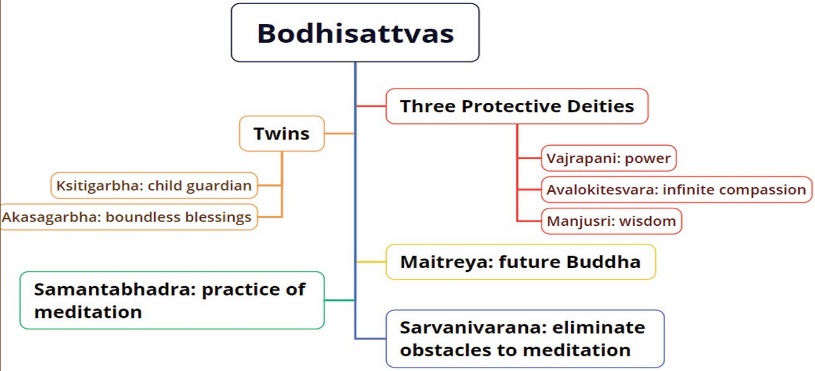
• Major Bodhisattvas include Avalokitesvara, Manjusri, Samantabhadra, Ksitigarbha, Maitreya, Vajrapani, Sadaparibhuta and Akasagarbha.
• Vajrapani (Buddha’s Power): He is described as one of the 3 protective deities around Buddha, others are Manjusri and Avlokiteshwara. Vajrapani represents Buddha’s power while Buddha’s wisdom
is symbolised by Manjushri and Avalokiteshwara manifests as Buddha’s compassion.
• Avalokitesvara(Buddha’s Compassion): Avalokiteshwara means ‘one who can see all’. He represents infinite compassion and mercy. He is depicted as holding a lotus flower. He is depicted as female also. A cave wall painting of Avalokitesvara is devoted in Ajanta Caves as Padmapani.
• Manjusri (Buddha’s Wisdom): Literally means ‘Gentle Glory’. He represents Pragya or transcendental wisdom at a very early age. Manjusri is depicted as a male bodhisattva wielding a flaming sword in his right hand.
• Maitreya (Buddha’s Activity): He is also known as Ajita Boddhisattva. It is believed that he will arrive when people will forget the path of righteousness. He is considered as the future Buddha or successor of Gautam Buddha. In Buddhist traditions, he is revered as someone who will achieve complete enlightenment and will teach dharma to people.
• Samantabhadra (Buddha’s Aspirations): Literal meaning is ‘Universal Worthy’ and he is associated with practice and meditation. He made ten vows to fulfil his journey of becoming a Buddha. His manifestation is ‘Action’ and he is a key figure in Flower Garland Sutra.
Buddhism and Its Philosophy Tenets and Decline
SHRAMANA TRADITIONS
Buddhism, Jainism and the Ajivikas sects trace their developments from the Shramana Traditions at end of the Later Vedic Period. A Shramana is one who strives for enlightenment. It started as a response to Later Vedic elaborate rituals and practices. Shramanas were against Brahmin dominance, complex Vedic rituals, Varna system of classification, backward status of women, shudras and indiscriminate animal sacrifice. This tradition was highly patronised by the Mauryan Rulers.
Journey from Siddhartha to Gautama Buddha
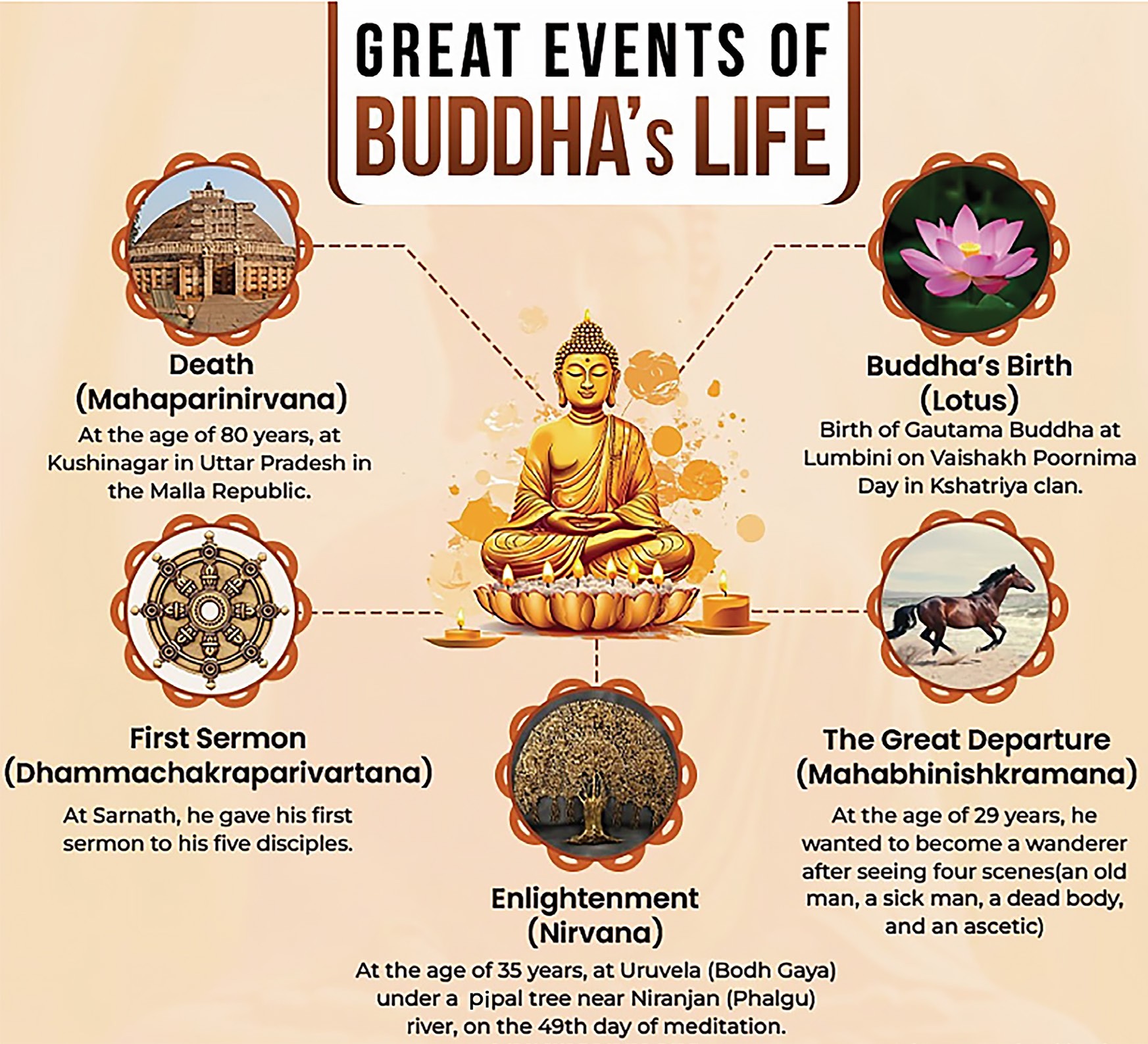
• Gautama Buddha was born in 563 BCE on the occasion of Vaishakhi Poornima at Lumbini, Nepal as Siddhartha Gautama in the Shakyan Kshatriya clan. His Father was Suddhodhana, King of Kapilavastu and his mother was Mahamaya, she was the princess of Kollia republic. He had a wife named Yashodhara and a son named Rahul. This janma event of Gautama Buddha’s life is symbolised by Lotus and Bull imageries.
• At the age of 29, he experienced pain from observing the outside world and renounced his home and life of comfort. His horse was known as ‘Kanthaka’ and his charioteer was known as ‘Channa’. This event is known as Mahabhinishkramana (renunciation). Siddhartha became a wandering ascetic (parivrajaka) and followed the Shramana tradition under the guidance of Alara Kalam (Early Sankhya philosopher).
• He wandered for years and finally reached a village uruvella on the banks of the river Niranjana. He sat under the Bodhi tree and meditated for 49 days before attaining Nibbana (extinguishment of the flame of desire). Thereafter, he was called as Buddha, the enlightened one.
• He gave his first sermon at Sarnath Deer Park near Varanasi. This event of Buddha’s life is known as ‘Dharmachakra Pravartana’ (turning of the wheel of law). He died in 483 BCE at the age of 80 years at Kushinagar, Uttar Pradesh. This event is known as Mahaparinirvana (final blowing out).
• Buddha is also known as Thathagat and Shakyamuni. His predecessor is known as Kassapa Buddha and his successor (future Buddha) would be known as Maitreya.
• His five disciples at Sarnath were Kaudinya, Bhadrika, Vashpa, Mahanaman and Ashvajit.
Philosophy and Tenets of Buddhism
• Buddha focused on the importance of metta (fellow feeling, brotherhood) and karuna (compassion).
• According to Buddha, the world is transient (anicca) and constantly changing. It is also soulless (anatta) as there is nothing permanent or eternal in it.
• Buddha emphasised on individual agency and righteous action as the means to escape the cycle of rebirth and attain nibbana.
• He gave the famous Chatwari Arya Satyani or the ‘four noble truths’:
• Life is full of sorrow Sabbam Dukham
• There are certain causes of sorrow Dukkha Samupadda
• Cessation of suffering can be done Dukkha Atikkama
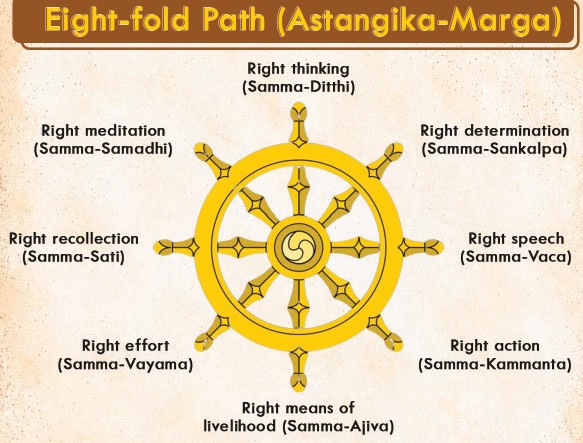
• Path Leading to the cessation of sorrow is the Ashtangika Marg or the 8-fold path Dukkha Nirodha
• He also highlighted the reasons for sorrow by giving the concept of dvadasa-nidana-chakra which has a list of 10 precepts generally ignored by people. When this chakra is not followed, it leads to sorrow or dukkha in the lives of the people.
• Ten Precepts
• Not to harm living beings
• Not to take what is not given
• Abstain from false speech
• Abstain from evil behaviour
• Abstain from alcoholic drinks
• Abstain from eating at forbidden times
• Abstain from dancing/singing/music/dramatic performance
• Abstainf romuse of jewellery/perfumes/ garlands
• Abstain from receiving gold/silver
• Abstain from use of broad or high bed
• Buddha suggested following the Madhyamka approach
– the middle path, avoiding the life of extremes; neither
pure ascetism nor pure worldliness.
• He rejected the authenticity of the Vedas. He also rejected the concept of soul or ‘atman’.
• Buddha gave the famous Tri-ratnas of Buddhism as:
• Buddha – The Enlightened One
• Dhamma- Doctrines
• Sangha- Commune order of monks
• Three Trainings or Trisiksha
• Morality (Sila)
• Meditation (Samadhi)
• Wisdom (Prajna)
• Metaphysical Thoughts of Buddhism
• Universe was created based on the Laws of Nature
• Rejected the authority of the Vedas
• Buddha was agnostic on the question of God. He neither confirmed nor deny the presence of God.
• Buddhism does believe in rebirth but based on karmic doctrine of ‘Pancha Skandha’
• Buddhism also does not believe in souls or atman but instead they believe in Doctrine of Momentariness or Kshanabhangavada and in Anicca (non-permanence)
Inclusion of Women and the Reasons for Decline
Buddha was initially against the idea of inclusion of women in the Sangha (Buddhist Monastic Order) and said that the religion would become corrupt within 1000 years if women were allowed to be members of the Sangha. On the insistence of his disciple Ananda, he relented and agreed to include women in the Monastic Order. The first women who was admitted into the Buddhist Sangha was Mahaprajapati Gautami.
The Decline of Buddhism happened due to
Corruption of the monks and luxurious lifestyles
Elitist attitude- gradual shift to Sanskrit language
Interference with the internal affairs of the rulers lead to stopping of state patronage to the religion
Frequent branching of Buddhism diluted it
Reform of Sanatana Dharma by assimilating various aspects of Buddhism on one hand and gradual reform of the sacrifice cult on the other.
Buddhist Councils and Buddhist Literature
BUDDHIST COUNCILS
| Buddhist Council | Place and Yea | Patronage by and Chairman of the Council | Details |
| First Buddhist Council | At Rajgir (Around 483 BC) | Under the patronage of King Ajatashatru. Chairman – Mahakasyapa | Upali recited Vinaya Pitaka, which contains the rules of the Buddhist order; Anand, the other disciple of Buddha, recited Sutta Pitaka, containing the great collection of Buddha’s sermons on matters of doctrine and ethical beliefs. |
| Second Buddhist Council | At Vaishali (383 BC) 100 years after the mahaparinirvana of Buddha | King Kalasoka. Chairman – Sabakami | Relaxation of the rules of the monastic order Codification of the Vinaya Pitaka. Split over this issue whether or not monastic rules should be relaxed? It led to the development of: Sthavirvadins (orthodox)- the school of elders; which later became the Theravada School Mahasanghikas (unorthodox)- later this split into the Hinayana and Mahayana |
| Third Buddhist Council | At Patliputra (250 BC) | Under the patronage of King Ashoka. Chairman – Mugali Putta Tissa | Ashoka removed all variations from Buddhism and its sects. Recognised Theravada Buddhism as the main. Compilation of Abhidhamma Pitaka took place. Decision taken to send missionaries abroad to promote Buddhism |
| Fourth Buddhist Council | At Kundalvana, Kashmir (72 AD) | Under the patronage of King Kanishka Chairman - Vasumitra | Resulted in the division of Buddhism into Hinayana and Mahayana. Asvaghosha (the deputy of Vasumitra) participated in this council and all the deliberations were made in Sanskrit. Mahavibhasha or the encyclopaedia of Buddhism was compiled |
BUDDHIST LITERATURE
| TEXT | AUTHOR | FEATURES |
| PALI TEXTS | ||
| Sutta Pitaka | Collectively called the ‘Tripitakas’ No specific authors mentioned | Buddha’s teachings and philosophy. It includes Nikayas which contained ‘Theragatha’ and ‘Therigatha’ (Hymns of the elder monks and nuns respectively) and Jataka poetic tales of previous births of Buddha. Five Nikayas are namely Digha Nikaya (long discourses), Anguttara Nikaya (numerical), Majjhima Nikaya (middle length), Khuddaka Nikaya (minor discourses) and Samyutta Nikaya (connected discourses of Buddha). |
| Vinaya Pitaka | Rules of the Monastic Order It includes three books namely Suttavibhanga, Khandhaka and Parivara. | |
| Abhidhamma Pitaka | Explains Buddhist philosophies It includes seven books namely Dhammasangani, Dhatukatha, Kathavatthu, Patthana, Puggalapannatui, Vibhanga and Yamaka | |
| Milindapanho | Questions of Milind It’s a dialogue between Milind (Meander) and the Buddhist saint Nagasena. | |
| Dipavamsha | Chronicles of Sri Lanka | |
| Mahavamsha | Great Chronicles |
| Nettipakaran | It is a mythological test of Burmese Theravada tradition. | |
| SANSKRIT TEXTS | ||
| Buddha Charita | Ashwaghosha | He was a poet, dramatist, musician, scholar and was contemporary to Kanishka. |
| Saundarananda | ||
| Sutralankara | ||
| Sariputra Prakarana | ||
| Vajra Suchi | ||
| Madhyamika Siddhanta | Nagarjunaor Nagasena | He propounded the Madhyamika Buddhist philosophy popularly known as Shunyavaad. He was a contemporary of Satvahan ruler Yagyashri Gautamiputra. Chandrakirti and Aryaveda were his disciples. |
| Madhyamika Sutralankara | ||
| Rasaratnakara | ||
| Subhalekha | ||
| Saddharma Pundarika | ||
| Amarkosha | Amar Simha | First dictionary in Sanskrit |
| Visuddhimagga or Vishuddhimarga | Buddhaghosh | |
| Sumangalvasini | ||
| Atthakathayen | ||
| Pramanasmuchaya | Dignaga | He created the first system of Buddhist logic and epistemology |
| Nyaya Bindu | Dharmkirti | |
| Catuhsataka | Aryadeva | It became an important source for Madhyamaka (centrism) philosophy also called Sunyavada |
| Avadanasatak | “Century of Noble Deeds” It is an anthology in Sanskrit of one hundred Buddhist legends, approximately dating to the same time as the Ashokavadana. | |
| Ashokavadana | Describes the birth and reign of Ashoka. |
Buddhist Disciples Scholars Monasteries Hand Gestures
Important Events in the life of Buddha
Ksitigarbha (Buddha’s Merit): He is popular as a Buddhist monk in the mostly East Asia. While the name literally means Earth Womb, he is revered as the guardian of children and patron deity of deceased children. He carries a staff.
Akasagarbha (Buddha’s Blessings): He is boundless as space. He was the twin brother of Ksitigarbha. He manifests as a blessing.
Sarvanivarana-Vishkambhin (Buddha’s Qualities): He is invoked to remove or eliminate all the obstacles to insure a successful meditation.
Prominent Disciples of Buddha in the Ancient Period
• Sariputta: Chief Disciple and possessed knowledge of Dhamma
• Mahamoggallana
• Ananda: Chief disciple of Buddha
• Mahakasyapa: President of First Buddhist assembly=
• Purna Maitrayani-putra
•
Anuruddha: Master of right mindfulness
• Rahul: Son of Gautama Buddha
• Katyayan
• Upali: Possesed knowledge of Vinaya
• Ananthapindaka
• Subhuti
• Jivaka
Important Buddhist Scholars
• Moggaliputta Tissa: Launched Ashoka’s dhamma campaign
• Aryadeva: Mahayana Buddhist monk was a disciple of Nagarjuna and a Madhyamaka philosopher.
• Dignaga: His work laid the groundwork for the development of deductive logic in India and created the first system of Buddhist logic and epistemology (Pramana).
• Asvagosha: Wrote Buddhacharita and Sanskrit drama
Sariputra Prakran
• Nagarjuna: Founded madhyamik school of Mahayana Buddhism, gave theory of Sunyavad’ Emptiness’ and important work include ‘Mulamadhyamakakarika’
• Buddhagosh: Most important commentator of Theravada, important work is Visuddimagga.
• Dharmakirti: Teacher at Nalanda, called as ‘Kant of India’.
•
Propounded the Vijnanavada (mind alone) School of Thought
• Expanded on the work of Diganaga
• Laid the foundations of development of logic in India called as ‘Hetu Vidya’
• Vasubandhu: A proponent of Mahayana Buddhism in 4th-5th century AD from Gandhara and wrote from the perspectives of the Sarvastivada and Sautrantika schools.
• Padmasambhava: An 8th century monk and is contemplated as ‘Second Buddha’ across Tibet, Nepal, Bhutan and the Himalayan States of India.
• Atisa: A Buddhist Bengali religious leader and master, and is one of the major figures in the spread of 11th century Mahayana and Vajrayana Buddhism in Asia. He inspired Buddhist thought from Tibet to Sumatra.
• Dalai Lama: They are modern spiritual leaders of the
Yellow Hat School of Tibetan Buddhism.

Important Monasteries in India
| MONASTERY | LOCATION | FEATURES |
| Hemis Monastery | Hemis, Ladakh, India | Hemis Monastery, founded in the 11th century, is Ladakh’s largest and wealthiest monastery. It is a Tibetan Buddhist monastery a.k.a Gompa of the Drukpa Lineage (Dragon Order of Mahayana Buddhism). Reconstructed by Sengge Namgyal in 1672, it is believed that ancient Buddhist pupil Naropa achieved enlightenment here. The monastery hosts a famous Hemis Festival dedicated to Lord Padmasambhava. |
| Thiksey Monastery | Leh, Ladakh, India | It is a Gompa (monastery) affiliated with the Gelug sect of Tibetan Buddhism. It is located on top of a hill in Thiksey village, approximately 19 km east of Leh in Ladakh. The 49 feet statue of Maitreya Buddha that covers two storeys is the key attraction of this monastery. It resembles the Potala palace in Lhasa, Tibet. |
| Namdroling Nyingmapa Monastery | Coorg, Karnataka, India | It is the is the largest teaching center of the Nyingma lineage of Tibetan Buddhism in the world. The monastery was established by the 11th throneholder of the Palyul lineage, Drubwang Padma Norbu Rinpoche in 1963. It has a number of gold statues of Buddha as well as several domes all around the complex. |
| Tabo Monastery | SpitiValley,Himachal Pradesh, India | It was founded in 996 CE in the Tibetan year of the Fire Ape by the Tibetan Buddhist lotsawa (translator) Rinchen Zangpo (Mahauru Ramabhadra), on behalf of the king of western Himalayan Kingdom of Guge, Yeshe-O. The monastery, also known as the ‘Ajanta of the Himalayas’, is surrounded by caves and is primarily filled with paintings on walls and ceilings. |
| Tawang Monastery | Tawang,Arunachal Pradesh, India | It is India’s largest monastery and the world’s second largest after the Potala Palace in Lhasa, Tibet. Merak Lama Lodre Gyatso founded this monastery in 1680– 1681. It belongs to the Gelug school of Vajrayana Buddhism and had a religious relationship with the Drepung Monastery in Lhasa that lasted under British administration. |
| Namgyal Monastery | Dharamsala,Himachal Pradesh, India | It is the personal monastery of 14th Dalai Lama. It was created in either 1564/ 1565 by the third Dalai Lama, Gendun Gyatso. In 1571, Namgyal Monastery was renamed in honour of the female long-life deity Namgyalma. |
| Ghoom Monastery | Darjeeling, West Bengal, India | The Ghum Monastery, founded in 1850 by Lama Sharap Gyatso, is a Buddhist monastery of the Yellow Hat sect. The Tibetan culture has left its mark on this monastery. The primary feature of this monastery is a 15-foot-tall statue of Lord Buddha. This statue is made entirely of pure gold and exquisite stones. Two massive oil lamps are placed in front of this monument and stay blazing all year. |
| Dhankar Gompa (Monastery) | Lahaul and Spiti, Himachal Pradesh, India | It is a Buddhist temple located at a height of 3894 meters in India’s Lahaul and Spiti region. It is the world’s second highest monastery, after Ki Monastery, and has been a prominent center of Buddhist scholarship since the seventh century. |
| Enchey Monastery | Gangtok, Sikkim, India | The Enchey Monastery was founded in 1909 and is affiliated with the Nyingma order of Vajrayana Buddhism. Lama Drupthob Karpo, a well-known practitioner of tantric (adept) art in Buddhism, blessed the place. |
| Mindrolling Monastery | Dehradun, Uttarakhand, India | The Mindrolling Monastery is one of India’s most prominent Buddhist monasteries, with the World’s Biggest Stupa (185 feet) and the largest Buddha statue. Belonging to the Nyingma school in Tibet, this is a great center for learning Buddhist scriptures and traditional Tibetan medicine. |
| Rumtek Monastery | Gangtok, Sikkim, India | It is also known as the Dharmachakra center and is a gompa, which are Buddhist ecclesiastical fortresses of study, lineage, and sadhana. It was built under the direction of Changchub Dorje (12th Karmapa Lama in the mid-1700s). |
| Mulbekh Monastery | Kargil, Ladakh, India | Mulbekh Monastery, a Tibetan Buddhist monastery, is located on a crag 656 feet above the road, with a steep footpath leading to the monastery. It is believed to have been built around 800 years ago by Tibetan scholar Lotsawa Rinchen Zangpo’s students. The monastery features a 30-foot-tall statue of Maitreya Buddha, a blend of Buddhist and Shaivite influences, and ancient inscriptions and an edict from King Lde to abandon goat sacrifice. |
Important Hand Gestures in Buddhism
| MUDRA | POSTURE | MEANING |
| Dharmachakra Mudra | This gesture is also known as the "Teaching of the Wheel of Dharma," symbolizing one of the key moments in the Buddha’s life when he performed the Dharmachakra mudra during his first sermon in Sarnath after attaining enlightenment. The mudra is performed with both hands positioned at chest level, with the left hand facing inward and the right hand facing outward. | |
| Dhyan Mudra | This gesture is also referred to as Samadhi or Yoga mudra. It is performed by placing both hands on the lap, with the right hand resting on top of the left. The fingers are stretched, with the thumbs pointing upwards and the other fingers of both hands gently resting on one another. This mudra is commonly associated with Buddha Shakyamuni, Dhyani Buddha Amitabh, and the Medicine Buddha. | |
| Bhumisparsa Mudra | This gesture, known as "touching the Earth," symbolizes the Buddha's moment of awakening when he calls upon the Earth as a witness to his enlightenment. It is performed by raising the right hand above the right knee, with the palm facing inward, and extending it toward the ground while touching the lotus throne. | |
| Varada Mudra | This mudra symbolizes offering, welcome, charity, giving, compassion, and sincerity. It is performed with both hands: the right hand is extended forward with the palm facing outward and fingers spread, while the left hand is positioned near the navel with fingers extended. | |
| Karan Mudra | This gesture symbolizes the protection against evil. It is performed by raising the index and little fingers while folding the other fingers. It is believed to help alleviate sickness and dispel negative thoughts. |
| Vajra Mudra | This gesture represents the fiery thunderbolt, symbolizing the five elements: air, water, fire, earth, and metal. It is performed by enclosing the left forefinger with the right fist, with the tip of the right forefinger touching or curling around the tip of the left forefinger. | |
| Vitarka Mudra | This gesture represents the sharing and transmission of the Buddha's teachings. It is performed by bringing the tips of the thumb and index fingers together, while keeping the other fingers straight. It resembles the Abhaya and Varada Mudras, but with the thumbs touching the index fingers. | |
| Abhaya Mudra | It is a gesture of fearlessness or blessing that represents the protection, peace, benevolence and dispelling of fear. It is performed with the help of right hand by raising to shoulder height with a bent arm and the face of the palm will be facing outward with fingers upright whereas the left hand hanging down while standing. This gesture is characteristic of Buddha Shakyamuni and Dhyani Buddha Amoghasiddhi. | |
| Uttarabodhi Mudra | This gesture denotes the supreme enlightenment by connecting oneself with divine universal energy. It is performed with the help of both the hand, which placed at the heart and the index fingers touching and pointing upwards and the remaining fingers intertwined. | |
| Anjali Mudra | It is also called ‘Namaskara Mudra’ or ‘Hridayanjali Mudra’ that represents the gesture of greeting, prayer and adoration. It is performed by pressing the palms of the hands together in which the hands are held at the heart chakra with thumbs resting lightly against the sternum. |