Clay and Pottery Works
Clay and Pottery Works
Making items out of clay is one of man’s earliest crafts. The oldest evidence was discovered in the Neolithic site of Mehrgarh, which is today in Pakistan. The technique of clay pottery manufacture was well developed around 6000 BC, according to the relics.
Painted Grey Ware pottery, which is generally grey in color and was associated with the Vedic period, is the most well- known ancient pottery (1000-600 BC).
| Name of Pottery | Place of Origin | Features |
| Khurja Pottery | Uttar Pradesh | Colorful and durable, it’s commonly used to manufacture home objects. |
| Black Pottery | Azamgarh, Uttar Pradesh | A dark tint that is unique. |
| Blue Pottery | Jaipur, Rajasthan | Multani Mitti was used to make this piece. |
| Kagzi Pottery | Alwar, Rajasthan | Delicate, thin, and slightly fragile ceramic |
| Pokhran Pottery | Pokhran, Rajasthan | Applied to everyday goods |
| Dalgate Pottery | Jammu and Kashmi | Uses a unique glaze |
| Karigari Pottery | Tamil Nadu | South Arcot has a number of special centers. |
| Surai | West Bengal | Common jugware |
| Gopichandan | Saurashtra | Clay items as artwork |
Cloth Handicrafts
Handicrafts refer to crafts involving the creative skills of hands. Indian handicrafts like textiles, pottery and toys have enjoyed immense mass appeal around the world and through the ages. Some of the handicrafts which are produced in India are as follows:
Glassware
Archaeological evidences have been found of a glass industry in Brahmapuri and Kolhapur in Maharashtra which was operational between 2nd century BC to 2nd century AD and produced specialised glassware, called lenticular beads. Also other sites where archaeological evidences have been found of glass are Maski, Ahar (Rajasthan), Hastinapur and Ahichachhatra (Uttar Pradesh), Eran and Ujjain (Madhya Pradesh), etc. Patna (Bihar) also produces a peculiar kind of decorative glass beads called ‘Tikuli
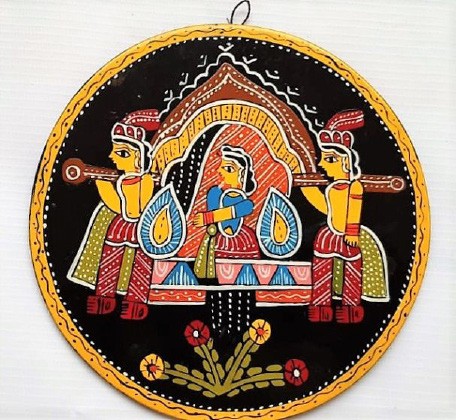
Tikuli
Cloth Handicrafts
It is of three types viz. Tie and dye, Embroidery and Weaving. Tie and Dye: It is most widely accepted method of printing textiles in India. It is an ancient art form that is still practiced in many parts of Gujarat, Madhya Pradesh and Rajasthan. This technique consists of two stages: tying sections of a length of cloth (silk or cotton) and then immersing it in colour vats.
| CLOTH HANDICRAFTS | PLACES | DETAILS |
| Lehariya | Jaipur and Jodhpur, Rajasthan | It is a type of tie and dye that results in ripples or wave-like patterns on the cloth. |
| Batik Art | Madhya Pradesh and West Bengal | In this one end of the fabric is permeated with molten wax and then dyed in cold to produce multi-coloured batik saris and dupattas. |
| Paagadu Bandhu Tie and Dye | Andhra Pradesh | Ikat is another Indonesian name for it. In this tie-dye method, the cloth is woven first, then resist bindings are added, and the fabric is coloured. |
| Tehlia Rumal (Resist dyed Textiles) | Andhra Pradesh | Alizarin dyes are used to make the cloth oily, hence it literally means “oily handkerchief.” |
| Ajrakh Printing | Gujarat | It’s a resist-dyed cloth that’s block-printed using natural dyes like indigo and madder. In the Kutch area, it is mostly carried out by the Khatris community. |
| Mata Ni Pachedi (Ritual Cloth Painting) | Gujarat | It literally implies ‘Behind the Mother Goddess,’. The predominant color in this design is red. |
| Thigma–Tie Resist Dyeing | Jammu and Kashmi | To color the woollen material, natural elements are employed, such as soot for grey, apple bars, and onion peels for brown. |
| Jadu Patua Painting | Jharkhand | Patua refers to the scroll on which the Jadu Community’s murals are created. |
| Pichhwai Paintings | Rajasthan | On a cloth or paper, a portrait painting based on Lord Krishna. |
| Dabru Printing | Rajasthan | It’s a one-of-a-kind old mud resist hand block printing method. |
| Muthangi (Pearl Studded attire) | Tamil Nadu | This style of attire is mostly designed for idols. |
| Sungadi (Tie Resist Dyeing) | Tamil Nadu | The traditional tie-and-dye method is known as sungudi. |
| Dhalapathar Parda and Fabrics | Odisha | By Odisha’s Rangani Community. |
| Kani shawl | Jammu and Kashmi | It is woven with Pashmina wool gathered from the underbelly of wild Tibetan and Ladakh mountain goats. |
| Kotpad Handloom Fabric | Odisha | Its patterns are based on geometrical patterns of ducks, hand fans, flowers, palanquins, fish, and animals, among other things. |
| Tangaliya Shawl | Gujarat | It is a hand-woven cloth with a dotted pattern. |
Traditional Regional Sarees of India
Traditional Regional Sarees Of India
| Saree styles and their Location | Features |
| Pochampalli (GI) (Telangana) | Silk and cotton saree with intricate motifs and geometric ikat style of dyeing. Air India airlines crew wears this saree. |
| Patan Patola (GI) (Gujarat) | Rich handloom silk sarees |
| Baluchari (West Bengal) | Depicts ancient stories on its border and pallu. Silk threads are extensively used. |
| Tanchoi Brocades (Uttar Pradesh) | A kind of banarasi saree where weaving technique involves a single or double warp and two to five colors on the weft on Silk fabric. |
| Chanderi (Madhya Pradesh) | Silk, zari and cotton woven together to make a fabric that is lighter than a feather. It is a see through saree. |
| Ilkal (Karnataka) | Use of kasuti embroidery with chariot and elephant as common motifs. |
| Nauvari (Maharashtra) | A single nine yard sari also known as Kasta saree. Bomkai Odisha Silk and cotton saree with ikat, embroidery and intricate thread work. |
| Konrad (Tamil Nadu) | Fabric usually has either stripes or checks and a wide border along with motifs of animals and natural elements. It is also called a temple saree. |
| Kosa (Chhattisgarh) | A silk saree |
| Paithani (Maharashtra) | Silk saree embroidered with gold colour thread and use of parrot as motif. |
| Kalamkari (GI) (Andhra Pradesh) | Use of pen for painting designs. |
| Kasavu (Kerala) | Saree characterized by thick golden border. |
| Dabu (Chittorgarh, Rajasthan) | Dabu is an ancient mud resist hand block printing technique used on cotton fabric. |
| Jamawar (Jammu and Kashmir) | Base used is generally wool with a little addition of cotton. The brocaded parts are woven in Silk or Pashmina. |
| Uppada Jamdani Saree (GI) (Andhra Pradesh) | Finest silk along with pure zari are used as raw materials. Jamdani Sari is a Persian terminology, in which Jam means flower and Dani means Vase. Jamdani West Bengal Finest muslin with opaque patterns woven on a transparent background. |
| Venkatagiri Saree (GI) (Andhra Pradesh) | The saree is ornamented with zari in pallow and border. Jacquards are used to weave extra weft designs. Generally, soft and pastel colours are used in the sari. |
| Kotpad Saree (GI) (Odisha) | Use of natural maddar in dyeing of cotton yarn is the USP of Kotpad products. The design is mainly inspired by the surroundings like duck, hand fan, flower, palanquin, fish, animal, etc. |
| Sambalpuri Saree (GI) (Odisha) | This is made from Tussar silk and soft cotton. |
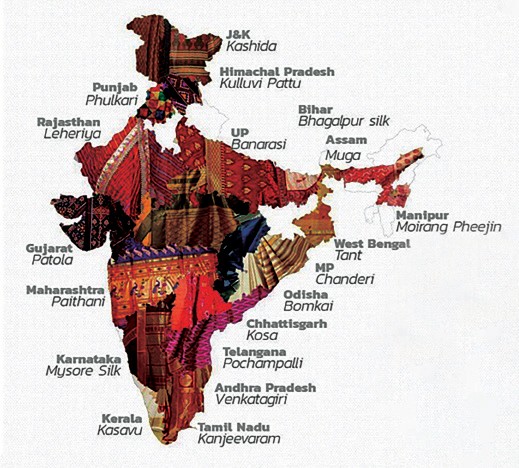
Sa ree Map of India
Embroidery Craft
Embroidery Craft
The skill of creating elevated patterns using threads or wooden blocks is unique among textile crafts. This is known as embroidery, and it is done with the use of needles and gold, silver, silk, or cotton threads on cloth.
| Embroidery | Produced Mainly in | Details |
| Chikankari (GI) | Lucknow, Uttar Pradesh | Created by first block printing designs on the cloth, then embroidering stitches following the pattern, and then washing the finished item to erase traces of the prints. |
| Kantha (GI) | West Bengal and Odisha | Kantha thread is often made from the used cloth’s border threads and has a variety of designs. |
| Phulkari (GI) | Punja | Embroidery of floral designs on light-colored cloth with contrasting brilliant colors. On the back of the material, the stitches are embroidered. |
| Bagh | Punja | It’s similar to phulkari, except it features embroidery throughout the entire fabric’s surface. |
| Zardozi | Uttar Pradesh | Gold, silver, or copper wire is combined with silver or gold polish and silk strands. |
| Khashdkari | Jammu and Kashmi | Floral designs are incorporated into simple chain stitches. Figures of humans and animals are mostly absent. |
| Banni | Gujarat | The Lohana Community is behind it. Silk floss was used to embroider geometrical designs, which included the usage of glassworks. |
| Banjara | Lambada tribes of Andhra and Banjara tribes of Madhya Pradesh. | A mix of applique with mirrors and beadwork. |
| Khatwa Applique work (GI) | Biha | Wall hangings, shamianas, saris, dupattas, pillow covers, and other items often have this appliqué and patchwork. |
| Lambani (GI) | Karnataka | Unique needlecraft did by women. |
| Sozni (or suzani) (GI) | Jammu and Kashmi | Dorukha is another name for this form of needlework. The designs are made in satin stitch and are identical on both sides, but the colors are different. |
| Sujni (GI) | Biha | The foundation cloth is usually red or white in color. The primary motif’s outline is accentuated with a thick chain stitch. |
| Aari | J&K and Gujarat | Floral designs are created in delicate, concentric rings of chain stitch using a long hooked needle called the crewel. |
| Mirror Work | Rajasthan and Gujarat | Stitched in between colorful needlework are little pieces of mirrors of all shapes and sizes. |
| Dharaniya | Gujarat | Embroidered wall hangings that may be found in houses. |
| Hee | Gujarat | Silk with bold geometric motifs. |
| Gota | Rajasthan | To create intricate designs, little pieces of gold zari ribbon are put to the cloth and the edges are sewed down. |
| Akshita | Biha | Similar to Bagh. |
| Kasuti | Karnataka | Kasuti is a technique that includes counting each thread on the cloth using a single thread. The designs are sewn without knots on both sides of the material, giving it a uniform appearance. |
| Rabari | Gujarat | Gujarati Rabari tribe’s embroidered animal decorations. |
| Shamilami | Manipu | It incorporates both weaving and embroidery. |
| PhoolPattiKa Kaam | Aligarh, Uttar Pradesh | Floral petals and leaves are used as motifs in the needlework. |
| Mukesh | Uttar Pradesh | Twisting thin metallic threads to create patterns all over the fabric is what this technique entails. |
| Kharchobi | Rajasthan | Sewing flat threads on cotton padding resulted in raised zari metallic thread embroidery. |
| Pipli | Pipli Village, Odisha | Patchwork is a method of sewing together vividly coloured and patterned fabric pieces on a simple backdrop. |
| Gara | Gujarat | Parsis took this technique from China and introduced it to the world. Gara entails first creating a pattern on paper and then tracing it onto the saree. |
| Kimkha | Varanasi, Uttar Pradesh | Fabric is a rich brocade with silk and gold threads sewn into it. Kalabattu is the name for the gold thread. |
| DongariaScarf- Kapragonda | Odisha | The Dongaria Kondh women embroider a kapragonda scarf that they wear over a white sari with a crimson border. |
Variety of Weavings in India
Variety of Weavings in India
| Weaving Patterns | Details |
| Pata Weaving (Bastar, Chhattisgarh) | Sari of this kind is mainly used by tribal women. |
| Mashru Weaving (Gujarat) | This is a handwoven mix of Silk and Cotton textiles |
| Bohra Cap weaving (Gujarat and Madhya Pradesh) | It is made using an aluminium vessel as a base, the crochet is begun at the centre and proceeds in a spiral form, from the core to the outer edge. Here both geometric and floral patterns are created. |
| Patku Weaving (Gujarat) | Patku is a tie-dyed textile, woven on a pit loom. |
| Crochet Work (Andhra Pradesh) | It is a process of creating fabric by interlocking loops of yarn, thread, or strands of other materials using a crochet hook |
| Pattu Weaving (Rajasthan) | It is mainly done on woollen textile. Threads of Pattu is made of either camel or sheep wool. |
| Wangkhei Phee (traditional weaving) (GI) (Manipur) | Very fine white cotton is used for this. The fabric is transparent with designs and patterns on it. |
| Shaphee Lanphee weaving (GI) (Manipur) | This traditional textile fabric is woven as a shawl. Meitei women are usually involved in making this type of shawl. |
Bronze Crafts and Other Famous Metal Crafts in India
Bronze Crafts
Presently, important centres of Brass work across India are:
| Bronze Craft Work | Details |
| Gaja Tandava (Kerala) | Shiva dancing in the Tandava position. |
| Rare Jain imagery and icons (Karnataka) | Reflects the need of ancient Jain pilgrim centres in Karnataka. |
| Dokra Casting (Odisha and West Bengal) | Used for ornaments made of brass. |
| Pahaldar Lamps (Jaipur and parts of Uttar Pradesh). | Copper and brass lamps in different styles and shapes. |
| Pembarthi craft (Telangana) | Exquisite sheet metal (brass) art to adorn chariots and temples. |
Other Famous Metal Crafts in India
| Metal Crafts in India | Details |
| Bidri Craft (GI) (Karnataka) | Blackened alloy of zinc and copper is inlaid in thin sheets of silver to make items like hookahs, vases, earrings, showpiece items, etc. which also have a good export market. |
| Aranmula Kannadi (Metal Mirror) (GI) (Kerala) | Being a rare piece of craft, it is a handmade metal-alloy mirror, made in Aranmula, a small town in Kerala. The alloy is polished for several days to get mirror’s reflective surface. The composition of alloy is a trade secret of the families involved. |
| Netturpetti jewellery boxes (Kerala) | It is an antique handicraft made normally using rosewood and brass curios. It has intricate patterns which are inspired by the temple architecture and traditional art forms of Kerala. |
| Chandi Tarkashi (Silver Filigree) (Odisha) | Alloy of 90 percent or more pure silver is used. Techniques such as granulation, snow glazing and casting are used innovatively to make ornaments. |
| Swamimalai Bronze Icons (GI) (Tamil Nadu) | Swamimalai is a traditional site where this craft is practiced since Chola Period. Idols of bronze and “panchaloha” (copper, brass, lead silver and gold) are made for religious purposes. |
Leather Products
Leather Products
Leather is mostly used to make footwear, bags and wallets. The biggest market of leather is in Rajasthan where camel leather is used to make bags of various shapes and sizes.
| Footwea | Details |
| Konglan Stitched Boots (West Bengal) | Made in the northern part of West Bengal. These boots have thick leather sole, and high layered sides made from either leather or thick cloth. |
| Paabu Stitched boots (Jammu and Kashmir) | Traditional colourful knee length boots from Ladakh region. |
| Kolhapuri chappal (GI) (Karnataka and Maharashtra) | Handcrafted pure leather ethnic footwear mainly produced in Kolhapur region of Maharashtra and some parts of Karnataka. |
| Katki chappal (Odisha) | Ethnic Leather footwear. |
| Tilla jutti (Traditional footwear) (Punjab) | Inspired from Indian Rajputana, it is traditionally made up of leather and with extensive embroidery using gold and silver thread. |
| Mojari (Leather footwear) (Rajasthan) | Traditionally, it is made by artisans mostly using tanned leather. |
| Multani Khussa (Rajasthan and Punjab) | It is made using vegetable tanned leather and is embroidered with brass nails, mirrors, ceramic beads, etc. |
Wood Crafts
Wood Crafts
| Woodwork | Features |
| Nirmal Painting (made on wood) (GI) (Telangana) | The evolution of this art form started from Kakatiya dynasty. It is a precise painting on a wooden surface and finally touched with gold and then varnished. |
| Kashtakari wood carving (Goa) | Along with household products, woodcarving is also visible in churches, temples, houses, etc. |
| Santalum (Sandalwood carving) (Karnataka) | It is mainly used to manufacture idols and products related to religious purposes. |
| Khatamband Woodcraft (GI) (Jammu and Kashmir) | The wood pieces are joined with the help of three different types of joints which forms the basic technique of Khatamband. This used designs originated from the geometrical tessellating patterns of Islamic tradition. |
| Sikki Grass Craft (Bihar) | It is used to make ornaments, boxes and the containers to store rice, grains and lentils, etc. |
| Shital Patti Grass mat (Assam) | Shital means cool and patti means mats. Green patidai or long-stemmed knotless mohtra reeds are used as raw materials to make the mats. |
| Khunda - Bamboo staves (Punjab) | It is used as an essential part of Bhangra dance. These iron tipped staves serve the purpose of a walking aid and weapon. |
| Kawad Mobile shrines (Rajasthan) | The portable shrine has multiple folding doors, each of which is painted with representations of epics and myths of Hindu Mythology. |
| Choktse - Tables (Sikkim) | It is a type of Tibetan small wooden foldable and portable table, carved with customary Buddhist signs such as lotus, mandala and fish. |
| Likhai (Wood Carving) (Uttarakhand) | The border of the wooden doors are adorned with Tibetan motif like 3-flower, arch and dragons. Sometimes it has 14 rows of curving like swans, parrots, lotus, creepers, etc. |
| Sankheda Furniture (GI) (Gujarat) | It is made of 100 percent seasoned teakwood. Abstract designs and floral paintings are drawn on wooden furniture with bright shades of gold, silver, maroon, green, vermilion and brown. |
| Walnut Wood Carving (GI) (Jammu and Kashmir) | This traditional carving technique is characterized by high relief and undercut style of carving to elaborate designs. The best quality walnut wood is obtained from Shopian and Anantnag. |
| Pethapur Printing Blocks (GI) (Gujarat) | This craft is preserved by artisans from Prajapati and Gajjar families. These blocks are used for printing on garments by manufacturers. |
Other Famous Handicrafts in India
Other Famous Handicrafts in India
| Handicrafts | Details | Gambira Masks (West Bengal) | The theme of the mask is the musk of Goddess Kali. | |
| Papier Mache (GI) (Jammu and Kashmir and Bihar) | This craft is made of paper pulp coarsely meshed and mixed with copper sulphate and rice flour and then moulded into the desired shape. |
| Chhau Mask (GI) (West Bengal) | Chhau mask is mainly used in Chhau dance. Mask consists of various mythological characterslike Mahishasur-Mardini, Rama-Sita, etc. | Molela Clay Ceramics (GI) (Rajasthan) | It is a type of terracotta tiles and murals. It literally means “baked earth”. | |
| Thongjao Pottery (Manipur) | It is a terracotta pottery which includes pitchers, cooking vessels, plates, pot rings, lids, bowls and pots, made mostly by women. | |||
| Thewa Art Work (GI) (Rajasthan) | It was the invention of Nathuni Sonewalla. It was used in making objects like comb, hairband, coat button, photo frame and jewellery items. | |||
| Sanjhi Paper stencils (Rajasthan) | Sanjhi paper cutting is an ancient craft of paper stenciling. These stencils were used to make rangoli patterns on walls and floors known as ‘Sanjhi’. | |||
| Ganjifa Cards (GI) (Mysore, Karnataka) | It is a card game which came from Persia. It was very popular during the Mughal Period. | |||
| Bitti Chitra (wall painting) (Rajasthan) | It is a mud wall painting. People decorate walls with bitti chitra through which they try to secure house from evil spirits. | |||
| Kondapalli Bommalu Toys (GI) (Andhra Pradesh) | It is made using a soft wood. The wooden piece is heated to make it moisture-free. Subsequently, different parts of the toy are carved separately and are then glued together. Example - Ambari Hathi | |||
| Suthai (Stucco Work) (Tamil Nadu) | It is practiced mainly by the craftsmen from Pilamar caste in Kakampudur. | |||
| Kinhal or Kinnal Toys (GI) (Karnataka) | This unique wooden craft flourished under the royal patronage of Vijayanagara Empire. | |||
| Rambaans Natural Fiber Craft (Uttarakhand) | Rambaans is a variety of the sisal plant. The fiber is bunched, rolled and braided into toys, ropes, tables, mats, bags, hats, etc. | |||