Prominent Painters of Modern Age
PROMINENT PAINTERS OF MODERN AGE
Raja Ravi Varma
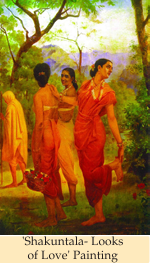
He was born in princely state of Travancore in 1848. He was the first and most prominent Indian painter associated with the Company style of modern painting. He was conferred with title of Kaisar-i-Hind by Lord Curzon. He gained popularity by painting the stories of Nala and Damayanti and Dushyanta and Shankutala.
Abanindranath Tagore
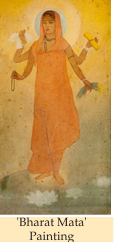
He was born at Jorasanko, Kolkata. He painted a Krishna Lila series in 1895 which represented a unique blend of 'Shakuntala- Looks of Love' Painting European and Indian traditions. He made the famous painting of Bharat Mata to inspire Indian nationalists during the anti-British struggle. His Arabian Night series created an impact on a global scale since it broke away from past Indian painting schools and introduced something fresh. He attempted to infuse Swadeshi values into Indian art and to lessen the influence of Western art styles on artists. Bharat Mata and other Mughal-themed paintings are among his most well known works.
Amrita Sher-Gil
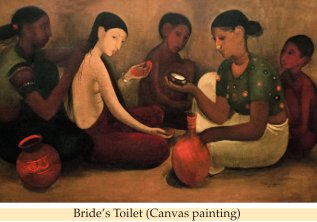
She is often referred as India’s Frida Kahlo. Many of her paintings have been conferred the status of National Art Treasures by Government of India. Bride’s Toilet is one of her most prominent works.
Nandalal Bose
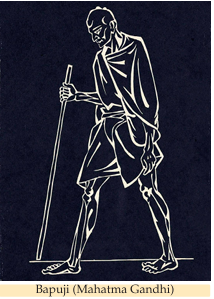
He was the disciple of Abanindranath Tagore. He became the principal of Kala Niketan in 1922. He is best known for his iconic white-on-black Gandhi sketch from the 1930s. He was also charged with the responsibility of illuminating the Indian Constitution's original document.
Prehistoric Paintings in India
The art of the painting has a long glorious history in the Indian subcontinent as progress in this field is started very early in the Stone age. Archaeologists have found wall paintings in parts of India, which suggest that even the early historic man in India was engaged in activities of art and leisure.
Murals were most common variety of paintings in ancient and medieval India. Both Fresco and Tempera techniques were used by Indian painters in making murals.
Mentions of Paintings
Vishnudharmottara Purana (written form in 5th century AD)
Vinaya Pitaka
Mudrarakshasa of Vishakhadatta
Vatsyayana’s Kamasutra
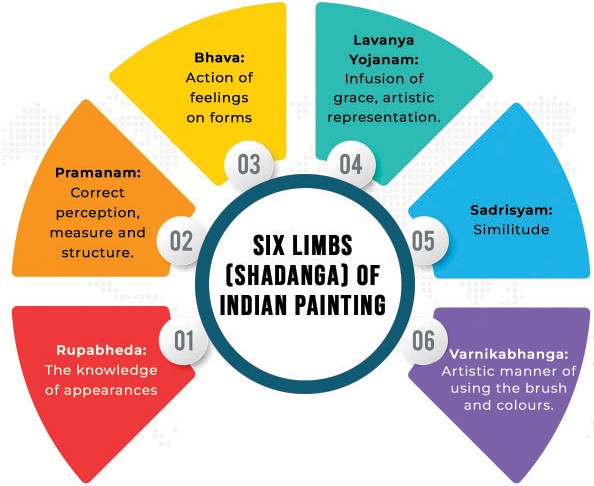
Six Limbs (Shadanga) of Indian Painting
In the 3rd century AD, Vatsyayana in his book Kamasutra enumerated about six main principles/limbs or Shadanga of paintings. They are:
PREHISTORIC PAINTINGS IN INDIA
The pre-historic paintings were generally executed on rocks and these rock gravings were called Petroglyphs. The first set of pre-historic paintings were discovered in Bhimbetka caves in Madhya Pradesh. There are three major phases of pre-historic paintings.
Upper Paleolithic Period (40,000-10,000 Bc)
The walls of the rock shelter caves were made of quartzite hence using minerals for pigments. One of the most common minerals was ochre or geru mixed with lime and water. To widen their palette, different minerals were used to make colours like red, white, yellow and green which widened their palette. The white, dark red and green were used to depict large animals like bison, elephant, rhino, tigers and boars. For the human figurines, red was used for hunters and the green mostly for dancers.
Mesolithic Period (10,000-4000 BC)
This period mainly saw the use of red colour. In comparison to the Upper Paleolithic Period, the size of the paintings became smaller during this period. One of the most common scenes depicted in these paintings is of group hunting and several other paintings depict grazing activity and riding scenes. Elephant, bison, tiger, boar, deer, antelope, leopard, panther, rhinoceros, fish, frog, lizard, squirrel and at times birds are also depicted. The Mesolithic artists loved to paint animals.
Chalcolithic Period (2000 BC to 700 BC)
This period saw an increase in the number of paintings using green and yellow colour. Most of the paintings seen depict battle scenes. There are many paintings of men riding horses and elephants. Some of them even carry bow and arrow which might indicate preparedness for skirmishes.
Prehistoric Painting Sites
Bhimbetka, Madhya Pradesh
It has about eight hundred rock shelters, five hundred of which bear paintings. These caves are located in the Lakhajauhar forest. The caves of Bhimbetka were discovered in 1957–58 by eminent
archaeologist V.S. Wakankar. The paintings at Bhimbetka belong to Upper Paleolithic, Mesolithic, Chalcolithic, early historic and even medieval period. However, most of the paintings belong to the Mesolithic age. The paintings generally portray every-day life of pre-historic men often in stick-like human figures. Various animals like elephant, bison, deer, peacock and snake are depicted. The paintings also show hunting scenes and war scenes with

men carrying weapons like bows, arrows, spears, shields and swords. Some paintings also have simple geometric designs and symbols. The other themes of the paintings are dancing, playing music, animal fighting, honey collection, etc. Social life is well-depicted with presence of children playing, women making food, community dancing, etc. Various colours like red ochre, purple, brown, white, yellow and green are used. Colours were obtained from natural resources, for example, Haematite ores were used for red colour.

Pre-historic Painting (Sites)
Mirzapur (Utta Pradesh)
Centre: Likhunia, Bhasauli, Lohri, Kohbar, Vijayagarh and Ahirora
Famous Paintings: The poaching scene of Sambhar using a spear. Scene of poaching a Barasingha and a poached wild pig.
Garhwal-Kumaon Region (Area of river Suyal, Uttarakhand)
Centres: Lakhudiyar (Almora) and Dalband (Chamoli).
Famous Paintings: Paintings of dancing humans, representation of human Figurine like a thin skin.
Panchmarhi Area (Mahadeva Hills, Madhya Pradesh)
Centres: Bazar Cave, Nimbbubhoj, Mahadeva, Mandadeva, Dorothi Island, Imli Khoh and Baniya Beri.
Famous Paintings: Collective poaching by men-women having prehistoric arms or a boomerang. The daily life scenes depicting the dancing, singing, grazing of cattles etc.
South Indian Sites
Kurnool, Betamcharla, Muchrla Chintiyani, Adoni, Balchakar, Odikadda, Tirupati, Reshpalli, Khowa, Warangal, Kazipet, Hasan Parti (Andhra Pradesh), Bellary (Karnataka) and Edkkal (North Kerala), Kupgallu, Piklihal and Tekkalkota.
Indian Mural Paintings
MINIATURE PAINTINGS IN INDIA
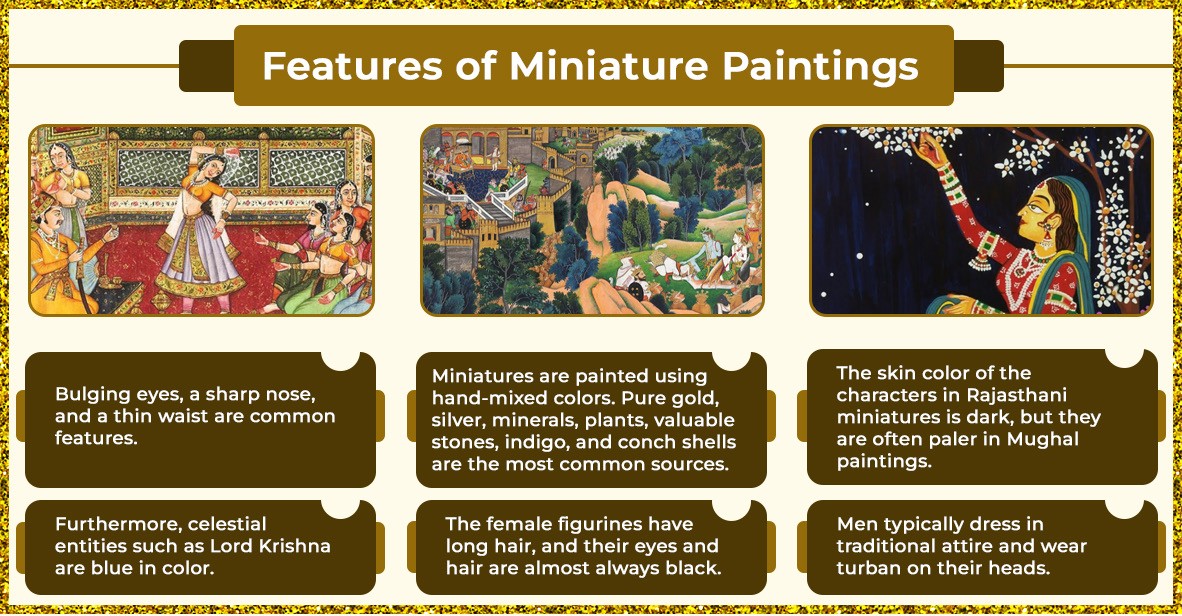
Miniature painting is an intricate form of art involving highly detailed paintings on a small scale. The Indian sub-continent has long tradition of these miniature paintings and many related schools developed that have difference in composition and perspective. Preconditions that are necessary to be fulfilled for making a Miniature painting are as follows:
The size of painting should not be larger than 25 square inches.
The subject of painting should be painted in not more than 1/6th of the actual size.
Early Miniature
Earlier, miniatures were frequently painted on perishable materials like paper, palm leaves and fabric for books or albums. The art of miniature painting emerged between the 8th and 12th centuries, virtually as a reaction to the massive wall paintings. This style of painting can be seen in both the eastern and western parts of the country.
Two well-known schools related to miniature painting are:
• Pala School of Art
• Apabhramsa School of Art
Pala School of Art
This school was flourishing during 750-1150 AD. These paintings are generally found as a part of manuscripts and were generally executed on palm leaf or vellum paper. These paintings are characterised by sinuous lines and subdued tones of the background imagery. There are lonely single figures in the paintings and one rarely finds group paintings. They have simple compositions and were patronised by some of those rulers who promoted Buddhism. The proponents of the Vajrayana School of Buddhism also used and patronised these paintings. The prominent painters were Dhimman and Vitapala.
Apabhramsa School of Art
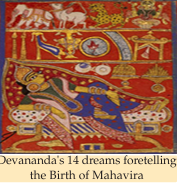
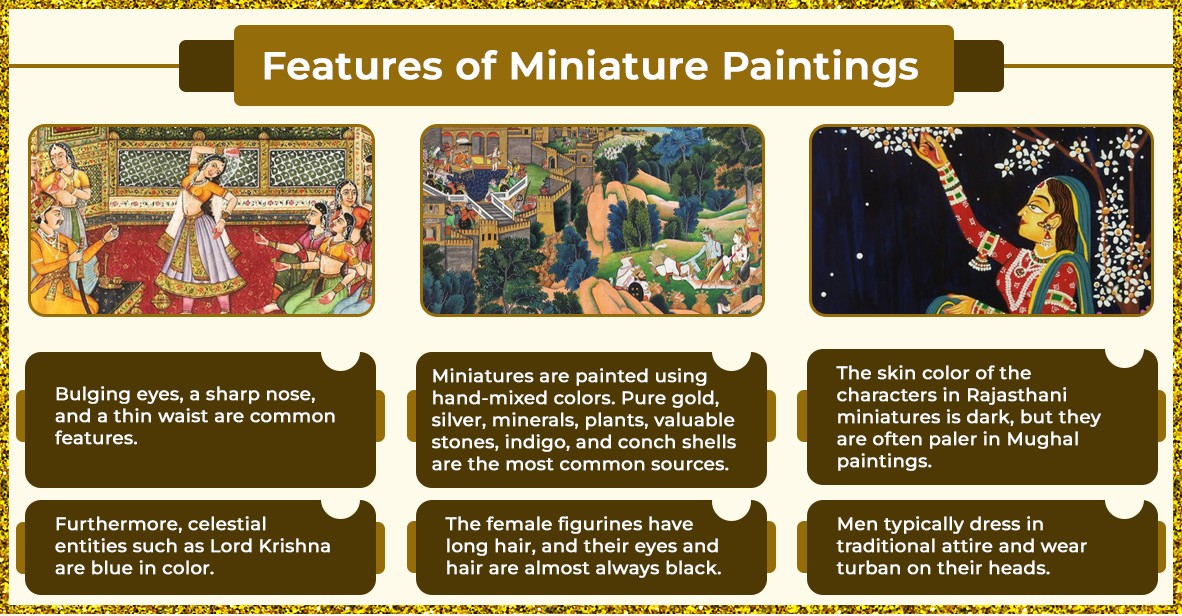
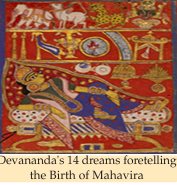
This school traces its origin to Gujarat and Mewar region in Rajasthan. It was the predominant school of painting in Western India during 11th to 15th century. The Jaina religion was the most prominent motif in these paintings and the Vaishnava School adopted it afterward. They included the concept of Gita Govinda and secular love in these artworks, which had previously been dominated by Jain imagery. The colors employed in the paintings were mainly red, yellow and ochre and they had symbolic value. They employed bright and gold colors in the final stages. Apabhramsa artists depicted human figures with fish shaped bulging eyes, pointed nose, double chin, angular face and female figure with large hips and breasts. Kalpasutra and Kalalacharyakatha are famous creations of Jain text by Apabhramsa artists.
Miniature Art During Delhi Sultanate
These paintings tried to bring together the Persian elements of their origin with the Indian traditional elements. They gave preference to illustrated manuscripts. Ex. Nimatnama (a book on cookery) during the reign of Nasir Shah who ruled over Mandu.
This manuscript shows the synthesis of the indigenous and Persian styles. Apart from that, a style known as the Lodi Khuladar was popular at this time and was practiced in many of the Sultanate-controlled districts between Delhi and Jaunpur.
According to Tarikh-i-Firozshahi of Shams-i-Siraj Afif, Sultan Firoz Shah Tughlaq banned the tradition of making paintings on the walls of the palace of Delhi.
Mughal Era Miniature Painting
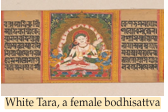
White Tara, a female bodhisattva Mughal paintings were an example of court art because progress was witnessed under the patronage of Mughal courts. They were influenced by Persian elements. Oil paintings were absent during this period. The Mughal paintings combined the realistic style of Persia with the grandeur of a vast empire to produce some stunningly illustrated folios. There was a change in colour palette, themes and forms. The focus shifted from depicting the god to glorifying the ruler and showing his life. They focused on hunting scenes, historical events and other court related paintings
DEVELOPMENTS IN PAINTINGS DURING MUGHAL ERA
Early Mughal Painters
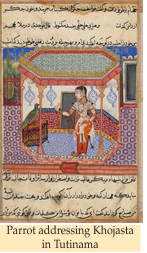
Babur, the founder of the Mughal empire in India, patronized the Persian artist Bihzad who made some illustrations of the Mughal family tree. Humayun, a great patron of the arts, ascended to the throne at a young age. He enjoyed painting and constructing beautiful monuments, but his atelier was disrupted when he lost the throne to Sher Shah Suri and was exiled to Persia. While at Shah Abbas' court in Persia, he hired two major painters, Abdus Samad and Mir Sayyid Ali, who stayed with him after he reclaimed his throne and established the Mughal dynasty in India. These artists were responsible for introducing Persian influences into Mughal paintings and produced a number of successful illustrated albums. They created an illustrated manuscript called Tutinama during Akbar's reign.
Akbar’s Era
• Akbar established a separate department for paintings known as Tasvir Khana where the artists were hired on salary and they developed their own styles. Akbar looked upon paintings as a means of study and amusement. The use of three-dimensional figures and the continued use of foreshortening are distinguishing features of Akbar’s paintings. The artists also encouraged the use of calligraphy in their paintings. One of the distinguishing features of this period was the transformation of popular art to court art, in which the artist was more concerned with depicting scenes of court life rather than scenes of popular life
• Daswant, Basawan, and Kesu are some of the most well known painters of this era. During Akbar’s reign, notably illustrated manuscripts include Tutinama, Hamzanama, Anvar-i-Suhaili, and Gulistan of Sadi.
Jahangir
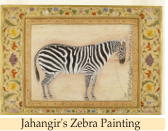
• During the reign of Jahangir, Mughal paintings achieved their pinnacle. By nature, he was a naturalist who loved paintings of flora and fauna, such as birds, animals, trees and flowers. He emphasized the importance of incorporating naturalism into portrait painting. One of the distinctive trends that emerged during this time period was the use of decorated margins around paintings that were sometimes as elaborate as the paintings themselves. Jahangir was regarded as a talented artist and he maintained his own private workshop, though no major works by him have survived. His atelier primarily produced miniature paintings, the most famous of which were naturalistic paintings of the zebra, turkey and cock.
• Ustad Mansoor, a master of drawing the features of the most complex faces, was one of his era's most famous artists. During his reign, an animal fable called Ayar i-Danish (Touchstone of Knowledge) was illustrated.
Shah Jahan
• During Shah Jahan’s reign, the tone of Mughal art shifted dramatically. In contrast to his father and grandfather, who preferred naturalistic images, Shah Jahan preferred to use artificial elements in his paintings.
• According to legend, he attempted to diminish the vitality of the paintings and introduce unnatural stillness as a result of European influence. He changed the drawing and painting techniques from the previous period. He discouraged the use of charcoal in drawing and instead encouraged the artists to draw and sketch with a pencil. He also directed that more gold and silver be used in the paintings. In addition, he preferred brighter color palettes than his predecessors
Miniature Paintings in India
MINIATURE PAINTINGS IN INDIA
Miniature painting is an intricate form of art involving highly detailed paintings on a small scale. The Indian sub-continent has long tradition of these miniature paintings and many related schools developed that have difference in composition and perspective. Preconditions that are necessary to be fulfilled for making a Miniature painting are as follows:
The size of painting should not be larger than 25 square inches.
The subject of painting should be painted in not more than 1/6th of the actual size.
Early Miniature
Earlier, miniatures were frequently painted on perishable materials like paper, palm leaves and fabric for books or albums. The art of miniature painting emerged between the 8th and 12th centuries, virtually as a reaction to the massive wall paintings. This style of painting can be seen in both the eastern and western parts of the country.
Two well-known schools related to miniature painting are:
• Pala School of Art
• Apabhramsa School of Art
Pala School of Art
This school was flourishing during 750-1150 AD. These paintings are generally found as a part of manuscripts and were generally executed on palm leaf or vellum paper. These paintings are characterised by sinuous lines and subdued tones of the background imagery. There are lonely single figures in the paintings and one rarely finds group paintings. They have simple compositions and were patronised by some of those rulers who promoted Buddhism. The proponents of the Vajrayana School of Buddhism also used and patronised these paintings. The prominent painters were Dhimman and Vitapala.
Apabhramsa School of Art
This school traces its origin to Gujarat and Mewar region in Rajasthan. It was the predominant school of painting in Western India during 11th to 15th century. The Jaina religion was the most prominent motif in these paintings and the Vaishnava School adopted it afterward. They included the concept of Gita Govinda and secular love in these artworks, which had previously been dominated by Jain imagery. The colors employed in the paintings were mainly red, yellow and ochre and they had symbolic value. They employed bright and gold colors in the final stages. Apabhramsa artists depicted human figures with fish shaped bulging eyes, pointed nose, double chin, angular face and female figure with large hips and breasts. Kalpasutra and Kalalacharyakatha are famous creations of Jain text by Apabhramsa artists.
Miniature Art During Delhi Sultanate
These paintings tried to bring together the Persian elements of their origin with the Indian traditional elements. They gave preference to illustrated manuscripts. Ex. Nimatnama (a book on cookery) during the reign of Nasir Shah who ruled over Mandu.
This manuscript shows the synthesis of the indigenous and Persian styles. Apart from that, a style known as the Lodi Khuladar was popular at this time and was practiced in many of the Sultanate-controlled districts between Delhi and Jaunpur.
According to Tarikh-i-Firozshahi of Shams-i-Siraj Afif, Sultan Firoz Shah Tughlaq banned the tradition of making paintings on the walls of the palace of Delhi.
Mughal Era Miniature Painting
White Tara, a female bodhisattva Mughal paintings were an example of court art because progress was witnessed under the patronage of Mughal courts. They were influenced by Persian elements. Oil paintings were absent during this period. The Mughal paintings combined the realistic style of Persia with the grandeur of a vast empire to produce some stunningly illustrated folios. There was a change in colour palette, themes and forms. The focus shifted from depicting the god to glorifying the ruler and showing his life. They focused on hunting scenes, historical events and other court related paintings
DEVELOPMENTS IN PAINTINGS DURING MUGHAL ERA
Early Mughal Painters
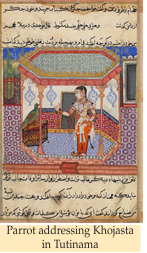
Babur, the founder of the Mughal empire in India, patronized the Persian artist Bihzad who made some illustrations of the Mughal family tree. Humayun, a great patron of the arts, ascended to the throne at a young age. He enjoyed painting and constructing beautiful monuments, but his atelier was disrupted when he lost the throne to Sher Shah Suri and was exiled to Persia. While at Shah Abbas' court in Persia, he hired two major painters, Abdus Samad and Mir Sayyid Ali, who stayed with him after he reclaimed his throne and established the Mughal dynasty in India. These artists were responsible for introducing Persian influences into Mughal paintings and produced a number of successful illustrated albums. They created an illustrated manuscript called Tutinama during Akbar's reign.
Akbar’s Era
• Akbar established a separate department for paintings known as Tasvir Khana where the artists were hired on salary and they developed their own styles. Akbar looked upon paintings as a means of study and amusement. The use of three-dimensional figures and the continued use of foreshortening are distinguishing features of Akbar’s paintings. The artists also encouraged the use of calligraphy in their paintings. One of the distinguishing features of this period was the transformation of popular art to court art, in which the artist was more concerned with depicting scenes of court life rather than scenes of popular life
• Daswant, Basawan, and Kesu are some of the most well known painters of this era. During Akbar’s reign, notably illustrated manuscripts include Tutinama, Hamzanama, Anvar-i-Suhaili, and Gulistan of Sadi.
Jahangir
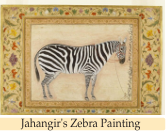
• During the reign of Jahangir, Mughal paintings achieved their pinnacle. By nature, he was a naturalist who loved paintings of flora and fauna, such as birds, animals, trees and flowers. He emphasized the importance of incorporating naturalism into portrait painting. One of the distinctive trends that emerged during this time period was the use of decorated margins around paintings that were sometimes as elaborate as the paintings themselves. Jahangir was regarded as a talented artist and he maintained his own private workshop, though no major works by him have survived. His atelier primarily produced miniature paintings, the most famous of which were naturalistic paintings of the zebra, turkey and cock.
• Ustad Mansoor, a master of drawing the features of the most complex faces, was one of his era's most famous artists. During his reign, an animal fable called Ayar i-Danish (Touchstone of Knowledge) was illustrated.
Shah Jahan
• During Shah Jahan’s reign, the tone of Mughal art shifted dramatically. In contrast to his father and grandfather, who preferred naturalistic images, Shah Jahan preferred to use artificial elements in his paintings.
• According to legend, he attempted to diminish the vitality of the paintings and introduce unnatural stillness as a result of European influence. He changed the drawing and painting techniques from the previous period. He discouraged the use of charcoal in drawing and instead encouraged the artists to draw and sketch with a pencil. He also directed that more gold and silver be used in the paintings. In addition, he preferred brighter color palettes than his predecessors
Regional School of Paintings
REGIONAL SCHOOL OF PAINTINGS
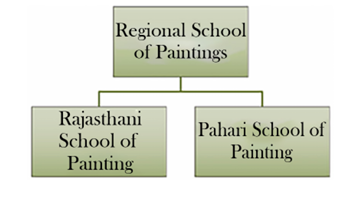
Even though the medieval period was dominated by the Mughal style of painting, the sub-imperial Schools developed by developing their own style
Rajasthani Schools of Painting
• The term ‘Rajasthani Schools of Painting’ refers to the schools of painting that flourished between the sixteenth and early nineteenth centuries in the princely kingdoms and thickens of what is now roughly Rajasthan and parts of Madhya Pradesh, such as Mewar, Bundi, Kota, Jaipur, Bikaner, Kishangarh, Jodhpur (Marwar), Malwa, Sirohi and other such principalities.
• Features of Rajasthani School of Painting:
• Impact of the cults of Vaishnavism, Shaivism and Sakti
• Bold lines and powerful contrasting colors
• The influence of the Mughals
• Use of paper, ivory and silk as canvas.
Mewar School of Painting
• Nathdwara and Deogarh were the main centres of Mewar school. The remarkable figure of Sahibdin dominates early Mewar paintings. The Rasikapriya, the Ramayana and the Bhagavata Purana are all shown by Sahibdin during this period of Mewari art. The style of Mewar paintings shifted after Sahibdin’s death. The majority of the paintings showed life in Mewar’s courts. The remarkable ‘tamasha’ paintings, which depict court rituals and city views in unprecedented detail, are a highlight of this period.
Kishangarh School of Painting
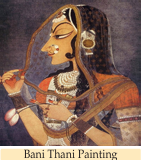
• The most romantic legends - Sawant Singh and his lover Bani Thani – and the merging of life and mythology, romance and bhakti are all shown in Kishangarh’s paintings. The Painting of Bani Thani was made by Nihal Chand. They also painted a lot about Radha and Krishna’s spiritual and romantic relationships.
Bundi School of Painting
• Hadoti is the name given to the twin kingdoms of Bundi and Kota. The sister republics, which were founded by splitting the elder Bundi kingdom between two brothers, have histories and artistic traditions that are inextricably linked. The monarchs of Bundi and Kota were devoted Krishna believers, and in the 18th century, they declared themselves to be mere regents, ruling on behalf of the god who was the genuine king (similar worship patterns can also be seen in Udaipur and Jaipur). Paintings of natural vegetation were detailed in the Bundi school. In the artwork, human faces were spherical with a pointy snout. The sky is painted in various colors, with a red ribbon visible most of the time.
Amber-Jaipur School of Painting
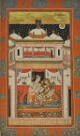
• The Amber school is also known as the ‘Dhundar’ school, and its oldest evidence can be seen in Rajasthan's Bairat wall paintings. The palace walls and mausoleum of Amer palace in Rajasthan also have some paintings. Despite the fact that some of the guys are depicted in Mughal-style attire and headdress, the paintings have a folk-style finish. In the 18th century, during the reign of Sawai Pratap Singh, this school attained its pinnacle. Suratkhana, or painting department, produced miniatures to accompany the Bhagavata Purana, Ramayana, Ragamala and a variety of portraits
Marwar School of Painting
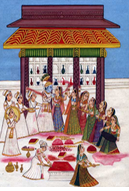
• Jodhpur and Bikaner, both controlled by the Rathods and Jaisalmer, ruled by the Bhati dynasty, make up one of the vast schools of painting. Jodhpur, like Bikaner, was a desert kingdom that prospered thanks to its ties to the Mughals. The men and ladies in paintings from the 15th and 16th centuries wore brightly coloured attire. They followed Mughal traditions throughout this time, but after the 18th century, the Rajput element grew more prominent, as seen by an influx of paintings with a linear rhythm and bright colors. Many excellent paintings may be seen in the Jodhpur atelier but the attention has always been on the exceptional paintings created during Man Singh’s (1803-1843) reign and beyond
Pahari School of Paintings
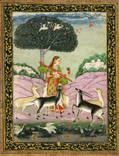
• Pahari painting is an umbrella word for a type of Indian paintings that originated in the Himalayan hill kingdoms of North India and are mainly done in miniature size. In terms of design and colour, it is quite comparable to Rajput paintings. These paintings were largely done in miniature painting forms throughout the era of the 17th to 19th centuries when they were formed and developed. Pahari painting evolved from Mughal painting, albeit it was primarily patronised by Rajput rulers who dominated many sections of the region and it gave rise to a new idiom in Indian painting
• Based on their regional diversity, Pahari paintings in India can be divided into two groups.
• Basohli and Kullu Style - Chaurapanchasika style
• Guler and Kangra Style - Calm colours and modification Features of Pahari school of painting
• The representation of the eternal love of Hindu deities Radha and Krishna is the core topic of Pahari art.
• Multiple figures appear on the canvas, all of them are animated.
• The composition, colour and pigmentation of each figure are unique
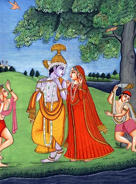
Jammu Kashmir Style of Pahari School of Painting
Basohli Paintings
• Basohli Paintings are famous in the Kathua region of Jammu and Kashmir. This town has produced a remarkable Devi series, a spectacular series of the Supreme Goddess’s incarnations. The exquisite portrayal of the Rasamanjari text is likewise well-known. Basohli paintings are characterised by geometrical designs, brilliant colours and shiny enamel.
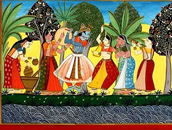
Jammu Paintings
• Jammu paintings have a striking resemblance to Kangra paintings. Jammu painters created the Shangri Ramayana in the late 17th and early 18th centuries.
Jasrota Paintings
• Jammu and Kashmir is home to the majority of Jasrota paintings. It revolves around kingly events, court scenes, symbolic scenes and so on.
Mankot Paintings
• Paintings from Mankot can be found in Jammu & Kashmir. It looks a lot like the Basohli kind. It makes use of vibrant colours and striking subjects. Portraiture became a popular motif in the mid-seventeenth century. Later on, realism and muted colours became more prominent.
Himachal Pradesh Style of Pahari School of Painting
• Chamba Paintings
The style of Chamba paintings is comparable to that of Mughal art. It is heavily influenced by the Deccan and Gujarat painting styles.
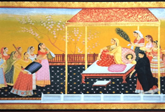
Bilaspur Paintings
• Around the mid-seventeenth century, this town witnessed the growth of Pahari art. Painters created paintings on coverlets for sacraments and rites in addition to the Bhagavata Purana, Ramayana and Ragamala series.
Guler-Kangra Style Paintings
• Around the year 1800, the Guler Kangra painting style was formed. It was a naturalised version of the artwork, with noticeable differences in the treatment of the eyes and face modelling. Landscapes were also frequently shown in Guler Kangra art. This style also emphasised Indian women’s grace and delicacy.
Garhwal Paintings
• When painters from outside the region settled in Srinagar, Garhwal Paintings began. The Mughal style was first dominant. Later, it came to reflect a more straightforward interpretation of Kangra customs.
Kulu Paintings
• Two Madhumalati manuscripts, the Bhagavata Purana and other Kulu-style paintings are included.
Mandi Paintings
• From 1684 through 1727, Mandi witnessed the birth of a new school of painting under Raja Sidh Sen. The king was depicted as a monstrous person with exaggeratedly large heads, hands and feet in the paintings. Other pieces featured geometric configurations and delicate, realistic features.
Nurpur Paintings
Himachal Pradesh is home to the Nurpur paintings. Bright colours and flat backgrounds are common in Nurpur paintings. Later periods substituted subdued colours for the bright ones.
South Indian Miniature Painting
SOUTH INDIAN MINIATURE PAINTING
The practice of creating miniature paintings was already well-established in the South Indian states throughout the early medieval period. Because of the climate, these schools differed from those in northern India.These paintings have a lot of gold in them. They also focussed their efforts. Much more time is spent drawing celestial creatures than it is spent painting rulers.
The following are some of the most well-known schools:
Tanjore painting
Mysore painting
Tanjore Painting
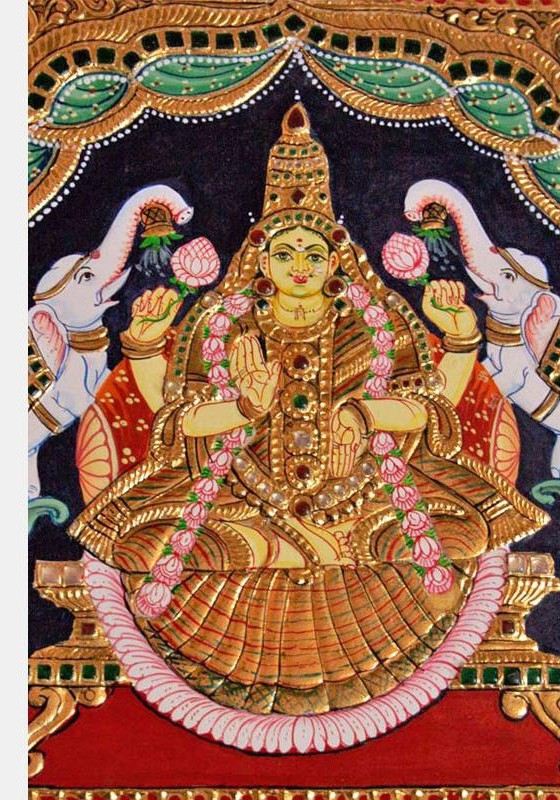
The Thanjavur or Tanjore School is known for its unique decorative painting style. It was patronized by the Maratha rulers. These paintings are primarily made of glass and board rather than the traditional cloth and vellum used in north
India. Rich vibrant colours, abundant use of gold leaf are features of Tanjore paintings.
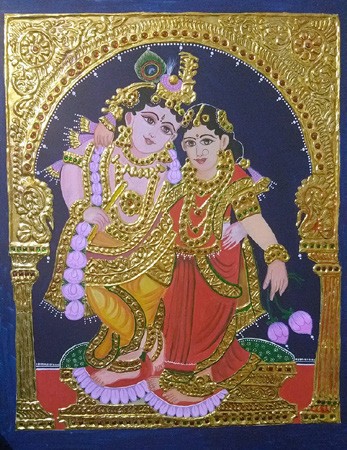
The majority of the paintings showed Krishna smiling in various stances and highlighted numerous significant events in his life.
Mysore Painting
The rulers of Mysore province were patrons of these paintings, which lasted under the British period as well. The representation of Hindu gods and goddesses is a key motif in the Mysore paintings. Lord Shrinath, an incarnation of Lord Vishnu was most notable theme.
They employ ‘gesso paste,’ which is zinc oxide and Arabic gum mixture. This provides the painting with a distinct foundation that produces a gloss over the backdrop. Main Centres: Sravanabelagola, Bengaluru, Tumakuru, Narasipura and Nanjanagudu
Modern Indian Paintings
MODERN INDIAN PAINTINGS
Modern Indian painting came into existence during the period of the British rule in India as a result of migration of some European painters. Oil colours were used in these modern paintings.
Company School/ Patna School/ Kasim Bazaar School
This branch of modern Indian paintings was characterized by predominance of European themes. Scenes from the life of Jesus Christ and European buildings were portrayed.
Patna and Kasim Bazaar (Bihar) were its main centres. William Reynolds, George Chinnery and Emile Eden were associated European painters. Later on Amrita Sher-Gill and Raja Ravi Varma were also associated with this school.
Bengal School of Art
• This School emerged at the end of 19th century when the nationalist movement commenced. Bengal was the main centre as it was the home of the strongest spirit of nationalism.
• Bharat Mata painting made by Abanindranath Tagore is the finest creation of this school. Paintings were made to inspire the Indian nationalists busy in their struggle against British rule. Gajendranath Tagore, Nandalal Bose and Jemini Roy were other famous painters belonging to this school. It is also known as Shanti Niketan School and Nationalist school.
Bazaar Paintings
• This school was also influenced by the European encounter in India. They were different from the Company paintings as that school mixed European techniques and themes with Indian ones. The Bazaar school did not take any Indian influence but adopted the Roman and Greek influence.
• They made the painters to copy the Greek and Roman statues. This school was prevalent in Bengal and Bihar region. Apart from the Greco-roman heritage, they made paintings of everyday bazaar that showed Indian bazaars with European background. One of the most famous genres was depiction of Indian courtesans dancing before the British officials. They also painted religious themes but the figures of Indian Gods and Goddesses with more than two axes and elephant faces like that of Lord Ganesha were prohibited as they deviated from the European notion of natural human figurine.
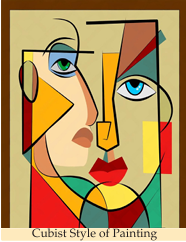
Cubist Style of Painting
• Painting’s cubist trend was influenced the by European Cubist movement. The artefacts were broken, analysed and then reassembled in this method. Through the use of abstract art forms, the artist rebuilt this process on the painting. They attempted to attain the ideal balance of line and colour.
• M.F Hussain, who created the ‘Personification of Romance’ series of paintings, was one of India's most popular cubist artists.
Folk Paintings
Folk Paintings
| PAINTING & LOCATION | DESCRIPTION | PICTURE |
| MadhubaniPainting (Mithila Painting) (Mithila region, Bihar) | The art can be found in Nepal’s Terai region and its surrounding areas. The paintings all have a common theme and are usually inspired by Hindu religious motifs such as Krishna, Rama, Durga, Lakshmi and Shiva. It has 3 styles viz. Brahmin, Tatoo and Kshatriya style. The figures in the painting are symbolic, for example, fish depicts good luck and fertility. Madhubani paintings are thought to have originated during the Ramayana period when the ruler of Mithila instructed his subjects to paint the walls and floors of their homes in honor of Sita and Rama’s marriage. | |
| Patua Arts (West Bengal) | It began as a local custom in which artists would tell Mangal Kavyas or auspicious stories about Gods and Goddesses. These paintings are done on pats or scrolls | |
| Pattachitra (Odisha) | The paintings combine classical and folk themes, with a slight preference for the latter. Cloth is used to make these paintings. These are inspired by Bhakti movement and predominated by religious themes. Hindu Gods are depicted in these paintings. Pattachitra on palm leaf is known as talapattachitra. | |
| Kalighat Paintings (West Bengal) | Originated in the area around the Kalighat Kali Temple of Kolkata. Depicts Hindu deities and other mythological characters. Country’s first of their sort, expressing subaltern sentiments and directly addressing customers. | |
| Paitkar Paintings (Jharkhand) | One of the ancient schools of painting practised by tribal people of Jharkhand. cultural association with Ma Mansa, one of the most popular goddesses in tribal household. |
| Kalamkari Painting (Andhra Pradesh) | Natural dyes are used on cotton and silk fabric to make painting. Use of a date palm or bamboo stick with pointed end and a bundle of hair attached to it to make their brush or pen. Kalahasti and Masulipattanam are the main centres. Figures have sharp features and high-level ornamentation. It has received GI tag status. | |
| Warli Paintings (Sahyadri region of Gujarat Maharashtra border) | Close resemblance to the mural paintings of Bhimbetka in Madhya Pradesh. Theme revolve around the marriage of God Palaghat. These ritualistic paintings have a central motif of a chaukat or chauk, which is surrounded by scenes portraying fishing, hunting, farming, dances, animals, trees and festivals. | |
| Thangka Paintings (Sikkim, Himachal Pradesh, Ladakh region & Arunachal Pradesh), | Thangkas are painted on a base of cotton canvas (white background) with paints made from natural vegetable dyes or mineral dyes. Thangkas were originally adopted as a form of veneration, evoking Buddhism’s ultimate ideals. The colours used in the paintings have their own significance. | |
| Manjusha Paintings (Bhagalpur, Bihar) | Angika art is another name for it, with ‘ang’ referring to one of the Mahajanapada. It’s also known as snake painting since snake patterns are constantly present. These paintings are done on jute and paper cartons. | |
| Phad Paintings (Rajasthan) | It is a scroll-type art that is mostly seen in Rajasthan. It is religious in nature, with depictions of local deities such as Pabuji and Devnarayan. They are 15 feet or 30 feet long and painted with vegetable colors on a long piece of cloth called Phad. The subjects have round features and wide eyes. They often feature pompous and cheerful narratives as well as scenes of the procession. | |
| Pithora Paintings (Gujarat and Madhya Pradesh) | The paintings are done by some tribal communities of Gujarat and Madhya Pradesh and is said to serve religious and spiritual purpose. They are painted on the walls of the houses to bring peace and prosperity. They are drawn on special family occasions as a ritual. Depiction of animals are common especially horses. |
| Saura Paintings (Odisha) | They are made by saura Tribe of Odisha and are similar to Warli paintings. It is essentially a wall mural painting and is ritualistic. The saura wall paintings are generally dedicated to Idital, the main deity of the sauras. The painting is done mostly in white, while the backdrop of painting is red or yellow. The colours are extracted from minerals and plants. The human shapes are geometrical and stick-like. |
Conclusion
Ancient Indian painting, with its rich and diverse heritage, stands as a testament to the enduring artistic creativity and cultural richness of the Indian subcontinent. Our exploration of this vibrant tradition has revealed that Indian painting is not just a visual art form; it is a reflection of the nation’s spirituality, history and social fabric.
Throughout the ages, Indian painting has evolved, adapting to the changing cultural and historical landscapes of the region. From the stunning murals of Ajanta and Ellora to the intricate miniature paintings of the Mughal courts, from the colorful Pattachitra of Odisha to the spiritual depictions of gods and goddesses, Indian painting encompasses a vast array of styles, techniques and themes.