Sculptures of Post Mauryan Age
SCULPTURES OF POST MAURYAN AGE
During this age Mathura school, Gandhara School and Amaravati school emerged and flourished. It is mainly associated with Buddhism.
Gandhara School
It flourished in north western parts of Indian subcontinent and emerged in second half of 2nd century. It is also known as Graeco-Buddhist School of art as it is based on Greco- Roman norms and techniques.
• Assimilating various traits of Acamenian, Parthian and Bactrian traditions into the local tradition is a hallmark of the Gandhara style.
• Materials used were blue-grey Mica schist / Grey Sandstone.
• Kushanas and shakas were the chief patrons of the school.
Major Centres: Jalalabad, Hadda, Bamaran, Begram & Taxila were the main centres where art pieces of Gandhara School have been found.
The Buddha image of Gandhara Art: The Gandharan Buddha image was inspired by Hellenistic realism, influenced by Persian, Scythian, and Parthian models.
• In contrast with Mathura School, the Gandhara School images are known for their anatomical accuracy, spatial depth, and foreshortening.
• In this art, Buddha’s curls were altered into wavy hair. The head of the Buddha matched very much with Greek God Apollo.
• Image of Buddha statue (Gandhara style)
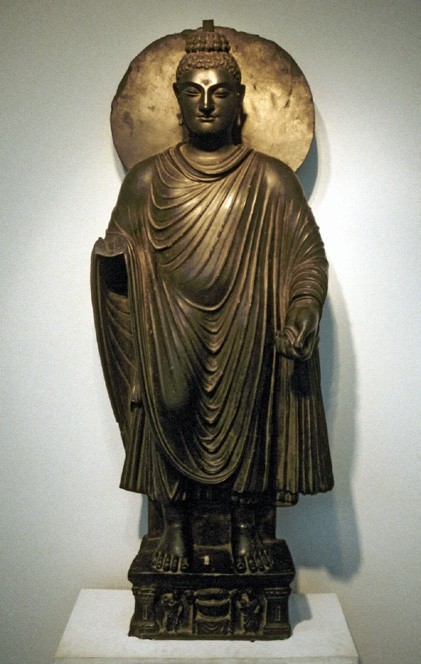
Example: Buddhas of Bamiyan, Afghanistan
Mathura School
The Gandhara and Mathura Schools of Art thrived during the first century AD, particularly under the reign of the Kushan emperor Kanishka. The Mathura School developed organically in India.
The main center for production in the Mathura School was Mathura, with other important hubs in Sarnath and Kosambi. ¾ The primary material used was spotted red sandstone.
Notable masterpieces of the Mathura School include statues of Wema Kadphises, Kanishka, Parkham Yaksha, Maholi Bodhisattva, and seated Kubera. Buddha Images: Before the emergence of this school, Buddha was never depicted in human form at sites like Sanchi, Barhut, or Gaya.
¾ Buddha was represented solely by symbols, such as footprints or wheels.
¾ Artists from Mathura initially continued to use these symbols but gradually began to create a human representation of Buddha, independent from other artistic traditions.
¾ These early human images of Buddha were inspired by Yaksha figures. However, anatomical accuracy was not a priority, and the images combined the 32 major and 80 minor marks (laksana) associated with Buddha. The early Buddha and Bodhisattva images were fleshy and joyful, with little spiritual depth. Their forms were block-like, with smooth, tight-fitting robes that lacked folds
By the second century AD, the figures became more sensual and rotund.
• By the third century AD, the excessive roundness was reduced, and the figures became more refined.
• This trend continued into the fourth century AD, with further reductions in mass and fleshiness, and the flesh appearing more taut. The Buddha’s halo became highly decorated.
As the human form of Buddha evolved, it came to symbolize beauty and heroic ideals.
• Both sitting and standing poses of Buddha and Bodhisattvas were sculpted in the Mathura style.
• The finest examples of standing Buddha images from this school can be found in Sravasthi, Sarnath and Kausambi.
Vaishnava and Shaiva Images
Although Buddhist images dominate the Mathura region, images representing the Vaishnava and Shaiva faiths are also found here.
Jaina Images:
• The Sarvatobhadrika image, featuring four Jinas standing back-to-back, is another notable work from the Mathura School.
• The Standing Buddhas of the Sravasthi, Sarnath and Kausambhi are finest example of Buddha image under this school.
Vaishnava and Shaiva images:
The images of Vaishnava and Shaiva faiths are also found at Mathura but Buddhist images are found in large numbers.
Jaina Images
The Sarvatobhadrika image of 4 Jinas standing back-to-back belongs to the Mathura school.
Amaravati School
The Amaravati school of art developed between the lower valleys of the Krishna and Godavari rivers in
Andhra Pradesh.
A distinct type of art originated and flourished at Amaravati for around six centuries between 200 and 100 BCE.
The ‘narrative art’ is a prominent feature of the Amaravati school.
White marble was most
used common material.
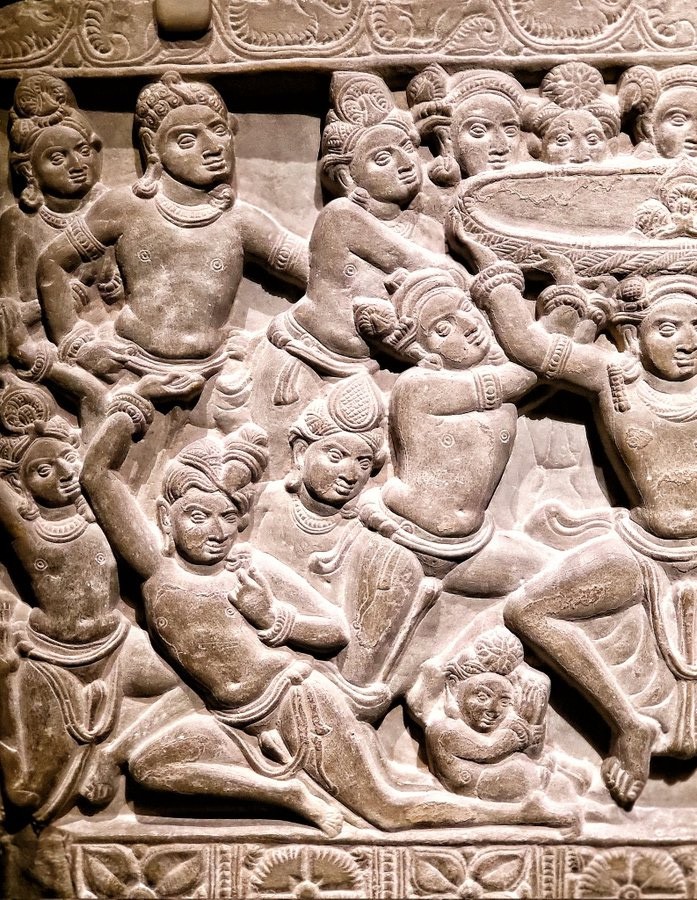
Sculpture of Amaravati School
Satavahanas were the first patrons of this school.
• Along with Satvahans, Ikshavaku and Vakataka
were patrons of this school.
• It was associated with Buddhism only.
• This style included both religious and secular images.
Pallava and Chola buildings evolved from this style later. Amravati, Nagarjunikonda, Goli, Ghantasala, and Vengi are notable locales where this style flourished.
Difference Between Sculpture and Architecture
Sculpture was the favoured medium of artistic expression on the Indian subcontinent. The subject matter of Indian sculpture was almost invariably abstract human forms that were used to instruct people in the truths of the Hindu, Buddhist, or Jain religions.
Difference between Sculpture and Architecture
| ARCHITECTURE | SCULPTURE |
| It is the art of the designing and constructing buildings. | It is purely an expression of human creativity. |
| They have some external meaning associated with them. | It carries some meaning in itself. |
| More than one person are engaged to design different parts of architecture. | Sculpture is an art of individual. |
| Work of architecture generally involves use of different materials. | Sculpture is made up of one material. |
| 3-dimensional but relatively larger in size | 3-dimensional but relatively smaller in size. |
| Works of architecture has usable hollow space inside. | There is no such hollow space inside. |
| Interior constitutes a special component and special attention is given to their designing. | Interiors are absent |
| Architecture involves aesthetic appeal. | Sculpture involves creative appeal. |
| Palaces, forts, temple, mosques, etc. | Figures of kings, queens, animals etc. |
Sculptures of Indus Valley Civilisation
SCULPTURES OF INDUS VALLEY CIVILISATION
In the second millennium, the arts of the Indus Valley civilization, one of the earliest in the world, emerged.
Sculptures, seals, ceramics, gold jewelry, terracotta figurines and other forms of art have been found at numerous archaeological sites of this civilization.
The primary materials used for sculptures included stone, bronze, terracotta, clay and others.
Stone Sculpture
• Male Torso: The Male Torso is a red sandstone figure with socket holes in the neck and shoulders for attaching the head and arms.
• The Male Torso was discovered at Harappa, one of the major town of Indus Valley Civilization
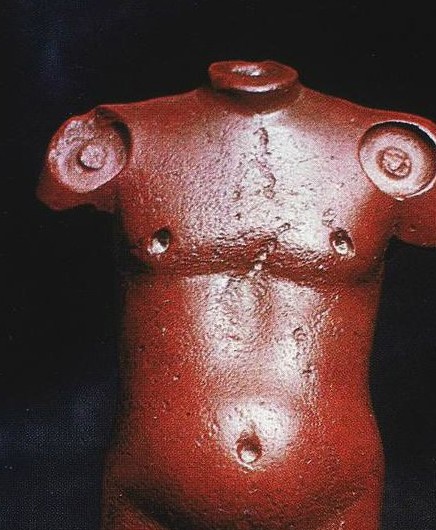
Mal e Torso
• The frontal posture of the torso is deliberately chosen.
• The shoulders are skillfully carved and the abdomen appears slightly prominent.
• This nude male torso is regarded as a significant piece, with its balanced lines comparable to the exquisite art of Gandhara from two thousand years later.
• It was discovered from the Harappa, a major city of the Indus Valley Civilization.
• Bearded Priest: This steatite figure of the bearded man interpreted as a priest or priest king is draped in a shawl coming under the right arm and covering the left shoulder.
• It was discovered from Mohenjo-Daro.
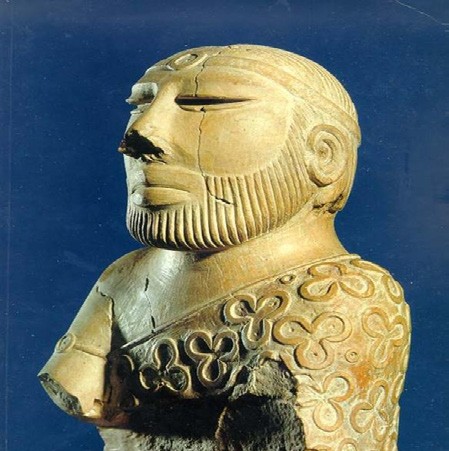
Bea rded Priest
• His shawl is decorated with trefoil patterns.
• His eyes are a little elongated, and half-closed as in meditation. The nose is well formed and of medium size; the mouth is of average size with close-cut
moustache and a short beard and whiskers; the ears resemble double shells with a hole in the middle.
• The hair is parted in the middle, and a plain-woven fillet is passed round the head.
• An armlet is worn on the right hand and holes around the neck indicate a necklace.
•
The shawl on the shoulder of the bearded priest indicates that the handicraft of embroidery was commonly practiced in Indus Valley Civilization.
• It was discovered from Mohenjo-daro in Sindh, present day Pakistan.
Bronze Sculpture
Bronze Sculpture

B ronze Nataraja & Bronze Dancing Girl
Bronze casting was conducted on a large scale in practically all of the civilization’s main sites.
The technique used for Bronze Casting was Lost Wax Technique.
Lost Wax Technique

Lost Wax Technique
Bronze casting was widely practiced during the Indus Valley Civilization, especially at Harappa, using the “lost wax technique.”
This method continues to be practiced in regions like Himachal Pradesh, Odisha, Bihar, Madhya Pradesh, and West Bengal.
Each region applies a slightly different technique. First, the bee wax is melted over an open fire and strained through fine cloth into cold water.
The wax quickly solidifies and is then passed through a pharni, forming noodle-like wires.
These wax wires are shaped to form the entire image, which is then covered with a paste made of clay, sand, and materials like cow dung.
On one side, an opening is kept. When it becomes dry, the wax was heated and the molten wax was drained out through a tiny hole. The hollow mould thus created was filled with molten metal which took the original shape of the object.
Dancing Girl: This is one of the best- known artefacts from the Indus Valley. It’s a four-inch-high copper figure, found in Mohenjodaro.
It depicts a girl whose long hair is tied in a bun. Bangles cover her left arm, a bracelet and an amulet or bangle adorn her right arm, and a cowry shell necklace is seen around her neck.
Her right hand is on her hip and her left hand is clasped.
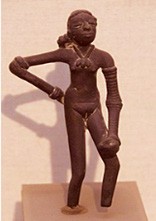
She is resting her weight on one leg in a very natural fashion, as in the contrapposto techniques of later sculptures.
The girl seems to be in what is called Tribhanga posture.
The jaunty manner and liveliness of the figure are remarkable. She is full of expression and bodily vigour and conveys a lot of information.
Terracotta Sculptures
Terracotta Sculptures
Numerous terracotta seals and figurines have been found at Harappan sites, ranging from toys to cult objects, such as the Mother Goddess, and representations of birds, animals, including monkeys, dogs, sheep, cattle, and both humped and humpless bulls.
The terracotta figurines of the Indus Valley are detailed, especially in their eyes, hands, and necks.
However, in terms of human representation, terracotta figures are less refined than the copper and bronze sculptures of the Indus Valley.
Among the human figurines, female figures are more common, and their headgear is often more elaborate.
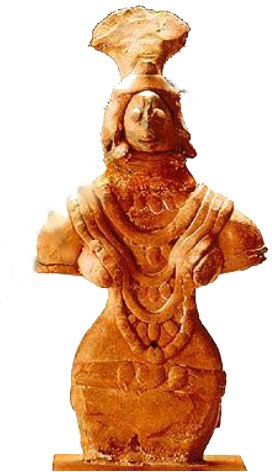
Mother Goddess: One of the most significant terracotta figures from the Indus Valley is the Mother Goddess.
This figure is a crude standing female adorned with necklaces over her prominent breasts, wearing a loincloth and girdle.
The distinctive feature of these figurines is a fan- shaped headdress, with cup-like projections on each side.
The rest of the facial features are very crude and far from realistic.
The most distinct feature of the mother goddess figurines is a fan-shaped head-dress with a cup-like projection on each side.
Rest of the facial figures are very crude and distant from being realistic
Sculptures of Mauryan Age
SCULPTURES OF MAURYAN AGE
• The Mauryan period saw significant advancements in Indian sculpture.
• Mauryan sculptures can be divided into two categories: court art and popular art.
Court Art:
• During the Mauryan era, stone sculpture reached new heights, and bright polish was applied to the stone surfaces.
• Mauryan art is known for its mirror-like polish and the wide range of creations.
• This art appears in stone pillars, railings, parasols, capitals, animal and human sculptures, and various other motifs.
• The finest examples of Mauryan court art are the numerous monolithic columns with majestic animal capitals.
Mauryan Pillars:
Typically, each column consists of two parts: the shaft and the capital. The shaft, circular and slightly tapered, is made from a single block of stone with graceful proportions.
The capital, also monolithic, is divided into three sections: an inverted lotus (often called a ‘bell’), an abacus, and a crowning sculpture.
• Both the shaft and capital are finely chiselled with remarkable precision.
• The bell is decorated with stylized lotus petals, featuring sharp and thin ridges in the center.
• Stone pillars were erected across the Mauryan Empire, often with inscriptions.
The capital figures atop the pillars include representations of animals like bulls, lions, and elephants.
Each capital stands on a square or circular abacus, which is adorned with stylized lotus designs.
Key sites where these pillars have been found include Basarah-Bakhira, Lauriya-Nandangarh, Rampurva, Sankisa, and Sarnath.
The pillars were carved from two types of stone: spotted red and white sandstone from the Mathura region, and buff- colored, fine-grained sandstone with small black spots from Chunar near Varanasi.
PILLAR EDICTS AND INSCRIPTIONS
• The seven pillar edicts of Ashoka have been discovered in Topra (Delhi), Meerut, Kausambhi, Rampurva, Champaran, and Mehrauli:
• Asoka’s idea of people protection is enshrined in Pillar Edict I.
• Pillar Edict II: Defines Dhamma as having the least sins, the greatest number of virtues, compassion, liberality, honesty, and purity.
• Pillar Edict III: Removes sins such as harshness, cruelty, rage, and pride, among others.
• Pillar Edict IV: Addresses the responsibilities of Rajukas.
• Pillar Edict V: A list of animals and birds that should not be slaughtered on certain days, as well as a separate list of species that should not be killed at all.
• Dhamma policy is the sixth pillar edict.
• Asoka’s work towards Dhamma policy is documented in Pillar Edict VII.
Minor Pillar Inscriptions
• Inscription on the Rummindei Pillar: Asoka’s visit to Lumbini and the exemption of Lumbini from taxation.
• Inscription on the Nigalisagar Pillar in Nepal: Asoka extended the height of Buddha Konakamana’s stupa to twice its original size.

Major Pillar Inscriptions
• Sarnath Lion Capital was erected by Ashoka in Varanasi to commemorate Dhammachakrapravartana or Buddha’s first discourse.
• Single lion on Vaishali Pillar in Bihar, with no inscription
• Uttar Pradesh’s Sankissa Pillar
• Champaran, Bihar: Lauriya-Nandangarh
• Champaran, Bihar: Lauriya-Araraj
• Uttar Pradesh’s Allahabad pillar
Lion Capital at Sarnath
The Mauryan pillar capital found at Sarnath popularly known as the Lion Capital, which is now our national symbol, is considered to be the finest example of Mauryan sculptural tradition.
It consists the shaft, which is broken in many parts now, a lotus bell base, a drum on the bell base with four animals proceeding clockwise and the figures of four majestic lions.
The capital without the crowning wheel and the lotus base has been adopted as the National Emblem of Independent India.
The four voluminous roaring lion figures firmly stand on a circular abacus which is carved with the figures of four animals – a striding elephant, a galloping horse, a walking bull and a prancing lion.
Four lions placed back-to-back face the cardinal directions, indicating the spread of dharma.
These are formal and stylised and are reminiscent of the Persian tradition
Pillar at Vaishali
• The Asokan pillar at Vaishali is different from the earlier
• Ashokan pillars because it has only one lion capital.
• Location of this pillar is contiguous to the site where a Buddhist monastery and a sacred coronation tank stood.
• The lion faces north, the direction Buddha took on his last voyage.
Asoka Pillar at Allahabad
In Allahabad, there is a pillar with inscriptions from Ashoka and later inscriptions attributed to Samudragupta and Jehangir.
• The pillar is located inside the Allahabad Fort. It is assumed that the pillar was first erected at Kaushambi an ancient town some 30 kilometres west of Allahabad that was the capital of the Koshala kingdom.
• The Ashokan inscription is in Brahmi and is dated around 232 BC.
Pillars at Lauriya-Nandangarh and Lauriya-Areraj
The column at Lauriya-Nandangarh, 23 km from Bettiah in West Champaran district, Bihar has single lion capital. The hump and the hind legs of the lion project beyond the abacus
• The pillar at Lauriya-Areraj in East Champaran district, Bihar is devoid of any capital.
Popular Art
• The popular art of the Mauryan period is characterized by images of Yakshas and Yakshinis. Yakshas are nature spirits, often benevolent and associated with fertility, while Yakshinis are their female counterparts.
• Yakshas are also linked to one of the ancient tribes of India and are considered guardians of natural treasures.
• They feature prominently in Hindu, Jain, and Buddhist literature and are frequently depicted in religious monuments of Buddhism and Jainism.
In India, large statues of Yakshas and Yakshinis, typically in standing poses, have been found in locations such as Patna, Vidisha, and Mathura. A common feature of these statues is their polished surface and finely detailed facial features.
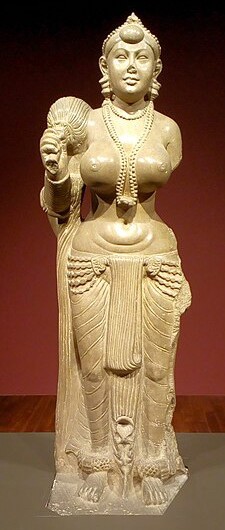
Didarganj Yakshini, Patna
Didarganj Yakshi (Chauri Bearer)
One of the finest examples of popular Mauryan art is the Yakshi figure from Didarganj, Patna. This tall, well- proportioned, free-standing sculpture in sandstone features a polished surface, showcasing the artist's skill in handling both form and material. The Yakshini holds a chauri (flywhisk) in her right hand, while her left hand is broken.
• The sculpture demonstrates the artist’s keen attention to the muscular female form. The folds of muscles are clearly defined, and the tightening of the garment around the belly emphasizes a bulging effect.
• The lower garment is crafted with great precision. Every fold on the legs is depicted through protruding lines, clinging to the legs and creating a slightly transparent effect.
• The figure's torso is portrayed with notable heaviness, reflected in the pronounced breasts and strong, impressive back.
Elephant Sculpture at Dhauli, Odishas
The rock cut sculpture of Elephant in Dhauli, near Bhubneshwar in Odisha represents the fore-part of an elephant carved over the Edicts of Aśoka, including the two specially meant for Kalinga. In the modelling and execution of this elephant figure, one may recognise a note and feeling different from those manifested in the animal figures surmounting the pillar capitals.
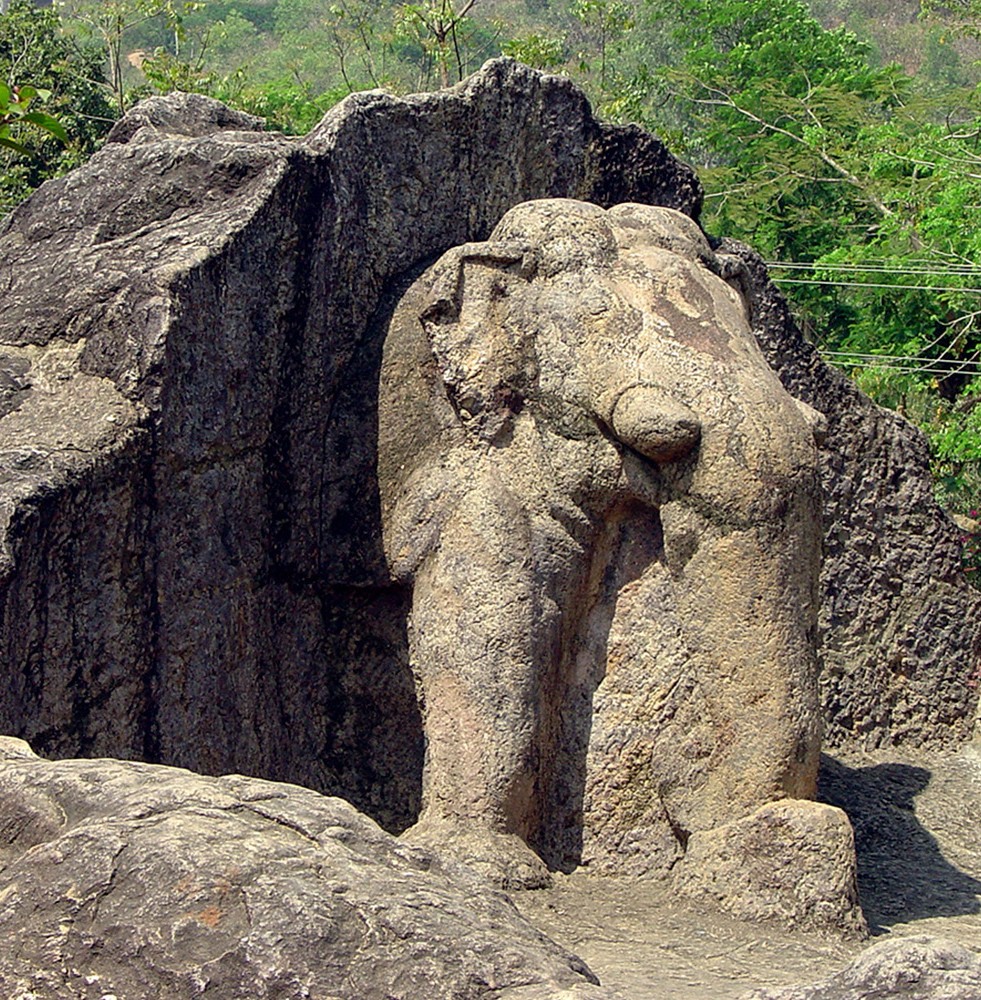
• It represents a fine delineation of bulky volume and living flesh, natural to that animal, along with a dignified movement and linear rhythm that has no parallel except in the elephant figure in relief on the abacus of the Sarnath capital.
Facades of Lomas Rishi Cave
• The rock-cut cave carved at Barabar hills near Gaya in Bihar is known as the Lomas Rishi cave.
• The facade of the cave is decorated with the semi- circular chaitya arch as the entrance.
• The cave was patronised by Ashoka for the Ajivika sect. The Lomas Rishi cave is an isolated example of this period.
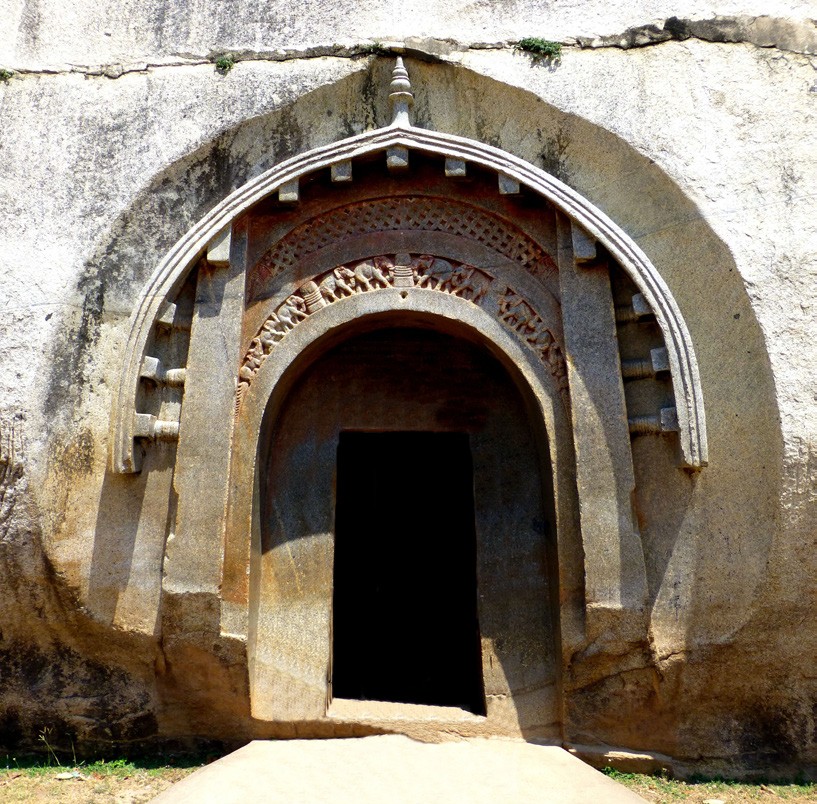
Lomas Rishi cave, Barabar hills
Sculptures of Gupta Age
SCULPTURES OF GUPTA AGE
During this period, Banaras school of art came into existence.
It is also known as Sarnath school of art.
• Sculpture of this age are simple, sober and grateful.
• They represent of synthesis of between symbolism of post-Maruyan period and nudity of early medieval age.
• Made of stone as well as metal. Gupta artists introduced Ekamukhi and Chaturmukhi Shiva Lingas
Sarnath school of Art
The Sarnath School of Sculpture arose around Sarnath. It was distinguished by its use of cream-colored sandstone and metal.
This school’s sculptures were meticulously dressed and devoid of any type of nakedness.
Many Buddha pictures in Sarnath have plain translucentdrapery
covering both shoulders and a sparsely ornamented halo around the head, whereas the Mathura Buddha images retain the folds of the drapery and the halo around the head is lavishly embellished.
A notable example: Sultanganj Buddha (7.5ft in height).
Other famous sculptures of Gupta period: The great
Varah figure of Udaygiri, Mehrauli iron pillar etc.
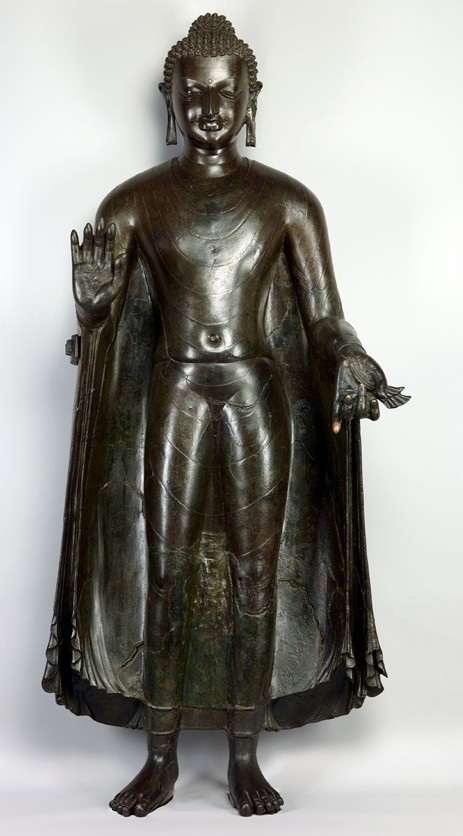
Image : Sultanganj Buddha
South Indian Sculptures and Other Developments
SOUTH INDIAN SCULPTURES
Pallava Sculptures: The Pallava style concerns itself with a tall and slender physiognomical form.
The thin and elongated limbs emphasize the tallness of the figure.
Examples: Mahishasurmardini in relief, Girigovardhanapanel, Arjuna’s penance or
the Descent of the Ganga, Trivikrama Vishnu, Gajalakshmi and Anatasayanam.
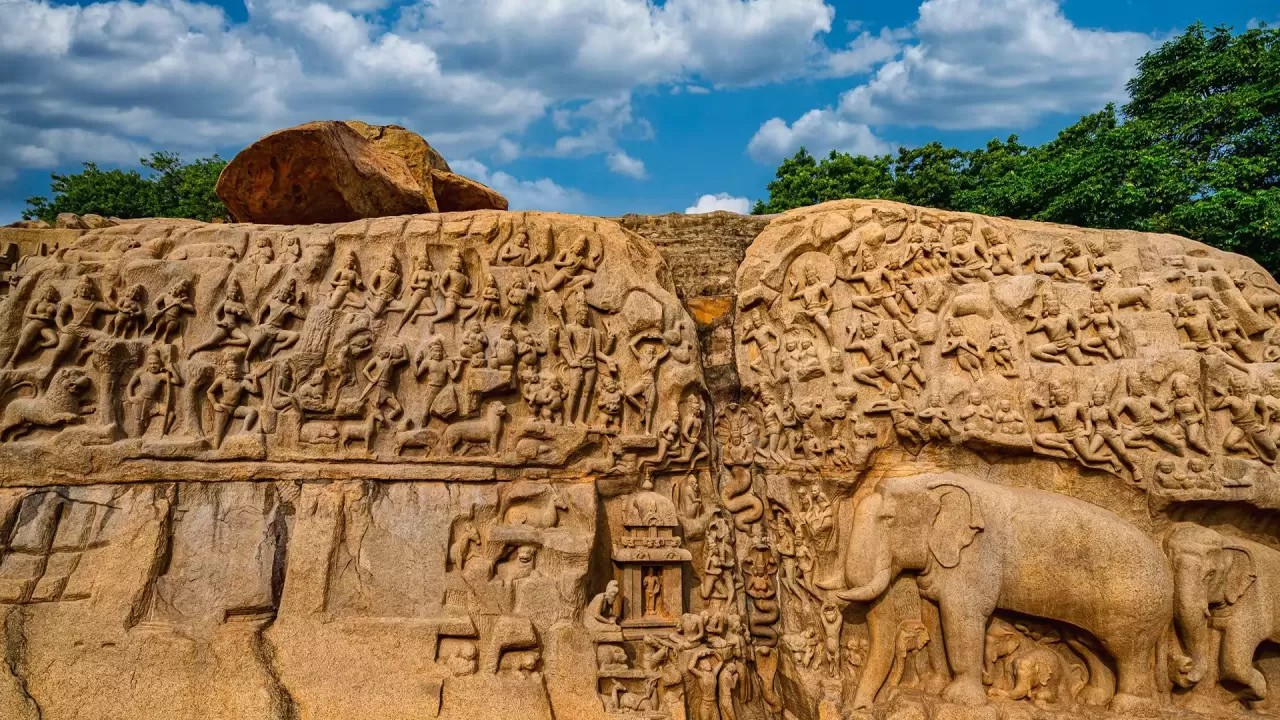
Arjuna's Penance sculptu re at Mahabalipuram
Rashtrakuta Sculptures: In the middle of the 8th century, the Rashtrakutas wrested power from the Chalukyas. They created the greatest wonder of medieval Indian art in their Kailasa temple at Ellora.
Examples: Rock sculpture from Cave No.29 at Ellora shows the marriage of Siva and Parvati and also a panel depicting Ravana shaking Mount Kailasa.
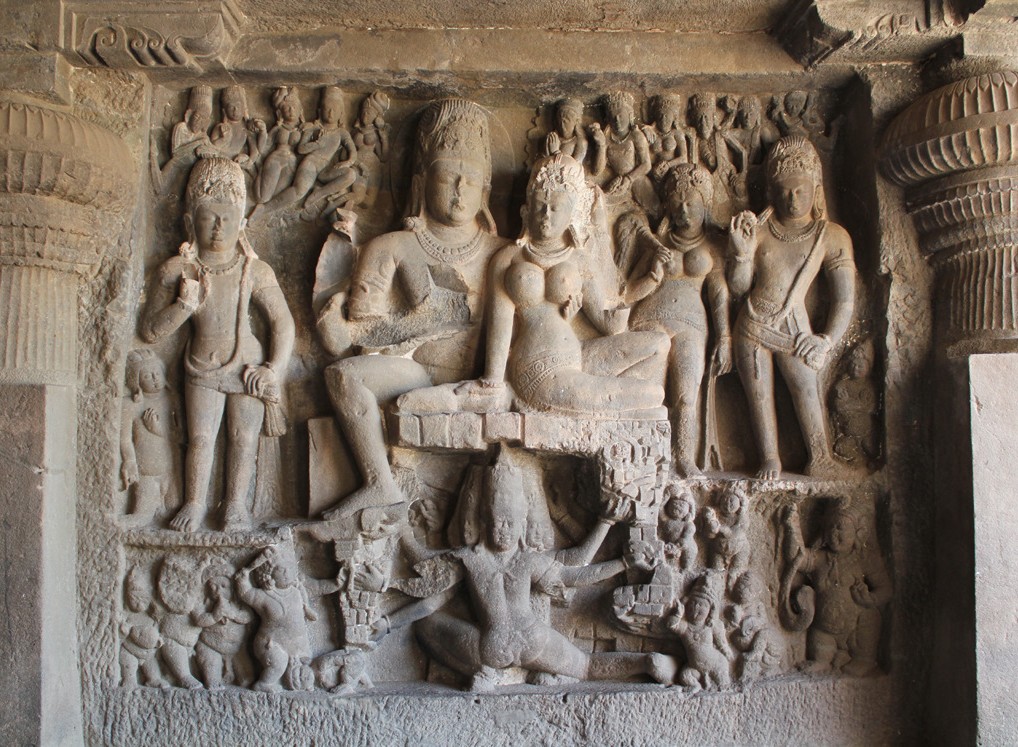
Ravana shakin g Mount Kailasa, Ellora Cave- 29
Chola Sculpture: Brihadisvara temple at Tanjavur is the most mature and majestic of the Chola temples. The sculpture there has attained a new maturity which is evident in the gracefully modelled contours of the figures, their flexed poses, delicate ornamentation, pleasing faces and certain freshness, all of

Nataraja Sculptu re
Other Important Developments of Indian Sculptures
Sculptures of Kandariya Mahadev temple at Khajuraho: They were constructed under the rule of Chandellas in 950 to 1100 AD.
• Sculptures have slender taller figures with a considerable accentuation of linear details.
• The Khajuraho temples feature a variety of artwork, of which 10% is sexual or erotic art outside and inside the temples.
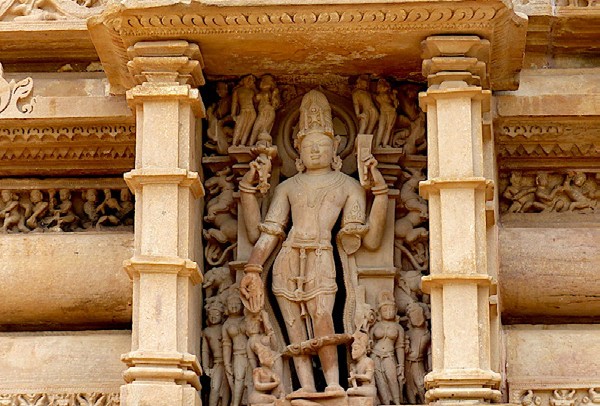
Statues of Gods (Khajuraho Temples)
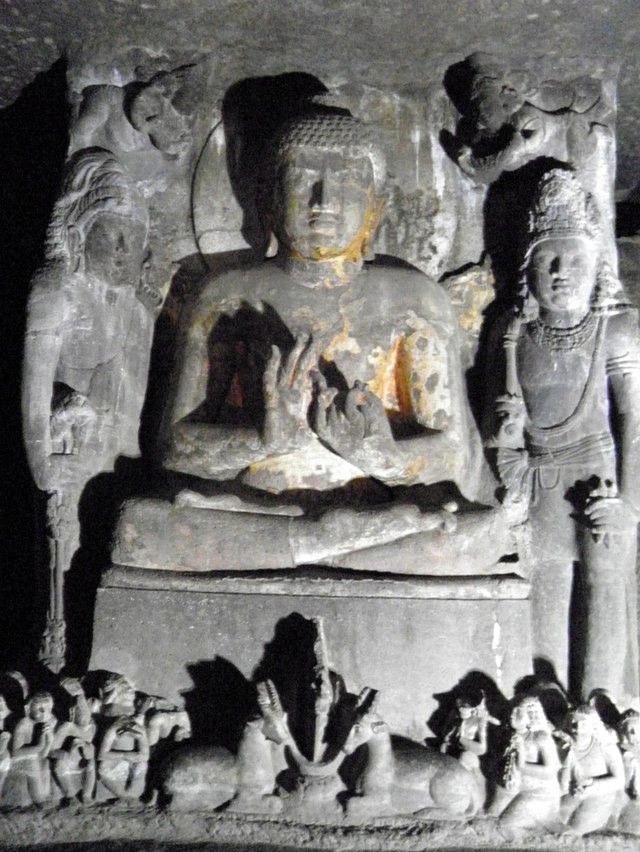
• Ajanta Cave Sculptures: The sculpture of Ajanta belongs to the great art-tradition of contemporary India. Sculpture from the 4th century AD, is remarkable for its grace, elegance, restraint and serenity. However, the general character of the sculpture of Ajanta tends towards a certain heaviness of form, and is considered inferior to the Gupta images. Every one of the sculptures was plastered and painted. But most of the plaster is now lost.
Prominent Sculptures at Ajanta:
• Naga King and his Consort, Cave 19
• Maha pari nirvana, Cave 2
• Hariti shrine, Cave 2
which add charm to the work.
• Chola art not only influenced the art of Ceylon, but it travelled as far away as Java and Sumatra.
• Nataraja images of Chola period represents climax in field of sculpture. They were made up of bronze with lost wax technique.
Conclusion
The world of ancient Indian sculptures is a mesmerizing realm where stone, metal and clay are transformed into expressions of divinity, humanity and the eternal quest for beauty and truth. Our exploration of this profound tradition reveals that Indian sculpture is not merely a collection of stone carvings or metal castings; it is a profound spiritual and artistic endeavor that has shaped the cultural heritage of the subcontinent.
Ancient Indian sculptures embody a remarkable diversity of forms, styles and subjects reflecting the multifaceted nature of Indian culture and spirituality. From the intricately detailed temples of Khajuraho to the serene Buddha statues of Sarnath, from the majestic reliefs of Ellora to the divine icons of Hinduism, Indian sculptures tell stories of devotion, creativity and the human spirit.
One of the defining features of ancient Indian sculptures is their capacity to convey deep spiritual and philosophical concepts. Whether in the depiction of gods and goddesses, the enlightened visage of Buddha or the intricate reliefs illustrating mythological narratives, these sculptures serve as powerful conduits for transmitting profound spiritual ideas to the masses.