Jainism
INTRODUCTION


Vardhaman Mahavira has been accepted as the founder of Jainism. He was the 24th and the last
Thirthankara (teacher) of the jains. He was born at Vaishali, the capital of the Vajji tribe. His father Siddhartha was the chief of a clan of Kshatriyas. At the age of thirty, Vardhaman left his house in search of truth. He gave up the life of ease and pleasure and became an ascetic. He was accompanied by Makkhali Gosala who later founded the Ajivika Sect. He undertook penance and meditation for twelve years before the truth was revealed to
him. At the age of 42 years, under a Sal tree at Jambhikagrama on the banks of the river Rhijupalika Mahavira attained Kaivalya or Supreme Knowledge. From then on, he was called Kevalin jina (perfectly learned), jitendriya (one who had conquered his senses), Arhant (blessed one), nrigrantha (free from all bonds), and Mahavira (the brave). He delivered his first sermon at Pava to his 11 disciples (known as 11 gandharas/gandharvas). Later, he founded a jaina sangh (jain commune) at Pava. He died in 468BCE at Pavapuri, Bihar.
The word Jaina is derived from ‘jina’ which means the conqueror of desires. Jainism rejects the authority of the Vedas like Buddhism but it does believe in the concept of atman or eternal soul. Atman is the fundamental focus in Jaina Philosophy. There were 23 Tirthankaras or great-learned men in Jain religion before Mahavira. The 1st tirthankara was Rishabha or Adinatha, 23rd Tirthankara was Parshavnath and the last was Mahavira.
Parshavnath gave Chaturthi concept of the Jains which lays down that one should follow these values:
Ahimsa (non-violence)
Satya (truth)
Asteya (non-stealing)
Aparigrah (non-possession or minimalism
• Mahaviraadded Brahmacharya or celibacy/non- indulgence
There are two forms of the five vows:
• Mahavrata: The above 5 vows followed by Jain monks and nuns.
• Anuvrata: The first five vows, anuvratas, or partial
vows (anu, “tiny,” as contrasted with maha, “big”), are more moderate versions of the mahavratas: abstinence from gross violence, gross falsehood, and gross stealing; contentment with one’s own wife; and limitation of one’s possessions.
Jain Teachings and Philosophy
Jains believe that non-injury is the highest religion. Jains aim to live in such a way that their jiva (soul) doesn’t get any more karma, and so that the karma it already has is either eliminated or helped to decay. They do this by following a disciplined life path.
The path or Dharma (truth, teaching) that Mahavira advocated was one of strict asceticism, renunciation and moral cultivation. He instructed his followers to cultivate the three jewels of:
• Samyak Shraadha/Vishwas (Right belief)
• Samyak jnana (Right knowledge)
• Samyak Karma/Aacharna (Right conduct)
Types of knowledge under the Jains:
• Mati Gyan- perception through sense organs
• Shruta Gyan- knowledge revealed by scriptures
• Avadhi Gyan- Clairvoyance or the supposed faculty of perceiving things or events in the future or beyond normal sensory contact.
• Manaparaya Gyan- telepathic knowledge
• Keval Gyan- temporal knowledge or omniscience
Syadvada- 'The theory of maybe/perhaps'
• All judgements are necessarily relative, conditional and limited. According to Syadvada, seven modes of prediction (Saptabhangi nyayavada) are possible.
• Absolute affirmation or negation are both wrong. It is closely related to Anekantavada.
• Every being has numerous properties. The permanent property that constitutes the nature of a thing is called as its attribute or guna.

• Our knowledge is partial and relative because of passion, greed, anger, lust, etc. obstruct our knowledge.

• All souls (jivas) are potentially equal because all of them are naturally endowed with four infinites (anantacatusatya)
Other beliefs/value systems
• Rejected the authority of the Vedas
• Did not believe in the existence of Gods
• Believe in karma and transmigration of soul theory
Eight auspicious symbols (Ashtamangala) under Jainism

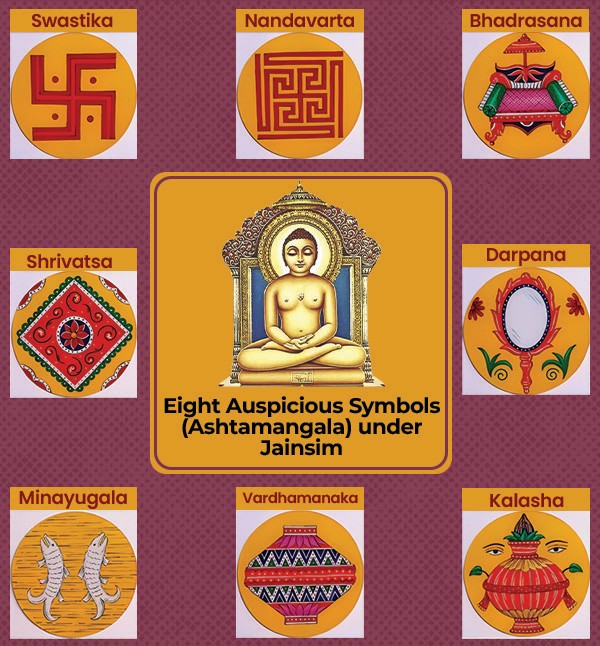
• Laid great emphasis on social equality
• Every object even the smallest particle has soul/atman.
• Karma is the bane of the soul and must be ended.
• Surest way of annihilating karma is through penance.
• Cycle of birth and rebirth are shaped through karma. Ascetism and penance are required to free oneself from the cycle of karma. This can be achieved only by renouncing the world; therefore, monastic existence is a necessary condition to attain salvation.
• Siddhachakra is a popular yantra or mystical diagram used for worship. It is also called as Navapada in the Shwetambara and Navadevta in the Digambara traditions.
Two Major Schools or Sects under Jainism
Jainism has two major ancient sub traditions:
Digambaras [Sub-sects include Mula Sangh (original community) and Terapanthi, Taranpathi and Bispanthi (these three are modern communities)]
Svetambaras (Sub-sects include Sthanakavasi and
Murtipujaka) There are several other smaller sub- traditions that emerged in the 2nd millennium AD.
Digambara School
• Monks of the Digambara tradition practice complete nudity, as they believe in renouncing all possessions, including clothing.
• Female monks, known as Aryikas, wear plain, unstitched white sarees.
• Digambaras adhere to the five principles of Ahimsa (non- violence), Satya (truth), Asteya (non-stealing), Aparigraha (non-attachment), and Brahmacharya (celibacy) as taught by Mahavira, in contrast to the Svetambara tradition.
• Bhadrabahu, a prominent figure in the Digambara sect, relocated to Karnataka with his followers after predicting a long famine.
• The earliest written record of Digambara beliefs is found in the Prakrit Suttapahuda by Kundakunda.
• Digambara Jains believe that women cannot be Tirthankaras, and they hold the view that Malli was a male Tirthankara.
• Monastic rules are more stringent in the Digambara tradition compared to the Svetambara sect.
Digamabara Jain Sects
• Mula Sangha: It was ancient Jain monastic order and Acharya Kundajunda was the founder of this sect.
• Kashta Sangha: Loharcharya was the founder of this sect. Mathura Sangha, Bagada gacha, Nanditat gachchha and Lata-bagada gacha are the branches of this sect.
• Digambara Terapanth: It was started by Amra Bhaunsa Godika and Jodhraj Godika. It was popular around Jaipur Rajasthan.
• Taranapanth: Taran Swami was the founder of this sect. It was popular in Bundhelkhand region. This sect did not practice idol worshipping.
Svetambara School
• Svetambaras follow the preachings of Parshvanatha, i.e. they believe in only four restraints (except Brahmacharya) to be followed to attain Kevalya.
• Svetambaras believe that the 23rd and 24th tirthankara did marry, unlike as thought by Digambara sect.
• Sthulabhadra was a great exponent of this school and stayed in Magadha unlike Bhadrabahu who went to Karnataka.
• The monks of Svetambara School can have simple white clothing, a begging bowl, a brush to remove insects from their path, books and writing materials with them.
• They believe tirthankaras can be men or women, and say that Malli began her life as a princess.
• Svetambara tradition of Jainism indicates five eternal substances in existence: Soul (Jiva), Matter (Pudgala), Space (Akasha), Motion (Dharma) and Rest (Adharma),

unlike Digambaras which added the sixth eternal substance as Time (Kala).


• While the Shwetambaras believed that women could achieve Kaivalya, Digambaras believe that women cannot achieve Kaivalya as they cannot follow all the rules of the sangh rigidly. So, they should follow all possible rules, get their next life as a man and then work toward
Svetambara Jain Sects
• Sthankakavasi: This sect was founded by Lavaji in 1653 AD. It opposes idol worship. It does not consider idol worship essential for purification of soul and attainment of Nirvana.
• Murtipujaka: Idols of Tirthankaras are worshipped by this sect and related rituals are also followed.
• Sventambara Terapanth: Acharya Bhikshu was the founder of this sect. This sect opposed idol worship.
Popular Practices Under Jainism
• Sallekhana – It is a religious practice of voluntarily fasting to death by gradually reducing the intake of food and liquids. It is not considered as a suicide by Jain scholars because it is not an act of passion, nor does it deploy poisons or weapons. It can be performed by both for Jain ascetics and householders.
• Pratikraman – It is a process during which Jains repent for their sins during their daily life, and remind themselves not to repeat them. The five types of Pratikarman include Devasi, Rai Pakhi, Chaumasi and Samvatsari.
Jain Literature
Mahavira used Ardha-Magadhi language to spread his ideas among the people. It was a variant of Prakrit language. Most of the Jain texts were written in Prakrit language. The most noted Jain literature are as follows:
14 Purvas
• Purvas were the oldest Jain scriptures that were preached by all Thirthankaras. They contained entire knowledge of this universe.
• Those who acquired knowledge of Purvas were accorded the high status of Shrutakevali (scripturally omniscient persons).
• Shrutakevali were just one step away from getting enlightened or attaining ‘Kaivalya Jnana’.
• Gautama Swami, Sudharman Swami and Jambuswami were the only persons after Mahavira to know Purvas.
• Parishishtaparvana by the Jain scholar Hemchandra informs us that the knowledge of Purvas was lost.
12 Angas
• The Angas consist of rules of conduct of Jain Sangha, Jain doctrine and teachings Mahavira.
•
They comprise of 12 primary texts that delve into various aspects of Jain Philosophy, ethics, cosmology, and conduct. Each anga focussed on a specific area of knowledge. These are Svetambara canonical scriptures.
• These were composed at the time of the first Jain council held at Pataliputra under Presidentship of Sthulabhadra.
• The 12th Anga was later lost.
12 Upangas
• The Upangas are appendices to 12 Angas.
• Upangas contain a range of topics. Fundamental beliefs of the Jain faith are discussed in them such as concept of the soul, karma, the cycle of births and cosmology.
10 Prakirnas
• The Prakirnas deal with doctrinal matters.
• These are written in verse form.
• They describe miscellaneous subjects related to Jain religion.
6 Chedasutras
• The Chedisutras contain rules for Jain monks and nuns.
4 Mulasutras
• The Mulasutras are associated with Svetambara sect of Jainism.
• They contain the basics of Jain doctrine.
• New monks and nuns studied these texts after their initiation into Jain Sangha.
Niryuktis and Churnis
• Niryuktis and Churnis are commentaries on Jain sacred texts.
• Niryuktis were composed in verse form.
• Churnis were composed in prose form.
Kalpasutra
• Kalpasutra contains biographies of Jain Tirthankaras
particularly Parshvanatha and Mahavira.
• It was composed by Bhadrabahu.
• It is read by Jain monks during the festival of Paryushan for general people.
• This festival continues for 8 days.
Acharanga Sutra
• Acharanga Sutra is one of the oldest Jain texts. It contains rules of monastic life.
• It is the first of the original 12 Angas, the original Acharanga Sutra was lost.

• The existing text of Acharanga Sutra was recompiled by bead of 2nd Jain council held at Vallabhi.
• Digambaras do not recognize the Acharanga Svetambara
Jains recognize and follow it.
JAIN COUNCILS
First Council: It was held in around 300 BC at Pataliputra under the Presidentship of Sthulabhadra and patronship of Chandragupta Maurya. It composed 12 Angas and relaxed rules of monastic life.
Second Council: It was held in 512 AD at Vallabhi (Gujarat) under the Presidentship of Devardhi Kshamashramana. This council was organized to recollect sacred Jain texts and to write them down systematically. The first 11 Angas composed at the first Jain council were written in Ardha-Magadhi language. The 12th Anga composed at the first council has been lost.
Relevance of Jain ideology in today’s world
The doctrines of Jainism with respect to the contemporary world situation are found to be very much relevant. With these doctrines of Jainism, we can bring back the peace and harmony in the society and the world.
• Anektavada highlights the spirit of intellectual and social tolerance in the world.
Differences Between Jainism and Buddhism
•
Non-violence: The principle of non-violence gained prominence in today's nuclear-weapon world to attain long-lasting peace in society.
• The principle of Aparigraha can help to control consumerist habits as there is a great increase in greed and possessive tendencies.
• The doctrine of Triratna is relevant to present-time situations, which can liberate the souls of women along with men from the subjugation to liberty and freedom.
Similarities Between Jainism and Buddhism
• Both religions believe in faith and Karma.
• Both of them are non-theistic religions.
• They both had a common background associated with the Aryan Culture.
• Both religions are founded by the Kshatriyas of Northern India.
• Both the religions were against Vedas and the Vedic culture as well as against Brahmanism.
• Both opposed the sacrifice of animals.
• Both the leaders in their religion preached Satya, Ahimsa, Brahmacharya, and detachment from the materialistic world.


| BUDDHISM | JAINISM |
| Rebirth is one of the principal beliefs in Buddhism. It is thought that the endless cycle of birth and re-birth can only be broken by attaining Nirvana (Enlightenment) | Jainism believes that the circle of rebirths and deaths will continue due to good or bad deeds until liberation is achieved |
| Scriptures include Tripitaka, which is a vast text consisting of 3 sections: the Discipline, the Discourse and the Commentaries. | Jain religious texts are called Agamas |
| The principal teaching of Buddhism is that life is suffering and to escape suffering (end cause of desire) one needs to dispel ignorance by realizing the Four Noble Truths and practising the Eightfold Path | Jainism lays emphasis on the respect of all living beings. Liberation from the cycle of rebirths is attained by taking the Five Vows and following the principles of the Three Jewels |
| Moderate and middle path is required for salvation. | Extreme acts are involved for attaining salvation. |
| Buddhism discarded rigorous asceticism. | Jainism believed in rigorous asceticism. |
| Sin is not a concept in Buddhism | Sin is defined as harm to others |
| Buddhism is divided into two major sects upon the death of Gautama Buddha. They are the Mahayana and the Theravada | Svetambara and Digambara are the two major sects of Jainism |


| According to some texts in Buddhism, there are beings in heaven but they are bound by “samsara”. They suffer less bu they ave, not yet achieved salvation | Deities in Jainism are known as 'Tirthankars'. But they are not worshipped in the conventional sense as they are regarded as wise teachers whose teachings must be followed |
| Buddhism was founded in modern-day Nepal by Prince Siddhartha in the 6th century B.C | Scholars of religion generally hold that Jainism originated in the 7th–5th century BC in Northern India. Mahavira, also known as Vardhamana was the 24th Tirthankara (Spiritual Teacher) of Jainism |
| Followers of Buddhism can be found mainly in Thailand, Cambodia, Sri Lanka, India, Nepal, Bhutan, Tibet, Japan, Myanmar (Burma), Laos, Vietnam, China, Mongolia, Korea, Singapore, Hong Kong and Taiwan | Followers of Jainism are found mainly in India, lower Asian subcontinent throughout, and America. |