Christianity
CHRISTIANITY

It is an Abrahamic, monotheistic religion based on Jesus of Nazareth’s life and teachings. Jesus lived almost 2,000 years ago in the region of Palestine (now part of Jordan and Israel) on the eastern shores of the Mediterranean Sea. He lived a life of poverty and humility.
Traveling on foot and preaching to the people, Jesus taught that men should love God and one another. Many people began to believe his teachings, but others misunderstood him. From his followers, Jesus had chosen twelve men to be his Apostles. According to them, Jesus appeared again, alive three days after his death. He then stayed on earth for 40 days before going to heaven. His Apostles set out to spread his teachings. The most famous of the Apostles were Saint Peter and Saint Paul, who founded many Christian churches. Their stories about the life of Jesus are written in the New Testament of the Bible. The early Christians were Jews but Christianity and Judaism separated in 381 A.D. The disciples of Jesus travelled to different parts of the Greco-Roman world and established many Christian churches. The basic philosophy of Christianity is the existence of one God who created the Universe. They also believe that after Jesus left earth, God’s presence was retained on Earth in the form of the Holy ghost or Holy spirit. In fact, Christians worship the Holy Trinity: the father (God), the son (Jesus) and the Holy ghost. The sacred text of the Christians is Bible.
It is believed that Saint Thomas, one of the disciples of Jesus travelled to India and reached Muziris (western coast). He established churches and his followers are known as Saint.
.
Hinduism
INTRODUCTION
The Indian subcontinent has a wide range of religions that define the morality and ethics of the people who follow them. Several communities live together and we have a range of religions that are practised in India. As hordes of people came to India in search of fertile lands as also to escape from cruel regimes, they also brought with them their cultures, a component of which is religion. Broadly, Indian religions can be divided in two categories: first, those which are of local origin and second, those which were introduced from other parts of the world. The spirituality of each religion is vested in the sacred books and physical spaces occupied by that particular religion. While religion is a complex issue, India’s brand of religious tolerance has a rich history and its model of secularism is appreciated world over. India has experienced far more years of religious peace and tolerance than periods of communal tension and disharmony. These ideas shape the composite culture of India and religions are an effective tool in that regard.

HINDUISM
The Hindu way of life is quite flexible in all respects, as it accepts into its fold almost any god and all devotees. There is no dogma and no single god or religious leader. Their rituals are colourful and festivities are very active. Through their rituals, Hindus interact closely with the divine images which are often housed in temples.
Hindus often travel for pilgrimages to holy rivers, mountains and temples in all corners of the country. Hindus call them sacred places or Tirtha and the act of going on a pilgrimage is called Tirthayatra.
According to Hindu traditions, Kama (pleasure), Artha (economic prosperity), Dharma (righteousness) and Moksha (salvation) are four important goals one should achieve in life. In the Upanishads, it is specified that there are four stages in life: Brahmachari (celibate students) who then graduates into grihasta (a householder). After an age he becomes a vanaprastha (a hermit) and the last stage in life is of a sanyasi (an ascetic).

Four Sects Under Hinduism
Vaishnavism: It considers Vishnu as the Supreme Lord. The tradition has traceable roots to the 1st millennium BC, as Bhagavatism, also called Krishnaism. The Vaishnava tradition has many sampradayas or sub-schools.
Shaivism: It considers Shiva as the Supreme Lord. Shaivism traces its origin before Vaishnaism in 2nd millennium BC in the form of the Vedic deity Rudra.
Shaktism: It considers feminine and the Devi or goddess as supreme. It is known for its various sub-traditions of Tantra.
Smartism: It is based on the teachings of Puranas. They believe in domestic worship of five shrines with five deities, all treated as equals: Shiva, Shakti, Ganesh, Vishnu and Surya. Smartism accepts two concepts of Brahman, namely Saguna Brahman - the Brahman with attributes, and Nirguna Brahman - the Brahman without attributes.
Under these four major traditions, there are various sub-sects or Sampradayas. These sects are teaching traditions with autonomous practices and monastic centers, with a guru lineage, and with ideas developed and transmitted by each successive generation of followers.
Prominent Sects under Vaishnavism
Varkari Sampradaya: The followers in this community are devotees of Lord Vitthal (A form of God Vishnu) and the worship is centered around temple of Pandharpur in Maharashtra. The sect strictly avoids alcohol and tobacco. Their annual pilgrimage Vari undertakes interesting events. Prominent figures under this sect include Jnaneshwar (1275-1296), Namdev (1270-1350), Eknath (1533-1599) and Tukaram (1598-1650).
Ramanandi Sampradaya: They follows the teachings of the Advaita scholar Ramananda. This is the largest monastic group within Hinduism, and these Vaishnava monks are known as Ramanandis, Vairagis or Bairagis. They worship Rama, one of the ten incarnations of Vishnu. These ascetics perform meditation and follow strict ascetic practices, but they also believe that the grace of god is required to achieve liberation. They are mainly settled around Gangetic plains. Its two sub-groups are Tyagi and Naga.
Brahma Sampradaya: It is associated with Lord Vishnu, the Universal Creator. The founder was Madhvacharya. Gaudiya Vaishnavism promoted by Chaitanya Mahaprabhu is associated with Brahma Sampradaya. ISKCON belongs to this sampradaya.
Pushti Marg Sampradaya: It is a Vaishnav sect founded by Vallabhacharya around 1500 AD. Their philosophy is that the ultimate truth is one and only one Brahm. The devotion is based on pure love for Lord Krishna. All followers are expected to do Seva to their personal idol of Krishna.
Nimbarka Sampradaya: Also known as the Hamsa Sampradaya and Kumara Sampradaya, the followers worship Radha and Krishna deities.
Prominent Sects under Shaivism
Nathpanthi: Also known as Siddha Siddhanta, they adhere to the teachings of Gorakhnath and Matsyendranath and worship Adinath, a form of Shiva. They use the technique of Hatha Yoga to transform one’s body into a state of awakened self’s identity with absolute reality. The monks never stay in the same place for long and are floating group of wanderers. They wear loin cloths and dhotis and also cover themselves with ashes, tie up their hair in dreadlocks and when they stop walking, they keep a sacred fire called dhuni.
Lingayatism: Also known as Veershaivism, it is a distinct Shaivite tradition which believes in monotheism through worship centered on Lord Shiva in the form of linga. It rejects the authority of the Vedas and the caste system. The tradition was established in the 12th century AD by Basava (a Kannada poet).
Dashanami Sanyasis: They are associated with the Advaita Vedanta tradition and are the disciples of Adi Shankaracharya. They are also called “Dash Nam Sanyasi” as they are further divided into 10 groups.
Aghoris: They are the devotees of Shiva manifested as Bhairava and are monists who seek salvation from the cycle of reincarnation through sadhana in cremation grounds and removal of bonds from their life which are sensual pleasure, anger, greed, obsession, fear and hatred. They indulge in extreme and tamasic ritual practices.
Siddhars or Siddhas: Siddhars were saints, doctors, alchemists and mystics all in one from Tamil Nadu. They attain spiritual perfection through special secret rasayanas to perfect their bodies, in order to be able to sustain prolonged meditation along with a form of pranayama which considerably reduces the number of breaths they take. Siddhars were said to have special eight powers. Siddhars are also believed to be the founders of Varmam - a martial art for self-defence and a medical
treatment at the same time.
Islam
ISLAM
Islam is a monotheistic religion. The literal meaning of Islam is ‘Peace and Submission’. Islam as a religion was established by Hazrat Mohammad in Mecca in 570 CE.
In 610 AD, at the age of forty Mohammad got Prophethood (Prophet of God). When Prophet Mohammad living in an age where there was idol worship in Arabia all over the place. He tried to oppose the idol worship, and was persecuted by the people of Arabia. The conflict between Mohammad and his opponents on idol worshipping continued for 13 years. It is marked by his first divine revelation. Revelation means guidance by God for mankind. But circumstances forced him to migrate from Mecca to Medina in 622 AD. His migration is called hijrat. The hijri era begins after this incident. Prophet Mohammad died in 632 AD.
The basic tenants of Islam are that there is only one Allah (manifestation of god) who sent his messenger to help the people on Earth and Prophet Muhammad was the last Prophet. They also believe in the Day of Judgment where the merits and bad deeds will be judged and one would be sent to the hell or heaven accordingly.
The Muslims should offer namaz or prayer five times a day. The prayers on Friday are supposed to be in the community mosque and it is called the Juma Namaz. It is necessary for the Muslims to keep fast from sunrise to sunset during the month of Ramzan, which ends with Eid celebrations on the first day of next month. According to Prophet, one has to give a portion of their earnings to the needy and the poor and is called Zakat or charity.
Although there are various sects in Islam, two major sub- divisions are: Shia (those who were partisans of Ali) and Sunni (those who follow the Sunnah). The difference between the two is based on who should be the successor to Prophet Muhammad. The Sunnis believed that it should be from those close to the Prophet and who were his initial followers like Abu Bakr. On the contrary the Shia’s claimed that Prophet’s successor should be from his own blood and supported the claim of Ali, his son-in law.
A significant aspect of Indo Islamic culture and heritage is the role of sufis in India. Sufis believed in universal peace and brotherhood. Their residences are known as dargahs and khanqahs. Different kind of travellers used to stay in their khanqahs. The khanqah people took care of their comfort and hospitality. Even today thousands of people visit these khanqahs particularly on the occasion of Urs (death anniversary) of the Sufi Sheikhs. This comprises an important part of domestic pilgrimage tourism.

There were some moments in history when the religion went through changes and movements, which affected the shape of Islam in the Indian sub-continent.
Major Movements in Islam
| MOVEMENT | FOUNDER(S) | DESCRIPTION |
| Ahmadiya Movement | Mirza Ghulam Ahmad (He called himself a Mahdi) | It began in Punjab with the goal of forming a community of people who would uphold true Islamic values. |
| Faraizi Movement (19th century) | HajiShariatullah (Prominent leaders were Naya Miyan and Dudu Miyan) | He advocated for the return of pure Islam and urged Muslims to perform the obligatory duties of Islam known as Faraiz. He did not want people to go to saints and perform their rituals. |
| Tariqah-i-Muhammadiya Movement | Under the leadership of Titu Mir who was initiated by Sayyid Ahmad Barelwi | It was a Muslim revivalist movement in the early nineteenth century. Aim: To establish the code of life advocated by Prophet muhammad. . |
| Aligarh Movement | SirSayyidAhmad Khan | He promoted modern education for Muslims, allowing them to collaborate with the British and, as a result, prosper. |
Sikhism
SIKHISM
Thomas Christians in India. The coming of the Portuguese in India during the 14th century opened a new vista in the history of Christianity. Consequently, they established churches on the western coast of India. It was at this time when Portuguese Christian mission under Francis Xavier (1506- 52), a Jesuit priest was sent to India. He became successful in converting a large number of people into Christianity, on the western coast. Emperor Akbar gave freedom to Christian missions to establish their Church, propagate their religion and to celebrate their religious festivals.
Guru Nanak, founder of the Sikh faith, was born in Talwandi, near Lahore in Pakistan in 1469. He was one of the greatest saints of the Bhakti movement. The word ‘Sikh” is derived from the Sanskrit word Shishya, meaning a disciple. Sikhs are disciples of their ten gurus. Guru Nanak (1469–1539) was the first Guru and Guru Gobind Singh (1666–1708), the last. Guru Nanak received his early education in Sanskrit and Persian. In 1496, he had an extraordinary spiritual experience (enlightment), after which he travelled extensively to spread the message of love and brotherhood. Guru Nanak preached through kirtans, bhajans and ragas and people flocked to listen to him. His hymns and songs were compiled in a book called the Adi Granth. He established sangats (people sitting together to listen to the Guru) and pangats (people eating together in langar or free kitchen). According to him, salvation would be achieved by right belief, right worship and right conduct which are all taught by the guru.

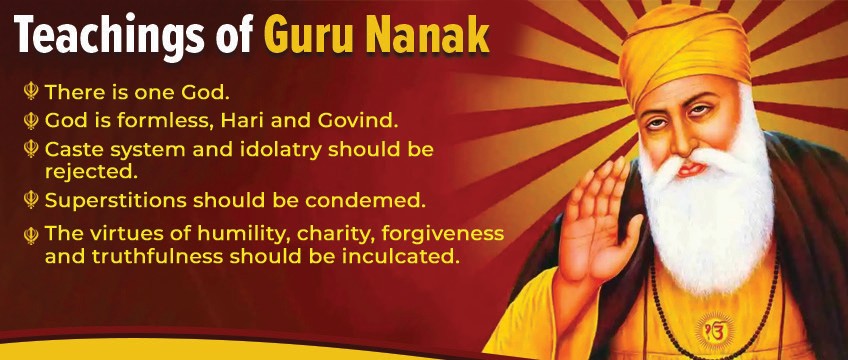
Teachings of Guru Nanak
Ten Sikh Gurus
| NAME | TIME PERIOD | DESCRIPTION |
| Guru Nanak | 1469 – 1539 | He is the first Guru of the Sikhs. Sikhism was founded by him. |
| Guru Angad Dev | 1504 – 1552 | He is the second Guru of the Sikhs. Guru Angad compiled Guru Nanak’s works, adding his own in a new script known as Gurmukhi. The sacred writings of the Sikhs were only written in Gurmukhi. Sikhs’ holy book, Guru Granth Sahib is written in Gurmukhi script. |
| Guru Amar Das | 1479 – 1574 | He is the third Guru of the Sikhs. He bolstered the Sikh movement by establishing the Manjis and Piris institutions. |
| Guru Ram Dass | 1534 – 1581 | He laid the foundation for the holy city of Amritsar, which would later become the Sikh faith’s spiritual capital. |
| Guru Arjun Dev | 1563 – 1606 | He was Guru Ram Dass’s son and successor. He constructed the Harmandir Sahib, also known as the Golden Temple and there he compiled and installed the Guru Granth, the Holy Book. |
| Guru Hargobind | 1595 – 1644 | He constructed Akal Takhat, the Immortal Throne and designated it to be the seat of Sikh temporal sovereignty. |
| Guru Har Rai | 1630 – 1661 | He carried on the work of his forefathers. |
| Guru Har Kishan | 1656 – 1664 | In Delhi, he treated smallpox patients and he is commemorated in the daily Sikh prayer as the one whose mere presence dispels all sorrows. |
| Guru Teg Bahadu | 1621 – 1675 | He is the ninth Guru of the Sikhs. He founded Anandpur Sahib. In 1675, he was executed under the orders of the Mughal Emperor Aurangzeb. |
| Guru Gobind Singh | 1666 – 1708 | The Sikhs were organized into a disciplined, military order of Sikh saints known as the Khalsa (the pure) by the last Guru. Kangha (comb), Kesh (length hair), Kada (iron bracelet), Kachcha (underwear) and Kirpan (knife) are the five emblems of Sikhism. |
The Guru Granth Sahib, the Sikh sacred text, is regarded as the 11th Sikh Guru and immortal. Aside from the songs of the Sikh Gurus, the Guru Granth Sahib also contains the works of Muslim and Hindu saints, some of whom are from the Hindu society’s so-called lower castes. As a result, the Sikh Holy Book can be seen as a singular example of the Sikh faith’s ecumenical character.
Zoroastrianism
ZOROASTRIANISM

Zoroastrianism, also known as Mazdayasna, is one of the world’s oldest continuously practiced organized religions. It originated in Persia around 6-7 BCE, founded by the prophet Zarathustra. As a monotheistic
faith, Zoroastrians believe in one eternal god, Ahura Mazda, the embodiment of justice and goodness. Opposing Ahura Mazda is Angra Mainyu, the spirit of evil and bad behavior. These two forces engage in an eternal struggle, with the belief that good will ultimately triumph over evil on the last day. In Zoroastrianism, fire and water are seen as symbols of purity.
Zoroastrians first arrived in India in 936 AD, fleeing Persia due to Islamic conquests. Known as Parsis, they are now one of India’s smallest (and rapidly declining) communities, primarily residing in Mumbai, Goa and Ahmedabad.
Zoroastrian places of worship are called fire temples, which feature an altar with a perpetually burning flame. These temples, known as Atash Bahram are rare, with only eight existing in India. Zoroastrians revere fire but also consider air, water and earth sacred. They believe that the corruption of death contaminates everything, so they leave the bodies of the deceased in the open to be consumed by vultures. These open-air burial sites, called ‘Dakhma’ or ‘Towers of Silence,’ are unique to Zoroastrianism. Once the vultures have stripped the bodies, the bones are collected and placed in ossuaries or lime pits.
The Zoroastrian sacred text, the Zend Avesta, is written in Old Avestan and contains 17 sacred hymns (gathas) and the Athuna Vairyo, a sacred chant attributed to Zarathustra. Translations and glossaries of these texts are collectively known as Zend. This collection is divided into five parts:
Yasna: Worship with ceremony and offerings
Vendidad: Laws against the demons or evil spirits
Yashts: to worship through praise
Khordeh Avesta: Book on common prayers
Gathas: These are part of yasna texts and are further divided into five parts called the Ahunavaiti, Ushtavaiti, Spenta-Mainyu, VohuKhshathra and Vahishto-Ishti.
The Parsis are divided into three primary sects:
Shahenshai - Calculate their calendar using Yazdegerd III, the last Sasanian ruler.
Kadmi - Claim to be the oldest and most accurate calendar.
Fasli - They observe the Persian calendar as it has been passed down through the generations.
Judaism
JUDAISM
Judaism is an Abrahamic, monotheistic and ethnic religion that encompasses the Jewish people’s collective religious, cultural and legal tradition and civilization. The Jews believe in Yahweh, or the one true God, whom Abraham established.

In Judaism, prophets are revered, with Moses being the first. Moses is said to have received the Ten Commandments from God. These rules are still followed by every faithful Jew today. It believes that the only way to salvation is through good deeds. The religion places a high value on living a moral life and does not support austerity, celibacy, or self- imposed hardship.
Sects in Judaism
Orthodox, Conservative, and Reformist are the three main Jewish sects. All old traditions and styles of religious worship and activities are upheld by the Orthodox. Conservative Jews took a medium ground, keeping some Orthodox characteristics while allowing for some flexibility in certain situations. The founder of the Reform movement believed in adapting to the times, so religious services and rituals were drastically reduced.
Judaism in India
The first Jewish settlers arrived on India’s western coast, and despite their small size, India has five main Jewish settlements.
Bene Israel – It means 'Israel’s Children'. Marathi is being spoken by them. They arrived 2100 years ago in Maharashtra.
Cochinis - 2,500 years ago, they landed in India and were established themselves in Kerala as traders.
Baghdadi Jews - Jews from West Asia, mostly Baghdad, who migrated to India as traders. They are mostly concentrated in Mumbai, Pune and Kolkata.
Bnei Menashe - The fourth group is the Manipuri Jews, also known as the Bnei Menashe. They have developed genealogies for the Menashe or Menasseh Tribe, which was one of the ten Jewish lost tribes. They refer to themselves as 'Children of Menasseh,' or 'believers in Jesus Christ.' There are Mizo, Kuki and Chin tribes among the Bnei Menashe.
Bene Ephraim – They also known as 'Telugu Jews'. They are a small community of Telugu speakers. Their conversion to Judaism began in 1981.
Conclusion
The ancient religions of India have left an indelible mark
on the spiritual, cultural and philosophical landscape of the world. As we conclude our exploration of these profound belief systems, we are immersed in the rich mosaic of diversity, wisdom and spirituality that characterizes ancient Indian religions.