Coinage in Medieval India
COINAGE IN MEDIEVAL INDIA
Turkish and Delhi Sultanate Coins
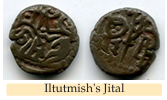
The inscriptions on the coins were in the form of the king’s name, title and the Hijri calendar date. Because idolatry was prohibited in Islam, the coins did not feature any images of the issuing king. The mint’s name was also inscribed on the coins for the first time. Gold, silver, copper and billon coins were issued by the Sultans of Delhi. Iltutmish's Jital Iltutmish introduced Silver Tanka and Copper Jital. Alauddin Khilji altered the original design by removing the Khalifa’s name and replacing it with self-congratulatory titles. Muhammad bin Tughlaq created bronze and copper coins as well as a token currency that failed miserably. Sher Shah Suri (1540–1545) established two weight standards: one for silver coins of 178 grains and one for copper coins of 330 grains. These were given the names rupee and dam, respectively.
Coins of Vijayanagara Empire
• The Vijayanagara Empire (14th 17th c) produced a great number of gold coins as well as pure silver and copper coins. Higher denomination pagodas have a figure of a running warrior with a dagger emblem. Gold Fanam and silver taras were fractional unit whereas, copper coins were used for day to day transactions.
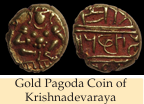
• Earlier Vijayanagara coins were made in many mints and were known by various names such as Barkur gadyanas, Bhatkal gadyanas and so on. Inscriptions in Kannada or Sanskrit were found. A double-headed eagle with an elephant in each beak and claw, a bull, an elephant and other Hindu deities were among the images discovered. Image of the Lord Venkateswara was commonly represented on the coins. Krishna Deva Raya (1509–1529) minted a gold varahan coin with a seated Vishnu on one side and a three-line Sanskrit legend Shri Pratap Krishna Raya on the other.
Mughal Coins
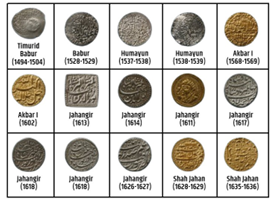
The Mohur, weighing around 170 to 175 grains, was the Mughals’ standard gold currency. In Ain-i-Akbari, Abul Fazl stated that a Mohur was worth nine rupees. There were also half and quarter mohurs.
The most famous of all Mughal currencies was the silver rupee, which was an adaptation of Sher Shah’s coin. Sher Shah’s dam became the basis for the Mughal copper currency, which weighed 320 to 330 grains.
Both round and square coins were minted by Akbar. To promote new religious ideology of ‘Din-i-Illahi,’ he created gold coins known as Ilahi coins in 1579. The largest gold coin was the Sahansah. The names of the Persian solar months were engraved on these coins. The story was depicted on the coins by Jahangir in a couplet. He engraved his beloved wife Noorjahan on some of his coins. His most renowned coins had Zodiac signs as images.
Iltutmish's Jital
The mint’s name was also inscribed on the coins for the first time. Gold, silver, copper and billon coins were issued by the Sultans of Delhi.
Iltutmish introduced Silver Tanka and Copper Jital. Alauddin Khilji altered the original design by removing the Khalifa’s name and replacing it with self-congratulatory titles. Muhammad bin Tughlaq created bronze and copper coins as well as a token currency that failed miserably. Sher Shah Suri (1540–1545) established two weight standards: one for silver coins of 178 grains and one for copper coins of 330 grains. These were given the names rupee and dam, respectively.
1seals
SEALS
Seals are one of the finest examples of Indian miniature art belonging to ancient age.
They were used for authentication of transactions by state as well as merchants and guilds.
The earliest seals in Indian sub-continent were found at
Mehrgarh and Damb- Sadaat.
Both these places are located in the valley of river Bolan in Baluchistan region of Pakistan.
Seals of Harappan Civilization

Harrapan Seals
In the ancient civilization of the Indus Valley, small objects called seals were carved out of stones and were burnt in order to make them durable.
These seals were used for commercial purposes such as sealing the mouth of the jars by pressing the seals against soft clays, to create clay tags for the sacks that carried goods to different destinations and were also used in trading activities.
A large number of seals were discovered from the port city of the Indus Valley Civilization, Lothal.
The several Harappan seals were also discovered in Mesopotamia, Central Asia and in the coasts of Arabian Peninsula.
Similarly, the Mesopotamia seals were found inLothal.
The seals which have been unearthed from various sites of the Indus Valley Civilization are of different sizes and shapes.
The shapes of the seals include triangle, square, rectangle and circle.
However, the square shaped seals of Harappan civilization outnumbered other shapes.
Materials used were steatite (relatively soft stone found in the river beds), copper, terracotta, chert, faience, agate gold and ivory.
Most of the seals have symbols or the pictographic script on one side and these scripts were written from right to left.
However, there are some seals where bidirectional style (i.e., right to left on one line and left to right on the following line) has been used to write those scripts.
On the other sides of the seals, animal impressions were carved on the surfaces.
Animal motifs of tiger, buffalo, elephant, rhinoceros, bison, goat, unicorn, ibex, humped bull, crocodile and so on were used.
Cow was not depicted by Harrapans on their seals.
However, the square shaped seals of Harappan civilization outnumbered other shapes.
Materials used were steatite (relatively soft stone found in the river beds), copper, terracotta, chert, faience, agate gold and ivory.
Most of the seals have symbols or the pictographic script on one side and these scripts were written from right to left.
However, there are some seals where bidirectional style (i.e., right to left on one line and left to right on the following line) has been used to write those scripts.
On the other sides of the seals, animal impressions were carved on the surfaces.
Animal motifs of tiger, buffalo, elephant, rhinoceros, bison, goat, unicorn, ibex, humped bull, crocodile and so on were used.
Cow was not depicted by Harrapans on their seals.
Pashupati Seal
It is a steatite seal in which a human figure, possibly a deity sitting cross legged, was carved.
The deity is regarded as Pashupati.
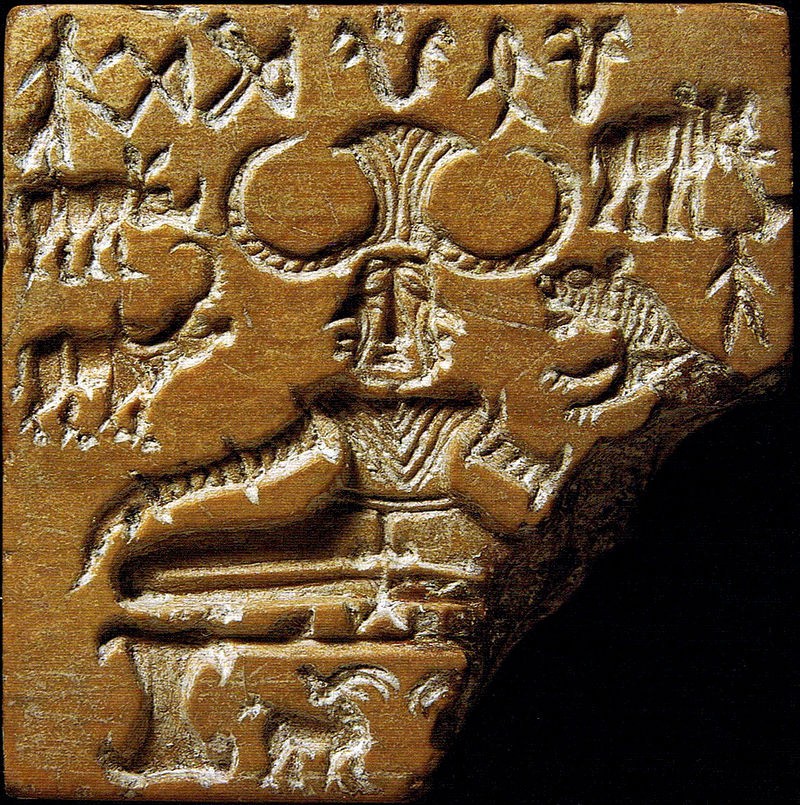
In the seal, he is pictured wearing a three-horned headgear and is surrounded by animals - an elephant and a tiger on the left side, a rhinoceros and a buffalo on the right side and two antelopes below the figure.
Some of the other Seals of Harappan Civilization
| SEALS | DESCRIPTION |
| Large Unicorn Seal from Mohenjo-daro | One of the largest seals found in the Harappan sites. |
| Bull Seal from Harappa | It featured the motif of a majestic zebu bull with wide curving horns. The zebu bull may represent the herd’s leader who protects them or it may represent a sacrificial animal. |
| Bull Seal from Harappa | This is a flat square double-sided seal. On one side, four script symbols are inscribed in reverse, above a bison with head lowered to the feeding trough. A swastika motif turning counter clockwise is carved on the reverse. The seal is perforated from the side along the axis of the animal motif. |
Seals Belonging to Historical Age (After 600 BCE)
Seals were used commonly by kings and guilds for authentication purpose.
A large number of seals were used by different guild in India during ancient age.
120 seals were discovered at Bhita, located near Allahabad in Uttar Pradesh.
Indian rulers used seals to issue orders to officials and for other important communication.
Mughal administration was famous for issuing written orders known as Farmans.
Royal seals were handled by most trustworthy members of the royal family or by emperor himself.
Coinage in Ancient India
COINAGE IN ANCIENT INDIA
Coins issued by Indian rulers and guilds through the ages are an extremely important example of human art belonging to the ancient age because these coins have different types of symbols on them. The coins throw light on the socio- economic, political and cultural life of people belonging to that period. The motifs, symbols and stamps used on the Indian coins since ancient times depict a lot about the rulers and their reign.
The study of coins and medallions is known as Numismatics.
Punch Marked Coins
Monetization of economy was absent during the Harappan age and Vedic age. The earliest known coins of India were silver punch-marked ones, bearing a design and were circulated in the Janapadas.
Different symbols like tree, river, hill, sun and moon were inscribed on them using punches. These coins were termed as Karshapana, Satamana and Dharana in ancient literature. The earliest Punch Marked Coins were issued by merchants and bankers, not by state.
The Punch-marked coins can be further classified into four categories:
• Taxila-Gandhara type
• Kosala type
• Avanti type
• Magadhan type
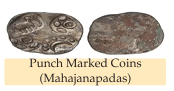
Coins during Mauryan Period (322–185 BCE)
In his Arthashastra treatise, Chanakya, the prime minister of the first Mauryan emperor Chandragupta Maurya, reported the minting of punch marked coins such rupyarupa (silver), suvarnarupa (gold), tamra rupa (copper) and sisarupa (lead). The sun and the six-armed wheel were the most consistent of the several symbols utilised. Karshapanas were silver coins with an average of 50–54 grains of silver and 32 rattis in weight.
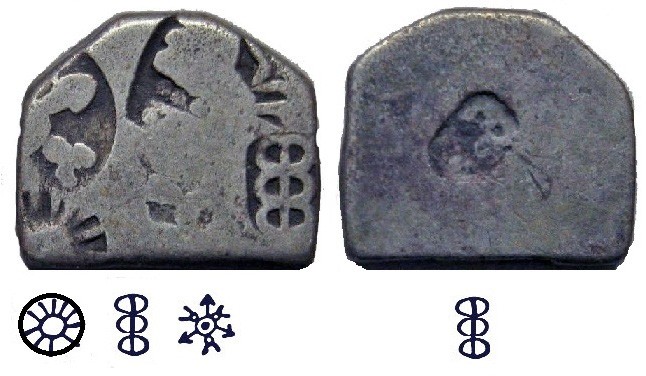
Punch Marked Coins o f the Ashoka Period
Indo - Greek Coins
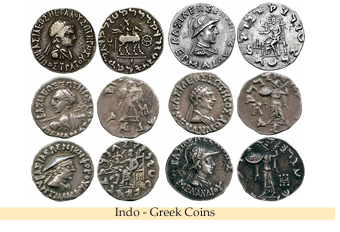
The Indo-Greeks popularised the practise of depicting the ruler’s buster head on coins. Greek kings’ coins in India were multilingual, with Greek on one side and Pali (in Kharosthi script) on the other. Zeus, Hercules, Apollo and Pallas Athene were among the Greek gods and goddesses depicted on Indo-Greek coins. The first series of coins featured Greek gods while later coins had Indian gods as well.
Silver, copper, nickel and lead were the most common metals for coins. Later, the Indo-Greek Kushan kings adopted the Greek practice of etching portrait heads on coins. On one side, a helmeted bust of the monarch was depicted while on the reverse, the king’s favourite deity was depicted.
Kushana Coins
Kanishka’s coins were all written in Greek. It depicted iconographic forms drawn from Greek, Mesopotamian, Zorastrian and Indian mythology. Major Indian deities portrayed were Shiva, Buddha and Kartikeya. The Kushan Empire’s wide coinage impacted a great number of tribes, dynasties and kingdoms, who began issuing their own coins as a result.

Gold coi n of Kanishka
Satavahana Coins

Gautamiputra Sri Yajna Satakarni Coin (Satavahana)
The Satavahana rulers mostly employed lead as a coinage material. Silver coins were extremely scarce. They also utilized a silver-and-copper alloy known as ‘potin’ in addition to lead.
The Satavahana coins are a useful source of information about the Satavahanas’ dynastic history, despite their lack of beauty and creative merit.
On one side of most Satavahana coins was a figure of an elephant, horse, lion or Chaitya. The Ujjain emblem was depicted on the other side, which was a cross with four circles at the ends of the two intersecting lines. Prakrit was the dialect used.
Western Kshatrapa Coins
• Western Kshatrapa coins have a long & illustrious history. They date from the Saka era, which began in 78 AD. Western Kshatrapas Coin On one side, the Western Satraps’ coins feature the king’s head, but on the other, they feature a Buddhist chaitya or stupa, which was undoubtedly copied from Satavahanas. Prakrit was a widely used language that is written in a variety of scripts.
• Image of the Western Kshatrapas Coin

.
Coins issued during the Gupta Age
• Unlike the predecessors, the Guptas did not confine the images of emperors only in martial poses such as Archer, Lion-slayer or Horse-rider. They also depicted socio political events such as marriage of the king and queen, king performing Ashvmedha Yagya, king playing Veena (Samudragupta) and involved in other leisure activities. Gold coin of Samudragupta Commemorative coin (Chandragupta and Kumaradevi type)
• The reverse sides of these coins depicted variety of Gods and Goddesses including Durga, Lakshmi, Ganga, Garuda and Kartikeya. This further enhanced the lustre and high-quality of coins.

Gold coin of Samudragupta

Commemorative coin
(Chandragupta and Kumaradevi type)
Coins of the Pandyan and Chola Dynasty
In the early time, the Pandyan dynasty struck square-shaped coins with an image of an elephant. Fish became a very important emblem in coins later on.
The inscriptions on the gold and silver coins were in Sanskrit while the inscriptions on the copper coins were in Tamil. Pandyan coin (above) Raja Raja I's coin (below)
The Chola ruler Raja Raja I’s coins featured a standing king on one side and a reclining goddess on the other, with inscriptions in Sanskrit. The legend ‘Sri Rajendra’ or ‘Gangaikonda Chola’ was written on Rajendra I’s coins,along with tiger and fish motifs. The lion was depicted on the coins of the Pallava dynasty.

Coinage in Modern India
COINAGE IN MODERN INDIA
Coinage During British Rule
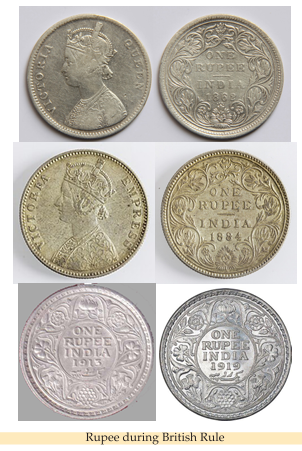
In 1835 AD the Coinage Act of 1835 was enacted by British Parliament. This Act introduced a centralized currency system in British India and the silver Rupiya was adopted as standard currency. Mansfield Commission (1866), Herschel Committee (1893), Fowler Committee (1898), Chamberlain Commission (1914) and Babington Smith Committee (1919) were appointed by the British Indian government to improve the currency system in India.
Post-Independence India Coinage
Coins started to be issued by Reserve Bank of India (RBI) in independent India. Coins issued during the period of British rule continued in circulation and government of independent India minted coins for the first time in 1950. These included 1 pice, 1/2 anna, 1 anna, 2 anna, 1/2 rupee and 1/4 rupee coins. These coins were referred as ‘anna series’. This was a non decimal coinage system. In anna series of coinage, one rupee was divided into 64 pice or 16 annas. Each anna was equal to 4 pice. India shifted to the decimal system of coinage in 1957. Between 1957 and 1964 coins were minted with the legend ‘Naya Paisa’ to distinguish new and old types of coins. In 1964, the word ‘Naya’ was dropped. All coins having denomination of 25 paisa or less were officially demonetized on 30 June 2011.
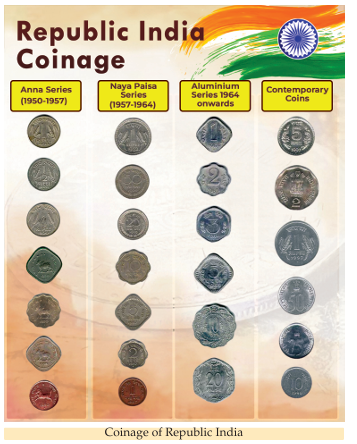
Recent Coins issued By Government of India
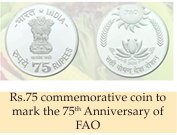
75th Anniversary of FAO
In 2020, India issued a commemorative coin to mark the 75th anniversary of the Food and Agriculture Organization (FAO) of the United Nations. The coin featured the FAO logo and symbolized India’s commitment to agricultural development.
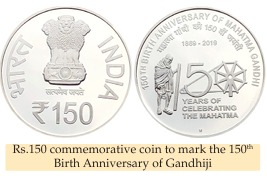
150th Birth Anniversary of Mahatma Gandhi
To honor the 150th birth anniversary of Mahatma Gandhi in 2020, India released special commemorative coins with various denominations. These coins featured Mahatma Gandhi’s portrait and significant quotes.
125th Birth Anniversary of Jawaharlal Nehru
India issued commemorative coins to mark the 125th birth anniversary of Jawaharlal Nehru, the first Prime Minister of India. These coins paid tribute to his contributions to the nation.
100th Birth Anniversary of Vijaya Raje Scindia Commemorative coins were released to celebrate the 100th birth anniversary of Vijaya Raje Scindia, an Indian politician and a prominent figure in the independence movement.
Sri Guru Nanak Dev Ji’s 550th Birth Anniversary In 2019 and continuing into 2020, India issued special coins and commemorative postage stamps to mark the 550th birth anniversary of Guru Nanak Dev Ji, the founder of Sikhism.
Significance of Coins in India
Significance of Coins in India
The significance of recent coins in India goes beyond their monetary value; they serve various purposes that reflect the country’s rich heritage, cultural diversity, and economic development. Here are some key aspects of the significance of recent coins in India

Other Popular Indian Coins
• Adali: Silver coin (weighing 144 grain) of Sultanate period
• Bahloli: Copper coin introduced by Bahlol Lodi.
• Hashtgani: Silver coin equivalent to 48 Jital introduced by Firoz Shah Tughlaq.
• Dokani: Coin introduced by Muhammad-bin-Tughlaq.
• Sultani: Coin introduced by Muhammad-bin-Tughlaq.
• Asrafi: Weighing 169 grains during Mughals (used for gifts & hoarding).
• Muhammadi: Silver coin of Gujarat
• Muzaffari: Silver coin of Malwa
• Varaha: Gold coin of Vijayanagar rulers weighed 52 grain and was called pagoda. Also known as Hun and Fanam.
• Jalali: Square silver coin during Mughals
• Ilahi: Most common type of gold coin during the Mughals.
• Shahamhah: Largest gold coin during the Mughals.
• Dramma: Siver coin of Pratiharas weighing 66 grains.
• Pice: Copper coin introduced by British.
• Panom/Fanom: Coins of Hindu kingdom of Mysore
Rajput coin designs were confined to martial motifs of bull and horseman type. Some of them had king’s name on obverse side and a Goddess on the reverse side.
South Indian coin designs were confined to dynastic crests– boar (Chalukya), bull (Pallava), tiger (Chola), fish (Pandya), bow and arrow (Cheras) and lion (Hoysala). Usually, the other side of the coin had image of temple/Goddess or was simply left blank [e.g. Western Chaluykya].
Prohibition of idolatry in Islam severely limited the scope of inscribing motifs and images in the coins of Delhi sultanate and Mughal empire. Usually, these coins bore only textual information such as name of the king and date of issue.
The weakening of Mughal empire and subsequent fall of land revenue had forced Aurangzeb to debase his coins. The subsequent reduction in the content & quality of metal had further reduced the scope of border designs, lustre and premium look, even in the coins of highest denomination.
British-Indian coins were monotonous in design as they had textual information of coin denomination and year on obverse side and portrait of the king or queen on the reverse side.
After independence, the king’s portrait was replaced by Lion Capital of the Ashoka Pillar and other indigenous motifs of sovereignty and freedom