15th Finance Commission on Disaster Management
15th Finance Commission on Disaster Management
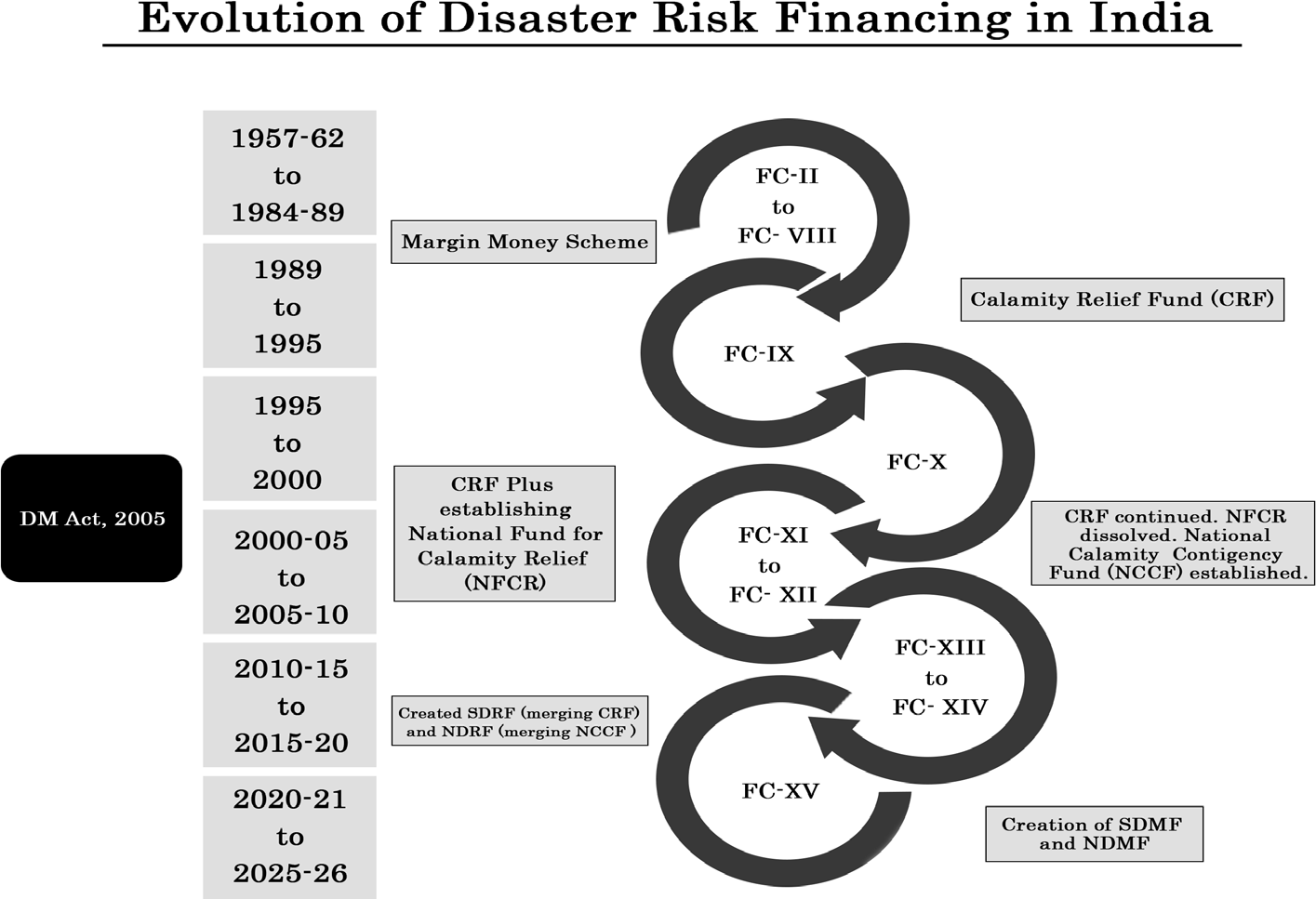
Fig: Evolution of Disaster Risk Financing in India
The contribution of states to the State Disaster Risk Fund (SDRF) remains at 25%, except for the Northeastern states, where it is set at 10%.
Establishment of Mitigation Funds at both the national and state levels, in accordance with the Disaster Management Act, 2005.
These funds should be utilized for local and community-based initiatives aimed at reducing disaster risks and promoting environmentally sustainable settlements and livelihood practices.
• Priority Areas for Funding:
• Allocating funds for the National Disaster Response Force (NDRF) to support the expansion and modernization of fire services and the resettlement of individuals displaced due to erosion.
• Providing financial support for the National Disaster Mitigation Fund (NDMF) to assist twelve drought- prone states, manage seismic and landslide risks in ten hilly states, mitigate urban flooding in seven major cities and implement erosion prevention measures.
• New Allocation Methodology:
• Previously, the Finance Commissions up to the 14th Finance Commission used an expenditure-based approach to allocate disaster management funds to states.
• The 15th Finance Commission introduced a new methodology based on:
• Capacity: Determined by past expenditure
• Risk Exposure: Assessed through area and population affected
• Hazard & Vulnerability: Measured using a disaster risk index
• National and State-Level Disaster Risk Management Funds:
• The National Disaster Risk Management Fund (NDRMF) and State Disaster Risk Management Fund (SDRMF) have been established at the national and state levels, respectively.
• NDRMF comprises both the NDRF and NDMF, while SDRMF includes SDRF and SDMF.
• From the total allocated disaster management grants at both levels, 20% is designated for mitigation efforts, while 80% is allocated for response activities.
• Changes in Funding Structure:
• The response fund is divided into three components:
• Response & Relief (40%) – 40% of NDRMF/ SDRMF is designated for immediate disaster response and relief efforts.
• Recovery & Reconstruction (30%) – Since most expenditures have historically been focused on response and relief, this allocation ensures resources are available for rebuilding assets and livelihoods.
• Preparedness & Capacity Building (10%)–
Recognizing the importance of disaster preparedness, this portion supports State Disaster Management Authorities (SDMAs), State Institutes of Disaster Management (SIDMs), training programs, capacity-building activities, and emergency response infrastructure.
• Cost Sharing Arrangement (Between Centre & States)
• Financial support from the National Disaster Response Fund (NDRF) and the National Disaster Mitigation Fund (NDMF) should be provided on a cost-sharing basis.
• The cost-sharing structure should follow a graded approach:
• States must contribute 10% for assistance amounts up to ₹250 crores.
• For assistance up to ₹500 crores, the state's contribution increases to 20%.
• For amounts exceeding ₹500 crores, states are required to contribute 25%.
• Implementing this cost-sharing model will help prevent excessive financial demands from states driven by competitive populism.
• Priorities related to preparedness, mitigation, and recovery through special initiatives
Four Priorities under NDMF
• Catalytic Assistance to develop district level drought mitigation plans (12 most drought prone States): Andhra Pradesh, Bihar, Gujarat, Jharkhand, Karnataka, Madhya Pradesh, Maharashtra, Odisha, Rajasthan, Tamil Nadu, Telangana, and Uttar Pradesh
• Reducing risk of Urban Flooding (7 most populous cities): Mumbai, Chennai & Kolkata, Bengaluru, Hyderabad, Ahmedabad, and Pune
• Managing Seismic & Landslide Risk (10 hill states): Himachal Pradesh, Uttarakhand and eight states in the North East
• Mitigation measures to prevent erosion to mitigate the risk of erosion. States would need to apply for these funds for undertaking erosion mitigation works.
Two Priorities under NDRF
• Resettlement of displaced people affected by erosion: To provide alternate settlements to people from recovery & reconstruction window of NDRF
• Expansion & modernisation of fire services: For strengthening fire services at state level, allocated through preparedness & capacity building head of NDRF. States contribution shall be 10% of amount sought.
• Empowering Panchayati Raj Institutions For Disaster Preparedness & Management
• Crucial/Critical to build capacities at the Panchayat Level
• PRIs have their own proximity to local community including weaker sections
• Hence, ability to enlist people’s participation on institutionalization basis
• Involvement would ensure quick response to disaster events (man-made or natural)
• Minimization on dependence on Government for rescue & relief
• It will be a Bottom-Up approach instead of top-down approach for disaster management
• PRIs can play a pro-active role in all stages of disaster management
• Relief, Recovery and Reconstruction and Mitigation
activities to be undertaken by the Panchayats
• State Governments should allocate some reasonable amount under the SDRF and SDMF to districts
• Alternate Source of Funding: Public Funds no matter howsoever large it will be inadequate for contingent situations hence mobilisation through alternate sources would be necessary. Some of the recommended sources include:
• Reconstruction Bonds
• In a Post Disaster situation States can issue reconstruction bonds
• Maturity of 3-5 years and with approval of Union Government
• Resources raised by bonds should largely be spent on construction of productive & social assets.
• Contingent Credit/ Stand-by facility (IFIs)
• The World Bank and ADB have been the vital sources of financial assistance post disasters.
• A long-term arrangement could be set-up to make lending operation shorter & easier.
• Activated if the cost of disasters exceeds a certain threshold.
• Costof borrowing, knowledge transfer and organisational help may be considered beforehand.
• Crowd Funding Platforms
• Way of raising funds from public through internet campaigns
• Playing an increasingly larger role in fundraising
• Government may set a platform with specified objectives and an assurance of transparency.
• Identifying the right time, setting up secure payment gateways and ensuring accountability.
• Union and State government should together prepare operational guidelines.
• Corporate Social Responsibility
• Tax exemptions to contributions to the NDRF and SDRF
• Enabling provision for the contribution of the private sector to disaster funding windows.
• Steps should be taken to improve & diversify private sector support for disaster management.
• Insurance & Risk Pooling
• Disaster relief through an Insurance intermediary earlier considered impractical.
•
Presently essential conditions for market-based risk management instruments exist in niche areas.
• Use of Insurance is most efficient for natural perils i.e. infrequent but with high potential impact.
XV FC has proposed four Insurance interventions
• National Insurance scheme for Disaster related deaths
• SynchronisingRelief assistance with Crop insurance
• Risk Pool for infrastructure protection & recovery
• Access to International Reinsurance for outlier hazard events
These will provide an additional layer of protection to people.
Will not replace the existing funding mechanism but will supplement them.
• Outcome Framework:
• Develop an Outcome Framework
• Link the State Allocations to Sendai Framework Indicators
• An annual report at the national level to record all the allocations, expenditures, key achievements and results against various indicators developed for the SFDRR.
• Dedicated capacity for managing NDRMF and SDRMF with emphasis on purpose of utilisation. Setting up an online system for release of fund allocations, expenditures and outstanding balance for each State.
• Two-stage assessment for NDRF allocation
• First assessment to ascertain humanitarian and relief needs
• Second assessment to cover damage, loss and recovery needs
• Post Disaster Needs Assessment (PDNA) may be used as a standard methodology for post disaster assessment.
• Setting up a Disaster Database as a special initiative: Database to include disaster assessments, fund allocation details, expenditures, preparedness and mitigation plans
• Disbursing assistance to women members of household: Cash assistance to be transferred to the families in a way that women members of the household also get access to money.
Resource Analysis
Resources form the foundation of any organization. The resource base comprises physical, financial, and human resources utilized during emergencies. Organizations with limited resources often face challenges in managing crises effectively. Logistics and inventory management play a vital role in maintaining a strong resource base. Traditionally, disaster management efforts have relied on government or donor funding. However, with such resources becoming scarce, alternative funding avenues must be explored. These include mobilizing local resources and leveraging corporate social responsibility initiatives to support disaster management efforts.
• Types Of Resources:
• Financial resources are obtained from multiple sources, including government grants, loans, institutional funding, private donations, revenue from products and services and community-driven initiatives.
• Government grants are allocated based on specific thematic areas, with various departments offering funding schemes. These include financial support for NGOs and community-based organizations through departments such as rural development and health.
• Loans are typically provided as soft loans with low- interest rates, aimed at supporting livelihoods for vulnerable and disaster-affected communities.
• Resource Analysis
• Resource Analysis is defined as understanding the needs and priorities as per available resources and working out modalities to avail alternate avenues, observing fiscal prudence in existing expenditure, all comes within resource analysis. Resource analysis forms the logical base for planning, mobilising and utilising resources, for all organisations, government or otherwise. The key steps in resource analysis are:
• Assessment of current resource availability and utilisation patterns:
• This includes an assessment of the current activities, resources available and how the resources are being used at present. The assessment should cover concerns like whether this is the best resource utilisation and how it can be improved. It should match needs with availability, identify shortfalls, and assess resource management process to find areas of improvement.
• Identification of potential new sources:
• This activity involves research on traditional as well as innovative sources of tapping resources. It can be done by looking at the various activities being carried out in the region by other organisations and finding out about the interest areas of other resource agencies working in the area.
• Assessment of growth trends and projection of resource requirements:
• Evaluating existing resource patterns should be complemented by the organization's growth plans for both the short and long term, ensuring that resource planning effectively considers future requirements.
• Criteria matching for purpose of tapping potential sources:
• Once potential resource contributors are identified and future activity patterns and resource needs assessed, the process of criteria matching should be carried out to help focus on selected sources that best match the requirements in terms of interest areas.
• Operationalisation of resource mobilisation process:
• The process of resource mobilization must be put into action, evolving into a specialized field of work. This involves drafting proposals, developing work plans, creating logical frameworks, and preparing budgets. Additionally, it requires identifying key factors that ensure the sustainability of initiatives, assessing potential risks to investments and efforts, and outlining strategies to mitigate those risks. Success indicators must also be established along with monitoring and evaluation plans to track progress effectively.
• Core Principles of Disaster Risk Finance
Governments aiming to assess and enhance their financial resilience should be guided by four fundamental principles. These principles do not prescribe specific actions for decision- makers but offer a framework for analyzing policy choices and financial tools.
Timeliness of funding: Speed matters but not all resources are needed at once.
Understanding the timing of financial requirements is crucial. Following a major disaster, the government does not need the entire funding for the reconstruction program immediately.
While immediate liquidity is essential for relief and early recovery efforts, there is more time to secure the larger financial resources needed for reconstruction.
This difference in timing significantly influences the design of a cost-effective disaster financial management strategy.
Disbursement of funds: How money reaches beneficiaries is as important as where it comes from.
Governments require dedicated mechanisms and expertise to effectively allocate, disburse, and monitor recovery and reconstruction funds.
Strong collaboration between the ministry of finance and the public entity tasked with spending post-disaster funds such as local governments or agencies that maintain public infrastructure is crucial.
In addition, the disbursement system must balance policy makers’ concern for fast disbursement with the transparency and accountability required by the public and donors.
Key Sources of Finance
Key Sources of Finance
Disaster Risk Layering: No single financial instrument can address all risk.
• Global experiences indicate that governments should ideally utilize a combination of financial instruments to safeguard against disasters of varying frequency and severity. This strategy, known as risk layering, forms a comprehensive financial protection approach by employing different financial tools, either proactively or in response to a disaster, to meet the evolving funding needs.
• Risk layering ensures that cost-effective financial sources are prioritized, while more expensive instruments are reserved for exceptional situations. For instance, insurance can help cover extreme events but is not suitable for managing frequently recurring, low-intensity disasters. To address this lower level of risk, governments may consider establishing a dedicated contingency fund.
Data and analytics: To make sound financial decisions, governments need the right information.
• Financial analysis of risk data and quantitative evidence empowers governments to take risk-informed decisions regarding their financial protection against disasters.
• Sound decision making requires actuarial analysis and tools to help governments understand and evaluate alternative financial instruments and strategies; user- friendly interfaces to bridge the gap between policy makers and underlying technical models; and quantitative analysis to leverage financial markets and private sector solutions.
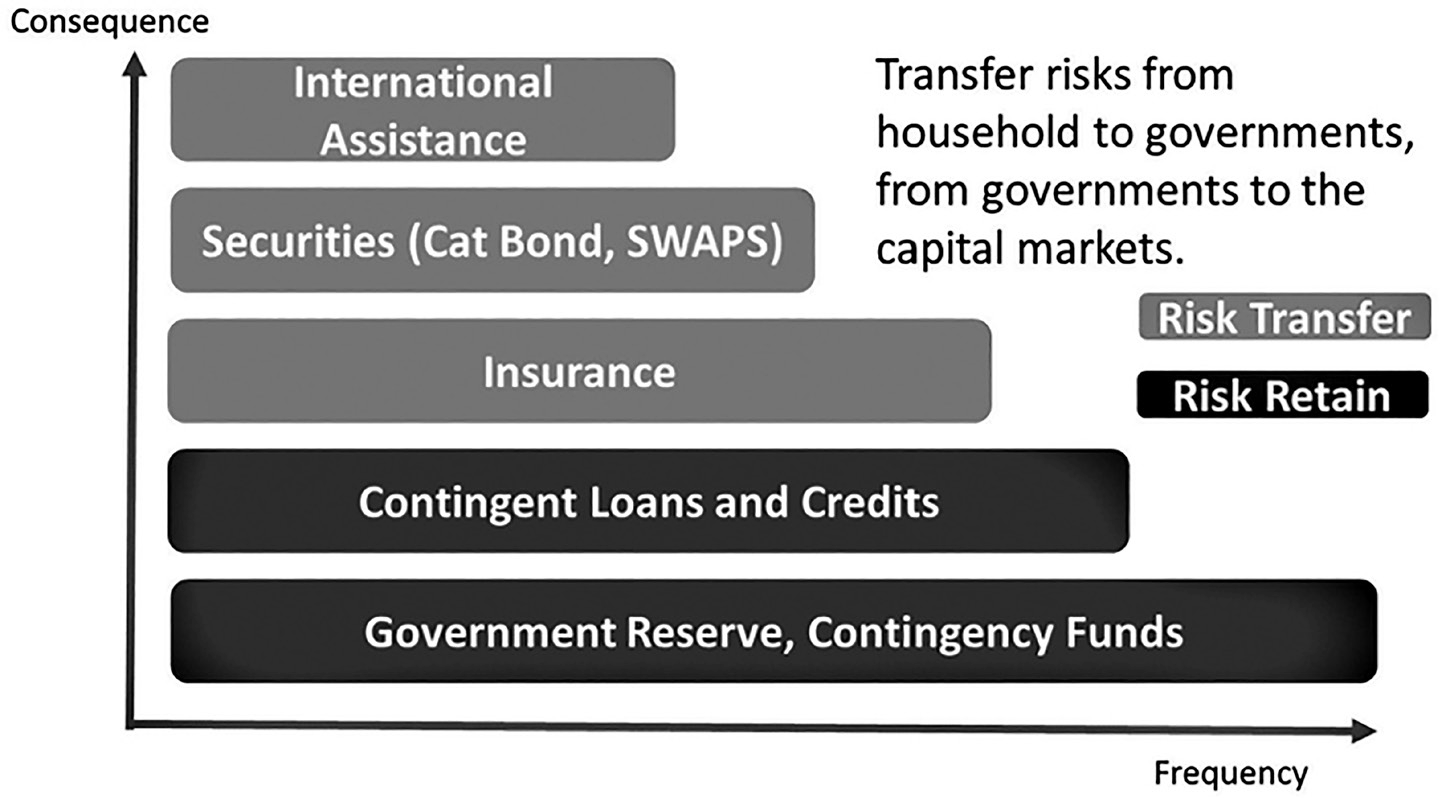
Figure: Disaster Risk Financing and Risk Transfer
• Government Funds
• Contingency Fund of India under Article 267 of the Constitution: It exists for disasters and related unforeseen expenditures. The fund is administered by the Finance Secretary (Department of Economic Affairs) on behalf of the President of India and it can be operated by executive action. In 2005, it was raised from Rs. 50 crore to Rs 500 crore.
•
National Disaster Response Fund (NDRF), constituted under Section 46 of the Disaster Management Act, 2005, supplements SDRF of a State, in case of a disaster of severe nature, provided adequate funds are not available in SDRF. National Calamity Contingency Fund (NCCF) has been merged into NDRF from 1st April, 2010 based on the recommendations of 13th Finance Commission
(FC). NDRF is financed through the levy of a cess on certain items, chargeable to excise and customs duty, and approved annually through the Finance Bill. The requirement for funds beyond what is available under the NDRF is met through general budgetary resources.
• The State Disaster Response Fund (SDRF), established under Section 48 (1) (a) of the Disaster Management Act, 2005, serves as the primary financial resource for state governments to respond to notified disasters. The Central Government contributes 75% of the SDRF allocation for general category States/ UTs and 90% for special category States/UTs, which include Northeastern States, Sikkim, Uttarakhand, Himachal Pradesh, and Jammu & Kashmir. The Finance Commission recommends and facilitates the annual Central contribution, which is disbursed in two equal installments. The SDRF is strictly meant for covering expenses related to immediate relief provided to disaster victims.
• The Calamity Relief Fund (CRF) was merged into the SDRF on April 1, 2010, based on the recommendations of the 13th Finance Commission (FC).
• Disasters Covered Under SDRF: The SDRF covers a range of disasters, including cyclones, droughts, earthquakes, fires, floods, tsunamis, hailstorms,
landslides, avalanches, cloudbursts, pest infestations, frost, and cold waves.
• Provision for Local Disasters: State Governments have the flexibility to utilize up to 10% of the SDRF funds to provide immediate relief for locally significant natural disasters, even if they are not included in the Ministry of Home Affairs' notified list. This is subject to the condition that the State Government must identify and notify such disasters along with clear and transparent norms and guidelines approved by the State Executive Committee (SEC).
• PM CARES Fund: The Prime Minister’s Citizen Assistance and Relief in Emergency Situations (PM CARES) Fund was created to address emergencies and distress situations, such as the COVID-19 pandemic, and to provide relief to affected individuals. The PM CARES Fund operates as a public charitable trust, officially registered under the Registration Act, 1908 in New Delhi on March 27, 2020.
• Prime Minister’s National Relief Fund (PMNRF): The PMNRF was established solely through public contributions and does not receive any budgetary support. It accepts voluntary donations from individuals, organizations, trusts, companies, and institutions. Contributions to the PMNRF are exempt from Income Tax under Section 80(G). The fund is utilized to provide immediate financial relief to families affected by calamities such as floods, cyclones, earthquakes, explosions, fires,storms, rail and road accidents, flyover collapses, and other emergencies. Additionally, it provides partial financial assistance for medical treatments, including heart surgeries, kidney transplants, cancer treatments, and acid attack rehabilitation for individuals in need.
• Corporate Social Responsibility:
• In simple terms, Corporate Social Responsibility (CSR) refers to a company's obligation to operate in compliance with the laws of the country where it functions while also actively contributing to social welfare. CSR initiatives often involve corporate funding and participation in social programs that benefit local communities.
• The private sector's social responsibility, also known as Corporate Social Responsibility (CSR), extends beyond interactions with clients, suppliers, and employees to include engagement with other stakeholders and alignment with the values, needs, and goals of the society in which a business operates.
• CSR consists of three fundamental elements:
• 1) Compliance – Companies must adhere to national regulations, while multinational corporations are required to follow the laws of the host country as per contractual agreements. Additionally, local operations should comply with internationally accepted laws, standards and conventions.
• 2) Risk Minimization – Businesses, particularly those operating in hazardous industries such as chemical plants and nuclear facilities, must incorporate risk management into their decision-making processes. Preventive measures should be in place to mitigate potential hazards and ensure public safety.
• 3) Value Creation – Beyond legal compliance and risk management, companies should actively engage in initiatives that contribute positively to society. This can include dialogue with communities, seeking expert guidance, and assisting in disaster relief efforts.
Motivations for Corporate Social Responsibility: The reasons for adopting CSR practices can be grouped into four broad categories based on motivation:
1) Philanthropic Motivation – Companies engage in CSR purely for charitable purposes, with no expectation of direct benefits.
2) Internal Motivation – CSR initiatives aimed at enhancing employee morale, improving customer satisfaction, and maintaining shareholder confidence.
3) External Motivation – Companies undertake CSR to build goodwill, gain positive publicity, strengthen relationships with local communities and take advantage of tax benefits.
4) Enlightened Self-Interest – Businesses recognize that fostering a stable and prosperous society creates a larger market, leading to long-term profitability.
Building Resilience Through Disaster Risk Insurance
Building Resilience Through Disaster Risk Insurance
• Human actions and the climate change are contributing to the increasing trend of natural disaster and the human and economic losses. A long-term global effort is needed towards reversing or slowing down the climate change, but the economic losses due to these natural disasters can be mitigated through efficient risk transfer solutions.
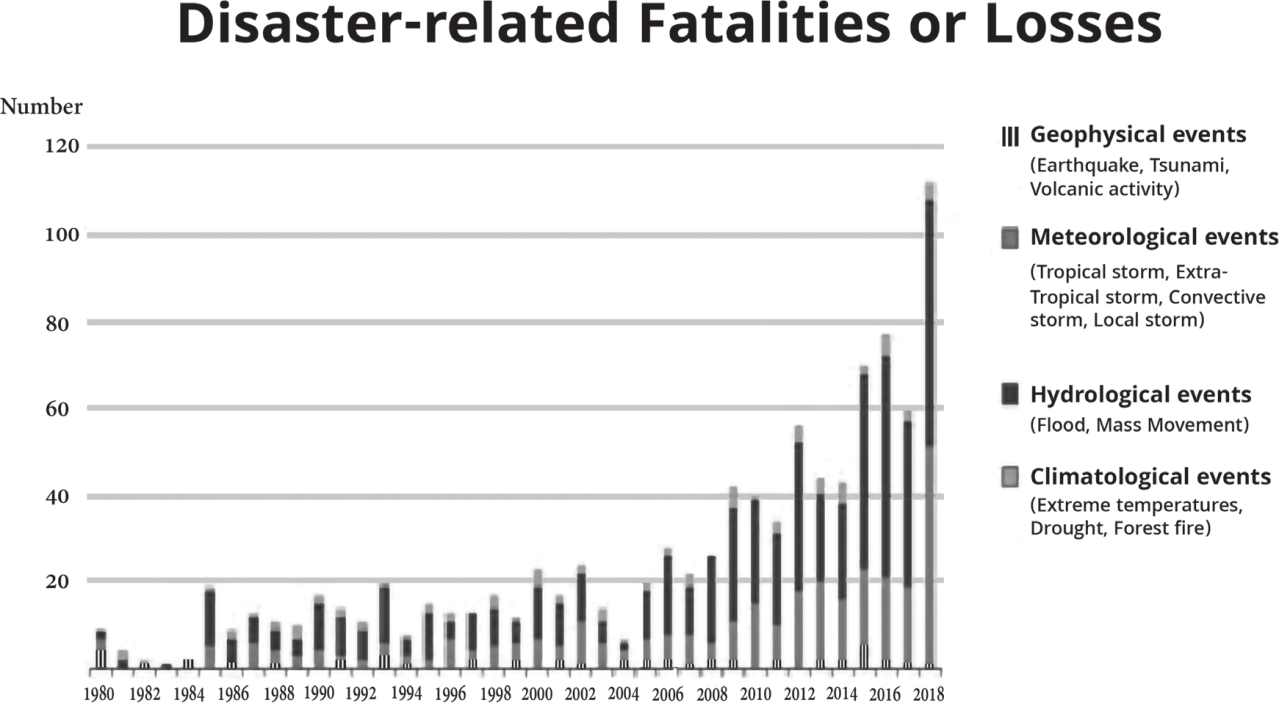
Figure: Natural Catastrophe in India since 1990
• Risk transfer refers to the process of shifting the financial burden of specific risks from one party to another, either formally or informally. This enables households, communities, businesses, or government entities to secure financial resources from another party after a disaster occurs, in return for ongoing payments or other compensatory benefits.
• A common example of risk transfer is insurance, where an individual or entity pays regular premiums to an insurer in exchange for financial coverage in case of a loss.
• Additionally, informal risk transfer takes place within families or communities through mutual aid, credit, or gift exchanges, where there is an expectation of reciprocal support. Formal mechanisms, on the other hand, are established by governments, insurers, multinational banks, and other financial institutions to manage large-scale losses. These mechanisms include insurance and reinsurance agreements, catastrophe bonds, contingent credit arrangements, and reserve funds. The financial support for these instruments comes from premiums, investor funding, interest rates and accumulated savings.
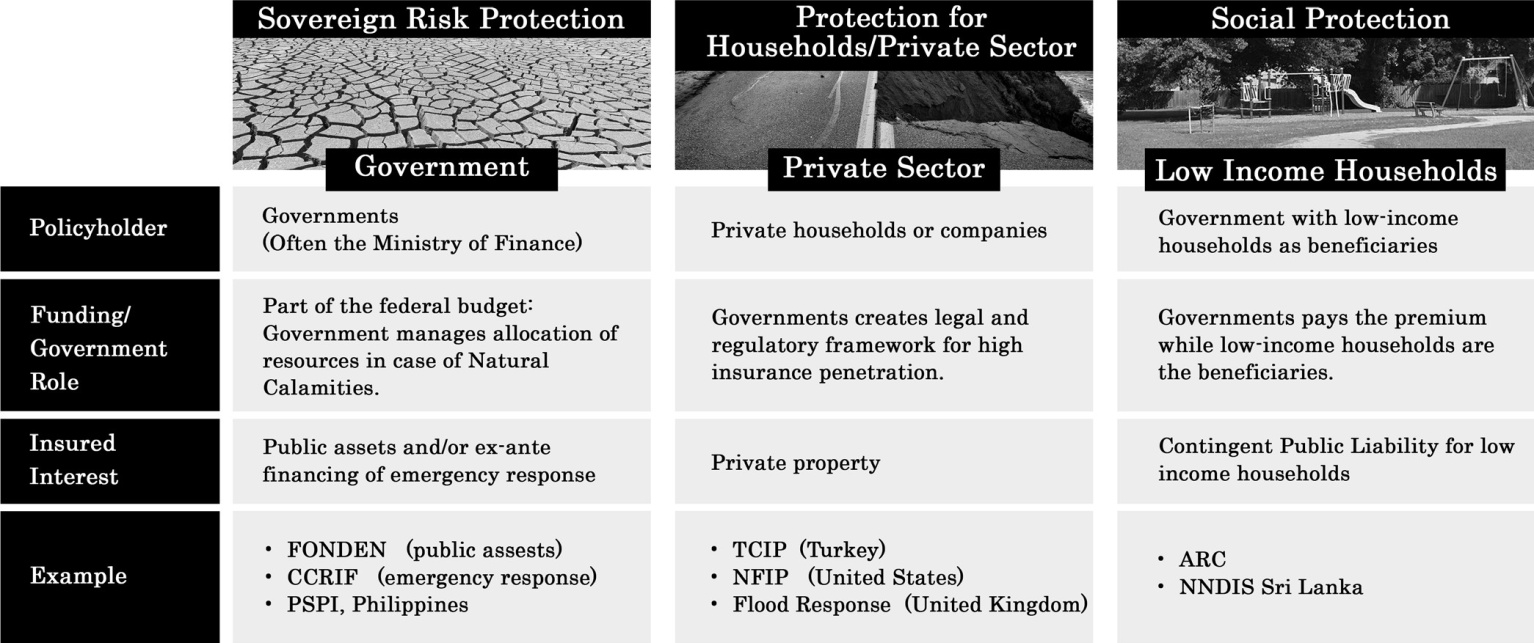
Figure: Sovereign Disaster Risk Management Framework
• Disaster Risk Finance and Insurance Instruments aim to increase the resilience of vulnerable countries against the financial impact of disasters and to secure access to post- disaster financing before an event strikes, thus ensuring rapid, cost-effective resources to finance recovery and reconstruction efforts.
• Typically, governments seek financial protection for four different groups across society: national and local governments; homeowners and small
and medium enterprises (SMEs); farmers; and the poorest segment of the population.
• When a new insurance solution has to be put in place one needs to assess the availability, breadth, and depth of market risk transfer solutions for disasters. In particular, regarding disaster insurance, the following main elements could be considered:
• The segment of the population and the economy covered (e.g. low income group, small business enterprises, large commercial and industrial corporations, local governments)
• The hazards covered (natural and/or man-made, depending on the disaster risk profile of the economy)
• The scope of losses covered (e.g. property damage, business interruption, livelihood costs, life, accident, liability) by insurance
• The contractual mechanism through which disaster coverage is made available in the market—such as government-supported insurance schemes—along with the pricing mechanism that determines the cost of such insurance coverage.
Insurance Schemes
Insurance is a crucial method of risk transfer and plays a significant role in mitigating losses resulting from disasters. However, it should not be considered a direct funding mechanism for disaster management. It is essential to have an insurance system that is accessible and affordable, particularly for the general public, including those in rural areas. Various insurance programs have been introduced to cater to this need. Some of the insurance schemes are: Pradhan Mantri Fasal Bima Yojana–
• The Pradhan Mantri Fasal Bima Yojana (PMFBY) offers extensive insurance protection against crop failure, ensuring financial stability for farmers.
• This scheme includes coverage for all food and oilseed crops, as well as annual commercial and horticultural crops, provided that historical yield data is available and the required number of Crop Cutting Experiments (CCEs) are conducted under the General Crop Estimation Survey (GCES).
Restructured Weather-based Crop Insurance Scheme–
• The Restructured Weather Based Crop Insurance Scheme (RWBCIS) is designed to alleviate financial distress for insured farmers by addressing potential crop losses due to unfavorable weather conditions such as rainfall, temperature, wind and humidity fluctuations.
•
Under the Weather-Based Crop Insurance Scheme (WBCIS), weather indicators act as a substitute for crop yields to determine compensation for assumed crop losses. The payout system is structured based on the degree of losses estimated through predefined weather triggers.
Seed Crop Insurance–
• This scheme aims to ensure financial protection and income stability for breeders and seed growers in case of seed crop failure. A key feature of the scheme is to cover risks associated with seed production at the field level, expected raw seed yield losses, and post-harvest seed crop losses. The objective is to encourage more breeders, institutions, organizations, and seed growers to participate in seed production.
Kisan Credit Card (KCC)–
Launched in 1998, the KCC scheme enables farmers to access credit for purchasing agricultural inputs such as seeds, fertilizers, and pesticides, as well as to withdraw cash for production-related expenses.
Over time, the scheme has been simplified to offer an ATM- enabled RuPay Debit Card with features like one-time documentation, a built-in cost escalation provision within the credit limit, and flexibility for multiple withdrawals within the sanctioned limit
Role of NGOs
• Prominent NGOs like the Self-Employed Women’s Association (SEWA) and the Tribhuvandas Foundation have made significant contributions to providing health insurance for economically disadvantaged families. They have introduced innovative approaches, such as integrating multiple risks into a single policy, linking insurance schemes with savings, and covering essential services that are often excluded from market-driven schemes, including maternity care and transportation costs during emergencies like riots and floods.
• Even in developed Western countries, sustainable insurance models have emerged from non-profit initiatives. Similarly, the Association for Sarva Seva Farms (ASSEFA) in Tamil Nadu offers livestock insurance, primarily covering buffaloes, cows, and bullocks.
• Cattle Protection Committees offer complementary services such as de-worming, vaccinations, and routine medical check-ups for livestock, with streamlined procedures for ease of access.
• Therefore, instead of a fully state-owned model, a state- led approach is increasingly viewed as a more effective strategy for insurance, which plays a crucial role in fostering disaster-resilient communities. Establishing meaningful partnerships with people's organizations, including cooperatives, trade unions, and savings and credit societies, is essential for ensuring comprehensive insurance coverage.
Role of Civil Society
• Numerous international and national NGOs, along with various institutions, provide grants for disaster management initiatives. Many of these institutions are affiliated with foreign governments and typically function through their embassies. Examples include the Japan International Cooperation Agency, the British Government’s Department for International Development, and the United States Agency for International Development.
• In addition to these, both international donor agencies like the Ford Foundation and national entities such as the Tata Trusts provide grants for disaster management efforts.
• Large international organizations, including CARE and OXFAM, also allocate resources to support smaller, local NGOs.
• Faith-based organizations such as Christian Aid, Islamic Relief, and Gayatri Parivar generate funds through private donations, which are then distributed to grassroots organizations for their initiatives.
Many organizations rely on private donations from individuals, corporations and institutions to raise funds. This donation-based approach is one of the oldest and remains among the most effective methods of fundraising.
Some organizations generate funds by charging for products and services. Examples include UNICEF and CRY, which raise money through the sale of greeting cards, while groups like the Centre for Science and Environment, Development Alternatives, and SEEDS generate revenue by selling publications and providing advisory services.
Lastly, some organizations secure funding through membership fees.