Important Laws and Acts on Disaster
The Epidemic Diseases Act, 1897
Objective and Scope: The Act grants authority to implement measures for controlling and preventing the outbreak or spread of epidemics within states or across the country. States have the power to designate officers or agencies to take necessary actions if they determine that a dangerous epidemic poses a threat to public health. Officials conducting inspections are empowered to assess the situation and take charge of all related responsibilities, including expenses for compensation, travel, temporary accommodation, and the isolation of infected individuals.
Relevant Legal Provisions:
• To take special measures and prescribe regulations as to dangerous epidemic diseases (Section 2)
• (a) If at any time the State Government determines that there is a threat of an outbreak of a dangerous epidemic disease and considers the existing legal provisions inadequate to address the situation, it may take necessary measures or authorize any individual to do so. The government may also issue public notices prescribing temporary regulations that the public or specific groups must follow to prevent the outbreak or spread of the disease. Additionally, it has the authority to decide how and by whom any incurred expenses, including compensation if applicable, will be covered
• (b) This includes conducting inspections of individuals traveling by railway and isolating suspected infected persons in hospitals or temporary accommodations as determined by the inspecting officer.
• Authority of the Central Government (Section 2A): If the Central Government determines that India or any part of it is experiencing or at risk of an outbreak of a severe epidemic disease, and existing legal provisions are insufficient to prevent its spread, it may implement necessary measures and establish regulations. This includes inspecting ships or vessels departing from or arriving at ports within the jurisdiction of this Act, as well as detaining such ships, vessels, or individuals intending to travel or arriving by them, if required.
• Penalties (Section 3): Any individual violating regulations or orders issued under this Act will be considered to have committed an offense punishable under Section 188 of the Indian Penal Code (45 of 1860).
• Legal Protection (Section 4): No legal action or proceedings can be initiated against any person for actions taken or intended to be taken in good faith under the provisions of this Act.
Case of COVID-19: Powers of Lockdown under the Law
• “Lockdown” is not a legal term. The term is being used by government officials and others to describe a situation where free movement of goods is restricted, with the exception of essential items declared by the Government of India under Section 2, 3, 4 of the Epidemic Diseases Act.
• Certain examples of exercise of lockdown powers of the government can be found in
• Delhi Epidemic Diseases (Covid 19) Regulations, 2020;
• MaharashtraEpidemic Diseases (Covid-19) Regulations, 2020;
• Punjab Epidemic Diseases (Covid-19) Regulations, 2020;
• Himachal Pradesh Epidemic Disease (Covid-19) Regulations, 2020, etc.
• Lockdown is not the same as curfew. One of the foremost differences between the two is that in lockdown, state enforcement authorities like the police cannot arrest persons for not following the lockdown without the permission of the competent court.
• They can, however, enforce a lockdown through the mechanism provided under Section 188 (disobedience to the directions given by a public servant), Section 269 (negligent act likely to spread infection of disease dangerous to life) and Section 270 (malignant act likely to spread infection of disease dangerous to life) of the Indian Penal Code.
•
‘Curfew’ again is not a legal term. Generally, exercise of a power available to the District Magistrate, SDM, or any other executive magistrate under Section 144 of the Code of Criminal Procedure is, in common parlance, referred to as a ‘curfew’.
• The authorities in these circumstances, for preventing danger to human life, health or safety, disturbance of public tranquility, or a riot or an affray, may issue such orders. If anyone defies such orders issued under Section 144 CrPC, the enforcement agencies have a right to detain/arrest the violators.
• Now we come to the terms ‘quarantine’ and ‘isolation’, which have been defined under the Indian Aircraft (Public Health) Rules, 1954. Similar restrictions are found under the Indian Port Health Rules 1955, framed under the Indian Port Act, for passenger ships, cargo ships, and cruise ships.
• Quarantine: Refers to the restriction of movement and activities or the separation of individuals suspected of being infected from those who are not ill. It also applies to suspect baggage, cargo, containers, aircraft, vehicles, facilities, goods, and postal parcels, ensuring that potential contamination or infection does not spread.
• Isolation: Involves the separation of infected or contaminated individuals, as well as affected baggage, containers, aircraft, vehicles, facilities, goods, or postal parcels, from others. This measure is taken to prevent the transmission of infection or contamination. While not explicitly defined, similar provisions exist under the Epidemic Diseases Act, 1897.
Disaster Management Act, 2005
The Disaster Management Act establishes an administrative framework for implementing measures to manage disasters. A disaster is defined as a catastrophic event, mishap, calamity, or severe occurrence in any region, resulting from natural or human-made causes, accidents, or negligence. Such an event leads to significant loss of life, human suffering, destruction of property, or environmenta damage and degradation. The scale or severity of the disaster is such that it surpasses the affected community's ability to cope.
The purpose of this law was to cater to a situation such as an earthquake, flood or fire rather than a disease like COVID-19. However, on March 14, the Home Ministry declared the Coronavirus outbreak as a “notified disaster”, thus, bringing into play the provisions of the Disaster Management Act.
This has allowed the National Executive Committee to give directions to the governments to take certain measures and has delegated powers to act under the Act to the Union Health Secretary. It further allows usage of disaster funds created for this purpose.
The Act has more teeth to deal with a disaster situation and includes the power to imprison, fine etc. The Act also has the means to control social media. The Act has been used in tandem with the Epidemic Diseases Act, with the latter providing the basis for containment measures such as restrictions on flights landing in India, prohibiting gatherings beyond a certain number of people, and various other measures adopted since the outbreak
.
• In the current health needs of the nation, the Act seems to be an archaic framework, owing to the changing priorities in public health emergency management. The first and the basic flaw that can be seen is that the Epidemic Act 1897 is silent on the definition of “dangerous epidemic disease”.
• However, looking at the outbreak of COVID-19 that has been declared as a pandemic disease by the World Health Organization, this Act comes in handy for the state functionaries to issue measures relating to isolation or ‘quarantine measure’. There is a definite need for a legal framework regulating the availability and distribution of vaccine and drugs and implementation of response measures.
• It is clear that no single law can effectually control the present outbreak. It is this reason that you will find that various provisions of Indian Penal Code, Criminal Procedure Code, the Epidemic Diseases Act, 1897 and the Disaster Management Act, 2005 are being invoked to control the current outbreak.
• Following the Prime Minister’s address to the nation on the “vital aspects of Coronavirus” on March 25, when a national lockdown was announced, different states have sought to enforce it by issuing Executive Orders under Section 144 of CrPC, and some by invocation of the Epidemic Diseases Act, 1897 only.
• These Executive Orders have been primarily issued to enforce the national lockdown in letter and spirit, and to restrict unnecessary movement of people on the basis I of Section 2 of Epidemic Diseases Act, 1897.
• Thus, the implications of not following a national lockdown could be:
• Section 188 of the CrPC whereby disobedience to the directions of a public servant is punishable with both imprisonment and fine.
• Section 269 of the Indian Penal Code can be invoked to ensure that nobody spreads infection of a dangerous disease.
• Section 270 of the Indian Penal Code can be invoked if people malignantly fail to act during an epidemic.
• Once these provisions are invoked, the enforcement authorities may arrest the person involved.
• If someone escapes “quarantine”, the authorities may invoke provisions of Section 271 IPC.
• Lastly, if there is imposition of Section 144 CrPC conditions, then it is a curfew.
•
Combined exercise of various laws allows the enforcement agencies to enforce a lockdown like a curfew if need be.
• Lightning
• Indian Standard Protection Of Buildings And Allied Structures Against Lightning Code Of Practice 1991
• Earthquake, Snow Avalanches/ Landslide
• Indian Standards On Earthquake Engineering
• Model Town And Country Planning Act 1960
• Model Building By- Laws 2004
• National Building Code Of India 2005
• Chemical/ Industrial/ Nuclear
• Atomic Energy (Safe Disposal Of Radioactive Wastes)
Rules, 1987.
• The Bhopal Gas Leak Disaster (Processing Of Claims)
Act, 1985
• Calcium Carbide Rules, 1987
• The Manufacture, Storage And Import Of Hazardous
Chemical Rules, 1989
• Chemical Accidents (Emergency Planning, Preparedness, And Response) Rules, 1996
• The Major Accident Hazard Control Rules, 1997
• Dumping And Disposal Of Fly Ash Discharged From Coal Or Lignite Based Thermal Power Plans On Land Rules 1999
• The Chemical Weapons Convention Act, 2000
•
Atomic Energy (Radiation Protection) Rules 2004
• Weapons of Mass Destruction And Their Delivery Systems (Prohibition Of Unlawful Activities) Act, 2005
• The Civil Liability For Nuclear Damage Act, 2010
• Biological Disaster
• Bio- Medical Waste (Management And Handling) Rules
1998
• The Municipal Solid Wastes (Management & Handling) Rules, 2000
• Rules for The Manufacture, Use, Import, Export And Storage Of Hazardous Micro Organisms Genetically Engineered Organisms Or Cells 1989
• Poisoning
• The Destructive Insects And Pests Act, 1914
• The Poisons Act, 1919
• The Drugs And Cosmetics Act, 1940
• The Prevention Of Food Adulteration Act, 1954
• The Insecticides Act, 1968
• The Insecticides Rules, 1971
• The Narcotic Drugs And Psychotropic Substances Act,
1985
• The Consumer Protection Act, 1986
• The Batteries (Management And Handling) Rules, 2001.
• Batteries (Management & Handling) Amendment Rules, 2010
• E-waste (Management And Handling) Rules, 2011
• Plastics (Manufacture, Usage And Waste Management) Rules, 2011
• Accident
• The Inland Vessels Act, 1917
• The Indian Carriage Of Goods By Sea Act, 1925
• The Aircraft Act, 1934
• Aircraft rules, 1937.
• National Highways Act, 1956
• The Merchant Shipping Act, 1958
• Carriage By Air Act 1972
• The Inland Waterways Authority Of India Act, 1985
• Motor Vehicles Act 1988
• The Railways Act, 1989
• Central Motor Vehicles Rules, 1989
• The Railway Accidents And Untoward Incidents (Compensation) Rules, 1990
• Railway (Notices Of And Inquiries Into Accidents) Rules,
1998
• Statutory Investigation Into Railway Accidents Rules
1998
• Carriage By Road Act, 2007
• Carriage By Road Rules 2011
• Stampede: Disaster From Management
• A guide for administrators and organizers of events and venues of mass gathering- a guide for state government, local authorites, administrators and organisers, ndma
• Police Act 1861
• Epidemic Diseases
• Epidemic Disease Act 1897
• Cloud Burst
• Dam Safety Act 2021
• Pest Attack
• Destructive Insects And Pests Act 1914
• Insecticides Act 1968
• Insecticides Rules 1971
National Policy on Disaster Management
National Policy on Disaster Management (NPDM) 2009
The National Policy on Disaster Management was sanctioned by the Union Cabinet on October 22, 2009, and officially introduced on January 18, 2010. It signifies a fundamental shift from the previous ‘Response-Centric’ approach to a comprehensive disaster management strategy, emphasizing Prevention, Preparedness, and Mitigation.
Vision
The goal is to establish a secure and disaster-resilient India by formulating a comprehensive, proactive, and technology- driven strategy that addresses multiple disasters through a strong emphasis on prevention, mitigation, preparedness, and response.
Disaster Management
A disaster is a severe event, mishap, or calamity arising from natural or human-induced causes, exceeding the affected community’s ability to manage it. Disaster management is
a continuous and integrated process that involves planning, organizing, coordinating, and implementing essential measures to:
• Prevent potential dangers or threats of disasters.
• Mitigate or minimize disaster risks, their severity, and consequences.
• Enhance capacity building, including research and knowledge management.
• Ensure preparedness to handle disasters effectively.
• Provide a swift response to disaster situations.
• Evaluate the severity and impact of disasters.
• Conduct evacuation, rescue, and relief efforts.
• Facilitate rehabilitation and reconstruction.
A standard disaster management framework consists of six key components. The pre-disaster phase focuses on prevention, mitigation, and preparedness, while the post-disaster phase includes response, rehabilitation, reconstruction, and recovery.
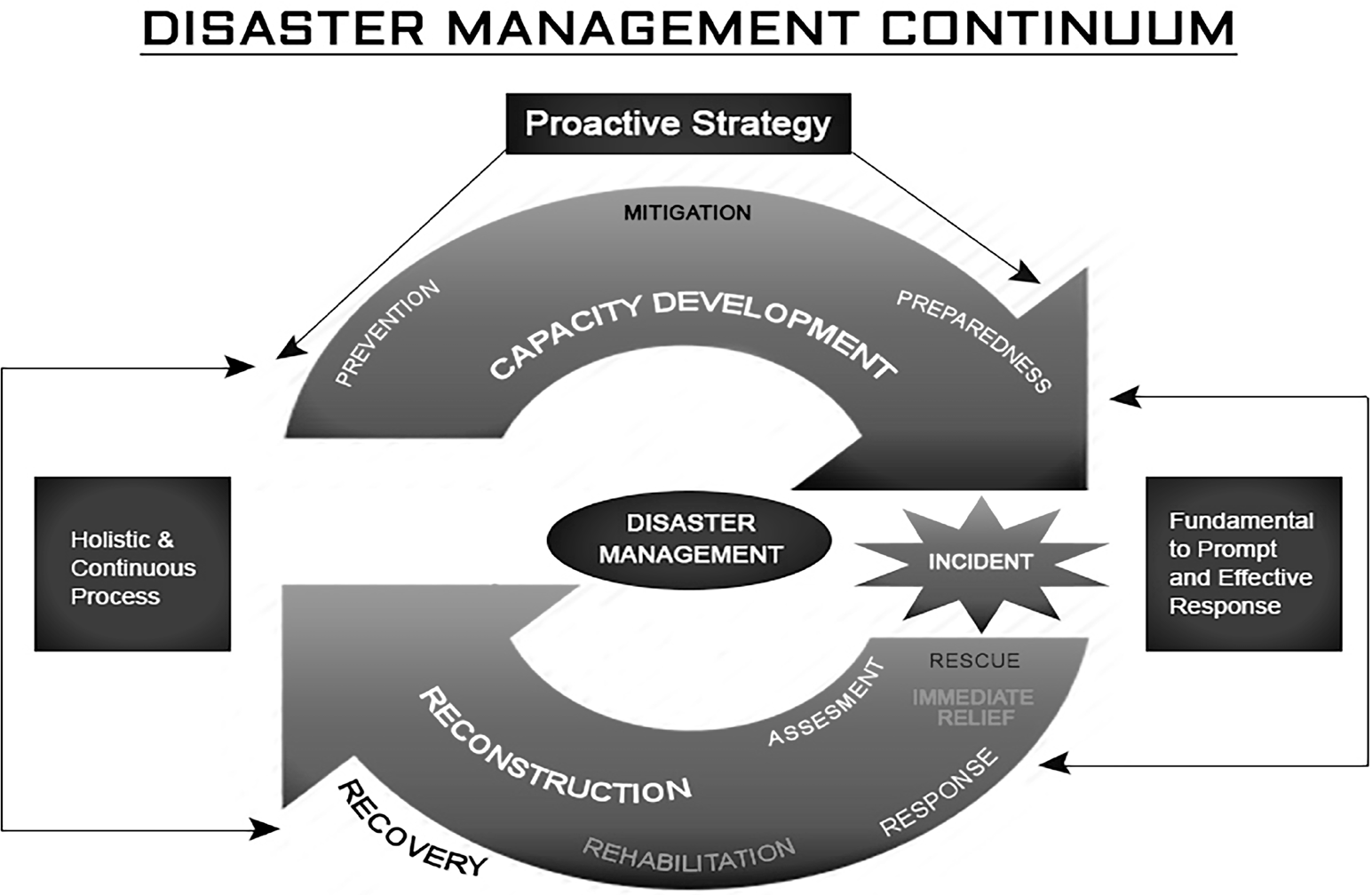
Figure: Disaster Management Continuum
Approach
• A comprehensive and cohesive approach will be developed for disaster management, focusing on fostering strategic partnerships at different levels. The key principles of the policy include:
• Community-centered disaster management, ensuring the seamless integration of policies, plans, and implementation at the grassroots level.
• Strengthening capacity across all sectors.
• Building upon previous initiatives and adopting best practices.
• Collaboratingwith national and international agencies.
• Promoting synergy across multiple sectors.
Objectives
The objectives of the national policy on disaster management are:
• Fostering a culture of prevention, preparedness and resilience at all levels through education, knowledge- sharing and innovation.
• Encouraging mitigation strategies that incorporate technology, traditional knowledge and environmental sustainability.
• Integrating disaster management into the developmental planning process.
• Establishing institutional and techno-legal frameworks to enable a strong regulatory environment and ensure compliance.
• Implementing effective mechanisms for identifying, assessing, and monitoring disaster risks.
• Developing modern forecasting and early warning systems, supported by reliable communication networks and information technology.
• Strengthening collaboration with the media to raise awareness and enhance capacity development.
• Ensuring a swift and effective response and relief approach, prioritizing the needs of vulnerable communities.
• Utilizing reconstruction as an opportunity to develop disaster-resilient infrastructure and safer living environments.
• Encouraging a proactive and cooperative relationship with the media for disaster management efforts.
National Disaster Management Plan (NDMP) 2016
NDMA had prepared the first National Disaster Management Plan in 2016. The same was revised after extensive consultations in November, 2019.
Vision
Make India disaster resilient, achieve substantial disaster risk reduction and significantly decrease the losses of life,
livelihoods and assets – economic, physical, social, cultural, and environmental – by maximizing the ability to cope with disasters at all levels of administration as well as among communities.
Objectives
Along with the mandate given in the DM Act 2005 and the NPDM 2009, the national plan has incorporated the national commitment towards the Sendai Framework. Accordingly, the broad objectives of the NDMP are:
• Enhance understanding of disaster risks, hazards and vulnerabilities.
• Strengthen disaster risk governance at all levels, from
local to national.
• Invest in disaster risk reduction to enhance resilience through structural, non-structural, financial measures and comprehensive capacity building.
• Improve disaster preparedness for an efficient and effective response.
• Advocate for the "Build Back Better" approach in recovery, rehabilitation and reconstruction.
• Prevent disasters and significantly reduce disaster risks and losses related to lives, livelihoods, health, and assets, including economic, physical, social, cultural and environmental aspects.
• Increase resilience, prevent the development of new disaster risks and minimize existing ones.
• Encourage the adoption of integrated and inclusive economic, structural, legal, social, health, cultural, educational, environmental, technological, political and institutional measures to minimize hazard exposure and vulnerabilities.
• Empower local authorities and communities to actively participate in disaster risk reduction and management.
Strengthen scientific and technical expertise in all areas of disaster management.
• Build capacity at all levels to effectively handle multiple hazards and promote community-based disaster management.
• Clearly define the roles and responsibilities of various Ministries and Departments engaged in different aspects of disaster management.
• Foster a culture of disaster risk prevention and mitigation at all levels.
• Support the integration of disaster management considerations into development planning and processes.
Salient Features of the Plan
• The plan covers all phases of disaster management i.e. prevention, mitigation, response and recovery.
• For each hazard, the national plan integrates the four priorities outlined in the Sendai Framework into the disaster risk reduction planning framework across five key thematic action areas:
• Understanding Risk
• Inter-Agency Coordination
• Investment in Disaster Risk Reduction (DRR)
– Structural Measures, which involve physical construction or engineering techniques to enhance hazard resistance and resilience in structures and systems.
• Investment in Disaster Risk Reduction (DRR) – Non- Structural Measures, which include knowledge- based strategies, policies, laws, public awareness campaigns, training, and education to mitigate risks and impacts without physical construction.
• Capacity Building
• The response section of the plan outlines eighteen broad activities, systematically arranged into a matrix to serve as a quick reference guide:
• Early Warning, Maps, Satellite inputs, Information Dissemination
• Evacuation of People and Animals
• Search and Rescue of People and Animals
• Medical Care
• Drinking Water/ Dewatering Pumps/ Sanitation Facilities/ Public Health
• Food & Essential Supplies
• Communication
• Housing and Temporary Shelters
• Power
• Fuel
• Transportation
• Relief Logistics and Supply Chain Management
• Disposal of Animal Carcasses
• Fodder for livestock in scarcity-hit areas
• Rehabilitation and Ensuring Safety of Livestock and other Animals, Veterinary Care
• Data Collection and Management
• Relief Employment
• Media Relations
•
The Plan includes a dedicated chapter on Enhancing Disaster Risk Governance. This section features a comprehensive responsibility matrix that outlines key themes for reinforcing disaster risk governance and identifies the respective roles of central and state agencies. The matrix categorizes actions required from both the Central and State Governments into six thematic areas to effectively strengthen disaster risk governance.
Mainstream and integrate DRR and Institutional Strengthening
Capacity Development
Promote Participatory Approaches
Work with Elected Representatives
Grievance Redress Mechanism
Promote Quality Standards, Certifications, and Awards for Disaster Risk Management
• The plan ensures seamless coordination between various government agencies and departments at both horizontal and vertical levels. It clearly defines the roles and responsibilities of different levels of government, extending up to the Panchayat and Urban Local Bodies, in a structured matrix format. Adopting a regional approach, the plan not only aids in disaster management but also contributes to development planning.
• It is structured to be scalable and applicable across all phases of disaster management. The plan outlines key activities such as early warning, information dissemination, medical assistance, fuel supply, transportation, search and rescue operations, and evacuation, serving as a reference for agencies responding to disasters. Additionally, it establishes a broad recovery framework, allowing flexibility to assess situations and implement "Build Back Better" strategies.
• Recognizing the importance of community preparedness, the plan emphasizes the necessity of Information, Education, and Communication initiatives to enhance disaster resilience at all levels.
Disaster Management Act
Disaster Management Act, 2005
• Objective and Scope: The Disaster Management Act of 2005 facilitates efficient disaster management and signifies a major shift in approach, emphasizing disaster mitigation, prevention, and preparedness. Recognized as the primary legislation governing disaster response for both natural and human-induced calamities, the Act establishes the National Disaster Management Authority at the central level, with corresponding structures replicated at the state and district levels.
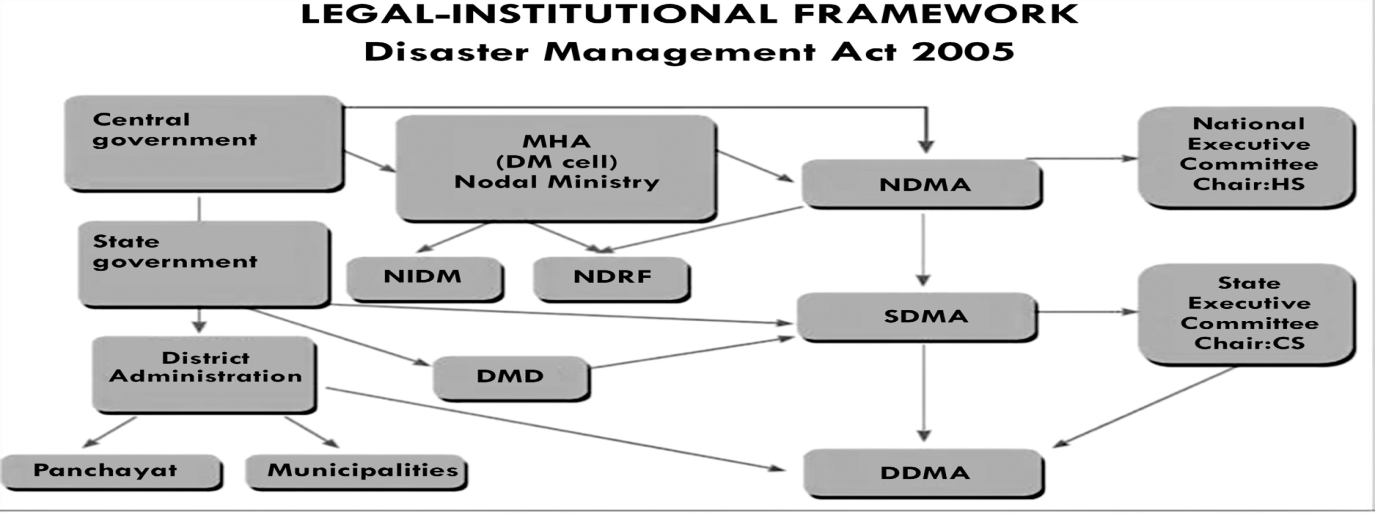
Figure: Legal Institutional Framework under Disaster Management Act 2005
Relevant Provisions of the Act:
Definitions
• A disaster refers to a catastrophic event, mishap, calamity, or severe occurrence in a specific area, resulting from natural or human-induced causes, accidents, or negligence. It leads to significant loss of life, human suffering, property destruction, and environmental damage beyond the affected community's capacity to cope.
• Disaster management is an ongoing and integrated process that involves planning, organizing, coordinating, and executing measures necessary for:
• Preventing potential disaster threats; (ii) Mitigating risks or reducing the severity and consequences of disasters; (iii) Strengthening capacity-building efforts; (iv) Preparing to handle disasters effectively;
• Ensuring a prompt response to disaster situations;
• Evaluating the magnitude and impact of disasters; (vii) Conducting evacuation, rescue, and relief operations; (viii) Facilitating rehabilitation and reconstruction efforts.
• The District Authority refers to the District Disaster Management Authority.
• The District Plan denotes the disaster management strategy formulated for a district.
• A Local Authority encompasses Panchayati Raj institutions, municipalities, district boards, cantonment boards, town planning authorities, Zila Parishads, or any other body responsible for delivering essential services within a designated local jurisdiction.
• Establishment of the National Disaster Management Authority (Section 3) The Central Government shall establish the National Disaster Management Authority, consisting of a Chairperson and up to nine additional members. The Prime Minister will serve as the ex-officio Chairperson of the Authority.
• Powers and Functions of the National Authority (Section 6) The National Authority is responsible for formulating policies, strategies, and guidelines related to disaster management. Its key functions include:
• Approving the National Plan.
• Endorsing plans prepared by Ministries and Government Departments in alignment with the National Plan.
• Establishing guidelines for State Authorities and Government Ministries/Departments to follow while formulating their respective disaster management plans.
• Overseeing the implementation and enforcement of disaster management policies and plans.
• Taking proactive measures to prevent disasters.
• Advisory Committee (Section 7): The National Authority shall establish an advisory committee comprising experts in disaster management at the national, state, or district levels. This committee will provide recommendations on various aspects of disaster management.
• National Executive Committee (Section 8): A National Executive Committee will be formed to support the National Authority in carrying out its responsibilities.
• Formation of Sub-Committees (Section 9): The National Executive Committee has the authority to establish one or more sub-committees to enhance the efficiency of its operations.
• Responsibilities of the National Executive Committee (Section 10): The National Executive Committee is tasked with implementing the policies set by the National Authority. It serves as the primary body for coordinating and overseeing disaster management efforts. Additionally, it is responsible for drafting the National Plan, which must receive approval from the National Authority. The committee also offers technical support to state governments, state disaster management authorities, and district authorities in developing their disaster management strategies.
• National Plan (Section 11): The National Executive Committee shall develop a comprehensive disaster management plan for the entire country, known as the National Plan.
• State Disaster Management Authorities (Section 14): Each state government shall establish a State Disaster Management Authority, consisting of a Chairperson and a maximum of nine members. The Chief Minister of the state shall serve as the ex-officio Chairperson.
• Advisory Committee (Section 17): The State Disaster Management Authority shall appoint an advisory committee composed of disaster management experts to provide guidance and recommendations.
• Functions of the State Authority (Section 18): The State Authority is responsible for formulating the state disaster management policy. It must approve disaster management plans prepared by various state government departments. Additionally, it establishes guidelines to be followed by state departments in disaster management initiatives.
•
Guidelines for Minimum Standards of Relief (Section 19): The State Authority shall establish guidelines to ensure a standard level of relief for individuals affected by disasters within the state.
• State Executive Committee (Sections 20 & 22): A State Executive Committee will be formed to assist the State Authority in fulfilling its responsibilities. The committee will be chaired by the Chief Secretary of the state (ex- officio) and will include four secretaries from different state government departments. It is responsible for executing the National and State Disaster Management Plans and serves as the primary body for coordinating and overseeing disaster management efforts in the state. Its key responsibilities include:
• Assessing the vulnerability of various regions within the state to different types of disasters and recommending appropriate measures.
• Establishing guidelines for the preparation of disaster management plans by state government departments and district authorities.
• Overseeing the implementation of disaster management plans at the state and district levels.
• Issuing directives to state departments, authorities, and agencies regarding disaster response measures.
• Advising, assisting, and coordinating efforts between different state government departments, district authorities, and other organizations involved in disaster management.
• Providing technical expertise and guidance to district and local authorities in carrying out their disaster management duties.
• Inspecting construction projects in local areas and ensuring compliance with approved safety standards. If necessary, it can instruct the District or Local Authority to take corrective action.
• State Disaster Management Plan (Section 23): Each state is required to develop a comprehensive disaster management plan, known as the State Disaster Management Plan, to address disaster preparedness, response, and mitigation
• District Disaster Management Authority (Section 25) District Disaster Management Authority is to be established for every district in the State. District Authority will consist of the Chairperson and other members (not exceeding seven). This includes the Collector or District Magistrate or Deputy Commissioner of the district (will act the Chairperson, ex officio), the elected representative of the local authority (Co-Chairperson, ex officio), Chief Executive Officer of the District Authority (ex officio), Superintendent of Police (ex officio), Chief Medical Officer of district (ex officio), other district level officers (not exceeding two). In Tribal Areas (referred to in the Sixth Schedule to the Constitution), Chief Executive Member of the district council of autonomous district will be the co-Chairperson (ex officio). In districts where zila
Parishad exists, Chairperson shall be the co-Chairperson of the District Authority. An officer, not below the rank of Additional Collector or Additional District Magistrate or Additional Deputy Commissioner will be appointed to be the Chief Executive Officer of the District Authority.
• Powers of Chairperson of District Authority (Section 26) Chairperson of the District Authority can in case of emergency exercise all the powers of the District Authority.
• Powers and functions of District Authority (Section 30) District Authority will act as the district planning, coordinating and implementing body for disaster management. It has the following functions
• Preparing a disaster management plan (including district response plan for the district).
• Coordinating and monitoring the implementation of the National Policy, State Policy, National Plan, State Plan and District Plan.
• Identification of districts vulnerable to disasters.
• Taking steps for the prevention and mitigation of disaster.
• Ensuring that the guidelines laid down by National Authority and State Authority are followed by all departments of Government at district level and the local authorities in the district.
• Giving directions to different authorities at district level and local authorities to take measures for prevention or mitigation of disasters.
• Laying down guidelines for prevention of disaster management plans by Government department at the district level and local authorities in the district.
• Monitoring implementation of disaster management plans prepared by the Government Department at the district level.
• Reviewing state of capabilities for responding to disasters.
• Reviewing preparedness measures to respond effectively to any disaster or threatening disaster situation.
• Organizing specialized training programmes for officers, employees and voluntary rescue workers in the district.
• Organizing community training and awareness programmes.
• Setting up, maintaining, reviewing and upgrading mechanism for early warning and dissemination of information to public.
• Prepare, review and update district level response plan.
• Coordinate response to any threatening disaster situation.
• Ensuring that Government Department at district levels and local authorities prepare their response plans.
• Examining construction in district and ensuring that it meets the necessary standards.
• Identifying buildings and places which can be used as relief centers.
•
Establishing stockpiles of relief and rescue material.
• Providing information to State Authority relating to different aspects of disaster management.
• Encouraging involvement of non-governmental organizations and voluntary social-welfare institutions in district for disaster management.
• District plan (Section 31) Every district will have a plan for disaster management. The plan will include the areas in the district which are vulnerable to different forms of disasters. The plan should list down the measures to be taken to prevent and mitigate disasters.
• Plans by different authorities at district level and their implementation (Section 32) Authorities at district level will prepare a disaster management plan.
• Powers and functions of District Authority in case of any disaster (Section 34) District Authority has the following powers and functions:--
Issue directives for the allocation and utilization of resources held by government departments and local authorities.
Regulate vehicular movement within the affected region.
Clear debris, conduct search operations, and facilitate rescue efforts.
Ensure the provision of shelter, food, clean drinking water, healthcare, and other essential services.
Set up an emergency communication network in the impacted area.
Arrange for the disposal of unclaimed deceased individuals.
Build temporary bridges or other required structures and remove hazardous constructions.
• State Government Responsibilities (Section 38): The state government must implement all measures outlined in the guidelines set by the National Authority, along with any additional necessary actions for disaster management.
• Disaster Management Plans for State Departments (Section 40): Every department within the state government is required to develop its own disaster management plan.
• Duties of Local Authorities (Section 41): Local authorities must take all essential steps for disaster management, including training their personnel, maintaining disaster- related resources, ensuring construction projects comply with disaster prevention standards, and carrying out relief, rehabilitation, and reconstruction activities in affected areas.
• National Institute of Disaster Management (Section 42): The Central Government will establish the National Institute of Disaster Management, which will focus on developing training programs, conducting research, maintaining disaster-related documentation, and assisting state governments and training institutes in policy development.
• National Disaster Response Force (Section 44): A specialized National Disaster Response Force will be set up to provide expert assistance during disasters.
• National Disaster Response Fund (Section 46): The Central Government will establish a fund dedicated to addressing disaster situations.
• National Disaster Mitigation Fund (Section 47): The Central Government will also create a fund exclusively for disaster mitigation projects.
• State-Level Disaster Funds (Section 48): State governments will establish various disaster response and mitigation funds at both the state and district levels, including the State Disaster Response Fund, District Disaster Response Fund, State Disaster Mitigation Fund, and District Disaster Mitigation Fund.
•
Offenses and Penalties (Chapter X):
• Obstruction of Officials (Section 51): Hindering any officer from carrying out duties under this Act is a punishable offense.
• False Claims (Section 52): Submitting fraudulent claims to obtain relief, aid, or other benefits is a punishable offense.
• Misuse of Relief Resources (Section 53): The misappropriation of funds or materials meant for disaster relief is punishable.
• False Disaster Alarms (Section 54): Spreading false information about a disaster or exaggerating its impact to incite panic is a punishable offense.
• Offenses by Government Departments (Section 55): If an offense is committed by a government department, the head of that department will be held accountable.
• Negligence by Officials (Section 56): Any government officer failing to fulfill duties assigned under this Act will face penalties.
• Offenses by Corporations (Section 58): If a company or corporate entity commits an offense, both the individuals responsible and the organization will be held liable.
• Non-Discrimination Clause (Section 61): No discrimination based on sex, caste, community, descent, or religion will be permitted when providing disaster relief and compensation.
• Jurisdiction Restriction (Section 71): Except for the Supreme Court or High Courts, no other court has jurisdiction over actions taken by the Central or State Government, National Authority, State Authority, or District Authority under this Act.
List of Laws for Disaster Management
List of Laws for Disaster Management
• General Laws
The Indian Penal Code, 1860
The Indian Evidence Act, 1872
The Civil Defense Act, 1968.
The Wild Life (Protection) Act, 1972
The Code Of Criminal Procedure, 1973
The Water (Prevention And Control Of Pollution) Act, 1974
The Water (Prevention And Control Of Pollution) Rules, 1975
Forest (Conservation) Act, 1980
The Air (Prevention And Control Of Pollution) Act, 1981
The Air (Prevention And Control Of Pollution) Rules,
1982
Environment (Protection) Act, 1986
The Enviroment (Protection) Rules, 1986
The Factories Act, 1948 as amended by the Factories (Amendment) Act, 1987.
Public Liability Insurance Act, 1991
The Public Liability Insurance Rules, 1991
The Protection Of Plant Varieties And Farmers’ Rights Act, 2001
The Biological Diversity Act, 2002
Forest (Conservation) Rules, 2003
• Disaster Management Act, 2005.
Food Safety And Standards Act 2006
• Laws for Fire Disaster
The Boilers Act, 1923
The Cinematograph Film Rule 1948
Oilfields (Regulation And Development) Act, 1948
The Cinematograph Act, 1952
The Inflammable Substances Act, 1952
The Mines Act, 1952
India Electricity Rules, 1956
The Coal Mines Regulations, 1957
The Coal Mines (Conservation And Development) Act, 1974
The Mines Rescue Rules, 1985
Indian Electricity Act 2003
The Mines And Minerals (Development & Regulation) Act, 2010
The Oil Mines Regulations, 2011
• Explosive Disaster
The Explosives Act, 1884
The Explosive Substances Act, 1908(as amended by the
amendment act of 2001)
Petroleum act, 1934
The Atomic Energy Act 1962
The Static And Mobile Pressure Vessels (Unfired) Rules
1981
Atomic Energy (Working Of The Mines, Minerals And
Handling Of Prescribed Substances) Rules, 1984
Hazardous Wastes (Management And Handling) Rules,
1989
The Gas Cylinder Rules 2004
The Petroleum And Natural Gas Regulatory Board Act, 2006
The Explosives Rules, 2008
HazardousWastes (Management, Handling And
Transboundary Movement) Rules, 2008.
• Flood, Dam Burst, Tsunami And Cyclone
Dam Safety Act 2021
Coastal Regulation Zone Notification 2011
Ndma Guidelines
NDMA Guidelines
National Disaster Management Guidelines- management of earthquakes, tsunami, Cyclones, Flood Management, urban flooding, drought, landslides and snow avalanches, nuclear and radiological emergencies, chemical, chemical (terrorism), biological disaster, psycho-social support and mental health services, Preparation of state disaster management plans, incident response system etc.
Guidelineson ‘National Disaster Management Information And Communication System’
National disaster management guidelines scaling, type of equipment and training of fire services
Nationaldisaster management guidelines seismic retrofitting of deficient buildings and structures
The Disaster Management (National Disaster Response Force) Rules, 2008
Cultural Heritage Conservation Bill, 2010
National Green Tribunal Act 2010
Wetlands (Conservation And Management) Rules, 2010