FDI and FPI
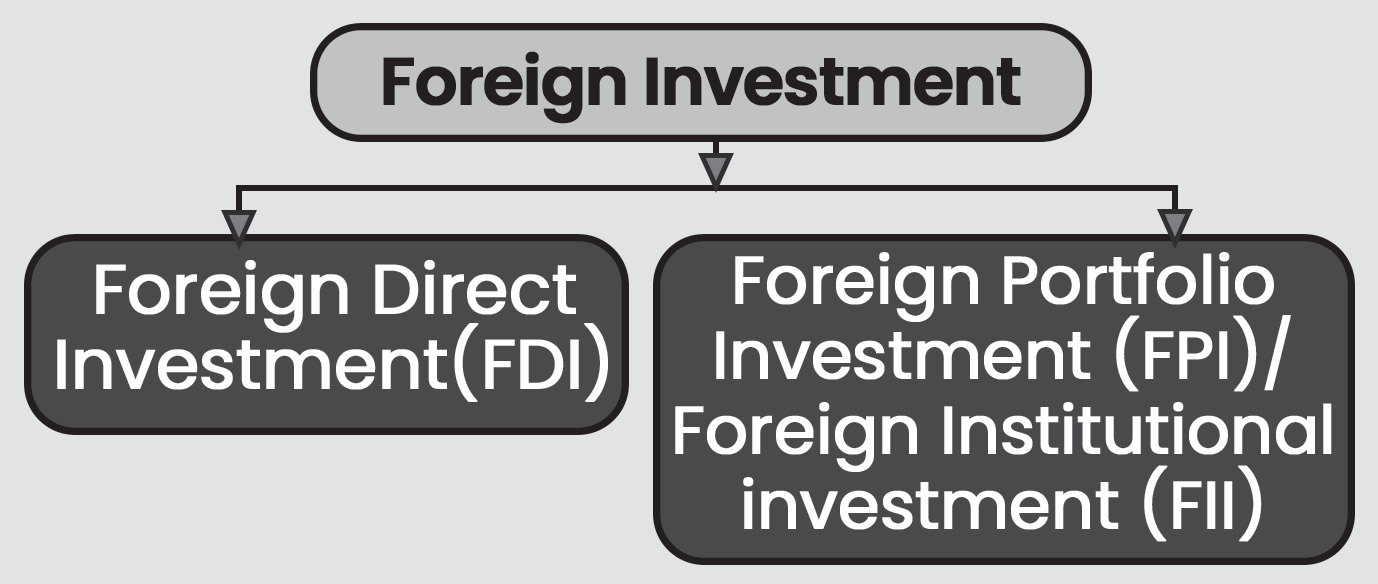
Foreign investment is when a domestic investor decides to purchase ownership of an asset in a foreign country. It involves cash flows moving from one country to another to execute the transaction. If the ownership stake is large enough, the foreign investor may be able to influence the entity’s business strategy.
Direct vs. Indirect Foreign Investments
Buying a physical asset in another country, like a factory, plant, or machinery, is known as a foreign direct investment. On the other hand, foreign indirect investments are made by investors who purchase shares in foreign businesses that are listed on stock exchanges abroad.
Foreign Direct Investment (FDI)
One important source of non-debt financial resources for economic development is thought to be foreign direct investment, or FDI. Since liberalisation, foreign direct investment (FDI) has steadily increased into India. FDI is a significant source of foreign capital because it helps the economy develop long-term sustainable capital and fosters innovation, competition, technology transfer, employment creation and other positive outcomes. Therefore, the Government of India intends and strives to encourage foreign direct investment (FDI) in order to augment domestic capital, technology and skills for faster economic growth and development. In contrast to foreign portfolio investment, foreign direct investment (FDI) refers to the establishment of a “lasting interest” in a business that is based in an economy other than the investor’s.
For example, if the UK invests either in TATA’s or by setting up a subsidiary of a UK based company in India.
The Arvind Mayaram Committee on rationalizing the FDI/ FII Definition recommended the following definition of FDI which was accepted by the Government. i.e.
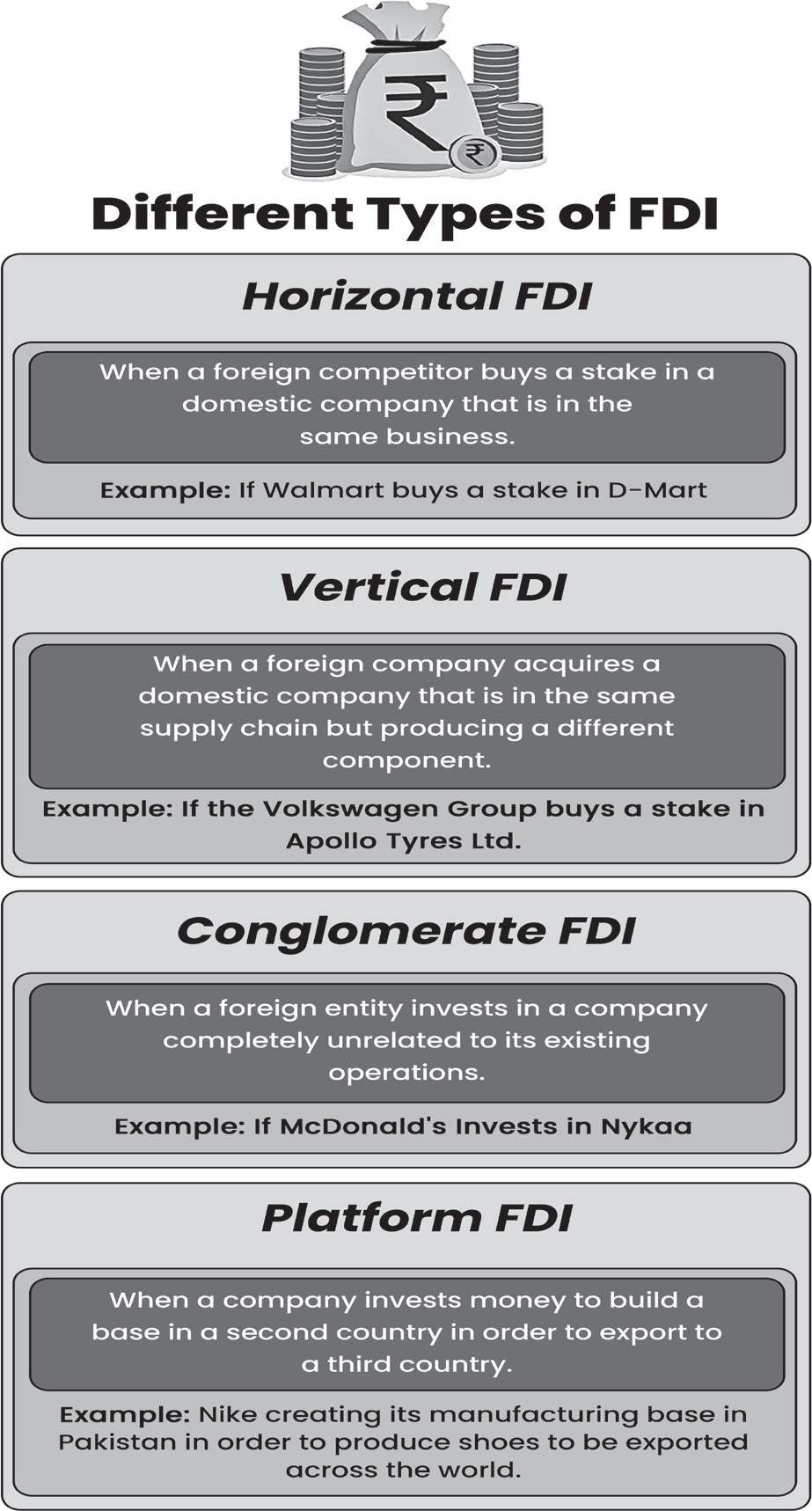
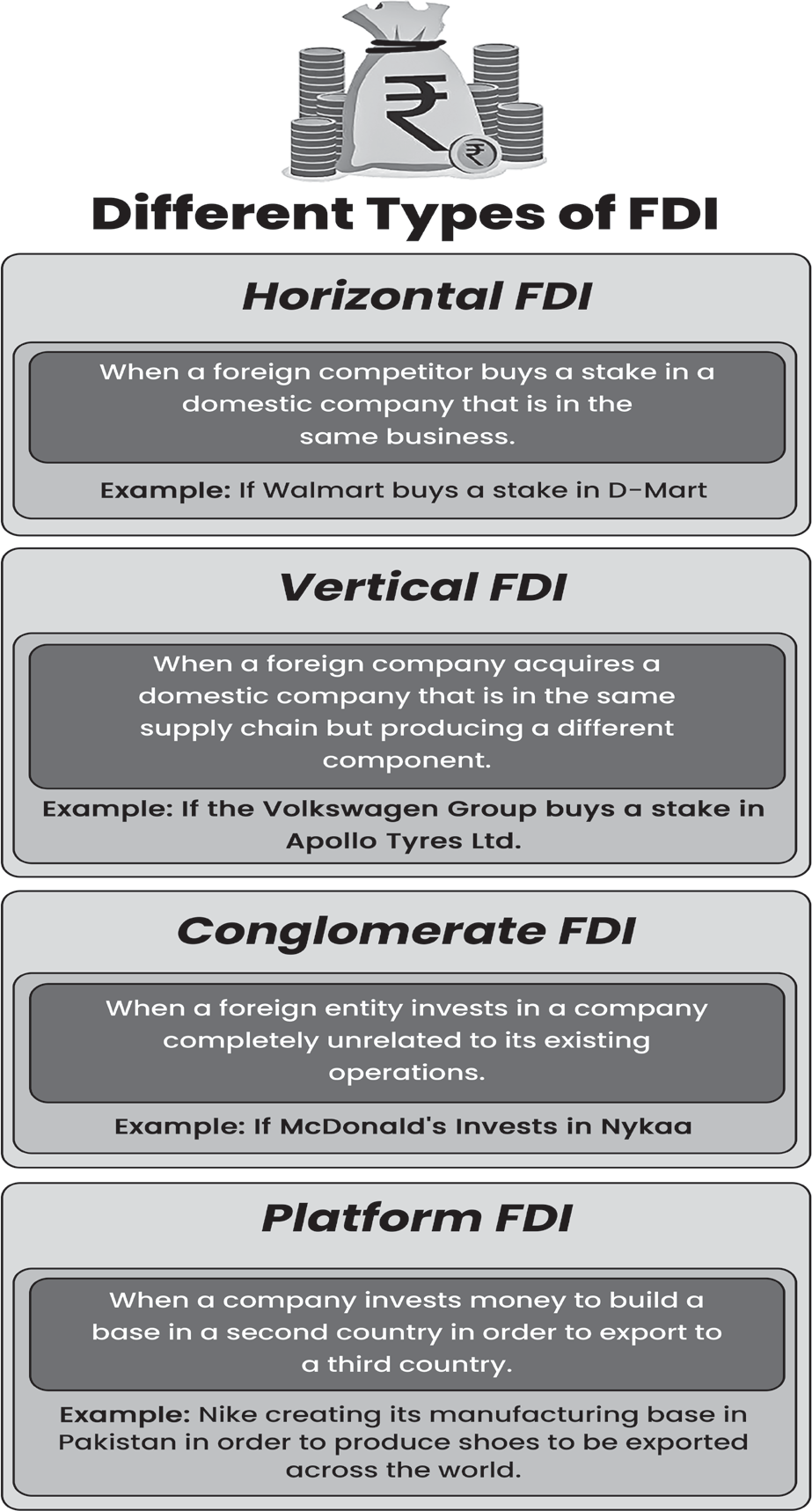
• Foreign direct investment (FDI) in a listed companywill now be regarded as such if it amounts to 10% or more.
Moreover, unlisted companies will be considered foreign direct investment (FDI) regardless of any threshold limit.
• If an investor makes an investment that is less than ten percent, it may be considered foreign direct investment (FDI) as long as the FDI stake is increased to ten percent or more within a year of the initial purchase date.
If the stake is not raised to 10 per cent or above, then the investment can be treated as portfolio investment.
• In a particular company, an investor can hold the investments either under the FPI route or under the FDI route, but not both.
Investment under FDI may be of two types
Brownfield Investment
• Brownfield investments occur when an entity purchases or leases an existing facility to begin new production.
• Companies may consider this approach a great time and money saver since there is no need to go through the motions of building a brand-new building.
Greenfield Investment
• When a parent company makes a greenfield investment,
it establishes a subsidiary abroad.
• Instead of buying an existing facility in that country, the company begins a new venture by constructing new facilities in that country.
• Construction projects may include more than just a production facility.
• They sometimes also entail the completion of offices, accommodations for the company’s staff and management, as well as distribution centers.
What are the entry routes for FDI?
Permissible FDI can be made under “Automatic route” or “Government route”.
• “Automatic route” means the entry route through which investment by a person resident outside India does not require the prior approval of the Reserve Bank of India or the Central Government.
• “Government Route” means the entry route through which investment by a person resident outside India requires prior Government approval and foreign investment received under this route shall be in accordance with the conditions stipulated by the Government in its approval.
What are sectors/activities in which FDI is prohibited?
FDI is prohibited in
Lottery Business including Government/private lottery,
online lotteries, etc.
Gambling and Betting including casinos etc.
Chit funds
Nidhi company
Trading in Transferable Development Rights (TDRs)
Real Estate Business or Construction of Farm Houses
Development of townships, building of residential or commercial buildings, building of roads or bridges and the creation of Real Estate Investment Trusts (REITs) that are registered and governed by the SEBI (REITs) Regulations 2014 are not considered real estate businesses.
Manufacturing of cigars, cheroots, cigarillos and cigarettes, of tobacco or of tobacco substitutes
Activities/sectors not open to private sector investment
e.g. (I) Atomic Energy and (II) Railway operations (other than permitted activities mentioned in permitted sectors)
Foreign technology collaboration in any form including licensing for franchise, trademark, brand name, management contract is also prohibited for Lottery Business, Gambling and Betting activities.
What is the regulatory and governing framework for FDI in India?
Primarily, foreign investment is regulated through the Foreign Exchange Management Act, 1999 (FEMA) as amended from time to time and rules/regulations issued thereunder.
Presently, the FDI regime in India is primarily governed by the Consolidated Foreign Direct Investment Policy.
Are there any restrictions/provisions related to FDI from land bordering countries?
A non-resident entity can invest in India, subject to the FDI Policy except in those sectors/activities which are prohibited. However, an entity of a country, which shares land border with India or where the beneficial owner of an investment into India is situated in or is a citizen of any such country, can invest only under the Government route. Further, a citizen of Pakistan or an entity incorporated in Pakistan can invest, only under the Government route, in sectors/activities other than defence, space, atomic energy and sectors/activities prohibited for foreign investment.
In the event of the transfer of ownership of any existing or future FDI in an entity in India, directly or indirectly will also require Government approval. Accordingly, an entity of a country, which shares land border with India or where the beneficial owner of an investment into India is situated in or is a citizen of any such country, can invest only under the Government route. Additionally,
any transfer of ownership of any existing or future FDI in an entity in India resulting in the beneficial ownership falling within the aforesaid jurisdiction(s) will also require Government approval.
Foreign Direct Investment: Indian Scenario
Foreign Direct Investment (‘FDI’) means investment through equity instruments by a person resident outside India in an unlisted Indian company; or in 10% or more of the post issue paid-up equity capital on a fully diluted basis of a listed Indian company.
Since the economy opened up in 1991, India’s investment climate has significantly improved. This is mainly because India’s FDI regulations are more lenient.
Total FDI inflows into India from April 2000 to September 2024 have crossed USD 1,033 billion (about USD 1.03 trillion), highlighting India’s rising appeal as a global investment destination.
In FY 2024-25, provisional **FDI inflows reached a record USD 81.04 billion, driven by strong investment in key sectors.
Top 5 source countries for FDI equity inflows in FY 2024- 25 were Singapore ( 30%), Mauritius ( 17%), USA ( 11%), Netherlands ( 9%), and UAE ( 9%).
Leading sectors attracting FDI equity included Services ( 19%), Computer Software & Hardware ( 16%), Trading ( 8%), Manufacturing, and Telecommunications.
Top states receiving FDI equity in FY 2024-25 were Maharashtra ( 39%), Karnataka ( 13%), Delhi ( 12%), Gujarat ( 11%), and Tamil Nadu ( 7%).
The Department for Promotion of Industry and Internal Trade (DPIIT) remains the nodal Ministry responsible for framing government policy on Foreign Direct Investment (FDI) in India.
Foreign Portfolio Investment (FPI)
Foreign Portfolio Investment (FPI) means investing in the financial assets of a foreign country, such as stocks or bonds available on an exchange Being able to sell off a portfolio quickly and sometimes being perceived as short-term money-making schemes rather than long-term investments in the economy make this type of investment less favourable than direct investment. Due to its short-term nature, it is also called ‘Hot money’. Investments in a foreign country’s stock are one example of FPI. Investing by buying bonds that a foreign government has floated is another example. FPI does not grant control over the business entity that receives the investment, in contrast to FDI.
The Arvind Mayaram Committee on rationalizing the FPI/ FII Definition recommended the following definition of FPI which was accepted by the Government. i.e.,
Any investment by way of equity shares, compulsorily convertible preference shares/debentures less than 10 percent of the post-issue paid up equity capital of a
company or less than 10 percent of the post-issue paid up value of each series of convertible debentures of a listed / to be listed Indian investee company by eligible foreign investors shall be treated as Foreign Portfolio Investment (FPI).
Less than 10% of the post-issue paid-up capital can be invested by foreign investors under a private placement or arrangement; these investments are classified as FPIs. This would be subject to the transaction being undertaken at a price determined according to the SEBI (ICDR) Regulations.
The monitoring of the individual FPI limit of less than 10 percent will be done as hitherto by SEBI.
Two categories can be used to classify portfolio investments
• Foreign institutional Investment (FII)
• Investment through depository receipts (ADR/GDR/ IDR)
Foreign Institutional Investors (FIIs): Large corporations that make investments in nations other than their home countries are known as Foreign Institutional Investors, or FIIs. In India, the term “FII” is most frequently used to describe foreign investors in the country’s financial markets. Investment banks, mutual funds, insurance companies, hedge funds and pension funds are examples of FIIs.
Depository Receipt: A depositary receipt (DR) is a type of negotiable financial security that allows investors to hold shares in a foreign public company. They are represented by a physical certificate and trade on national stock exchanges. The most common example of a depositary receipt is the American Depositary Receipt (ADR). Other examples include the Global Depositary Receipt (GDR) and Indian Depositary Receipt (IDR).
Participatory Notes (P-notes): P-notes are Offshore Derivative Instruments (ODIs) issued by registered Foreign Portfolio Investors (FPIs) to overseas investors who wish to be a part of the Indian stock markets without registering themselves directly. Indian stocks make up the underlying assets of P-notes. Non-resident investors in Indian securities, such as shares, corporate bonds, government bonds, etc., are known as FPIs. P-note holders must go through a proper due diligence process of the Security and Exchange Board of India (SEBI), despite having less strict registration requirements.
| The Distinction between Foreign Direct Investment and Foreign Portfolio Investment | |
| Foreign Portfolio Investment | Foreign Direct Investment |
| The term “foreign portfolio investment,” or FPI, describes the financial assets of a company that is headquartered in another nation and is owned by foreign investors. | Foreign direct investment, or FDI, is a type of foreign investment in which the investor acquires a long-term stake in a business venture abroad. |
| An investor is inactive | An investor is active |
| Investments in assets are made indirectly | Investments in assets are made directly |
| The investments are of a transient nature. | The investments are of a long-term nature. |
| FPIs have a volatile character. | FDI tends to be stable. |
Balance of Payments
BALANCE OF PAYMENTS
The transactions in goods, services and assets between citizens of a nation and the rest of the world are documented in the balance of payments (BoP) for a given time period, usually a year. These transactions are in - goods (visibles), services (invisibles) and capital (loans, deposit, investment).

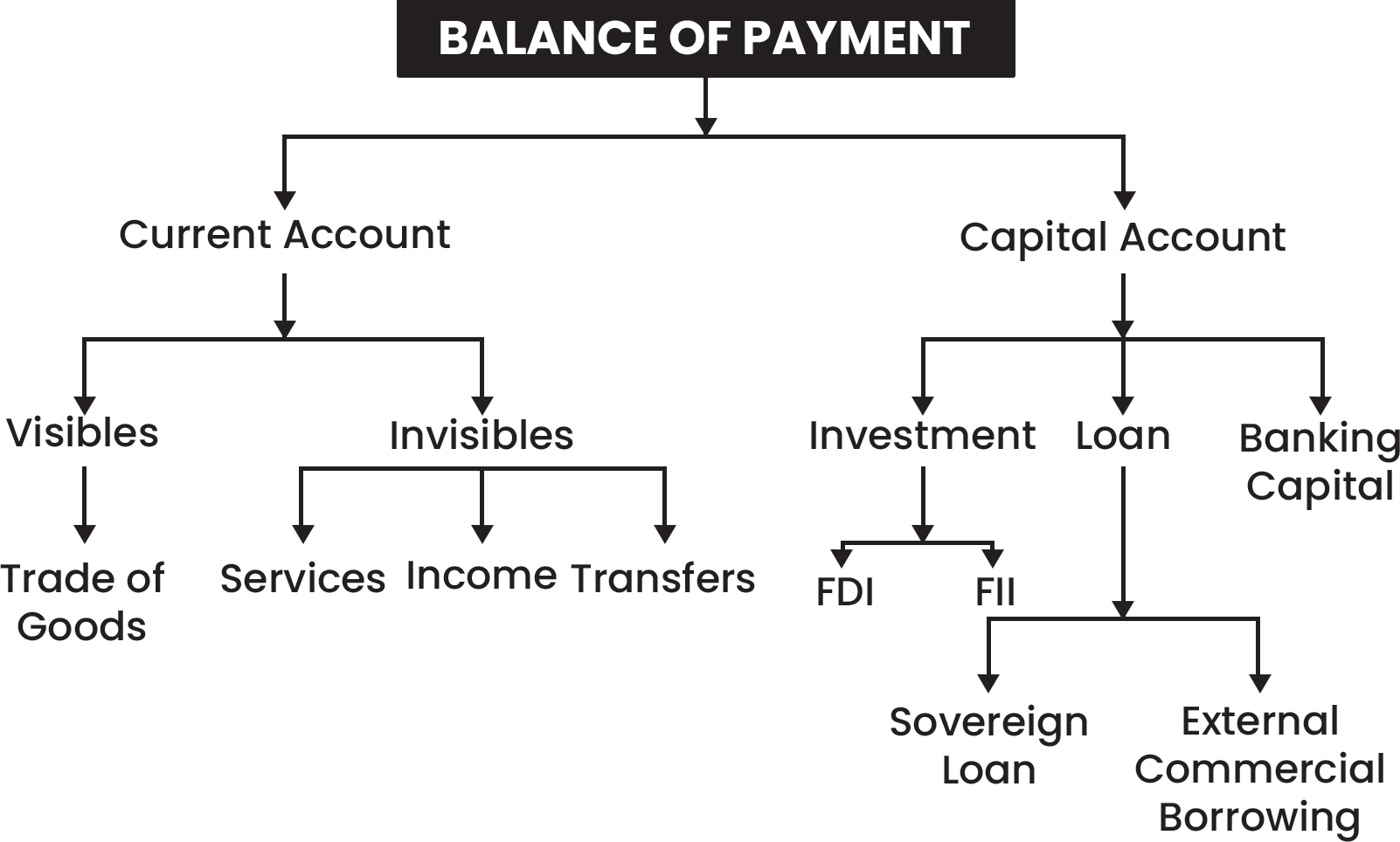
The Balance of Payment consists of two primary accounts
• Current Account
• Capital Account.
CURRENT ACCOUNT
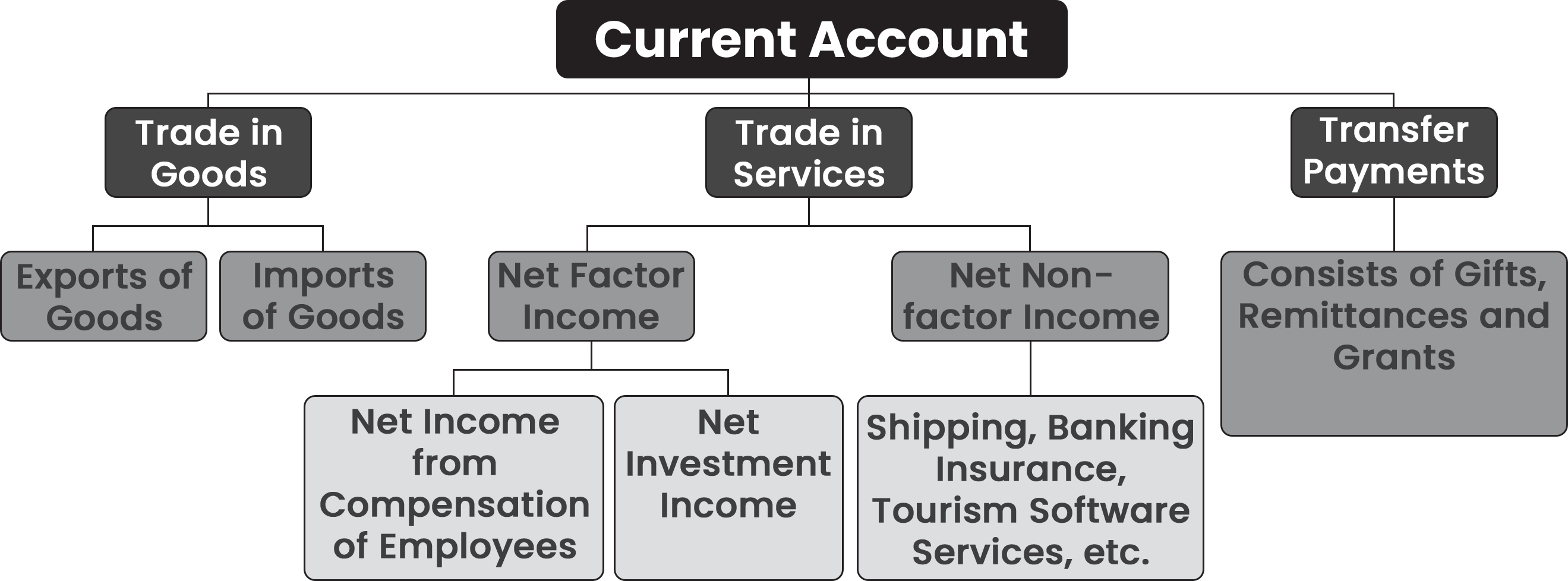
Current Account is the record of trade in goods and services and transfer payments.
Trade in goods includes exports and imports of goods. Trade in services includes factor income and non-factor income transactions. Transfer payments are the receipts which the residents of a country get for ‘free’, without having to provide any goods or services in return. They consist of gifts, remittances and grants. They could be given by the government or by private citizens living abroad.
Buying foreign goods is an expenditure from our country and it becomes the income of that foreign country. Hence, the purchase of foreign goods or imports decreases the domestic demand for goods and services in our country. Similarly, selling of foreign goods or exports brings income to our country and adds to the aggregate domestic demand for goods and services in our country.
The Current Account Deficit (CAD) is a challenging issue at a time when world is facing chaos whether middle east and Iran crisis or Russia-Ukraine crisis it increases the CAD of India to 1.3% of GDP from 0.7% in 2023-24 contribute to a great amount of trade deficit with 7.9% of GDP.
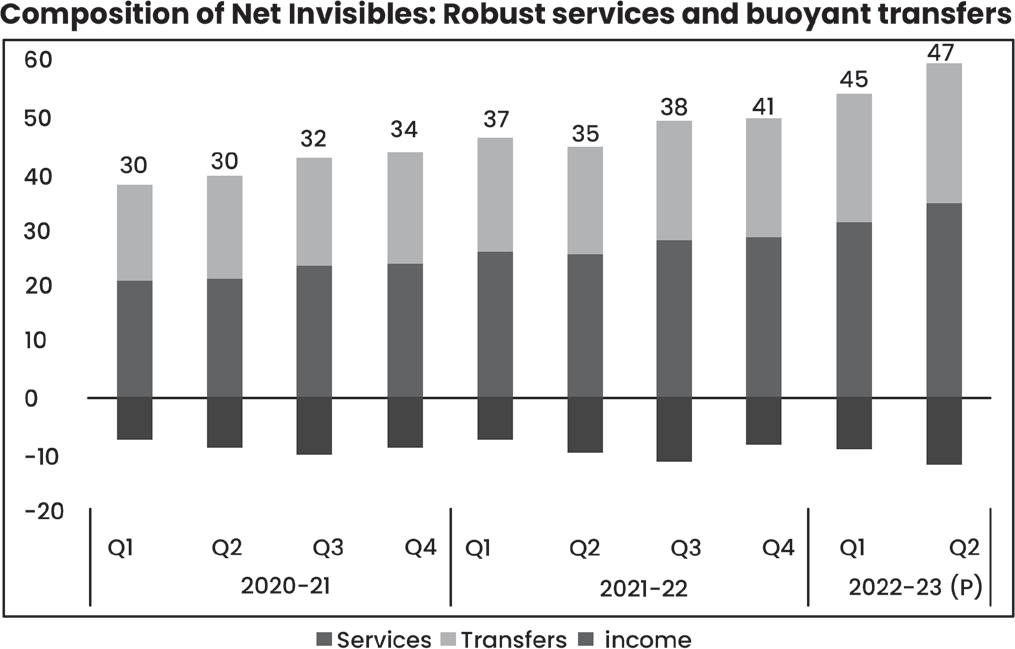
Net Invisibles (services, income, and private transfers) reached $190,127 million.
Components of Current Account
Balance on Current Account
Current Account is in balance when receipts on current account are equal to the payments on the current account. A surplus current account means that the nation is a lender to other countries and a deficit current account means that the nation is a borrower from other countries.


Balance on Current Account has two components
• Balance of Trade or Trade Balance
• Balance on Invisibles
Balance of Trade (BOT) or Balance of Visibles
Balance of Trade (BOT) or Balance of Visibles is the difference between the value of exports and value of imports of goods of a country in a given period of time.
• Export of goods is entered as a credit item in BOT,
whereas import of goods is entered as a debit item in BOT. It is also known as Trade Balance.
BOT is said to be in balance when exports of goods are equal to the imports of goods.
If, Exports = Imports Trade Equilibrium


A nation will have a trade surplus, also known as surplus BOT, if it exports more goods than it imports.
If, Exports > Imports Trade Surplus


Whereas, Deficit BOT or Trade deficit will arise if a country imports more goods than what it exports.
If, Exports < Imports Trade Deficit


| Narrow concept | Broader Concept | |
| It is part of Current Account. | It consists of Balance of Trade. | |
| In the case of India, BOT has al has been in a trade deficit. | Balance of Invisibles Invisibles include services, tran take place between different co ways been negative, i.e., India Services trade includes both Factor income includes net inte of production (like labour, la income is net sale of service pr tourism, software services, etc. Note: In India’s case, despite dividends, the balance of invisi since India has always been a ne | sfers and flows of income that untries. factor and non-factor income. rnational earnings on factors nd and capital). Non-factor oducts like shipping, banking, a net outflow of interest and bles has always been positive t exporter of services and the |
| Balance of Trade | world’s largest recipient of rem Balance in Current Account | ittances. |
| It consists of only visible items/ merchandise. | It consists of both - visiblesBalance of Current Accoun and invisibles.Balance of | t = Balance of Visibles + Invisibles |


Remittances

The term is derived from the word remit, which means to send back. Remittance refers more broadly to the funds migrants send to their relatives in their home country while working and living abroad. These are also referred to as worker or migrant transfers.
They are a significant source of foreign exchange and revenue for many developing nations, particularly those in South Asia. Remittances have the potential to lower poverty, raise living standards, promote health and education and boost the economy.
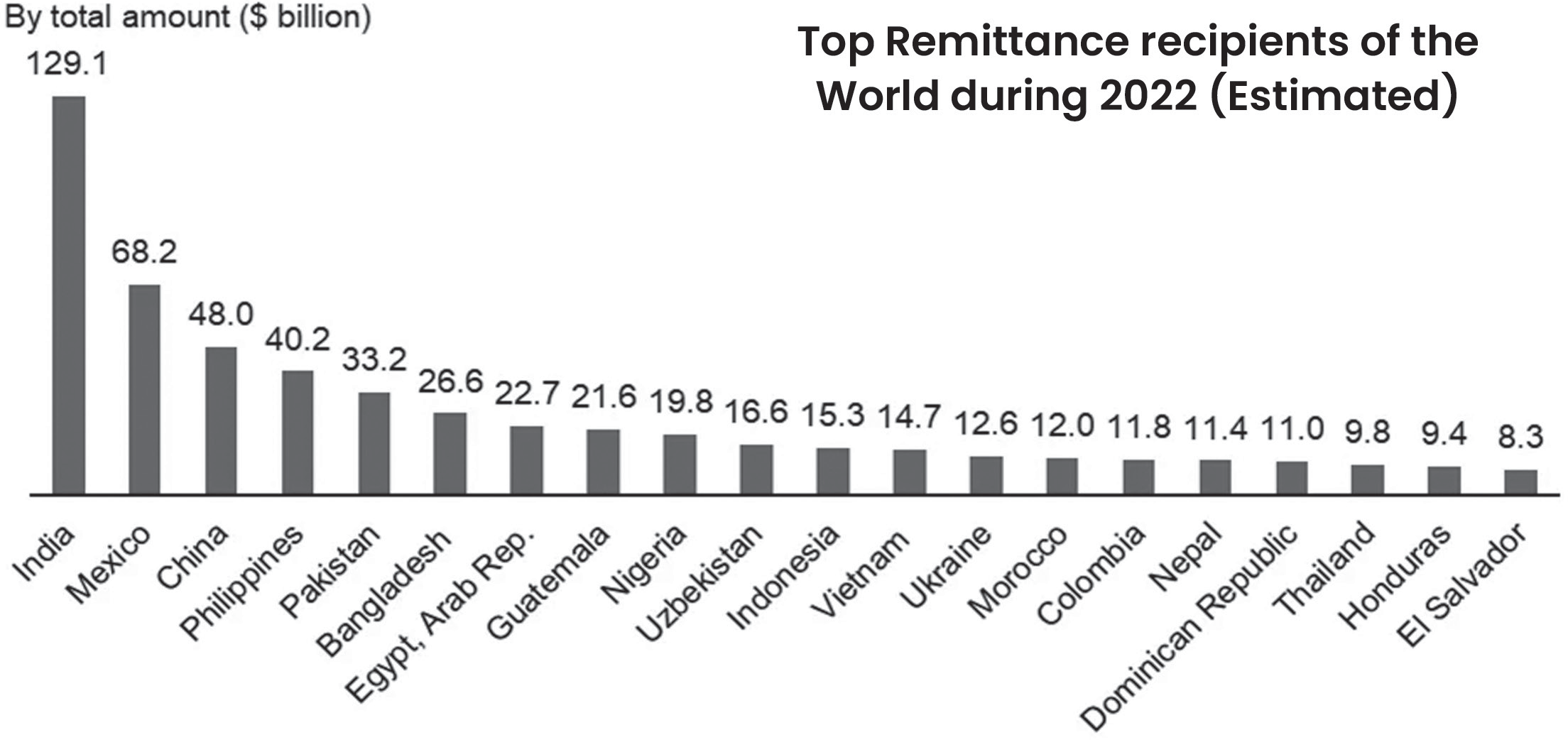
India holds the first position in the by receiving an amount of $135.4 billion as a remittance in FY 2025.
Top country with highest remittance India: ($135.4) billion
Mexico: ($68) billion China: ($48) billion Philippines: ($40) billion
CAPITAL ACCOUNT
Capital Account records all international transactions of assets. An asset is any one of the forms in which wealth can be held, for example: money, stocks, bonds, Government debt, etc.
Purchase of assets is a debit item on the capital account. If an Indian buys a UK Car Company, it enters capital account transactions as a debit item (as foreign exchange is flowing out of India).
On the other hand, the sale of assets like the sale of shares of an Indian company to a Chinese customer is a credit item on the capital account.

Components o f Capital Account
Balance on Capital Account
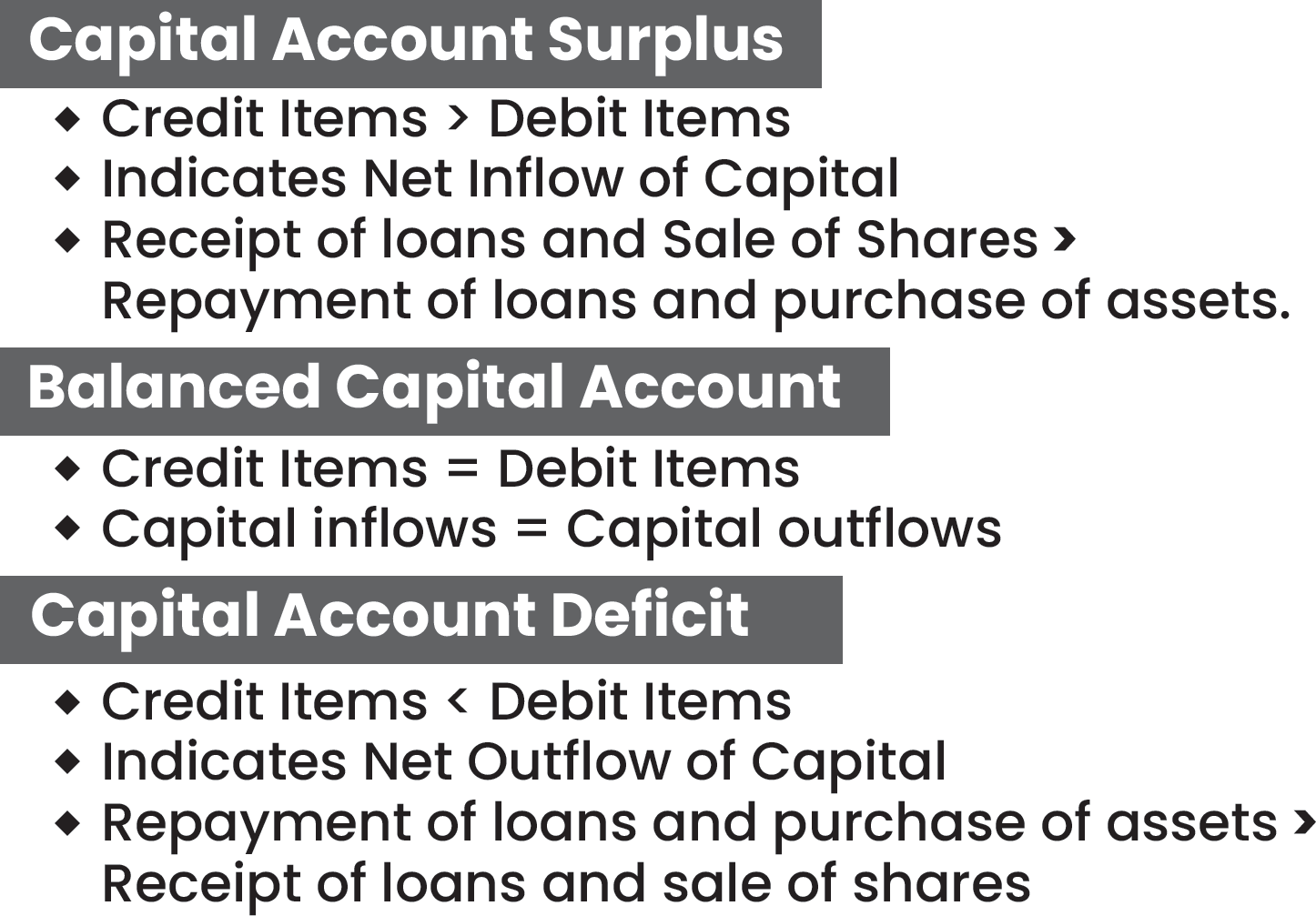
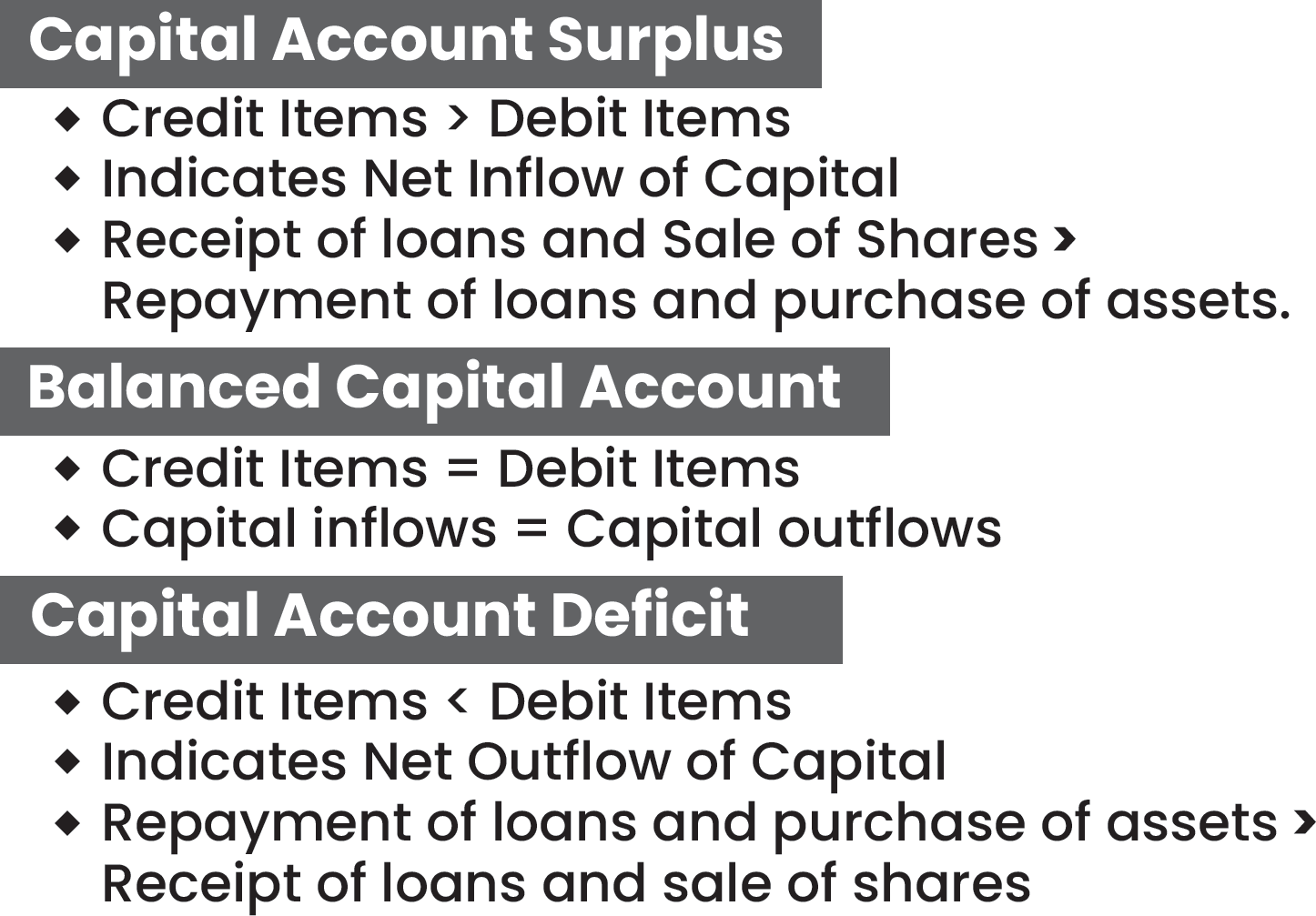
• When capital inflows (such as receiving loans from overseas, selling assets or shares in foreign corporations) equal capital outflows (such as loan repayment, buying assets or shares in foreign nations), the capital account is in balance.
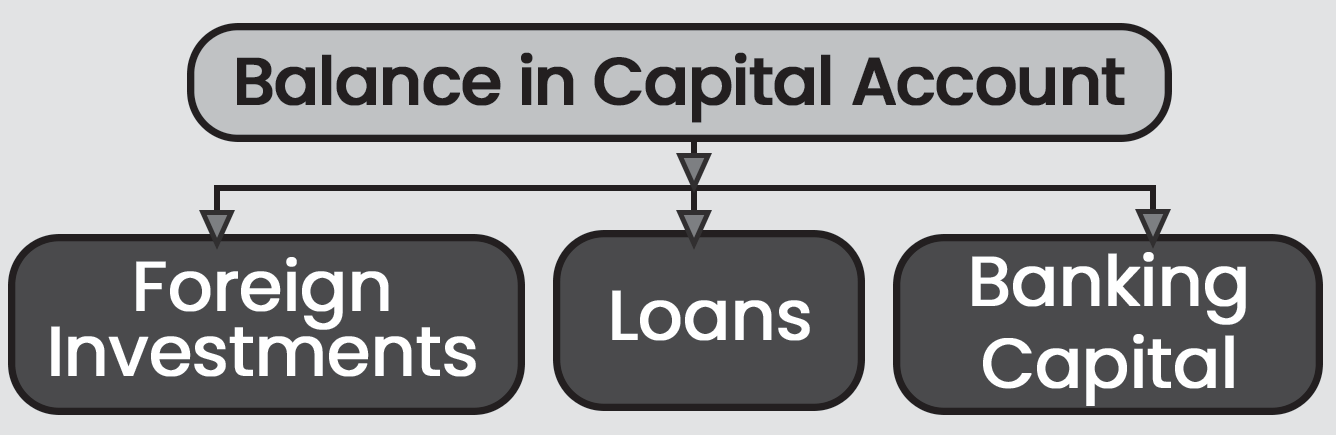
• Surplus in capital accounts arises when capital inflows are greater than capital outflows, whereas deficit in capital account arises when capital inflows are lesser than capital outflows.
Loans
External Assistance (Loans)
They are a country’s (government and private sector) borrowings from the international money market. They are debt-creating capital transactions.

TYPES OF LOANS
External Commercial Borrowings (ECBs)
• External Commercial Borrowings (ECB) refer to commercial loans [in the form of bank loans, buyers’ credit, suppliers’ credit, securitised instruments (e.g., floating rate notes and fixed rate bonds)] availed from non-resident lenders with minimum average maturity of 3 years.
• ECB can be accessed under two routes, viz., Automatic Route and Approval Route.
• Source of ECBs: Foreign banks, global financial institutions and overseas subsidiaries of Indian businesses are some of the places where ECBs can be found.
• ECB may take the form of loans denominated in foreign
currencies that must be repaid in those currencies or loans denominated in Indian rupees that must be repaid in those currencies.
Regulation: The RBI is in charge of ECB regulation and imposes restrictions on the quantity and uses of ECB that Indian businesses are permitted to acquire.
Additionally, in order for a company to be eligible for ECB, it must meet certain requirements, like minimum debt-to-equity ratios and credit ratings.
Benefits
Large-scale fund borrowing is made possible by
ECBs.
The money is available for a sizable amount of time.
In addition, interest rates are less than those of domestic funds.
Foreign currencies are the form that ECBs take. They thus make it possible for the corporation to have foreign exchange to pay for the import of machinery, etc.
Risks
Exchange rate risk: Variations in the Indian rupee’s value relative to other currencies may have an impact on how much it will cost to pay back the loan.
Sovereign risk: Businesses are exposed to sovereign because foreign lenders may view a country’s creditworthiness based on its capacity to repay its debt. The ability of foreign lenders to repay their loans to Indian companies may suffer if a foreign government defaults on its debt.
• Credit risk: Companies are exposed to credit risk because, in the event of default, foreign lenders might not be as protected as domestic lenders.
• Regulatory risk: ECB is vulnerable to regulatory risk because alterations to laws or policies may have an impact on borrowing costs and availability.
External Assistance
• The term “borrowings as external assistance” describes loans made by one nation to another for mutual aid. Compared to what is offered on the open market, it has a lower interest rate.
• Numerous multilateral organisations, including the World Bank Group, Asian Development Bank, European Investment Bank, New Development Bank, etc., provide India with external assistance.
• As per the Union Budget 2025-26 documents, India’s net external assistance in FY 2024-25 amounted to approximately ₹33, 168 crore.
Trade Credit
• A business-to-business (B2B) arrangement known as trade credit allows a customer to make purchases on credit, deferring payment to the supplier until a later date.
• Trade credit businesses typically give customers 30, 60, or 90 days to pay after a transaction is documented on an invoice.
• Trade credit can be viewed as a form of zero percent financing, adding to a business’s assets while postponing payment for a predetermined amount of goods or services until later and necessitating the payment of no interest during the repayment term.
• Businesses can finance short-term growth and free up cash flow by using trade credit.
• Trade credit can create complexity for financial accounting depending on the accounting method used.
• Trade credit financing is usually encouraged globally by regulators and can create opportunities for new financial technology solutions.
• Suppliers are usually at a disadvantage with a trade credit as they have sold goods but not received payment.
BANKING CAPITAL TRANSACTIONS
It is a transaction involving the external financial assets and liabilities of commercial banks and other cooperative institutions acting as authorized foreign exchange dealers. They include NRI deposits.
NRIs can maintain the following types of accounts
Non-Resident External Rupee Account (NRER account)
• NRER account is a rupee account maintained with a bank.
Funds from an NRER account are freely repatriable.
Interest credited to the NRER account is exempt from tax in the hands of the NRI.
NRER accounts can be opened with funds remitted from abroad or generated in India.
Non-Resident Ordinary Rupee Account (NROR account)
NRIs can open NROR account for the purpose of putting through bona fide transaction in rupees.
Balance in the NROR account is generally non- repatriable.
However, funds in NROR accounts can be remitted abroad subject to such limits and conditions as may be prescribed by RBI directives at the time of repatriation.
NROR account balances need to be used only for payments within India in rupees.
Foreign Currency Non-Resident (Bank) Account (FCNR-B account)
Such accounts can be opened only in form of term deposits of 1 to 5 years.
Deposits can be made in freely convertible foreign currencies.
Only NRIs can be joint holders in an FCNR (B) account.
Net Errors and Omissions
It is difficult to record all international transactions accurately. Thus, we have a third element of BoP (apart from the current and capital accounts) called errors and omissions which reflects this.
Autonomous and Accommodating Transactions
International economic transactions are called autonomous when transactions are made due to some reason other than to bridge the gap in the balance of payments, that is, when they are independent of the state of BoP. One reason could be to earn profit. These items are called ‘above the line’ items in the BoP. The balance of payments is said to be in surplus (deficit) if autonomous receipts are greater (less) than autonomous payments.
Accommodating transactions (termed ‘below the line’ items), on the other hand, are determined by the gap in the balance of payments, that is, whether there is a deficit or surplus in the balance of payments. In other words, they are determined by the net consequences of
the autonomous transactions. Since the official reserve transactions are made to bridge the gap in the BoP, they are seen as the accommodating item in the BoP (all others being autonomous).
Balance of Payments Surplus and Deficit
The essence of international payments is that just like an individual who spends more than her income must finance the difference by selling assets or by borrowing, selling assets or taking out loans from outside are the only ways for a nation with a negative current account (i.e., spending more than it makes from sales to other countries) to pay for its deficit. Thus, any current account deficit must be financed by a capital account surplus, that is, a net capital inflow.
Current account + Capital account = 0
In this case, in which a country is said to be in balance of payments equilibrium, the current account deficit is financed entirely by international lending without any reserve movements.
Alternatively, the country could use its reserves of foreign exchange in order to balance any deficit in its balance of payments. When there is a deficit, the reserve bank sells foreign exchange. We refer to this as an official reserve sale. The decrease or increase in official reserves is called the overall balance of payments deficit or surplus respectively. The basic premise is that the monetary authorities are the ultimate financiers of any deficit in the balance of payments (or the recipients of any surplus).
Foreign Exchange Reserves
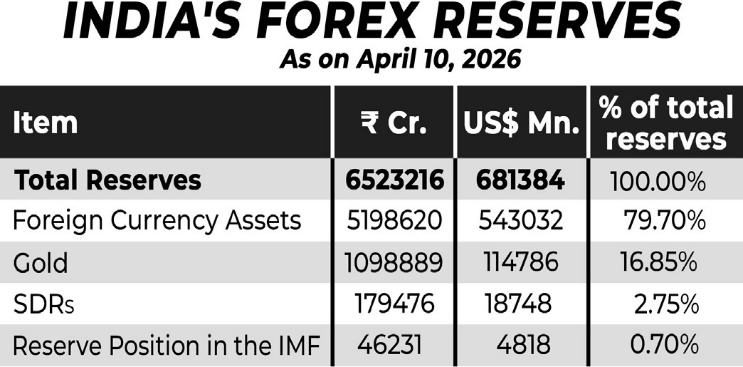
India’s foreign exchange reserves refer to assets held by the Reserve Bank of India (RBI) in foreign currencies. These reserves act as a cushion and provide liquidity, ensuring our country can meet its external obligations. The importance of Indian forex reserves cannot be overstated, as they play a vital role in maintaining the stability of the nation’s currency and economy.
The Indian forex reserves consist of
• Foreign Currency Assets (FCAs)
• Monetary Gold
• Special Drawing Rights (SDRs) and
• IMF’s (International Monetary Fund) Reserve Tranche Position.
At present, FCAs have the maximum share in the forex reserves of RBI, followed by Gold.
As per the latest data from the RBI, India’s foreign exchange reserves stood at $640.33 billion as of April 19, 2024.
BOP TRENDS IN INDIA
1. Period I (1956-57 to 1975-76)
There was significant imbalance in the balance of payments (BoP). During this time, there were three wars, multiple conflicts, and the first oil shock in 1973. Despite this, the government implemented import controls, foreign exchange regulation and other measures.
2. Period II (1976-77 to 1979-80)
This was a very brief time, yet it was a golden period in terms of BoP. During this time, India had a tiny current account surplus of 6% of GDP and foreign exchange reserves equal to nearly seven months of imports. However there were difficulties
Increasing trade deficits
Net receipts from invisibles were gradually declining.
Reduced flows of concessional assistance to India, primarily from the World Bank Group
3. Period III (1980-81 to 1990-91)
This era roughly correlates to the years between the sixth and seventh plans, when the following occurred
The third oil shock that occurred in 1990–91.
Domestic political developments during the 1990s impacted foreign confidence in the Indian economy, etc.
Significant withdrawal from NRIS’s deposits.
In January 1991, reserves dropped as low as $0.9 billion.
Period IV (1991-92 onwards)
India was able to move from a closed economic system to a more open and liberal economy thanks to the reforms carried out in the 1990s. Foreign exchange reserves were accumulated to extremely comfortable levels, and the BoP’s difficulties were brought under control. The trade balance has always been negative because imports have always outpaced exports. Foreign exchange reserves are used to make up the difference when capital account surpluses are exceeded by current account deficits.