Financial Inclusion
• Financial inclusion refers to the process of ensuring access to financial services, and timely and adequate credit for vulnerable groups and low-income groups at an affordable cost. Financial inclusion has a multiplier effect in boosting overall economic output, reducing poverty and income inequality and in promoting gender equality and women empowerment.
Objectives of Financial Inclusions
• Provide financial service to all – The process aims to provide accessible and affordable financial services and products.
•
Set up financial institutions – Financial inclusion also aims to set up more institutions that would cater to the financial needs of the people.
• Strong economy – As the finance of an economy becomes more robust, the economy grows through growth in trade and commerce.
• Create financial awareness – Financial education is essential for economic growth. Financial inclusion will promote financial education.
• Globalize digital solutions – Financial inclusion will lead to globalizing any digital methods adopted to promote and grow the financial sector.
• Provide customized solutions – Banks and financial institutions will take more interest in innovation and designing customized solutions to attract clients.
Benefits of Financial Inclusion
Contributes to economic growth by stimulating entrepreneurship.
Increasingsavings, and expanding investment opportunities.
It boosts consumer spending and business development.
Leading to job creation and improved productivity.
Also attracts more foreign investment and helps achieve
sustainable development goals.
National Strategy for Financial Inclusion (2019-24)
The Reserve Bank of India (RBI) released the National Strategy for Financial Inclusion 2019-2024 on January 10, 2020. It sets forth the vision and objectives of financial inclusion policies in India. The strategy was prepared by the
RBI with inputs from the central government and financial sector regulators (Securities and Exchange Board of India, Insurance Regulatory and Development Authority of India and Pension Fund Regulatory and Development Authority of India).
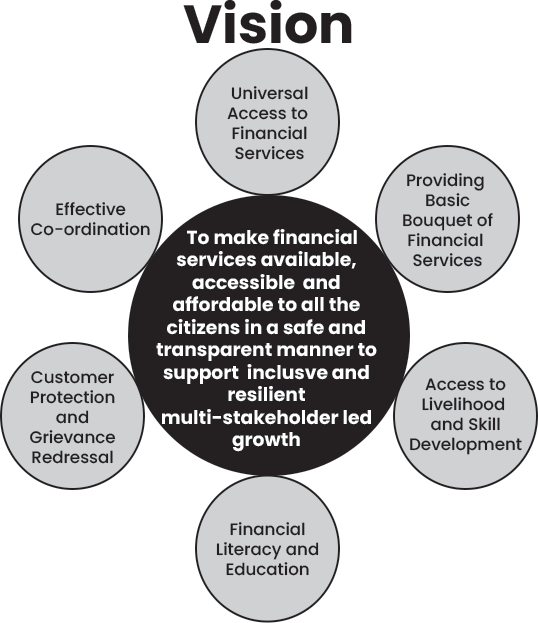
RBI has identified six major strategic objectives of Financial Inclusion
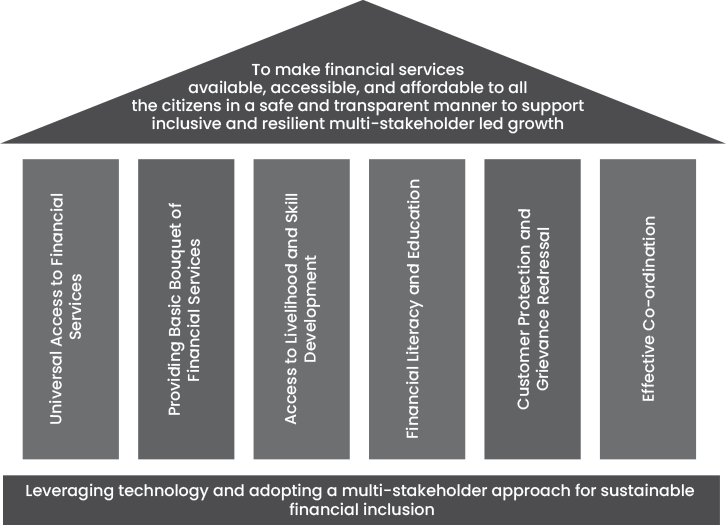
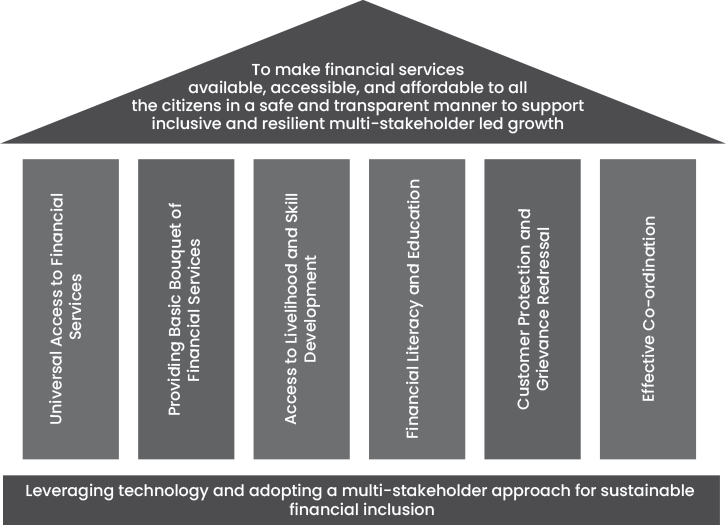
Strategic pillars of National Strategy for Financial Inclusion
Financial Inclusion Strategy
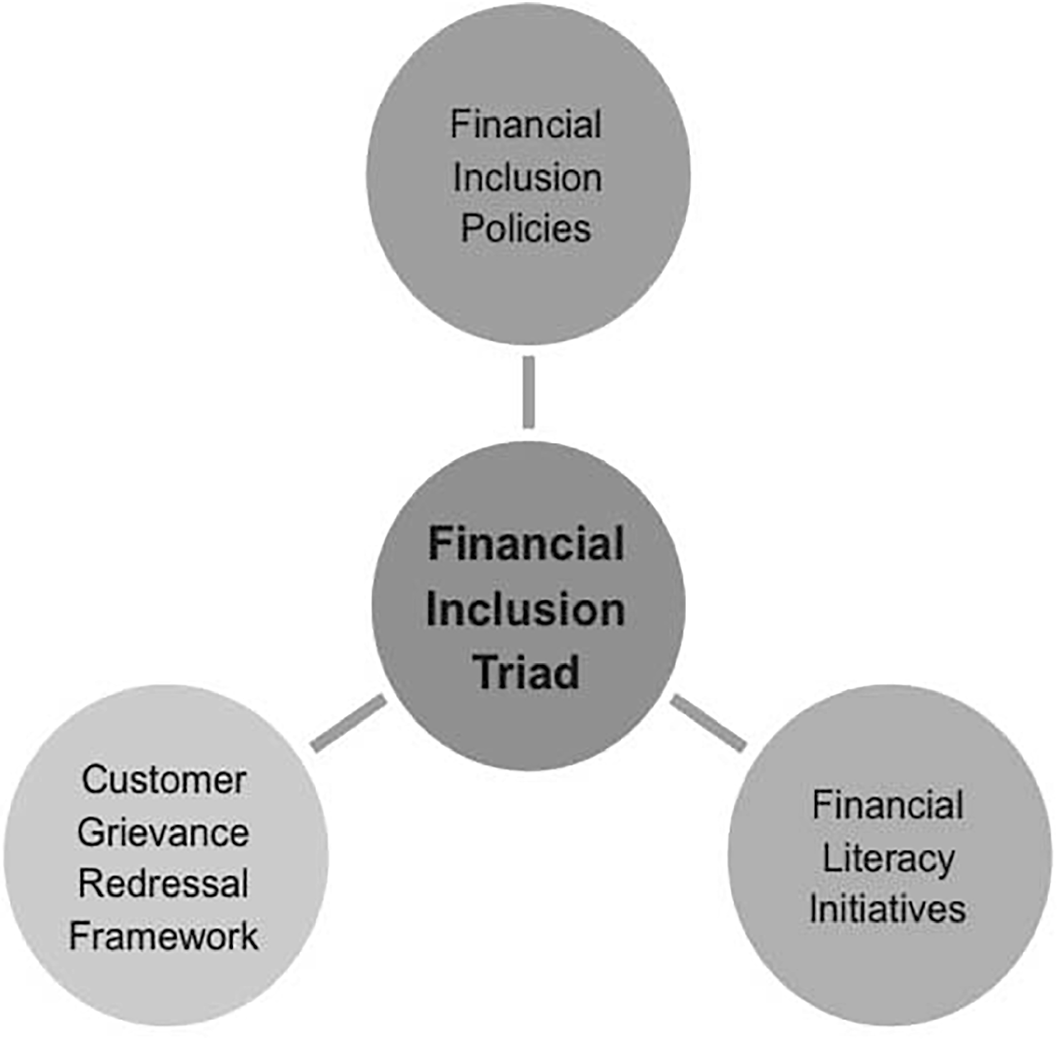
Inclusion, Literac y and Grievance Redressal
Status of Financial Inclusion in India
India began its financial inclusion journey as early as in 1956 with the nationalisation of Life Insurance companies. This was followed by nationalisation of banks in 1969 and 1980. The general insurance companies were nationalised in 1972.
The RBI noted that several steps have been taken to further financial inclusion in the country. These include:
Pradhan Mantri Jan Dhan Yojana (PMJDY), Atal Pension Yojana, Pradhan Mantri Suraksha Bima Yojana, which provides accidental death or disability coverage.
Further, it noted that the bank-led model of financial inclusion adopted by the RBI through issuance of differentiated banking licenses (small finance banks and payments banks) and the launch of Indian Post Payments Bank in September 2018 has helped bridge the gap in last mile connectivity.
Challenges
Despite the various measures that have been undertaken by various stakeholders in strengthening financial
inclusion in the country, there are still critical gaps existing in the usage of financial services that require attention of policy makers through necessary co-ordination and effective monitoring.
Inadequate Infrastructure: Limited physical infrastructure, limited transport facility, inadequately trained staff etc., in parts of rural hinterland and far-flung areas of the Himalayan and North East regions create a barrier to the customer while accessing financial services.
Poor Connectivity: With technology becoming an important enabler to access financial services, certain regions in the country that have poor connectivity tend to be left behind in ensuring access to financial services thereby creating a digital divide.
Convenience and Relevance: The protracted and complicated procedures act as a deterrent while on- boarding customers. This difficulty is further increased when the products are not easy to understand, complex and do not meet the requirements of the customers such as those receiving erratic and uncertain cash flows from their occupation.
Socio-Cultural Barriers: Prevalence of certain value systems and beliefs in some sections of the population results in lack of favourable attitude towards formal financial services. There are still certain pockets wherein women do not have the freedom and choice to access financial services because of cultural barriers.
Product Usage: While the mission-based approach to financial inclusion has resulted in increasing access to basic financial services including micro insurance and pension, there is a need to increase the usage of these accounts to help customers achieve benefits of relevant financial services and help the service providers to achieve the necessary scale and sustainability. This can be undertaken through increasing economic activities like skill development and livelihood creation, digitising Government transfers by strengthening the digital transactions’ eco-system, enhancing acceptance infrastructure, enhancing financial literacy and having in place a robust customer protection framework.
Payment Infrastructure: Currently, majority of the retail payment products viz., CTS, AEPS, NACH, UPI, IMPS etc. are operated by National Payments Council of India (NPCI), a Section (8) Company promoted by a group of public, private and foreign banks. There is a need to have more market players to promote innovation & competition and to minimize concentration risk in the retail payment system from a financial stability perspective.
Recommendations
Universal Access to Financial Services: Every village to have access to a formal financial service provider within a reasonable distance of 5 KM radius.
In order to achieve the objective of providing universal
access to financial services, it is important to provide a robust and efficient digital network infrastructure to all the financial service outlets / touch points for seamless delivery of the financial services.
It is also recommended to extend the digital financial infrastructure to co-operative banks and other specialised banks (Payments Banks, Small Finance Banks) as well as other non-bank entities such as Fertilizer Shops, Office of the Local Government bodies / Panchayats, Fair Price Shops, Common Service Centres, Educational Institutions etc. to promote efficiency and transparency in the services offered to customers.
Providing Basic Bouquet of Financial Services: Every adult who is willing and eligible needs to be provided with a basic bouquet of financial services that include a Basic Savings Bank Deposit Account, credit, a micro life and non-life insurance product, a pension product and a suitable investment product.
The objective of providing a basic bouquet of financial services can be achieved through designing and developing customized financial products by banks and ensuring efficient delivery of the same through leveraging of Fin-tech and Banking correspondant networks.
Access to Livelihood and Skill Development: The new entrant to the financial system, if eligible and willing to undergo any livelihood/ skill development programme, may be given the relevant information about the ongoing Government livelihood programmes thus helping them to augment their skills and engage in meaningful economic activity and improve income generation.
While ensuring access to livelihood and skill development requires multi-dimensional efforts, it is recommended to attain convergence of objectives of various employment generation and skill development programmes like National Rural Livelihoods Mission (NRLM), National Urban Livelihoods Mission (NULM), Pradhan Mantri Kaushal Vikas Yojana (PMKVY) and other state level programmes through an integrated approach.
Financial Literacy and Education: Easy to understand financial literacy modules with specific target audience orientation (e.g., children, young adults, women, new workers/ entrepreneurs, family person, about to retire, retired etc. in the forms of Audio-Video/ booklets shall be made available for understanding the product and processes involved.
Concerted efforts are needed to ensure coordination among the ground level functionaries viz. Lead District Manager (LDM), District Development Manager (DDM) of NABARD, Lead District Officer (LDO) of RBI, District and Local administration, Block level officials, NGOs, SHGs, BCs, Farmers’ Clubs, Panchayats, PACS, village level functionaries etc. while conducting financial literacy programmes.
• Customer Protection and Grievance Redressal: Customers shall be made aware of the recourses available for resolution of their grievances. About storing and sharing of customer’s biometric and demographic data, adequate safeguards need to be ensured to protect the customer's Right to Privacy.
• Develop a portal to facilitate inter-regulatory co- ordination for redressal of customer grievances.
• Effective Co-ordination: There needs to be a focused and continuous coordination between the key stakeholders viz. Government, the Regulators, financial service providers, Telecom Service Regulators, Skills Training institutes etc.
• Leverage on the emerging developments in technology to promote effective stakeholder co-ordination by having in place a digital dashboard/ MIS monitoring.
• Encourage decentralized approach to planning and development by creating a forum to actively involve Gram Panchayats/ Civil Society/ NGOs to accelerate financial inclusion using various tools like social audit.
Measurement of Financial Inclusion
• RBI recommended that financial inclusion should be measured through parameters across three key indicators. These include parameters to: (i) measure access, such as number of bank branches or ATMs for a specified population, (ii) measure usage, such as percentage of adults with a saving account, insurance or pension policy, and (iii) measure quality of services, such as grievance redressal (through number of complaints received and addressed).
• Additionally, it recommended conducting surveys to assess the current impediments to financial inclusion (such as issues faced while using digital services, knowledge of customer rights and attitude of service provider).
India Effort for Financial Inclusion
INDIA’S EFFORTS FOR FINANCIAL INCLUSION
Lead Bank Scheme
• The Reserve Bank of India introduced the Lead Bank Scheme in 1969 as a means of extending banking services to rural communities.
• The DR Gadgil study group, which introduced the concept of social banking during the post-independence era, suggested the LBS.
• The lead bank conducts surveys and extends credit
facilities to different industries.
• The lead bank acts as a leader for coordinating the efforts of all credit institutions in the allotted districts to increase the flow of credit to agriculture, MSE and other economic activities with the district being the basic unit in terms of geographical area.
Banking Ombudsman Scheme
The Reserve Bank of India (RBI) has introduced an Ombudsman Scheme for Digital Transactions, 2019. The Scheme will provide a cost-free and expeditious complaint redressal mechanism relating to deficiency in customer services in digital transactions conducted through non-bank entities regulated by RBI. The scheme is being introduced under Section 18 Payment and settlement Systems Act, 2007, with effect from January 31, 2019.
Some of the salient features of the Scheme are
The scheme defines ‘deficiency in service’ as the ground for filing a complaint, with a specified list of exclusions. Therefore, the complaints would no longer be rejected simply on account of “not covered under the grounds listed in the scheme”.
The scheme has done away with the jurisdiction of each
ombudsman office.
A Centralised Receipt and Processing Centre has been set up at RBI, Chandigarh for receipt and initial processing of physical and email complaints in any language.
The responsibility of representing the Regulated Entity and furnishing information in respect of complaints filed by customers against the Regulated Entity would be that of the Principal Nodal Officer in the rank of a General Manager in a Public Sector Bank or equivalent.
The Regulated Entity will not have the right to appeal in cases where an Award is issued by the ombudsman against it for not furnishing satisfactory and timely information/documents.
Recent major initiatives to improve Financial Inclusion
Pradhan Mantri Jan Dhan Yojana (PMJDY): This government program, launched in 2014, is one of the world’s largest financial inclusion initiatives. Led by the Ministry of Finance, it aims to provide affordable banking services to underprivileged populations. Some of the Pradhan Mantri Jan-Dhan Yojana benefits include simplified access to all privileges under the scheme and no minimum balance requirements.
It is a zero-balance savings account.
Hassle-free “small savings account” opening for those without valid government documents.
Insurance benefits up to Rs. 1 lakh.
Instant issue of ATM card and 4 free withdrawals at other Nationalised Bank ATMs.
Atal Pension Yojana (APY): Launched in 2015, this scheme aims to create a social security system for all Indians, particularly the underprivileged and informal sector workers who lack such benefits. Its primary focus is to provide retirement security.
Pradhan Mantri Vaya Vandana Yojana (PMVVY):
Introduced in 2017, this program offers guaranteed
pensions to senior citizens. It aims to provide social security and protect them from fluctuating market interest rates. Implemented through Life Insurance Corporation (LIC), it’s backed by the government and has a maximum investment limit of ₹15 lakh.
Stand Up India Scheme: Launched in 2016, this initiative by the Ministry of Finance promotes entrepreneurship among women and marginalized communities (Scheduled Castes and Tribes) at the grassroots level. It focuses on economic empowerment and job creation by facilitating bank loans between ₹10 lakh and 1 crore for one SC/ST borrower and one-woman borrower per bank branch in greenfield ventures (new businesses) across manufacturing, services, trading and agriculture sectors.
Pradhan Mantri Mudra Yojana (PMMY): Launched in 2015, this government scheme provides loans of up to ₹10 lakh to small and micro businesses that are not corporations and are not involved in agriculture. MUDRA (Micro Units Development & Refinance Agency Ltd.) acts as a financing intermediary, channeling funds through banks, non-banking financial companies (NBFCs), and microfinance institutions (MFIs) to these businesses.
Pradhan Mantri Suraksha Bima Yojana (PMSBY): Introduced in 2015, this government program provides affordable life insurance for low-income individuals aged 18-70. For a yearly premium of Rs.12, it offers coverage of Rs.2 lakh in case of accidental death or permanent disability. Account opening is included.
Sukanya Samriddhi Yojana: Launched in 2015 as part of the Beti Bachao, Beti Padhao initiative, this savings scheme encourages parents of girl children to invest in their future. It offers a high interest rate (currently 8.4%) with tax benefits. Accounts can be opened at post offices or authorized banks.
Credit Enhancement Guarantee Scheme (CEGS) for Scheduled Castes (SCs): This scheme, launched by the Ministry of Social Justice & Empowerment, aims to support entrepreneurship among Scheduled Castes. It provides a guarantee to lending institutions that finance such businesses.
Venture Capital Fund for Scheduled Castes: This national initiative promotes entrepreneurship among this population group. “Entrepreneurship” refers to individuals or businesses driving innovation and growth.
The fund aims to support entrepreneurs who create value
for society and run successful businesses.
Varishtha Pension Bima Yojana (VPBY): Implemented by the Ministry of Finance, VPBY is a social security scheme for seniors. Launched in 2003 and relaunched in 2014, it guarantees a minimum pension based on the invested amount.
Priority Sector Lending (PSL)
Priority sector lending (PSL) is a lending requirement administered by the RBI, requiring banks to give a minimum proportion of their loans to sectors of development importance or the sectors that have difficulty of getting loans.
The RBI is periodically updating the sectors that are eligible to get priority sector lending and the limits of loans. Similarly, the regulations identify institutions that are obliged to provide these loans.
According to priority sector norms, scheduled commercial banks have to give 40% of their loans (measured in terms of Adjusted Net Bank Credit or ANBC) to the identified priority sectors in accordance with the RBI regulations.
There are specific limits for Commercial Banks including RRBs, Small Finance Banks, Local Area Banks and Urban Cooperative Banks. The regulations are modified periodically by setting limits for subsectors and other qualifications for the beneficiary groups. If these targets are not realized, banks have to finance the development programmes implemented by the government for the specific sectors.
Several changes are made in PSL norms in recent years, and this includes new eligible categories: MSMEs, social infrastructure and renewable energy. A separate target for small and marginal farmers (8% for 2021, gradually to be increased to 10% by 2024), microenterprises (7.5%) and weaker sections (10% in 2021, to be increased 12% by 2024). The priority sector non-achievement is assessed on a quarterly average basis.
Banks that have to implement the PSL norms (Applicability of PSL norms)
Commercial Banks [including Regional Rural Bank
(RRB), Small Finance Bank (SFB), Local Area Bank] and
Primary (Urban) Co-operative Bank (UCB) other than
Salary Earners’ Bank.
| Categories | Domesticcommercial banks (excl. RRBs & SFBs) & foreign banks with 20 branches and above | Foreign banks with less than 20 branches | RegionalRural Banks | Small Finance Banks |
| Total Priority Secto | 40% | 40% | 75% | 75% |
| Agriculture | 18% | Not applicable | 18% | 18% |
| Micro Enterprises | 7.50% | Not applicable | 7.50% | 7.50% |
| Advancesto Weaker Sections | 12% | Not applicable | 15% | 12% |
UCBs have to achieve a PSL target of 75% by 2024 in a phased manner.
Weaker Sections
• From the above categories, a subcategory called Weaker Sections is also identified so that they can get special preference under PSL. The new regulations stipulate that banks should give 10% (2021 and be increased to 12% by 2024) of their loans to the weaker sections.
Weaker sections under the PSL
• Small and Marginal Farmers.
• Artisans, village and cottage industries where individual
credit limits do not exceed Rs. 1 lakh.
• Recipients of government-sponsored schemes including the Self Employment Scheme for Rehabilitation of Manual Scavengers (SRMS), National Urban Livelihood Mission (NULM) and National Rural Livelihoods Mission (NRLM).
• Scheduled Castes and Scheduled Tribes.
• Beneficiaries of Differential Rate of Interest (DRI) scheme.
• Self Help Groups.
• Distressed farmers indebted to non-institutional lenders.
• Distressed persons other than farmers.
• Individual women beneficiaries up to Rs. 1 lakh per borrower.
• Persons with disabilities.
• Minority communities may be notified by the Government of India from time to time.
The National Strategy for Financial Education (NSFE): 2020-2025
• The NSFE document intends to support the Vision of the Government of India and Financial Sector Regulators by empowering various sections of the population to develop adequate knowledge, skills, attitude and behaviour which are needed to manage their money better and plan for their future.
• It has been released by the Head of the Technical Group on Financial Inclusion and Financial Literacy (TGFIFL) The Deputy Governor, Reserve Bank of India (RBI) on 20th August 2020. The Strategy has recommended a ‘5 C’ approach for the dissemination of financial education in the country.
• This NSFE for the period 2020-25, the second one after the 2013-18 NSFE, has been prepared by the National Centre for Financial Education (NCFE) in consultation with all the Financial Sector Regulators (RBI, SEBI, IRDAI and
PFRDA), DFS and other Ministries of Govt. of India and other stakeholders (DFIs, SROs, IBA, NPCI) under the aegis of the Technical Group on Financial Inclusion and Financial Literacy under the Chairmanship of Deputy Governor, RBI.
The recommendations laid down in the Strategy under each of the ‘5 Cs’ are as under:
Content
Financial Literacy content for school children (including curriculum and coscholastic), teachers, young adults, women, new entrants at workplace/ entrepreneurs (MSMEs), senior citizens, persons with disabilities, illiterate people, etc.
Capacity
Develop the capacity of various intermediaries who can be involved in providing financial literacy.
Develop a ‘Code of Conduct’ for financial education
providers.
Community
Evolve community led approaches for disseminating financial literacy in a sustainable manner.
Communication
Use technology, mass media channels and innovative ways of communication for dissemination of financial education messages.
Identify a specific period in the year to disseminate financial literacy messages on a large/ focused scale.
Leverage on Public Places with greater visibility (e.g., Bus Stands, Railway Stations, etc.) for meaningful dissemination of financial literacy messages.
Collaboration
Preparation of an Information Dashboard.
Integrate financial education content in school curriculum, various Professional and Vocational courses (undertaken by Ministry of Skill Development and Entrepreneurship (MSD&E) through their Sector Skilling Missions and the likes of B.Ed./M.Ed. programmes.
Integrate financial education dissemination as part of various on-going programmes.
Streamline efforts of other stakeholders for financial literacy. The Strategy also suggests adoption of a robust ‘Monitoring and Evaluation Framework’ to assess the progress made under the Strategy.
• Financial Inclusion Index (FII)
• Financial Inclusion Index (FII) is published by RBI annually. It is based on the three pillars of access, usage and quality of financial service. In 2025, the
index has achieved the score of 67 which record the rise of 24.3% since 2021.
As per the Global Findex 2025, the account holders in India have reached to 89 per cent since 2011 and reported that active accounts of adult population of India have significantly increased.
• Financial Inclusion Index (FII)
• Financial Inclusion Index (FII) is published by RBI annually. It is based on the three pillars of access, usage and quality of financial service. In 2025, the
index has achieved the score of 67 which record the rise of 24.3% since 2021.
As per the Global Findex 2025, the account holders in India have reached to 89 per cent since 2011 and reported that active accounts of adult population of India have significantly increased.