Five Year Plans
FIVE YEAR PLANS
The planning commission proposed that India should formulate a plan for a period of 5 years for its development and economic growth, known as the Five- Year Plan. Under the influence of then Prime Minister Pt Jawahar Lal Nehru, India established its first five-year plan inspired by the Soviet Union.
Till now, India has established twelve five-year plans. The first eight plans in India were focused on growing the public sector, but since the launch of the Ninth Plan, The focus has shifted towards making the government a growth facilitator.
Goals of Five-Year Plan
The main aim of the five-year plan is to remove the economic backwardness of the country and make India a developed economy. It also ensures that the weaker sections of the population benefit from economic progress.
The basic goals of five-year plans are:
Growth
The primary and foremost objective of any economic plan is economic growth. The growth implies:
• Either a large size of supporting services like banking and transport;
• Or a larger stock of productive capital;
• Or an increase in efficiency of productive capital & services.
Economic growth can be measured by the increase in the Gross Domestic Product (GDP) of the nation or country. GDP is the market value of all the goods & services produced in a country during a particular year. Higher GDP indicates that the general public can avail more benefits from the nation’s economic policies.
This economic growth takes place due to an increase in the production capacity of goods & services or due to an influx of capital into the economy. The GDP of the country is derived from various sectors, the basic sectors of an economy are: Agriculture, Industrial and Service sector, and every sector contribute to the composition of GDP. In some countries, the agricultural sector contributes more to the GDP, while in some countries, the service sector contributes more to the GDP.
Increase in share of service sector in GDP
By 1990, the share of the service sector was 40.59%, more than that of agriculture and industry. This phenomenon of growing share of the service sector was accelerated in post 1991 period, which marked the beginning of globalization in the country.
Modernisation
Modernisation refers to the incorporation of technology into the economy. It helps in raising the standard of living of people in society. Inventions, advancements and innovations in technology play a vital role in the growth of our economy and increasing its output. Modernisation includes:
Adopting New Technology: The main aim of modernisation is to increase the production of goods
& services by using new technology. For example, the introduction of technology in agriculture resulted in increased output, and over the years, the Indian economy has also witnessed a rise in the IT sector due to modernisation.
Change in Social Outlook: Modernisation also needs changes in social outlooks, such as women empowerment or providing equal rights to women. A society can be more prosperous or civilised if it uses the talent of women employees in the workplace.
Self-Reliance
Post-independence Indian economy became too reliant on imports, therefore, for seven editions of the five-year plan government encourages self-reliance. Self-reliance means anything that India is capable of manufacturing domestically will not be imported, especially food and agricultural products. In nutshell, self-reliance means development through domestic resources.
Self-reliance was encouraged due to two reasons:
• To reduce Foreign Dependence: As India recently got freedom from foreign control, it was necessary for India to become independent or self-reliant and reduce its dependency on foreign countries, especially for food or agricultural items.
• To avoid Foreign Interference: The government of India was afraid that dependency on foreign countries for food supplies, capital, & technology may increase foreign interference in the economic policies of the country.
EQUITY
The previous goals focus on the development of the economy only. But only economic development is not sufficient. The five-year plan must focus on the development of society also. It is necessary to make sure that all the members of society equally enjoy these benefits from the economy. This is where equity comes in. In addition to the previous three goals (growth, modernisation, and self-reliance), equity is also important. Equity concentrates on ensuring that all citizens of the nation have their basic needs for clothing, food and shelter properly met. It also tries to reduce the inequality and wealth gap in society. In short, equity aims at raising the standard of living of people and promoting social justice.
Planning Commission of India
Once the National Planning Committee published its report in 1949, there was a firm inclusion of the need for” ECONOMIC and SOCIAL PLANNING” in the constitution. Thus, the stage was set up for the formal launching of Planning Commission in the country. For the formal planning to begin, for the whole economy at the national level, there was a need for a permanent expert body that could take over the responsibility of the whole planning. Thus, on 15 March 1950, the Planning Commission was set up by the government by a cabinet resolution.
• It is an extra-constitutional body.
• It is an advisory body to the Government of India on an
array of issues of economic development.
• It is a “think tank” on economic development with the Prime Minister as its ex-officio Chairman and with the provision of a Deputy Chairman. The main function of the Deputy Commissioner was to coordinate the work of the commission.
• It had an open provision for the number of its members other than Six Union Cabinet Ministers as its ex-officio members and a Member Secretary. The minister of Planning is already an ex-officio member of the PC.
• The Planning Commission is chaired by the Prime Minister of India and Jawaharlal Nehru was the first chairman of the Planning Commission.
• Planning Commission was seated at the “Yojana Bhavan”, New Delhi. The commission had a staff of secretaries and advisers, and also a research organization.
• The planning commission was a technical body with experts and professionals coming from an array of specific areas as per the need of planning.
Functions of the Planning Commission
• Assess the country’s material, capital, and human
resources, as well as technical staff.
• Make a plan to use the country’s resources in the most
efficient and balanced way possible.
• On a determination of priorities, define the stages in which the plan should be carried out and the purpose of allocation of resources.
• Indicate the factors which are tending to retard
economic development, and determine the conditions.
• Determine the nature of the machinery which will be necessary for securing the successful implementation of each stage of the plan.
First five-year plan (1951 to 1956):
Jawaharlal Nehru, who was the prime minister during that time, unveiled the first five-year plan.
Raising the level of living for Indians was the main goal of the first five-year plan. This might be accomplished by wisely utilising India’s natural riches.
It was based on the Harrod-Domar Model.
Community Development Program launched in 1952.
Main focus was on agriculture, price stability, power and transport.
Enough money was also set aside for the industrial sector.
Furthermore, steps were done to support the expansion of small-scale industries.
Second Plan (1956 - 61)
Also called Mahalanobis Plan named after the well- known economist.
Its main emphasis was on quick industrialization. It promoted massive imports made possible by foreign borrowing. Far too soon, the primary focus shifted from agriculture to industry.
Five steel plants, including those in Bhilai, Jamshedpur, and Durgapur, were established in accordance with the second five-year plan. The Second Five-Year Plan saw the formation of hydroelectric power plants. The production of coal increased significantly.
The establishment of the Atomic Energy Commission took place in the course of the Second Five Year Plan. The Tata Institute of Fundamental Research was established in this same time frame.
Third Plan (1961 - 66)
When it was first proposed, the Indian economy was thought to be in its ascendancy. Making India a “self- reliant” and “self-generating” economy was, thus, its goal.
In order to support industry and exports, agriculture was given high priority based on the lessons learned from the first two plans.
Total failure to meet targets because of unanticipated circumstances, such as the Indo-Pak War (1965), the Chinese assault (1962), and the severe drought (1965–1966).
The states were given more prominence and their role grew. Boards for state electricity were established. Building roads fell under the purview of the state administrations.
Three Annual Plans (1966-69) Plan holiday for 3 years
Severe agricultural crisis and food shortages due to consecutive droughts in 1965–66 and 1966–67, forcing an immediate focus on food security rather than long-term growth targets.
After-effects of the Third Plan’s failures, particularly the inability to achieve self-sufficiency in foodgrains and industrial growth as expected.
External pressures, including the 1962 war with China and the 1965 war with Pakistan, which strained public finances and diverted resources to defence.
Macroeconomic instability, marked by high inflation, balance of payments stress, and dependence on food imports (notably PL-480).
Need for policy reorientation in agriculture, leading to the adoption of a new strategy based on High-Yielding Varieties (HYV), fertilisers, irrigation, and modern inputs, which required short-term, flexible planning rather than a rigid Five Year Plan
Fourth Plan (1969 - 74)
The “Garibi Hatao” slogan was announced in 1971.
In order to facilitate the advancement of other sectors, the growth rate of agriculture was highlighted.
The plan’s first two years saw record production. Because of the weak monsoon, the previous three years were lacking.
It was felt that foreign reserves were necessary. This promoted an increase in exports. A lot of emphasis was paid to import substitution. The industrial platform was expanded by each of these initiatives.
Pre- and post-Indo-Pak war (1971) Bangladeshi refugee inflow was a significant concern.
Fifth Plan (1974-79)
D.D. Dhar created and implemented the fifth plan.
It aimed to accomplish two primary goals: “eliminating poverty” (Garibi Hatao) and “achieving self-sufficiency.”
The promotion of rapid development, improved income distribution and a notable increase in the domestic savings rate were considered essential tools.
The plan was terminated in 1978 (instead of 1979) when Janata government came to power to power.
Rolling Plan (1978 - 80)
There were two sixth plans. The Janta Government presented a plan for the years 1978–1983. But the government was only in power for two years. When the Congress Government took back office in 1980, they implemented a new strategy.
Sixth Plan (1980 - 85)
Priorities: raising the country’s income, updating technology, guaranteeing a steady decline in unemployment and poverty, managing the population through family planning, etc.
The sixth five-year plan has changed a lot of things in India. On one hand it had improved the tourism industry in India and on the other hand it aimed at development in the Information Technology sector.
Under this Plan, the transport and communication system was also enhanced. During this period, the National Highways were completely constructed.
The depreciation of the Indian currency during this period resulted in a sharp rise in the number of foreign visitors to India, which aided in the country’s development as a tourism destination.
In India, economic liberalisation was implemented for the first time during this time.
In India, family planning was introduced for the first time.
Seventh Plan (1985- 90)
The main priorities are the quick rise in the production
of food grains, more job possibilities and productivity all within the bounds of the fundamental planning principles.
Special care was taken to spread education among girls, enhance telecommunication within the country. The government of India also strove to maintain a balance in the economy and by striking a balance within export and import.
First time the private sector gets priority over the public sector.
The plan was very successful, the economy recorded 6% growth rate against the targeted 5%.
Eighth Plan (1992- 97)
Focus on “Human Resource Development”.
At the start of the plan, the main concerns were inflation
during 1990–1991 and the balance of payments situation.
During this period only India received a coveted opportunity to become a member of the World Trade Organization on January 1st 1995.
The plan implemented stringent policy measures aimed at countering the adverse economic conditions and achieving an average yearly growth rate of 5.6%.
Some of the main economic outcomes during the eighth plan period were rapid economic growth, high growth of agriculture and allied sector, and manufacturing sector, growth in exports and imports, improvement in trade and current account deficit.
Ninth Plan (1997- 2002)
Aim was “Growth with Social Justice”.
It was created with consideration for four key factors: self-reliance, regional balance, the creation of productive jobs and quality of life.
Tenth Plan (2002- 2007)
The plan’s goal is to “Double the Per Capita Income”
over the following ten years.
Reduction of poverty ratio by 5 percentage points by 2007.
Offering high-quality, gainful work to those who join the labour force during the tenth plan period.
Reduction in gender gaps in literacy and wage rates by at least 50% by 2007.
Increase in literacy rate to 72% within the plan period to 80% by 2012.
Cleaning of all major polluted rivers by 2007 and other notified stretches by 2012.
Eleventh Plan (2007- 2012)
It focuses on “Faster and more Inclusive Growth”.
It was prepared by C Rangarajan.
It aims to accelerate GDP growth from 8% to 10%. Increase agricultural GDP growth rate to 4% per year.
It aims to create 70 million new work opportunities and reduce educated unemployment to below 5%.
It aims to connect every village by telephone and provide broadband connectivity to all villages.
It aims to ensure direct and indirect beneficiaries of all government schemes are women and girl children.
Twelfth Plan (2012- 17)
The Twelfth Plan focuses on “Faster and more Inclusive and Sustainable Growth”.
The rate of poverty will be 10% lower than it was at the conclusion of the eleventh plan.
Close the social and gender gaps in school enrollment.
Cut children’s undernutrition in the 0–3 age group to half
of NFHS-3 levels.
Expand the amount of green space by one million hectares annually.
Achievements of the Five-Year Plans
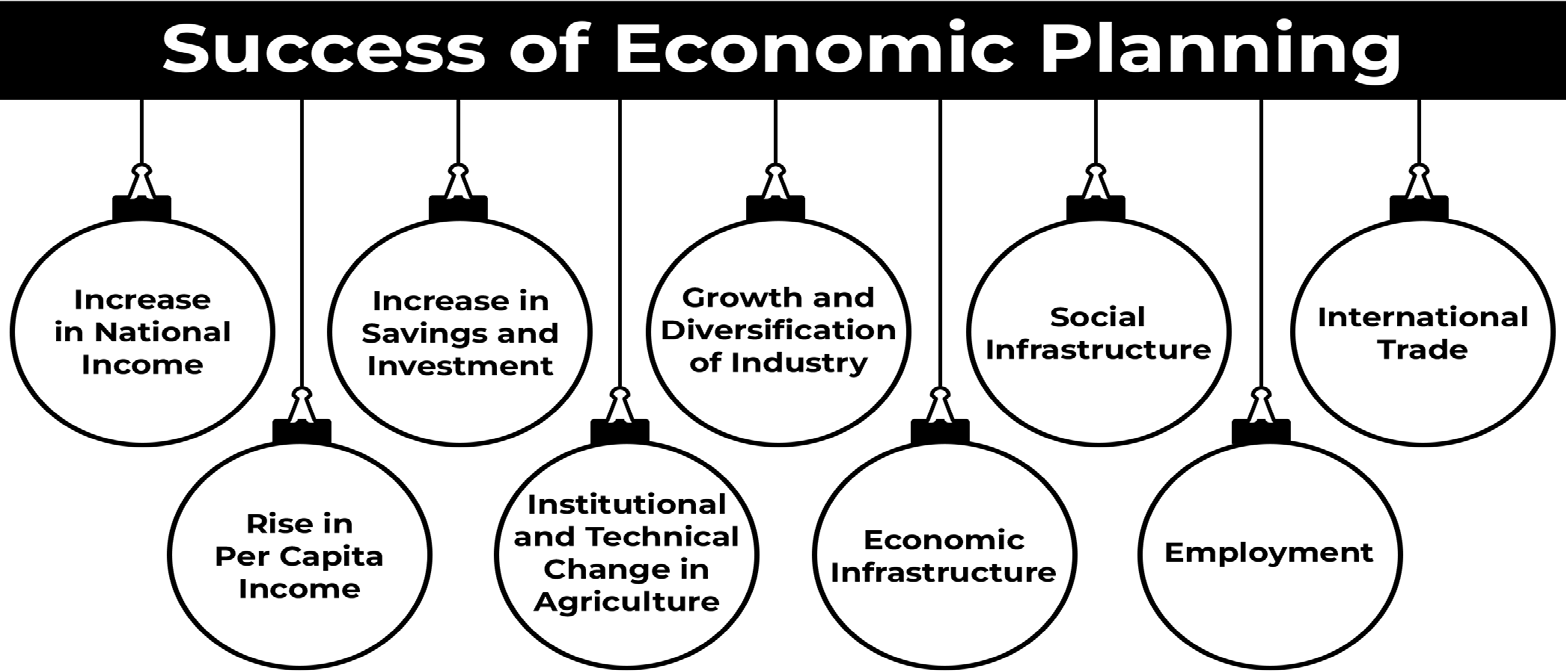
Increase in National Income: India’s national income grew by 0.5% annually before planning. India’s average yearly growth rate has been around 5% during the planning period.
The rise in per capita income during the planning period:
The annual per capita income growth rate was 2.9%.
Institutional and technical advancements in agricultural planning have significantly contributed to the growth of agriculture in our nation. The average annual growth rate of agricultural output was 2.8% during the planning period.
Industry expansion and diversification: During the planned period, the growth rate of industrial production was roughly 7% annually. Industries producing capital and essential goods have expanded significantly. The nation became independent in the consumer products sector. The industrial sector has evolved and been modernized.
Economic and social infrastructure: During the planning phase, financial and insurance infrastructure, as well as transportation and communication infrastructure, irrigation, and power infrastructure, grew significantly. Facilities for health and education have saw a tremendous increase.
Increased job prospects were the focus of targeted efforts throughout the plan period. The government set a goal of 58 million employees in the eleventh five-year plan.
Foreign trade: India’s trading abroad has also expanded astronomically. The value of international commerce in 1948–1949 was Rs. 792 crores. It was Rs. 38,11,422 crores in 2011–2012.
Therefore, we may conclude that during the plan period, our economy made significant improvement.
Major Failures of National Planning Commission
The National Planning Commission (NPC) of India was constituted on the 15th of March 1950. The NPC was founded by a Resolution of the Government of India as an advisory and a specialized institution. It was an extra-constitutional, non-statutory and advisory body. The Commission has effectively played an important role in India’s rejuvenation from the reins of the British to an independent nation with ambitious developmental goals.
In 2014 however, the NPC was replaced by the Niti Aayog a more vibrant organization compared to the NPC. It aims at achieving goals of sustainable development by adopting cooperative federalism thereby enhancing the
participation of the states in the developmental activities of the nation.
Despite the many developmental goals fulfilled by the NPC, the body has been accused of a lot of criticisms. The Commission has often been criticized for being a soviet styled-bureaucratic body that stifled the economic growth of the country.
The actual growth rate of the Indian economy was much less compared to the targeted rate of growth. Barring the First and the Sixth Five Year Plans, the actual rate of growth remained way below the aimed growth rates of GNP and per capita income. There was a gap between the aimed target and the actual growth rate which is
4.4% against the 5% targeted growth rate. This difference between the target growth rate and the achieved growth rate portrays the failure of the Five-Year Plans. India continues to be one of the poorest nations even today despite 50 years of economic planning.
Failure to Eliminate Poverty: Poverty is one of the major impediments which continue to haunt India. More than a quarter of the population in the rural areas which is 25.7 percent live below the poverty line. In the urban areas, the situation is a little better than the rural areas where
13.7 percent of the population live below the poverty line. Altogether about 22 percent of the Indian population is carrying out their livelihood while sustaining themselves below the poverty line. Despite numerous schemes launched by the Planning Commission via the Five Year Plans the problem of poverty has not been eliminated properly.
Failure to reduce inequality of income and wealth: Throughout the planning period, the rich have turned richer while the poor have become poorer. Even though the incidence of poverty went down to some extent, the incidence of inequality increased significantly owing to the concentration of wealth in the hands of a few wealthy people. India’s richest 1 percent acquired about 73% of the country’s total wealth according to a survey by the International Rights group Oxfam while 67 crore Indians which comprise the population’s poorest lot saw an average increase in their wealth by only 1%. This can be attributed significantly to the increase in the prices of essential goods, inflation which has favored the rich but deprived the poor.
Regional imbalance: The five-year plans aggravated the gap between the states furthermore. A lot of changes were expected from the Planning Commission concerning developmental activities, but instead, it emphasized more on macro, sectoral, economic and national aspects while it lacked the regional thrust. This has led to an unequal distribution of resources between the states. The backward areas continue to be neglected and underdeveloped while the metropolis has seen a surge of developmental activities.
Failure to Implement Land Reforms: Land reform measures have been largely neglected by the five-year Plans. The policy decisions of transferring ownership of land to the peasantry were not implemented properly. The government was not eager to implement these measures which aimed at progressive agriculture and socialism this led to the alienation of a large number of peasants and brought them more hardship.
Inability to Check the flow of Black Money: For several reasons, there has been a concentration of a large amount of black money with a section of the wealthy population. These people have misused the available resources and indulged in illegal activities, which has also led to the misallocation of resources. The schemes adopted to check the concentration of black money have also failed to serve their purpose
National Development Council (NDC)
• The Prime Minister chairs the National Development Council (NDC), also known as the Rashtriya Vikas Parishad, which is India’s premier council for development decision-making and deliberation. The National Development Council is one of India’s most important planning systems. It represents the federal approach to planning and serves as a check to ensure that the planning system is really national in scope.
Powers, Functions and Responsibilities of NDC
• The Council was formed in October 1967, following the recommendations of the Administrative Reforms Commission, and its powers were redefined to include:
• Establishing guidelines for the creation of the National Plan, which encompass resource evaluations and the National Plan as formulated by the National Development Council
• Examining important social and economic policy
matters that affect the development of the country.
• Periodically assess the Plan’s functioning and suggest any actions required to meet its goals and objectives, which include guaranteeing people’s active involvement and cooperation, enhancing the effectiveness of administrative services, ensuring the community’s less developed areas and sections receive the fullest development, and through equally sharing sacrifices from all citizens.
• The National Development Council was tasked with advising and recommending policies to the state and federal governments.
• It has served as a high-powered consultative group from its formation, where the framework of the Five- Year Plans, the major problems facing the Indian economy and the policies that must be enacted to address the important problems have all been discussed and solutions reached.
• As a result, in addition to the Plan, the Council has focused on issues such as food, the establishment of the State Trading Corporation, and land reforms.
• The NDC chairman (chairman of National Development Council) or the Council’s primary role is to serve as a link between the Union government, the Planning Commission, and state governments.
It aids in the coordination of not only policies and plans, but also other issues of national significance. It gives a good forum for discussion and a free and open sharing of views
Indian Economy During the British Rule
Indian Economy during the British Rule
India possessed a self-governing economy prior to the arrival of British authority. Even though the majority of people relied on agriculture for their primary source of income, the nation’s economy was distinguished by a variety of manufacturing industries.
India was renowned for its handicraft industry, which included textiles made of cotton and silk, metal crafts, precious stone work and more.
The superb grade of material utilised and the high standards of craftsmanship evident in all imports from India gave these products a global market.
The colonial government of India prioritised the preservation and advancement of their native nation’s economic interests over the advancement of the Indian economy in its economic policies.
These measures resulted in a significant shift in the economic structure of India, turning it into a supplier of raw resources and a buyer of British-made industrial goods.
Agricultural Sector
During the British colonial era, India’s economy remained predominantly based on agriculture, with over 85% of the population living in villages and earning a living via it either directly or indirectly.
Nevertheless, even though so many people worked in it, the agricultural industry was still plagued by periods of extraordinary decline and stagnation.
Despite some growth in the sector in absolute terms, agricultural productivity declined as a result of the expansion of the total area under cultivation.
The colonial government’s numerous land settlement schemes were mostly to blame for this stagnation in the agriculture sector.
Besides this, low levels of technology, lack of irrigation facilities and negligible use of fertilisers, all added up to aggravate the plight of the farmers and contributed to the dismal level of agricultural productivity.
Of course, there was some indication that the commercialization of agriculture had led to a comparatively larger production of cash crops in some parts of the nation.
India’s agriculture was deprived of funding for terracing, flood control, drainage, and soil desalination, notwithstanding some advancements in irrigation.
A significant portion of tenants, small farmers, and sharecroppers lacked the resources, technology and motivation to engage in agriculture, whereas a tiny percentage of farmers shifted from growing food crops to commercial crops.
Industrial Sector
Similar to the situation with agriculture, India was unable to establish a strong industrial foundation while under colonial control.
During the collapse of the nation’s renowned handicraft industries, no contemporary industrial foundation was permitted to emerge to replace the former’s position of prominence.
The colonial authority had two main goals in mind when it implemented its policy of methodically deindustrializing India.
Initially, the goal was to downgrade India to the role of a supplier of vital raw materials for Britain’s emerging modern industries.
Secondly, to establish India as a vast marketplace for the final goods produced by those sectors so that their continuous growth could be guaranteed to the fullest benefit of their native Britain.
As the economy developed, the collapse of the country’s native handicraft industries led to both widespread unemployment in India and a new demand in the country’s consumer market because there was no longer a supply of locally produced goods. Profitably, Britain’s imports of low-cost manufactured goods increased to meet this need.
During the second half of the nineteenth century, modern industry began to take root in India but its progress remained very slow.
At first, this progress was limited to the establishment of textile mills for cotton and jute.
The majority of Indian-owned cotton textile mills were situated in Maharashtra and Gujarat in the west of the nation, whilst foreign-owned jute mills were primarily centred in Bengal.
But there wasn’t much of a capital goods sector to support India’s continued industrialization.
Moreover, the rate of expansion of the recently established industrial sector and its share of the GDP or GDPV stayed relatively low.
The public sector’s extremely constrained operational area was yet another major disadvantage of the emerging industrial sector.
This industry was limited to the railroads, electricity generation, communications, ports, and certain other departmental projects.
Foreign Trade
India has historically played a significant role in international trade. However, the structure, makeup, and amount of India’s foreign commerce were negatively impacted by the colonial government’s restrictive regulations regarding commodities production, trade and tariffs.
As a result, India started exporting basic items like raw silk, cotton, wool, sugar, indigo, jute and so on while importing capital goods like light machinery made in British factories as well as finished consumer goods like cotton, silk and woollen clothing.
In all actuality, Britain continued to have monopolistic control over India’s imports and exports.
This led to the restriction of over half of India’s foreign trade to Britain, with the remaining portion being permitted with a select group of nations like China, Persia (Iran), and Ceylon (Sri Lanka).
The creation of a significant export surplus was the key feature of India’s international commerce throughout the colonial era.
Moreover, there was no inflow of gold or silver into India as a result of this export surplus. Instead, money was utilised to cover costs associated with an office that the British colonial government established, military expenditures that were once more carried out by the British government and the import of undetectable goods, all of which depleted Indian income.
Demographic Condition
A census was conducted in 1881 to gather the first set of demographic data for British India.
India was in the initial stage of its demographic shift prior to 1921. Following 1921, the second phase of change started. But at this point, neither India’s overall population nor its pace of population growth was very high.
The other social development metrics were also not very promising. Less than 16 percent of people were literate overall.
Public health facilities were either unavailable to large chunks of population or, when available, were highly inadequate.
Consequently, water and air-borne diseases were rampant and took a huge toll on life.
No wonder, the overall mortality rate was very high and in that, particularly, the infant mortality rate was quite alarming about 218 per thousand in contrast to the present infant mortality rate of 33 per thousand.
Occupational Structure
There was minimal indication of a shift in India’s occupational structure the way people were employed in various industries and sectors during the colonial era.
At a peak of 70–75 percent, the agriculture sector employed the greatest number of people, while the manufacturing and service sectors employed just 10-15 and 15-20 percent of the workforce, respectively.
Another striking aspect was the growing regional variation. Parts of the then Madras Presidency, Bombay and Bengal witnessed a decline in the dependence of the workforce on the agricultural sector with a commensurate increase in the manufacturing and the services sectors. However, there had been an increase in the share of the workforce in agriculture during the same time in states such as Orissa, Rajasthan and Punjab.
Indian Economy after Independence
On 15 August 1947, India woke to a new dawn of freedom. Among other things, the founders of independent India had to choose the kind of economic structure most suited for our country—one that would advance the well-being of the majority rather than just a select few. The most appealing thing to Jawaharlal Nehru was socialism. He did not, however, support the type of socialism that had been instituted in the former Soviet Union, where the government owned all of the nation’s farms and enterprises and private property did not exist. Private property did not exist. Essentially, he sympathised with the socialist perspective and believed that an economic system that included the finest aspects of socialism with none of its negatives was the solution. According to this theory, India would be a socialist country with a robust public sector, private property, and democracy. The government would organise the economy and promote participation from the private sector. This perspective was reflected in the 1948 “Industrial Policy Resolution” and the Indian Constitution’s Directive Principles. The Prime Minister chaired the Planning Commission when it was established in 1950. Five-year plans became the new norm.
NITI Aayog
NITI Aayog: National Institute for Transforming India
• The new institution will serve as a development catalyst, developing an overall enabling environment through a holistic approach to development that goes beyond the public sector and the Indian government.
• The following pillars will be used to construct this:
• Empowering states to participate in national development as equal partners; bringing the Cooperative Federalism ideal into practice.
• An internal and external resource hub that serves as a library of good governance best practices and a think tank that provides domain knowledge and strategic expertise to all levels of government.
• A collaborative platform for tracking progress, fixing gaps, and bringing together disparate ministries at the federal and state levels in the pursuit of a single goal to make implementation easier.
Composition
• The Prime Minister of India chairs the NITI Aayog
• Governing Council, is made up of the Chief Ministers of all Indian states, as well as the Chief Ministers of Union Territories and legislators.
• Regional Councils are constituted to deal with unique concerns and situations that affect multiple states or regions. The Prime Minister convenes these meetings, which are attended by the Chief Ministers of States and Lieutenant Governors of Union Territories in the region. The NITI Aayog Chairperson or his nominee chairs these meetings. Special invitees are experts, professionals and practitioners with extensive domain knowledge who have been nominated by the Prime Minister.
• Full-time Organizational Framework: It includes the Prime Minister as Chairperson, as well as other members.
• Vice-Chairperson: The Prime Minister appoints him. He holds the position of Cabinet Minister.
• Members: Full-time. They enjoy the rank of a Minister of State.
• Part-time Members: Maximum of 2, from leading universities, research organisations and other relevant institutions in an ex-officio capacity.
• Ex-Officio Members: Maximum of 4 members of the Union Council of Ministers to be nominated by the PM.
• Chief Executive Officer: He is appointed by the Prime Minister. They enjoy the rank of a Minister of State.
Objectives
• To create a shared national development vision.
• To promote federalism in which states work together.
• Create mechanisms for developing credible plans at the village level.
•
To ensure that national security interests are served in areas specifically referred to it.
• Paying special attention to the segments of our society that may be at risk of not benefiting sufficiently from economic progress.
• Create strategic and long-term policy and programme frameworks and initiatives, as well as track their progress.
• To provide guidance and encouragement to important stakeholders and like-minded national and international partners.
• Create a structure to foster knowledge, creativity, and entrepreneurship.
• Actively monitor and evaluate the implementation of programmes and initiatives.
• To make technical advancement a priority.
The NITI Aayog is built on seven pillars of successful governance:
• A pro-people programme that addresses both social and individual needs (Pro-People).
• Anticipates and responds to citizens’ needs in a proactive manner (Pro-Activity).
• The process is more participative since citizens are involved (Participation).
• Women’s empowerment in all aspects of their lives (Empowering).
• All ethnic groups are represented, with a particular emphasis on SCs, STs, OBCs, and minorities (Inclusion of all).
• Young people have the same opportunities as adults (Equality).
• Using technology to make government more visible and responsive, transparency is accomplished (Transparency).
Difference Between NITI Aayog and Planning Commission
• The Planning Commission was established by a resolution issued by the Indian government in March 1950. It was created to help the government accomplish its stated goals of fostering a quick improvement in the people’s quality of life by effective exploitation of the country’s resources, greater output, and giving opportunities for everybody to participate in the community’s service. The Planning Commission was tasked with assessing all of the country’s resources; supplementing those that were insufficient; devising plans for the most efficient and balanced use of resources, and deciding priorities. In 1951, the country’s first five-year plan was implemented. The Indian government replaced the Planning Commission, which was created in 1950, with the NITI Aayog. This action was taken to better fulfill the people’s needs and ambitions with a focus on a “Bottom-Up” approach to envision the goal of Maximum Governance, Minimum Government, mirroring the spirit of “Cooperative Federalism.”. The Government of India’s top policy think tank, NITI Aayog, provides directional and policy suggestions. NITI Aayog offers appropriate technical assistance to the Centre, States and Union Territories in addition to creating strategic and long-term policies and programs for the Government of India. This action was taken to better fulfill the people’s needs and ambitions. NITI Aayog is a significant evolutionary development in that it serves as the Government of India’s primary platform for bringing the States together in the national interest, fostering cooperative federalism.
Concepts adopted by NITI Aayog differ from the Planning Commission:
• Organization: A deputy chairperson, a member secretary, and full-time members make up the Planning Commission. The regular procedure is used to nominate secretaries or member secretaries. New CEO and Vice- Chairperson positions have been created at NITI Aayog. There will be five full-time and two part-time members. Ex-officio members will include four cabinet ministers. The Prime Minister appoints the CEO directly. The position of CEO is equivalent to that of a secretary. Ex- officio members would be four Cabinet members. Two part-time members and five full-time members make up the NITI Aayog.
• Planning: With public sector resources, the Planning Commission favors top-down planning for government. In a market economy that is connected with the globalized globe, the NITI Aayog develops national development strategies. Recognizing the states’ rising autonomy and responsibility, the NITI Aayog recognizes and allows for more engagement by states and other stakeholders (civil society). Furthermore, one of the key pillars of the NITI Aayog is openness and e-governance, which contrasts sharply with the old Planning Commission’s planning style.
• Finance and States’ Role: With the introduction of the Planning Commission, the role of the Finance Commission was severely decreased. The Planning Commission was in charge of allocating monies. The NITI Aayog has no responsibility for the allotment of funds. The Finance Ministry will decide on the tax portion that states will get, as well as money distribution and Union support. The Planning Commission had the authority to provide funding to state governments and several central government ministries for a variety of national and state-level programs and projects. The Planning Commission developed policies first, and subsequently, state governments were consulted on funding allocations for programs and projects. The ultimate policy will produce fruit at NITI Aayog
following adequate discussions with state governments throughout the policy formation stage. NITI Aayog offers appropriate technical assistance to the Centre, States, and Union Territories in addition to creating strategic and long-term policies and programs for the Government of India.
• Reporting and Constitution: The National Development Council, which included State Chief Ministers and Lieutenant Governors, reported to the Planning Commission. The Governing Council of NITI Aayog consists of State Chief Ministers and Lieutenant Governors. The Planning Commission, which is now defunct, was an Executive Body. Because it is not named in the Indian Constitution and was not constituted by an Act of Parliament, NITI Aayog is likewise an Executive Body. However, it may be turned into a Statutory Body, if necessary, by passing a statute in Parliament; UIDAI is one example.
• Good governance principles include: The governance principles adopted by the two planning organizations are perhaps the most important variation between them. The modern NITI Aayog aspires to foster an open, transparent, responsible, proactive, and purposeful governing approach. In the case of the former Planning Commission, these concepts were there in theory but mostly lacking in practice. The former Planning Commission was founded as ‘a staff agency’, but over time it grew into a strong and directive body, deficient in good governance norms.
• Key role and objectives: Albeit, the former Planning Commission worked as an extra-Constitutional body with broad powers over financial allocation and use, the NITI Aayog (while non-constitutional) has a more consultative role and a lesser executive role. Its primary function is that of a “think tank.” While the PC has considerable executive powers, the NITI Aayog functions as a policy research organization that assists the government (executive) in devising effective policies for the creation of a “new India.”
• The number of participants: There were eight full-time members on the previous Planning Commission. The number of full-time members on the NITI Aayog board might be lower than those on the Planning Commission.
Conclusion
With changing conditions, new ideas (such as sustainable development and cooperative federalism) were added to the planning objectives, resulting in the formation of NITI Aayog. However, the Planning Commission’s contributions to the nation’s progress must not be overlooked. In addition, several flaws in the operation of NITI Aayog must be addressed as soon as possible. The NITI Aayog’s replacement of the Planning Commission will help shift the focus away from projects and programs and toward policies and institutions, from spending inputs to real results through stronger governance, and away from political squabbling over incremental appropriations and toward new challenges and possibilities
Documents Published by NITI Aayog
The following are the documents that NITI Aayog has
published.
Fifteen-Year Vision: The first is a “vision” for the next 15 years that includes the overarching aims and objectives of the nation.
Seven-Year Strategy: The second is a seven-year “Strategy,” which establishes the development roadmap for the following seven years and splits those aims and objectives into two categories.
Three-Year Action Agenda: The third and last step is a “Three Year Action Agenda,” which further divides the plan into two sections by listing the actions and goals that must be achieved over the following three years.
Economic Planning
Economic Planning
• Planning under a democratic system may be defined as the technical co-ordination, by disinterested experts, of consumption, production, investment, trade and income distribution, in accordance with social objectives set by bodies representative of the nation. Such planning is not only to be considered from the point of view of economics and the raising of the standard of living but must include cultural and spiritual and the human side of life.
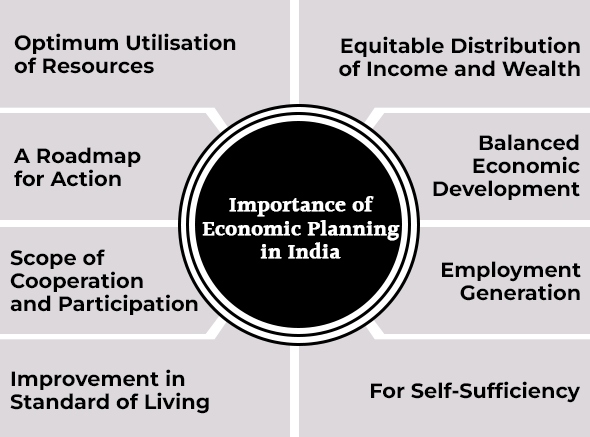
Economic Planning refers to the system in which the central authority sets targets, programs and policies to achieve those specified targets and policies within a specific period. The primary purpose is to achieve optimum utilization of the resources. With this social welfare along with growth can be maximized.
PLAN MODELS
Gandhian Model
Mahatma Gandhi was a keen supporter of agriculture. His belief was always to make decentralisation and a self-contained nation. He didn’t follow either centralisation, industrialisation, or state control over the economy. Agriculture-based small businesses and cottage industries were encouraged by him. These beliefs were opposed by the National Planning Commission. Jawaharlal Nehru assured that industrialisation will not hamper the establishment and encouragement of cottage enterprises. The major focus of the National Planning Commission was to construct a power-based economy and also lay down a top-down planning system which was not in synchronization with the Gandhian plan.
The National Planning Commission wished to lay focus on the goals of poverty reduction, setting up more jobs for individuals as well as economic growth. The Gandhian Model was laid down keeping in mind these socio-economic goals and assigning it to the respective process.
Which Five-Year Plan is Known as the Gandhian Model?
The Third Five-Year Plan can be referred to as the Gandhian Model. It commenced from 1961-1966 under the leadership of Pandit Jawaharlal Nehru. The major objectives of the Third five- year plan were the establishment of an independent economy. Such an economy was based on the idea of establishing a self-reliant and self-generating economy, enhancement of agriculture and improvement in the production of wheat. This plan was also known as the Gadgil Yojana. D.R. Gadgil was
the Deputy Chairman of the Planning commission during the tenure of this five-year plan.
Sarvodaya Plan
• The “Sarvodaya Plan” was written in 1950 by Jai Prakash Narayan. Sarvodaya is a Sanskrit phrase meaning ‘development of all’ or ‘universal uplift’. Gandhi used the phrase for the perfection of his own political theory because it appeared in the title of his 1908 translation of John Ruskin’s economics pamphlet, Unto This Last.
• In order to achieve economic development, the Sarvodaya plan proposed and highlighted the significance of agricultural and village industries, particularly small- scale textile and cottage industries. The plan was negative about the use of foreign technology and advocated the Luddite way.
• The plan’s emphasis on decentralised participatory people planning and land reforms was its most significant and widely praised component.
People’s Plan
• M N Roy was the author of the People’s Plan, which was written by the Indian Federation of Labour’s Post-War Re-Construction Committee.
• The object of the Plan is to provide for the satisfaction of the immediate basic needs of the Indian people within a period of ten years. This objective is to be achieved by expanding production and by ensuring an equitable distribution of the goods produced. Therefore, the Plan prescribes increased production in every sphere of economic activity. However, its writers place a strong focus on agricultural growth because they think that unless agriculture which is the largest industry in the nation becomes profitable, people’s purchasing power would not increase.
Bombay Plan
• In 1944, towards the end of WWII, on the heels of the Bengal Famine, the Quit India movement, and the inevitability of independence, JRD Tata and seven other leading industrialists and executives of the era – G D Birla, Purshottamdas Thakurdas, Ardeshir Shroff, Kasturbhai Lalbhai, Ardeshir Dalal, John Matthai, Lala Shri Ram came together to write a manifesto for the Indian economy post-independence. It was dubbed The Bombay Plan, or more formally A Plan of Economic Development for India. Its authors helped set up the Reserve Bank of India (RBI), Federation of Indian Chambers of Commerce and Industry (FICCI), supported the Congress during the freedom struggle, and even sat on the Viceroy’s executive council during WWII.
The Bombay Plan was a two-part statement written by Indian businessmen and academics as they navigated the struggles and constraints imposed on them by the British Raj during WWII, and a way for them to indicate to future governments how they envisioned India’s political economy after independence. The plan aimed to triple India’s GDP in 15 years, and significantly increase India’s per-capita income to improve overall living standards. It planned to achieve these aims through three ‘leaps’, each spread out over five years, analogous to the five-year plans developed by the Nehru government after independence, which prioritised agriculture, industrialisation and then a transition to a services economy.
The Harrod-Domar Growth Model
• The Harrod-Domar models of economic growth are based on the experiences of advanced capitalist economies to analyse the requirements of steady growth in such economy. The Harrod-Domar economic growth model stresses the importance of savings and investment as key determinants of growth.
The model emphasises on the dual character of investment:
It creates income which is regarded as the ‘demand effect’.
It augments the productive capacity of the economy by increasing its capital stock which is regarded as the ‘supply effect’ of investment.
• The Harrod model is based on three growth rates. One, there is the actual growth rate which is determined by the saving ratio and the capital-output ratio. It shows short- run cyclical variation in the rate of growth. Two, there is the warranted growth rate which is the full capacity growth rate of income in an economy. Three, there is the natural growth rate which is regarded as ‘the welfare optimum’. It may also be called the potential or the full employment rate of growth.
The Mahalanobis Model
• Also known as Nehru-Mahalanobis model.
The foundation of this growth model is the preponderance of basic products, which include factories, machinery, tools and other items that make up the industrial market (capital goods, also known as investment goods, are goods that are used to make additional goods).
• The goal was to establish strong industry ties as quickly as feasible in order to increase the system’s productive capacity.
Industrial Policy Resolution 1956 (IPR 1956)
• The Industrial Policy Resolution of 1956 was enacted with the intention of the state dominating the highest echelons of the economy.
• This resolution served as the foundation for the Second Five Year Plan, an attempt to establish the framework for a socialist social structure.
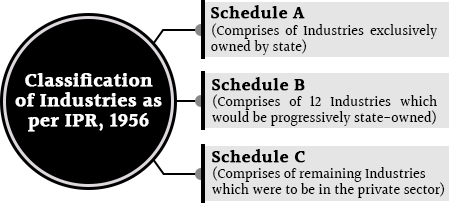
• Three categories were created for industries by this resolution.
• The first group included industries that the government would own outright; the second group included industries where the public sector could be supplemented by the private sector, with the government bearing the exclusive responsibility for establishing new units; the third group included the remaining industries that were to be owned by the private sector.
• The private sector was allowed to handle some industries, but a licencing system maintained state control over the industry.
• New industries were prohibited unless they secured a government licence. The goal of this policy was to advance industry in underdeveloped areas.
• To advance regional equity was the goal of this strategy.
• Even an established industry has to get a licence in order to diversify its production and increase output (creating new kinds of items).
Liberalization, Privatization and Globalization
Liberalization
• The rules and laws which were aimed at regulating economic activities became major hindrances in growth and development. Liberalization was introduced to put an end to these restrictions and open various sectors of the economy.
•
Though a few liberalization measures were introduced in the 1980s in areas of industrial licensing, export-import policy, technology upgradation, fiscal policy and foreign investment, reform policies initiated in 1991 were more comprehensive.
• Some important areas, such as the industrial sector, financial sector, tax reforms, foreign exchange markets and trade and investment sectors which received greater attention in and after 1991.
Deregulation of Industrial Sector
• In India, regulatory mechanisms were enforced in various ways: industrial licensing under which every entrepreneur had to get permission from government officials to start a firm, close a firm or decide the amount of goods that could be produced private sector was not allowed in many industries some goods could be produced only in small-scale industries controls on price fixation and distribution of selected industrial products.
• Many of these limitations were lifted by the reform measures that were implemented in and after 1991. Almost all product categories were exempt from industrial licencing, with the exception of alcohol, cigarettes, hazardous chemicals, industrial explosives, electronics, aerospace and pharmaceuticals and medications.
• The only industries which are now reserved for the public sector are a part of atomic energy generation and some core activities in railway transport. Numerous products made by small-scale businesses are now deserving. The market has been permitted to set prices in the majority of industries.
Financial Sector Reforms
• Financial sector includes financial institutions, such as commercial banks, investment banks, stock exchange operations and foreign exchange markets. The Reserve Bank of India (RBI) oversees the regulation of the financial industry in India.
• The RBI decides the amount of money that the banks can keep with themselves, fixes interest rates, nature of lending to various sectors, etc.
• One of the major aims of financial sector reforms is to reduce the role of RBI from regulator to facilitator of the financial sector. This implies that a number of choices made by the financial industry might be permitted to be made without first contacting the RBI.
• The reform policies led to the establishment of private sector banks, Indian as well as foreign.
• The cap on foreign investments in banks was increased to approximately 74%. The ability to open new branches and streamline their current branch networks without RBI clearance has been granted to banks that meet specific requirements.
• Though banks have been given permission to generate resources from India and abroad, certain managerial aspects have been retained with the RBI to safeguard the interests of the account-holders and the nation.
• Foreign Institutional Investors (FII), such as merchant bankers, mutual funds and pension funds, are now allowed to invest in Indian financial markets.
Tax Reforms
• Tax reforms are concerned with the reforms in the government’s taxation and public expenditure policies, which are collectively known as its fiscal policy.
• Indirect and direct taxes are the two categories of taxes. The category of direct taxes includes levies on both corporate earnings and individual income. With the belief that high income tax rates were a major contributing factor to tax evasion, there has been a steady decrease in individual income taxes since 1991.
• It is now widely accepted that moderate rates of income tax encourage savings and voluntary disclosure of income. The company tax rate has gradually decreased from its previous extremely high level.
• Efforts have also been made to reform the indirect taxes, taxes levied on commodities in order to facilitate the establishment of a common national market for goods and commodities.
• In 2016, the Indian Parliament passed a law, Goods and Services Tax Act 2016, to simplify and introduce a unified indirect tax system in India. This law came into effect from July 2017. This is expected to generate additional revenue for the government, reduce tax evasion and create ‘one nation, one tax and one market’.
• Simplifying is another aspect of reform in this field. Many procedures have been made simpler, and the rates have also been significantly reduced, in an effort to encourage taxpayers to comply with the law better.
Foreign Exchange Reforms
• The first important reform in the external sector was made in the foreign exchange market. In 1991, as an immediate measure to resolve the balance of payments crisis, the rupee was devalued against foreign currencies. As a result, there was a rise in foreign exchange influx.
• It also set the tone to free the determination of rupee value in the foreign exchange market from government control. Now, more often than not, markets determine exchange rates based on the demand and supply of foreign exchange.
Trade and Investment Policy Reforms
• Liberalization of trade and investment regime was initiated to increase international competitiveness of industrial production and also foreign investments and technology into the economy.
• The aim was also to promote the efficiency of local industries and adoption of modern technologies.
India was imposing quantitative import limits in an effort to safeguard its own businesses. This was promoted by maintaining extremely high tariffs and strict import controls. Due to these regulations, the industrial sector’s expansion was slowed and its efficiency and competitiveness were decreased.
• The trade policy reforms aimed at (i) dismantling of quantitative restrictions on imports and exports (ii) reduction of tariff rates and (iii) removal of licensing procedures for imports.
• Import licencing was done away with the exception of industries that were environmentally delicate or dangerous.
• Quantitative restrictions on imports of manufactured consumer goods and agricultural products were also fully removed from April 2001. Export duties have been removed to increase the competitive position of Indian goods in the international markets.
Privatization
• It means giving up control or direction of a business held by the government. There are two ways that government- owned businesses can become private: either they are sold outright or the government removes itself from administration and ownership of the public sector businesses.
• Privatization of the public sector enterprises by selling off part of the equity of PSEs to the public is known as disinvestment. The purpose of the sale, according to the government, was mainly to improve financial discipline and facilitate modernisation.
• It was also envisaged that private capital and managerial capabilities could be effectively utilized to improve the performance of the PSUs.
• The government anticipated that privatisation would give FDI a significant boost. Additionally, the government has tried to increase PSU efficiency by granting them managerial autonomy. As an illustration, certain PSUs have been given unique status as miniratnas, navratnas, and maharatnas.
Globalization
• Although globalization is generally understood to mean integration of the economy of the country with the world economy, it is a complex phenomenon.
• It is an outcome of the set of various policies that are aimed at transforming the world towards greater interdependence and integration.
• It involves creation of networks and activities transcending economic, social and geographical boundaries. Globalization attempts to establish links in such a way that the happenings in India can be influenced by events happening miles away. It is establishing a world without borders or uniting the entire world.
Outsourcing
• One of the significant results of the globalisation process is this. When a business engages in outsourcing, it means that it is hiring regular services from outside, primarily from other nations, that were formerly handled internally or domestically (such as security, computer services, legal advice, and advertising, which are all handled by different company divisions).
• As a form of economic activity, outsourcing has intensified, in recent times, because of the growth of fast modes of communication, particularly the growth of Information Technology (IT). Many of the services such as voice-based business processes (popularly known as BPO or call centres), record keeping, accountancy, banking services, music recording, film editing, book transcription, clinical advice or even teaching are being outsourced by companies in developed countries to India.
• With the help of modern telecommunication links including the Internet, the text, voice and visual data in respect of these services is digitized and transmitted in real time over continents and national boundaries.
• Most multinational corporations, and even small companies are outsourcing their services to India where they can be availed at a cheaper cost with reasonable degree of skill and accuracy.
• The low wage rates and availability of skilled manpower in India have made it a destination for global outsourcing in the post-reform period.
Benefits of the LPG Reforms
• The LPG reforms in India have had significant positive impacts on the Indian economy. They helped overcome a balance of payments crisis, reduced dependence on foreign loans and helped the government address its fiscal deficit by privatizing inefficient PSUs. The policy also fostered economic growth by reducing government restrictions, encouraging private market entry, and establishing India as a major developing country. There is a change in occupational structure with a decline in the percentage share of the labour-force in the agricultural sector and a rise in the services sector. The Economic Census of India estimates that around 41.89 million rural people are employed in non-agricultural establishments which registered a growth rate of 4.56 % during 1998- 2005. Steady transition to urbanisation over the years is leading to the decline in the rural share in population, workforce and GDP of the country. Foreign exchange reserves have increased by 20 times and foreign direct investment (FDI) by 150% as a result of the economy’s opening up. Between 1990–1991 and 2003–2004, international investment which comprises both foreign direct and foreign institutional investment rose from roughly US $100 million to US $150 billion. During the reform era, India was regarded as a prosperous exporter of engineering items, auto components, textiles, and IT software.
• However, the reforms faced criticism for their negative impacts on the agriculture sector, income inequality, and difficulties faced by local businesses. Following the reform, the agricultural sector’s contribution to the Indian economy has gradually decreased. Traditionally accounting for 29% of India’s GDP in 1991, agriculture currently only makes up roughly 15% of the country’s GDP. With more than 56% of the workforce, Agriculture and Allied Activities has the lowest GVA per worker in terms of levels.
Despite these challenges, the LPG Reforms allowed India to emerge from an economic crisis, reduce its dependence on loans, and become a major developing economy