Classification of Receipts
CLASSIFICATION OF RECEIPTS
Revenue Receipts
Receipts that do not result in a claim against the government are known as revenue receipts. As a result, we refer to them as non-redeemable.
Revenue receipts are from tax and non-tax sources. For a considerable amount of time, taxes have been separated into two categories: direct taxes, such as personal income tax and corporation tax, and indirect taxes such as excise duties (which are levied on goods produced domestically), customs duties (which are taxes imposed on goods imported into and exported from India), and service taxes. Some direct taxes have been referred to as “paper taxes” because they have never generated significant revenue, such as the gift tax. Estate duty and wealth tax have since been abolished in India.
The primary sources of non-tax revenue for the central government are interest payments from loans it has given, dividends and profits from investments it has made, and fees and other payments received in exchange for services provided. Included are monetary grants-in-aid from international organizations and other nations.
Tax Revenue
The term “tax revenue” refers to the money received from social security contributions, payroll taxes, taxes on the ownership and transfer of property, taxes on income and profits, and other taxes.
The Union Budget’s Annual Financial Statement includes the Tax Revenue, which is a component of the Receipt Budget.
The comprehensive report provides information on the various forms of revenue collected, including corporation tax, income tax, customs, union excise, service, and taxes on Union Territories such as land revenue and stamp registration. Tax revenue includes the sum of all direct and indirect taxes collected.
Governments impose taxes on their people in order to raise funds for initiatives aimed at improving the nation’s economy and raising the living standards of its populace.
The Indian Constitution, which gives the Central and State governments the right to impose taxes, is the source of the government’s ability to do so. Every tax imposed in India must be supported by a corresponding legislation enacted by the State Legislature or the Parliament.
Types of Taxes
There are two different kinds of taxes: direct taxes and indirect taxes. The manner in which these taxes are imposed differs. Some taxes like corporation tax, income tax, etc are paid by you directly, while other taxes like the goods and services tax, service tax, sales tax, etc.are paid indirectly.
However, in addition to these two traditional taxes, the Central Government has implemented additional taxes in order to further specific goals. Both direct and indirect taxes are subject to “other taxes,” i.e. cess and surcharges which include Krishi Kalyan, and Swachh Bharat cess, among others.
Direct Tax
As previously mentioned, direct taxes are those that you pay directly to the government. These taxes cannot be passed on to another person or organization; they are imposed directly on the subject. The Department of Revenue’s Central Board of Direct Taxes (CBDT) is one of the organizations that overlook these direct taxes.
EXAMPLES OF DIRECT TAXES
Income Tax
It’s the tax that you pay on the money you make during a fiscal year. Income tax has many different aspects, including tax slabs, taxable income, tax deducted at source (TDS), and taxable income reduction. Companies as well as individuals are subject to the tax. The tax that an individual must pay is determined by the tax bracket in which they are placed. This bracket, also known as a slab, ranges from no tax to 30% tax for high-income groups, depending on the assessee’s yearly income.
The government has established distinct tax brackets for distinct categories of individuals, including general taxpayers, senior citizens (those between the ages of 60 and 80), and very senior citizens (those over the age of 80).
Capital Gains Tax
You must pay this tax each time you get a substantial sum of money. It might come from a real estate sale or an investment. It typically comes in two kinds: long-term capital gains from holdings longer than 36 months, and short-term capital gains from holdings shorter than 36 months. Since the tax on short-term gains is determined by your income bracket and the tax on long-term gains is 20%, the applicable taxes for each are also significantly different. The most interesting feature of this tax is that the gain isn’t always required to be monetary. An exchange in kind is another possibility, in which case the exchange’s value will be taken into account for the purposes of taxation.
Securities Transaction Tax
A type of turnover tax known as the Securities Transaction Tax requires investors to pay a small tax on the total sum they receive or pay in a share transaction. Since the levy is imposed at the source, its goal is to reduce tax evasion. STT covers exchange-traded funds, mutual funds, stocks, futures, and options. The STT that applies to an intraday transaction will differ from that which applies to a delivery transaction. Because a broker is involved and collects STT from clients, it is occasionally regarded as an indirect tax.
Perquisite Tax
All benefits or privileges that employers may grant to staff members are referred to as perquisites. These benefits could include a house that the company provides or a car that the company lends you for use. These benefits can include things like reimbursement for gas or phone bills. Finding out how the benefit was obtained by the business or utilized by the employee is how this tax is assessed. When it comes to cars, it might be the case that a vehicle given by the business and used for both official and personal reasons qualify for tax benefits while a vehicle used exclusively for official reasons does not.
Corporate Tax
The income tax that businesses pay on their earnings is known as corporate tax. Additionally, this tax has a separate
slab that determines the amount of tax the business must pay. For instance, a domestic business with annual revenue of less than Rs. 1 crore is exempt from paying this tax; however, a business with annual revenue of more than Rs. 1 crore is subject to paying this tax. It is also known as a surcharge, and the amount varies depending on the income bracket. International businesses are subject to a different system, with a corporate tax rate of 41.2%, if their revenue is less than Rs. 10 million and so on.
There are three different types of corporate tax.
• Minimum Alternative Tax: The Income Tax Department uses Minimum Alternative Tax, or MAT, as a means of requiring businesses to pay a minimum tax, which is currently set at 18.5%. Section 115JA of the Income Tax Act was introduced, bringing this type of tax into force. Companies operating in the power and infrastructure sectors are not required to pay MAT, though.
• Fringe Benefit Tax: The tax known as the Fringe Benefit Tax, or FBT, was levied on nearly all fringe benefits that employer offered to their staff. These include: employee welfare, lodging, entertainment, and employer-sponsored travel expenses (LTA) etc.
• Dividend Distribution Tax: Following the conclusion of the 2007 Union Budget, the Dividend Distribution Tax was implemented. In essence, it is a tax based on the dividends companies give investors. The gross or net income an investor receives from their investment is subject to this tax.
Indirect Tax
Indirect taxes are by definition those imposed on products or services. In contrast to direct taxes, which are imposed on an individual and paid to the government directly, indirect taxes are imposed on goods and are collected by a middleman, the person who sells the good. Value-added tax, sales tax, import goods taxes, and other levies are examples of indirect taxes.
EXAMPLES OF INDIRECT TAXES
Sales Tax
Sales tax is a tax imposed on the sale of a product, as the name implies. This product may be an import, something
made in India, or it may even cover services provided. This tax is imposed on the product seller, who then passes it along to the customer by adding the sales tax to the product’s price. This tax’s restriction is that it can only be applied once to a single product, so sales tax cannot be applied to a product that is sold twice.
Service Tax
Services rendered in India are subject to service tax in the same way that sales tax is added to the cost of goods sold there. It is collected either monthly or quarterly, depending on the nature of the services rendered, and it is not applicable to businesses that sell goods but rather to those that offer services. The service tax is only paid after the client settles the bills if the business is an individual service provider. Regardless of whether the customer pays the bill or not, businesses must pay the service tax at the time the invoice is generated.
Value Added Tax
VAT, commonly referred to as commercial tax, is not applied to goods that are classified as exports or as zero-rated (such as food and necessary medications). This tax is imposed at every point in the supply chain, from the producers, retailers, and distributors to the final consumer.
Custom duty & Octroi: Customs duty is the price that is imposed on goods that are purchased and need to be imported from another nation. It is applicable to all goods arriving by air, sea, or land. Octroi is intended to guarantee that goods crossing state borders within India are taxed appropriately, much as customs duty ensures that goods for other countries are taxed. It is imposed by the state government and operates similarly to customs duty.
Excise Duty: This tax is applied to all products that are produced or manufactured in India. It is also referred to as the Central Value Added Tax, or CENVAT, and differs from customs duty in that it is only applied to goods made in India. The government collects this tax from the product’s manufacturer. It can also be gathered from organizations that purchase manufactured goods and hire workers to deliver them from the producer to their location.
Difference between Direct Tax and Indirect Tax
| Basis | Direct Tax | Indirect Tax |
| Meaning | These are the taxes that ultimately rest on the taxpayer who pays the government. | These are the taxes that one person pays indirectly to the government through another person like shop owner. |
| Incidence and Impact of Tax | Direct taxation is the term used when the tax’s incidence and impact are on the same individual. | An indirect tax is one in which the source and effect of the tax are placed on a different individual. |
| Basis | Direct Tax | Indirect Tax |
| Shift of Taxation | It is hard to change the effects of direct taxation. | It is possible to change how indirect taxes are perceived. |
| Nature | Generally speaking, these are progressive. | These tend to be regressive in character. |
| Effect on the market price | The product’s market price is unaffected by these taxes. | The market price of the product is directly and favourably impacted by these taxes. |
| Example | Corporation tax, wealth tax, income tax, etc. | Goods and Services Tax (GST). |
GST: One Nation, One Tax, One Market
The single comprehensive indirect tax on the supply of goods and services, from the manufacturer or service provider to the customer, is known as the Goods and Service Tax (GST), and it went into effect on July 1, 2017.
It is a consumption tax that is destination-based and offers supply chain input tax credit capabilities. It has a single rate for a single category of goods and services and is applicable nationwide.
A significant number of Central and State taxes and cesses have been combined by it. It has largely taken the place of taxes on goods and services that are imposed on the production, sale, or provision of goods or services.
Under the Goods and Services Tax (GST), taxes are discharged at each stage of the supply process, and the tax credit from one stage can be offset against the next stage of the supply of goods or services.
It has taken the place of several levies and taxes imposed by the federal, state, and local governments. Central Excise Duty, Central Sales Tax, Central Service Tax, and Cesses such as KKC and SBC were among the principal taxes imposed by the Centre. VAT/Sales Tax, Entry Tax, Luxury Tax, Octroi, Entertainment Tax, Advertisement Tax, Lottery/Betting/ Gambling Tax, State Cesses on Goods, etc. were the main state taxes. These are now included in the GST.
Although five petroleum products are currently exempt from GST, over time they will be included in this tax system. State governments shall maintain their VAT levies on alcoholic beverages intended for human consumption. Central Excise Duty and Goods and Services Tax will apply to tobacco and tobacco products. States also continue to retain the power to levy Stamp Duty.
On September 8, 2016, the President of India gave his assent to the 101st Constitution Amendment Act. The amendment added Article 246A to the Constitution, giving the State and Union legislatures and the Parliament the authority to enact laws pertaining to the Goods and Services Tax.
Benefits of GST
Uniform Taxation: Single tax structure simplifies business operations and promotes a standardized national economy.
Boosts Government Revenue: Broadened tax base, improved compliance, and potentially lower collection costs lead to higher revenue and a better Ease of Doing Business ranking.
Eliminates Cascading Taxes: Removes “tax on tax” effect, reducing overall tax burden on goods and services.
Easy Compliance: Online IT system simplifies registration, filing returns, and payments.
Benefits Small Businesses: Higher registration threshold (20 lakh) reduces compliance burden for small traders and retailers.
Improved Logistics: Reduced interstate check points and warehousing needs improve efficiency and lower costs.
GST Council
It is a constitutional body which offers suggestions on matters pertaining to the Goods and Services Tax to the Union and State governments. In order to make these suggestions, it gathers a lot of information from the market regarding shifts in the demand for products and services.
The Goods and Services Tax Council (GST Council)
comprises
According to the Article 279A of the amended Constitution, the GST Council comprises the following members:
Chairperson: Finance Minister.
Vice Chairperson: He/she is chosen amongst the Ministers of State Government.
Members: The Minister of State for Finance and Taxation, along with every state’s minister of finance, comprise the GST Council.
Voting takes place when at least half of the members are assembled.
The Centre has one-third weightage, whereas the States have two-thirds of the total votes cast at the meeting.
The decision is taken by a 75% majority.
The Council will offer recommendations on all matters pertaining to the GST, such as regulations and tariffs.
National Anti-Profiteering Authority
The Central Goods and Services Tax Act (2017) established the NAA under Section 171. This body safeguards consumer interests by ensuring that reductions in tax rates and benefits from input tax credits are passed on to them through lower prices. The NAA implements several measures to achieve this
• Collaboration: Regular meetings with Central Tax Chief Commissioners and Zonal Screening Committees promote consumer awareness initiatives.
• Public Outreach: A dedicated helpline addresses public inquiries related to filing complaints against profiteering businesses.
• Complaint Channels: The NAA portal and email address facilitate the submission of complaints.
• Consumer Advocacy: The NAA assists consumer welfare organizations in outreach programs.
• Investigation: It investigates potential profiteering activities by GST-registered suppliers who might be unfairly raising prices under the guise of the tax.
• Punishment: It has the legal authority to recommend punitive actions, including cancellation of registrations, against such non-compliant businesses.
Advance Ruling
An advance ruling is a formal decision issued by the GST authorities (Authority or Appellate Authority) to an applicant. This decision clarifies the applicant’s tax liability on a specific supply of goods or services, either planned (proposed) or already undertaken.
Compared to previous tax regimes, GST’s advance ruling system offers several advantages
• Broader Scope: It covers both proposed and completed transactions.
• Enhanced Certainty: It provides advance assurance on tax liability for the applicant’s activity.
• Investment Promotion: It aims to attract foreign direct investment (FDI) by ensuring certainty.
• Litigation Reduction: It seeks to minimize tax-related disputes.
• Efficiency: It emphasizes swift, transparent, and cost- effective rulings.
Revenue Neutral Rate (RNR)
RNR is the rate at which tax revenue remains constant despite crediting input duty and other factors. The tax rate that permits the government to collect the same amount of money even when tax laws change is known as the revenue neutral rate.
Inverted Tax Structure under GST
An inverted tax structure is simply one in which the tax rate on inputs used exceeds the tax rate on outputs for sale. For instance, finished goods like fabric bags are subject to a 5% GST. Non-woven fabric, a raw material used to make fabric bags, is purchased with a 12% GST.
A registered person may request a refund of unused Input Tax Credit (ITC). The ITC resulting from an inverted tax structure can be claimed at the end of any tax period in which the credit has accumulated due to the higher rate of tax on inputs than the rate of tax on output supplies. A tax period refers to the time required to submit a return.
Tax Expenditure
A tax expenditure is a government concession within the tax code that reduces the tax burden for a particular activity or group of taxpayers. It functions like a government spending program achieved through the tax system. These breaks typically come in various forms
Exemptions: Certain income or activities are entirely excluded from taxation.
Deductions: Taxpayers can subtract specific expenses from their taxable income.
Offsets: Reductions in the amount of tax owed, similar to tax credits.
Reduced Rates: Specific activities or income classes benefit from lower tax rates.
Deferrals: Delaying the payment of taxes until a later date.
It’s important to note that tax expenditures can be positive or negative. While most examples provide a benefit, some rare cases might impose an additional tax burden.
Indian Taxation and Public Finance
Public finance is the term used to describe the sector of the economy that deals with the nation’s investments, debt and money. This includes elements such as the national budget, tax collection, investment, and country debt. To fund the expansion and development of the nation, the Indian government levies taxes.
FISCAL POLICY
The definition of fiscal policy is the strategy by which the government use borrowing, public spending and taxation to accomplish certain economic policy goals.
Simply put, it is the policy of government spending and taxation to achieve sustainable growth.
The central bank (RBI) regulates monetary policy, which is frequently contrasted with fiscal policy which is regulated by the Government.
Fiscal policy leverages the ideas of John Maynard Keynes, formulated during the Great Depression. He advocated for government intervention at times of recession and depression to boost the economy and lead to recovery.
How does it work?
When policymakers want to influence the economy, they mainly have two tools at their disposal, monetary policy and Fiscal policy. The central banks control the monetary policy. Changes in interest rates, bank reserve rates, the buying and selling of government securities, and foreign exchange all affect the amount of money available in the market.
Conversely, governments can affect fiscal policy through changing the types and amounts of taxes, borrowing, and spending. Maintaining the value of money, boosting employment, and containing inflation all depend on sound fiscal policies. It has a very important role in managing the economy.
The government has two variables to influence fiscal policy, namely Taxation and Government spending.
Taxation- With this the government increases or decreases the disposable cash in the hands of the public.
Government spending- Which the government uses to fund social welfare programs and public infrastructure
projects that either directly or indirectly affect the status of the economy.
Significance of India’s Fiscal Policy
The primary cause of the increasing levels of capital formation in both the public and private sectors in India is its fiscal policy. The fiscal strategy heavily emphasizes tax collection as a means of generating money required to fund its operations. One additional benefit of fiscal policy is an increase in the savings rate. The spending policies of the government foster expansion in the private sector.
The following are the primary goals of India’s fiscal policy:
Growth of the Economy: Fiscal policy is used to maintain economic growth at a pace that aligns with economic objectives.
Stability of Prices: To makes sure that even in situations where inflation rates are too high, the total cost of living in the country is maintained under control.
Full Employment: It seeks to reach full employment or near full employment to recover from low economic activity. Full employment is often referred to as working at full capacity.
Infrastructure Development: The development of the infrastructure is funded in part by tax money. All economic sectors benefit as a result of improved infrastructure availability.
Balancing the Current Account: Fiscal policy can incentivize exports by reducing taxes on export income and production costs.
Effective Regional Development: The government offers a variety of incentives for establishing projects in underdeveloped areas, including cash subsidies, financing with lowered interest rates, Tax holidays etc.
Types of Fiscal Policies
There are primarily two distinct approaches to fiscal policy, known as expansionary and contractionary. They are used at different times in a business cycle to regulate it as per the needs of the country.
It is crucial to remember that contractionary fiscal policy can lead to budget surpluses given that the government is currently collecting more money in taxes than it is spending. However, as it decreases demand in the economy, contractionary fiscal policy can also cause a slowdown or recession
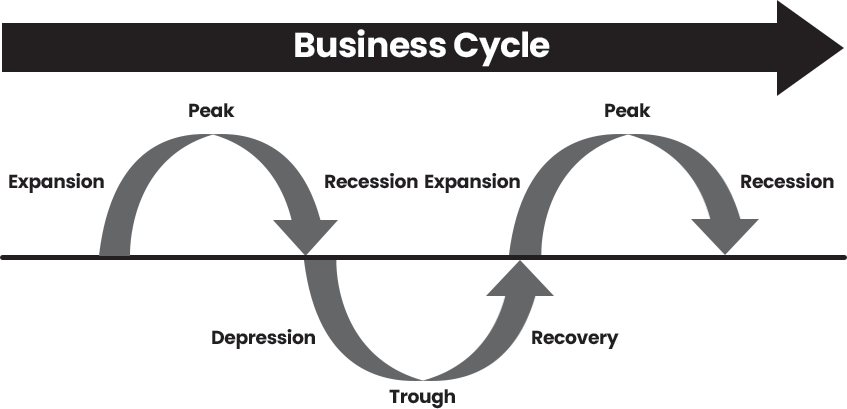
Components of Fiscal Policy
Expansionary Fiscal Policy
Measures used to boost demand and economic growth by reducing taxes or raising government spending are referred to as expansionary fiscal policy. In order to increase demand and encourage economic activity, these policies are generally used during periods of economic recession or slowdown. Following steps are taken:-
Increase government spending: On infrastructure, education, and defence. This can boost the economy’s demand and generate jobs.
Reduce taxes: To boost disposable income and promote spending, governments might lower taxes on individuals or corporations. This could increase demand and promote economic expansion.
Implement transfer payments: Transfer payments, like social security or unemployment benefits, which put money in the hands of those who are likely to spend it, is another way for governments to boost demand.
It is important to keep in mind that an expansionary fiscal policy may result in higher budget deficits since the government is spending more than it is bringing in through taxes. This could be a problem if the deficit grows too large since it could result in higher levels of government debt.
Contractionary Fiscal Policy
In order to lower demand and moderate the economy, methods known as contractionary fiscal policy involve raising taxes or cutting back on spending by the government. These measures are often employed to lower demand and prevent economic overheating during periods of inflation or economic boom.
Governments can adopt a contractionary fiscal policy in a number of ways:
Reduce government spending: Governments have the option of reducing their expenditures on a range of products and services, including infrastructure, training and defense. This might lower economic demand.
Tax increases: Governments can raise taxes on citizens or corporations to reduce disposable income and deter expenditure. This can lower demand and cause a slowdown in the economy.
Implement austerity measures: Governments can also enact
The policy’s elements are divided into
Government receipts
Government expenditures
Public account of India
Government Receipts
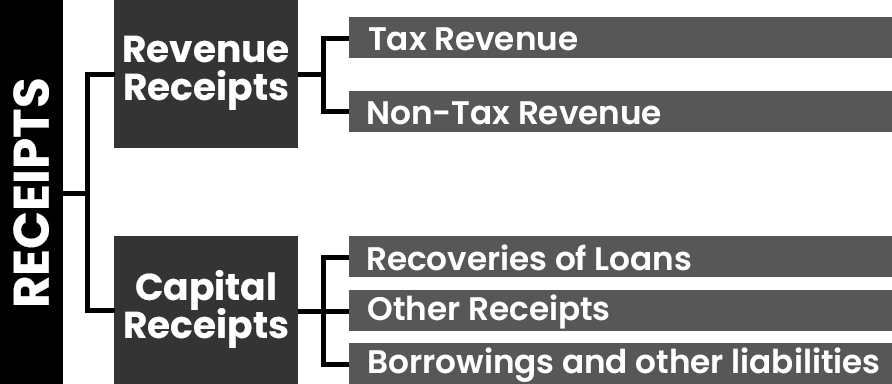
Government receipts are any funds received by the government in the form of interest, taxes, investment gains, and other payments for rendered services. This income enables them to invest in other industries. Capital receipts and Revenue receipts are the two categories into which the government’s receipts are divided.
• Capital Receipts: Capital receipts, unlike revenue receipts from daily operations, are one-time inflows that finance government spending. These can come from asset sales or raising debt, which creates a future liability for repayment. They are also referred to as incoming cash flows. As the governing bodies pay back the money and interest, all loans and borrowings are regarded as debt receipts.
• Revenue Receipts: Revenue receipts are those that neither increase assets nor decrease obligations. It is separated into tax and non-tax forms, respectively. The two main sources of tax revenue are direct and indirect taxes. Cess, interest, dividends on government investments and other receipts are included in the non-tax revenues.
Government Expenditures
The two categories of government spending are capital expenditures and revenue expenditures.
• Revenue Expenditures: Revenue expenditures are one- year, short-term spending. It includes the costs necessary to cover the government’s operating expenses. It also covers
routine maintenance and repairs, which are necessary to keep assets functional without extending their useful lives.
• Capital Expenditures: Capital expenditures are funds used by a government (or any entity) for acquiring, upgrading, or maintaining long-term assets with a lifespan exceeding
one year. These assets are not consumed immediately but contribute to future operations. Examples include buildings, machinery, infrastructure projects and software licenses
Structure of Government Accounts
The Accounts of the Government are kept in three parts:
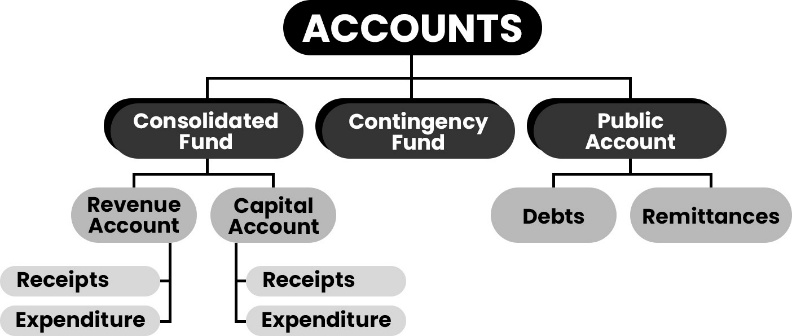
The Consolidated Fund
This fund consists of all state government revenues, all loans raised by the state government (bonds, loans from the Central Government, loans from financial institutions, Special Securities issued to the National Small Savings Fund, etc.), way and means advances from the Reserve Bank of India and all funds received by the state government as loan repayments.
No funds may be taken from this Fund other than in compliance with the law, for the purposes specified by the Indian Constitution, and in the manner stipulated by it. The Legislature does not have the authority to vote on certain types of expenditures, such as loan repayments and salaries of constitutional authorities, which are considered charged on the state’s consolidated fund. The Legislature votes on all other expenditures, often known as voted expenditures.
The Contingency Fund
The Contingency Fund of India is the country’s emergency fund, as its name implies.
It is utilised when the country faces a catastrophe (for example, natural disaster) and funds are needed to address it.
States may choose to establish their own emergency savings accounts. The President of India has access to the Union government’s contingency fund. He or she distributes fund upon request from the Union Cabinet, which then receives permission from Parliament.
The Public Account
Any additional public funds that the government receives or handles on its behalf—in cases where it serves as a trustee or bank—are credited to the public account.
Repayable items such as Small Savings and Provident Funds, Reserve Funds (with or without interest), Advances, Remittances, Suspense heads (both of which are transitory categories, pending final booking), and Deposits (bearing interest and not bearing interest) are all included in the Public Account.
Budget
Article 112 of the Indian Constitution mandates that the government should submit a financial statement to the Parliament - detailing its expected receipts and expenditures for each fiscal year, which begins on April 1 and ends on March 31. The primary government budget document is called “Annual Financial Statement.”
Objectives of Government Budget
Improving people’s welfare is a major responsibility of the government. The government uses the following methods of economic intervention to achieve that goal.
Allocation Function of Government Budget
Certain goods and services that are not available through the market mechanism that is, through direct trade between producers and individual consumers are supplied by the government. These goods are referred to as public goods
or things like government administration, highways, and national defence.
But public production and public provision are not the same thing. By public provision, we mean that they are funded by the government and are available for use without requiring a direct contribution. The private sector or the government may produce public goods. Public production is the term used to describe things that are directly produced by the government.
Redistribution Function of Government Budget
Personal income is the portion of private income that ultimately reaches households; it is often referred to as personal disposable income. Through tax collection and transfer, the government sector influences households’ personal discretionary income. By doing this, the government can alter the income distribution and establish what society views as a “fair” distribution and this is known as redistribution function.
Stabilisation Function of Government Budget
Aggregate Demand Management: The government manages overall economic activity (employment and prices) by influencing aggregate demand (total spending in the economy). Government does this with spending and taxation tools. During economic downturns (low demand, high unemployment), the government increases spending or lowers taxes to stimulate demand and economic recovery. Conversely, during inflationary periods (high demand), the government might raise taxes or decrease spending to cool down the economy.
TYPES OF BUDGETS
Balanced Budget
If the anticipated government spending for a certain fiscal year is equal to the forecast government receipts, the budget is considered balanced. Most classical economists back this type of budget as it is based on the virtue of “living within one’s means”. To put it simply, a balanced budget emphasises the idea that a government’s expenditure should never exceed their collected revenue. A balanced budget does not guarantee financial stability, even if it appears to be the best method for preserving financial discipline and achieving economic balance. This is especially true during times of deflation, recession, and economic depression.
Surplus Budget
If the government’s projected revenue for a given fiscal year is more than its actual expenditures, the budget that the government presents is deemed to be surplus. In essence, it indicates that the government has more money from taxes collected from residents than it does from spending on development and public welfare. Accordingly, a nation’s financial prosperity is indicated by a surplus budget. During times of inflation, the government usually implements a surplus budget because it lowers the nation’s aggregate demand.
Deficit Budget
When projected government spending exceeds anticipated revenue for a given fiscal year, the budget is considered to be in deficit. India is one of the developing economies that will benefit most from a deficit budget. A budget like this is especially helpful in recessions since it increases demand and accelerates the country’s economic growth. The government is largely responsible for the excessive spending that is incurred in a deficit budget in order to increase employment.
Major Reforms in Union Budget
Improved fiscal transparency and realistic revenue assumptions in the Budget: The Union Government raised above-the-line expenditures from below the line in an effort to increase openness in fiscal accounts and disclosures. From Rs 1.48 lakh crore in FY20 and Rs 1.21 lakh crore in FY21, the government’s extra-budgetary borrowings were reduced to Rs 750 crore in FY22 (RE). There were no estimates for Extra Budgetary Resources in the FY23 budget.
In addition to having clearer fiscal accounting, the previous year’s budget relied on reasonable assumptions for revenue predictions, giving the government a buffer against global uncertainty.
Discontinuation of Plan-Non Plan Classification: Plan and Non-Plan classifications of Government expenditure were discontinued in Budget FY18. The classification of government expenditures into revenue and capital was given more weight by the reform. The Economic Survey pointed out that a misconception that developed over time, that Plan expenditures were good and Non-Plan ones weren’t led to distorted budget allocations.
Merger of Railway Budget with the main Budget:
In 1924, the Railway Budget was separated from the General Budget, as per the recommendations of the Acworth Committee (1920-21). The Union Budget and the Railway Budget were combined in FY18 on the recommendations of a committee headed by Bibek Debroy, a member of NITI Aayog. This was done to provide a comprehensive picture of the government’s financial situation. The goal of the initiative was to make it easier to plan multimodal transportation between inland waterways, highways, and railroads. Gatishakti Programme has reportedly strengthened this in subsequent years.
Additionally, it assisted in increasing the Union Government’s and the Railways’ resources. Railways are not required to pay dividends to Government Revenues as a result of the merger, and the survey indicates that the Finance Ministry will have more flexibility in allocating resources during the mid-year review. It also allowed the Ministry of Finance to ensure there is a coherent emphasis on Capex across sectors in recent times.
Shifting the date of the Budget to February 1: The date of the Budget was shifted from Budget FY18 to February 1.
Advancing it by a month paved the way to complete the Budget cycle. Ministries can also now plan better and execute schemes from the start of the financial year.
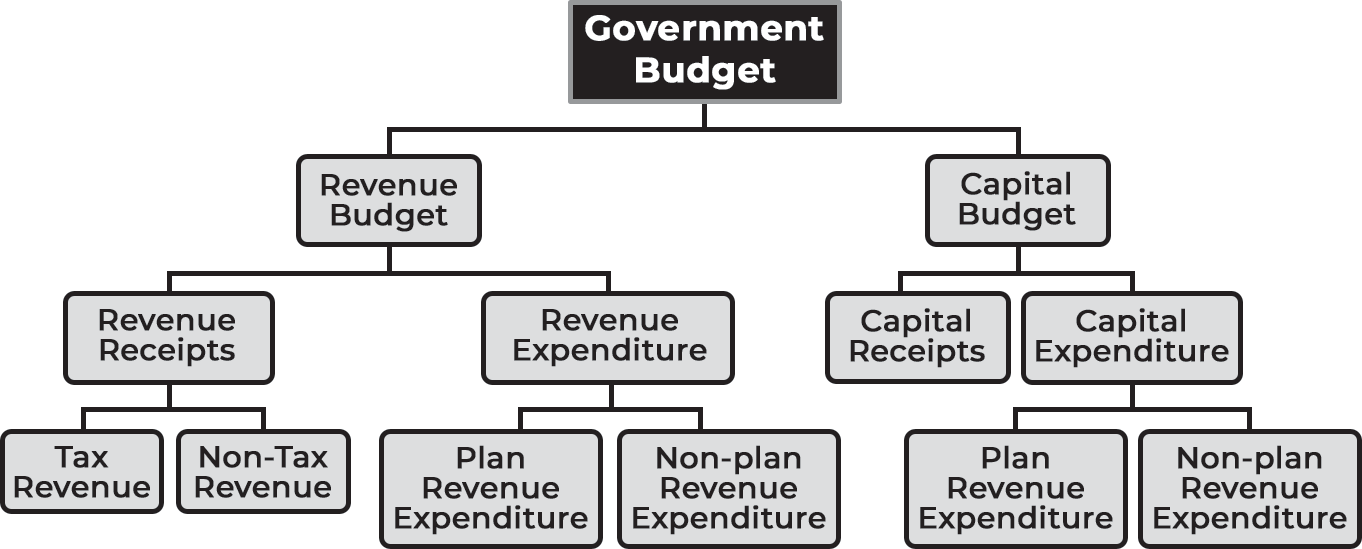
Components of the Government Budget
The impact of the budget document will persist into subsequent years even though it pertains to the government’s
receipts and expenditures for a specific fiscal year. As a result, two accounts are required: the revenue account, also known as the revenue budget, contains all of the information pertaining to the current fiscal year, while the capital account, also known as the capital budget, contains all of the information pertaining to the government’s assets and liabilities.
Taxation Reforms
TAXATION REFORMS
New Income Tax Slab under the New Tax Regime
(Applicable for FY 2025–26)
Income tax is a direct tax imposed on the income earned by individuals and entities during a financial year. Under the Union Budget framework applicable for FY 2025–26, individuals with annual income up to ₹7 lakh are not required to pay any income tax due to the rebate available under Section 87A. This exemption threshold remains higher than the earlier limit of ₹5 lakh.
The new tax regime continues as the default option for individuals and Hindu Undivided Families (HUFs), though taxpayers may opt for the old regime if they wish
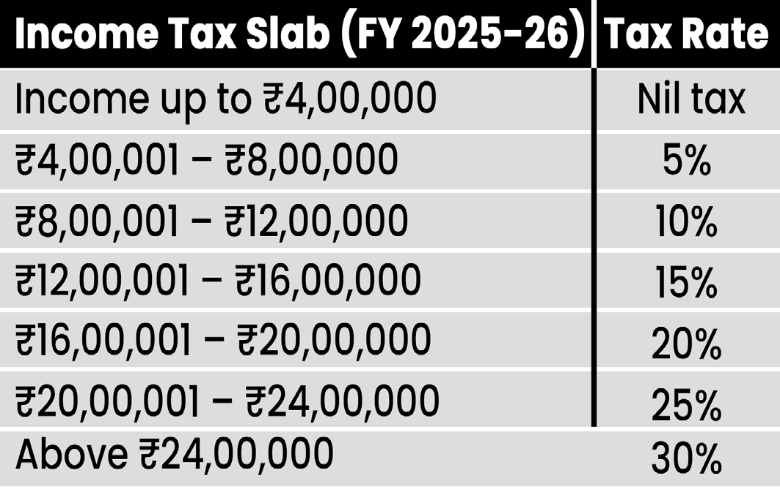
Major features of the New Income Tax Regime (FY 2025–26):
• Basic Exemption Limit: Income up to ₹3 lakh is exempt from tax.
• Tax Rebate: Full tax rebate available for taxable income up to ₹7 lakh under Section 87A.
• Revised Slab Structure: Lower and more evenly distributed tax rates across income slabs, with the highest rate of 30% applicable beyond ₹15 lakh.
• Standard Deduction: Salaried taxpayers and pensioners can claim a standard deduction of ₹50,000.
• Family Pension Deduction: Deduction allowed up to
₹15,000 on family pension income.
• Surcharge Rationalisation: Maximum surcharge capped at 25% for high-income earners.
• Default Regime: The new tax regime is applied automatically unless the taxpayer chooses otherwise.
Compared to the old regime, the new regime offers lower tax rates and simpler compliance, but most exemptions and deductions are not available.
Measures for Simplification of Direct Taxes:
• Lower Corporate Tax Rates: 22% for existing companies and 15% for new manufacturing units to promote investment.
• Reduced MAT Rate: Minimum Alternate Tax lowered to 15%.
• Abolition of Dividend Distribution Tax: Dividend income taxed only in the hands of shareholders.
• Faceless E-Assessment and Appeals: Minimises human interface and enhances transparency.
• Document Identification Number (DIN): Ensures traceable and transparent communication.
• Pre-filled Income Tax Returns: Facilitates easier and faster return filing.
Vivad se Vishwas Scheme – Aims to settle long standing and pending tax disputes under the Direct Tax Vivad se Vishwas Act, 2020 (“DTVsV Act”)
Raising of monetary limit for filing of appeal: Increased Appeal Limits: Higher monetary thresholds for filing appeals at various levels.
Restrictions on Repetitive Appeals: In the event that an assessee’s legal question is the same as one that is currently under appeal before the jurisdictional High Court or the Supreme Court in any case, the assessee’s right to file a further appeal with the Appellate Tribunal or the jurisdictional High Court will be postponed until the relevant Court has resolved the legal question, subject to certain limitations.
GST Reforms 2025
Now there are two-slab structure (5% & 18%) containing the four older slabs of 5%, 12%, 18% and 28%.
Various goods which are injurious to health, are provided in the special slab of 40%. This is done to discourage the people for their consumption and utilisation. These are Tobacco, pan masala, aerated drinks, and luxury goods
Income-tax Act 2025
Effective from April 1, 2026
Operational authority - The Central Board of Direct Taxes (CBDT)
Replace – Older Income-tax Act, 1961
Income-tax Act, 1961 was older and did not meet the requirements of the contemporary time as it faced more than 4000 amendments which requires lot of time and money every time. So, to simplify this procedure and to meet the demand of time and the requirements of future such as cryptocurrencies the new income tax was enacted in 2025.
Key Features of Income Tax Act, 2025
Now the word ‘tax year’ includes in place of ‘Assessment Year’ and ‘Previous Year.
Incorporate the concept of Virtual Digital Assets to meet digital technology like cryptocurrencies and Virtual Digital Space to maintain the accountability for the better management of taxation.
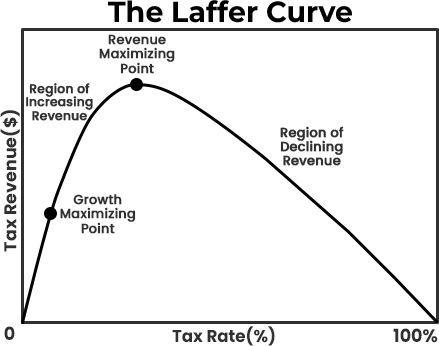
Laffer Curve
The Laffer Curve is a graph depicting the relationship between tax rates and government revenue. It suggests an “ideal” tax rate that maximizes government income.
Key Points
Created by economist Arthur Laffer, it proposes that very high or very low tax rates lead to low revenue.
At 0% tax, there’s no income. At 100% tax, people have no incentive to work.
The curve rises with increasing tax rates until reaching a peak (optimal tax rate) and then falls.
Significance
Influenced supply-side economics and tax cuts under President Reagan in the US.
Lower taxes can stimulate the economy by increasing consumer spending.
India’s income tax rate reductions aim to achieve similar results to boost spending and aggregate demand in the economy.
lowering tax rates would lessen the incentive to invest in tax havens and promote saving and capital formation.
Limitations
• Effectiveness depends on worker responsiveness to tax incentives.
• Lower rates might not encourage work for everyone (fixed contracts, high earners).
• Reduced tax revenue could impact government programs and lead to borrowings for funding them.
• Reduced tax rates have the potential to increase income disparity.
Tax Buoyancy & Elasticity
Tax buoyancy measures how responsive government tax revenue is to changes in GDP. A buoyant tax sees revenue rise even without increasing tax rates.
Factors Affecting Buoyancy
Tax base size: A larger base (e.g., more taxpayers) generates more revenue with GDP growth.
Tax administration: Efficient collection processes improve buoyancy.
Tax structure: Simple and logical tax rates are easier to administer and collect.
Tax elasticity focuses on how tax revenue reacts solely to changes in tax rates. For example, if the corporate tax rate drops from 30% to 25%, this is a test of tax elasticity.
Key Difference
Tax elasticity considers the automatic response of revenues to changes in income when the tax structure remains unchanged.
Tax buoyancy, on the other hand, takes into account both income and discretionary changes in revenue earnings. It considers both automatic (GDP changes) and discretionary (tax rate changes) factors impacting revenue.
Windfall Tax
A windfall tax is a temporary, one-off tax levied by the government on specific industries experiencing exceptionally high profits due to unforeseen external factors, not necessarily due to their own business strategies or actions.
The oil industry is a prime candidate for windfall taxes. Global events like geopolitical tensions, supply chain disruptions, or natural disasters can cause a sudden surge in oil prices. These price hikes lead to significant profit increases for oil companies, even with constant production levels.
The rationale for imposing a windfall tax is as follows:
Redistribution of unexpected profits, when high prices benefit producers at the expense of consumers
Funding of social welfare systems
Sin Tax
Goods that are viewed as detrimental to society are known as sin goods. Sin goods include things like candy, drugs, alcohol and tobacco, soft drinks, fast food, coffee, sugar, gambling, and so on. The term “Sin Tax” refers to government taxes imposed on sinful goods. Products and services that are deemed to be harmful to society are subject to a sin tax. Thus, products that are subject to a sin tax include cigarettes, alcohol, tobacco, and gambling-related items
Supplementary revenue source for the government
Method for the government to reduce the country’s growing trade imbalance
Tax-GDP Ratio
It is used to assess how effectively the government manages a country’s economic resources. The tax-to-GDP ratio compares the size of a country’s tax revenue to its GDP. The higher the tax-to-GDP ratio, the stronger the country’s financial position. The ratio represents the government’s ability to
cover its expenses It helps a government reduce its reliance on borrowing. According to the World Bank, tax revenues exceeding 15% of a country’s GDP are a critical component of economic growth and poverty reduction.
A decrease in the tax-to-GDP ratio indicates slower economic growth rates. This is because when the economy is growing, tax revenues tend to increase as a result of higher incomes and consumption. Therefore, a decrease in tax to GDP ratio can be an early warning sign of slowing economic growth rates. However, a lower tax-to-GDP ratio does not necessarily imply a less equitable distribution of national income. This is because the tax system can be designed to be more or less progressive, regardless of the amount of tax revenue collected. For example, a country with a lower tax- to-GDP ratio may have a more progressive tax system that more effectively redistributes income than one with a higher tax-to-GDP ratio.
Non-Tax Revenue
Non-Tax Revenue refers to the government’s recurring income from sources other than taxes.
The most significant receipts under this category are interest receipts (received on loans made by the government to states, railways, and others) as well as dividends and profits received from public sector companies.
Non-Tax Revenue refers to the government’s recurring income from sources other than taxes. They are revenue receipts that do not come from taxing the public.
Some of the major sources of non-tax revenue are listed
below.
The government receives interest from loans made to state governments, UTs, private enterprises, and the general public, which is an important source of non-tax revenue.
• Power Supply Fees: This includes fees collected by any nation’s central power authority. In India, this includes fees collected by the Central Electricity Authority.
• Fees are charges imposed by the government to cover the cost of recurring services. It is a compulsory contribution, similar to a tax.
• License Fee: A type of tax levied by the government and its affiliated entities for engaging in an activity, such as opening a restaurant or operating a heavy vehicle.
• Fines and Penalties: Fines are most commonly used in criminal law, where a court will impose a fine on a person who has been convicted of a crime. Penalty is used in both civil and criminal law. It covers both monetary and physical punishment.
• Escheats are the transfers of estate assets or property to the government that occur when an individual dies without leaving a legally binding bill or legal heirs.
• The government receives several grants from international organisations and foreign governments. Such grants
are not a consistent source of revenue and are typically received during a national crisis such as war, flood, etc.
Forfeiture is the loss of property without compensation as a result of failing to meet contractual obligations or as a penalty for illegal conduct. According to the terms of a contract, forfeiture refers to the defaulting party’s obligation to give up ownership of an asset or cash flows from an asset in exchange for the other party’s resulting losses.
Interests: It includes the interest on loans and insurance provided to the government for both non-plan and planned schemes, as well as interest on loans advanced to Public Sector Enterprises or other statutory bodies.
Fees for Communication Services: This primarily includes license fees from telecom operators for spectrum usage charges licensed Telecom.
Capital Budget
The Union Budget comprises both Revenue and Capital Budgets. The Capital Budget focuses on long-term investments and is financed by Capital Receipts.
Capital Receipts
Inflows of cash used for government investments.
Include debt (loans) from public, foreign sources, and RBI.
Also include non-debt receipts like recoveries of loans given by the central government and disinvestment proceeds (sale of PSU assets).
Recorded on the receipts side of the government’s balance sheet.
Capital receipts themselves are not taxable, but the interest earned on some instruments might be.
Debt vs. Non-Debt Capital Receipts
Debt creates a liability (obligation to repay). E.g. Market borrowings, treasury bills.
Non-debt receipts do not create future repayment burdens.
E.g. Loan recoveries, PSU disinvestment proceeds.
Disinvestment in India
Disinvestment refers to the sale or liquidation of assets by the government, typically central and state public sector enterprises, projects, or other fixed assets.
The Department of Investment and Public Asset Management (DIPAM) handles disinvestment.
Annual disinvestment targets are set in the Union Budget. The government makes the final decision on whether to increase the divestment target or not.
Main objectives of Disinvestment in India:
Reducing the fiscal burden on the exchequer.
Encourages private ownership.
Funding growth and development initiatives.
Maintaining and promoting market competition.
Potential for long-term growth in the country and the ability for the government and even businesses to reduce debt.
Disinvestment allows for a greater share of PSU ownership in the open market, which promotes the development of India’s capital markets.
Are disinvestment and privatisation related?
Disinvestment can be partial, with the government retaining 51% control of the company. However, when the government sells the majority stake or entire enterprise to a private sector owner it is called privatisation.
Methods of Disinvestment of CPSEs
• An initial public offering (IPO) is the first time an unlisted CPSE or the government offers shares to the public for subscription from its shareholding or a combination of both.
• A Further Public Offering (FPO) is an offer of shares to the public for subscription by a listed CPSE or the government from its shareholding, or a combination of the two.
• Offer for sale (OFS) of shares by Promoters via the Stock Exchange mechanism - method that allows for the auction of shares on the Stock Exchange’s platform; extensively used by the government since 2012.
• Strategic sale- the sale of a substantial portion of the government’s shareholding in a central public sector enterprise (CPSE) of up to 50%, or a higher percentage as determined by the competent authority, along with the transfer of management control.
Institutional Placement Program (IPP)- This offering is only open to institutions.
CPSE Exchange Traded Fund (ETF)- Disinvestment via ETF allows the government to sell its stake in multiple CPSEs across various sectors in a single offering.
Revenue Expenditure
Revenue expenditure is defined as spending incurred for purposes other than the creation of physical or financial assets for the central government.
It refers to expenses incurred for the normal operation of government departments and services, interest payments on government debt, and grants given to state governments and other parties (even if some of the grants are intended to create assets).
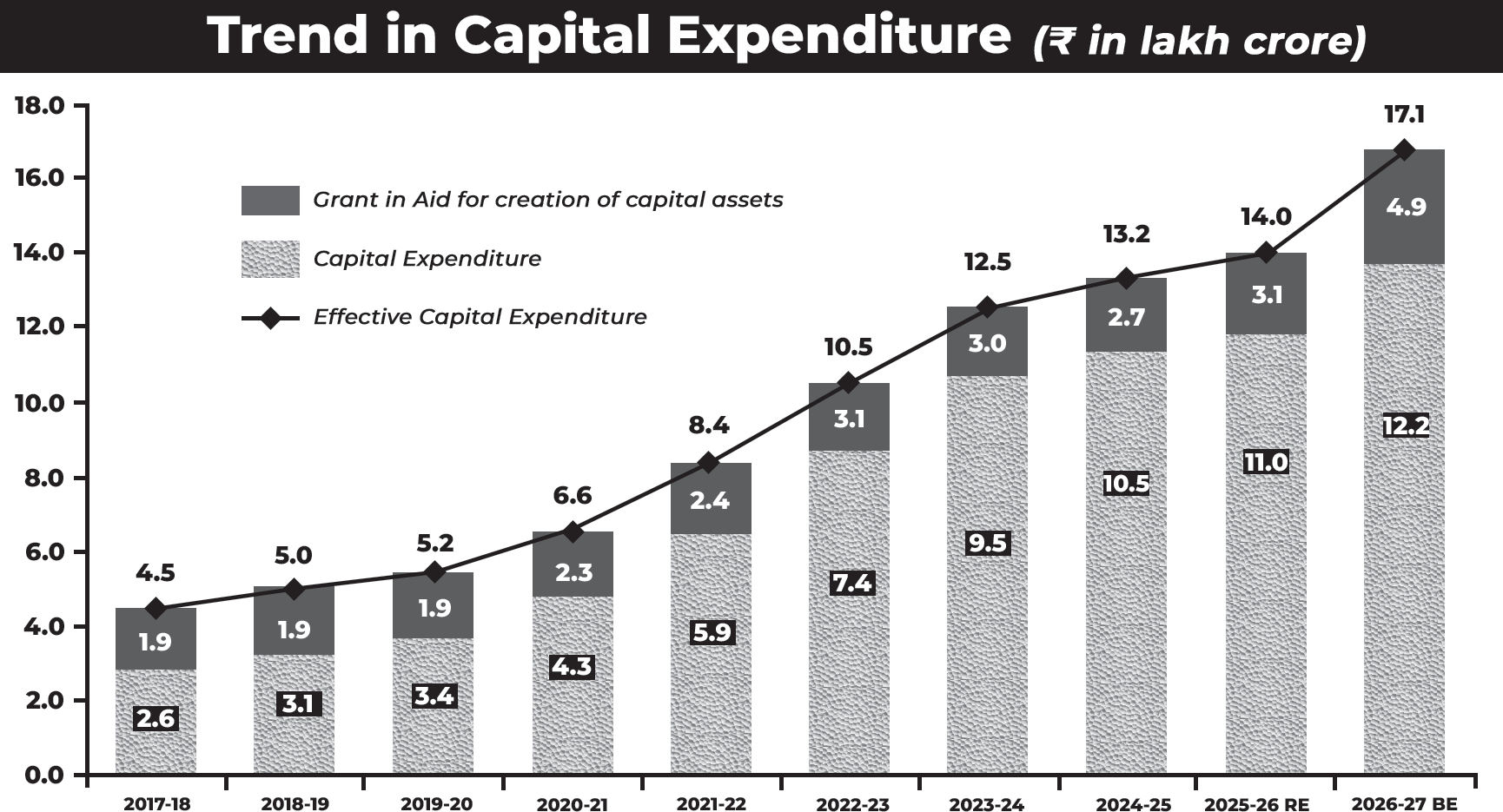
Capital Expenditure
The government’s expenditures result in the creation of physical or financial assets, as well as the reduction of financial liabilities.
This includes expenditures for the acquisition of land, buildings, machinery, and equipment, share investments, and loans and advances made by the central government to state and union territory governments, PSUs, and others.
The budget documents also divide capital expenditure into two categories: planned and unplanned/non planned. Plan capital expenditure, like revenue expenditure, refers to the central plan and central assistance for state and union territory plans. Non-plan capital expenditure includes a variety of general, social, and economic services provided by the government.
Non-Plan Expenditure
This primarily represents the government’s revenue expenditure, but it also includes capital expenditure. It covers all expenses not included in the Plan Expenditure.
Non-plan Expenditure refers to spending on programs other than those outlined in a country’s current five-year strategic plan. For example, expenditures on defense services, interest payments, administrative expenses, and so on.
Non-Plan Expenditure accounts for the largest proportion of the government’s total expenditure.
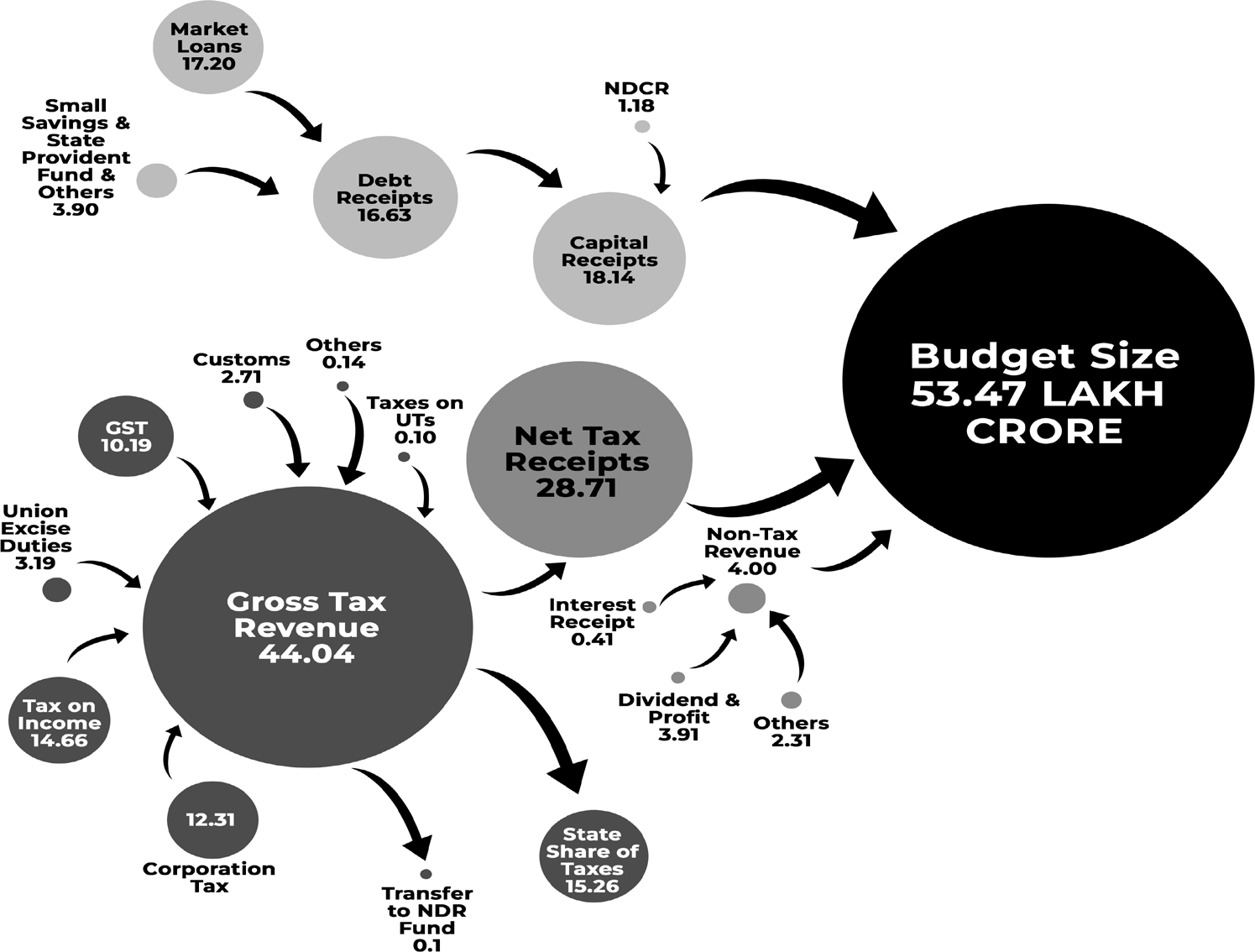
Review of Government’s Budget for Financial Year 2026-27: Receipts of Government in FY 26-27 Budget (In Rs. lakh crore)

Measures of Government Deficit
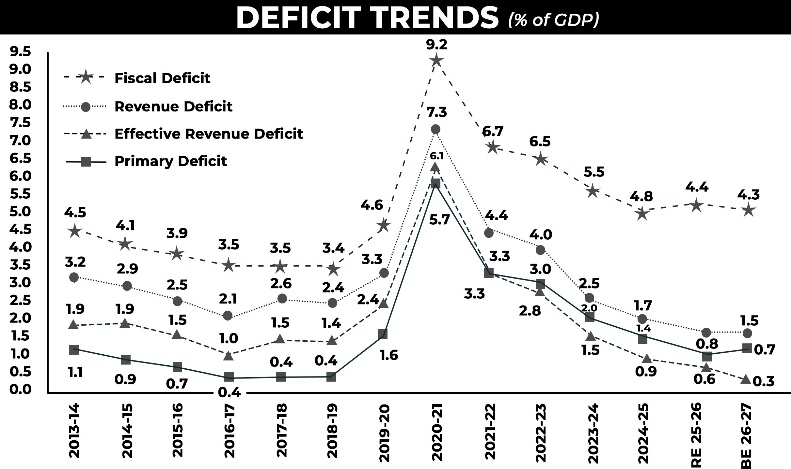
A budget deficit occurs when the government spends more money than it receives in revenue. There are various measures for capturing the government deficit, each with its own economic implications.
The Finance Minister said that the projected fiscal deficit for the fiscal year 2025-26 stands at 4.4% of the GDP.
The government maintains its dedication to fiscal consolidation, aiming to bring down the fiscal deficit to under 4.3% by the fiscal year 2026-27
Revenue Deficit
The revenue deficit indicates the gap between the government’s current income (revenue receipts) and its current spending (revenue expenditure). It’s calculated as revenue expenditure minus revenue receipts. This deficit arises when the government spends more on day-to-day operations like salaries and subsidies than it collects through taxes and other regular income sources.
Impact of Revenue Deficit: A revenue deficit forces the government to borrow money not just for investments but also to meet its basic needs. This increases the national debt and future interest payments, potentially leading to cuts in government spending in the long run. Since essential expenses like salaries are difficult to reduce, cuts often fall on crucial areas like infrastructure development or social welfare programs, hindering economic growth and impacting public well-being.
The effective revenue deficit takes the standard formula a step further by excluding grants-in-aid for capital assets from revenue receipts. These grants are meant for creating new assets, not covering current expenses.
Fiscal Deficit
The fiscal deficit is the difference between the government’s total expenditures and total receipts, excluding borrowing.
Non-debt creating capital receipts are those that are not borrowings and thus do not generate debt. Examples include loan recovery and proceeds from the sale of public-sector undertakings.
The fiscal deficit will have to be financed by borrowing. Thus, it represents the government’s total borrowing requirements from all sources.
Net borrowing at home includes both direct borrowing from the public through debt instruments (such as various small savings schemes) and indirect borrowing from commercial banks via the Statutory Liquidity Ratio (SLR).
It is evident from the above method of measuring gross fiscal deficit that revenue deficit contributes to fiscal deficit.
A large revenue deficit within the fiscal deficit indicates that a significant portion of government borrowing is used to cover daily expenses rather than investments in future growth.
Primary Deficit
The primary deficit is a further refinement of the fiscal deficit. It’s calculated as fiscal deficit minus interest payments on prior borrowings. This deficit reflects the government’s borrowing needs to meet its current spending excluding the burden of interest payments on past debts. By analyzing the primary deficit, we can understand the government’s new borrowing requirements specifically for new expenditures.
Measures to Reduce Government Deficit
Strengthening Tax Collection
Increased emphasis on tax revenues and appropriate measures to combat tax evasion. A broader tax base could also help to reduce the government deficit.
Strategic Disinvestment
Sell off government-owned assets that are underperforming or not core to public functions. This generates one-time revenue and reduces ongoing maintenance costs.
Subsidy Rationalization
A reduction in government subsidies will also help to reduce the deficit.
Budget Discipline
Try to avoid unplanned expenses. Enhance government spending efficiency through better program planning and administration to reduce unnecessary costs.
Deficit financing
Deficit financing is a strategy employed by governments to bridge the gap between their expenditures and revenue. When spending exceeds income (revenue receipts), a deficit arises. Deficit financing involves measures to generate funds and cover this shortfall.
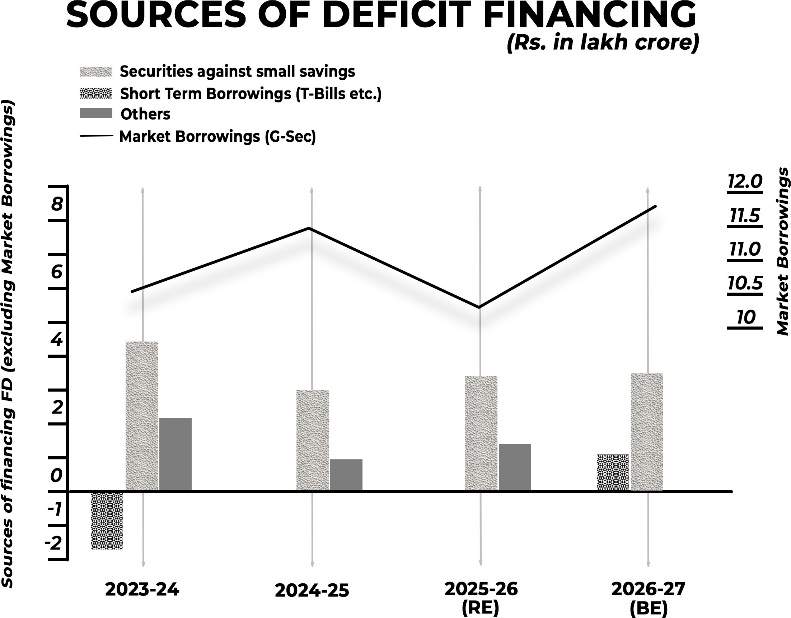
Methods of Deficit Financing
Borrowing from the Central Bank: The government can borrow from the Reserve Bank of India (RBI) through the issuance of new currency. This increases the money supply in circulation. However, this has been prohibited under the FRBM Act.
Bond Issuance: The government can sell bonds to the public, essentially borrowing money from domestic investors.
Withdrawing Cash Balances: The government might utilize its existing cash reserves held with the RBI to finance deficits temporarily.
Economic Effects of Deficit Financing
Inflation: Increased money supply through deficit financing can lead to inflation, particularly if the additional funds are not used productively. However, if developmental expenditures are made, deficit financing may not be inflationary, despite the fact that it increases the money supply.
Capital Formation and Economic Development: It can be a tool for stimulating economic development by funding crucial infrastructure projects or social programs.
Income Distribution: Deficit financing can potentially widen the income gap if the additional purchasing power it creates benefits only certain segments of society. However, if the funds are directed towards social welfare programs or public goods, it can contribute to a more equitable distribution of income.
Debt
The concepts of deficits and debt are closely related. Deficits can be thought of as a flow that increases the stock of debt. If the government continues to borrow year after year, it accumulates debt and must pay increasing amounts in interest. These interest payments add to the debt.
Intergenerational Equity Issues: By borrowing, the government shifts the burden of reduced consumption to future generations. This is because it borrows by issuing bonds to current residents, but may decide to repay the bonds twenty years later by raising taxes. These may be levied on the young population that has recently entered the labor force, whose disposable income and thus consumption will decrease. As a result, national savings may fall. Debt acts as a ‘burden’ on future generations in the sense that it reduces capital formation and growth.
• Affecting Private Sector Funds: Furthermore, government borrowing from the people reduces the private sector’s ability to raise funds. As a result, some private borrowers will be ‘crowded out’ of the financial markets as the government claims an increasing share of the economy’s total savings.
• Using Debt Wisely: However, it is important to note that the economy’s flow of savings is not fixed unless we assume that income cannot be increased. If government deficits achieve their goal of increasing output, there will be more income and, thus, more savings. In this case, both the government and industry may borrow more.
What is Public Debt?
Public debt is defined as a debt incurred by the government from its citizens or foreign countries. The government can collect debts from a variety of sources, including banks, financial institutions, business entities, and foreign banks. The government incurs public debt for a variety of reasons, including insufficient revenue to cover expenditures on various public-related facilities and projects. The government can borrow money in the short, medium, or long term. Short- term debts are typically in the form of treasury bills or bonds, and the government is required to pay interest at a specified interest rate on a regular basis, as well as a lump sum amount at the end of the specified period.
Internal Debt
Internal Debt: This type of debt is obtained by the nation from its citizens, financial institutions, or other sources. Taking internal debt can be voluntary or forced. Internal debts are controllable and can be estimated easily. The sources of internal debt include domestic financial institutions such as commercial banks, etc. The interest rate for such internal debt is also less as compared to external debt. However, these debts do not increase the country’s total available resources. For example, the Government wants to start a new small infrastructure-related project. For this government takes a loan that is public debt from the country’s National Bank for a certain amount of time.
External Debt
External Debt: External Debt is the term for debt that a nation incurs when it borrows money from other nations. These debts are taken from international banks or financial institutions in other countries. When a huge investment or loan is required that cannot be provided within the country then the government goes for external debt. The interest rate on such debts is quite high, making it a less suitable source of borrowing money than internal debt. Besides, external debt can also pose a threat to the country’s economic and political independence.
What is Private Debt?
Private debt refers to loans or credit extended by private entities like banks and firms, not governments. It finances individuals and businesses through various forms like personal loans, business loans, and corporate bonds.
Creditors often require collateral (an asset used as security) to mitigate risk. Late payments or defaults on private debt can incur high charges and penalties.
Fiscal Responsibility and Budget Management Act, 2003 (FRBMA)
The Fiscal Responsibility and Budget Management (FRBM) Act came into being in 2003 to maintain fiscal discipline and promote transparency in India’s government spending. It aimed to address issues like high fiscal deficits, growing debt burdens, and lack of transparency. The Act mandated limits on fiscal deficit and debt levels to promote responsible fiscal management.
Main Features
Ban Debt Monetisation: The purchase of government bonds by the RBI was stopped from April 1, 2006, no more allowing government to borrow directly from the RBI thereby stopping monetisation of deficit.
Deficit and Debt Reduction & Elimination Targets: They are revised from time to time and the latest include
By March 31st, 2021, the government needs to limit the fiscal deficit to 3% of the GDP.
By the financial year 2024-25, the central government is mandated to cap its debt at 40% of the GDP.
Three Policy Statements: The central government is required to present three statements along with the Budget before both Houses of Parliament
The Medium-term Fiscal Policy Statement: It establishes targets for fiscal indicators over a three-year period and assesses whether revenue expenses can be sustained by revenue receipts, as well as the effective utilization of capital receipts.
The Fiscal Policy Strategy Statement: Outlines the government’s fiscal priorities, evaluates current policies, and provides rationale for any deviations in significant fiscal measures.
The Macroeconomic Framework Statement: Evaluates the economy’s prospects, including GDP growth, central government fiscal balance, and external balance.
• Quarterly Review: A quarterly review of budgetary receipts and expenditure trends will be presented to both Houses of Parliament.
• Disclosure of Contingent Liabilities and Off-Budget Transactions: To enhance transparency in fiscal reporting, ensuring comprehensive disclosure of government financial obligations.
• Escape Clauses: The FRBM Act includes clauses that allow for exceptions and escape routes during extraordinary situations, such as national security and natural disasters.
• Application to State Governments: The act applies to the central government. However, 26 states have already enacted fiscal responsibility legislation, broadening the government’s rule-based fiscal reform programme
NK Singh Review Committee Recommendations, 2016
• Revise Targets: The committee found that the fiscal deficit targets in the FRBM Act were too strict, given the requirement for flexibility in adapting to changing economic circumstances. It proposed following:
• The committee proposed aiming for a fiscal deficit of 3% of the Gross Domestic Product (GDP) until March 31, 2020 and afterwards an annual reduction target of 0.3% of GDP.
• The committee proposed targeting a debt-to-GDP ratio of 60%, with 40% allocated for the central government and 20% for the states.
• The committee suggested lowering the revenue deficit to 0.8% of GDP by March 31, 2023, with a yearly reduction target of 0.5% of GDP.
• Targeting Debt: Until now, the focus of the act has mainly been on targeting fiscal deficit. However, the Committee proposed shifting the primary target for fiscal policy to debt. They recommended setting a target debt-to-GDP ratio of 60%, with 40% allocated to the central government and 20% for all states combined.
• Escape Clause: It grants the central government leeway to adjust fiscal deficit targets under exceptional circumstances, upon advice from the Fiscal Council. However, the deviation must not exceed more that 0.5% of the GDP in that year. These exceptions include
• National security concerns, war, natural disasters, or agricultural crises affecting output and incomes,
• Structural reforms in the economy with fiscal implications, or
• A decline in real output growth of at least 3% compared to the previous four quarters’ average.
Amendments to the FRBM Act
In the year 2012 and 2015, notable changes were introduced to the FRBM Act, resulting in an extension of target realization years.
Introduction of Effective Revenue Deficit (E.R.D): Effective Revenue Deficit (E.R.D) is the difference between revenue expenditure and revenue receipts, excluding grants for creation of capital assets.
Inclusion of Medium-Term Expenditure Framework Statement: The MTEF aims to improve integration between the budget and the FRBM Statements. It is presented separately in the session immediately following the presentation of the Budget, which is typically held during the Monsoon Session.
Finance Commission of India
Article 280 provides for the constitution of Finance Commission. It is constituted every fifth year or as deemed necessary by the President. Comprising a Chairman and four members whose qualifications are outlined by the Parliament. Its functions include advising the President on financial matters which are given to it in its terms of reference. The recommendations made by the Finance Commission are considered as advice and are not binding on the Central Government. The first Finance Commission was established on November 22, 1951, with K.C. Niyogi as chairman. The Government of India has constituted the Sixteenth Finance Commission with Shri Arvind Panagariya as the Chairman in December 2023.
Functions of Finance Commission
It is tasked with advising the President of India on several matters like
Division of taxes between Centre and States and manner of allocation of share of States
Principles governing grants-in-aid from the Centre to the States from the Consolidated funds of India
Measure to boost Consolidated Funds of a State, supporting local panchayats and municipalities based on the recommendations made by State Finance Commission (added by the 73rd and 74th Constitutional Amendment: this amendment also granted constitutional status and protection to the panchayats and the municipalities)
Deciding whether to keep or change the terms of an agreement between the government of India and a specific state in Part B of First Schedule under Article 278 or Article 306.
Any other financial matters which are referred to by the President.
State Finance Commissions: Are Established by state governors to review Panchayat finances (Article 243(1).
Recommendation of 16th finance commission:
Chaired by Arvind Panagariya, has submitted its report for the award period 2026-31.
• Tax Devolution:
• Vertical Devolution: This is the percentage of the Central Government's Divisible Pool of taxes that is given to the States.
• Under 16th FC, states’ share in the divisible pool of central taxes was retained at 41%, unchanged from the 15th Finance Commission.
• Horizontal Devolution: This is the formula used to decide exactly how many rupees each state gets from that 41% pot.
• The 16th FC has introduced a major shift toward rewarding economic performance.
| Criteria for distribution of central taxes among states | ||
| Criteria | 15th FC (2021-26) | 16th FC (2026-31) |
| Income Distance | 45% | 42.5% |
| Population (2011) | 15% | 17.5% |
| Demographic Performance | 12.5% | 10% |
| Area | 15% | 10% |
| Forest | 10% | 10% |
| Tax and Fiscal Efforts | 2.5% | - |
| Contributionto GDP | - | 10% |
| Total | 100% | 100% |
Grants-in-aid under 16th FC
| Grants-in-aid for 2026-31 (in Rs crore) | |
| Grants | Amount |
| Local governments | 7,91,493 |
| Rural local bodies | 4,35,236 |
| Basic Grant | 3,48,188 |
| Performance Grant | 87,048 |
| Urban local bodies | 3,56,257 |
| Basic Grant | 2,32,125 |
| Performance Grant | 58,032 |
| SpecialInfrastructure Component | 56,100 |
| Urbanisation Premium | 10,000 |
| Disaster management | 1,55,916 |
| Total | 9,47,409 |
Modernisation Fund for Defence and Internal Security (MFDIS): Was recommended as a non-lapsable dedicated fund necessary to defend India in the times of rising cybercrime.
• Performance Incentives: Grants to be allocated to States based on achieving certain benchmarks by States in various welfare programmes like
Developing online and professional courses in regional language.
Undertaking agricultural reforms.
Aligning land laws with the NITI Aayog model law.
Growth in agricultural exports.
Maintenance of roads under Pradhan Mantri Gramin Sadak Yojana.
Power Sector Reforms
POWER SECTOR REFORMS
Subsidies
What Is a Government Subsidy?
Government subsidies are financial grants made by the government to private institutions or other public entities to stimulate economic activity or promote activities that benefit the public good. Subsidies frequently go toward
Achievement of social policy goals such as income distribution and population control, etc.
Wage subsidies for industries with high labor costs can increase employment.
Increasing consumption and/or output.
Balancing out market flaws, including absorption of externalities (costs or benefits not reflected in market prices).
Different Types of Subsidies
Subsidies come in a variety of forms, but they can be broadly classified as follows
Export Subsidies: Financial assistance to businesses to encourage exporting goods. The government compensates exporters after successful international sales, potentially aiming to boost a trade surplus or reduce a deficit.
Agricultural Subsidies: Government support for agricultural production and sales activities. This can involve providing public goods like roads, storage facilities, or irrigation infrastructure (canals, wells) at below-market costs or free of charge. The rationale is that these infrastructure investments benefit all farmers in an area but wouldn’t be undertaken by individual farmers due to their size and public good nature.
Housing subsidies: Housing subsidies help give citizens the opportunity to own homes.
Interest Rate Subsidies: Tax deductions for mortgage interest payments.
Down Payment Assistance: Financial aid to help with initial home purchase costs for low-income.
Consumption subsidy: This occurs when the government subsidises the costs of food, education, healthcare, and water.
Employment subsidy: The government provides this incentive to businesses and organizations so that they can create more job opportunities.
• Production subsidy: This type of subsidy is intended to encourage the production of a product. In order for manufacturers to increase their production output, the government compensates for some of their components, lowering their costs while increasing output. As a result, production and consumption increase, but the price remains constant. The disadvantage of such an incentive is that it may promote excess production.
Effects of Subsidies
• Locative effects: These have to do with how resources are distributed by sector. Subsidies encourage the allocation of greater resources to the subsidized industry.
• Redistributive effects: These are generally determined by the elasticities of the relevant groups’ desires for the subsidized commodity, the elasticities of supply of the same good, and the method of subsidy administration.
• Fiscal effects: Because a large portion of subsidies come from the budget, they undoubtedly have an impact on the economy. Fiscal deficits are immediately widened. Subsidies may have an indirect negative impact on the budget by diverting funds from tax-producing industries to those with low tax generation potential.
• Trade effects: A fixed price that is markedly less expensive than the market clearing price might decrease domestic production while increasing imports. However, subsidies to domestic manufacturers may allow them to provide prices that are competitive internationally, either lowering imports or increasing exports.
Advantages of Subsidies
• Price Control and Inflation Reduction: Subsidies on production inputs (e.g., fuel) can help manage inflation, especially when global prices rise.
• Industry Protection: Subsidies can support critical sectors (like agriculture and fisheries) or nascent industries.
• Increased Supply of Goods: Governments use subsidies (e.g., tax credits) to encourage production of essential goods and services with positive externalities (benefits beyond the direct transaction), making them more accessible to citizens.
Disadvantages of Subsidies
• Supply Shortages: Subsidies can lead to increased demand that outpaces production, resulting in shortages and potentially higher prices.
• Difficulty Measuring Success: Quantifying the effectiv- eness of subsidies can be challenging.
• Increased Tax Burden: Government funding for subsidies often comes from higher taxes, essentially transferring resources from taxpayers to subsidized industries.
Direct Benefit Transfer (DBT)
Launched in 2013 to reform government service delivery
and improve welfare program efficiency, DBT Mission aims to achieve accurate targeting, de-duplication of beneficiaries, and reduced fraud. It is over seen by the Cabinet Secretariat.
Categories of schemes covered under DBT
The scope of DBT includes all welfare/subsidy schemes operated directly or indirectly by all Ministries/Departments of the Government of India that involve cash or in-kind benefits transfers to individuals. Therefore, the following types of schemes are included in the DBT’s scope.
Cash Transfer- Cash Transfer to Individual Beneficiary: This category covers programs or parts of programs in which the government transfers cash benefits to specific recipients. For instance, NSAP, MGNREGA, PAHAL, etc.
In-kind- It is Transfer from Government to Individual Beneficiary: Government provided goods or services delivered through intermediaries. These products or services are provided to specific beneficiaries at no cost or at a discounted rate.
For instance, Food Corporation of India (FCI) is the government agent in charge of acquiring, transporting, storing, and distributing food grains to Fair Price Shops under the Public Distribution System (PDS).
Other Transfers: Transfers to various non-governmental organizations that support a variety of government initiatives up to the final mile. Example: Teachers in assisted schools, sanitation workers in ULBs, ASHA employees under NHM, Aanganwadi workers under ICDS, and so on, are not beneficiaries in and of themselves; instead, they receive compensation, benefits, and training for their services to the beneficiaries and community.
Key Enablers for DBT
The following would be the main success factors or facilitators for an effective DBT implementation:
JAM Trinity- By utilizing the JAM (Jan Dhan, Aadhaar, and Mobiles) trinity and technological advancements, DBT has the potential to significantly enhance the nation’s benefit delivery system. This innovative system will be able to distribute benefits in a timely, cashless, well targeted, and leakage proof manner thanks to the JAM Trinity.
Business Correspondents (BC) Infrastructure-The Reserve Bank of India launched Business Correspondents (BC) or Bank Mitras, as an infrastructure substitute for traditional bank branches. In cases where the bank does not have a branch, BC is currently permitted to provide services like cash transactions guaranteeing that beneficiaries receive payments on schedule, at their door, and for the full amount due.
Payments Bank- A payments bank functions similarly to
a regular bank, however on a smaller scale and without assuming any credit risk. It is unable to grant credit cards or advance loans, but it can perform the majority of banking functions and allow transfers and remittances via a mobile device.
India’s Fuel Subsidies
The International Institute for Sustainable Development (IISD), a non-governmental organization, estimated India’s fossil fuel subsidies between 2017 and 2019 to be around US
$40 billion. Earlier subsidies offered discounts on LPG and kerosene for low-income households. These discounts were replaced with direct benefit transfers, significantly reducing post-tax consumption subsidies. This is why there has been a dramatic decrease in fuel subsidies as a percentage of GDP, from 1.7% in 2010-11 to about 0.06% in 2020-21.
Food Subsidy
The food subsidy is a producer and consumer subsidy at the same time. It is used to purchase grains at a price that makes farming profitable, then sell the grain to low-income
households for reduced prices or sometimes even free. A portion of the subsidy is also used for other administrative expenses like maintenance.
For distribution under the PDS, food grains are purchased by the state and the Centre.
Under “centralised procurement,” the Centre purchases it through the Food Corporation of India (FCI), and various state agencies purchase it on behalf of the individual states under “decentralised procurement.”
The Food Corporation of India purchases rice and wheat from farmers at the Minimum Support Price (MSP) under centralised procurement. It then sells the goods through PDS shops at the Central Issue Prices (CIP), which are set by the government and must be less than the MSP.
A portion of this grain is also supplied to the armed forces, used in welfare programs (such as the Mid-Day Meal Program and the Scheme for Adolescent Girls), and sold in the market during hard times.