Inflation
INFLATION
Inflation is the steady rise in the overall price level of goods and services in an economy over time. It leads to a reduction in purchasing power, meaning that each unit of currency can buy fewer goods and services. As inflation increases, the value of money diminishes, causing a decline in its purchasing power.
Inflation classification system is often employed to categorize inflation into demand-pull, cost-push and built-in inflation.
Demand-pull inflation arises when consumer demand for goods and services outpaces the ability of producers to supply them. This surge in demand can lead to higher prices as businesses attempt to balance the increased demand with their limited supply.
Cost-push inflation occurs when production costs rise due to factors beyond a producer’s control, such as increased input costs or supply chain disruptions. These higher costs are often passed on to consumers in the form of increased prices for finished goods. While both cost-push and demand-pull inflation ultimately result in higher prices for consumers, the root cause of the price increase differs significantly.
Built-in Inflation, arises from adaptive expectations, where people anticipate current inflation rates to persist. As the cost of goods and services increases, these expectations can become self-fulfilling, leading individuals to demand higher wages to preserve their purchasing power. Firms, in turn, elevate prices to accommodate rising labor costs, perpetuating a cyclical pattern of wage and price adjustments.
Inflation Targeting in India
Inflation targeting is a monetary policy tool used by central banks to keep prices stable at a specific level or within a range.
It stipulates the priority of price stability as the top objective of monetary policy.
On February 20, 2015, the Reserve Bank of India and the Government of India signed the Monetary Policy Framework Agreement. In accordance with the agreement, the framework for monetary policy would primarily aim to preserve price stability while bearing in mind the goal of growth.
The RBI would oversee the monetary policy framework and seek to keep consumer price inflation within a range
of 6 percent and 4 percent, with a margin of +/- 2 percent.
Since April 2014, the RBI has used headline CPI (Combined) inflation as the nominal anchor for its monetary policy stance.
The Finance Act of 2016 (Chapter XII) amended the preamble of the RBI Act, 1934, enshrining in the RBI the specific purpose of inflation targeting and management of monetary policy. The RBI has been legally tasked with maintaining price stability through inflation targeting since 2016.
Once every five years, the Central Government, in discussion with the RBI, sets the inflation objective in terms of the Consumer Price Index under Section 45ZA
(1) of the RBI Act, 1934.
The Central Government notified the following as criteria that constitute failure to meet the inflation objective, in execution of the powers granted by section 45ZN of the RBI Act, 1934
In any three consecutive quarters, either the average inflation exceeds the upper tolerance level of the inflation target notified under section 45ZA of the RBI Act or the average inflation falls below the lower tolerance level of the inflation target notified under section 45ZA of the RBI Act.
Major impacts of inflation on the economy
• Inflation Erodes Purchasing Power: This is the main and most widespread effect of inflation. Consumers’ purchasing power is diminished when prices rise generally over the time since a given quantity of money can only support a certain level of spending.
• Inflation Disproportionately Impacts Lower-Income Consumers: People who come under the low income category are impacted by inflation the most. This is because they spend a bigger chunk of their income on essentials like food and rent, which often go up faster in price. So, they have less leftover money to deal with these increases.
• Inflation Raises Interest Rates: There is a strong incentive for government and central banks to control inflation. For the past century, the strategy has been to control inflation through monetary policy. By limiting the amount of money in circulation, officials can increase the minimum interest rate, which would raise borrowing costs for everyone in the economy.
• Inflation Lowers Debt Service Costs: Those with fixed- rate mortgages and other loans gain from repaying these with inflated money, cutting their debt service costs after adjusting the inflation but new borrowers are likely to incur higher interest rates when inflation rises.
• Inflation Lifts Growth & Employment in the Short Term: In the short run, higher inflation may accelerate economic growth. Because it gradually reduces the purchasing power of people, high inflation discourages saving. Businesses and consumers alike may be encouraged to invest and spend by that prospect. As a result, when inflation increases, unemployment frequently decreases initially.
• Inflation Can Cause Recessions: The issue with the trade-off between unemployment and inflation is that, as was the case in the United States during the stagflation of the 1970s, a prolonged acceptance of higher inflation to preserve jobs may raise inflation expectations to the point where they trigger an inflationary spiral of price.
Methods to Control Inflation
Monetary Policy: Usually, the government or the central bank keep an eye on inflation. The primary tool used is monetary policy, which modifies interest rates. Supply- side measures aim to increase the economy’s efficiency and production while bringing down long-term expenses.
Fiscal Policy: With the help of higher rate of income tax under fiscal policy, it could decrease spending, demand and inflationary pressures.
How Does the Government Fight Inflation?
Generally speaking, governments work to manage inflation at a range that encourages growth without significantly depreciating the value of the currency.
Price Controls: These are government-mandated price floors or caps that are applied to particular goods. Price restrictions and wage controls can be used in concert to prevent wage driven inflation.
Fiscal Measures: To control inflation, the government cuts back on wasteful spending on non-development projects. The rates of corporate, personal and commodity taxes can all be increased, and additional taxes can even be imposed, in order to reduce consumer consumption expenditure.
Contractionary Monetary Policy: A contractionary policy’s objective is to lower the amount of money in an economy by raising interest rates. By raising the cost of credit and lowering consumer and company spending, this contributes to slowing economic growth.
Open Market Operations (OMOs): OMOs are a tool that the Central Bank uses to modify interest rates and alter the money supply by either buying or selling government securities.
Reserve Requirements: The Central Bank also controlled the amount of money in circulation by dictating the legal provision that banks had to maintain in order to cover customer withdrawals. Banks had less money to lend to customers because they had to maintain more reserves.
RBI’s steps to combat Inflation
The steps generally taken by the RBI to tackle inflation include
• Increase in repo rates (the rates at which banks borrow from the RBI)
• Increase in Cash Reserve Ratio
• Reduction in rate of interest on cash deposited by banks with RBI.
These steps are meant to encourage banks to decrease the amount of credit extended and to increase lending rates. It is anticipated that the RBI’s actions will drain a sizable amount of money from the banks. In other words, the central bank is restricting credit supply even as the economy is growing and credit requirements are rising.
RBI Intervention in Forex Market: The RBI engages in open market operations by purchasing US dollars from exporters and banks. This aims to absorb excess dollar supply and prevent a significant depreciation of the rupee. A weaker dollar, achieved through increased supply, would indirectly strengthen the rupee. In essence, these operations enhance rupee liquidity while achieving the objective of managing rupee depreciation. A managed depreciation can improve the price competitiveness of Indian exports in the global market.
Sterilization to Manage Liquidity: To neutralize the inflationary impact of rupee purchases, the RBI issues sterilization bonds. These bonds function by mopping up the excess rupee liquidity injected into the system through dollar purchases. Essentially, the RBI sells these bonds to banks, absorbing the rupees used to buy dollars.
Monetary Measures to Control Inflation
• Management of Credit: One of the most important monetary interventions is monetary policy. The country's central bank uses a range of methods to control the amount and capacity of lending. In order to do this, a number of selective credit management measures are implemented, including boosting margin requirements and limiting consumer lending, as well as hiking bank rates, selling securities on the open market and raising the reserve ratio. Monetary policy is ineffective in controlling inflation when cost-push factors are the cause of the inflation. Monetary policy can only be effective in managing inflation because of demand-pull factors.
• Currency Demonetization: Lowering the value of higher- denomination currencies is one of the monetary processes. This kind of action is usually done when there is an excess of black money in the nation.
• New Currency Issuance: The issue with using a new currency in place of the previous one is the most extreme approach. One new note is swapped for many old currency notes under this procedure. The value of bank deposits is also determined in this manner. When hyperinflation occurs in the area and there is an excessive note issue, then such a method is implemented. It is a really effective measure. However, it primarily impacts the smallest deposits.
Important Terms
IMPORTANT TERMS
Stagflation
Stagflation means slow growth and a high unemployment rate accompanied by inflation. Economic policymakers and experts find this combination particularly delicate to handle, as trying to correct one of the factors can complicate another.
Recession
A recession is a significant downturn in economic activity characterized by a sustained decline in real Gross Domestic
Product (GDP). This translates to a contraction in the production of goods and services within an economy. Key economic indicators like GDP growth, corporate profits, and employment levels all experience a decline during a recession. This reflects a decrease in overall economic output and activity. To handle the menace, economies generally respond by loosening monetary policy by lowering interest rates. Governments can implement fiscal stimulus measures, such as increased spending on infrastructure projects or social programs. Reducing tax burdens on businesses and individuals can incentivize spending and investment, thereby providing a shot of stimulus to the economy.
Skewflation
Economists generally distinguish between inflation and a relative price hike. ‘Inflation’ refers to a sustained, across the board price increase, whereas ‘a relative price increase’ is a reference to an episodic price increase pertaining to one or a small group of goods.
On the other hand, Skewflation is a relatively new term used to describe a scenario where prices of a specific good or a small basket of goods experience a sustained and significant increase, while the overall price level in the economy remains relatively stable. This creates a skewed distribution of price movements across different sectors.
Deflation
Deflation is a general decrease in Inflation is the steady rise in the overall price level of goods and services in an economy over time. It leads to a reduction in purchasing power, meaning that each unit of currency can buy fewer goods and services. As inflation increases, the value of money diminishes, causing a decline in its purchasing power. for goods and services, associated with a reduction in the supply of money and credit in the economy. During deflation, the purchasing power of currency rises over time.
Disinflation
Disinflation is a temporary slowing or decreasing of the pace of price inflation and is used to explain cases when the inflation rate has reduced hardly over the short term. Unlike inflation and deflation, which relate to the direction of prices, disinflation means the rate of change in the rate of inflation. A healthy quantum of disinflation is necessary since it protects the economy from overheating.
Reflation
Reflation is a financial or monetary policy designed to expand output, stimulate expenditure, and curb the impact of deflation, which generally occurs after a period of economic volatility or a recession. Reflationary policies are typically implemented after periods of economic slowdown or recessions. They can also describe the initial stages of economic recovery, characterized by rising prices and renewed economic activity.
Headline and Core affectation
Headline inflation captures the overall rise in the cost of living, encompassing a broad basket of goods and services. This includes volatile components like food and energy prices. Core inflation, on the other hand, excludes these volatile elements to provide a more stable measure of underlying inflation trends. This focus on non-food and non- energy prices helps isolate the impact of factors like changes in demand and production costs. The unpredictable nature of food and energy prices makes headline inflation a more fluctuating indicator. Core inflation, by contrast, offers a more reliable gauge of long-term inflationary pressures within an economy.
Inflationary Gap
The inflationary gap measures the difference between the economy’s current real GDP and the level achievable at full employment. It reflects excess demand in the economy:
Inflationary Gap = Actual GDP – Potential GDP
Governments can use fiscal policy to close this gap and curb inflation by tightening the money supply, reducing government expenditure, tax increases, issuing more bonds to absorb liquidity and reducing transfer welfare payments to reduce aggregate demand. These measures aim to restrict consumer spending, ultimately bringing demand and inflation closer to desired levels.
Recessionary Gap
The recessionary gap, also known as the contractionary gap, is a macroeconomic concept that arises when a country's real Gross Domestic Product (GDP) falls below its potential GDP at full employment. This situation signifies a deficiency in aggregate demand relative to the economy’s productive capacity.
• Causes of the Recessionary Gap: It can be caused due to involuntary unemployment due to high wages. Another reason can be unexpected events like financial crises or external trade disruptions can trigger a sudden drop in aggregate demand, creating a recessionary gap or due to tightening fiscal or monetary policy excessively.
• Consequences of the Recessionary Gap: Increased unemployment due to reduced demand leading to underutilized resources. It can lead to deflation and a decline in the general price level.
Policy Responses
• Expansionary Monetary Policy: Central banks can lower interest rates and engage in quantitative easing to increase the money supply and stimulate borrowing and investment.
• Expansionary Fiscal Policy: Governments can increase spending on infrastructure projects or social programs, or implement tax cuts, to inject additional money into the economy and boost aggregate demand.
Base Effect
The base effect refers to a phenomenon that distorts the interpretation of inflation figures when comparing them across different time periods. It arises because inflation is typically measured as a percentage change from a previous period (often the same month a year ago). Hence, it doesn’t reflect a true change in inflation itself, but rather a mathematical distortion caused by the chosen reference point.
High Base Effect: If inflation was unusually high in the corresponding period of the previous year (the base), even a moderate increase in prices this year will result in a seemingly high inflation rate due to the larger starting point (base). This can be misleading as the actual price increase might be smaller than it appears.
Low Base Effect: Conversely, if inflation was very low in the previous year’s corresponding period, a similar absolute increase in prices this year will translate into a seemingly large inflation rate. However, this inflation rate might be overstated because it’s measured against a very low base.
Phillips Curve (Inflation vs Unemployment)
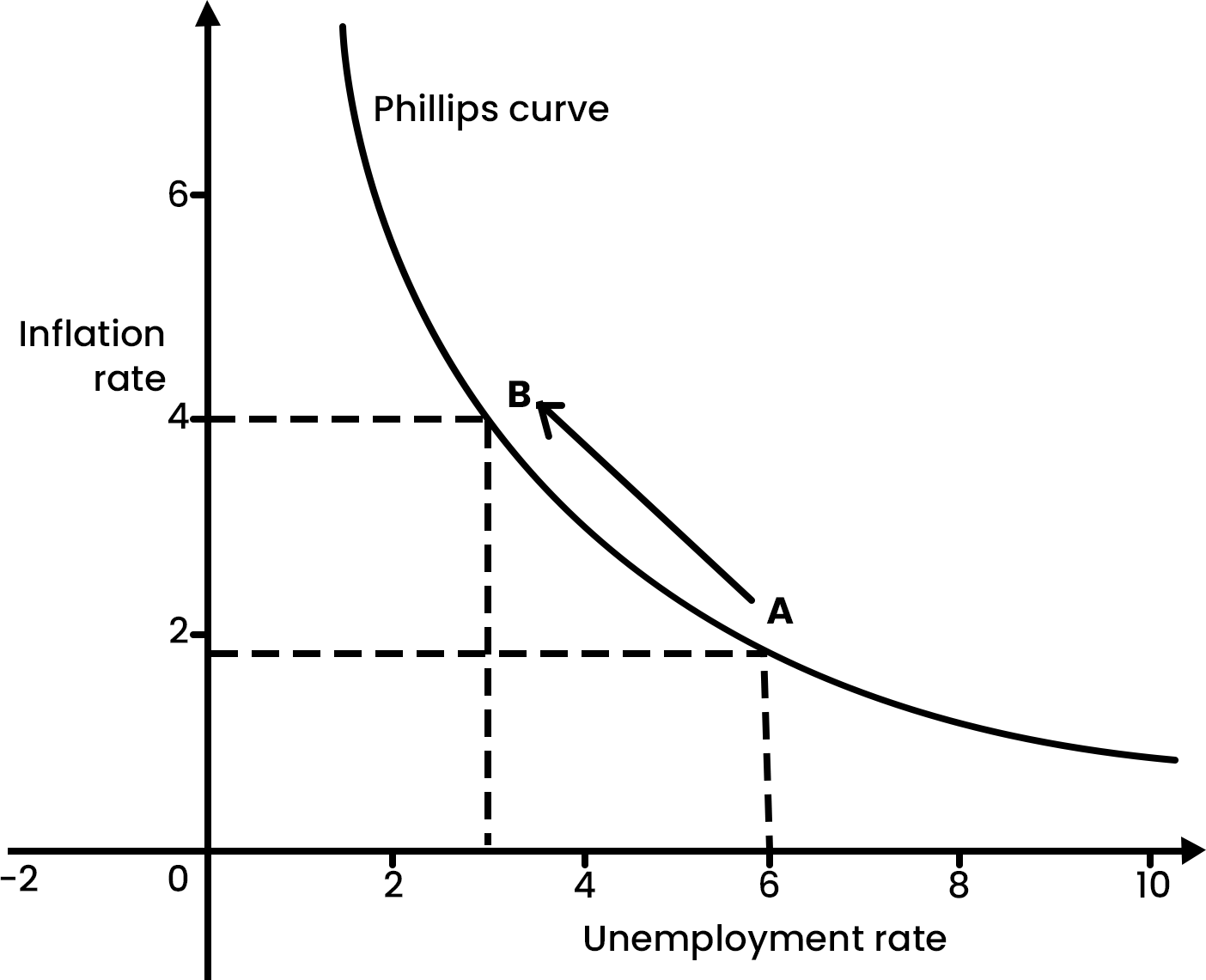
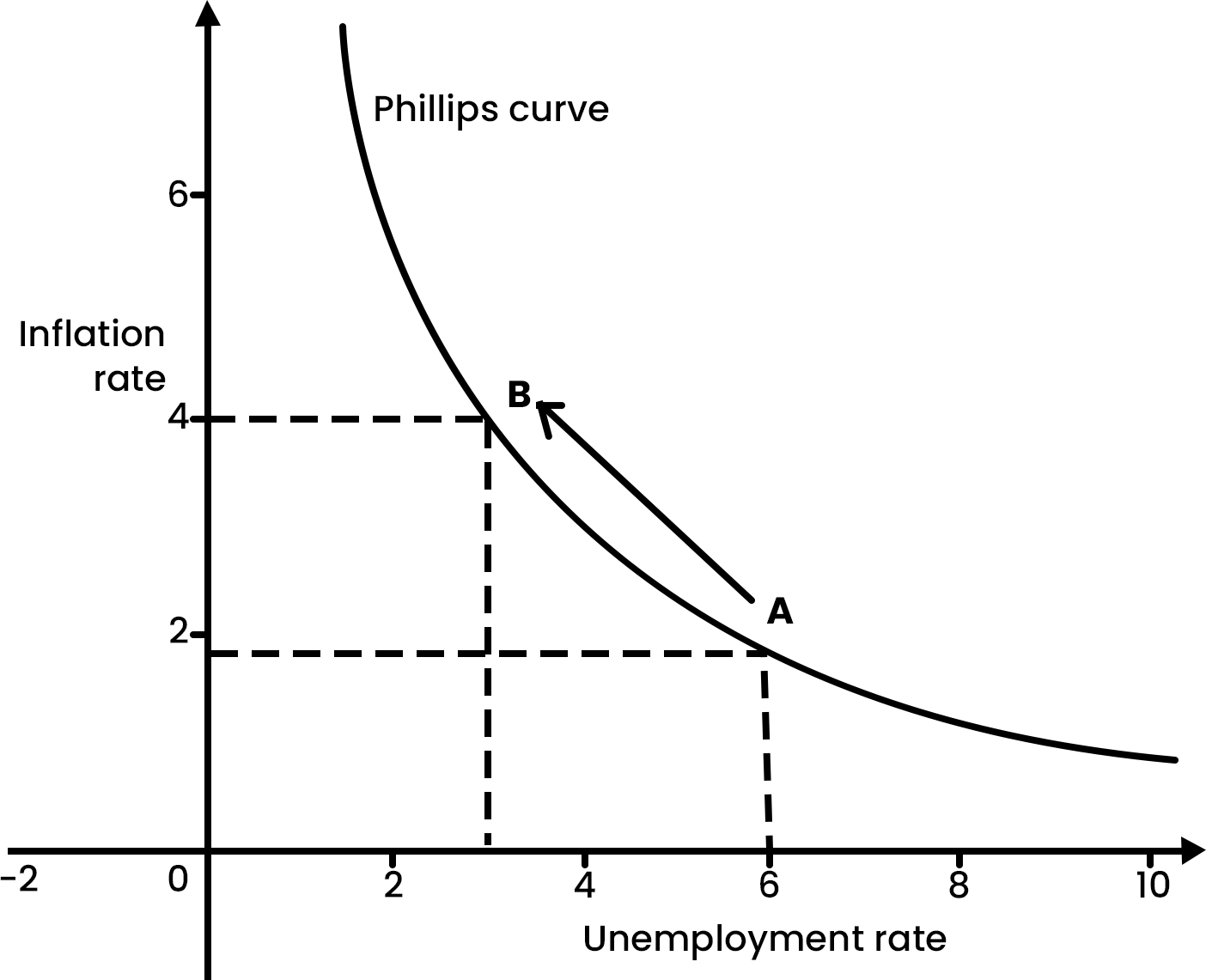
The Phillips curve explains that inflation and unemployment have an inverse relationship. Advanced inflation is associated with higher employment and vice versa.
The inverse relationship between higher employment and inflation is represented as a downward sloping, concave curve, with inflation on the Y- axis and unemployment on the X-axis.
This curve shows that unemployment and inflation are inversely proportional to each other. This means if inflation increases unemployment rate will decrease and vice versa. However, the relationship breaks down under conditions of hyperinflation, where extremely high inflation rates render the curve inapplicable. Despite these limitations, the Phillips Curve remains a valuable framework for understanding the potential relationship between inflation and unemployment, especially in more stable economic environments.
Inflation-Indexed Bonds (IIBs)
IIBs are a special type of debt security designed to hedge against inflation. Their key characteristic is that both the principal amount (face value) and the interest payments are adjusted for inflation, typically against the Consumer Price Index (CPI). While IIBs offer protection against inflation, they may not perform well in deflationary environments (falling prices). However, fixed coupon rate of IIBs might be lower compared to traditional bonds, as investors are compensated for the inflation protection feature.
Advantages of IIBs
• Principal Protection: The inflation-adjusted principal
ensures you receive at least your original investment amount, even if inflation erodes its purchasing power over time.
Real Returns: The combination of a fixed coupon rate and inflation-adjusted principal helps you achieve positive returns that outpace inflation.
Regular Income: IIBs typically offer fixed interest payments at regular intervals, providing a predictable income stream.
Low Default Risk: As IIBs are usually issued by the government, they carry a very low risk of default compared to corporate bonds.