Smart Cities Mission
Smart Cities Mission
The Indian government launched the Smart Cities Mission, an urban renewal and retrofitting initiative, to create smart cities that are sustainable and hospitable to citizens. The mission will be carried out in cooperation with state governments by the Union Ministry of Urban Development.
Need For the Mission
About 31% of India’s population currently lives in cities, which also generate 63% of the country’s GDP. 40% of India’s population is predicted to live in urban areas by 2030, and they will generate 75% of the country’s GDP. Cities experiencing population growth face challenges in managing their infrastructure and providing services. One initiative in India that seeks to effectively and efficiently address these issues is the Smart Cities Mission.
The following are the main components of a smart city’s infrastructure:
Sufficient supply of water.
Guaranteed power supply.
Solid waste management is a part of sanitation.
Public transport and urban mobility done well.
Affordable housing, particularly for the underprivileged.
Solid digitalization and IT connectivity.
Effective government, particularly e-governance and public involvement sustainable surroundings.
Citizens’ safety and security, especially that of women, children, and the elderly education and health.
Sustainable and inclusive development is the main focus, and the plan is to examine small areas and develop a replicable model that can act as a guide for other aspirational cities.
Coverage
Based on equitable criteria, 100 cities have been distributed among the States and Union Territories (UT) for the mission. The formula assigns the number of statutory towns (a town having a municipality, corporation, cantonment board, or notified town area committee) and the urban population of the State or UT equal weight (50:50). Each State/UT will consequently have a certain number of potential Smart Cities based on this formula, with at least one in each State/UT.
Strategy
The 100 Smart Cities Mission in India includes a pan- city initiative in addition to area-based development components such as city extension (greenfield development), city renewal (redevelopment), and city improvement (retrofitting).
Financing
The Smart Cities Mission in India is a centrally sponsored scheme. It also mandates that, in order to carry out projects under the Smart City Proposal (SCP), state governments and urban local bodies (ULBs) contribute equally. For the projects listed in the Smart City Proposal, states are expected to look for funding from a variety of sources.
ATAL MISSION FOR REJUVENATION AND URBAN TRANSFORMATION (AMRUT)
Atal Mission for Rejuvenation and Urban Transformation (AMRUT) was launched in 500 cities and towns across the country.
Purpose
The purpose of Atal Mission for Rejuvenation and Urban Transformation (AMRUT) is to:
• Ensure that every household has access to a tap with the assured supply of water and a sewerage connection.
• Increase the amenity value of cities by developing greenery and well-maintained open spaces (e.g., parks) and
• Reduce pollution by switching to public transport or constructing facilities for non-motorized transport (e.g., walking and cycling). All these outcomes are valued by citizens, particularly women, and indicators and standards have been prescribed by the Ministry of Housing and Urban Affairs (MoHUA) in the form of Service Level Benchmarks (SLBs).
Thrust areas
The Mission will focus on the following Thrust Areas:
• Water supply,
• Sewerage facilities and septage management,
• Storm water drains to reduce flooding,
• Pedestrian, non-motorized and public transport facilities, parking spaces, and
• Enhancing the amenity value of cities by creating and upgrading green spaces, parks and recreation centers, especially for children.
AMRUT 2.0
The Atal Mission for Rejuvenation and Urban Transformation 2.0 (AMRUT 2.0) was approved as a step towards Atma Nirbhar Bharat and with the aim of making the cities ‘water secure’ and ‘self-sustainable’ through a circular economy of water.
AMRUT 2.0, targets universal coverage of water supply by providing household tap connections in all statutory towns and coverage of sewage/septage management in 500 cities covered in the first phase of the AMRUT scheme.
Mission also has a reform agenda on ease of living of
citizens through reduction of non-revenue water, recycle of treated used water, rejuvenation of water bodies, augmenting double entry accounting system, urban planning, strengthening urban finance etc.
Other components of AMRUT 2.0 are:
Pey Jal Survekshan to ascertain equitable distribution of water, reuse of wastewater, mapping of water bodies and promote healthy competition among the cities /towns.
Technology Sub-Mission for water to leverage latest global technologies in the field of water.
Information, Education, and Communication (IEC) campaign aimed at raising public awareness of water conservation.
HOUSING FOR ALL
Pradhan Mantri Awas Yojana (Urban)
The Ministry of Housing and Urban Poverty Alleviation (MoHUPA) launched the Pradhan Mantri Awas Yojana (Urban) Programme to provide pucca houses with basic amenities to all eligible urban beneficiaries, including slum dwellers across the nation.
Scope
The Mission covers the entire urban area consisting of Statutory Towns, Notified Planning Areas, Development Authorities, Special Area Development Authorities, Industrial Development Authorities or any such authority under State legislation which is entrusted with the functions of urban planning & regulations.
Housing for All” Mission for urban area will provide central assistance to implementing agencies through States and UTs for providing houses to all eligible families/beneficiaries which was earlier from 25.06.2015 to 31.03.2022, has since been extended up to 31.12.2024.
Mission will be implemented as Centrally Sponsored Scheme (CSS) except for the component of credit linked subsidy which will be implemented as a Central Sector Scheme.
Implementation Methodology
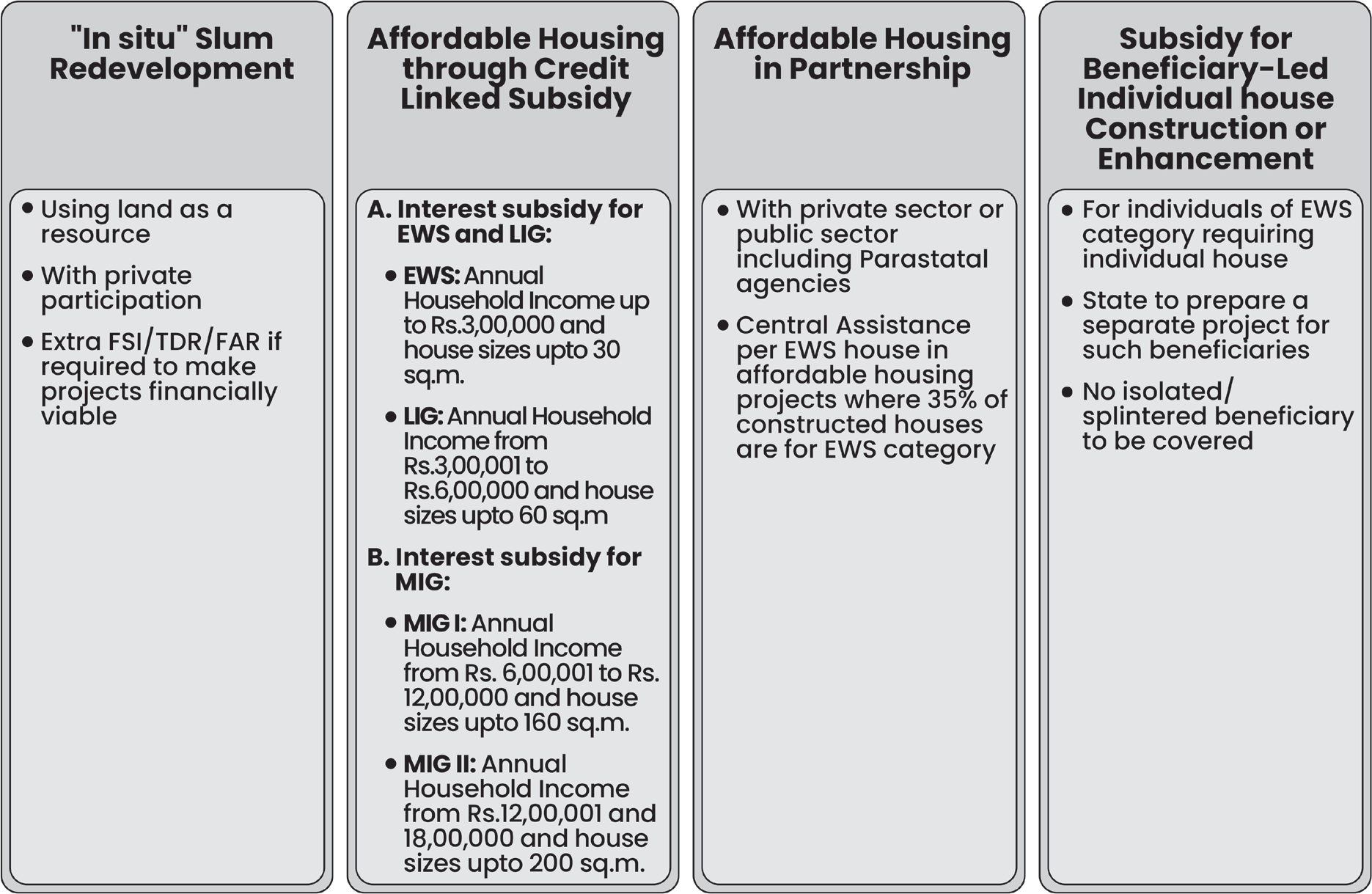
The Mission will be implemented through four verticals giving option to beneficiaries, ULBs and State/UT Governments. These four verticals are as below:
Pradhan Mantri Awaas Yojana (Gramin)
The rural housing programme Indira Awas Yojana was redesigned as Pradhan Mantri Awaas Yojana - Gramin and approved in March 2016 with the aim of achieving “Housing for all by 2022.”
Under the programme, all homeless people and households residing in run-down homes are eligible to receive financial assistance for the construction of pucca houses.
Under PMAY-Gramin Phase I & II, 4.15 crore houses
allocated to states, 3.90 crore sanctioned, 2.99 crore houses completed.
The cumulative target aims to achieve 4.95 crore rural houses by 2029.
Objective
To provide pucca houses to all who are houseless and living in dilapidated houses in rural areas. The overall target is to construct 2.95 crore pucca houses with basic amenities by March, 2024.
Funding Pattern
The Central and State Governments are to split the cost of unit assistance under PMAY in the following ratios: 60:40 for plain areas and 90:10 for hilly and North Eastern states.
The unit assistance given to beneficiaries under the programme is Rs 1,20,000 in plain areas and to Rs 1,30,000 in hilly states/difficult areas /Integrated Action Plan (IAP) for Selected Tribal and Backward Districts.
Through convergence with Swachh Bharat Mission – Gramin (SBM-G), Mahatma Gandhi National Rural Employment Guarantee Scheme (MGNREGS), or any other dedicated source of funding, an additional Rs. 12,000/- is extended for the construction of toilets.
Under MGNREGA, the beneficiary is eligible for 90 or 95 days of unskilled labour.
It would be made easier for the beneficiary to obtain a loan of up to Rs. 70,000 for the optional construction of the house.
Money will be sent electronically and deposited straight into the beneficiary’s account.
Target Group
Beneficiaries of this PMAY scheme will be identified as per data available from the Socio-Economic and Caste Census (SECC) and include
Scheduled castes and scheduled tribes.
•
Non-SC/ST and minorities under BPL.
• Freed bonded labourers.
• Next of kin and widows of paramilitary forces and individuals killed in action, ex-servicemen, and those under a retirement scheme.
National Investment and Infrastructure Fund
The National Investment and Infrastructure Fund, or NIIF for short, is an organisation supported by the Indian government that was founded to give long-term funding to the nation’s infrastructure industry.
Budget 2015 set the ball rolling for its creation and NIIF was set up as an alternative investment fund (AIF) in December 2016 with a planned corpus of Rs. 40,000 crore.
The remainder of NIIF is owned by notable domestic and international investors like Temasek, Abu Dhabi Investment Authority, and HDFC Group, with the Indian government owning 49% of the company. With the Centre’s significant stake, NIIF is considered India’s quasi sovereign wealth fund.
NIIF oversees $3 billion in capital between its three funds: the Master Fund, Fund of Funds, and Strategic Fund.
Its portfolio now includes investments in ports and logistics, real estate and renewables. It is also said to have put in bids for four airports Jaipur, Lucknow, Ahmedabad and Mangaluru in the recent auctions.
It manages USD 4.9 billion in Assets Under Management (AUM) across its funds.
Active Funds under NIIF
• Master Fund – Focused on infrastructure investments.
• Private Markets Fund – A fund of funds supporting private equity managers.
• India–JapanFund – Dedicated to climate, sustainability, and bilateral corridor projects.
• Strategic Opportunities Fund – Concentrated on growth equity investments.
Infrastructure Sector in India
INFRASTRUCTURE SECTOR IN INDIA
India’s high growth imperative in 2023 and beyond will significantly be driven by major strides in key sectors with infrastructure development being a critical force aiding the progress.
Infrastructure is a key enabler in helping India become a US $ 26 trillion economy.
Investment is the process of putting money in assets for increasing production or financial gains.
To understand the investment, consider it as putting money in banks deposits, shares of companies, real estate, gold, business or industry.
Investments in building and upgrading physical infrastructure, especially in synergy with the ease of doing business initiatives, remain pivotal to increase efficiency and costs.
Infrastructure support to nation’s manufacturers also remains one of the top agendas as it will significantly transform goods and exports movement making freight delivery effective and economical.
Infrastructure sector is a key driver for the Indian economy. The sector is highly responsible for propelling India’s overall development and enjoys intense focus from the Government for initiating policies that would ensure time-bound creation of world class infrastructure in the country.
Infrastructure sector includes power, bridges, dams, roads, and urban infrastructure development. In other words, the infrastructure sector acts as a catalyst for India’s economic growth as it drives the growth of the allied sectors like townships, housing, built-up infrastructure and construction development projects.
In order to meet India’s aim of reaching a US$ 5 trillion economy by 2025, infrastructure development is the need of the hour.
The government has launched the National Infrastructure Pipeline (NIP) combined with other initiatives such as ‘Make in India’ and the Production-Linked Incentives (PLI) scheme to augment the growth of the infrastructure sector. Historically, more than 80% of the country’s infrastructure spending has gone toward funding for transportation, electricity, and water and irrigation.
While these sectors still remain the key focus, the
government has also started to focus on other sectors as India’s environment and demographics are evolving.
There is a compelling need for enhanced and improved delivery across the whole infrastructure spectrum, from housing provision to water and sanitation services to digital and transportation demands, which will assure economic growth, increase quality of life, and boost sectoral competitiveness.
Market Size
The Union Budget 2026–27, capital investment outlay for infrastructure has been increased to Rs. 12.22 lakh crore (US$ 132.8 billion)
Provision is made to support of capital expenditure of states accordance with fiscal federalism and allocates Rs.
1.5 lakh crore (US$ 17.30 billion) as 50-year interest-free loan.
India’s infrastructure investment to rise from 5.3% of GDP in FY24 to 6.5% by FY29.
The Union Budget 2026–27 clearly indicates that Government is promoting investment for urban development. Robust infrastructure is the priority of government. To achieve this vision, government made the provision of Infrastructure Risk Guarantee Fund and City Economic Regions (CERs). To boost the CER government grants an amount of ₹5,000 crore per CER.
Under the PM Gati Shakti National Master Plan (PMGS- NMP), 352 infrastructure projects with cost of ₹ 16.10 Lakh Crore have been sanctioned.
A detailed report to supervise and monitor the status of the PM Gati Shakti projects is being published from July 2025 on PAIMANA (Project Assessment Infrastructure Monitoring and Analytics for Nation Building) portal.
India currently has the fifth-largest metro network in the world and will soon overtake advanced economies such as Japan and South Korea to become the third- largest network.
India plans to spend US$ 1.4 trillion on infrastructure through ‘National Infrastructure Pipeline’ in the next five years as per union budget 2023-24.
Government initiatives and investments in the infrastructure sector
The Infrastructure Finance Secretariat is being established to enhance opportunities for private
investment in infrastructure that will assist all stakeholders for more private investment in infrastructure, including railways, roads, urban infrastructure, and power.
The Government has decided to continue the 50-year interest free loan to state governments for one more year to spur investment in infrastructure and to incentivize them for complementary policy actions.
An Urban Infrastructure Development Fund (UIDF) will be established through use of priority sector lending shortfall, which will be managed by the National Housing Bank, and will be used by public agencies to create urban infrastructure in Tier 2 and Tier 3 cities.
To realize the vision of “Make A-I in India and Make A-I work for India”, three centers of excellence for Artificial Intelligence will be set-up in top educational institutions.
The Digital Public infrastructure for agriculture will be built as an open source, open standard and interoperable public good that will enable inclusive, farmer-centric solutions through relevant information services for crop planning and health, improved access to farm inputs, credit, and insurance, help for crop estimation, market intelligence, and support for growth of agri-tech industry and start-ups.
Skill India International Centres to be set up across different States to skill youth for international opportunities.
Central Processing Centre to be set up for faster response to companies through centralized handling of various forms filed with field offices under the Companies Act.
District Institutes of Education and Training to be developed as vibrant institutes of excellence for Teachers’ Training.
National Digital Library for Children and Adolescents will be set-up for facilitating availability of quality books across geographies, languages, genres and levels, and device agnostic accessibility.
States will be encouraged to set up a Unity Mall in their state capital or most prominent tourism center or the financial capital for promotion and sale of their own ODOPs (One District, One Product), GI products and other handicraft products, and for providing space for such products of all other States.
Public Private Partnership
PUBLIC-PRIVATE PARTNERSHIPS
Public-private partnerships involve collaboration between a government agency and a private-sector company that can be used to finance, build, and operate projects, such as public transportation networks, parks, and convention centers.
When public sector incentives are combined with private sector innovation and technology to finish work on schedule and within budget, these partnerships function effectively.
Risks for public partners include the possibility that agreed-upon usage fees won’t be supported by demand, as might be the case for a toll road or bridge, while risks for private enterprise include cost overruns, technical flaws, and an inability to meet quality standards.
Public-private partnerships often involve concessions of tax or other operating revenue, protection from liability, or partial ownership rights over nominally public services and property to private sector, for-profit entities.
Advantages of Public-Private Partnerships
Private-sector technology and innovation, for example, can help improve the operational efficiency of providing public services. For its part, the public sector offers incentives to the private sector to ensure that projects are completed on schedule and within budget.
Furthermore, by diversifying the economy, the nation can more easily support its infrastructure and grow related industries like construction, equipment, support services, and other businesses.
Make sure the public sector receives the required funding, and that public resources are managed more efficiently.
Assure prompt and higher-quality delivery of public services.
The majority of investment projects are completed on schedule and don’t require unanticipated additional costs from the public sector.
A private organisation is given the chance to receive a long-term payment.
PPP projects are implemented using the experience and expertise of the private sector.
The right PPP project risk allocation makes it possible to spend less on risk management.
Assets created under PPP agreements may frequently be excluded from the public sector’s balance sheet.
Disadvantages of Public-Private Partnerships
There could be a higher cost for the infrastructure or services.
Postponing public sector payments obligations for PPP projects to later periods may have a negative impact on public sector fiscal indicators in the future.
The process for procuring PPP services is lengthier and more expensive than that of traditional public procurement.
The lengthy, intricate, and relatively rigid nature of PPP project agreements stems from the inability to anticipate and assess every specific event that may impact the project’s future.
Public-private partnerships also create risks from the general public’s and taxpayers’ point of view. Private operators’ partnership with the government may insulate
them from accountability to the users of the public service for cutting too many corners, providing substandard service, or even violating peoples’ civil or Constitutional rights. At the same time, the private partner may enjoy a position to raise tolls, rates, and fees for captive consumers who may be compelled by law or geographic natural monopoly to pay for their services.
With any situation where ownership and decision rights are separated, public-private partnerships can create complex principal-agent problems. This may facilitate corrupt dealings, pay-offs to political cronies, and general rent-seeking activity by attenuating the link between the private parties who make important decisions over a project, from which they stand to benefit, and accountability to the taxpayers who foot at least part of the bill and who may be left holding the bag in terms of ultimate liability for the project’s outcome.
PUBLIC-PRIVATE PARTNERSHIPS MODELS
Managing an adequate amount of funds for infrastructure development has always been a challenge for India. Public-Private Partnerships (PPPs) were developed by the government during the reform era with the goal of luring private sector investments, both domestic and foreign. A brief review of the major PPP models (few of them are non-PPP models, too) are given below.
Build-Operate-Transfer-Toll (BOT-TOLL)
It was among the first PPP models. In addition to splitting project costs with the government, the private bidder was responsible for building, maintaining, running the road, and collecting tolls from moving cars. The private company that offered to give the government the maximum amount of toll revenue won the bid.
The private company was responsible for “all risks” pertaining to land purchase, construction (damage), inflation, delays-related cost overruns, and advertisements. The only things the government had to worry about were regulatory clearances.
This model’s inherent flaws made it unfeasible for the private bidder; for example, unjustified delays in land acquisition caused by legal disputes, cost overruns, and traffic movement uncertainties (commercial risk) rendered road projects economically unfeasible.
BOT-Annuity
By primarily lowering the risk for the private players, this model was an improvement over the BOT-TOLL model and was intended to reverse the private companies’ declining interest in road projects.
In addition to splitting project costs, the private partner was in charge of building, maintaining, and running the road projects without having any say over who pays the toll on traffic.
The private players were compensated with an annual fixed amount of money known as an “annuity”; the party offering the lowest “annuity” was awarded the project. The government was in charge of toll collection.
Private players were not exposed to any commercial risk, such as traffic, which made this model different from the previous one (BOT-TOLL). However, they were still highly vulnerable to other risks, such as delays in land acquisition, inflation, cost overruns, and construction. Over time, the risks associated with this model continued to make it unfeasible for the private sector.
Engineering- Procurement-Construction (EPC) Model
In this model, the government paid for the entire project cost (i.e., it was not a PPP model and was instead awarded to bidders as regular contracts) and assumed most of the risks associated with it, including those related to land acquisition, delays, inflation, and commercial risks.
The government was to assume responsibility for maintenance, operation, and toll collection of the road projects after they were designed, built, and turned over by the private developers.
The private player who offered to build roads at the lowest cost/price while guaranteeing the required quality levels was awarded the contract. It means, the private player in this model was only exposed to the construction-related risks which is a normal risk involved in any contract given by the government to the private party.
EPC Model could have been a temporary way out to develop road projects as it was fully funded by the government—the reform era had aimed to attract investment from the private players by evolving a ‘business model’ for the road sector—needed to develop a new PPP model.
Hybrid Annuity Model (HAM)
A combination of the EPC and BOT-ANNUITY models is the Hybrid Annuity Model (HAM). According to this model, the government and the private player split the project’s costs 40:60 each.
The private player is in charge of building the roads and turning them over to the government, which will handle toll collection (if desired); upkeep of the roads will remain the private player’s responsibility until the annuity period.
The government provides a set amount of financial compensation to private players for a predetermined period of time (usually 15 years, though this is negotiable). In a bidding war, the private player who offers the lowest annuity wins the contract.
The majority of the major risks in this model land acquisition, clearances, operation, toll collection, and commercial are covered by the government, while the risks associated with inflation and cost overruns are divided according to the project cost sharing ratio.
However, the risks associated with construction and maintenance remain with the private sector (the degree of risk that private players face may increase due to government delays in land acquisition and clearances).
Swiss Challenge Model
For the first time, the Indian government declared that this model would be used to revitalise the nation’s railway stations. Public procurement, or this method of awarding contracts, is highly adaptable and can be applied to both PPP and non-PPP projects.
In this, one bidder is asked by the government to submit the proposal for the project which is put in public domain. Afterwards, several other bidders submit their proposals aimed at improving and beating the original (first) bidder finally an improved bid is selected (called a counter proposal). If the original bidder is not able to match the counter proposal, the project is awarded to the counter bidder. Government has made it an online method.
Though the Government of India used this model for the first time, this has already been used by several states by now Karnataka, Andhra Pradesh, Rajasthan, Madhya Pradesh, Bihar, Punjab and Gujarat for roads and housing projects.
PPP Model for other sectors
Although the PPP model was initially developed for the infrastructure industry, there have been suggestions recently to apply it to other fields as well, including healthcare, education, and even agriculture. The model is getting popular support from the urban local bodies in the country and it is believed that in the Smart Cities scheme it could play a very lucrative role.
Road Infrastructure in India
Road Infrastructure in India
India has the second-largest road network in the world, spanning a total of 6.3 million kilometres (kms). 90% of all passenger traffic in India commutes via the nation’s road network, which carries 64.5% of all goods carried in the nation.
Road transportation has gradually increased over the years with improvement in connectivity between cities, towns and villages in the country.
National Highways (NH) account for 2% of the total road network and carry over 40% of total traffic.
100% Foreign Direct Investment (FDI) is allowed under the automatic route in the road and highways sector.
India has a well-developed framework for Public-Private- Partnerships (PPP) in the highway sector.
The highways sector in India has been at the forefront of performance and innovation. The government has successfully rolled out over 60 road projects in India worth over $10 bn based on the Model (HAM). HAM has balanced risk appropriately between private and public partners and boosted PPP activity in the sector.
Asset recycling, through the toll-operate-transfer (ToT) model, has been taken up by the National Highways Authority of India (NHAI) for 100 highways.
As one of the biggest reforms in the road transportation industry in India, the NHAI has gone ‘Fully Digital’, with the launch of a unique cloud-based and Artificial Intelligence-powered Big Data Analytics platform – Data Lake and Project Management Software.
Government Initiatives
Some of the recent Government initiatives are as follows
• NHAI plans to construct 25,000 kilometres of national highways in 2022-23 at a pace of 50 km per day.
• India’s Gati Shakti Program has consolidated a list of 81 high impact projects, out of which road infrastructure projects were the top priority.
• The Indian government launched Gati Shakti- National Master Plan, which will help lead a holistic and integrated development of infrastructure generating immense employment opportunities in the country.
• In October 2021, the government issued a notice related to concessions under the Vehicle Scrapping Policy (effective from April 2022) to encourage vehicle owners towards discarding old vehicles which have higher fuel consumption costs.
• In October 2021, the government announced a plan to install charging stations every 40 to 60 kilometres on national highways to strengthen wayside amenities.
• The Bharatmala Pariyojana was launched with the primary focus on optimizing the efficiency of the movement of goods and people across the country. A network of 35 Multimodal Logistics Parks is planned to be developed as part of Bharatmala Pariyojana.
• Launch of Bharat New Car Assessment Programme. Bharat NCAP rating will provide consumers an indication of the level of protection offered to the occupants.
Private Sector Participation
With a view to attract private investment in road development, maintenance and operation, National Highways Act (NH Act) 1956 was amended in June 1995.
In terms of these amendments, the private persons can invest in the NH projects, levy, collect and retain fee from users and is empowered to regulate traffic on such highways in terms of provisions of Motor Vehicle Act, 1988.
Types of Public Private Partnership
While there are a number of forms of Public Private Partnership, the common forms that are popular in India and have been used for development of National Highways are
• Build Operate and Transfer (BOT) Toll basis.
• Build Operate and Transfer (BOT) Annuity basis.
• Hybrid Annuity Model (HAM)
• Special Purpose Vehicle (SPV) basis
Special Purpose Vehicle
The NHAI has also formed a Special Purpose Vehicle (SPV) for funding road projects.
SPVs are separate legal entities formed under the Companies Act, 1956.
It involves very less cash support from the NHAI in the form of equity/debt; rest of the funds comes from Ports/ Financial Institutions/beneficiary organisations in the form of equities/debt.
The amount spent on developments of roads/highways is to be recovered in prescribed concession period by way of collection of toll fee by SPV.
Advantages
Involving the private sector leads to greater efficiency.
The private sector has more flexible procurement and decision-making procedures and therefore, it can speed up implementation efforts.
Better quality since the concessionaire (private sector) is to maintain the road for the period of concession.
Early completion of the project, since the concessionaire could save interest and earn early toll (in the case of BOT project) / additional annuity instalments (in the case of Annuity project).
No cost overrun (price escalation).
The Client (Government/NHAI) does not have the burden of maintaining the highways.
Issues impacting PPPs in the highway projects and suggestions
Aggressive bidding: There has been evidence of aggressive bidding in multiple instances. This might be as a result of the pre-qualification criteria, which violated well-established international norms by making a large number of applicants eligible for pre-qualification. The current system needs to be thoroughly examined in order to guard against project failure due to disorganised, aggressive, or unsustainable bids.
Land Acquisition and environmental clearances: Projects have a history of being awarded before the necessary land and clearances are obtained. This has caused stress for banks and developers, as well as a delay in project cash flows. To guarantee strict adherence to the conditions outlined in the concession agreements, such as the availability of 80% of the land and environmental clearance on or before the designated date, the road agencies must expedite the land acquisition and approval process within their respective organisations.
Over-leveraged balance sheets and downward traffic trend
Research indicates that thirty to forty highway development companies receive over seventy percent of the projects awarded in the transportation sector. These companies’ appetites have been sated as a result, and the majority of them have highly leveraged balance sheets and little to no remaining financial capacity to engage in new projects.
The problem has been further compounded due to the recent downward trend in the traffic revenues, thereby making several of the projects financially unviable on DBFOT model.
After extensive stakeholder consultation, a new Model Concession Agreement for Annuity Projects has been developed to address the aforementioned issues.
Bharatmala Pariyojana Project
With the goal of bridging critical infrastructure gaps through effective interventions like the development of economic corridors, inter corridors and feeder routes, national corridor efficiency improvement, border and international connectivity roads, coastal and port connectivity roads, and green-field motorways, Bharatmala Pariyojana is a new umbrella programme for the highways sector.
Key Features
Improving the quality of roads- The initiative was started in order to introduce well-maintained and advanced roads as a new wave of development for the country. Under this project, the construction of roads, in all parts of the nation will be undertaken.
Total road construction- The government and the ministry intend to work towards completing the 34,800 km of new roads as outlined in the scheme draft.
Integrated scheme- The Bharatmala is the name that is given to the road development and it will include many other related schemes as well. With the completion of all the schemes, the overall success of the scheme will be guaranteed.
Total tenure of the program-The goal of the central government is to complete the programme in five years. Thus, all is set for finishing the first phase before the end of 2022.
Segmentation in phases- The scheme will be split into seven distinct phases due to its sheer size and scope. As of now, the first phase in under construction.
Constriction on a daily basis- To finish the first phase in time, the respective department has made efforts of constructing at least 18 km of path on a daily basis. Ongoing efforts are being made to increase it to 30 km/ day in order to beat the clock.
Different categories of road construction- The official scheme draft has made it clear that different types of road construction will be done in order to improve connectivity.
Multi-source of finding- One source will not be enough for funding a mammoth project. Thus, the government will have to depend on other sources for generating adequate money to meet the expenses.
Highlights of Bharatmala Pariyojana Bharatmala Pariyojana
Improvement in efficiency of existing corridors through development of Multimodal Logistics Parks and elimination of choke point
Enhance focus on improving connectivity in North East and leveraging synergies with Inland Waterways
Emphasis on use of technology & scientific planning for Project Preparation and Asset Monitoring
Improving connectivity in the North East
Indian Railways Industry
Indian Railways Industry
The Indian railway system is regarded as the foundation and lifeblood of the economy. Indian railways span over thousands of kilometres practically covering the entire nation, making it the fourth largest in the world after the US, China and Russia.
The Railways Board, which has a monopoly over the provision of rail services in India, is in charge of overseeing the whole infrastructure. Due to its low cost and effective operations, railways continue to be the most popular means of transportation for the majority of Indians when travelling long distances.
India’s railway network is recognised as one of the largest railway systems in the world under single management.
The Government of India has focused on investing in railway infrastructure by making investor-friendly policies. It has moved quickly to enable Foreign Direct Investment (FDI) in railways to improve infrastructure for freight and high-speed trains.
Taking cognizance of its significance in overall infrastructural development, the NIP envisages the investment in Indian Railways worth Rs 11.43 lakh crore till 2024-25.
RLDA is spearheading the redevelopment of 60 railway stations across India on a PPP Model. There are two parts to the station redevelopment: the station’s required renovation and the station estate’s (commercial) development.
While commercial development will allow developers to tap several revenue streams to ensure the viability of the entire project, the mandatory station redevelopment will streamline travel and preserve the historical significance of these stations.
These redeveloped stations will be endowed with state- of-the-art amenities such as segregation of arrival and departure, excellent road connectivity with multi-modal transport integration, security and surveillance systems to enhance the travel experience. It will increase the
potential for tourism, value of real estate, promote the creation of jobs, and have a domino effect on the regional economy.
Government Initiatives
Recently, the Indian government has taken a few steps to improve the railway industry. A few of these are listed below
• Under the Union Budget 2023-24, capital outlay of Rs.
2.40 lakh crore (US$ 29 billion) has been allocated to the Ministry of Railways, which is the highest ever outlay and about nine times the outlay made in 2013- 14.
• Indian Railways launched a new tourism product i.e., theme-based tourist circuit train - ‘Bharat Gaurav’ to showcase India’s rich cultural heritage and magnificent historical places.
• The government launched Mission Raftaar for speed enhancement and to achieve a target of doubling average speed of freight trains and increasing the average speed of superfast /mail/express trains by 25 kmph.
• Induction of semi-high speed Vande Bharat trains.
• IR has decided for large scale proliferation of Linke Hofmann Busch (LHB) coaches which are technologically superior with features like Anti climbing arrangement, Air suspension (Secondary) with failure indication system and less corrosive shell.
• In 2026, Government praposes a plan of 40- km Underground Rail Corridor to Strengthen Connectivity Between Northeast and Rest of India (also known as Siliguri corridor) as part of border management and defence security to counter the threat from China and Bangladesh.
• In the spirit of Atma Nirbhar Bharat, Kavach has been adopted as the National Automatic Train Protection system.
• One Station One Product scheme was announced in the Union Budget 2022-23. This scheme aims to provide opportunities for enhanced livelihood through skill development to local artisans, potters, weavers/handloom weavers, craftsmen etc, through provision of sale outlets at Railway Stations across the Country.
• To empower youth by way of giving entry level training in Railway Training Institutes, “Rail Kaushal Vikas Yojana” has been launched on Indian Railways.
• Chenab Rail Bridge, the world’s highest railway arch bridge was inaugurated on December 2025 in Udhampur-Srinagar-Baramula Rail Link (USBRL)
Recommendations of Bibek Debroy Committee
A committee led by Mr. Bibek Debroy was established by the Railway Board to mobilise funds for large-
scale railway projects and to restructure the Railway Ministry and Railway Board. On September 22, 2014, the Committee was established with the goal of creating a blueprint for Indian Railways reform. In June 2015, the Committee turned in its final report. The principal conclusions and suggestions of the report:
• Failure of private participation: One of the main causes of the Ministry of Railways’ monopoly on policy-making, regulation, and operations is that these three functions are all housed within one organisation. The Committee suggests that in order to have widespread and long-term private participation, the three roles should be kept apart from one another. The monopoly held by railways prevents the private sector from entering the market. Second, plans for the involvement of the private sector are not developed with input from stakeholders. Thirdly, the schemes are set up so that private parties bear the majority of the risk.
• Need for an independent regulator: The Committee suggests establishing the Railways Regulatory Authority as an independent regulator to provide fair competition for private companies operating in the industry. The regulator will function as a statutory body that is separate from the Ministry and has its own budget. It will keep an eye on whether the tariff is competitive and determined by the market, but it will not set the tariff. Because the railway industry is so specialised and technical, it also requires its own independent regulator.
• Issues with financing: Funding railways is difficult because: (i) money is invested in projects that don’t have traffic and don’t bring in money; (ii) an uneven mix of passenger and freight traffic doesn’t bring in money; (iii) efficiency gains don’t bring in more money; and (iv) project delays lead to cost escalation, which makes it harder to recover expenses. In addition, internal funds and budgetary support have largely funded railroads rather than outside funding. As a result, its projects have not been subject to financial oversight.
• Zone restructuring: There are 17 zones in Indian Railways, which are further split up into 68 divisions. The current zones did not originate from a particular strategy, but rather from history. As a result, the organization’s zones and divisions must be reorganised.
• Pay attention to core activities: The Committee has noted that in addition to its primary duty of operating trains, Railways also manages auxiliary services like schools, hospitals, and a police force. It is anticipated that future competition will only get stronger for these different Railways zones and divisions. They must cut expenses on these non- core, nonremunerative tasks in order to effectively compete, and they must instead allocate more
resources to this function in order to run trains more efficiently. Private companies may be hired to handle non-core tasks. The Committee gave the example of funding alternative schools and hospitals, including private ones, for their educational and medical needs, respectively.
• Accounting reforms: The cost of various services and activities, like the introduction of new trains and the scheduling of stops, is not detailed in the current accounting system. It doesn’t keep track of assets or evaluate liabilities. As a result, calculating the expenses and advantages of any project or activity becomes challenging. In this context, the Committee suggests converting to a double entry accounting system based on commercial accruals. This will provide a comprehensive view of debt and other liabilities and make a clear distinction between revenue and capital expenditures. It will also assist in figuring out how much it costs to operate a train and if doing so is feasible.
Dedicated freight corridor project
In order to meet the demands of the quickly expanding Indian economy, the DFC project was first proposed in April 2005.
Due to capacity issues, the current golden quadrilateral railway network, which connects the major metropolises of Delhi, Mumbai, Chennai, and Kolkata, is unable to meet the increasing demand. Addressing these issues required the creation of a dedicated goods corridor.
In January 2006, RITES, an engineering consultancy set up by the government, submitted a feasibility report for the two corridors. RITES proposed the route and length of the corridors. The Western DFC stretches 1,506 km from Dadri in Haryana to JNPT in Maharashtra, while the Eastern DFC stretches 1,337 km from Ludhiana in Punjab to Dankuni in West Bengal.
In order to carry out the project, the Indian government formed the Dedicated Freight Corridor Corporation of India (DFCCIL) in 2006. Concurrently, the DFCCIL started construction on the eastern and western corridors in three stages.
A $4 billion soft loan from the Japan International Cooperation Agency covers about 67% of the Western DFC’s construction costs. The remaining funds are provided in equity by the Ministry of Railways. The Eastern DFC is constructed through funds received from the World Bank and the Ministry of Railways.
FDI In Railway Sector
It is the intent and objective of the Government of India to attract and promote Foreign Direct Investment (FDI) in order to supplement domestic capital, technology and skills, for accelerated economic growth1. FDI, as distinguished from portfolio investment, has the connotation of establishing a ‘lasting interest’ in an
enterprise that is resident in an economy other than that of the investor. FDI is largely a matter of private business decision. FDI inflows depend on a host of factors such as the availability of natural resources, market size, infrastructure, political and general investment climate as well as macro-economic stability and investment decision of foreign investors.
Government is pursuing modernisation and strengthening of rail network and development of rail- related industries through infusion of foreign equity and technology leading to growth in manufacturing and enhancing competitiveness. With this in view, the Government has allowed 100% FDI in the railway infrastructure segment which has opened up opportunities for participation in infrastructure projects such as high-speed railways, railway lines to and from coal mines and ports, projects relating to electrification, high-speed tracks and suburban corridors. Indian Railways envisages a prospective investment of USD
130.76 billion in the next five years.
Some of the important areas opened for FDI in Railways are indicated below
Suburban corridor projects through PPP;
High speed train projects;
Dedicated freight lines;
Rolling stock including train sets, and locomotives/ coaches manufacturing and maintenance facilities;
Railway Electrification;
Signalling systems;
Freight terminals;
Passenger terminals;
Infrastructure in industrial park pertaining to railway line/sidings including electrified railway lines and connectivities to main railway line; and
Mass Rapid Transport Systems.
Bullet Train-High Speed Rail Corridor
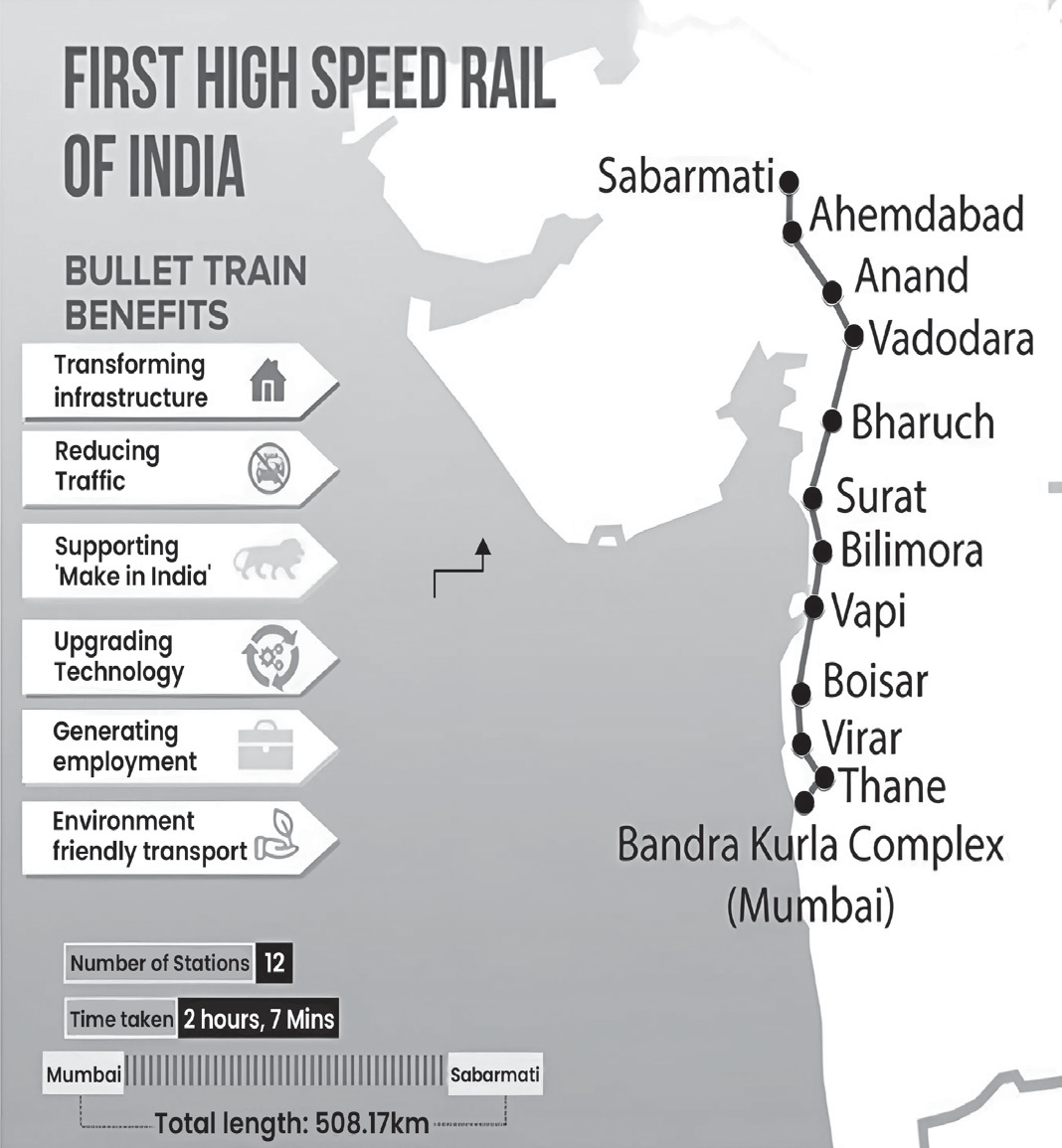
National High-Speed Rail Corporation Limited (NHS- RCL) was incorporated on 12th February 2016 under the Companies Act, 2013 with an object to finance, construct, maintain and manage the High-Speed Rail Corridor in India. The Company has been modelled as ‘Special Purpose Vehicle’ in the joint sector with equity participation by Central Government through Ministry of Railways and two State Governments viz. Government of Gujarat and Government of Maharashtra.
In addition to being a technological marvel, the High- Speed Rail (HSR) project would provide numerous quantifiable benefits, such as reduced travel times, vehicle operating costs, pollution reduction, employment creation, improved safety/reduction in accidents, and replacement of imported fuel. The project would also
boost the infrastructure and add to the growth of economy. HSR would be an integrated system having overall optimization of various components, viz. Hardware, Software, Human-ware, and their interface, etc.
Amrit Bharat Station Scheme
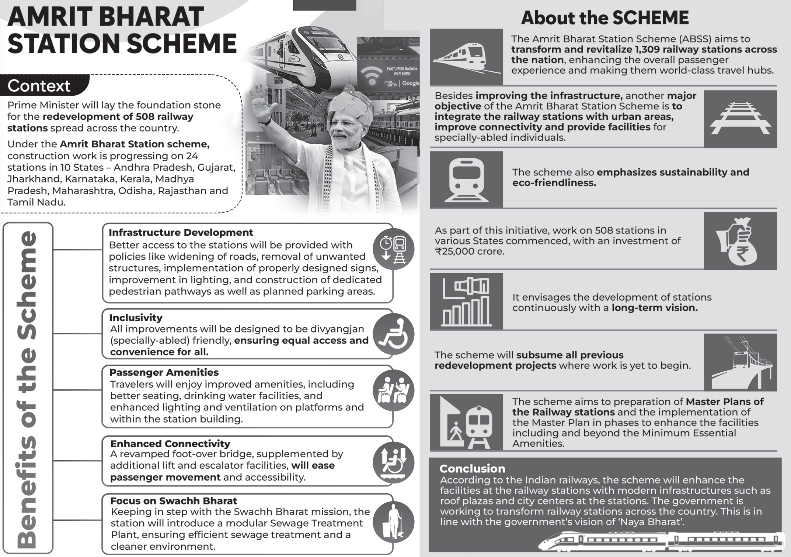
The recent introduction of the Amrit Bharat Station Scheme aims to enhance and modernize railway stations throughout the Indian Railways network. The scheme currently intends to upgrade and modernize a total of 1275 stations across the Indian Railway system. Within this initiative, 18 stations from the Sonpur Division and
20 stations from the Samastipur Division have been singled out for attention.
The Amrit Bharat Station scheme has a long-term vision for the ongoing development of stations. It involves creating Master Plans and executing them in phases to enhance various station facilities. These enhancements encompass bettering station accessibility, waiting areas, toilet facilities, lift and escalator installations as needed, cleanliness, offering free Wi-Fi, setting up kiosks for local products through initiatives like ‘One Station One Product’.
Furthermore, the scheme emphasizes upgrading station structures, integrating stations with the surrounding city areas on both sides, promoting multimodal connectivity, providing facilities for individuals with disabilities (Divyangjans), implementing sustainable and eco-friendly solutions, introducing ballastless tracks, incorporating ‘Roof Plazas’ when required, and considering the feasibility and phasing of improvements. The ultimate goal is to transform these stations into vibrant city centres over the long term.
Industrial Corridors, Nip, Nmp
Industrial Corridors in India
Industrial corridors are specialized, high-end, multi- model transport corridors in India that are built with the express purpose of facilitating convenient, quick mobility for industrial uses.
The different sectors of an economy are inter-dependent on each other. Industrial corridors, recognizing this inter- dependence, offer effective integration between industry and infrastructure, leading to overall economic and social development. Industrial corridors constitute world-class infrastructure, such as
High-speed transportation network – rail and road
Ports with state-of-the-art cargo handling equipment
Modern airports
Special economic regions/industrial areas
Logistic parks/transshipment hubs
Knowledge parks focused on catering to industrial needs
Townshipsand realestate a re examplesof complementary infrast ructure.
Additional urban infrastructure and a supportive legislative environment.
A corridor for industry’s main objectives are
• drawing in capital and generating employment in the manufacturing industry.
• Increasing the contribution of manufacturing sector to GDP
• Promoting equitable industrialisation and urbanisation
• Increasing labour productivity and income levels
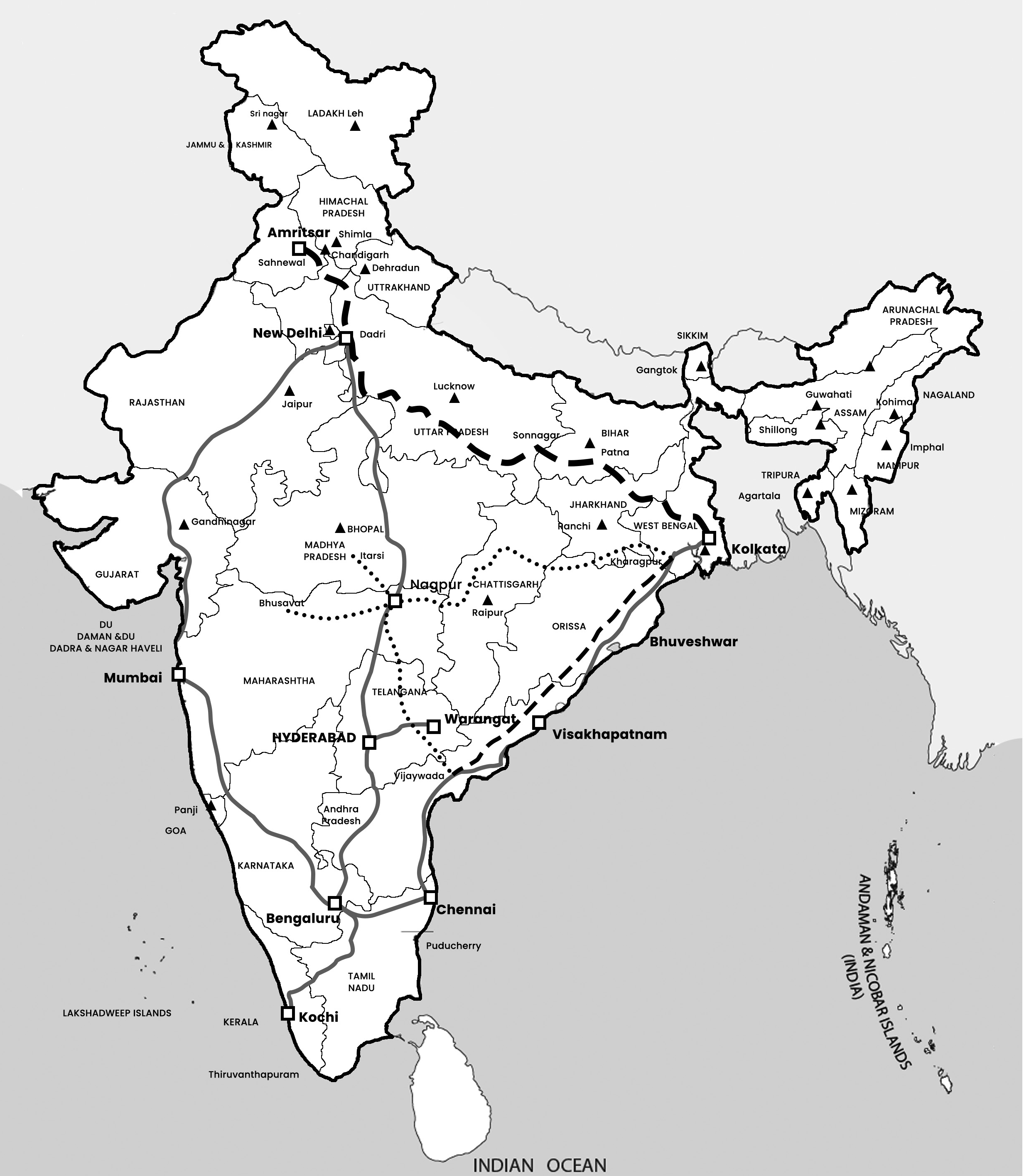
Government of India has accorded approval for development of 11 Industrial corridors (32 projects) in four Phases. The existing Industrial Corridors list is as follows
• Delhi Mumbai Industrial Corridor (DMIC)
• Chennai Bengaluru Industrial Corridor (CBIC)
• Extension of CBIC to Kochi via Coimbatore
• Amritsar Kolkata Industrial Corridor (AKIC)
• Hyderabad Nagpur Industrial Corridor (HNIC)
• Hyderabad Warangal Industrial Corridor (HWIC)
• Hyderabad Bengaluru Industrial Corridor (HBIC)
• Bengaluru Mumbai Industrial Corridor (BMIC)
• East Coast Economic Corridor (ECEC) with Vizag Chennai Industrial Corridor (VCIC)
• Odisha Economic Corridor (OEC)
• Delhi Nagpur Industrial Corridor (DNIC)
Proposed Industrial Corridors
National Industrial Corridor projects are getting developed on the overall framework of PM GatiShakti - National Master Plan to provide a systematic, multi modal connectivity to various economic zones for a seamless movement of people, goods and services resulting in efficient conduct of logistics and economic activities.
The development of these eleven industrial corridor projects will be implemented through the National Industrial Corridor Development and Implementation Trust (NICDIT).
National Infrastructure Pipeline (NIP)
The National Infrastructure Pipeline (NIP) for FY 2019- 25 is a first-of-its-kind, whole-of-government exercise to provide world-class infrastructure to citizens and improve their quality of life. It seeks to raise capital for infrastructure projects and enhance project preparation.
The infrastructure projects in different states that are expected to receive US$ 1.4 trillion in funding over the next five years are unveiled by the National Infrastructure Pipeline (NIP).
Benefits of NIP
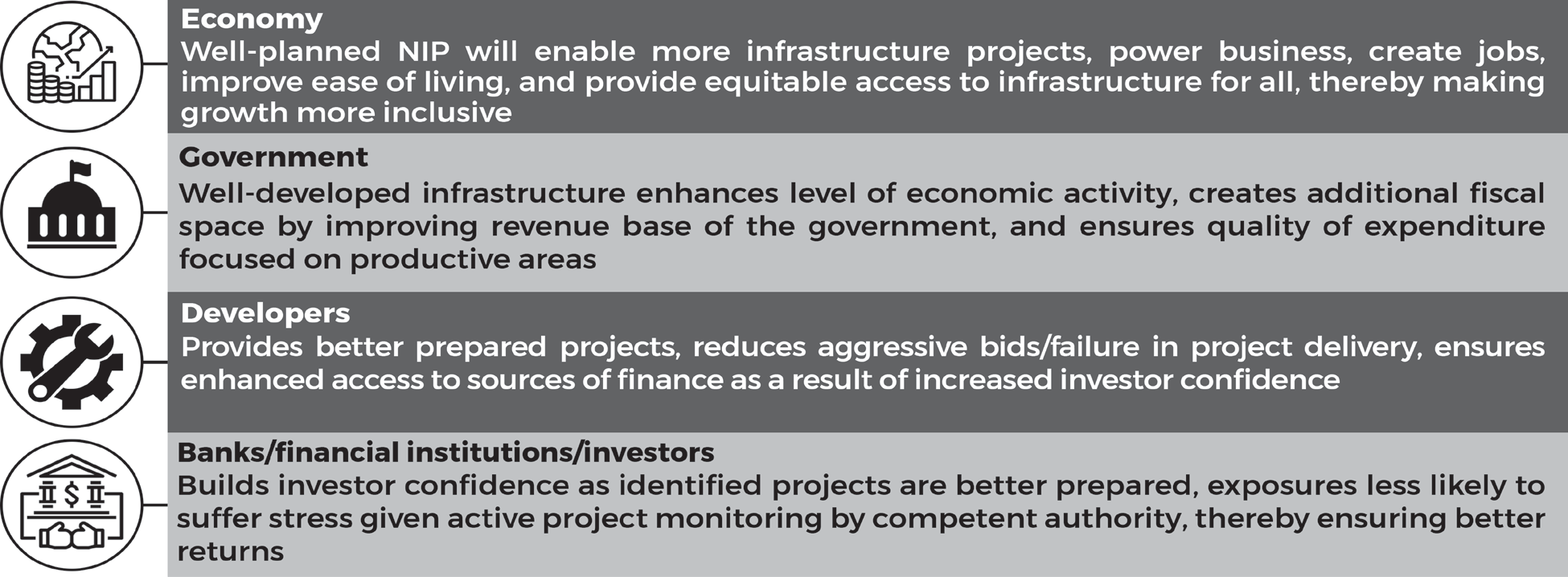
Constituents of NIP
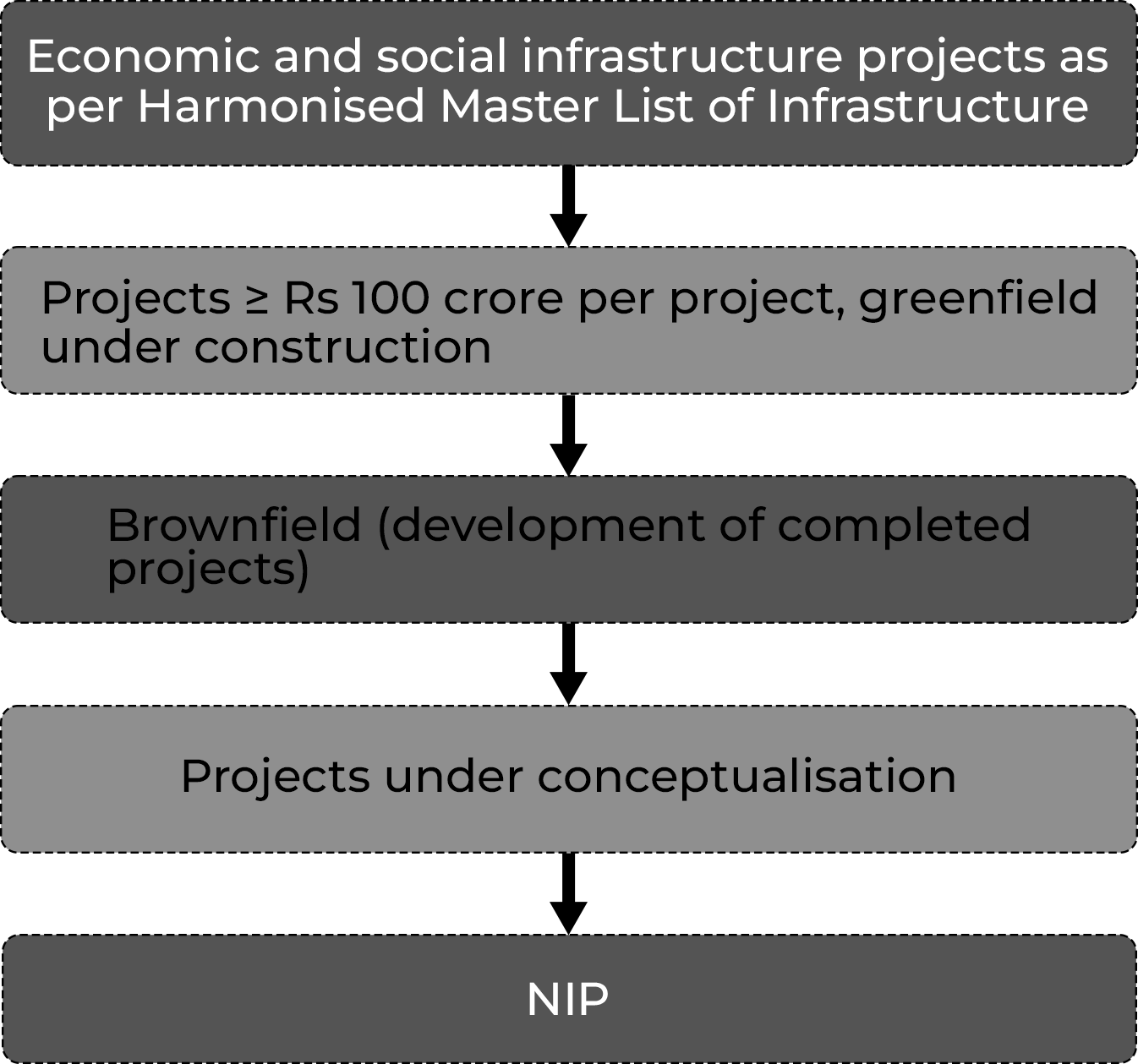
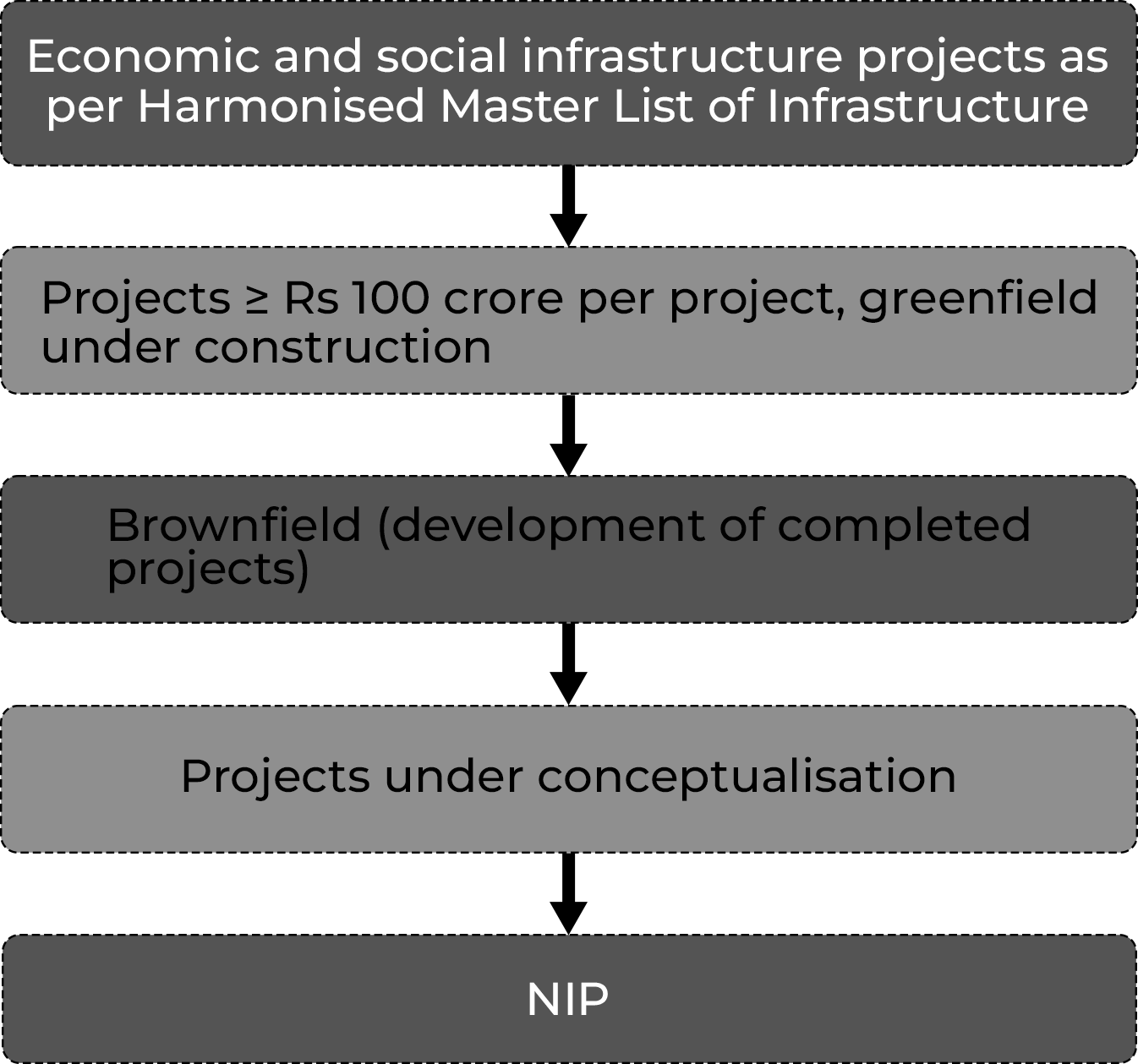
The NIP has been made on a best effort basis by aggregating the information provided by various stakeholders including line ministries, departments, state governments and private sector across infrastructure sub-sectors identified in the Harmonized Master List of Infrastructure.
Sector wise break-up of NIP

SECTOR-WISE BREAK-UP OF CAPITAL EXPENDITURE OF RS 111 LAKH CRORE DURING FISCALS 2020-2025
National Monetisation Pipeline (NMP)
Union Minister for Finance and Corporate Affairs on 23 August 2021 launched the asset monetisation pipeline of Central ministries and public sector entities as ‘National Monetisation Pipeline’.
Under the ambitious NMP, the government has identified 13 sectors - including airports, railways, roads, shipping, gas pipeline among others - which will be privatised as the government aims to monetise its brownfield infrastructure assets.
It estimates aggregate monetisation potential of Rs 6.0 lakh crores through core assets of the Central Government, over a four-year period, from FY 2022 to FY 2025.
The National Monetization Pipeline is a whole of a government initiative. It has been developed by NITI Aayog, in consultation with infrastructure line ministries, based on the mandate for ‘Asset Monetisation’ under Union Budget 2021-22.
The strategic objective of the programme is to unlock the value of investments in brownfield public sector assets by tapping institutional and long-term patient capital, which can thereafter be leveraged for further public investments.
Sectors
NMP: Framework, Implementation, and Monitoring
As part of a multi-layer institutional mechanism for overall implementation and monitoring of the Asset Monetization programme, an empowered Core Group of Secretaries on Asset Monetization (CGAM) under the chairmanship of Cabinet Secretary has been constituted.
The primary ownership of the assets under these structures, hence, continues to be with the Government with the framework envisaging hand back of assets to the public authority at the end of transaction life.
Presently only assets of central government line ministries and Central Public Sector Enterprises in infrastructure sectors have been included in NMP. Monetization through disinvestment and monetization of non-core assets have not been included in the same.
Real time monitoring of projects under NMP will be undertaken through the asset monetization dashboard.
• The framework for monetization of core asset monetization has three key imperatives as under.

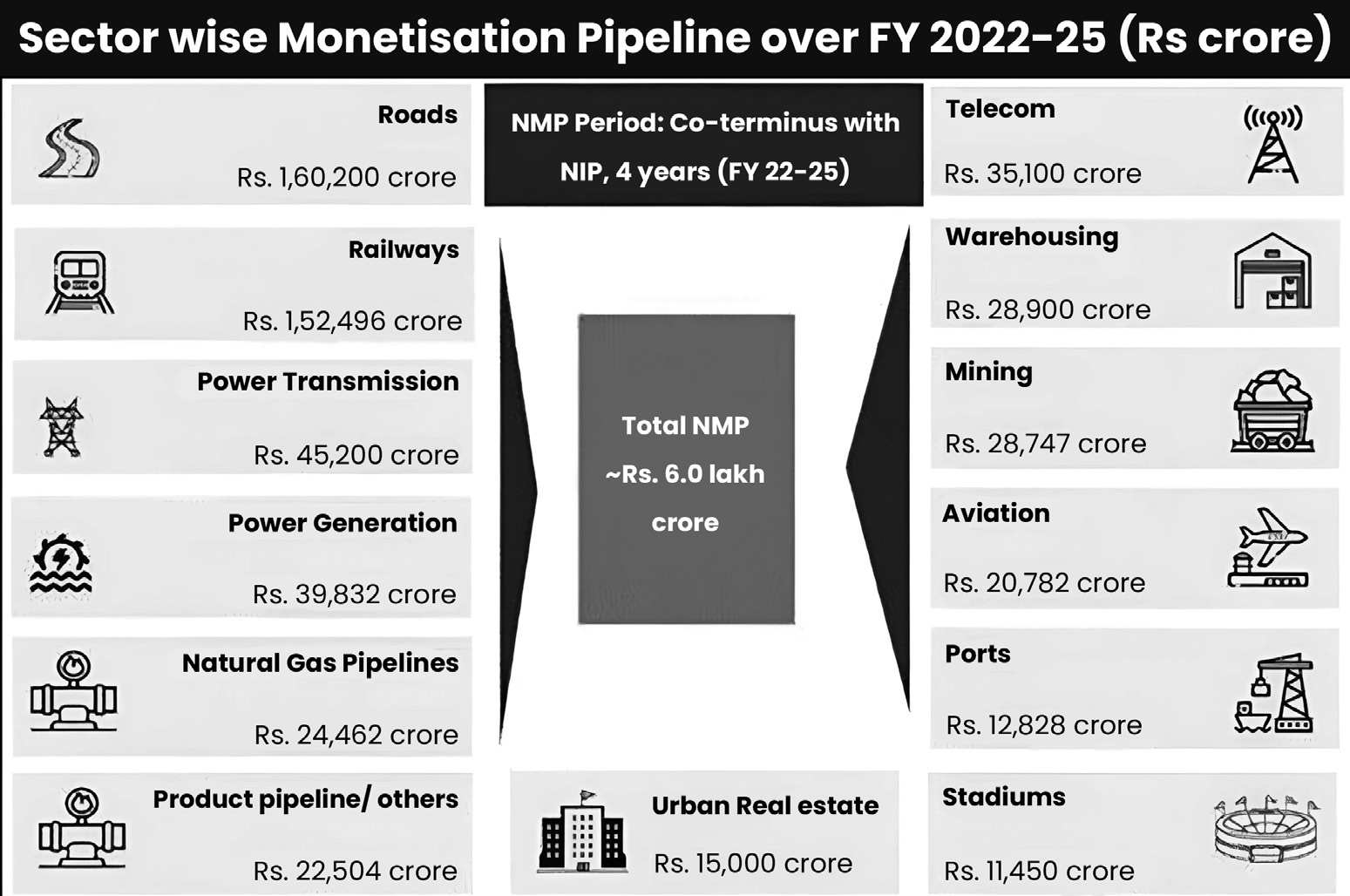
The top 5 sectors (by estimated value) capture ~83% of the aggregate pipeline value. These top 5 sectors include Roads (27%), Railways (25%), Power (15%), Oil & Gas pipelines (8%), and Telecom (6%).
Special Economic Zone , Coastal Economic Zone
Special Economic Zone (SEZ)
Special Economic Zone (SEZ) is a specifically delineated duty-free enclave and shall be deemed to be foreign territory for the purposes of trade operations and duties and tariffs. In other words, SEZ is a geographical region that has economic
laws different from a country’s typical economic laws. Usually, the goal is to increase foreign investments. SEZs have been established in several countries, including China, India, Jordan, Poland, Kazakhstan, Philippines and Russia.
Special Economic Zones - An overview:
India was one of the first in Asia to recognize the effectiveness of the Export Processing Zone (EPZ) model in promoting exports, with Asia’s first EPZ being set up in Kandla in 1965.
With a view to overcome the shortcomings experien-ced on account of the multiplicity of controls and clearances, absence of world-class infrastructure and to attract larger foreign investments in India, the Special Economic Zones (SEZs) Policy was announced in April, 2000.
This policy intends to make SEZs an engine for economic growth supported by quality infrastructure complemented by an attractive fiscal package, both at the Centre and the State level, with the minimum possible regulations.
The Special Economic Zones Act, 2005, was passed by Parliament in May, 2005 which received Presidential assent on June 23, 2005. The SEZ Rules, came into effect on February 10, 2006, providing for drastic simplification of procedures and for single window clearance on matters relating to Central as well as State governments.
The main objectives of the SEZ Act are
Generation of additional economic activity.
Promotion of exports of goods and services.
Promotion of investment from domestic and foreign sources.
Creation of employment opportunities.
Development of infrastructure facilities.
The SEZ Act, 2005 envisages a key role for the State Governments in Export Promotion and creation of related infrastructure.
The category ‘SEZ’ covers a broad range of more specific zone types, including, but not limited to
Free Trade Zones (FTZs)
Export Processing Zones (EPZs)
Free Zones (FZs)
Industrial Estates (IEs)
Free ports
Urban enterprise zones
Incentives for setting up a business in an Indian SEZ
Some incentives for setting up a sourcing or manufacturing platform within an Indian SEZ include
Duty free import and domestic procurement of goods for the development, operation, and maintenance of your company/SEZ unit.
•
100% Income Tax exemption on export income for SEZ units under Section 10AA of the Income Tax Act for the first 5 years, 50% for the next 5 years thereafter.
• Income tax exemption on income derived from the business of development of the SEZ in a block of 10 years in 15 years under Section 80-IAB of the Income Tax Act. (Sunset Clause for Developers has become effective from 01.04.2017).
• Exemption from customs/excise duties for development of SEZs for authorized operations.
• Exemption from the Goods and Service Tax (GST) and levies imposed by the state government (supplies to SEZs are zero rated under the IGST Act, 2017, meaning they are not taxed).
• Exemption from Minimum Alternate Tax (MAT).
• Single window clearances for all state and federal government approvals.
• Exemption in electricity duty and tax on sale of electricity by certain states in India.
• Presence of customs officer in the SEZs to facilitate and expedite the trade processes.
• Some states also offer land to SEZ developers at concessional rates to promote industries in accordance with the state’s prevailing Industrial Policy.
Sagarmala Project
Maritime sector in India has been the backbone of the country’s trade and has grown manifold over the years. To harness India’s 7,500 km long coastline, 14,500 km of potentially navigable waterways and strategic location on key international maritime trade routes, the Government of India has embarked on the ambitious Sagarmala Program which aims to promote port-led development in the country.
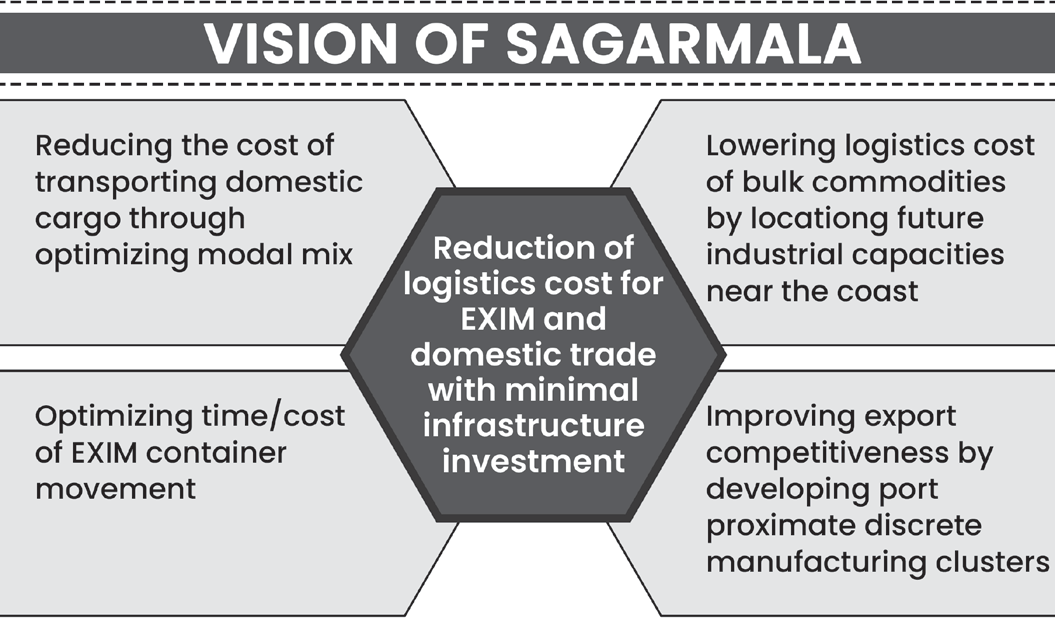
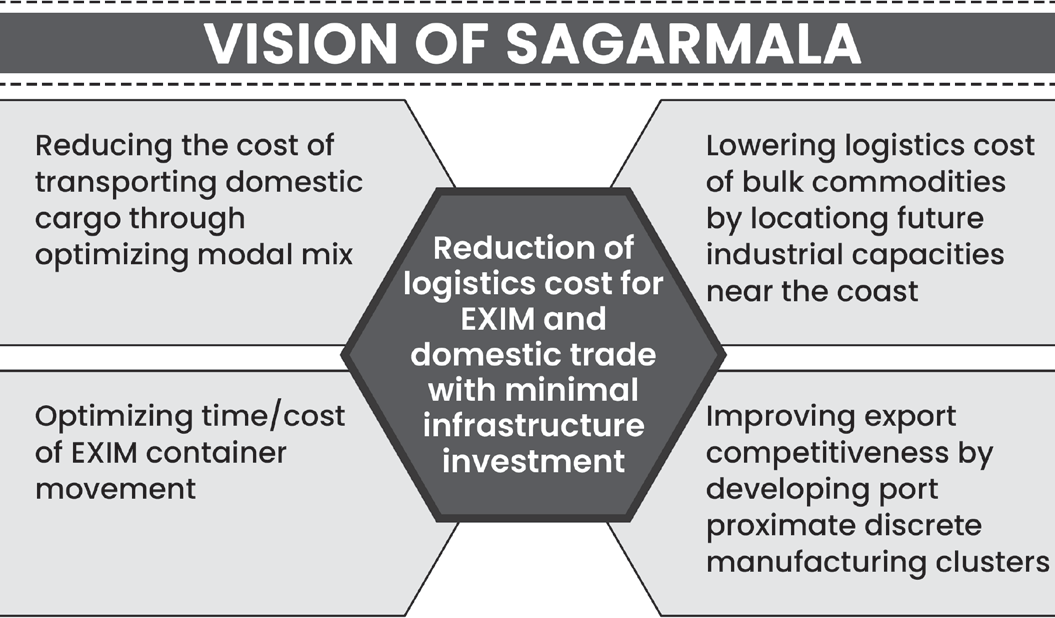
Components of Sagarmala Programme
Port Modernization and New Port Development: Developing new greenfield ports and debottling and increasing the capacity of already-existing ports.
Improvement of Port Connectivity: Increasing the ports’ accessibility to the hinterland and maximising the time
and cost of cargo movement by utilising multimodal logistics solutions, such as domestic waterways (inland water transport and coastal shipping).
Creating port-proximate industrial clusters and Coastal Economic Zones can lower the cost and duration of logistics for both domestic and export cargo. This is known as port-linked industrialization.

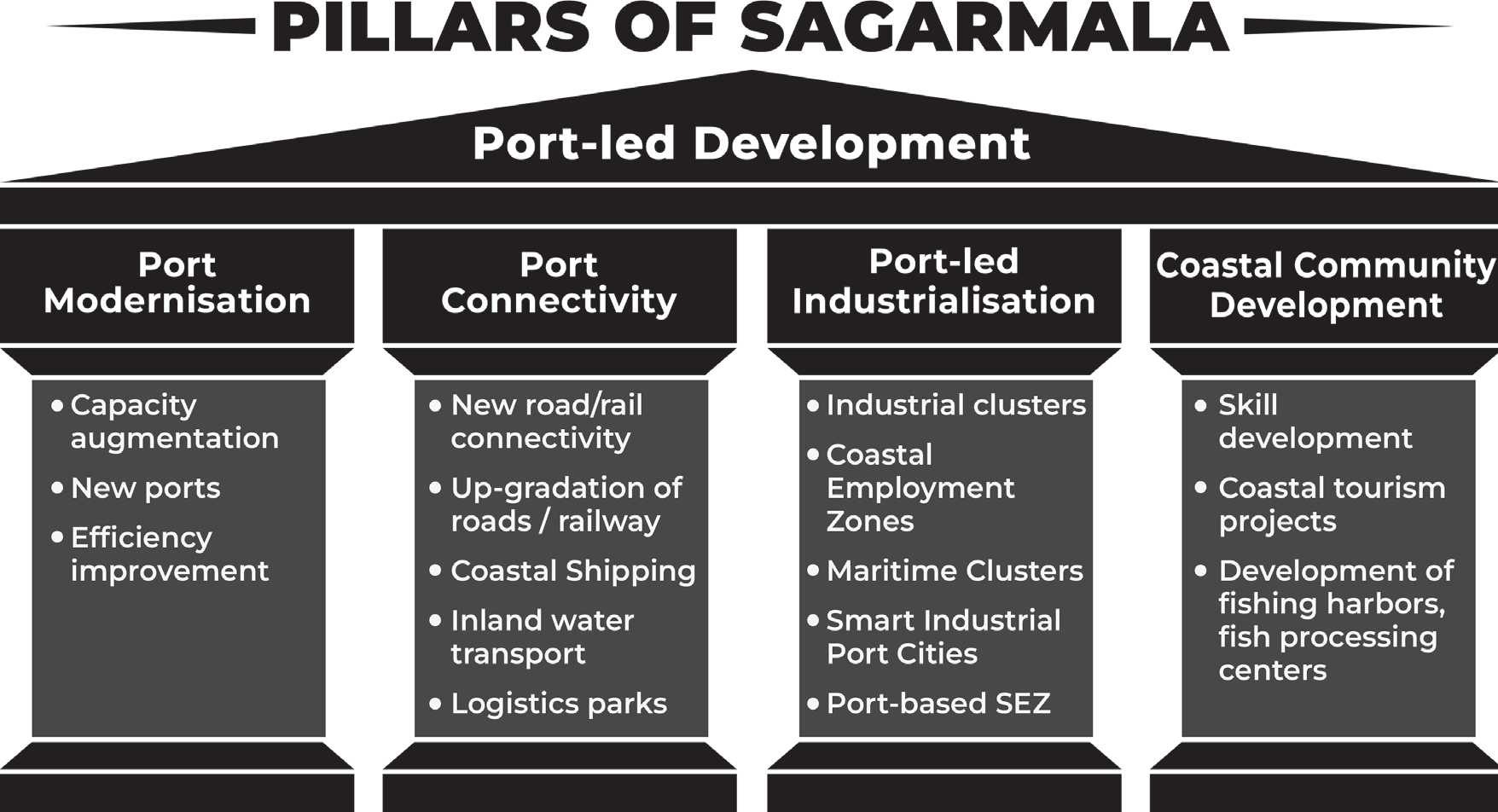
Coastal Community Development: Encouraging the sustainable growth of coastal communities by means of activities such as fisheries development, coastal tourism, skill development, and livelihood generation.
Coastal Shipping and Inland Waterway Transport: Encouragement to transport goods by environmentally responsible, sustainable coastal and inland waterway modes.
Coastal Economic Zones
The Ministry of Shipping has introduced the Coastal Economic Zone (CEZ). The CEZs are categorized to develop the country’s economic status by initiating port- led industrialization. The zones are set up to create a business-friendly environment by making the import and export easy and fast on the environmental clearances.
It consists of a group of coastal districts or districts with strong linkage to ports in the region to utilize the synergies with planned industrial corridor projects.
In order to support manufacturing and create jobs, 14 such industrial clusters will be developed, and CEZ will be one of them.
Each CEZ will consist of multiple CEUs and more than one industrial cluster can be housed within a CEU. Within each industrial cluster there can be several manufacturing units. To accelerate the CEU development process, it is proposed that CEUs be prioritized in locations where land parcels are available in areas close to a deep draught port and with strong potential for manufacturing.
Coastal Economic Units (CEUs): CEUs will be specific industrial estate projects with a demarcated
boundary similar to the DMIC nodes. The CEUs will house the industrial clusters / projects proposed within the CEZ.
Under the auspices of NITI Aayog, an Inter-Ministerial Committee (IMC) was established to oversee the development of CEZs in India.
Multi-Modal Logistics Parks (MMLPs)
Multi-Modal Logistics Parks (MMLPs) is a logistic programme by the government to develop Multi-Modal Logistics Parks across different logistics centers in the country.
The initiative is led by National Highways Logistics Management Limited under Ministry of Road Transport and Highways (MoRTH) and the National Highways Authority of India (NHAI).
These MMLPs will be developed in a hub-and-spoke model (a hub-and-spoke network connects every location through a single intermediary location called a hub) to improve the country’s freight logistics sector.
MMLP development is expected to give tremendous benefits to the transportation sector. Among them are
• Reduced freight expenses overall.
• Lower costs for warehousing.
• Decreased traffic and pollution from cars.
• Improved traceability and tracking of shipments during transportation.
The MMLPs additionally offer value-added services like
customs clearances, IT services, storage, and warehousing solutions.
Design of Multi-Modal Logistics Parks (MMLPs)
The Cabinet Committee on Economic Affairs (CCEA) had authorized MoRT&H to develop 35 Multi Model Logistics Parks (MMLP) across the country.
These 35 MMLPs being implemented by MoRTH are to be developed under Public Private Partnership (PPP) on Design, Build, Finance, Operate and Transfer (DBFOT) mode.
A total five MMLPs at Jogighopa, Chennai, Bengaluru, Nagpur and Indore are expected to complete in FY 2025- 26 and FY 2026-27 which will improve logistic efficiency by decreasing the cost of logistic. It is seen as great achievement in the field of logistics
The National Highways and Logistics Management (NHLML), which is a special purpose vehicle (SPV) and fully owned by the National Highways Authority of India (NHAI), plans to construct the majority of the proposed MMPLs in public private partnership (PPP) mode. The parks will have a 50:50 funding model.
Need for the MMLPs
According to the Asian Development Bank (ADB), India’s Logistics sector is having high cost and lower efficiency compared to other countries. This has reduced the overall efficiency in the economy and increased the cost structure of all commodities.
Compared to other countries road freights in India are higher, while the average speed of freight vehicles is about 50%–60% lower. Following factors adversely affect freight movement in India according to the ADB.
Skewed modal transportation mix: In India, 60% of freight moves by road, which is significantly larger than in many developed economies. Coastal movement and inland waterways are at a nascent stage. Rail transport is marginal, in spite of being 45% cheaper per ton–km than road, due to adverse pricing and rake booking practices and lack of intermodal facilities to enable easy transfer.
Underdeveloped material handling infrastructure: Warehousing landscape is highly unorganized with the presence of a large number of small, private, and unorganized warehouses, providing little or no value- added services. The economies of scale associated with integrated and large warehousing facilities or multimodal logistic parks (MMLPs) is not available to all participants in the value chain, including the small and medium enterprises.
Inefficient fleet mix: Small and inefficient trucks with gross vehicle weight rating of 16–25 metric tons (MT) have lower payloads. Absence of logistics hubs to act as zones for freight consolidation and disaggregation results in higher point-to-point freight movement on
lower sized vehicles, compared to more efficient line haul freight.
• Outdated/inefficient service model: Efficiency is also compromised as many firms try to compete through the factor advantage of low wages which have led to hiring poorly skilled personnel thereby eschewing investments in information technology and equipment technology, and consequently sacrificing productivity gains and service quality.
Fragmented institutional and governance structure: Different parts of the logistics value chain currently are being managed by different ministries including Road Transport and Highways, Shipping, Railways, Civil Aviation, Commerce and Industry, Finance, Home Affairs, and Department of Posts. In addition, a large number of government agencies including Central Drug Standard Control Organization, Food Safety and Standards Authority of India, and Plant and Animal Quarantine Certification Service provide relevant trade clearances and impact the value chain. Globally, leading countries that have achieved efficiency in logistics, like Germany, Japan, the Republic of Korea, and Malaysia, follow a completely integrated approach towards logistics, and the government provides coordinated oversight to the entire logistics value chain
Coal Industry
Coal industry
Indian coal reserves are the third largest in the world, after the United States and China.
India is the second largest consumer of coal and coal has hitherto played a crucial role in India’s energy sector, accounting for 55% of the country’s energy needs and over 75% of its electricity needs.
In addition, coal is also a vital ingredient and energy source in production of many important material/ products viz. Steel, Cement, Fertilizer, Paper etc. With significant availability of indigenous coal reserves and
its affordability, coal is likely to continue as the primary source of energy for a considerable period of time to meet the developmental needs of the rising economy.
Although in line with NDC goals and commitments made in its Panchamrit declaration at COP 26, India will push for renewable/non-fossil-based energy, but the share of coal in the energy basket is going to remain significant in the foreseeable future.
As per one of the assessments of NITI Aayog, although there may be a 10% drop in share of Coal in Primary energy supply in 2035 (BAU) but quantum of coal demand may rise 1.40 times due to increased energy demand driven by the rising economy.
The IEA also estimates that the share of coal in the overall energy mix steadily declines to 34% in 2040; however, overall demand for coal still remains stronger to meet the rising energy demand of the rapidly developing economy.
The Mines and Minerals (Development and Regulation) Act, 2015
The Act replaces the Mines and Minerals (Development and Regulation) Amendment Ordinance, 2015 introduces highly anticipated mining reforms and amends the 1957 Mining and Minerals (Development and Regulation) Act Background to the Act long-standing and overdue on the change of mines and minerals (development and regulation) from 2011.
Key Changes
The goal of the 2015 MMDR Amendment Act was to make a straightforward and non-discretionary system for the conceding of mineral concessions and to cure the decline in mining creation. Some of the major amendments introduced by the MMDR Amendment Act 2015 were as follows
• Maximum area for mining: Under the Act, a person could acquire one mining lease for a maximum area of 10 sq. km. The central government may, however, allow the person to obtain one or more licences or leases covering additional areas in order to develop any mineral. The amended provision to allow the central government to increase the area limits for mining, instead of providing additional leases.
• Deemed extension of mining leases: The lease period for all metallic and non-metallic minerals, such as, iron-ore, lead, manganese ore, zinc, lead, gold etc. were extended to a period of 50 years. On expiry of the leases, the lease won’t be renewed, rather the concessions will be set available to be purchased.
• Prospecting license-cum-mining lease: new concept of prospecting licences-cum-mining leases was introduced for certain notified minerals (such as,
bauxite, iron ore, limestone, manganese ore) in areas where there is scarce proof to show presence of mineral substance through the system of serious offering.
• Protection of the rights of existing concession holders and applicants under Section 10A of the MMDR Act.
• Allocation mechanism: The grant of mining leases in respect of certain notified minerals would be done through auction by competitive bidding; further all provisions with respect to the process of allocation of mines through auction by competitive bidding were streamlined.
• Grant of mining leases: The requirement of prior Central Government approval for grant of mineral concession for all the minerals specified in the First Schedule was removed for all mineral concessions.
• Transferability of leases: mineral concessions (prospecting license-cum-mining lease or mining lease) in respect of minerals other than coal, lignite and the atomic minerals, granted through auction were made transferable, subject to prior State Government consent and defiance with prescribed process. Significantly, the concept of approved approval was introduced if the state government did not submit its approval within 90 days of receiving the request.
• Institutions: The act arranges for the formation of a District Mineral Foundation (DMF) and a National Mineral Exploration Trust (NMET). The state government will set up the DMF to improve people’s lives in areas affected by mining. The NMET is set up by the central government for regional and detailed mine exploration. Lease holders and licensees are required to pay the NMET two percent of the royalty and the DMF no more than one-third of the royalty set forth by the central government.
The MMDR Amendment Act, 2025
The MMDR Amendment Act, 2025 was effective from 1st September 2025. The objective is to enhance the supply of the critical minerals by increasing the efficiency of exploration and production. It will reduce the dependency from other countries mainly China which is sensitive and vulnerable to the security of India promote the mining of minerals in India which helps in smooth supply chain.
Provisions of the 2025 amendment include:
Inclusion of Associated Minerals: Leaseholders can now apply to add other minerals to their existing mining leases without extra royalty for certain strategic and deep-seated minerals like lithium, cobalt, nickel, and gold.
Removal of Sale Limits: Captive mines are no longer restricted to selling only 50% of their annual mineral
production in the open market after fulfilling their own plant requirements.
• Lease Extension for Deep-Seated Minerals: The Act allows a one-time area extension for contiguous land: up to 10% for mining leases and 30% for composite licenses focused on minerals found deeper than 200 meters.
• National Mineral Exploration and Development Trust (NMEDT): The former NMET was expanded to fund mine development and overseas exploration. The mandatory lessee contribution was raised from 2% to 3% of royalty.
• Mineral Exchanges: The Central Government is empowered to establish registered electronic marketplaces and trading platforms to determine transparent, supply-demand-based prices for minerals and metals.
National Critical Mineral Mission (NCMM) 2025
India's National Critical Mineral Mission (NCMM) is a comprehensive framework launched to achieve self- reliance in the critical mineral sector. Backed by an outlay of Rs 34,300 crore, it aims to secure resilient supply chains for high-tech industries, clean energy, and national defense by boosting domestic exploration, overseas acquisitions, and recycling.
The objective is to carried out 1200 exploration by the Geological Survey of India (GSI) to make India self- reliance in Critical Mineral by 2030-31.
Core Objectives & Targets:
• Domestic Exploration: The Geological Survey of India (GSI) is conducting 1,200 exploration projects (2024–2031) to ensure the domestic production of at least 15 critical minerals (such as lithium, graphite, and rare earth elements).
• Overseas Acquisitions: Indian companies and PSUs are tasked with securing strategic mining assets worldwide through entities like Khanij Bidesh India Limited (KABIL).
• Fast-Track Approvals: The framework is supported by the Mines and Minerals Development and Regulation Act (MMDR), granting the central government exclusive power to auction key critical minerals with expedited environmental clearances
National Logistics Policy
National logistics Policy (NLP)
India aims to increase its exports manifold, it is important that the logistics aspects, that will facilitate this goal, be addressed. Logistics costs in India have been in the range of 14-18 percent of GDP against the global benchmark of 8 percent.
The key dimensions to be addressed to improve logistics for trade include
• Ensuring efficiency of the clearance process (i.e., speed, simplicity, and predictability of formalities) by border control agencies, including customs.
• Improving the quality of trade and transport- related infrastructure (e.g., ports, railroads, roads, information technology).
• Easing of arranging competitively priced shipments
• Enhancing the competence and quality of logistics services (e.g., transport operators, customs brokers)
• Providing for tracking and tracing of consignments and ensuring timeliness of shipments in reaching destinations within the scheduled or expected delivery time.
These aspects have been captured by the World Bank in the form of a Logistics Performance Index (LPI).
Significant steps to be undertaken for NLP
Integration of Digital System (IDS): There will be digital integration of different systems of seven various departments (like road transport, railways, aviation, commerce ministries and foreign trade)
Unified Logistics Interface Platform (ULIP): This ensures shorter and smoother cargo movement and enables the exchange of information confidentially on a real-time basis. This National Industrial Corridor Development Corporation (NICDC) Logistics Data Bank Project has been leveraged.
Ease of Logistics (ELOG): Through accessibility and transparency, it will guarantee and facilitate the ease of doing business in logistics.
System Improvement Group: It will monitor all logistics- related projects regularly.
Implementation of the NLP
The Policy will be implemented through a Comprehen- sive Logistics Action Plan (CLAP).
The interventions under the CLAP are divided into specific key action areas, including Integrated Digital Logistics Systems, standardization of physical assets & benchmarking service quality standards, Logistics Human Resources Development and Capacity Building, State Engagement, EXIM (Export-Import) Logistics, Service Improvement framework, Sectoral Plan for Efficient Logistics and Facilitation of Development of Logistics Parks.
Government Initiatives to improve the logistics ecosystem
Government of India to improve the logistics ecosystem through ‘infrastructure initiatives’ such as Ude Desh ka Aam Nagarik (UDAN), Bharatmala, Sagarmala, Parvatamala, National Rail Plan, and through ‘process reforms’ GST, e-Sanchit, Single Window Interface for Trade (SWIFT), Indian Customs Electronic Data Interchange Gateway (ICEGATE), Turant Customs, and others.
PM Gatishakti
PM GatiShakti National Master Plan (PMGS-NMP) was launched for providing multimodal connectivity infrastructure to various economic zones. PM GatiShakti is a transformative approach for economic growth and sustainable development. The approach is driven by 7 engines, namely.
• Railways
• Roads
• Ports
• Waterways
• Airports
• Mass Transport
• Logistics Infrastructure
Focus
The focus is on integrated planning and synchronized implementation across ministries/ departments, with innovative use of technology.
Pillars of GatiShakti
Comprehensiveness: It will have a single, central portal that will house all of the Ministries’ and Departments planned and ongoing projects. Each and every Department will now have visibility of each other’s activities providing critical data while planning & execution of projects in a comprehensive manner.
Prioritization: Through this, different Departments will be able to prioritize their projects through cross-sectoral interactions.
Optimization: The National Master Plan will assist different ministries in planning for projects after identification of critical gaps. For the transportation of the goods from one place to another, the plan will help in selecting the most optimum route in terms of time and cost.
Synchronization: Individual Ministries and Departm- ents often work in silos. There is lack of coordination in planning and implementation of the project resulting in delays. PM Gati Shakti will help in synchronizing the activities of each department, as well as of different layers of governance, in a holistic manner by ensuring coordination of work between them.
Analytical: The plan will provide the entire data at one place with GIS based spatial planning and analytical tools having 200+ layers, enabling better visibility to the executing agency.
Dynamic: All Ministries and Departments will now be able to visualize, review and monitor the progress of cross-sectoral projects, through the GIS platform, as the satellite imagery will give on-ground progress periodically and progress of the projects will be updated on a regular basis on the portal. It will help in identifying the vital interventions for enhancing and updating the master plan
Civil Aviation
Civil Aviation
Over the last three years, India’s civil aviation sector has grown at one of the fastest rates in the nation. It can be broadly divided into three categories: scheduled air transport, which includes both domestic and international airlines; non-scheduled air transport, which includes air taxi and charter operators; and air cargo, which includes cargo and mail transportation by air.
Approximately 69% of all airline traffic in South Asia is domestic, and by 2023, it is anticipated that India’s airports will handle 1 billion trips annually.
Indigo is the largest airline company in India with the highest market share. India has become the third-largest domestic aviation market in the world and is expected to overtake the UK to become the third-largest air passenger market by 2024.
India is expected to overtake China and the United States as the world’s third-largest air passenger market in the next ten years, by 2030, according to the International Air Transport Association (IATA).
The government has allowed 100% FDI under the automatic route in scheduled air transport service, regional air transport service, and domestic scheduled passenger airlines. However, FDI over 49% would require government approval.
The following list includes some of the major elements that will propel the aviation industry’s expansion
Higher Household Income- As the GDP of India grew after a contraction during the COVID period, there has been more business travel by professionals and greater leisure travel by individuals due to increasing income groups which drive the consumption pattern in India and primarily based out of urban areas, contributing more to the aviation industry.
Entry of Low-cost Carriers (LCC)- This model, which has been in the domestic market since 2004, is what has allowed the average person to afford air travel. The market suggests that this model is driving domestic traffic and thus, has shown strong operational performance over the years.
Increased FDI Inflows- The inflow of FDI contributes to the better development of the infrastructure of the aviation industry.
Under the automatic route, up to 100% FDI in civil aviation is allowed for non-scheduled air transport services in India.
Under the automatic route, up to 100% FDI is allowed in seaplanes and helicopter services.
Under the automatic route, up to 100% FDI is allowed in maintenance and repair organisations (MRO); flying training institutes; and technical training institutes.
•
Ground Handling Services may accept up to 100% Foreign Direct Investment (FDI) in the aviation industry, subject to sector-specific laws and automatic security clearance procedures.
Increased Tourist Inflows- Over time, air travel has grown in tandem with the expansion of the tourism sector. For Foreign Tourist Arrivals (FTA), air travel is the most chosen mode of transportation. In 2023, out of 1.52 million FTAs in India, 87.5% of individuals entered via air routes, 11.8% via land routes, and 0.7% via sea routes.
Development of Modern Airports with New Technologies- Modern airports contribute more to the aviation industry because they have developed infrastructure with regard to speed, capacity, sustainability goals, etc. The recently constructed greenfield international airport in Mopa, Goa, is one instance.
Supporting Government Policies-Government interventions play a major role in the development of the aviation industry in India. One of the schemes launched by the government in support of the growth of aviation was the UDAN (Ude Desh Ka Aam Nagrik) scheme which was released in June 2016 with the motive of offering half of the flights at subsidized fares and is expected to be in process for a period of 10 years (till 2026).
Government Initiatives
Some major initiatives undertaken by the Government are
NABH (NextGen Airports for Bharat): Nirman is a government initiative to expand airport capacity more than five times to handle billions of trips a year, in the next 10-15 years.
AAI Startup Policy: Delivering a framework & mechanism for the interaction of AAI with internal and external stakeholders that catalyze innovation at airports and leveraging technology for addressing challenges and enhancing the delivery of services to passengers.
The Ministry of Civil Aviation (MoCA): announced that airlines can operate domestic flights without any capacity restriction, effective from October 18, 2021.
October 2021 saw the introduction of the Krishi UDAN
2.0 programme by the Ministry of Civil Aviation. The plan suggests providing support and incentives to facilitate the air transportation of agricultural products.
Digi Yatra initiative was launched by the Ministry of Civil Aviation for providing passengers seamless and hassle-free experience at airports without the need for verification of ticket and ID at multiple touch points.
Power Sector in India
Power Sector in India
Power is among the most critical components of infrastructure, crucial for the economic growth and welfare of nations. For the Indian economy to grow
steadily, sufficient power infrastructure must exist and be developed.
India’s power sector is one of the most diversified in the world. Sources of power generation range from conventional sources such as coal, lignite, natural gas, oil, hydro and nuclear power, to viable non-conventional sources such as wind, solar, agricultural and domestic waste.
India stands 4th globally in Renewable Energy Installed Capacity, 4th in Wind Power capacity and 5th in Solar Power capacity (as per International Renewable Energy Agency - Renewable capacity statistics 2023). India is the only country among the G20 nations that is on track to achieve the targets under the Paris Agreement.
India is the third-largest producer and consumer of electricity worldwide, with an installed power capacity of 417.67 GW as of May 31, 2023.
As of May 31, 2023, India’s installed renewable energy capacity (including hydro) stood at 173.62 GW, representing 41.4 per cent of the overall installed power capacity. Solar energy is estimated to contribute 67.08 GW, followed by 42.87 GW from wind power, 10.25 GW from biomass, 4.94 GW from small hydropower, 0.55 from waste to energy, and 46.85 GW from hydropower.
Electricity: growth in installed capacity fueled by renewables
Among energy sources, thermal sources comprise the most (56.8 per cent) share of total installed capacity in utilities, followed by renewable energy resources with
• per cent and hydro with 11.2 per cent.
“India’s Power Sector Transformation: A Journey Towards Sustainable Energy and Universal Access”
Renewable Energy Installed Capacity
India’s journey towards a greener future has gained global recognition. With the addition of over 175 GW of generation capacity in the past nine years, India has transitioned from a power deficit to a power surplus nation.
The country’s commitment to renewable energy sources has played a pivotal role in achieving this feat. The remarkable growth of solar and wind energy capacity has cemented India’s position as a global leader in renewable energy adoption.
India stands 4th globally in Renewable Energy Installed Capacity, with 43% of its total installed electricity capacity coming from non-fossil energy sources.
Pradhan Mantri Sahaj Bijli Har Ghar Yojana (SAUBHAGYA)
India’s commitment to power generation and universal electrification has been a driving force
behind its transformation. This initiative stands tall as a symbol of success, achieving universal household electrification, covering every village and district in the country.
• The International Energy Agency (IEA) has called this the fastest expansion of access anywhere in the world in the history of power. The availability of power in both rural and urban areas has significantly increased.
Deen Dayal Upadhyaya Gram Jyoti Yojana (DDUGJY)
• To improve the quality and reliability of power supply in rural areas DDUGJY program achieved 100% village electrification.
Unnat Jyoti by Affordable LEDs for All (UJALA)
scheme
• The government’s efforts in promoting energy efficiency have also yielded remarkable results. Under this scheme, the procured price of LED bulbs decreased by almost 90%.
• This initiative not only brought down electricity costs for households but also encouraged domestic manufacturing of LED bulbs, supporting the “Make in India” campaign.
• As a result, India has witnessed widespread adoption of energy-efficient lighting solutions, contributing to reduced energy consumption and a greener environment.
Restructured Distribution Sector Scheme (RDSS)
To enhance the efficiency of power distribution, the government has implemented this initiative. The RDSS has significantly reduced distribution losses of DISCOMs.
These initiatives focus on reducing technical and commercial losses, improving metering and billing systems, and promoting energy efficiency.
The integration of smart grids, advanced metering infrastructure, and demand response mechanisms has enhanced grid stability and allowed consumers to actively manage their energy consumption.
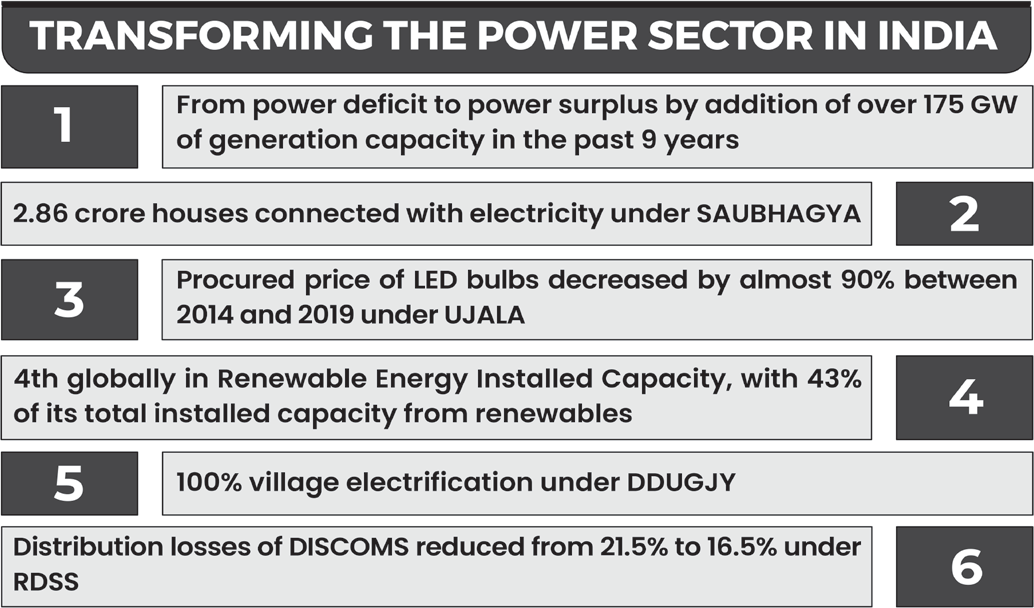
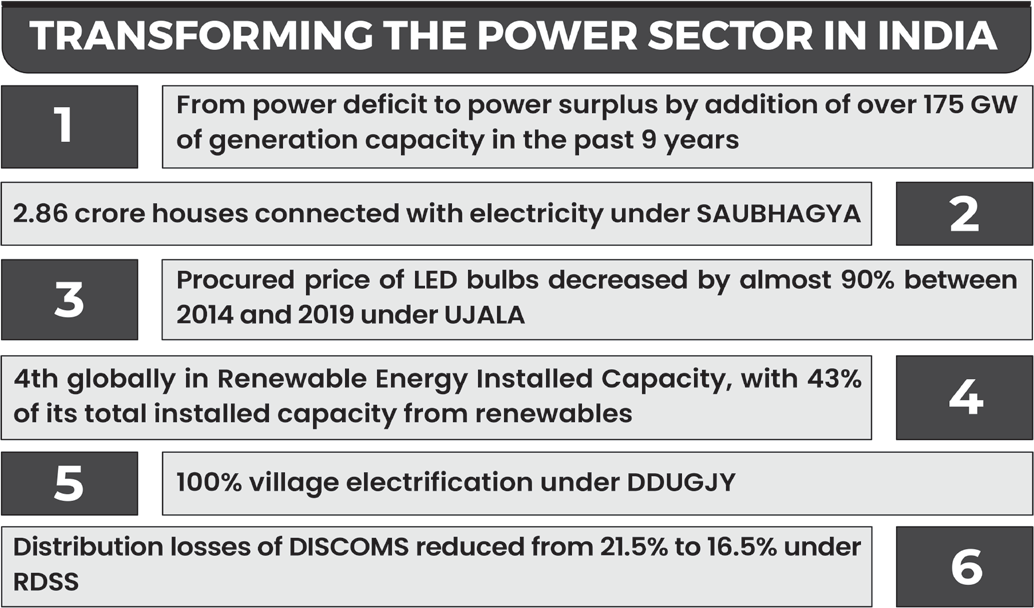
The transformation of India’s power sector since 2014 is a remarkable story of progress and resilience. With achievements like universal electrification, the rapid expansion of renewable energy, improved distribution, and enhanced energy efficiency, India has set an inspiring example for the world.
The commitment of the Government of India, coupled with the participation of stakeholders, has propelled the nation towards a future powered by sustainable, affordable, and reliable energy.
Shipping Sector
Shipping Sector
According to the Ministry of Shipping, around 95% of India’s trading by volume and 70% by value is done through maritime transport
India has 12 major and 200+ notified minor and intermediate ports.
Under the National Perspective Plan for Sagarmala, six new mega ports will be developed in the country.
The Indian ports and shipping industry play a vital role in sustaining growth in the country’s trade and commerce. India is the sixteenth-largest maritime country in the world with a coastline of 7,516.6 kms.
The Indian Government plays an important role in supporting the ports sector. It has allowed Foreign Direct Investment (FDI) of up to 100% under the automatic route for port and harbour construction and maintenance projects.
It has also facilitated a 10-year tax holiday to enterprises that develop, maintain, and operate ports, inland waterways and inland ports.
Jawaharlal Nehru Port Trust (JNPT) Special Economic Zone (SEZ) became the first of its kind operational port- based multi-product SEZ in India.
The capacity of major ports, which was 871.5 million Tonnes Per Annum (MTPA) at the end of March 2014, has increased to 1617.39 MTPA by the end of March 2023.
To meet the ever-increasing trade requirements, the expansion of port capacity has been accorded the highest priority by the government through the implementation of well-conceived infrastructure development projects.
For streamlining the port compliances and for reducing the Turnaround Time for (TAT) for vessels, long strides have been taken at the major ports towards the digitisation of key EXIM processes.
The Port Community System (PCS) has digitised processes such as Electronic Invoice (e-Invoice), Electronic Payment (e-Payment) and Electronic Delivery Order (e- DO) for the physical release of cargo by custodians, in addition to the processes of generating electronic Bill of Lading (e-BL) and Letter of Credit (LC).
Further, the Radio Frequency Identification Device (RFID) solution has been implemented at all major ports to enable seamless movement of traffic across port gates, including substantial reductions in documentation checks.
Additionally, the process to bootstrap PCS into National Logistics Portal-Marine (NLP-Marine) is already under way which will act as a Unified Digital Platform for all maritime stakeholders.
Using navigable waterways to their full potential for inland water transport
There is a lot of unrealized potential for using inland water transportation to move both people and products.
India has a large endowment of rivers, canals, and other waterways. The total navigable length of waterways in India is around 14,850 kilometres.
Under the National Waterways Act 2016, 106 new waterways have been declared as National Waterways (NWs), taking the total number of NWs in the country to 111.
Further, to promote the use of inland waterways, waterway usage charges levied by the Inland Waterways Authority of India (IWAI) on vessels moving on NWs were waived in July 2020, initially for a period of three years.
The Inland Vessels Bill 2021, which replaced the over 100-year-old Inland Vessels Act, 1917 was passed by the Parliament in August 2021. This will usher in a new era for the inland water transport sector and fulfil the vision to utilize the potential of a multi-modal transport ecosystem while making the legislative framework user- friendly and promoting ease of doing business.
Inland Vessels act 2021
The Inland Vessels Act of 1917, which had undergone several amendments, had provisions for the restrictive movement of mechanically propelled vessels and non- uniform standards and regulations across different states. The Inland Vessels Act 2021, which replaced the erstwhile Act, aims to bring uniformity in the application of the law relating to inland waterways and navigation within the country. Some salient features of the Act include:
• State governments may declare by notification any inland water area as a “Zone” depending on the maximum significant wave height criteria as prescribed in the Act. Any mechanically propelled vessel would have to obtain a certificate, which would indicate the zone in which the vessel is to be operated.
• A central database of inland vessels would be maintained by the government.
• The standards for qualification, training, training institutes, examination, and grant of certificate of competency would be prescribed by the Central Government.
• Standards for prevention of environmental pollution.
• Constitution of a Development Fund by the State Government to be utilised for meeting emergency preparedness, containment of pollution, removal of unidentified wrecks or obstruction, boosting development works of inland water navigation, etc.
Overall, the new Act would lead to uniformity of rules across states ensuring unhindered and safe movement of vessels within and across states. This is likely to promote inland water transport as a potential mode for large- scale movement of cargo as well as passengers across the country owing to its relative cost effectiveness.
Telecommunications Sector
Telecommunications Sector
The telecommunication sector is made up of companies that make communication possible on a global scale, whether through the phone, the internet, over airwaves, or cables.
The biggest businesses in the industry are internet service providers, cable companies, satellite companies, and wired and wireless phone operators.
Investors seeking income and growth can find a common interest in telecommunications companies. Although individual stocks can be quite volatile, the telecom sector overall has exhibited stable long-term growth, as telecommunications have become increasingly essential and impervious to business cycles.
India is the world’s second-largest telecommunications market with a subscriber base of 1.17 billion and has registered strong growth in the last decade.
India has an overall tele-density of 84.86 %, of which, the tele-density of the rural market, which is largely untapped, stands at 58.01 % while the tele-density of the urban market is 134.62 %.
The Telecom sector is the 3rd largest sector in terms of FDI inflows, contributing 6.43% of total FDI inflow, and contributes directly to 2.2 mn employment and indirectly to 1.8 mn jobs.
The rapid steps in the telecom sector have been facilitated by liberal policies of the Government that provide easy market access for telecom equipment and a fair regulatory framework for offering telecom services to the Indian consumers at affordable prices.
India is also the second-largest country in terms of internet subscribers. India is one of the biggest consumers of data worldwide.
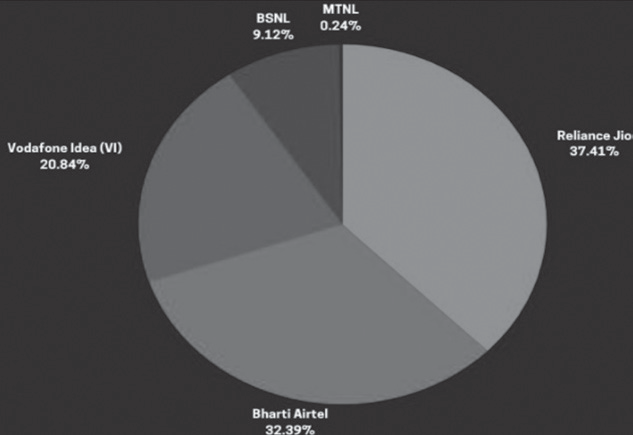
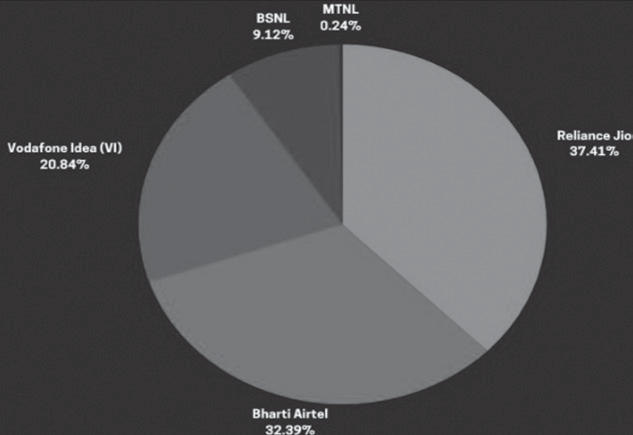
Telecom Market Share FY 2023
Government Initiatives
The government has fast-tracked reforms in the telecom sector. Some of the other major initiatives taken by the government for growth for telecom companies are as follows:
• The Ministry of Communications & Information Technology has launched Twitter Sewa, an online communications platform for registration and resolution of user complaints in the telecommunications and postal sectors.
• In an effort to provide free Internet services to consumers while adhering to net neutrality principles, the Telecom Regulatory Authority of India (TRAI) has published a consultation paper outlining three models for providing free data delivery to users without breaking any laws.
• By giving telecom companies two payment options upfront payment or payment in instalments for obtaining the right to use spectrum, the Indian government has liberalised the terms of payment for spectrum auctions.
• The Department of Telecommunications (DoT) has amended the Unified License for telecom operations which will allow sharing of active telecom infrastructure like antenna, feeder cable and transmission systems between operators, thereby lowering the costs of operations and leading to faster rollout of networks.
• The Telecom Regulatory Authority of India (TRAI) has recommended a Public-Private Partnership (PPP) model for Bharat Net, the central government’s ambitious project to set up a broadband network in rural India, and has also envisaged central and state governments to become the main clients in this project.
• The Ministry of Skill Development and Entrepreneurship (MSDE) signed a Memorandum of Understanding (MoU) with Department of Telecommunication (DoT) to develop and implement National Action Plan for Skill Development in Telecom Sector, with an objective of fulfilling skilled manpower requirement and providing employment and entrepreneurship opportunities in the sector.
• In an effort to stop the rising number of dropped calls, the Telecom Regulatory Authority of India (TRAI) has ordered telecom companies or mobile operators to reimburse customers for any dropped calls.
• Prime Minister Wi-Fi Access Network Interface (PM- WANI): Provision of public Wi-Fi service through Public Data Offices (PDOs) spread across the country to accelerate the expansion of broadband internet services.
Importance of spectrum in telecom
In telecommunications, the term “spectrum” refers to a range of radio waves used for communication purposes comprising of radio and microwave frequencies
Radio frequencies are used for a wide variety of applications, including FM and AM radio broadcasts, television broadcasts, satellite communications, Wi-Fi, Bluetooth and cellular data transmission.
Spectrum Allocation and Regulation: Ensuring Order in the Airwaves
The radio spectrum, being critical for various applications, needs careful regulation to prevent interference between services.
In India, the 2.4 GHz and 5 GHz bands are unlicensed for use in technologies like Wi-Fi and Bluetooth, while the commonly used bands for cellular communication are 800 MHz, 900 MHz,1800 MHz, 2100 MHz, 2300 MHz and 3300 MHz
Telecom Circles and Spectrum Licensing: Managing
Spectrum on a National Scale
In India, spectrum management at the national level is done by dividing the country into 22 telecom circles.
Telecom companies bid for a spectrum license in these circles to offer uninterrupted access across India. This system allows for more granular control over spectrum allocation and ensures nationwide access to telecommunications services.
AGR (adjusted gross revenues) dispute
The telecom sector was liberalized under the National Telecom Policy, 1994 in which licenses were issued to companies in return for a fixed license fee.
In 1999, the government came out with an option of migration to a revenue sharing model.
Revenue sharing model: operators to share a percentage of their AGR as annual license fee and spectrum usage charges.
Definition of AGR soon became a bone of contention: The Department of telecommunications said AGR will include all revenues from telecom and non-telecom services, while telecom players said AGR should only include revenue from telecom services.
The definition for AGR calculation provided by the government was contested in 2005 by the Cellular Operators Association of India (COAI). The telecom companies won a 2015 ruling by the Telecom Disputes Settlement and Appellate Tribunal.
In 2019, the Supreme Court set aside TDSAT’s order and upheld the definition of Department of telecommunications, telcos were asked to pay over Rs 1.4 lakh crore (includes penalties and interest on penalties) combined by January 2020.
Recently the government announced that the definition of AGR will be rationalized and non-telecom revenue will be excluded on prospective basis.
Oil and Gas Sector
Oil and Gas sector
The oil and gas sector are among the eight core industries in India and plays a major role in influencing the decision-making for all the other important sections of the economy.
India’s economic growth is closely related to its energy demand, therefore, the need for oil and gas is projected to increase, thereby making the sector quite conducive for investment. India retained its spot as the third-largest consumer of oil in the world as of 2022.
It has allowed 100% foreign direct investment (FDI) in many segments of the sector, including natural gas, petroleum products and refineries, among others.
The FDI limit for public sector refining projects has been raised to 49% without any disinvestment or dilution of domestic equity in existing PSUs.
It attracts both domestic and foreign investment, as attested by the presence of companies such as Reliance Industries Ltd (RIL) and Cairn India.
India is already a refining hub with 23 refineries, and expansion is planned for tapping foreign investment in export-oriented infrastructure, including product pipelines and export terminals.
Market Size
The gross domestic product (GDP) of India is projected to reach US$ 8.6 trillion by 2040, which means that primary energy demand will almost double to 1,123 million tonnes of oil equivalent, according to the IEA (India Energy Outlook 2021).
India is expected to be one of the largest contributors to non-OECD petroleum consumption growth globally.
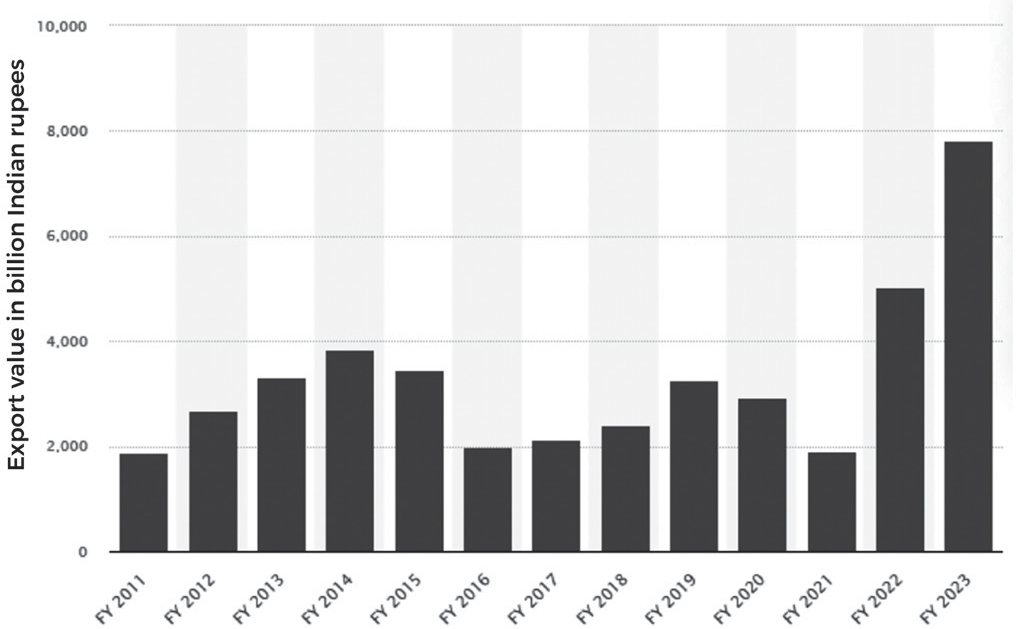
Recent Developments
The Oil and Gas industry in India is set for a sea change with recent developmental ambitions of the Government of India
• India set to achieve 450 GW renewable energy installed capacity by 2030.
• 10% reduction of oil and gas import dependence by 2022
• provision of clean cooking fuels.
In the next ten years, India intends to nearly double its capacity for oil refining to 450 MT in order to meet the growing demand for fuel both domestically and internationally.
The government has moved forward with the E20 target, which is to achieve 20% blended ethanol by 2025.
Government Initiatives
Government announced a reduction in excise duty of Rs. 8 per litter on petrol and Rs. 6 per liter on diesel.
The government approved changes in the Biofuel Policy to bring forward the target for 20% ethanol blending with petroleum to 2025-26 from 2030.
The customs duty on certain critical chemicals such as methanol, acetic acid and heavy feed stocks for petroleum refining were reduced.
India will more than double its exploration area of oil and gas to 0.5 million sq. km. by 2025 and to 1 million sq. km. by 2030 with a view to increase domestic output.
India and the US agreed to expand their energy collaboration by focusing on emerging fuels. This was followed by a ministerial conference of the US-India Strategic Clean Energy Partnership (SCEP).
The Department for Promotion of Industry and Internal Trade (DPIIT) approved an order allowing 100% foreign direct investments (FDIs) under automatic route for oil and gas PSUs.
The Government is planning to set up around 5,000 compressed biogas (CBG) plants by 2024. By 2023-24 with production target of 15 MMT.
One Nation, One Gas Grid
It refers to connecting multiple regional grids to form a national grid and supplying natural gas-produced energy to various stakeholders, such as the federal government, state governments, the public sector, and the commercial sector.
A single gas system can be used to produce and distribute energy based on natural gas across the entire nation. Given that there is now very little natural gas available across the nation, it will aid in reducing the regional disparity in gas availability.
The Petroleum and Natural Gas Regulatory Board (PNGRB) is the organisation responsible for approving the construction of pipelines, and a 33,500 km network of natural gas pipelines has been authorised nationwide.
Objective of One Nation & One Gas Grid
Meeting the targets: The move by the Indian government will assist in achieving its goal of having 15% natural gas in its energy basket mix by 2030. At the moment, natural gas makes up 6.2–6.5% of the mix, while the global average is 23-24%.
Linking the country: With a single nation and gas grid, all of the country’s energy needs will be met by a single source of natural gas.
Enhancing regional imbalance: Since natural gas is currently only available in certain areas of the nation, this will help to improve the regional imbalance of gas availability.
The gas-based economy of India: One country, one gas grid—this will facilitate India’s transition to a gas-based economy. It will promote a clean environment in addition to strong economic development.
Cleaner environment: Natural gas can be a blessing in times when conventional sources are running low and mining is expanding geographically and deeply because it keeps deforestation and desertification at bay.
Cut down on reliance on imports: India now imports 53% of its natural gas. The government is acting to diversify India’s energy mix in an effort to lower this high percentage.
BIOFUELS
Biofuels, which can be liquid or gaseous, are fuels primarily made from biomass and can be used for transportation, stationary applications, portable energy, and other purposes. These biofuels serve as alternatives to, or supplements for, fossil fuels like petrol and diesel. Most biofuel crops are rich in starch (e.g., tapioca and maize), sugar (e.g., sugarcane, sugar beetroot, and sweet sorghum), or oil (e.g., soybean, rapeseed, coconut, and sunflower).
Categories of biofuels
Generally speaking, biofuels fall into three groups. They are:
• First generation biofuels: Conventional technology is used to create first generation biofuels from sugar, starch, vegetable oil, or animal fats. First-generation biofuels that are frequently used are bioethanol, biodiesel, vegetable oil, bio ethers, and biogas.
• Second generation biofuels: These come from non- food crops like wood and wheat and maize stalks, as well as cellulosic biofuels. Advanced biofuels like biohydrogen and bio methanol are two examples.
• Biofuels of the third generation: These are made from microorganisms such as algae.
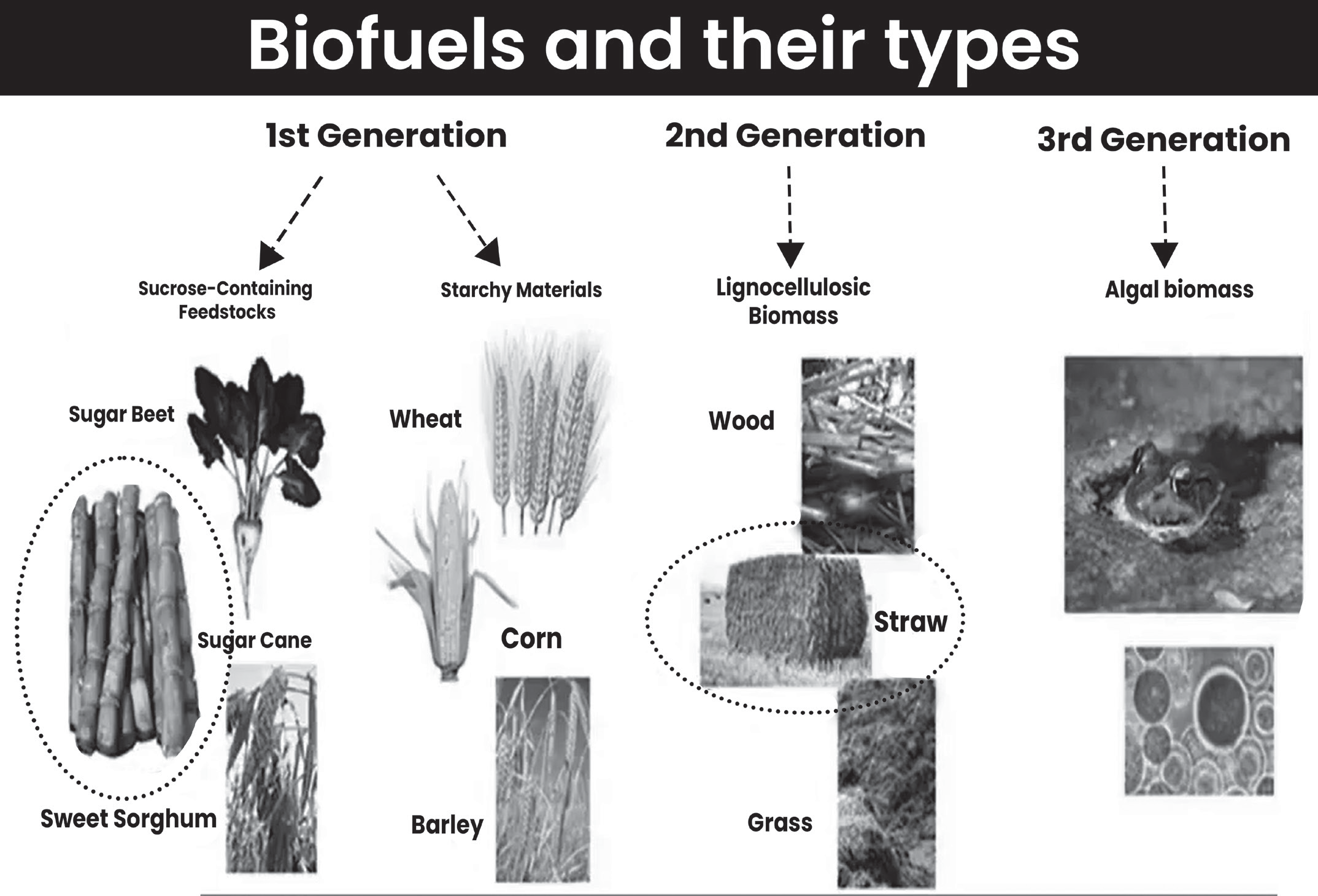
National Policy on Biofuels 2018
In order to promote biofuels in the country, a National Policy on Biofuels was made by the Ministry of New and Renewable Energy.
Biofuels in India are of strategic importance as it augurs well with the ongoing initiatives of the Government such as Make in India, Swachh Bharat Abhiyan, Skill Development and offers great opportunity to integrate with the ambitious targets of doubling of Farmers Income, Import Reduction, Employment Generation, Waste to Wealth Creation.
Biofuels programme in India has been largely impacted due to the sustained and quantum non-availability of domestic feedstock for biofuel production which needs to be addressed.
Salient Features
The policy classifies biofuels into two categories: "Basic Biofuels" and "Advanced Biofuels." "Basic Biofuels" include First Generation (1G) bioethanol and biodiesel, while "Advanced Biofuels" encompass Second Generation (2G) ethanol, Municipal Solid Waste (MSW) converted to drop-in fuels, Third Generation (3G) biofuels, bioCNG, and others. This classification allows for the provision of suitable financial and fiscal incentives for each category.
The Policy expands the scope of raw material for ethanol
production by allowing use of Sugarcane Juice, Sugar containing materials like Sugar Beet, Sweet Sorghum, Starch containing materials like Corn, Cassava, Damaged food grains like wheat, broken rice, Rotten Potatoes, unfit for human consumption for ethanol production.
Farmers are at a risk of not getting appropriate price for their produce during the surplus production phase. Taking this into account, the Policy allows use of surplus food grains for production of ethanol for blending with petrol with the approval of National Biofuel Coordination Committee.
With a thrust on Advanced Biofuels, the Policy indicates a viability gap funding scheme for 2G ethanol Bio refineries of Rs.5000 crore in 6 years in addition to additional tax incentives, higher purchase price as compared to 1G biofuels.
The Policy encourages setting up of supply chain mechanisms for biodiesel production from non-edible oilseeds, Used Cooking Oil, short gestation crops.
Roles and responsibilities of all the concerned Ministries/ Departments with respect to biofuels has been captured in the Policy document to synergise efforts.
Benefits
Import dependency: In 2022-23, with production of about 502 crore litres of ethanol, India has saved about ₹
24,300 crores of foreign exchange and improved India’s energy security.
Cleaner environment: By reducing crop burning & conversion of agricultural residues/wastes to biofuels there will be further reduction in Greenhouse Gas emissions.
Health benefits: Long-term cooking oil reuse, especially when deep-frying, poses a risk to health and can result in a variety of illnesses. Used Cooking Oil is a potential feedstock for biodiesel and its use for making biodiesel will prevent diversion of used cooking oil in the food industry.
MSW Management: It is estimated that, annually 62 MMT of Municipal Solid Waste gets generated in India. There are technologies available which can convert waste/plastic, MSW to drop in fuels. One ton of such waste has the potential to provide around 20% of drop in fuels.
Employment Generation: One 100 klpd 2G bio refinery can contribute 1200 jobs in Plant Operations, Village Level Entrepreneurs and Supply Chain Management.
Additional Income to Farmers: By adopting 2G technologies, agricultural residues/waste which otherwise are burnt by the farmers can be converted to ethanol and can fetch a price for this waste if a market is developed for the same. Also, farmers are at a risk of not getting appropriate price for their produce during the surplus production phase. Thus, conversion of surplus grains and agricultural biomass can help in price stabilization.
Infrastructural Investment in Rural Areas: At present Oil Marketing Companies are in the process of setting up twelve 2nd Generation bio refineries with an investment of around Rs.10,000 crore. Further addition of 2G bio refineries across the Country will spur infrastructural investment in the rural areas.
National Policy on Biofuels (2022 Amendment)
Due to advancements in the field of Biofuels, various decisions taken in the National Biofuel Coordination Committee (NBCC) meetings to increase biofuel production, recommendation of the Standing Committee and the decision to advance to introduce Ethanol Blended Petrol with up to twenty per cent ethanol throughout the country, amendments are done to the National Policy on Biofuels.
The following are the main amendments approved to the National Policy on Biofuels:
To allow more feedstocks for production of biofuels,
To advance the ethanol blending target of 20% blending of ethanol in petrol to ESY 2025-26 from 2030,
To promote the production of biofuels in the country, under the Make in India program, by units located
in Special Economic Zones (SEZ)/ Export Oriented Units (EoUs),
• To add new members to the NBCC.
• To grant permission for export of biofuels in specific cases, and
• To delete/amend certain phrases in the Policy in line with decisions taken during the meetings of National Biofuel Coordination Committee
The Real Estate (Regulation and Development) Act 2016 (RERA)
The real estate industry is an important part of the Indian economy, with linkages to over 250 ancillary sectors and employing more than 10% of India’s workforce.
The Real Estate (Regulation and Development) Act (RERA) was passed in 2016 to safeguard consumers’ interests through regulation and promotion of the sector, as well as to provide grievance redressal channels to address disputes.
The RERA Act is the most ground-breaking change in the Indian real estate sector since independence. It dismantled obscurity by requiring a uniform disclosure method, frequent financial monitoring, and a grievance redressal structure. RERA has made tremendous progress despite a re-alignment of interests that was not well received by its stakeholders.
Key Provisions
Developers must now register their projects with RERA
before they can be advertised or sold.
Before the sale starts, developers must also have all sanction plans approved and all regulatory clearances obtained. The regulator and the majority of buyers must approve any further changes.
The ambitious Act mandates an electronic system where developers are required to submit regular audits and architectural reports, as well as a quarterly update on the status of their projects, on the RERA website.
It requires developers to maintain separate escrow accounts in relation to each project and deposit 70% of the collections in such an account to ensure that funds collected are utilised only for the specific project.
Real estate brokers and agents must register with the regulator in accordance with the Act.
Additionally, the Act aims to create an adjudicatory process for the prompt resolution of disputes. It is anticipated that complaints will be resolved by RERA and the Appellate Tribunal in an ambitious 60 days.