Irrigation
Irrigation is defined as the science of artificial application of water to the land, in accordance with the crop requirement throughout the crop period for full-fledged nourishment of the crops.
The irrigation system is a manmade water management system, which is required to fulfil the water demands of the crop during less rainfall. Irrigation leads to increased efficiency and potentially higher incomes.
Necessity of irrigation in India
Non-irrigated (rain-fed) agriculture depends entirely on rainfall, stored in the soil profile. This form of agriculture is possible only in regions where rainfall distribution ensures continuing availability of soil moisture during the critical growing periods for the crops.
In irrigated agriculture, water taken up by crops is partly or totally provided through human intervention. Irrigation water is withdrawn from a water source and led to the field through an appropriate conveyance infrastructure.
The reasons why irrigation is a necessity in India
Seasonal Rainfall: Most of India’s rain falls during the monsoon season (June-September). The remaining eight months lack sufficient precipitation to meet crop water needs, making irrigation essential.
Unpredictable Monsoons: The monsoon’s erratic nature necessitates year-round irrigation facilities to safeguard against droughts and ensure crop survival.
Low Rainfall Regions: Areas like Rajasthan receive minimal rainfall, requiring irrigation to fulfill the water demands of crops.
Porous Soils: Sandy soils in some regions have high permeability, causing irrigation water to drain quickly, leaving crops thirsty. Irrigation becomes crucial in these areas to ensure adequate water reaches the plants.
Increased Crop Yields: Irrigation allows for optimal water supply, leading to increased agricultural output and improved profits for farmers. This fosters economic growth in India, where a significant portion of the population relies on agriculture.
Multiple Cropping: Without irrigation, areas may only support one crop during the rainy season. Irrigation enables farmers to cultivate additional crops (Rabi crops) in other seasons, maximizing land use.
Perennial Crops and Cash Crops: Perennial crops like
sugarcane require consistent water supply throughout the year, which irrigation provides. Additionally, irrigation allows for cultivating commercially valuable crops that might otherwise struggle with limited rainfall.
Controlled Water Delivery: Proper irrigation systems ensure controlled water distribution, optimizing water usage and maximizing crop yield. Additionally, proper irrigation practices can contribute to groundwater recharge, storing water reserves for drier periods.
Current Scenario
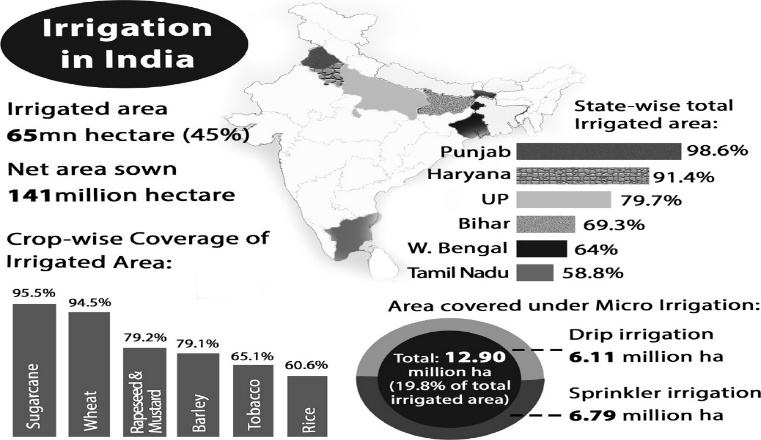
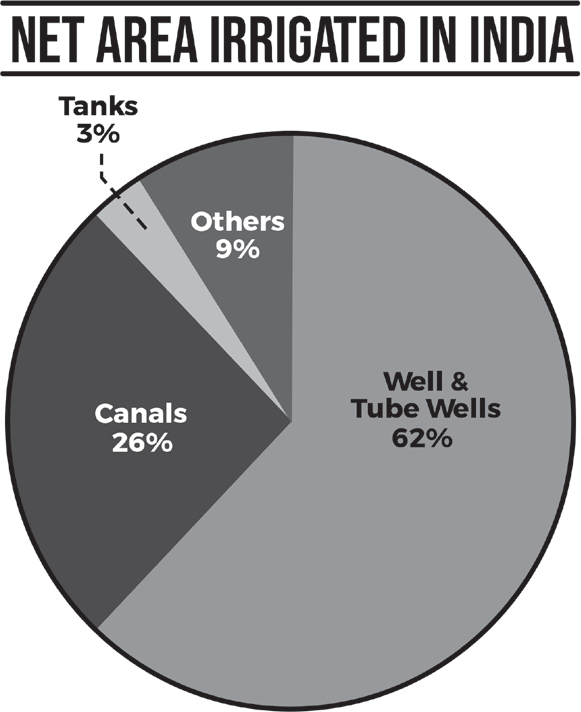
Of the total available agricultural land i.e. 1,80,888 thousand hectares. In several major states, including Maharashtra and Jharkhand, less than 20 percent of arable land is irrigated. Punjab is the only State which has nearly achieved 100 percent net irrigation followed by Haryana. Uttar Pradesh, Bihar, and West Bengal are among the five top States with more than 50 per cent net irrigated area. Interestingly, as per the government data 60 percent of the net irrigated area in the country is serviced through groundwater, which is under threat due to depleting water tables.
WATER BODIES AND STORAGES
Inland water resources of India are classified as rivers, canals, reservoirs, tanks and ponds, beels, oxbows,
lakes, derelict water and brackish water, and they cover an area of 7 mha excluding rivers and canals.
These are unevenly distributed in the country, and five states, i.e., Orissa, Tamil Nadu, Andhra Pradesh, Karnataka and West Bengal, account for more than 50 percent of the inland water bodies.
Uttar Pradesh has the highest total length of rivers and canals of 31,200 km, followed by Jammu & Kashmir and Madhya Pradesh.
Most of the lakes, beels and derelict water bodies lie in the states of Kerala and Tamil Nadu, whereas Orissa, West Bengal and Kerala have the largest areas of brackish water.
Irrigation Census
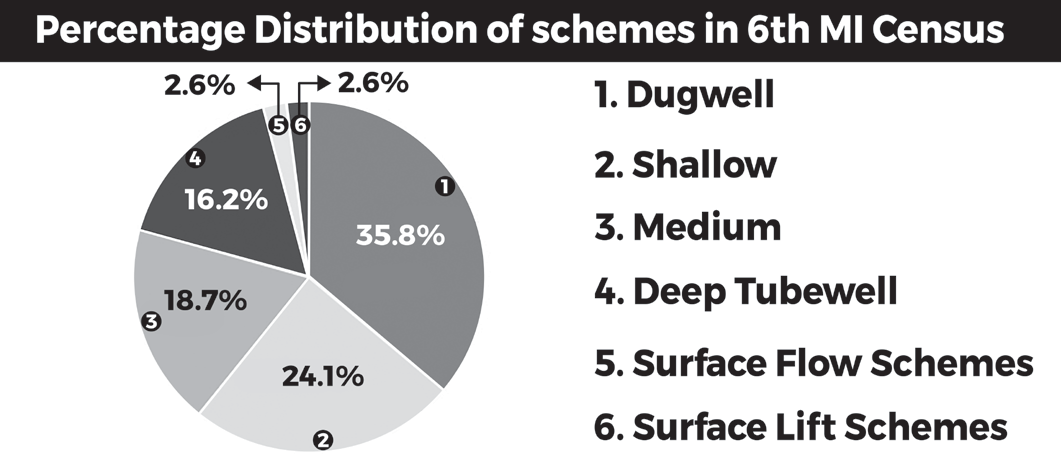
Minor irrigation schemes, utilizing groundwater or surface water and serving areas less than 2,000 hectares, play a vital role in expanding irrigation across India.
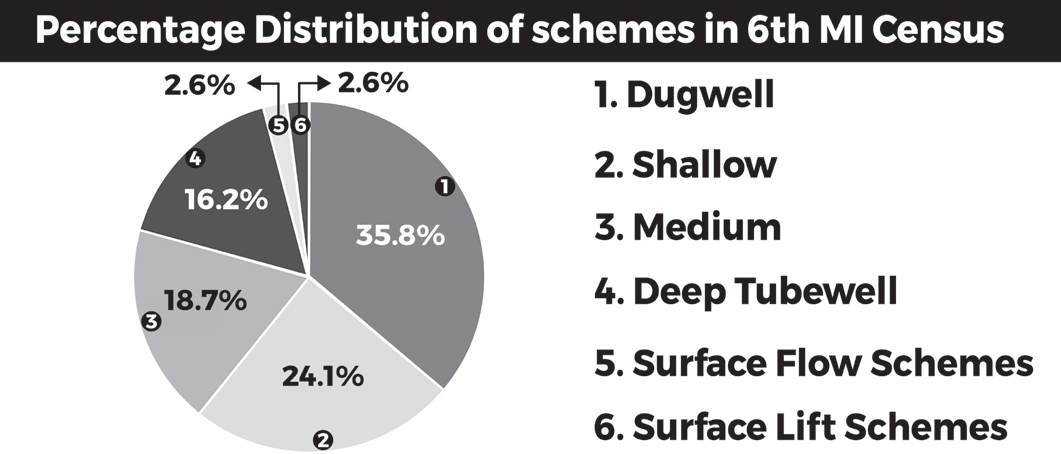
These schemes are categorized into six main types: 1. dug wells, 2. shallow tube wells, 3. medium tube wells, 4. deep tube wells, 5. surface flow schemes, and 6. surface lift schemes.
Recognizing the importance of minor irrigation for agriculture, several censuses have been conducted to create a comprehensive database for planning, development, and management of these schemes. The first census began in 1986-87, with subsequent censuses conducted periodically, with the latest one being the Sixth Minor Irrigation Census referencing the year 2017-18.
Methods of Irrigation
METHODS OF IRRIGATION
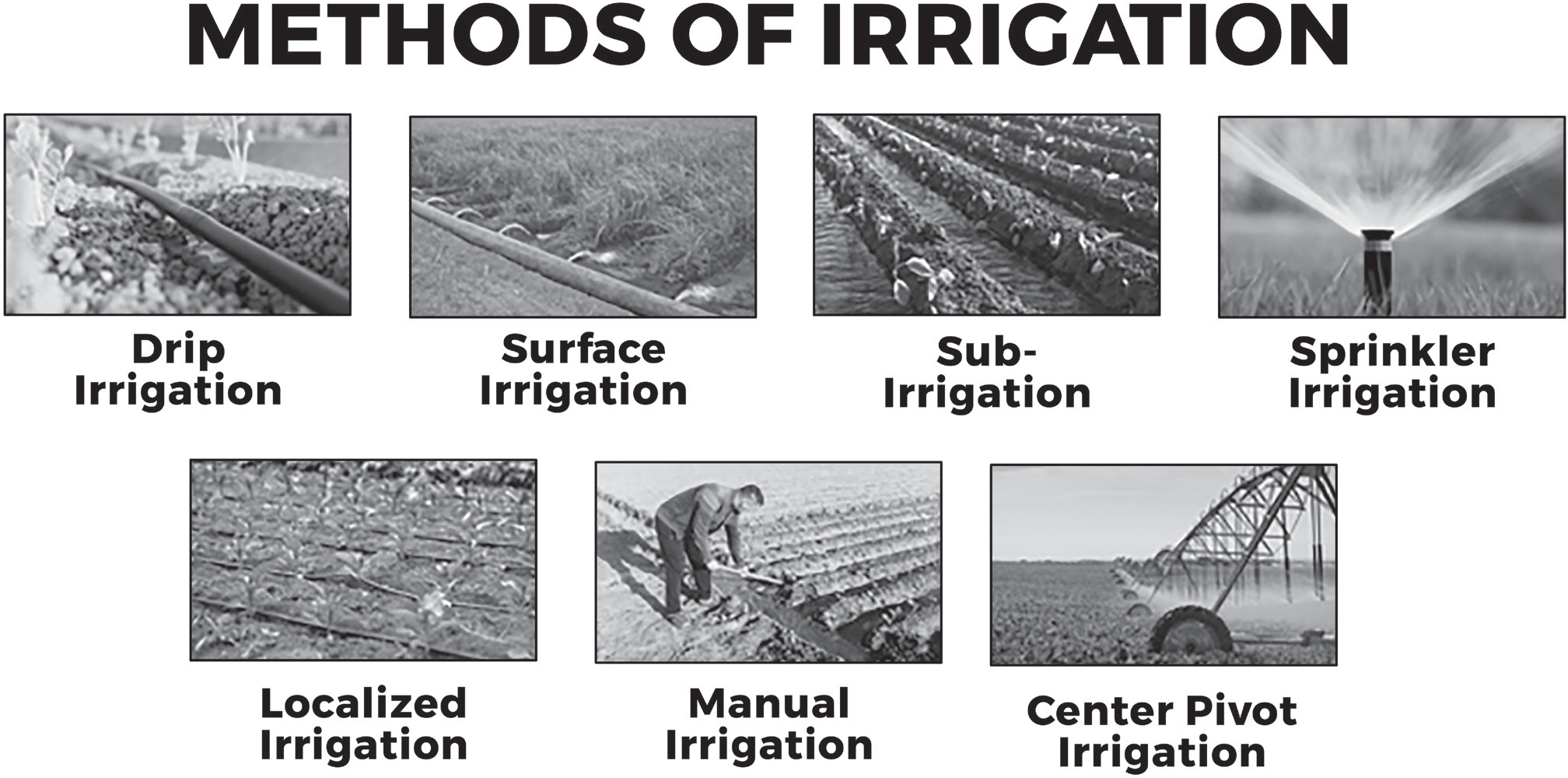
Efficient methods of irrigation enable the application of the right amount of water to the crop at the right time and its uniform distribution in the field. Water may be applied to the crops by spreading it in a sheet or in small streams on the soil surface, by spraying it over the crop through pipes and nozzles or by applying it in drops to wet the crop root zone.
Border irrigation
Border irrigation is a controlled surface flooding method of water application. The field is divided into a number of long parallel strips called borders, that are separated by low ridges.
The border method of irrigation is most suitable for close growing grain crops, such as wheat, barley and fodder crops.
Field trials in India have shown that border irrigation is suitable in most areas of the country. Water is retained in the basin until it soaks into the soil.
Basin irrigation
The basin method of irrigation is essentially applied to orchards.
On flat terrain, the basins are square-shaped for efficient water distribution to each tree.
For sloped land, the basins are formed differently. Ridges are constructed along the contours (imaginary lines following equal elevation) of the slope, with shorter ridges added at the ends to create enclosed compartments. Ideally, each basin holds a single tree.
Sprinkler irrigation
In sprinkler irrigation, water is sprayed into the air through a sprinkler nozzle and allowed to fall on the land surface in a uniform pattern at a rate less than the infiltration rate of the soil.
Sprinklers were introduced in India during the early 1950s and were used initially on high value plantation crops such as tea, coffee, chicory, cardamom and in orchards.
Their use is gaining popularity on food crops, orchards, cotton and vegetables in areas where sprinklers are economically suitable and technically feasible.
Sprinkler irrigation can be used for almost all crops (except rice and jute) and on nearly all soils.
Drip irrigation
Drip irrigation, also called trickle irrigation, involves slow application of water to the plant root zone.
Water is applied slowly and directly to the plant’s root zone, minimizing waste through evaporation or deep drainage. This replenishes moisture optimally and promotes growth by maximising effectiveness of the water and fertilizer. It minimises water wastage.
TYPES OF IRRIGATION SYSTEM
Depending upon the availability of surface or groundwater, topography, soil and rivers, various types of irrigation practiced in India are as follows
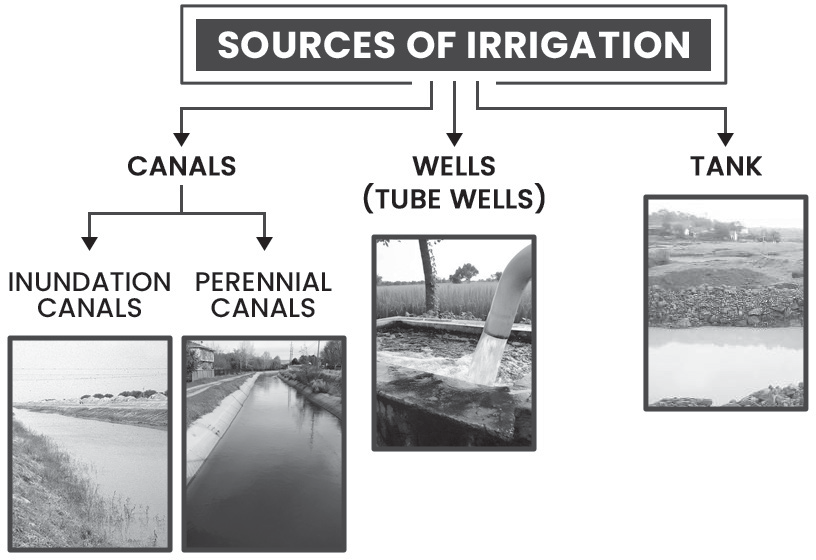
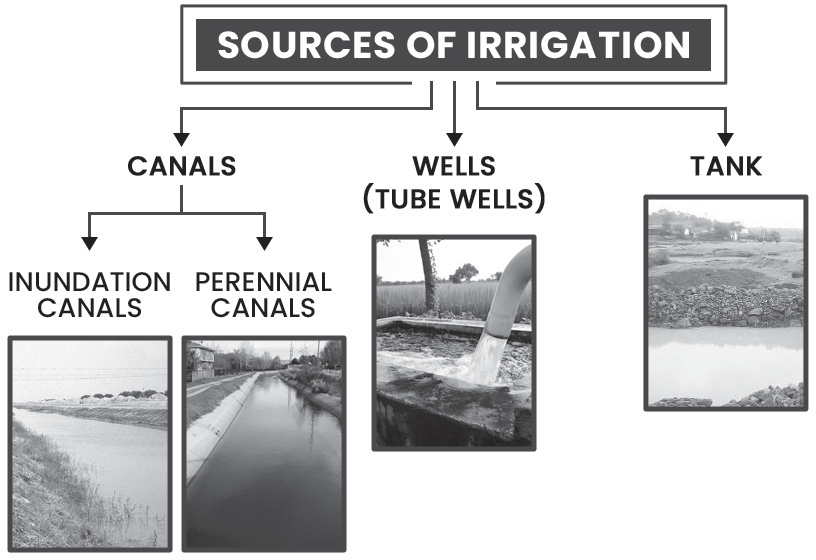
Well irrigation accounts for more than 60 percent of the net irrigated area in the country against 26 percent by the canal and only 3 per cent through the tank irrigation.
TANK WATER IRRIGATION SYSTEM
It is prevalent in the uneven and relatively rocky plateau of Peninsular India.
Tanks are commonly used in Deccan Plateau, Andhra Pradesh, Karnataka, Tamil Nadu, Eastern Madhya Pradesh, Chhattisgarh, Orissa and Maharashtra.
Most of the tanks are small in size and built by individuals or groups of farmers by raising bunds across seasonal streams.
Advantages
Most of the tanks are natural and do not involve heavy cost for their construction. Even an individual farmer can have his own tank.
Tanks are generally constructed on rocky beds and have a longer life span.
In many tanks, fishing is also carried on. This supplements both the food resources and income of the farmer.
Disadvantages
Tanks cover a large area of cultivable land.
Evaporation of water is rapid due to large expanses of shallow water of tanks, which do not ensure perennial supply of water.
Moreover, lifting of water from tanks and carrying it to the fields is a difficult and costly exercise.
WELL WATER IRRIGATION SYSTEM
It is more widespread in plains, coasts and some regions of peninsular India.
It is less costly and more flexible as water can be drawn whenever needed and ‘evaporation loss’ is minimized.
Uttar Pradesh has the largest area under well irrigation which accounts for about 28 per cent of the well irrigated area of India.
Uttar Pradesh, Rajasthan, Punjab, Madhya Pradesh, Gujarat, Bihar and Andhra Pradesh account for three- fourths of the total well irrigated area of India.
Wells are of two types
Open wells: open wells are shallow and irrigate a small area because water available is limited and the level of water goes down during the arid season.
Tube-wells: Tube wells are deep, more suitable and have the capacity to draw a large volume of water. Such type of well always has water irrespective of time. A deep tube well uses electricity to work, can irrigate much larger area (about 400 hectares) than a surface well (1/2 hectares).
Inundation/Canal Irrigation system
Canal irrigation is playing a vital role in Indian agriculture because these are the main source of irrigation in India.
It covers nearly 26 per cent of total irrigated land.
These canals are found in W.B., Bihar, Orissa, etc.
They supply water only when there is flood in the rivers, and therefore, are of no use during the dry season when water is required most.
Perennial Canals Irrigation System
Perennial canals provide a dependable source of irrigation by drawing water from rivers or reservoirs built on rivers (“dams”). These reservoirs store water during high-flow periods, ensuring a year-round supply for crops. This system is prevalent in states like Tamil Nadu, Andhra Pradesh, Karnataka, Punjab, and Uttar Pradesh. Canals then transport the stored water from these reservoirs to agricultural fields.
Multipurpose River Valley Projects: They have increased since Independence and are being setup primarily for irrigation like Bhakra Nangal Project on Sutlej, Hira Kud Dam on Mahanadi etc.
Advantages of Irrigation
Increase in food production: Irrigation helps in increasing crop yields, and hence, to attain self-sufficiency in food.
Optimum utilization of water: Due to different irrigation techniques, we provide water as per the requirement of the crop resulting, we obtain maximum crop yield. Hence, we get maximum crop yield by optimum use of water.
General Prosperity: Due to the well-designed irrigation system, we get a high revenue return which ultimately helps to develop the country and the prosperity of the entire nation.
Multi-purpose Water Resources: Dams built for irrigation can also serve as sources of domestic water for nearby communities.
Environmental Benefits: Irrigation can support afforestation efforts by enabling tree growth along embankments, reducing air pollution and soil erosion while enhancing aesthetics.
Increase in Land Value and Productivity: Efficient irrigation increases the value of land by allowing for multiple harvests throughout the year, leading to a more stable and productive agricultural sector. This can potentially lower the cost of living.
Reduced Labor: Irrigation reduces farmers’ time and effort by automating the watering process, potentially increasing efficiency and income.
Issues Related to Irrigation in India
Despite large-scale investment and expansion of irrigation facilities it is a matter of serious concern that about 60 percent of the total cropped area is still dependent on rain. There are number of problems related to irrigation
Project Delays: A major hurdle has been the slow completion of irrigation projects, often due to starting too many initiatives at once. This neglects existing potential and delays crucial steps like building field channels and land development.
Inter-state Water Disputes: Since irrigation falls under state control, disputes arise between states sharing rivers. Differing priorities and water usage strategies lead to regional rivalries over limited water supplies.
Uneven Development: Development of irrigation infrastructure varies greatly across regions in India. The north have achived a much higher development rate (around 95%) compared to the northeast (around 29%).
Waterlogging and Salinity: Excessive irrigation has contributed to waterlogging and salinity issues in some states. Millions of hectares of land is affected, impacting agricultural productivity.
Rising Costs: The financial burden of irrigation projects has steadily increased over time.
Decline in water table: There has been a steady decline in water table in the recent period in several parts of the country, especially in the western dry region, on account over exploitation of ground water and insufficient recharge from rain-water.
Measures to Improve Water Storage and Irrigation System
The per capita water availability has come down from 5177 cubic meters in 1951 to 1545, as per the 2011 census. This translates into a decline of about 70 percent in 60 years. The decline is expected to progress further reaching a low of 1140 cubic meters by 2050. As per the government of India, per capita water availability of less than 1700 cubic meters is considered a water-stressed condition and when availability drops to 1000, the situation is termed as water scarcity condition. Since there are large variations in both temporal and spatial patterns of precipitation, many regions in the country are already facing the water-stressed or water- scarcity condition.
The challenges faced by the country in water management includes
High spatial and temporal variability in respect of rainfall distribution and availability of water resources.
An increase in population is one of the major causes of declining per-capita water availability.
Inadequate water storage for meeting future water demand.
Over-exploitation of groundwater resources.
Droughts.
Low water use efficiency.
Way Forward
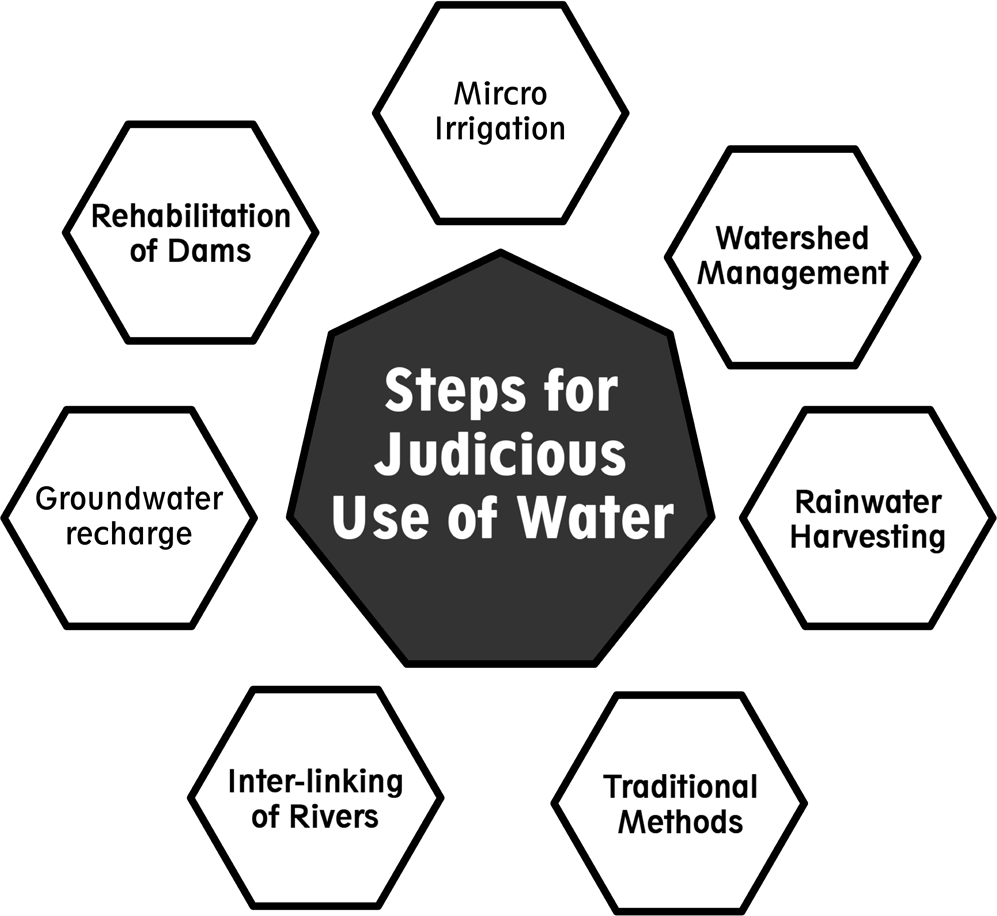
Watershed Management
Within a watershed, we can manage the land and water resources in a comprehensive manner in such a way that the quality of water and other natural resources is improved, while humans are able to avail the desired goods and services. The implementation of such practices is termed watershed management. Under this, one of the components is checking the wild run-off of rainwater in upper slopes. This reduces soil erosion and increases water percolation, replenishing groundwater reserves. India has witnessed the launch of several schemes for watershed management like the Desert Development Programme (DDP), Drought Prone Area Programme (DPAP), and Integrated Wasteland Development Programme (IWDP). All these have now been integrated into the Watershed Development Component of Pradhan Mantri Krishi Sinchayee Yojana (WDC-PMKSY), whose main objective is to restore ecological balance by harnessing, conserving, and developing degraded natural resources like water, soil, vegetative cover, etc. To strengthen WDC-PMKSY, World Bank-assisted
Neeranchal is being run to provide technical assistance to the program.
Intensive afforestation and reforestation also form an important component of watershed management. Forests decrease the run-off rate and increase the percolation of water. This prevents floods and helps in recharging groundwater. Since the run-off rate decreases, the soil erosion rate also decreases, preventing flooding of water channels and maintaining the capacity of reservoirs of dams. The government is implementing the following three major schemes for the development of forest areas.
For afforestation of degraded forest lands, National Afforestation Programme (NAP) scheme was launched in 2002.
National Mission for a Green India (GIM) for improving the quality of forest and increase in forest cover
Forest Fire Prevention & Management Scheme (FFPM) takes care of forest fire prevention and management measures.
Micro-irrigation
Agriculture is a water-intensive activity. Globally, agriculture consumes 70% of the water used for human activities. In India, this it is as high as 90%. This makes micro-irrigation the best solution to the problem of depleting water resources. The micro-irrigation techniques reduce water consumption in agriculture in the range of 30-70%. Fertigation and chemigation are added advantages, leading to the efficient application of fertilizers and pesticides. All this is not just environment friendly, but also highly cost-effective. Also, micro-irrigation results in better crop productivity and helps in bringing cultivable wastelands and water-deficient areas under cultivation.
Micro-irrigation in India has a penetration of just around 20%. The percentage is less than 2 for Uttar Pradesh and Punjab, the two states where water-intensive crops are cultivated and intensive agriculture is practiced in large areas. Though India introduced micro-irrigation way back in 1992, it has been given a thrust as a component of PMKSY (PMKSY- Per Drop More Crop) and as an important part of the National Mission for Sustainable Agriculture.
Rainwater Harvesting, Traditional Methods and Groundwater Recharge
Rainwater harvesting is practiced since ancient times in India. Rainwater harvesting is simply about collecting and storing rainwater at the surface or in sub-surface aquifers to prevent rainwater from getting lost as runoff. Recently, popular traditional methods like Johads, led by Waterman of India, Shri Rajendra Singh. Traditional methods are not only inexpensive but can be implemented by the local population especially in rural areas. Urban areas, however, require more modern methods due to the large-scale concretization of the landscape.
In 2019, Jal Shakti Abhiyan (JSA) was launched in 256 districts in mission mode for improving water availability including groundwater conditions. In addition, the ‘Jal Shakti Abhiyan Catch the Rain’ campaign has been launched recently in March 2021 for creating appropriate Rain Water Harvesting Structures (RWHS) suitable to the climatic conditions and sub-soil strata before monsoon. Mission Water Conservation has been launched to ensure synergy between MGNREGS, PMKSY-WDC, and Command Area Development & Water Management (CAD&WM) programmes.
Under the Environment (Protection) Act, 1986, Central Ground Water Authority (CGWA) has been constituted for regulating and controlling groundwater development and management in the country. It advises states on measures to be taken for managing groundwater and issues No Objection Certificate (NOCs) for groundwater extraction to industries and large-scale projects. It has undertaken Aquifer Mapping of India for formulating aquifer-specific management plans.
Mass awareness programs and National Water Awards have been constituted for incentivising good practices in water conservation and groundwater recharge. World Bank funded Atal Bhujal Yojana (ABHY) is being taken up in identifying over exploited and water stressed areas for sustainable management of groundwater with community participation.
Inter-Linking of Rivers
To overcome the challenge of high temporal and spatial variability in respect of rainfall and availability of water resources, the interlinking of rivers to transfer water from areas with excessive water to areas deficient in water has been envisaged. The interlinking will be done through a network of canals, resulting in the prevention of floods in water excess areas and overcoming droughts in water deficit areas. This will also enhance the irrigation potential of India as well as help in recharging groundwater.
There are three components of the project:
Himalayan component,
Southern Peninsular component, and starting 2005,
An intrastate river linking component.
However, due to high ecological, human, and cost impacts, the project has been moving at a slow pace.
Rehabilitation of Dams
Along with a variety of other uses, flood prevention is one of the major advantages of reservoirs created by dams. India has more than 5000 large dams in operation and more than 400 are under construction. Being essential to the water security of India, their management and safety becomes important. To improve the safety and operational performance of more than 200 dams, Dam Rehabilitation and Improvement
Project (DRIP) was launched with World Bank assistance. It was successfully concluded in March 2021. Since then, DRIP Phase II and III have been given nod to include more than 700 dams under its safety net.
Conclusion
The problem of depleting sources of water can be managed through increasing water use efficiency through micro- irrigation, recharging groundwater aquifers through watershed management, intensive afforestation, and reforestation and rainwater harvesting with a special focus on traditional methods in rural areas, and rehabilitation of dams. Mass awareness campaigns with IEC (Information, Education, and Communication) approach will go a long way in water conservation efforts. Other techniques like recycling wastewater for uses other than human consumption may be taken up in cities. This will free the freshwater for human consumption. All these approaches implemented in synergy, along with population control, will lead to better per capita availability of water.
Recent Government Initiatives in Irrigation
RECENT GOVERNMENT INITIATIVES IN IRRIGATION
Pradhan Mantri Krishi Sinchayee Yojana (PMKSY)
It is a Centrally Sponsored Scheme on Micro Irrigation with the objective to enhance water use efficiency in the agriculture sector by promoting appropriate technological interventions like drip & sprinkler irrigation technologies and encourage the farmers to use water saving and conservation technologies.
The broad objectives of PMKSY include
Investing in Efficiency: Focus investments at the field level, prioritizing District Level Water management Plans. This optimizes water usage through targeted infrastructure development.
Expansion: Enhance the physical access of water on the farm and expand cultivable area under assured irrigation (Har Khet ko Pani).
Technological Innovation: Integrate water sources, distribution networks, and efficient water use practices. Promote precision irrigation and water-saving technologies to maximize “Per Drop More Crop” outcomes.
Sustainability: Enhance aquifer recharge through sustainable water conservation practices. This includes rainwater harvesting and watershed management to ensure long-term water availability.
Farmer Empowerment: Promote extension activities educating farmers and field workers on water harvesting, management, and crop selection for optimal water use.
Alternative Resources: Explore the feasibility of reusing treated wastewater for peri-urban agriculture.
Public-Private Partnership: Attract greater private sector investment to support the modernization and expansion of irrigation infrastructure.
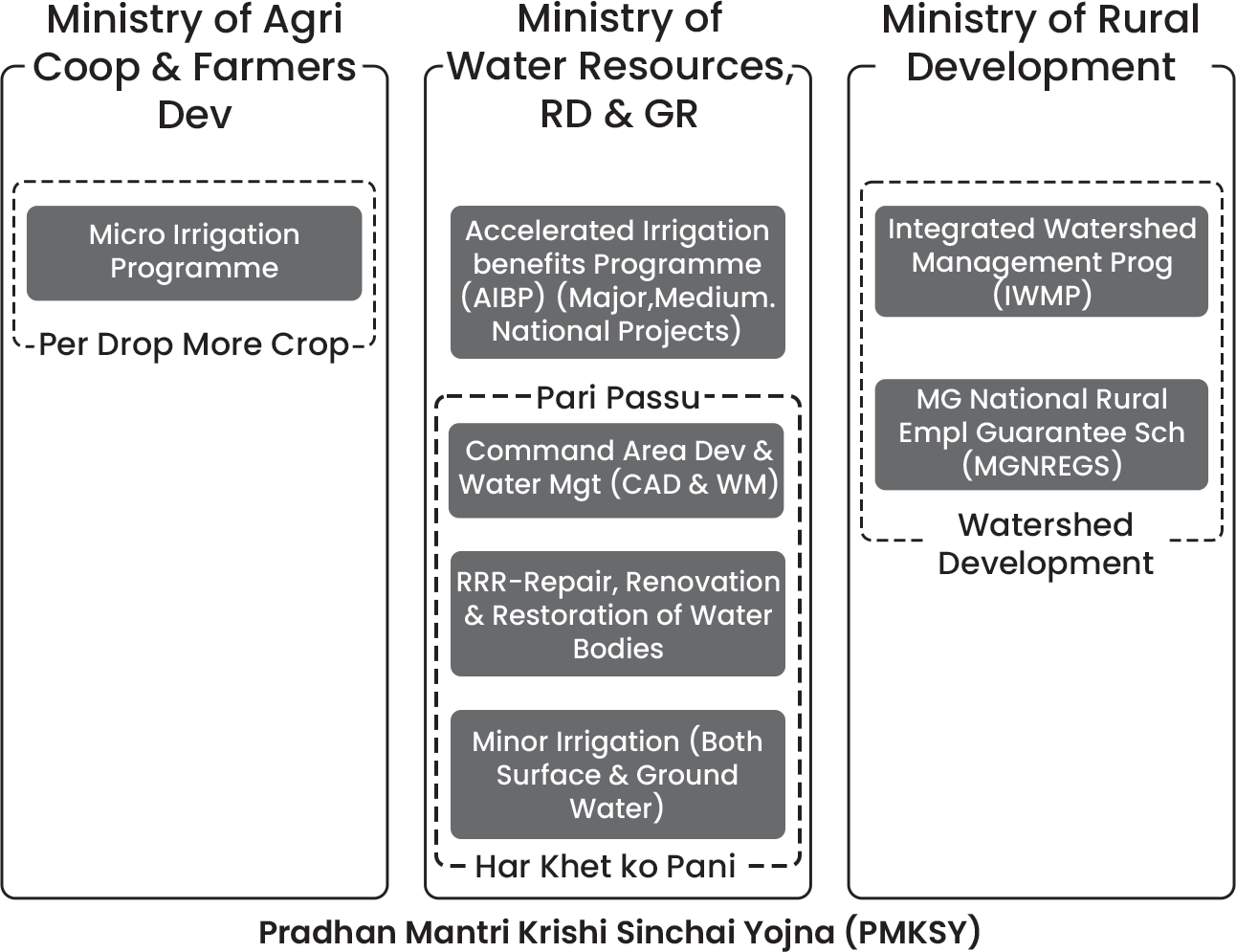
Programme Components of PMKSY
Accelerated Irrigation Benefit Programme (AIBP): To focus on faster completion of ongoing Major and Medium Irrigation including National Projects.
Har Khet Ko Pani (HKKP): focuses on expanding cultivable area under assured irrigation and is funded through the ongoing Command Area Development & Water Management (CADWM) programme.
Per Drop More Crop: Focuses on maximizing water use efficiency at the farm level through “Micro Irrigation” including Drip, Sprinkler, Micro Sprinklers etc. and “Supplementary Water Management Activities" (SWMA) and Other interventions which include farm level secondary storage structures.
Watershed Development: Watershed Development component focuses on Effective management of runoff water and improved soil & moisture conservation activities such as ridge area treatment, drainage line treatment, rain water harvesting, in-situ moisture conservation and other allied activities on watershed basis.
Micro Irrigation Fund under PMKSY
Micro Irrigation Fund: A dedicated Micro Irrigation Fund (MIF) established with National Bank for Agriculture and Rural Development (NABARD) helps states expand micro irrigation coverage. This fund supports innovative
projects and incentivizes farmers beyond existing subsidy schemes.
Farmer Education: The Indian Council of Agricultural Research (ICAR) plays a crucial role in educating farmers. They train farmers and organize field demonstrations through Krishi Vigyan Kendras (KVKs) to promote efficient irrigation techniques like micro irrigation for various crops.
Financial Assistance: The government provides a subsidy of 55% for small and marginal farmers and 45% for others to install micro irrigation systems under the Per Drop More Crop (PDMC) scheme. Some states offer additional incentives to further reduce the cost burden on farmers and encourage adoption.
Achievements
Through tireless efforts, the government has achieved key milestones in improving Irrigation facilities in India. It its Year End Review, the Ministry of Jal Shakti reported the following
Under the Catch the Rain Campaign 10,59,816 Water Conservation & Rain Water Harvesting Structures, 5,88,816 reuse and recharge structures & 12,41,245 watershed development structures were built. 661 Jal Shakti Kendras and 520 District Water Conservation Plans were prepared.
67,902 Small & Marginal Farmers Benefitted Under Pradhan Mantri Krishi Sinchayi Yojana – Har Khet Ko Pani.
In the Assessment Of Dynamic Ground Water Resources Of India 2023 Report the total groundwater recharge in India was 449.08 Billion Cubic Meters (BCM). Of this, it was assessed that the Annual Groundwater Extraction is
241.34 BCM.
Bureau of Water Use Efficiency (BWUE) has been setup to improve Water Use Efficiency (WUE) by 20% under National Water Mission to work on mission mode.
National Perspective Plan (NPP) has been formulated by Government of India for 30 inter-basin water transfer links (16 Peninsular and 14 Himalayan component) for which the National Water Development Agency is preparing feasibility reports (FRs)
Central Water Commission (CWC) with Asian Development Bank (ADB) will conduct Support for
Irrigation Modernization Program (SIMP) which will provide technical assistance to modernize Major/ Medium Irrigation (MMI) projects in the country.
Central Ground Water Board (CGWB) is implementing National Aquifer Mapping and Management program (NAQUIM), which envisages mapping of aquifers (water bearing formations), their characterization and development of Aquifer Management Plans to facilitate sustainable management of ground water resources.
Pradhan Mantri Krishi Sinchayee Yojana (PMKSY) for 2021-26 with an outlay of Rs.93,068 Crore to benefit about 22 lakh farmers. Geo Information System (GIS) based Application has been developed for geo-tagging of project components. Remote Sensing Techniques have been used for digitization of the canal network of the projects. Further, the Cropped Area estimation in the command of 99 priority projects is being carried out annually through remote sensing