Recent Developments
RECENT DEVELOPMENTS: DIGITALIZATION OF LAND RECORD
Digital India Land Records Modernization Programme (DILRMP)
Launched in 2008, DILRMP aims to:
Digitize and modernize land records.
Automate updates and mutations (changes in ownership) in records.
Integrate textual and spatial data for land parcels.
Connect revenue and registration departments.
Replace current deed registration with a guaranteed conclusive titling system.
Key Components
Computerized land records.
Land surveying and re-surveying.
Registration computerization.
Modern record rooms and management centers at local levels.
Training and capacity building for involved personnel.
Benefits
Real-time access to land ownership records for citizens.
Reduced citizen interaction with government officials.
Faster and easier access to land records through single- window service.
Reduced risk of fraudulent property deals.
E-linkages for easier access to credit facilities.
NATIONAL GENERIC DOCUMENT REGISTRATION SYSTEM (NGDRS)
Department of Land Resources, Ministry of Rural Development launched the National Generic Document Registration System (NGDRS) as part of the Digital India
Land Records Modernization Programme. NGDRS is a single platform for registering documents and properties across India has been implemented in 10 states/UTs, benefiting over 10 crore people.
The system offers several advantages, including:
Reduced land disputes and fraudulent transactions.
Faster document registration: time taken in document registration has reduced from 9 to 6 processes and from 3-4 hours to 15-20 minutes respectively.
Online appointment scheduling and property information access through SMS.
Improved monitoring and data analysis for authorities through live dashboard.
Integration: data shared and used by important government authorities/stakeholders like the Revenue Department (Income Tax) can be incorporated with data policy and standards in place; and even external system integrations can be provided as required (i.e. eSign, eKYC, Payment Gateways, PAN Verification, ROR to fetch party names for data standardization).
NGDRS is expected to improve India’s ease of doing business ranking and enhance citizen convenience.
UNIQUE LAND PARCEL IDENTIFICATION NUMBER (ULPIN) SCHEME
Launched in 2021 as part of the DILRMP, ULPIN is a unique 14-digit alphanumeric ID for land parcels in India. It will be an Integrated Land Information Management System (ILIMS) plan for India. Similar to Aadhaar for individuals, ULPIN uses longitude, latitude, and lineage to identify land uniquely. It has the following features
Information: The landowner’s confidential inform-ation, such as their age, location, sexual orientation, bank account information, and other specifics about the land they own, is contained in their unique number.
Up-to-date: ULPIN guarantees unique identification of land parcels and ensures the accuracy and swift updation of land titles.
Modernized Records: The program involves resurve- ying land, computerizing records and registrations, and streamlining procedures.
Transparency and Access: Citizens gain real-time access to their property information. It will also eliminate the need for stamp paper while facilitating online payment of land taxes.
Simplified Transactions: It protects government property from being taken over and offers cost-effective record management.
Data-Driven Decisions: Enables informed planning for agriculture and other sectors through accurate land data.
Reduced Disputes: Reduces land disputes due to clear ownership identification.
DIGITAL AGRISTACK
AgriStack is a standardized platform to provide end-to-end services across the whole value chain of agriculture and food processing to farmers. Government hopes AgriStack will contribute to tripling farmer's income and improve targeting of services, subsidies, and initiatives for farmers.
Farmer ID: Each farmer who participates in the program will acquire a unique digital identity, or farmers’ ID, that will include personal information, details on the land they farm, and financial and productivity statistics. Each ID will be linked to the individual’s Aadhaar ID.
Coordination: Central and state data will be independent architectural elements that can cooperate to give farmers the data they require.
Pilot Project: With Microsoft has been launched in 100 villages over six states where only “necessary data sets” will be shared to develop a smart interface.
Centralized Platform: Government-built platform for digitizing delivery of agricultural services.
However, there are certain challenges in successful implementation of this programme
Incomplete Land Records: While most villages have digital land records, key details like cadastral maps (land ownership details) are often missing or outdated. This compromises the accuracy of AgriStack data.
Commercialization Concerns: AgriStack’s focus on creating a “business unit” out of small farms through unique IDs and private sector involvement raises concerns about commercialization of agriculture.
Dispute Resolution: The programme requires physical verification of digital records, however this is impossible when there are ownership disputes. Settling such disputes can be time-consuming.
Data Privacy Issues: Private companies might have unfettered access to sensitive farmer data, raising privacy concerns which must be mitigated by laws.
Exclusion and Literacy Barriers: Sharecroppers, tenant farmers, and agricultural laborers risk exclusion if the farmer database relies solely on land records. Additionally, low internet penetration and digital literacy rates in rural areas could limit farmer participation.
Land Banking
Land banking is the practice of acquiring land at current market rates or lower, with the goal of selling it later for a profit. Land aggregators, often with expertise in geographic trends and infrastructure development, identify promising areas for investment. They may acquire undeveloped land, prepare necessary documentation, and hold onto it until its value increases.
Who Uses Land Banking?
Government Agencies: Governments use land banking for long-term civic planning, securing land for future roads, metro, hospitals, or economic development projects.
Businesses: Companies can use land banking to secure strategically located land for future expansion or development, guided by city master plans.
Universities, Non Profit Organization & NGOs : These entities acquire land for future growth or expansion to serve public needs.
Individuals: Owning properties, including land, provides a sense of security. Individuals can use land as wealth creation vehicles, either for their retirement plans, to pay for their children’s education, or to create a family legacy.
LAND BANKING MODELS IN INDIA
Buying and selling model: In this model, the land aggregator will buy land from the primary land owner and sell it to a third party.
Joint Development: Owner and developer collaborate, with the owner contributing land and the developer handling construction. This is most popular.
Land leasing model: Landowners lease their land for a long period without development. This is a less expensive option for land mobilization. Mobilizing land through leasing contracts is less expensive than through the buying and selling model. Here, the land aggregator works as a middleman between land- owners and the third party, to process lease contracts, provide guarantees to the procedure and to process the mobilization of land
.
Land Reforms
Redistributing land from landowners to the landless for agricultural use or other designated uses is known as “land reform.” Land reform refers to modifications to laws, regulations, or customs pertaining to land ownership. It refers to the transfer of property, usually agricultural land that is started or supported by the government.
The goal of land reforms is to improve the socioeconomic standing of people who depend on agriculture in various ways. The goal of land reform in India was to transfer ownership from the rich to the poor in order to establish equity in the allocation of land. India has implemented a number of land reforms since gaining its independence in an effort to give farmers more authority. The Indian constitution gives State governments the authority to adopt and carry out land reforms.
OBJECTIVES OF LAND REFORMS
The main objectives for Land Reforms are as given below
A comprehensive overhaul of India’s agriculture laws.
A fair and consistent allocation of agricultural land, limiting the concentration of ownership to a small number of individuals.
Elimination of middlemen from India’s historic and Medieval land-holding structure.
Boosting agricultural output by distributing land.
Upliftthe social status of disadvantaged rural communities.
Promote equitable economic and social development.
Safeguard tribal lands from encroachment by outsiders.
Land Rights before Independence
Before the Britisher’s invaded India, the village community was self-sufficient with a mix of agriculture and manufacturing activities. During British rule there was widespread destruction of village industries leading to shifting of artisans to agriculture mostly to work as agricultural labourers. This increased the load on land and brought in layers of intermediaries. At the same time, British changed the land revenue system and gave farming rights to anyone who would be the highest bidder. The peasants were thus kept totally out of this change and were also literally robbed by the unscrupulous zamindars. This reckless process, which continued till the permanent settlement in 1793, resulted in
frequent famines and loss of human life. The British brought in following land revenue policies
Eastern India (Bengal & Bihar): Permanent Settlement of 1793.
Northern and Central India: Zamindari/Mahalwari Systems.
Western and Southern India: Ryotwari System.
Eastern India: Permanent Settlement of 1793
The Permanent Settlement of 1793 in Bengal and Bihar declared the zamindars ‘proprietors of the land’ and fixed their dues to the state. This system declared the zamindars, existing landlords, as “proprietors of the land.” Crucially, the revenue demand on these zamindars was fixed in perpetuity. The British aimed to achieve several objectives through this system. First, they sought to ensure a steady and predictable stream of revenue for the British East India Company. Second, they hoped to incentivize investment in agriculture by zamindars, who now had a guaranteed return on their land ownership. Finally, the British envisioned creating a class of loyal supporters in the zamindars, who would benefit from a stable and prosperous land system.
However, the Permanent Settlement had mixed consequences. While the zamindars enjoyed the benefits of rising agricultural prices without a corresponding increase in their revenue obligation, the peasants bore the brunt of this system. Rents were not regulated, and zamindars were free to raise them as they saw fit. This often led to exploitation of peasants, who had little bargaining power and were forced to pay a larger share of their produce to the zamindars.
Northern and Central India: Zamindari/Mahalwari Systems
The revenue system followed in Northern India was a mix of both the zamindari and mahalwari systems. While the basic unit for revenue assessment in the zamindari system was the ‘primary cultivator’, in the mahalwari system the unit of revenue assessment was the ‘village’ making the payment of revenue the joint responsibility of both the individual cultivator and the village proprietary body (i.e., the Gram Sabha).
However, in the early decades of British rule, a policy of ‘excessive assessment’ was adopted. Under this, the lands were assessed so high that payment of revenue became impossible. This rendered many people impoverished.
Later, in 1864 in the Central Provinces, revenue payers were recognized as the proprietors of the land with a right to sell or mortgage their property. Tenancy rights were also conferred on the cultivators.
Western and Southern India: Ryotwari System
Under this, the settlement was normally for a fixed period of 30 years. Under the ryotwari settlement, the ‘ryoti cultivator’ was recognized as proprietor and the land revenue was fixed permanently based on the estimated value of the gross produce.
The cultivator was allowed to submit, mortgage or transfer the land either by gift or by sale deed. Further, a ‘ryot’ (i.e., the tiller-cultivator) could not be evicted as long as she/he paid the revenue.
All uncultivated lands were deemed to be under the control of the state which could let them out to be cultivated at freshly assessed rates. Though the system favoured peasant proprietorship, it also accommodated large landowners, as was the case in the Malabar region of Kerala.
Land Reforms Post-Independence
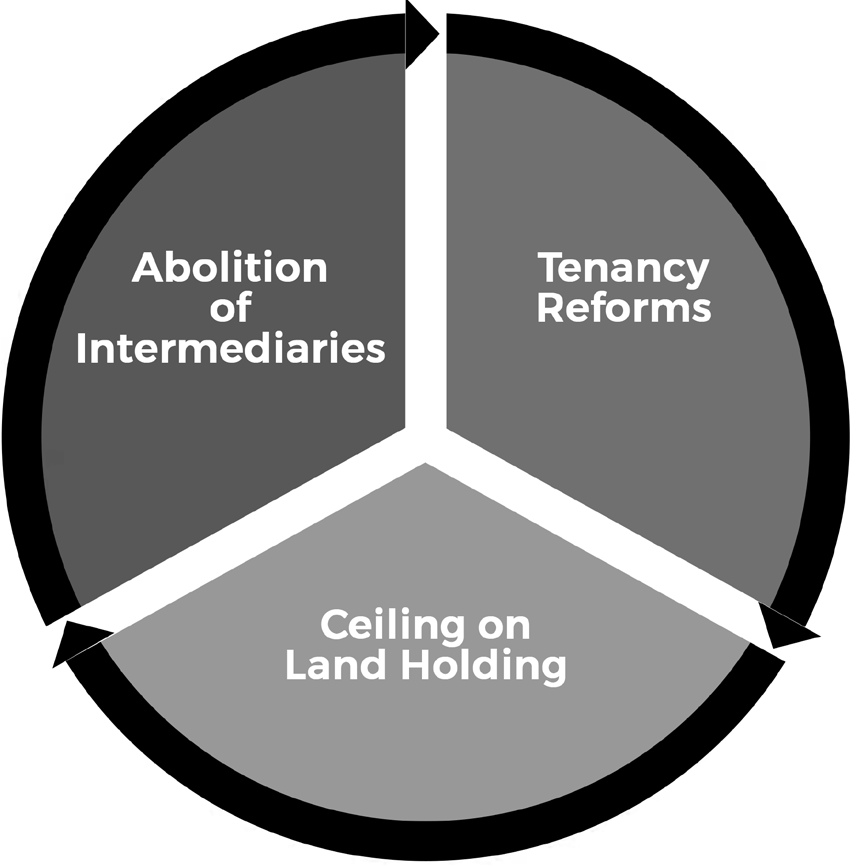
Pandit Jawaharlal Nehru sought to resolve and dismantle the class system of agriculture where there were landed zamindar and landless labourers. Soon after independence, measures for the abolition of the Zamindari system were adopted in different states. The first Act to abolish intermediaries was passed in Madras in 1948 and soon other states followed.
Advantages
Empowered Farmers: Around 2 crore tenants became landowners, gaining direct control over their land.
Equitable: The elimination of intermediaries (zamindars) ended a system seen as exploitative towards farmers.
Increased Land Availability: Government acquired land previously owned by intermediaries for redistribution to landless farmers.
Increased Production: Land distribution and development can lead to higher agricultural output.
Reduced Poverty: Improved agricultural productivity creates more income for farmers, lowering poverty rates.
Improved Land Use: Land reforms encourage better land use practices for overall agricultural growth.
Disadvantages
Abolition of intermediaries resulted in a heavy burden on the state exchequer. The ex-intermediaries were given a compensation amounting to Rs. 670 crores in cash and in bonds.
Evictions: The process of abolishing intermediaries sometimes led to evictions of existing tenants.
Shifting Power: Absentee landlords may have replaced
the official intermediary system, potentially continuing land ownership disparities.
TENANCY REGULATION IN INDIA
Rural India witnessed three types of tenants
Permanent or occupancy tenants: The permanent tenants have the permanent ownership right over the land. The rent for permanent tenants is fixed. Land is inheritable to their future generations. There is hardly any difference between the peasant proprietors or the owners of land and occupancy tenants. The only difference is that while the owners pay the rent to the government, the occupancy tenant pays it to the landlord.
Temporary or non-occupancy tenants: Have no right to cultivate the land permanently. They can be evicted from land on minor pretexts. In their case, rent is too high. It may be increased arbitrarily. They do not make any improvement on the land for the fear of eviction.
Subtenants are the tenants who cultivate the land of the big land owners. They cultivate land only on lease basis. The leases are rather oral. These can be changed at will. They pay rent either in cash or in share of the product. In any case the rent is exorbitant. There is no security of tenure.
The tenancy reforms in various states have following features, though the provisions are not similar in all cases.
Security of tenure for the tenants: Most states passed laws to prevent tenants from eviction. Land can be resumed by the landlord only on the ground of personal cultivation. But the land-lord can resume the land only up to a maximum limit (ceiling). Even then the landlord should leave some area to the tenant for his own cultivation. The tenant in no case should be made landless.
Fixation of fair rent: Amount owed as ‘rent’ from the produce was as high as 70% in British India. This amount
was now regulated by state governments to make the rent fair and reasonable. For example, while in Orissa and Bihar the rent is fixed at one forth of the gross produce, in Punjab it is one third and in Rajasthan it is one sixth of the gross produce. The rates also vary within the state because of the difference in the fertility of land.
Grant of ownership rights to certain types of tenants: Tenants were declared owners of the land. They would pay compensation to the landlord which would not exceed the fair rent amount. Some states allowed this on long term lease basis. If any dispute arises between the tenant and the landlord over the payment of price, this may be referred to a land tribunal. The tribunal will decide the price to be paid by the tenant to the landlord. As a result of these measures about 40 lakh tenants have already acquired ownership rights over 37 lakh hectares of land.
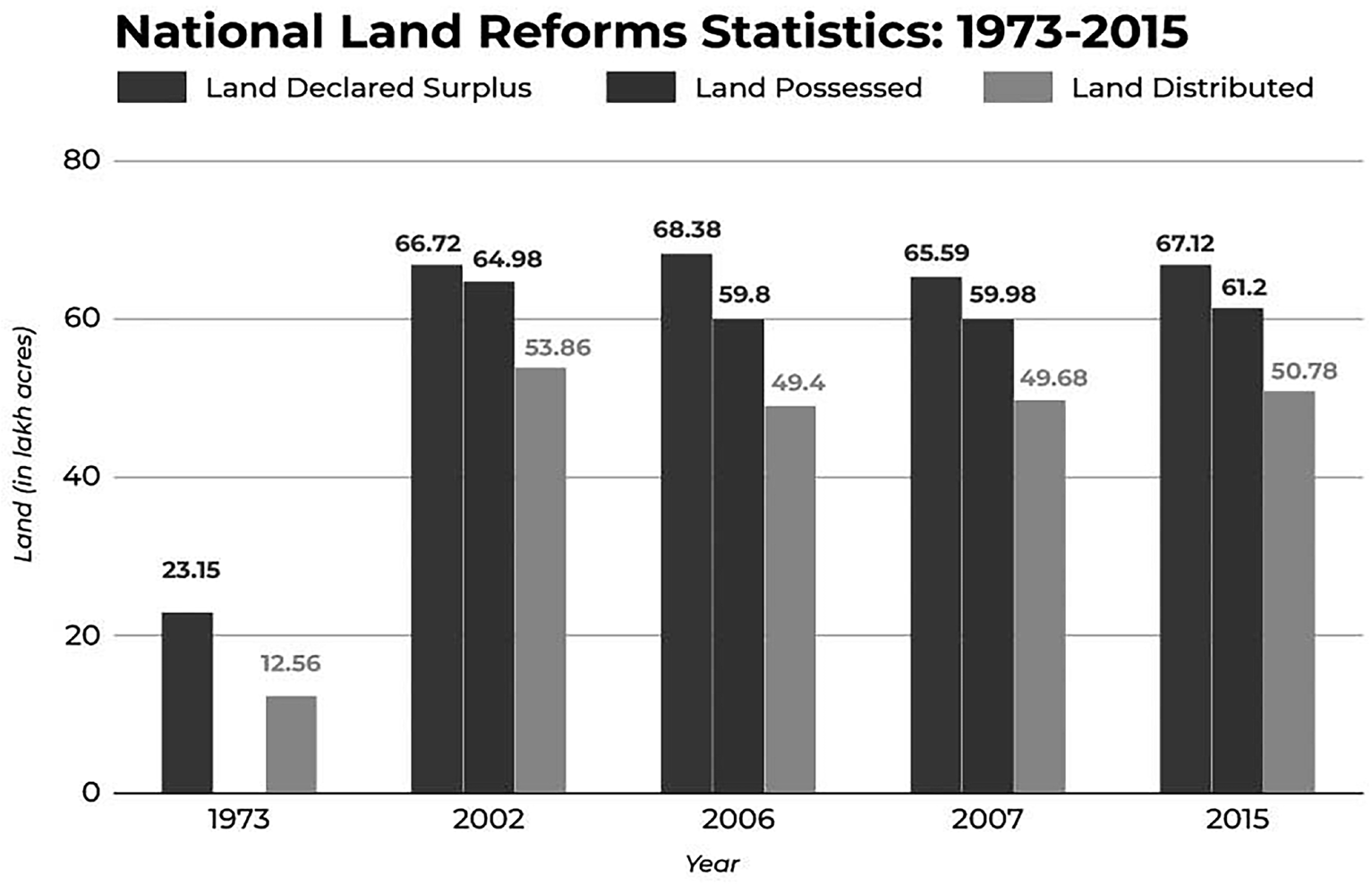
Ceiling on Landholdings (to redistribute surplus land to the landless tenants): Ceiling on land holdings implies the fixing of the maximum amount of land that an individual or family can possess. Land ceiling has two aspects: one, the fixation of ceiling limit and two, the acquisition of surplus land and its distribution among the small farmers and landless workers.
Efforts to Implement Land Reforms
The successful introduction of land reforms in India were driven by several factors
Economic Development Goal: Policymakers recogni-zed the importance of agriculture for economic growth and saw land reforms as a tool to improve it.
Political Consensus: Major political parties agreed on the need for land reforms to strengthen the agricultural sector.
Legal Framework: Constitutional amendments and new laws (along with judicial interpretations) helped recognize land rights for farmers.
Farmer Movements: Organized farmer movements pressurised the government to implement reforms for better social and economic conditions.
Voluntary Land Redistribution: The Bhoodan Move- ment (1951) by Vinoba Bhave aimed to persuade large landowners to voluntarily give up land for the landless.
These combined efforts aimed to create a legal and social environment conducive to land reform implementation in India.
Attempts to Consolidate Small Landholdings
Consolidation of Holdings means bringing together the various small plots of land of a farmer scattered all over the village as one compact block, either through purchase or exchange of land with others.
Following are some advantages of consolidation of landholdings:
It prevents the endless subdivision and fragmentation of land holdings improving land management.
It saves the time and labour of a farmer.
It affects improvement on land in the form of bunding, fencing, etc.
It promotes large scale cultivation.
It brings down the cost of cultivation and reduces litigation among farmers.
However, there are various obstacles to the speedy implementation of the consolidation programme. These are poor response from cultivators, wide variation in the quality
of land, complicated process of land consolidation, lack of enforcing machinery, lack of political will, etc.
Causes of Failure of Land Reforms
Undue advance publicity and delay in enacting land laws: Time taken for a bill to become an Act in many states has been unusually long. This has enabled the landowners to make necessary adjustments so as to be able to evade various provisions of land reform legislation.
Loose definition of the term “personal cultivation”: One could resume land for personal cultivation under the definition even while sitting at a distance of 200 miles. The Zamindars have been permitted to possess substantial areas of land for cultivation. Again, the laws have provided for many exemptions in the form of land awarded for gallantry, land under orchards, tea estates, well-run farms, etc.
Optional nature of the laws: Most of the laws granting ownership rights to tenants are not mandatory. They are rather optional. The tenants have to move the government for grant of ownership rights. They will not get them automatically. On many occasions, tenants hesitate to approach the law courts for this purpose merely out of fear of the landlords.
Malafide transfer of land: To escape the laws relating to land ceilings, the Zamindars have indulged in large scale transfer of land to their family members or kinsmen. Such malafide transfers do not make any change in the operational aspect of agriculture.
Lack of social consciousness among the tenants: The social consciousness of the tenants is an important factor responsible for the successful implementation of land reforms. The small cultivators and the landless were not only unorganised but in most cases, ignorant of legal and constitutional process.
State inclination towords the big farmers: The state governments which control the land operations have moved favourably towards the big farmers. The interests of the small farmers have been vitally affected.
Lack of strong political will: Demonstrated by the large gaps between policy and legislation and between law and its implementation.
Bureaucratic corruption: Land reforms provide a golden opportunity to the Patwari and other functionaries of the Revenue Department to make money. Again, in many cases the highly placed officials are themselves landlords. Moreover, the lands which are acquired to be distributed among landless farmers are grabbed by the politicians and bureaucrats at cheap rate.
Surplus land is fallow and uncultivable land: The holders of surplus land manipulate the land data in such a way that the land in excess in their possession is usually barren and uncultivable. Such a surplus land does not yield any benefit to the landless peasants.
Absence of records: Absence of records regarding ownership and possession of land and about its actual cultivators stands in the way of properly identifying the beneficiaries of land reforms.
Lack of uniformity in land reforms laws: Land reforms laws are not uniform throughout India. They are different in different states.
Right to Fair Compensation and Transparency in Land Acquisition, Rehabilitation & Resettlement Act, 2013 (Land Acquisition Act)
The Act provides for land acquisition as well as rehabilitation and resettlement. It replaced the Land Acquisition Act, 1894.
The process for land acquisition involves a Social Impact Assessment survey, preliminary notification stating the intent for acquisition, a declaration of acquisition, and compensation to be given by a certain time. All acquisitions require rehabilitation and resettlement to be provided to the people affected by the acquisition.
Compensation for the owners of the acquired land shall be four times the market value in case of rural areas and twice in case of urban areas.
In case of acquisition of land for use by private companies or public private partnerships, consent of 80 per cent of the displaced people will be required. Purchase of large pieces of land by private companies will require provision of rehabilitation and resettlement.
The provisions of this Act shall not apply to acquisitions under 16 existing laws including the Special Economic Zones Act, 2005, the Atomic Energy Act, 1962, the Railways Act, 1989, etc.
MODEL AGRICULTURE LAND LEASING ACT 2016
The NITI Aayog-prepared and approved Model Land Lease Act, 2016 provides states and union territories (UTs) with a suitable model to develop their own legislation, in compliance with local needs, and implement an enabling Act.
The main features of this Act are:
Legalize Land Leasing: Allow land leasing to improve agricultural efficiency, equity, and reduce landowner power. This will also promote productivity, occupational mobility, and rural development.
Mutual Benefits: The Model Land Leasing Act balances the needs of landlords and leaseholders.
Landlord Rights: Landowners can legally lease land for agriculture and related activities while retaining ownership rights.
Tenant Support: Leaseholders can access institutional loans, insurance, and disaster relief to invest in agriculture.
Streamlined Leases: Automatic land return after the agreed lease period simplifies the process.
Investment Incentives: Tenants are encouraged to invest
in land improvements with compensation for unused value upon lease termination.
Dispute Resolution: Special Land Tribunals within Civil Courts offer a mechanism to resolve landlord-tenant disputes.
GATHERING AND MAINTAINING LAND RECORDS
An effective land reform program requires the implementation of a land record management system. In 1987-88, a Centrally sponsored scheme for Strengthening of Revenue Administration and Updating of Land Records (SRA&ULR) was introduced in Orissa and Bihar which was later extended to other states. In 1999, the Ministry of Rural Development (MoRD) brought out a Vision Document for Computerisation of Land Records to bring uniformity in land administration.