South Asian Association of Regional Cooperation
SOUTH ASIAN ASSOCIATION OF REGIONAL COOPERATION (SAARC)
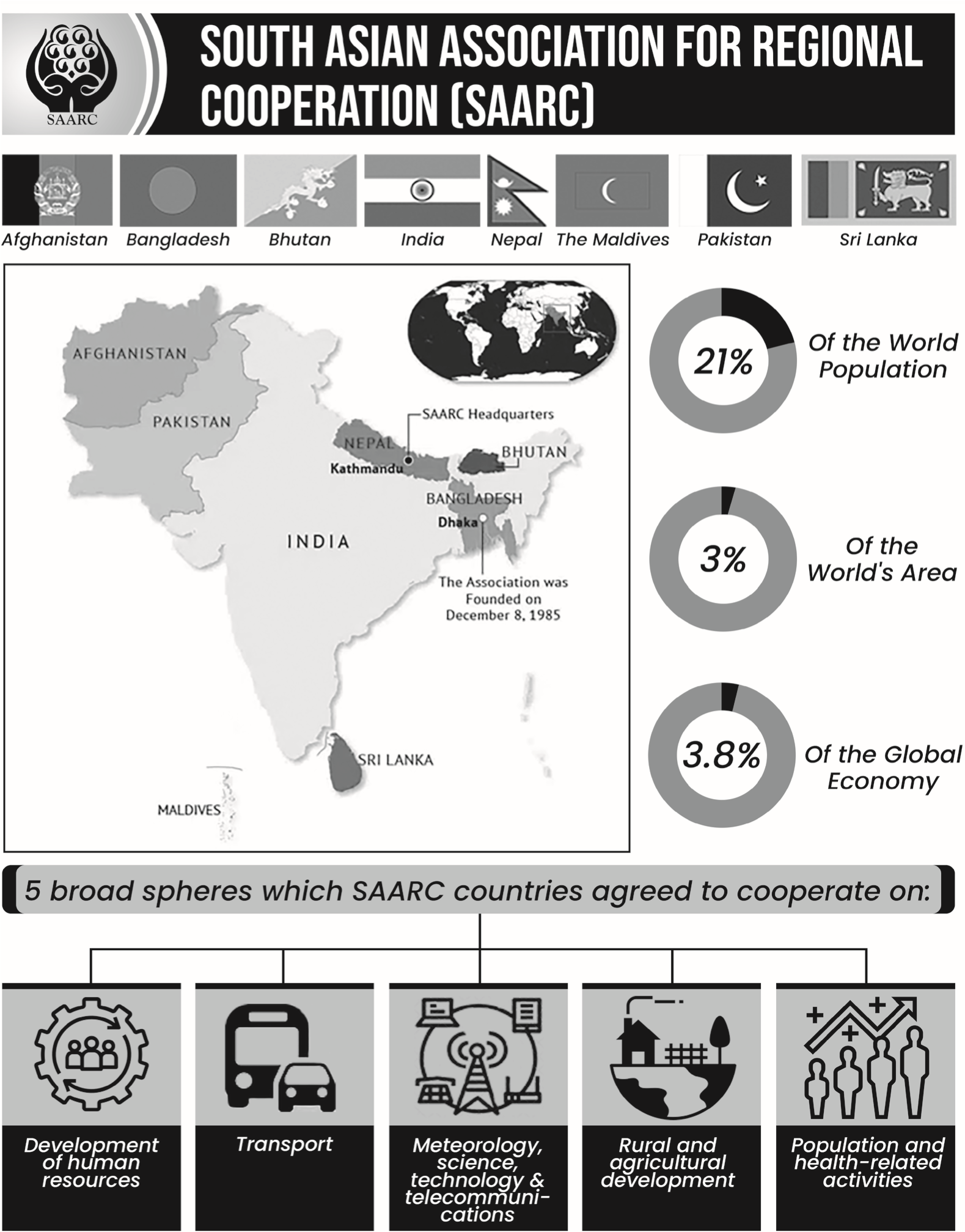
• The South Asian Association for Regional Cooperation (SAARC) is a regional intergovernmental organization and political union of South Asian nations.
• Its member countries are Afghanistan, Bangladesh, Bhutan, India, the Maldives, Nepal, Pakistan, and Sri Lanka.
• India played a key role in founding SAARC, with the goal of fostering greater connectivity and integration within South Asia, while advancing the development and prosperity of all member states.
• SAARC was established in Dhaka on December 8, 1985.
• The organization holds observer status at the United Nations and has also built relationships with various multilateral bodies, such as the European Union.
Principles of SAARC
• Respect for the principles of sovereign equality, territorial integrity, political independence, non-interference in the internal affairs of other States and mutual benefit.
• Such cooperation shall not be a substitute for bilateral and multilateral cooperation but shall complement them.
• Such cooperation shall not be inconsistent with bilateral and multilateral obligations.
Objectives of SAARC
• Promote the welfare of the people of South Asia and to improve their quality of life.
• Accelerate economic growth, social progress and cultural development in the region and to provide all individuals the opportunity to live in dignity and to realize their full potentials.
• Promote and strengthen collective self-reliance among the countries of South Asia.
• Contribute to mutual trust, understanding and appreciation of one another’s problems.
• Promote active collaboration and mutual assistance in the economic, social, cultural, technical and scientific fields.
• Strengthen cooperation with other developing countries.
• Strengthen cooperation among themselves in international forums on matters of common interests, and
• Cooperate with international and regional organizations with similar aims and purposes.
Principal Organs of SAARC
• Meeting of Heads of State or Government
• Meetings are held at the Summit level, usually on an annual basis.
• Standing Committee of Foreign Secretaries
• The Committee provides overall monitoring and coordination, determines priorities, mobilizes resources, and approves projects and financing.
• Secretariat
• The SAARC Secretariat was established in Kathmandu on 16 January 1987.
• Its role is to coordinate and monitor the implementation of SAARC activities, service the meetings of the association and serve as a channel of communication between SAARC and other international organizations.
• The Secretariat comprises the secretary-general, seven directors, and the general services staff.
• The secretary-general is appointed by the Council of Ministers on the principle of rotation, for a non-renewable tenure of three years.
SAARC’s Specialised Bodies
• SAARC Development Fund (SDF) (2010):
• Its primary objective is funding of project-based collaboration in social sectors such as poverty alleviation, development, etc.
• SDF is governed by a Board consisting of representatives from the Ministry of Finance of the Member States. The Governing Council of SDF (Finance Ministers of MSs) oversees the functioning of the Board.
• South Asian University (SAU) (2010)
• South Asian University (SAU) is an international university, located in India.
• Degrees and Certificates awarded by the SAU are at par with the respective Degrees and Certificates awarded by the National Universities/ Institutions.
• South Asian Regional Standards Organization (SARSO) (2011)
• South Asian Regional Standards Organization (SARSO) has its Secretariat at Dhaka, Bangladesh.
• It was established to achieve and enhance coordination and cooperation among SAARC member states in the fields of standardization and conformity assessment and is aimed to develop harmonized Standards for the region to facilitate intra-regional trade and to have access in the global market.
• SAARC Arbitration Council (2007)
• It is an inter-governmental body having its office in Pakistan is mandated to provide a legal framework/ forum within the region for fair and efficient settlement of commercial, industrial, trade, banking, investment and such other disputes, as may be referred to it by the member states and their people.
What is its Importance?
• SAARC comprises 3% of the world’s area, 21% of the world’s population and 3.8% (US$2.9 trillion) of the global economy.
• It is the world’s most densely populated region and one of the most fertile areas.
• SAARC countries have common tradition, dress, food and culture and political aspects thereby synergizing their actions.
• All the SAARC countries have common problems and issues like poverty, illiteracy, malnutrition, natural disasters, internal conflicts, industrial and technological backwardness, low GDP and poor socio-economic condition and uplift their living standards thereby creating common areas of development and progress having common solutions.
SAARC Achievements
• Free Trade Area (FTA): The member countries have established a Free Trade Area (FTA) which will increase their internal trade and lessen the trade gap of some states considerably.
• South Asia Preferential Trading Agreement for promoting trade amongst the member countries came into effect in 1995.
• SAFTA: A Free Trade Agreement confined to goods, but excluding all services like information technology. Agreement was signed to reduce customs duties of all traded goods to zero by the year 2016.
• SAARC Agreement on Trade in Services (SATIS): SATIS is following the GATS-plus ‘positive list’ approach for trade in services liberalization.
• Other initiatives: Establish a SAARC university in India, a food bank and also an energy reserve in Pakistan.
Significance of SAARC for India
Neighbourhood first: Primacy to the country’s immediate neighbours.
Geostrategic significance: Can counter China (OBOR initiative) through engaging Nepal, Bhutan, the Maldives and Sri Lanka in development process and economic cooperation.
Regional stability: SAARC can help in creation of mutual trust and peace within the region.
SAARC offers India a platform to showcase its leadership in the region by taking up extra responsibilities.
Game changer for India’s Act East Policy by linking South Asian economies with South East Asian will bring further economic integration and prosperity to India mainly in the Services Sector.
Associated Challenges
Low frequency of meetings: More engagement is required by the member states and instead of meeting biennial meetings should be held annually.
Broad area of cooperation leads to diversion of energy and resources.
Limitation in SAFTA: The implementation of SAFTA has not been satisfactory a Free Trade Agreement confined to goods, excluding all services like information technology.
Indo-Pak Relations: Escalated tension and conflict between India and Pakistan have severely hampered the prospects of SAARC.
India-SAARC & Covid-19
At the initiative of the Prime Minister, a Video Conference of SAARC Leaders on combating COVID-19 was held on 15 March 2020.
It demonstrated the shared resolve of countries in the SAARC region to fight together the unprecedented challenge of the coronavirus pandemic.
India created a COVID-19 Emergency Fund with an initial offer of USD 10 million to meet the costs of immediate actions.
India’s humanitarian relief in the region includes supply of essential drugs, antibiotics, medical consumables, COVID protection and testing kits, and other laboratory and hospital equipment.
India has developed a ‘SAARC COVID19 Information Exchange Platform¬ (COINEX)’ platform for use by all
SAARC countries to facilitate exchange of specialized information and tools on COVID-19 among designated health professionals.
Way Forward
In a region increasingly influenced by Chinese investments and loans, SAARC could serve as a collective platform to advocate for more sustainable development alternatives, challenge trade tariffs together, or negotiate better conditions for South Asian workers globally.
SAARC embodies the shared South Asian identity of its member countries, both historically and in the present. This identity is rooted in the region’s natural geography, as well as its cultural, linguistic, religious, and culinary connections.
The organization’s potential to promote peace and stability in the region should be fully explored by all member states.
SAARC should be allowed to evolve organically, with greater opportunities for people-to-people engagement, especially considering that the people of South Asia make up a quarter of the world’s population.
Bimstec
BIMSTEC
The Bay of Bengal Initiative for Multi-Sectoral Technical and Economic Cooperation (BIMSTEC) is set to form an 'Eminent Persons Group' to provide future direction to the regional body.
About BIMSTEC

• Initially known as BIST-EC (Bangladesh-India-Sri Lanka- • Thailand Economic Cooperation), the organisation is now known as BIMSTEC and comprises seven Member States with the admission of Myanmar on 22 December 1997, and Bhutan and Nepal in February 2004.
Significance
• It connects not only South and Southeast Asia, but also the ecologies of the Great Himalayas and the Bay of Bengal.
• For India, BIMSTEC aligns with its ‘Act East’ policy for
• greater regional cooperation in southeast Asia.
• It could also be seen as aligning with India’s larger goal to gain trade and security prominence in the Indian Ocean region and to cater to the concept of the ‘IndoPacific’ region, a major focus of Quad countries.
• Another important factor for India in becoming a prominent leader in the Bay and maintaining peace and security, is China making inroads in the Indian Ocean Region over the years.
• Connectivity to North-East: About 45 million people, who live in landlocked Northeastern states, will have the opportunity to connect via the Bay of Bengal to Bangladesh, Myanmar and Thailand, opening up possibilities in terms of development.
Important Connectivity Projects:
• Kaladan Multimodal Project – links India and Myanmar.
• Asian Trilateral Highway - connecting India and Thailand through Myanmar.
• Bangladesh-Bhutan-India-Nepal (BBIN) Motor Vehicles Agreement - for seamless flow of passenger and cargo traffic.

Each country takes lead in specific areas. India is the Lead Country in four areas, viz Counter-Terrorism and Transnational Crime, Transport & Communication, Tourism, and Environment and Disaster Management.

India and BIMSTEC
• India is expected to face challenges from both within and outside, in terms of policy dilemmas.
• India is the largest contributor to the BIMSTEC secretariat's budget, and even provided an additional operational budget of 1 million USD at the Vth BIMSTEC Summit. India leads the Security Sector, which includes Counter Terrorism and Transnational Crime (CTTC), Disaster Management, and Energy.
• India would have to counter the impression that BIMSTEC is an India-dominated bloc. This is also a problem that it faced for a long time in SAARC. But today, many smaller neighbours are willing to engage with India to benefit from its economic rise.
• Nonetheless, for internal political reasons, the dominance issue may re-emerge and pose hurdles.
• To moderate such suspicions, India will need to show sensitivity to the concerns of smaller neighbours.
Challenges Associated with BIMSTEC
• Though largely devoid of bilateral tensions, as is the case in SAARC, BIMSTEC does not seem to have made much progress.
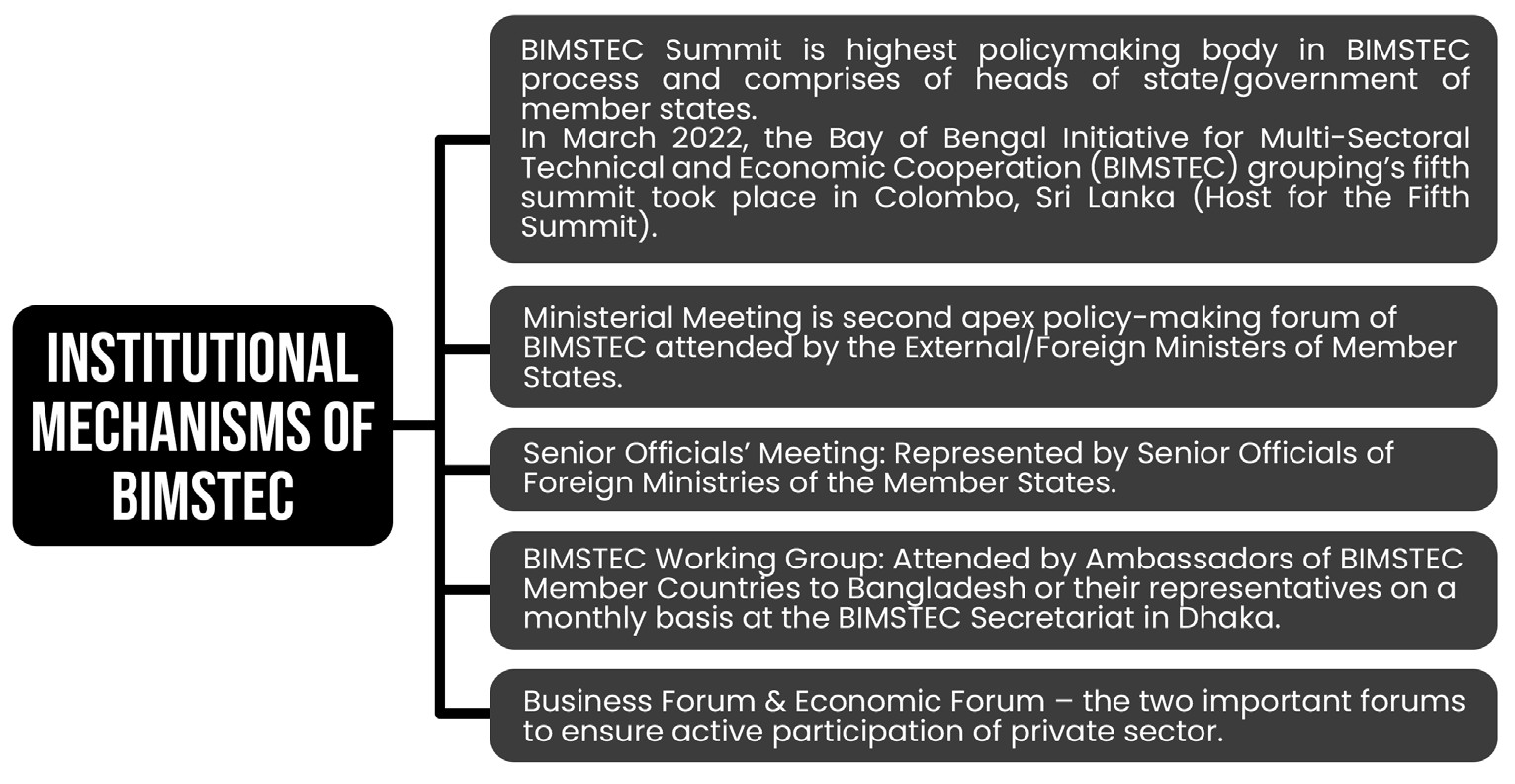
• Inconsistency in Meetings: BIMSTEC planned to hold summits every two years, ministerial meetings every year, but only five summits have taken place in 20 years upto 2022. Thailand is working towards hosting the VIth BIMSTEC Summit and related meetings in 2024.
BIMSTEC Summits that have taken place in the past -
Ist Summit - Bangkok (2004)
IInd Summit - New Delhi (2008)
IIIrd Summit - Naypyidaw (2014)
IVth Summit - Kathmandu (2018)
Vth Summit - Colombo (2022)
It seems that India has used BIMSTEC only when it fails to work through SAARC in the regional setting and other major members like Thailand and Myanmar are focused more towards ASEAN than BIMSTEC.
Broad Focus Areas: The focus of BIMSTEC is very wide, including 14 areas of cooperation like connectivity, public health, agriculture etc.. It is suggested that BIMSTEC should remain committed to small focus areas and cooperate in them efficiently.
Bilateral Issues between Member Nations: Bangladesh is facing one of the worst refugee crisis of Rohingyas from Myanmar who are fleeing prosecution in the state of Rakhine in Myanmar. There is a border conflict between Myanmar and Thailand.
BCIM: The formation of another sub-regional initiative, the Bangladesh-China-India-Myanmar (BCIM) Forum, with the proactive membership of China, has created more doubts about the exclusive potential of BIMSTEC.
Inadequate Focus on Economic Cooperation: A quick look at the unfinished tasks and new challenges gives an idea of the burden of responsibilities on the grouping.
Unfinished Projects: The general formulations of the Colombo Declaration (fifth BIMSTEC Summit) instil little confidence about prospects of early progress.
Despite talks for the need for expansion of connectivity,
much of the work is unfinished when it comes to finalising legal instruments for coastal shipping, road transport and intra-regional energy grid connection.
WAY FORWARD
BIMSTEC member countries should focus on deepening cooperation in various sectors such as trade, technology, energy, transport, tourism, fisheries, security, counterterrorism, disaster management, and energy.
The organization should work towards implementing existing agreements and exploring new avenues for collaboration.
BIMSTEC should work towards enhancing trade facilitation, reducing barriers, and promoting economic integration among member countries.
The organization should explore opportunities for a free trade agreement (FTA) to boost regional trade and investment
Mekong Ganga Cooperation
MEKONG GANGA COOPERATION (MGC)

Addressing the 12th MGC Ministerial Meeting in Bangkok, External Affairs Minister S Jaishankar has priorised the implementation of the India-Myanmar-Thailand Trilateral Highway. They decided to establish a Mekong-Ganga Cooperation Business Council to take forward economic cooperation and expand the ambit of exchanges in agriculture, science and technology and water resource management.
The meeting also explored new areas of development partnership, including through Quick Impact Projects and taking forward culture and tourism, and deepening museum-based cooperation.
New MGC Plan of Action 2019-2022 at 11th MGC Ministerial meeting
It envisages project-based cooperation among member countries in various areas including tourism and culture, education, public health and traditional medicine, agriculture and allied sectors, transport and communication, MSMEs and water resources management.
Membership: The MGC, is a subr egional cooperation organisation comprising India and five ASEAN countries, namely, Cambodia, Laos, Myanmar, Thailand and Vietnam.
Mandate: Facilitating closer contacts among the people inhabiting these two major river basins and enhancing cooperation in tourism, culture, education, transport and communications.
Details:
Mekong River Basin countries are Myanmar, Thailand, Cambodia, Laos and Vietnam.
MGC was launched in 2000 at Laos capital Vientiane.
Information Fusion Centre
| INFORMATION FUSION CENTRE – INDIAN OCEAN REGION (IFC-IOR) According to Indian Navy, IFCI OR has started functioning as an information sharing hub of maritime data and “cutting incident responses” to maritime security situations through a collaborative approach. About IFC-IOR |
The idea is to develop comprehensive maritime domain awareness and share information on vessels of interest (i.e., information on white shipping).
White shipping information refers to exchange of advance information on the identity and movement of commercial non-military merchant vessels.
So far, this fusion centre has information sharing links with 50 nations and multinational/maritime centres.
Major challenges: Maritime terrorism, illegal unregulated and unreported fishing (IUUF), piracy, armed robbery on the high seas, and human and contraband trafficking. IFC aims to tackle these emerging challenges.
Significance
• The IOR is vital to world trade and economic prosperity of many nations.
• More than 75% of the world’s maritime trade and 50% of global oil consumption passes through the IOR.
• In recent years, IUUF has been seen as growing into a bigger threat to maritime states than international piracy.
• This is because they deplete stocks and deprive vulnerable regional economies of an important food source.
• IUU fishing also tramples sovereign rights, undermines the rule of law, and robs coastal states of a valuable economic resource.
• Need for collaborative effort.
The scale, scope and the multi-national nature of maritime activities, make it difficult for countries to address these challenges individually
• Part of the India’s SAGAR (Security and Growth for All in the Region) initiative.
The centre was established as part of the government’s SAGAR framework for maritime co-operation in the Indian Ocean Region
Comparision of Saarc and Bimstec
COMPARISION OF SAARC AND BIMSTEC
The two organisations are often compared and contrasted as they are a crucial part of India’s focus on its neighbourhood countries.
DIFFERENCE BETWEEN SAAARC AND BIMSTEC
| SAARC | BIMSTEC |
| 1. A regional organisation looking into South Asia | 1. Interregional organisation connecting South Asia and South East Asia. |
| 2. Established in 1985 during the cold war era. | 2. Established in 1997 in the post-Cold War. |
| 3. Member countries suffer for mistrust and suspicion. | 3. Members maintain reasonably friendly relations. |
| 4. Organisation suffers from regional politics. | 4. Core objective is the improvement of economic cooperation among countries. |
| 5. SAARC has asymmetric power balance. | 5. Balancing of power with the presence of Thailand and India on the bloc. |
| 6. Intra-regional trade only 5 percent. | 6. Intra-regional trade has increased around 6 precent in a decade. |