Agreements and Initiatives to Resolve the Border Disputes
AGREEMENTS AND INITIATIVES TO RESOLVE THE BORDER DISPUTES
S himla agreement of 1914: In 1914, a convention was held in Shimla to demarcate the boundary between Tibet and Northeast India, with representatives from Tibet, China, and British India present. Following discussions, an agreement was signed by British India and Tibet, but Chinese officials did not sign it. Today, India recognizes the McMahon Line, established by the Shimla Convention, as the legal boundary between India and China. However, China rejects both the Shimla Agreement and the McMahon Line, arguing that Tibet was not a sovereign state and thus lacked the authority to enter into treaties.
P anchsheel Agreement of 1954: The Panchsheel doctrine clearly indicated the willingness to ‘Respect each other’s sovereignty and territorial integrity’. Although we have come a long way since, from 1962 war to the cold peace era of 1962-1989, to the revived tensions of the present, the intent of the doctrine was well directed. It must have acted as a safeguard against any such disputes arising at the first place.
The Five Principles
In the treaty, the leaders of China and India outlined their policy of Panchsheel and defined it through five ideological principles. Those principles are:
M utual respect for each other’s territorial integrity and sovereignty
Mutual non-aggression
Mutual non-interference
Equality and cooperation for mutual benefit
Peaceful coexistence
According to Nehru and Zhou, China and India’s relationship would be one of respect and peace. Basically, each nation agreed not to mess with the internal affairs of the other and committed them to pursue peaceful solutions to any conflicts that might arise between them.
• In 1989, India-China formed a Joint Working Group for Confidence building measures (CBMs) and agreed to mutually settle all border disputes.
• India-China Agreements regarding the Line of Actual Control (LAC): The LAC is the effective military border which separates Indian controlled areas of Jammu and Kashmir from Aksai Chin. It is to be noted that this border is not a legally recognised international boundary, but rather it is the practical boundary. Conventionally, India considers the Johnson line of 1865, marked by a civil servant W.H. Johnson, which put Aksai Chin in Jammu and Kashmir. On the other hand, China recognises the Macartney-Macdonald Line as the actual boundary which puts Aksai Chin in Xinjiang region of China. In 1993, when the then Prime Minister Narasimha Rao visited China, ‘The Agreement for Maintenance of Peace and Tranquillity’ along the LAChas been signed between India and China. In 1996 an agreement took place on Confidence Building Measures in the military field along the LAC.
• In 2003 India and China signed a Declaration on Principles for Relations and Comprehensive Cooperation and also mutually decided to appoint Special Representatives to explore the framework of a boundary settlement from the political perspective. The IndiaChina relations received a major boost in 2003. China recognised India’s sovereignty over Sikkim. This was also followed by a framework of Guiding principles and political parameters to improve bilateral ties. It proposed a three-step resolution to the border disputes:
A bilateral agreement on the laid down principles.
T his was to be followed by an exchange of maps between the two countries.
O nce satisfied with the markings, the final demarcation of borders was to take place.
• In 2005 a protocol was agreed on Modalities for the implementation of Confidence Building Measures in the Military field along the LAC.
Working mechanism for Consultation and Coordination on India China borders:
The WMCC was established in 2012 as an institutional mechanism for consultation and coordination for management of India – China border areas, as well as to exchange views on strengthening communication and cooperation, including between the border security personnel of the two sides.
Composition: It is headed by joint secretary-level officials from both sides. They are entrusted to help the special representative for boundary talks, a position currently held by NSA Ajit Doval.
BORDER PERSONNEL MEETING POINTS
• Border Personnel Meeting points are locations along the disputed Sino-Indian border where the armies of both countries hold ceremonial and practical meetings to resolve border issues and improve relations. While border meetings have been held since the 1990s, the first formal Border Personnel Meeting point was established in 2013.
• There are five meeting points: two in the Indian Union Territory of Ladakh or India’s Western (Northern) sector corresponding to China’s Southern Xinjiang Military District of the Western Theater Command, one in Sikkim, and two in Arunachal Pradesh in India’s Central and Eastern sectors corresponding to China’s Tibet Military District.
Clearly, the policies have not sufficed in realising a solution to the long-standing disputes. A status-quo exists owing to the face-off between differential aspirations of the two nations. While China’s support for resolution of border disputes stands subservient to Tibet issue, India would continue to hold on to the Tibet card unless the border-disputes are resolved. Besides, the changing global and regional picture – from China’s move towards ‘assertive regionalism’, its strengthening ties with Pakistan and its complete disregard for counter-opinions on contentious issues like South-China sea – has only worsened the chances of a quick resolution.
The 1993 agreement:
No activities of either side shall overstep the line of actual control. In case personnel of one side cross the Line of Actual Control, upon being cautioned by the other side, they shall immediately pull back to their own side of the Line of Actual Control. When necessary, the two sides shall jointly check and determine the segments of the Line of Actual Control where they have different views as to its alignment.”
The 1996 agreement:
“If the border personnel of the two sides come in a face-toface situation due to differences on the alignment of the line of actual control or any other reason, they shall exercise selfrestraint and take all necessary steps to avoid an escalation of the situation. Both sides shall also enter into immediate consultations through diplomatic and/or other available channels to review the situation and prevent any escalation of tension.”
The agreement, also for the first time in India-China rules of engagement, makes it clear that “neither side shall open fire or conduct blast operations within 2 km of the Line of Actual Control”. This is what led to a practice, where troops on both sides, never brandished weapons at each other and at most, indulged in a physical jostle.
The 2013 agreement:
“The two sides agree that they shall not follow or tail patrols of the other side in areas where there is no common understanding of the Line of Actual Control in the IndiaChina border areas.”
China’s track record on adhering to agreed CBMs and protocols on the LAC has been poor in the past few years. Having agreed to establish a hotline between the two military headquarters in 2013, the Chinese side scuttled the proposal by saying its embassy in Delhi should be notified first in case the Indian side wanted to make a call. Then, there were differences on encryption codes and translation arrangements. As a result, a hotline is still to be operationalized despite positive noises from the Indian side.
CHINA STUDY GROUP (CSG)
The CSG is the central and sole advisor to the government on policies related to China, and is currently playing a key role as the two countries try and chalk out a comprehensive disengagement process.
The CSG was set up in November 1975 on the instructions of then-PM Indira Gandhi, comprising the secretaries of external affairs, defence, and home. Its first head was diplomat K.R. Narayanan, who would go on to become President of India.
The primary task of the CSG was to monitor the IndiaChina border, assess its management, and help in preparations for negotiations with China on the border question.
The CSG was subsequently upgraded post 2003, after the establishment of the Special Representatives meetings to resolve the border question with China.
It was also put under the charge of Brajesh Mishra, the NSA at the time, and many top civil servants were brought into it. In the next few years, the CSG was further expanded to include representatives of intelligence agencies.
Currently, the CSG is a secretary-level grouping which includes the foreign secretary, home secretary, defence secretary, and the vice-chiefs of the three services, along with the chiefs of the Intelligence Bureau and R&AW.
The group meets on its own, but the National Security Advisor convenes the meeting from time to time. At such meetings, the service chiefs also attend, and based on the issue at hand, the external affairs minister may also attend
Introduction
INTRODUCTION
On April 1, 1950, India became the first non-communist country to establish diplomatic ties with the People’s Republic of China. Prime Minister Nehru visited China in October 1954.
Although the India-China border conflict in 1962 dealt a major blow to their relations, Prime Minister Rajiv Gandhi’s visit in 1988 marked a turning point, initiating a period of improving bilateral ties.
India-China relations have often been characterized by a mix of cooperation and tension, with lingering mistrust between the two nations.
• Despite their potential to significantly contribute to regional peace and development, these two major powers have, whether by design or circumstance, at times fueled regional instability and insecurity.
• Beyond their own internal dynamics, the actions and interests of neighboring countries and global powers also play a crucial role in shaping the relationship between India and China.
THE INDIA-CHINA WAR OF 1962
• The pretext of the war was a dispute over the sovereignty of the Aksai Chin and Arunachal Pradesh.
• But, in reality, there were many reasons and the prominent one was China’s perception of India as a threat to its rule of Tibet.
• The war was preceded by various conflicts and military incidents between India and China throughout the summer of 1962.
• Then on October 20, 1962, People’s Liberation Army (PLA) of China invaded India in Ladakh and across the McMahon line in the Arunachal Pradesh.
• Until the start of the war, India was confident that a war would not happen and made little preparations.
• After a month-long War, China unilaterally declared a ceasefire on 19 November 1962. By then China had made significant advances on both the fronts. India suffered a huge setback and was badly defeated.
• China achieved its objective of acquiring control in the Aksai chin. In the eastern sector, their troops went back to the north of the McMahon line.
BORDER DISPUTES BETWEEN INDIA AND CHINA

The India-China borders can be broken down into three sectors
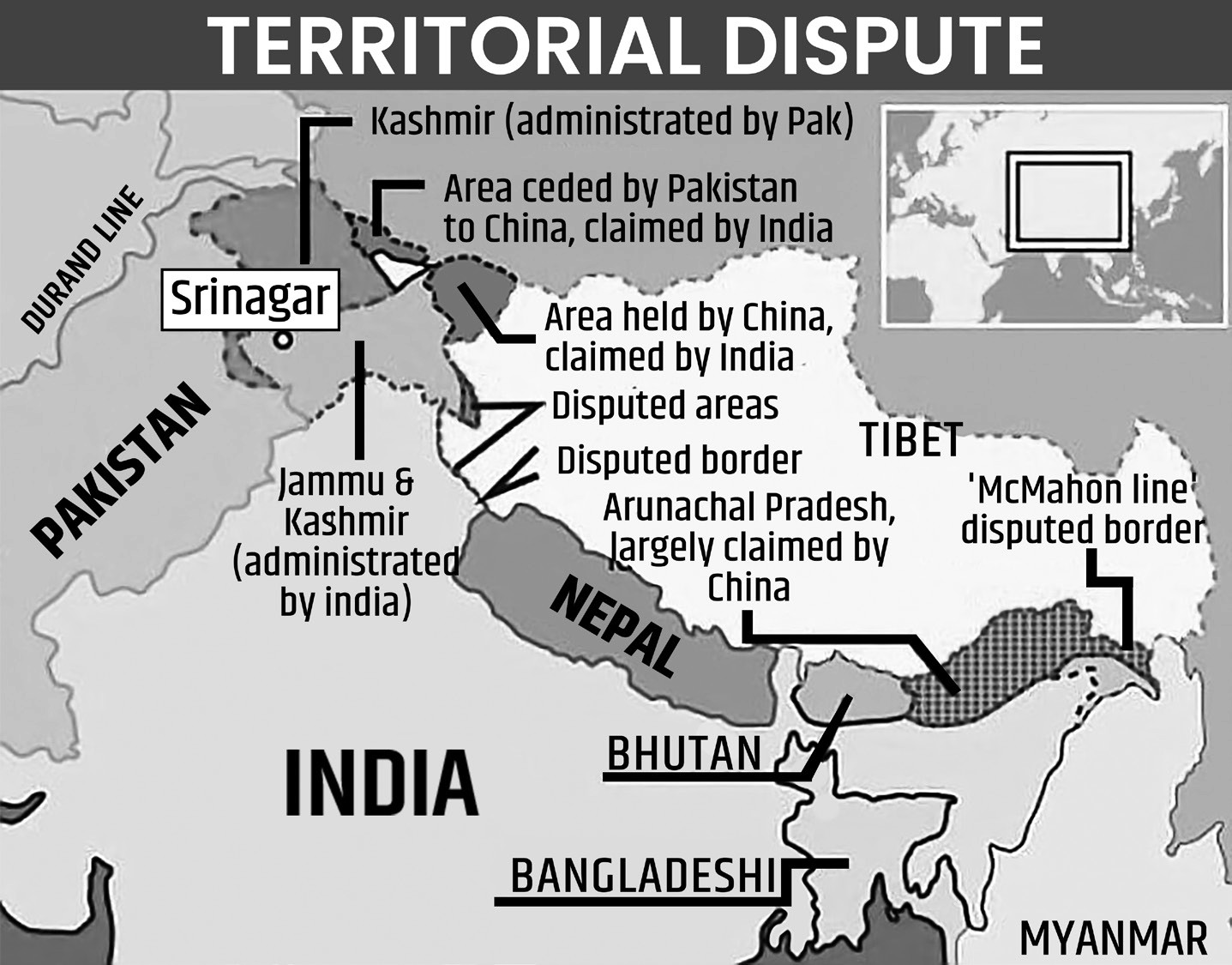
• Western Sector – DISPUTED – This comprises the Aksai Chin sector.
• This region which originally was a part of the state of Jammu and Kashmir is claimed by China as part of its autonomous Xinjiang region.
• After the 1962 war, it is administered by China. It is the second largest India-China border area covering over 38000 sq. km. However, it is an uninhabited land.
• While India claims the entire Aksai Chin territory as well as the Shaksgam valley (Indian territory gifted to China by Pakistan), China contests Indian control over Daulat Beg Oldi (a tehsil in Leh, south of Aksai Chinait is believed to host the world’s highest airstrip)
• C entral Sector – UNDISPUTED – Although China has recognised India’s sovereignty over Sikkim and had initiated the trade at Nathu La pass, the Doklam fiasco could mean trouble at all ends.
• E astern Sector – DISPUTED – The Arunachal Pradesh border that China still claims to be its own territory is the largest disputed area, covering around 90000 sq. km. It was formally called North East Frontier Agency.
• During the 1962 war, the People’s Liberation Army occupied it, but they announced a unilateral ceasefire and withdrew respecting the international boundary (McMahon Line). However, it has continued to assert its claim over the territory. Nowadays, almost the whole of Arunachal is claimed by China. (Note: This is the reason why the recent visit of Dalai Lama to Tawang monastery had become such a contentious bilateral issue).
Recent incident in Eastern Ladakh, at Naku La, Sikkim and at Galwan Valley
Two incidents of face-off occurred between Indian and Chinese troops recently, resulting in injuries to several soldiers of both sides.
The first incident occurred in Eastern Ladakh on May 5, 2020 and the second occurred at Naku La, Sikkim, on May 9, 2020. The issues were resolved locally.

Pangong Tso Dispute
The Line of Actual Control (LAC) - the line that separates Indian and Chinese troops since 1962, generally runs along the land except for the width of Pangong Tso lake.
Here it runs through water. Both sides have marked their areas announcing which side belongs to which country - in English, Hindi and Mandarin.
India controls about 45 km stretch of the Pangong Tso and China the rest.
The current site of confrontation is spurs jutting out of Chang Chenmo, an eastern extension of the Karakoram Range. These spurs are called fingers. There are eight of them in contention here.
India and China have different understanding of where the LAC passes through. India has maintained that the LAC passes through Finger 8, which has been the site of the final military post of China.
India has been patrolling the area - mostly on foot because of the nature of the terrain - up to Finger 8. But Indian forces have not had active control beyond Finger 4.
China, on the other hand, says the LAC passes through Finger 2. It has been patrolling up to Finger 4- mostly in light vehicles, and at times up to Finger 2.
The confrontation that took place in May 2020 happened at Finger 5. And, the current theatre of eye-to-eye confrontation is Finger 2, where the Chinese rushed in the aftermath of the confrontation.
Chinese troops had erected tents in the Finger 4 area and were preventing India from reaching its LAC at Finger 8, leading to a stand-off.
Traditionally, China has been staking claim up to Finger 4, which is where Chinese troops had made advances in 2017 during the Doklam standoff.
Pangong Tso is strategically crucial as it is very close to Chusul Valley, which was one of the battlefronts between India and China during the 1962 war.
Incident at Naku La
The skirmishes and the standoff between Indian and Chinese troops at Naku La in Sikkim in an area of the Line of Actual Control (LAC) that is considered settled, may be Beijing’s way of attempting a new claim.
It was unusual for Chinese troops to open up a part of the LAC that has not been in contention before.
The Gazetteer of Sikkim in 1894, while describing the physical features of Sikkim, also mentions the boundary that runs along Naku la - Chorten Nyima La.
The alignment of the features was so prominent that it could easily be identified and recognized.
Even analysing the available Google images of the pass, the location of Naku La could be discerned by anyone as the watershed parting line in the area was very prominent.
There exists no ambiguity with respect to the location of the pass, since geographic realities cannot be altered.
Galwan Valley Dispute

The valley refers to the land that sits between steep mountains that buffet the Galwan River.
The river has its source in Aksai Chin, on China’s side of the LAC, and it flows from the east to Ladakh, where it meets the Shyok river on India’s side of the LAC.
The valley is strategically located between Ladakh in the west and Aksai Chin in the east, which is currently controlled by China as part of its Xinjiang Uyghur Autonomous Region.
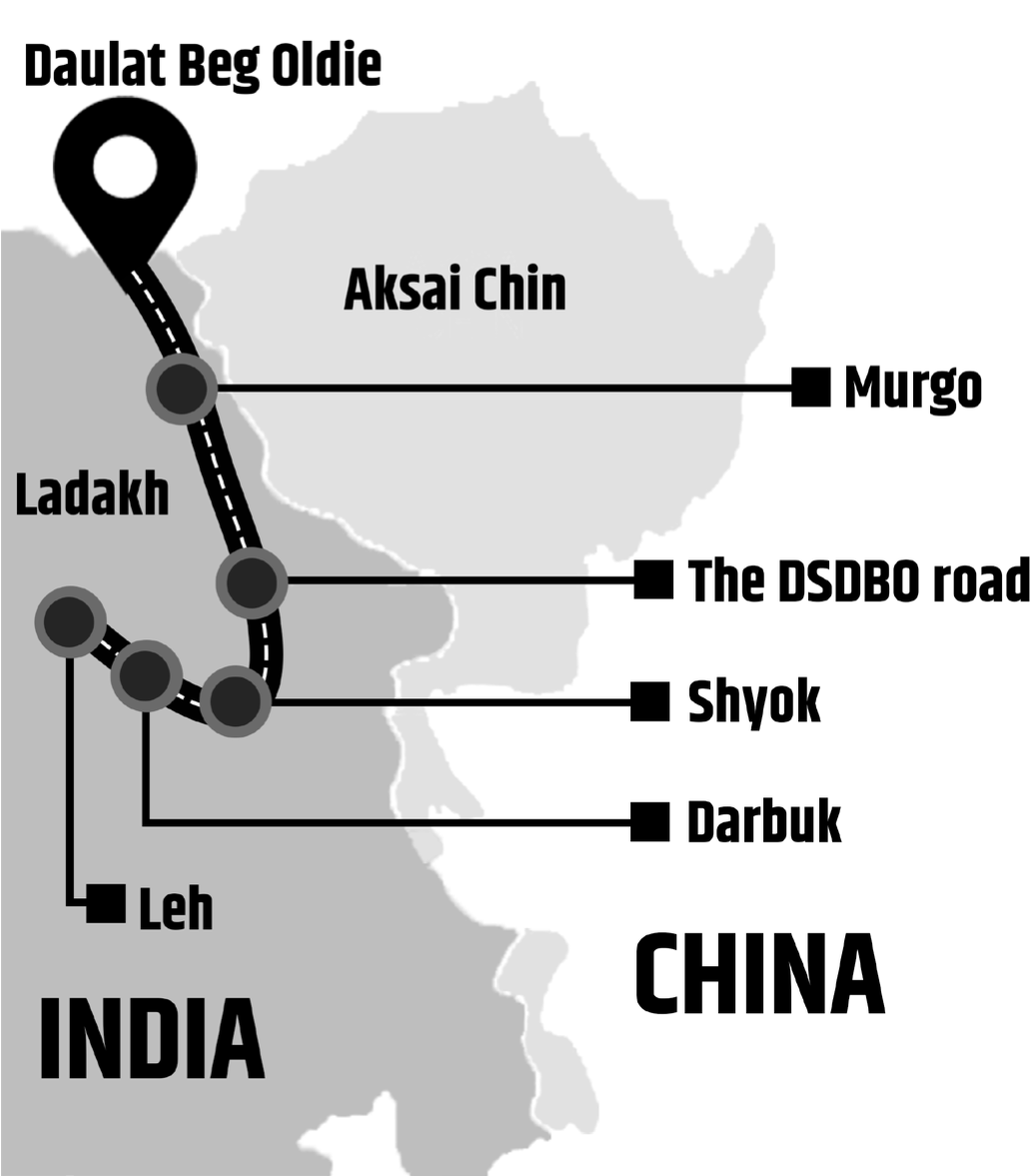
At its western end are the Shyok River and the DarbukShyok-Daulet Beg Oldie (DSDBO) road.
Its eastern mouth lies not far from China’s vital Xinjiang Tibet Road, now called the G219 highway.
The LAC lies east of the confluence of the Galwan and Shyok rivers in the valley, up to which both India and China have been patrolling in recent years.
After the June 15 clash, China has claimed the entire valley lies on its side of the LAC.
Since early May, China has been objecting to India’s road construction activities at the western end of the valley, in the area between the Galwan-Shyok confluence and the LAC.
Beijing is now saying the entire valley is on its side of the LAC, which pegs the line further west near the Shyok river.
India has rejected the claim as “exaggerated and untenable”.
Reasons for Recent Chinese Aggressions
REASONS FOR RECENT CHINESE AGGRESSIONS Daulat Beg Oldie-Darbuk-Shyok Road
• The current impulses of China seem to be guided by 255 km Daulat Beg Oldie-Darbuk-Shyok road.
• It extends up to the base of the Karakoram pass, which is the last military post. Daulat Beg Oldie is the highest airfield in the world.
• This road, when complete, will reduce the travel time from Leh to Daulat Beg Oldie from two days to six hours.
LAC and Article 370
• India released a new map following the changes in Article 370.
• China alleges that India opened up new territory on the map, incorporated part of the areas under the local jurisdiction of Xinjiang and Tibet into its Ladakh union territory.
• And this forced China into the Kashmir dispute, stimulated China and Pakistan to take counter-actions on the Kashmir issue, and dramatically increased the difficulty in resolving the border issue between China and India.
The Brahmaputra Dispute
• India has long expressed concerns over dam-building on the Brahmaputra.
• In 2015, China operationalised its first hydropower project at Zangmu, while three other dams at Dagu, Jiexu and Jiacha are being developed.
• Though these dams are not likely to impact the quantity of the Brahmaputra’s flows because they are only storing water for power generation.
• Moreover, the Brahmaputra is not entirely dependent on upstream flows and an estimated 35% of its basin is in India.
• India does not have a water-sharing agreement with China, but both sides share hydrological data.
Concerns on Brahmaputra
• No Water Sharing agreement
• Chinese construction activities
• Impact on natural flow of the river
• River Pollution
• The issue may escalate into a larger geo-political conflict
Mekong case study
The Mekong flows from China to Myanmar, Laos, Thailand, Cambodia and Vietnam. The Mekong River Commission, which comprises Cambodia, Laos, Thailand, and Vietnam, has said more scientific evidence was needed to establish whether dams caused a 2019 drought.
The eight dams in China, which were built on the Mekong River, or Lancang as it is called in China, have been blamed as the chief culprit in the sharp fall in water levels downstream and the resulting hardships caused to people in lower riparian countries.
The dams have blocked a combined total of over 40 billion cubic metres of water for use in electricity generation, irrigation and other purposes and they are the main cause of unnatural flows of the river, affecting the livelihoods of the people living along the river.
The impacts from dams to food security in the region would is colossal, as the fisheries in Mekong River, which is the main source of food and income for the people in the region, would largely be diminished.
Even though the agricultural sector could get a yield boost in the early years from better irrigation and fewer threats from flood and drought, the lack of sediment influx to downstream agricultural areas would make the soil infertile and reduce the farming yield in the long run.
From this scenario, the severe erosion at the Mekong River Delta in Vietnam and along the riverbank from Vientiane to Stung Treng in Cambodia will occur, forcing the governments of Mekong countries to invest up to $6.8 billion on riverbank reinforcements.
From these outcomes, the food insecurity and poverty will intensify in the region and the poor people in Laos and Cambodia will be the most affected population in this scenario.
Areas of Cooperation
AREAS OF COOPERATION
• Despite their rivalries, the two countries have played up their cultural links-such as the importation of Buddhism into China by wandering Chinese monks more than 1,500 years ago-and have found ample room for economic cooperation.
• Both are members of the BRICS grouping of emerging economies, which is now establishing a formal lending arm, the New Development Bank, to be based in China’s financial hub of Shanghai and to be headed by a senior Indian banker.
• India also was a founding member of the China-backed Asian Infrastructure Investment Bank, which plans to be formally established by year’s end and seeks to emulate institutions such as the World Bank and International Monetary Fund.
(a) Educational areas
• India and China signed Education Exchange Programme (EEP) in 2006, which is an umbrella agreement for educational cooperation between the two countries. Under this agreement, government scholarships are awarded to 25 students, by both sides, in recognized institutions of higher learning in each other’s country. The 25 scholarships awarded by India are offered by Indian Council for Cultural Relations (ICCR).
(b) Cultural Relations
• India-China cultural exchanges date back to many centuries and there is some evidence that conceptual and linguistic exchanges existed in 1500- 1000 B.C. between the Shang-Zhou civilization and the ancient Vedic civilization.
• During first, second and third centuries A.D. several Buddhist pilgrims and scholars travelled to China on the historic “silk route”. Kashyapa Matanga and
Dharmaratna made the White Horse monastery at Luoyang their abode. Ancient Indian monk-scholars such as Kumarajiva, Bodhidharma and Dharmakshema contributed to the spread of Buddhism in China.
Similarly, Chinese pilgrims also undertook journeys to India, the most famous among them being Fa Xian and Xuan Zang.
• Indian Bollywood movies were popular in China in the 1960s and 1970s and the popularity is being rekindled in recent times again. India and China have entered into an agreement on co-production of movies, the first of which based on the life of the monk Xuan Zang that hit the theaters in 2016. Many recent Bollywood movies like Three Idiots, Dangal, Secret Superstar, Bajrangi Bhaijan, Hindi Medium, Toilet – Ek Prem Katha and Andhadhun have become super hits in the Chinese box office.
• Yoga is becoming increasingly popular in China.
China was one of the co-sponsors to the UN resolution designating June 21 as the International Day of Yoga.
During the visit of Prime Minister Narendra Modi to China in May 2015, a Yoga-Taichi performance in the world heritage site of Temple of Heaven was witnessed by Premier Li Keqiang and the Prime Minister.
(c) Trade cooperation: India China export & import data
• Two countries have shown tremendous economic growth. Change in the dynamics of the global economy has provided the opportunity to both countries to cooperate on wider scale. China and India are the major trading partners in the region.
• The trade and economic relationship between India and China has seen a rapid growth in the last few years.
• China has emerged as India's largest trading partner in the FY 2023-24 with USD 118.4 billion two-way commerce.
• In the year 2024, India became the 12th largest trade partner of China.
• However, there are still enormous opportunities that have not been exploited in such fields as manufacturing, construction, electricity, gas and water industries, infrastructure (such as, roads, buildings, transportation, storage and communication), hotels and tourism, financial institutions, agriculture, healthcare, education and the various training sectors. China and India have synergies in many areas.
• China has wide experience and expertise in the field of construction industry. Due to its international recognition, Chinese firms have been successful in creating infrastructure base for many countries.
India could utilize Chinese expertise in the development of its high-speed railway network, metro lines and other infrastructure facilities. While the sides are seeking to expand bilateral trade to $100 billion this year, China exports far more than it imports, something Indian Prime Minister Narendra Modi hopes to alter with increased market access for Indian goods and services.
China maintains close ties with Pakistan, with defense cooperation at the heart of the relationship—something that deeply concerns India. On the other hand, Beijing is uneasy about India’s support for the Tibetan opposition.
China also fears India’s potential backing of Tibet’s independence. Meanwhile, there is intense competition between Beijing and New Delhi for influence over countries like Bangladesh, Myanmar, Sri Lanka, and Nepal.
Areas of Competition
AREAS OF COMPETITION
(a) Africa
• The rapid economic growth of China and India has led to increased competition for global resources and investment opportunities. Unsurprisingly, Africa’s wealth of natural resources has made the continent a key focus for both Chinese and Indian economic activity.
• This growing Sino-Indian engagement has been economically beneficial, driving significant investment and development, with African leaders generally welcoming the competition. Africa has become the new front in the global rivalry between India and China for new markets, agricultural land, and access to natural resources.
• While Western media and politicians have expressed concerns over the surge of Chinese trade and investment in Africa, Indian companies have been steadily increasing their presence on the continent.
• As China deepens its influence in South Asia—an area many Indians consider within their sphere—Africa presents an ideal opportunity for Indian businesses to challenge China’s expanding reach. For many
Indians, especially in certain political circles and online discussions, competition with China is framed within a classic realpolitik context.
• Ironically, this intensifying competition between Chinese and Indian companies is most directly affecting European and American firms, who are increasingly being shut out of Africa’s emerging markets. While China’s aggressive economic strategy has allowed it to establish the strongest influence in Africa, India’s growing presence is beginning to challenge that dominance.
• India has focused on leveraging its cultural and historical ties to bolster its trade relations with resource-rich countries like Zimbabwe, Ethiopia, and Sudan.
• India’s soft power strategy has shown notable success, particularly in Sudan, where Indian corporations have gained near-total control over the country’s oil and natural gas industries. A similar trend is unfolding in Zimbabwe, where China’s dominance in the energy and resource sectors is being contested by both private and state-owned Indian enterprises. This shift is seen by some as a reflection of the intensifying rivalry between China and India. While China continues to lead in Africa, India’s growing economic influence raises questions about China’s future economic dominance on the continent.
(b) Foreign Policy
Despite growing economic cooperation, China and India remain strategic rivals.
• Along with the US, Japan, and Australia, India is viewed as a key player aiming to counterbalance China’s dominance in Asia. While both China and India are members of BRICS, this alliance alone cannot overcome their natural inclination to align with opposing groups, a trend that continues to shape Asia's strategic landscape.
• Furthermore, India has made securing a permanent seat on the United Nations Security Council (UNSC) a major national objective, seeking global recognition as a great power. In contrast, China leads the opposition to UNSC reform, firmly resisting any changes that would include India, Japan, and other countries in the Council.
• The two nations also have conflicting strategic interests in South Asia.
• China maintains close ties with Pakistan, with defense cooperation at the heart of the relationship—something that deeply concerns India. On the other hand, Beijing is uneasy about India’s support for the Tibetan opposition.
• China also fears India’s potential backing of Tibet’s independence. Meanwhile, there is intense competition between Beijing and New Delhi for influence over countries like Bangladesh, Myanmar, Sri Lanka, and Nepal.
RESOURCES AS A DRIVER OF COMPETITION
Many analysts believe that competition for resources has become a major factor driving territorial disputes and tensions, particularly in the South China Sea and East China Sea.
For instance, the South China Sea is a crucial fishing ground for all the nations bordering it, serving as the primary source of fish for China, the Philippines, and Vietnam. Overfishing in coastal waters has led to resource depletion, pushing fishing boats to venture further offshore.
Additionally, many energy industry experts consider the sea to hold significant reserves of oil and natural gas. As energy demand grows, countries are increasingly including offshore energy development in their economic plans.
Advancements in technology are making complex offshore oil and gas extraction more feasible, while rising energy prices heighten the drive to control these valuable resources.
(a) Energy Resources
• Much of the South China Sea remains largely unexplored, so accurate assessments of its exploitable oil and gas reserves are unavailable.
A 2008 report by the U.S. Department of Energy’s Energy Information Administration (EIA) referenced some of the most optimistic estimates, including Chinese projections that the sea could contain 213 billion barrels of oil and 900 trillion cubic feet of natural gas. However, many analysts argue that the northern part of the South China Sea is quite deep, meaning the energy resources in this area may not be as accessible or exploitable on such a large scale.
• Offshore energy development is closely tied to claims of sovereignty over certain parts of the sea, and since these claims often overlap, the potential for conflict is growing. For instance, in 2006, China warned international oil companies not to operate in areas with unresolved territorial disputes, particularly in regions where Vietnam was seeking development partners.
• In 2012, the China National Offshore Oil Corporation (CNOOC) offered tenders for offshore oil and gas exploration within Vietnam’s exclusive economic zone (EEZ), overlapping areas that Vietnam had already opened up for exploration, in some cases with companies already drilling. This move sparked strong protests from Vietnam, which considered it illegal.
• Such disputes have created uncertainty, hindering offshore resource exploration and development, which relies on long-term stability.
• Despite these challenges, there have been instances of exploration and development in disputed areas. China, the Philippines, and Vietnam have all conducted oil and gas exploration in contested parts of the South China Sea. Additionally, the Philippines and Vietnam have awarded exploration and development contracts to international oil and gas companies, including American firms.
(b) Fishery Resources
Fishing is another potential source of conflict in the South China Sea, which serves as the largest source of fish— an important food resource—for each of the claimant nations.
The fishing industries of these countries rely on a large fleet of vessels, many of which are increasingly venturing farther from their home coasts due to overfishing in nearby waters, often entering disputed areas. This has led to frequent incidents, including harassment of fishing boats, confiscation of catches and equipment, and in some cases, the imprisonment of fishermen.
A notable example occurred in 2012, when a dispute erupted between the Philippines and China over Scarborough Shoal, located within the Philippines’ EEZ but also within China’s claimed nine-dash line. The conflict began when Philippine coast guard officials boarded Chinese fishing vessels and seized illegally caught shark and coral from the area, which is part of the contested Spratly Islands archipelago.
Some analysts suggest that joint management of fisheries could be a viable way to reduce tensions and promote cooperation among the disputing nations.
Attempts for Resolution
Currently, Southeast Asian countries are employing four distinct strategies to address the issue.
First, some states are advocating for bilateral solutions in incremental steps. Beijing has consistently expressed a preference for this approach, but many regional countries view it as an effort to freeze resource development without addressing the underlying territorial claims. However, Vietnam and China recently used bilateral diplomacy to ease tensions between them.
Second, there have been efforts to tackle the issue at the multilateral level, primarily through ASEAN. So far, progress has been limited, as only four of ASEAN’s 10 members are directly involved in the South China Sea dispute. Additionally, China has managed to sway the remaining six members at various times, distancing them from positions taken by Vietnam, Malaysia, Brunei, and the Philippines.
Third, strengthening ties with the US remains another strategy, given Washington's continued dominance in the region. The Philippines and Vietnam, in particular, have sought security assurances through new or renewed agreements with the US, and Washington, concerned about China’s strategic interests in the sea, has responded positively.
Finally, Southeast Asian nations are involving nonregional powers in the issue. Vietnam’s agreement with India to conduct drilling in contested waters is part of this strategy, as Hanoi has actively sought the engagement of external countries and oil companies like Chevron, Exxon Mobil, BP, and Zarubezhneft to put pressure on Beijing. However, these strategies have yet to yield meaningful results and tend to escalate tensions rather than resolve them.
Recent Ruling of the Tribunal
The Permanent Court of Arbitration (PCA) in The Hague, Netherlands, has ruled that China’s claims of historical rights over South China Sea (SCS) has no legal basis. The case was brought to the court in 2013 by the Philippines, centring on the Scarborough Shoal, but Beijing chose to boycott the proceedings.
What did the arbitration panel rule?
The court at The Hague ruled that China’s claims to the waters within the so-called “nine-dash line”, with wideranging economic interests, was in breach of the UN Convention on the Law of the Sea (UNCLOS).
The court slammed China for damaging parts of the ecosystem in the Spratly islands- a contested archipelago– on account of overfishing and development of artificial islands.
The Court also said that China violated the Philippines’ sovereign rights. It said China has caused “severe harm to the coral reef environment” by building artificial islands.
What is the ‘nine-dash’ line?
The ‘nine-dash line’ stretches hundreds of kilometres south and east of its southerly Hainan Island, covering the strategic Paracel and Spratly island chains. China buttresses its claims by citing 2,000 years of history when the two island chains were regarded as its integral parts.
Chinese response to ruling of PCA
China rejected an international ruling on the South China Sea as “null and void” and devoid of any “binding force”.
China is contemplating to establish a military Air Defence Identification Zone (ADIZ) in the South China Sea (SCS). The imposition of an ADIZ would require overflying planes to first notify China.
Many Chinese experts stressed that the entire episode was a cover to enforce the US’ “Pivot of Asia” or Rebalance strategy, aimed at the containment of China.
India’s response
India has made it clear that it recognised that the tribunal had been set up within the jurisdiction of the UN’s Convention on the Law of the Sea (UNCLOS) that must be given the “utmost respect”.
India and South China Dispute
INDIA AND SOUTH CHINA DISPUTE
India’s Interests in the SCS
India has a strong interest in keeping sea lanes open in the SCS.
The SCS is not only a strategic maritime link between the Pacific and the Indian Oceans, but also a vital gateway for shipping in East Asia. Almost, 55% of India’s trade with the Asia Pacific transits through the SCS.
Apart from helping secure energy supplies for countries
like Japan and Korea, India has the unique distinction of shipping oil from Sakhalin to Mangalore through sea routes of the region. Therefore, it is vital for India to have access to the region. If China continues to assert dominance over these waters, it will be difficult for India to continue with its activities through this channel.
Presence of India in SCS is not only to counter China in South East Asia but it will put pressure on China in South Asia too.
Presence in South China Sea will help India to have effective control over Malacca strait.
SCS is crucial in India’s Look East Policy-2.
Analysis
China’s hard line on the South China Sea has affected India too. New Delhi was a bit taken aback after Beijing denounced plans by an Indian Company to develop oil fields in the region. The Chinese objection was to ONGC Videsh’s (OVL) venture for off-shore oil exploration in water’s belonging to Vietnam (not recognized by China), Beijing urged India to refrain from entering into deals with Vietnamese firms exploring oil and gas in the disputed South China Sea over which China enjoys ‘indisputable’ sovereignty.
India however, in recent years, has been seen as a credible counterweight to China. Southeast Asian countries, wary of continued Chinese aggression in the South China Sea, have encouraged joint maritime exercises with India.
In February 2010, the Indian Navy concluded its Milan series of maritime exercises in the Andaman and Nicobar Islands and almost all ASEAN countries participated in Milan exercise. India, which has helped Malaysia in building up its Coast Guard in the past, must consider assisting other ASEAN countries. India has a strong Navy with technological credibility that can be leveraged by ASEAN. Collaboration on missile technology, radar systems, defence component systems and supporting hardware are again areas where ASEAN countries can work in partnership with India. China, naturally, does not welcome the ASEAN move to interact militarily with India.
India has also shown keenness to sell Brahmos missiles to friendly countries including the neighbouring Southeast Asian countries. Most of the ASEAN countries have been engaged in a defence modernization programme and would like to obtain assistance in weapons up-gradation and systems integration. Like India, most of the Southeast Asian countries also rely on Russia for their defence procurements. India with its long experience in using Russian products and developed the technological capabilities for low cost servicing could be a potential
ally for ASEAN in this field. Assisting ASEAN will also improve India’s relations with the Southeast Asian countries bilaterally and multilaterally and it will also boost India’s morale in balancing China in the IOR.
One Belt One Road
ONE BELT ONE ROAD (OBOR) by China
Chinese President Xi Jinping announced one of China’s most ambitious foreign policy and economic initiatives at the end of 2013. He called for the building of a Silk Road Economic Belt and a 21st Century Maritime Silk Road, collectively referred to as One Belt One Road (OBOR).
What is “One Belt, One Road” or OBOR?

One Belt, One Road (OBOR) is China’s much-touted new foreign and economic policy. It is a development strategy to connect China with Central Asia, Europe, and Indo-Pacific littoral countries. This policy has two components:
Belt– The “One Belt” refers to the land-based “Silk Road Economic Belt”. Here Beijing aims to connect the country’s underdeveloped hinterland to Europe through Central Asia.
Road – The “One Road” references the ocean-going “Maritime Silk Road”. It is to connect the fast-growing South East Asian region to China’s southern provinces through ports and railways.
The plan is to connect the Pacific Ocean and the Indian Ocean. This will connect Chinese coastline with SE Asia, South Asia, Gulf and East coast of Africa. China will build hard and soft maritime infrastructure. It will include custom co-ordination, the formation of SEZ, new ports, e-commerce, trade liberalisation and policy coordination.
OBOR covers countries throughout the Asian continent from China to the rest of Eurasia. The geographical stretch makes it comparable with Silk Road or Silk Route, an ancient network of trade routes connecting the East and West around 120 BCE to 1450s CE that is famous for the profitable silk (and horses) trade. That is why it is also called as “New Silk Road” initiative.
Objectives of China behind the One Belt One Road
• The OBOR strategy is often reported as China’s ambitious push to take a bigger role in global affairs and expand its friend circle.
• While China insists that the investment in OBOR is economically motivated and it will bring economic benefits to host countries but the project is multiprolonged and is intended to serve diplomatic, economic and strategic purposes.
• It is also intended to address its domestic needs in economic transformation. The demand for industrial output will increase and thus will revitalise its economy.
• This project will build China’s soft power and some analysts call it a China’s Marshall Plan.
• This initiative will make Indo-Pacific region to be Sinocentric economic and security region.
• It is also an attempt to counter US propaganda that rising China is a threat to world peace. Thus, it is to convince that rising China is not a threat rather creates a win-win situation for all.
• Maritime Silk Road, and especially Chinese infrastructure investment is implicitly intended to facilitate more frequent People’s Liberation Army Navy deployments in the Indian Ocean and beyond.
Which countries are involved?
The ‘Belt’ and ‘Road’ covers primarily Asia and Europe, encompassing around 60 countries.
On China’s “One Belt, One Road” official website, it also says the initiative is open to all countries as well as international and regional organisations for cooperation.
India’s position regarding One Belt One Road
India is opposed to Chinese One Belt One Road (OBOR) initiative since the China-Pakistan Economic Corridor (CPEC) passes through the Indian Territory. Indian government stated that the connectivity cannot undermine the sovereignty of other nations.
Should India join One Belt One Road?
Advantages of joining OBOR
• India will not be able to stop China in carrying on this initiative nor can it stop its neighbours from joining this initiative. So, whether India joins this initiative or not, the project will take place and not join may harm India’s interests.
• India may become isolated in this region since all of its neighbours (except Bhutan) have joined One Belt One Road. Leaving any regional platform may hamper India’s credentials and may hasten the end of its regional hegemony.
• Some analysts say that this initiative will be a win-win situation for India since it will increase the connectivity of
the region. There may emerge mutually beneficial swap where India protecting Chinese interests in the Indian Ocean and China securing India’s essential undertakings in their part of the waters.
• Regional transport, energy security, and blue economy are key to OBOR initiative which will be helpful for India.
• China has the financial capital, technology to accelerate the development of other countries and India also need resources and funds for its own development.
• Trade: The OBOR project will open more links of trade between India and other countries. Further, India does not enjoy much leverage to guide ocean trade markets despite having proximity to the sea and a strong navy. Through OBOR project India will get access to more business in an environment which promote friendly reforms.
• Some analysts feel that countries like Russia and others in SCO would want Indian participation in OBOR as a counterweight to Chinese influence.
• Regardless of economic interests, India cannot ignore the symbolic significance as it was along the Silk Route that Indian trade and philosophy (Buddhism) travelled to the rest of Asia. Thus, China may gain cultural hegemony in the region which may prove counterproductive to India.
Disadvantages of joining OBOR
• OBOR is a unilateral ideational of China and there is a lack of transparency in its working. The process is not participatory and collaborative in nature.
• Under Maritime Silk Route (MSR) China is developing ports in Bangladesh, Sri Lanka, and Pakistan and is trying to enlarge its influence using its economic might in the Bay of Bengal and the Arabian Sea. Thus, MSR is nothing but an economic disguise to the “Strings of Pearls” Theory. China is investing a huge amount of money in India’s immediate neighbourhood and these countries tend to use the China card against India.
• OBOR seems to be primarily driven by broad geostrategic and geopolitical aim. For Example, China-Pakistan Economic Corridor (CPEC) gives de facto legitimization to Pakistan’s rights in Pakistan Occupied Kashmir which is against India’s interests. Since this port is closer to the Persian Gulf, it could be used as a transhipment point for China’s energy supplies obviating the needs to go through the Strait of Malacca in South East Asia. Apart from serving as a commercial port, Gwadar is also deep enough to accommodate submarines and aircraft carriers. Thus, it may be used as a military port by People Liberation Army Navy in future.
• Through OBOR, China is countering the strategies of India in North East region and is promoting its greater presence in North East India, part of which China claims as its own territory. This may have a security impact on India.
What should India do to counter One Belt One Road?
India has already refused to join this initiative due to geostrategic and geopolitical angle attached to this project. Instead, India has started initiatives for connectivity on its own. Following are some of the steps taken by India.
Project Mausam: It is soft power diplomacy by India. The project is under Ministry of Culture and its purpose is to reconnect and re-establish communication links between countries of Indian Ocean and enhancing their cultural values.
Project Sagarmala: It is a port led direct and indirect development with a focus on infrastructure and connectivity. The project is to enhance the capacity of major and non-major ports and also to start their modernization process.
Chabahar Port: Chabahar’s location gives India access, besides Iran, to Afghanistan, Central Asia, and Europe, bypassing Pakistan altogether and cutting down significantly current travel distances and time. International North South Transport Corridor (INSTC) initiated by India, Russia, and Iran is another connectivity solution for India in Central Asia.
SAGAR: In 2015, India unveiled its strategic vision for the Indian Ocean i.e. Security and Growth for All in the Region (SAGAR). It is an increasing recognition of the increasing importance of maritime security, maritime commons and cooperation..

I ORARC: India is involved in the Indian Ocean Rim Association grouping whose first summit took place in Jakarta in 2017. The association gains importance by the fact that the Indian Ocean carries half of the world’s container ships, one-third of the world’s bulk cargo traffic and two-thirds of the world’s oil shipments.
T he Asia-Africa Growth Corridor (AAGC): It is an IndiaJapan economic cooperation agreement aimed at the socio-economic development of Asia and Africa. The vision document for AAGC was released by India in the 2017 African Development Bank meeting. The aim of the Asia-Africa Growth Corridor is to develop infrastructure and digital connectivity in Africa through Indo-Japan collaboration.
A lliances: Alliance of India with like-minded countries like Japan. Japan has agreed to promote India’s “Act East” policy by developing and strengthening reliable, sustainable and resilient infra that augments connectivity within India and between India and other countries in the region aimed at advancing Asian industrial networks and regional value chains with open, fair and transparent business environment in the region. Japan and India can build rail and road connectivity across the Eurasian landmass running parallel to OBOR.
China-pakistan Economic Corridor (cpec)
CHINA-PAKISTAN ECONOMIC CORRIDOR (CPEC)
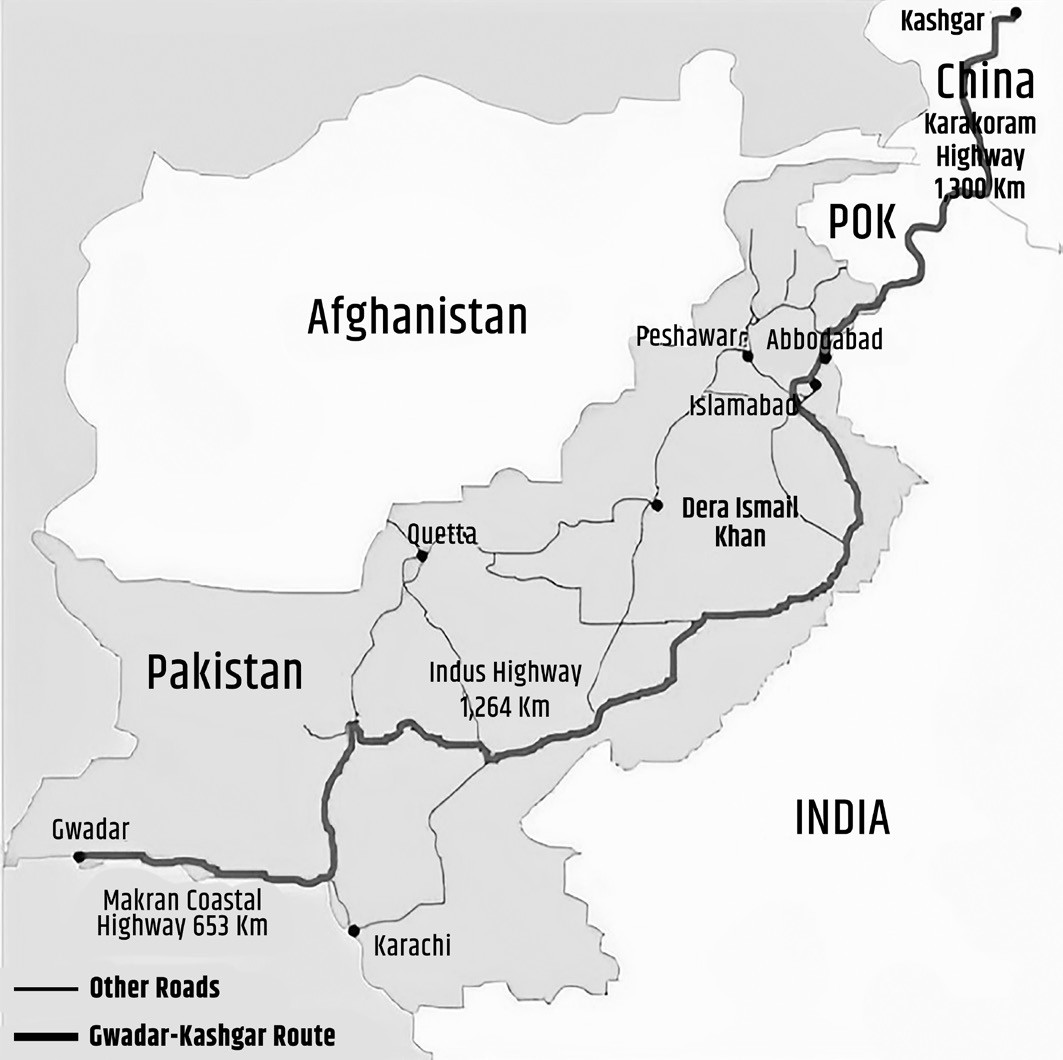
China-Pakistan Economic Corridor (CPEC) is expected to connect Kashgar in Xinjiang in China’s far west with the Port of Gwadar in the province of Baluchistan via a network of highways, railways, and pipelines. This project would allow China to transport energy resources such as petroleum from Middle Eastern countries to China via a land route through Pakistan. This corridor is an extension of China’s Silk Road initiative. This project will provide economic growth to Pakistan and will help in boosting infrastructure development with the help of China.
China and Pakistan have decided to invite interested third country to join the CPEC project and are also planning to expand CPEC projects to Afghanistan.
Geostrategic aspect in CPEC
Energy security is a key concern for China and oil pipelines through Pakistan would cut about 16,000 kilometres from the distance travelled by goods traded between China and the Middle East. China plans to build oil storage facilities and a refinery at Gwadar Port, with oil transported to its Xinjiang Uighur Autonomous Region via road and pipeline. This will let it move energy and goods to inland China without going through the Strait of Malacca, which could be blocked by US or India should hostilities break out in the region.
This project will lead to development in Western China where tensions are simmering from activities by radical separatists due to closeness with Pakistan and Afghanistan. Ideally, this project would promote growth in Pakistan, weaken the extremists and encourage Pakistan army to support peace efforts in Afghanistan.
India’s objections and apprehensions over CPEC:
Violation of India’s Sovereignty and Territorial Integrity: CPEC is unilaterally devised by China and passes through parts of the Union Territories of Jammu & Kashmir and Ladakh which are under illegal occupation of Pakistan.
Perception regarding China’s motives of strategically encircling India: Experts believe that the CPEC will evolve China-Pakistan strategic cooperation into a bilateral military alliance against India.
¾ Apprehensions about lack of transparency and financial viability: There is also the apprehension that inability to repay loans will pave the way for a Chinese intrusion in the internal affairs of defaulting countries particularly in light of the recent Sri Lankan crisis.
Possible security implications: That parts of the road built within the project can potentially act as a transit point for Islamic insurgents such as the East Turkestan Islamic Movement (ETIM).
Other Alternatives to Bri
OTHER ALTERNATIVES TO BRI
India–EU Global Gateway Conference Connectivity for Asia and beyond
India and the EU are holding a crucial dialogue on connectivity and building infrastructure in the Indian subcontinent under the Global Gateway (GG) Conference. Based on the three pillars: Digital, Energy and Transport, the talks will unfold new possibilities in the region. This was also identified as a key deliverable in the recently concluded Ministerial Meeting of the India – EU Trade and Technology Council (TTC).
Global Gateway (GG) is the EU’s ₹300 billion international investment project. This is the biggest investment roadmap ever. In terms of financial commitment, several agencies within the EU–the Neighbourhood, Development and International Cooperation Instrument (NDICI)-Global Europe, InvestEU and European Fund for Sustainable Development all together commit upto ₹135 billion for guaranteed investments for infrastructure projects between 2021 and 2027.
Why is it needed?
• Global Gateway is intended to shape and redefine the norms of global infrastructure projects from Asia to Africa.
• EU’s Global Gateway provides a positive offer for its partners by financing them under fair and favourable terms in order to limit the risk of debt distress in contrast with China’s BRI.
• At the heart of the Global Gateway is the connectivity that puts India at the center stage amidst ongoing greatpower competition. It derives its strength from the EU Strategy for Cooperation in the Indo-Pacific which was laid down by European Council in April 2021.
• Under the GG, the EU is also finding ways to embrace opportunities for Indian infrastructure developmental projects and connectivity in the Indian subcontinent.
| Why India’s stance on BRI projects matters to China? India as an immediate neighbour and an important player in the region remains very relevant to Chinese neighbourhood policy. Strengthening BRI’s legitimacy: Despite being unilaterally proposed, the BRI is/shall be bilaterally/ multilaterally pursued. Taking India on board in discussion is much needed for supporting BRI’s legitimacy. Effective achievement of BRI’s policy objectives: The five priority areas of BRI namely, policy coordination, facilitating connectivity, unimpeded trade, financial integration and people-to-people bonds can be better achieved at various levels with Indian cooperation. G lobal Peace: An active Indian engagement would promote a sustainable relationship which would go a long way in promoting international peace and prosperity. Indian markets are a fertile ground for Chinese investment: Involving India in the BRI negotiation would help dispel any mistrust that both countries may have against each other, thereby paving way for increased investment and enhanced cooperation in other areas of international importance. |
Conclusion
Theoretically, if India’s political and strategic concerns are met, the initiative could be seen as viable, particularly given that many of the projects envisaged under the BCIM (Bangladesh China India Myanmar) corridor and the Asian Highway project would dovetail into OBOR. Already all of India’s neighbours (with the exception of Bhutan) are a part of it, and India too is keen to increase connectivity with them. However, tense bilateral relations with China, deep mistrusts and India’s growing concerns over Chinese hegemonic intentions in South Asia and Indo-Pacific region make it practically unlikely that India will ever consider joining this project
Doklam Crisis
DOKLAM CRISIS
The standoff between India and China at the Doklam plateau which lies at a tri-junction between the India, China, and Bhutan has gained much attention in the recent years. It has turned into the biggest military stand-off between the two armies in years. There are many who even fear a war.
What is Doklam?

• The offensive stand of China on Doko La (Doklam) and India’s strong warning in return, is the latest addition to the worries that spoil Indo-China relations.
• It started when India (Indian Army) objected a road construction by the People’s Liberation Army (PLA) of China in the Doklam plateau which China claims to be a part of its Donglang region. However, India and Bhutan recognise it as Doklam, a Bhutan territory.
• Later, China accused Indian troops of entering in its territory and India accused the Chinese of destroying its bunkers (People’s Liberation Army bulldozed an old bunker of the Indian army stationed in Doklam).
• Thereafter China stopped the passage pilgrims heading toward Kailash-Mansarovar through the Nathu La pass, Sikkim. The route is a better alternative to Lipulekh route via Uttarakhand and had been opened for pilgrims in 2015.

• Hereafter, both India and China increased the presence of their troops and since then there has been a war of words especially from the Chinese state media.
• Although a military standoff was averted, diplomatic negotiations have not yielded many results to cool-off the passions across the border.
Why is Doklam so critical?
• Doklam (Zhoglam or Droklam or Donglang) is a narrow plateau lying in the tri-junction of India, China and Bhutan.
• China believes Doklam to be a disputed territory between Bhutan and China.
• It, therefore, contests the presence of Indian army in the region as a transgression.
• The disputed region is very close to India’s Siliguri Corridor which connects the seven north eastern states to the Indian mainland.
Why is India supporting Bhutan in the Doklam issue?
• Bhutan and India have a very cordial relationship where as Bhutan and China do not have formal relations.
• Bhutan has a very strategic position considering India’s geography.
• To foster the relationship, India and Bhutan signed a ‘Friendship Treaty’ in 2007 that commits India to protect
Bhutan’s interests and the close coordination between the two militaries.
• Also, India is worried that if the road is completed, it will give China greater access to India’s strategically vulnerable “chicken’s neck” (Siliguri Corridor) that links the seven north eastern states to the Indian mainland.
• Is Indian border ready to face challenges?
• India clearly is far ahead of what it was in 1962, both militarily as well as infra-structurally. However, to undermine China would be to relive the fallacies that led to the 1962 war.
• The ‘Theory of asymmetry’ does not hold ground when dealing with China. Therefore, a rational policy of dialogue is essential. Along with that, seeking gains on the works which have already done must be the target. (Note: Theory of Asymmetry is an approach of capitalising on the huge asymmetry in resources by the major party, followed by a show of magnanimity and conciliation. While this approach is a possibility when dealing with Pakistan, it can’t be the way forward in case of China)
Negatives
• Contrasting the border readiness of the two, for instance, we see stark distinctions, more often, revealing a Chinese upper-hand.
• As of now, only 21 of the proposed 73 roads have been developed by India for the Indo-China border (Also the revised target is now 2020 instead of the original target, 2012).
• China, on the other hand, developed and still developing their borders in the pretext of CPEC, OBOR or even otherwise (as in the case of Doklam). This exposes how we are lagging behind in connectivity of our border posts.
• The ‘Mountain Strike Corps’ of India, specifically proposed to be raised to check the Chinese influence, has a strength which is much less than the proposed strength. Along with that, the force is not yet equipped with advanced armouries that were envisioned for them.
Positives
• The recent initiatives including Dhola-Sadiya bridge (Bhupen Hazarika Setu-9.2km-Connects Assam with
Arunachal Pradesh) are a welcome step as they help bring down the travel time and as such, a military response time as well.
• A Brahmos cruise missile regiment is being deployed in Arunachal Pradesh. This clearly signals Indian intentions to China, that finds every opportunity to reiterate its sanction over the territory.
• Many abandoned airstrips in India are also being reactivated. Though thought-provoking, it is a step towards the right direction.
WUHAN SUMMIT (April 2018)- First informal Summit
Indian PM Modi and Chinese President Xi Jinping had an informal meet in the Chinese city of Wuhan. China’s assent to going for an informal summit with India needs a deeper analysis in the prevailing geo-political scenario.
How does it benefit India?
• Until the 2019 elections, the government in power would prefer to avoid any border threats.
• This is particularly in relation with problems with Pakistan.
• India used the summit as a kind of assurance from the Chinese.
• It is to ensure that China, as Pakistan’s benefactor, did not interfere on the border.
INDIA-CHINA 2nd INFORMAL SUMMIT- MAMALLAPURAM SUMMIT
Prime Minister of India and the President of the People’s Republic of China held their Second Informal Summit in Chennai (Mamallapuram), India.
• The Mamallapuram Summit has begun a “New Era of Cooperation” between India and China.
• First India- China informal summit invoked the ‘Wuhan spirit’, whereas the second informal India-China summit has called for ‘Chennai Connect.
• Informal summits allow discussion on wide-ranging issues, they are not particularly purpose-specific, and are sometimes considered to play bigger roles in diplomatic dialogue than formal exchanges. It also acts as supplementary exchanges to annual summits.
KEY POINTS
• Reiteration of the first Informal Summit in Wuhan (2018)
• Both the countries reiterated the consensus reached during the first informal Summit in Wuhan to consider India and China as factors for stability in the current international landscape.
• It also emphasized upon managing the differences and not to allow differences on any issue to become disputes.
• Economic Development:
• A High-Level Economic and Trade Dialogue mechanism to be established to enhance trade and commercial relations.
• The manufacturing partnership is to be established to encourage mutual investments in identified sectors.
• Multilateral trading system
• India-China agreed to support and strengthen the rules-based multilateral trading system.
• Also promised to work together for open and inclusive trade arrangements to maintain inclusive international order.
• Strategic Issues:
• Boundary issues to be solved on the lines of a mutually-agreed framework based on Political Parameters and Guiding Principles that were agreed by the two sides in 2005.
• The strategic communication to be enhanced to maximize usage of high-level exchanges like dialogue mechanisms.
• Terrorism:
• Both countries recognized the joint efforts to ensure that the international community strengthens the framework against training and financing terrorist groups throughout the world and on a nondiscriminatory basis.
• Sister State Relations:
• Considering the age-old commercial as well as maritime linkages, both the countries agreed to establish Sister-State Relations between Tamil Nadu and Fujian Province.
• An academy to study links between Mahabalipuram and Fujian province on the lines of the experience between Ajanta and Dunhuang to be established.
• 70 years of India-China relations:
• The year 2020 will mark the 70th anniversary of the establishment of India-China diplomatic relations, to celebrate the event two countries will be organizing 70 activities to emphasize the historical connection between the two civilizations.
• Also, the year 2020 will be designated as the Year of India-China Cultural and People to People Exchanges.
• Being important contemporary civilizations in the world, efforts will be taken in order to foster cultural understanding between the two countries.
Why Mamallapuram is chosen?
• India has chosen Mamallapuram as a symbol of India’s ‘soft power’.
• Mamallapuram is an important town of the erstwhile Pallava dynasty that ruled in parts of South India from 275 CE to 897 CE.
• The name Mamallapuram got distorted during the British era to Mahabalipuram and thus it is also known as Mahabalipuram.
• The city of Mamallapuram was founded by the Pallava king Narasimhavarman I in the 7th century AD.
• The name Mamallapuram derives from Mamallan, or “great warrior”, a title by which the Pallava King Narasimhavarman I was known.
• It is renowned for its architecture, widely admired across the world.
• Mamallapuram and the Pallava dynasty are also historically relevant, for the earliest recorded security pact between China and India (in the early 8th century) that involved a Pallava king (Rajasimhan, or Narasimha Varma II), from whom the Chinese sought help to counter Tibet.
Wuhan Spirit
Wuhan Spirit is in line with the five principles of peaceful coexistence (Panchsheel) jointly advocated by China and India in the 1950s.
Wuhan Spirit highlighted
To form the “backbone” of economic globalization, and they should jointly make positive contributions to global peace and development.
T o cooperate, for the first time ever, on a joint project in Afghanistan.
China has indicated that India’s refusal to join the Belt and Road Initiative will not come in the way of economic cooperation.
Fujian Province
It is located on the south-eastern coast of China, situated opposite the island of Taiwan.
Fujian (meaning “Happy Establishment”) is one of the country’s smaller provinces.
Other Issues Between India and China
OTHER ISSUES BETWEEN INDIA AND CHINA
The recent standoff is seen as a culmination of a number of disagreements between India and China and the relations between the two sides has soured in the last 2-3 years. Few of them are:
• India’s entry into the UNSC and the NSG
China has been opposing India’s entry into the United Nations Security Council (UNSC) and in the Nuclear Supplier’s Group (NSG).
• India’s opposition to the OBOR
India has been opposing China’s flagship ‘One Belt One Road’ (OBOR) initiative‘, as the ‘China Pakistan Economic
Corridor (CPEC)‘, a part of OBOR, passes through the Pakistan Occupied Kashmir (POK) and acceding to OBOR would mean undermining India’s sovereignty.
• Strengthening of India-USA relations
China is critical of India-USA relations and it is not merely a coincidence that the escalation at the tri-junction coincided with the Indian Prime Minister’s visit to the United States. India supports the US and other countries in reaffirming the freedom of navigation in international waters, which includes the South China Sea. Along with this, the ‘MALABAR Naval exercise’ between India, Japan and USA is also a matter to worry for China.
• Issue of Masood Azhar
India’s bid to get Jaish-e-Mohammad chief Masood Azhar be declared as an UN- designated terrorist has been blocked by China again and again. In fact, China is the only country in the 15 members UNSC to have opposed to the ban. China is of the view that India is trying to pursue political gains in the name of counterterrorism.
• India-China Water Dispute
The Brahmaputra and Ganga glaciers originate in China, which has an advantageous position in the region due to its upstream riparian position. However, China's reluctance to disclose details of its hydro-power projects has created a trust deficit between India and Bangladesh. The tension stems from China's dam-building and water division plans along the Brahmaputra, despite signing several MoUs to strengthen communication and strategic trust. India and Bangladesh, lower riparian countries, rely on the Brahmaputra's water for agriculture. China plans to build four more dams on the Brahmaputra in Tibet, raising concerns about Beijing's ability to divert or store water during political crises. India has built dams on the Teesta River to utilize its dry season flow.
WAY FORWARD
In recent decades after India gained its independence from Britain in 1947, there was a lot of popular hope for a strong and mutually beneficial partnership between the two nations. This was reflected in the popular phrase that was chanted by Indian children in the 1950s: Hindi-Chini bhai-bhai, the general atmosphere of bonhomie and Friendship was such that most Indians could not imagine the advent of Chinese military aggression on their relative unguarded northeast.
The following five decades have seen generation of Indians growing up with an inherent wariness of China and anything Chinese. The public popular imagination in India was fuelled by the often-repeated stories of the great betrayal by the supposed ally nation.
Despite gloomy predictions about the inevitability of competition between China and India, cooperation between Asia’s two emerging powers is possible. It, will however, require a much more concerted effort to bridge the gap in socio-cultural understanding that existed between them, there remains a fundamental lack of appreciation on the part of each country of the underlying cultural and societal norms that define the other norms that influence each country‘s perception of its own national interest.
It is argued that greater appreciation of these elements is critical if China and India are to successfully address issues such as the ongoing border dispute and the mounting trade imbalance.
In present and future scenarios, strategic and diplomatic relations between China and India are fraught with complication, tensions and misgivings on both sides upon the historical legacies of relations between the two countries. Much of the mistrust and misgivings emanate from the legacy of the 1962 war between the two countries.
From the recent incidents, although the possibility of an India-China armed conflict cannot be ruled out, any kind of military conflict is not in the interest of any country. The need of the hour is realising that our ‘strategic partnership’ could serve us both and help see Asia emerge as the core of world economy. This dream of ‘India-China Millennium of Exceptional Synergies’ that our Prime Minister envisions, however, needs magnanimity and willingness on part of both the nations.
OTHER CHINESE INITIATIVES
• China Myanmar Economic Corridor (CMEC)
• CMEC is a branch of the Belt and Road Initiative (BRI) in the Indian Ocean.
• China Nepal Economic Corridor (CNEC) which will link Tibet to Nepal. The endpoints of the project will touch the boundaries of the Gangetic plain. Thus three corridors signify the economic as well as strategic rise of China in the Indian subcontinent.
The String of Pearls
• According to experts, it is an attempt by China to encircle India through maintaining and developing its strategic bases in countries around India, such as Pakistan, Maldives, Myanmar among others which will help in confining India to its own land and limiting its influence on the neighbouring countries.
• This also provides China with an easy access and control over the vast Indian ocean. Interestingly, even when China continued to pursue this strategy, however unofficially, previous government of India had no reply to it.
• This string of pearls phenomena in the background of recent Chinese ‘One Belt One Road’ strategy has got a further boost as China is now not only focussing on countries around India but going further to Central Asia and Africa.
INDIA’S RESPONSE TO CHINA’S AGGRESSIVE MEASURES
India’s Necklace of diamonds strategy
Some strategic experts have always talked about a potential necklace of diamonds (strategic bases) that India can use to garland China or deploy the very Chinese strategy of encirclement. They have even hailed it as India’s answer to China’s string of pearls. India Building its Strategic Bases (Mining the Diamonds)
Changi Naval Base, Singapore – Prime Minister Narendra Modi paved the way for signing of a significant agreement between India and Singapore which provided Indian Navy ‘direct’ access to this naval base. This is crucial as Indian navy ships can now not only refuel but even rearm while sailing through the South China Sea.
Sabang Port, Indonesia – India got the military access to a strategic port like Sabang in 2018, located right at the entrance of one of world’s most famous choke point, Malacca Strait. This is one of the most significant agreements, as India now holds the strategic position in the Indian ocean through which large chunk of trade and crude oil passes on to China. Indian Naval ship INS Sumitra had visited Sabang Port recently.
Duqm Port, Oman – India leveraging its rising status in the Indian Ocean gained strategic military access to this port in 2018, located on the south-eastern seaboard of Oman which protects Indian interests in the western theatre of the Indian Ocean, especially for facilitating India’s crude imports from the Persian Gulf. Moreover, it is now an Indian facility located right between the two important Chinese pearls (bases) Djibouti in Africa and Gwadar in Pakistan.
Assumption Island, Seychelles – Overcoming the initial resistance, India is now developing this naval base in Seychelles, first agreed in 2015. Both the countries have continued to work on the project which gives the military access to India. This particularly signifies India’s increasing strategic presence not only in Indian ocean but also in the African continent where China is desperately trying to penetrate through the maritime silk route.
Chabahar Port, Iran – Prime Minister Narendra Modi signed the contract for development of this port in 2016. This port provides India access to Afghanistan and a precious trade route to Central Asia. In fact, India is reportedly about to begin operations at the Iranian port soon. This will give an unprecedented boost to India’s plan to increase its co operation and contacts with Asian and Central Asian countries.

India Developing its Existing Strategic Assets (Polishing the Potential Diamonds)
India, Asia and Central Asia Ashgabat Agreement & INSTC India joined this multi-modal transport agreement in 2018, to access Central Asian countries like Turkmenistan, Uzbekistan, Kazakhstan, which are western neighbours of China.
In recent times, India has been seen increasing its engagements with various countries in Central Asia. This is essentially reflected in the remarkable increase of India’s trade with Central Asia from approximately $ 750 Mn in 2012-13 (here) to almost $ 1.5 Bn in 2017-18 (here). This is a growth of 100 per cent in the last 4-5 years.
Ashgabat agreement has provided India land connectivity to Central Asia if seen in conjunction with the International North-South Transport Corridor (INSTC) in which India has hugely invested. This gives a clear view of the picture that India is not only escalating fast towards establishing connectivity to Russia but is also expanding its routes to all Central Asian countries like Turkmenistan, Uzbekistan, Kazakhstan, Kirgizstan and Tajikistan.
India, East Asia and South East Asia
Mongolia
Mongolia is a country which is sandwiched between two giant neighbours, Russia and China. It has been actively looking to widen its relations with other countries, also known as its “Third Neighbour Foreign Policy”. Notably, it was Prime Minister Narendra Modi’s vision to develop India’s relationship with Mongolia. This was particularly a strategic move to hint China that if it dares to come and play in and around India, we will no longer tolerate such overtures and can respond back methodically.
The Prime Minister announced a credit line of $1 Billion to Mongolia. Mongolia has already started the construction of its first ever oil refinery using India’s credit line which will end its dependency on fuel from neighbouring countries like China and Russia.
Further, an important point which advertently gave this crucial relationship a boost was that India and Mongolia decided to establish an air-corridor which will end Mongolia’s dependency, a landlocked country, on China which keeps threatening it by land blockages.
This gave a bargaining chip to Mongolia which it can easily leverage against China. So, due to all these mindful efforts, a symbiotic relationship has been established between India and Mongolia. Both the countries have come closer than ever before and Mongolia is emerging as a diamond in India’s necklace.
Japan
Japan is the Chinese neighbour on its north-eastern frontier. It has always felt threatened by the rise of China. By and large, the complementarities between Japan and China don’t exist. In fact, Japan has been aligned to USA’s camp since the days of cold war. India is its recent emerging special strategic partner to counter China’s influence. As soon as Prime Minister Narendra Modi went to Japan in 2014, Japan and India elevated their relationship and arrived at a “Special Strategic and Global Partnership”.
Not only this, India and Japan signed the long-pending civil nuclear agreement in 2016. This has been a major achievement of the Modi Government, as India is the only country outside of the Non-Nuclear Proliferation Treaty (NPT) that has been signed by Japan for civil nuclear cooperation.
Further, India and Japan are working together on a game changing Asia-Africa Growth Corridor (AAGC) which is being seen as a counter to China’s One Belt and One Road Initiative (OBOR) initiative. China is so rattled by this plan that one of its leading news agencies found it a ‘division plan’.
This clearly shows that China is actually upset by this India and Japan’s joint strategic move on the ever-evolving ‘grand chessboard’ of Asia and Africa. Undoubtedly, Japan is the natural diamond of India’s necklace.
Vietnam
Strengthening its deterrence against China, Vietnam, the south-east neighbour of China has been increasingly bestowing its full cooperation with This recently saw a greater boost when Prime Minister Narendra Modi visited the country in 2016, after a gap of almost 15 years.
This is also reflected in “Comprehensive Strategic Partnership” between India and Vietnam. Further, India upped the ante by holding a joint naval exercise in 2018 with Vietnam in Vietnamese waters, the region is in proximity to the South China Sea. Chinese media reported it as a futile attempt to flex muscle.
After much hesitation under the previous regime, Brahmos missiles deal with Vietnam is now in the advanced stage. India has also expedited the process of supplying high speed patrol boats for Vietnamese coast guards. India’s satellite monitoring station in Vietnam, which is going to be activated soon, suggests that India is now ready to play a more constructive role in the South China Sea than ever before.
So, in recent times, Vietnam has emerged as yet another important diamond in India’s necklace, which will particularly be helpful to maintain a balance of power in the South East Asia region.
Global Strategic Alliances
India swiftly collaborates with other nations that share its values in order to counter China's influence in the Indian Ocean region.
QUAD: The QUAD, known as the ‘Quadrilateral Security Dialogue’ (QSD), is an informal strategic forum comprising four nations, namely — United States of America (USA), India, Australia and Japan who support the common interest of unhindered maritime trade and security aiming to ensure a free, open, and prosperous region.
I2U2:
The I2U2 Group, a strategic partnership between India, Israel, the UAE, and the US, aims to enhance cooperation in areas like water, energy, transportation, space, health, and food security. The grouping aims to promote economic development, scientific innovation, and regional stability, with member countries working together to address common challenges and explore new growth opportunities.
India-Middle East-Europe Economic Corridor (IMEC):
Establishment: The initiative was formalized through a Memorandum of Understanding (MoU) signed by leaders from India, the European Union, France, Germany, Italy, Saudi Arabia, the UAE, and the United States during the G20 Summit in New Delhi (2023).
• Objective: This multi-modal connectivity project aims to enhance trade between India, the Arabian Peninsula, the Mediterranean, and Europe by developing critical infrastructure, including ports, railways, roads, maritime routes, and pipelines.
Key Components:
• Eastern Corridor: Connecting India to the Gulf region.
• Northern Corridor: Linking the Gulf to Europe.
• The project is a key component of the Partnership for Global Infrastructure and Investment (PGII). Announced at the 2021 G7 summit in the UK, it is widely viewed as a strategic counter to China’s Belt and Road Initiative (BRI).
• International North-South Transport Corridor (INSTC): The INSTC, a 7,200-km multi-mode transportation network between India, Iran, and Russia, connects the Indian Ocean, Persian Gulf, and Caspian Sea. Its key node, Chahbahar Port in Iran, monitors China's activities in the Arabian Sea and Strait of Hormuz.
Indian Ocean Rim Association (IORA): The Indian Ocean Regional Authority (IORA) is an intergovernmental organization promoting economic cooperation and regional integration among Indian Ocean countries, focusing on trade, investment, and sustainable development initiatives among its member states.
Mutual Interests of Indo
Mutual Interests of Indo -China
India and China are members of BRICS, a regional grouping to support developing countries by forming the New Development Bank (NDB).
Both countries have a similar stand on trade disputes and WTO negotiations.
India’s induction into Shanghai Cooperation Organization (SCO), a Eurasian regional group of political, economic and security alliance.
India is also a member of China backed AIIB (Asian Infrastructure Investment Bank) that provides loans for building infrastructure in the AsiaP acific region.
Is Boycott China Feasible?
Background:
Prime Minister Narendra Modi, in his address to the nation, gave a clarion call for an ‘Atmanirbhar Bharat’.
Sonam Wangchuk, engineer, innovator from Ladakh, took to social media to promote the boycott of all products ‘Made in China’.
On June 29, the Indian government banned 59 Chinese apps including WeChat and TikTok citing the “threat to sovereignty and integrity” that these apps pose through the misuse and transmission of user data to servers outside India
India has banned more than 100 additional apps with linkage to China, including popular mobile game PUBG, citing cybersecurity concerns as geopolitical tensions escalate at the two neighboring nations’ disputed border
India China Trade
India-China bilateral trade has experienced exponential growth since the beginning of this century, with China becoming India's largest goods trading partner by 2008.
The trade between India and Chinese amounted to USD 127.71 billion in FY 2024-25, with India’s exports at USD 14.25 billion and Chinese exports to India is USD 113.46 billion.
Though trade volumes have grown exponentially, they have also led to the biggest single trade deficit India is running with any country. The trade deficit was USD
99.21 billion in 2024-2025. The trade deficit with China is primarily due to a narrow range of commodities exported to China and market access barriers for agricultural products and competitive sectors like pharmaceuticals and IT/IteS.
The main exports include iron ore, cotton, copper, aluminium, and diamonds. However, Chinese exports have overshadowed these raw materials, leading to a trade deficit. The US continues to engage with China to address market access issues.
Some of India's key imports from China include smartphones, components for smartphones and automobiles, telecom equipment, plastic and metallic goods, active pharmaceutical ingredients (APIs), and other chemicals.
Bilateral Investment:
Growth in bilateral investment has not kept pace with the expansion in trading volumes between the two countries.
While both countries have emerged as top investment destinations for the rest of the world, mutual investment flows are yet to catch up.
According to the Ministry of Commerce of China, Chinese investments to India in the year of 2023 was USD 60.37 million and cumulative Chinese investments to India was USD 3.2 billion till 2023 (since 2015).
From April 2000 to March 2025, India's total foreign direct investment in China was USD 2.5 billion, according to DPIIT data.
Institutional Bilateral Economic and Commercial Dialogue Mechanisms
India-China Economic and Commercial Relations are shaped through various dialogue mechanism such as:
Joint Group on Economic Relations, Science and Technology (JEG) - It was established in 1988 to discuss trade cooperation issues between India and China.
Strategic Economic Dialogue (SED) – It was established in 2010 to discuss macro-economic cooperation between India and China.
The NITI Aayog
Development Research Centre of China (DRC) Dialogue - It was established in 2015 to discuss global economic cooperation issues. The India delegation is led by ViceChairman NITI Aayog, while the Chinese delegation is led by the President of DRC of China..
India-China Financial Dialogue – It was established in 2005 and is held in accordance with the MoU signed during Chinese Premier Wen Jiabao’s visit to India in April 2005.
Some of the other institutionalized dialogue mechanisms between the two countries include the JWG on Collaboration in Skill Development and Vocational Education, Joint Working Group on Information and Communication Technology & High-Technology, Joint Working Group on Industrial Park Cooperation, Joint Study Group and Joint
Task Force on Regional Trading Agreement (RTA), IndiaChina Joint Working Group on Agriculture, India-China Joint Working Group on Cooperation in Energy and the Joint Study Group on BCIM Economic Corridor.
Government Steps to cut dependence on China for imports
The government is taking steps such as framing technical regulations and quality norms for several products.
The government has also imposed anti-dumping duties on several goods which are being dumped in the domestic market at below the average prices from China with a view to guard domestic players from cheap imports.
As many as 371 products have been identified for technical regulations. Out of these, technical regulations have been formulated for 150 products worth about USD 47 billion of imports.
Over 50 quality control orders (QCOs) and other technical regulations have been notified in the past one year including on electronic goods, toys, air conditioners, bicycle parts, chemicals, safety glass, pressure cooker, items of steel, electrical items such as cables.
China accounts for about 14 per cent of India’s imports and is a major supplier for sectors like mobile phones, telecom, power, plastic toys, and critical pharma ingredients.
In April, the government tightened FDI norms coming from the countries which share land border with India. As per the amended FDI policy, a company or an individual from a country that shares land border with India can invest in any sector only after getting government approval.
Analysis
Trade figures suggest that India is the biggest importer of Chinese consumer goods.
India imports almost seven times more from China than it exports to it.
India has huge trade deficit with China – it’s largest with any country.
On the other hand, it needs to be acknowledged that China’s exports to India account for only 2% of its total exports, so even if Indians boycott all the goods imported from China; it will not make as big an impact on China.
Data also suggests that China is India’s largest trading partner, but the trade is heavily skewed in favour of China. Thus initiating a trade war when Indian manufacturing ability is limited is not going to favor India.
Trade data also goes on to demonstrate that India exports less to China (mainly raw materials) and imports more (mainly electronics and other manufactured goods which are in high demand).
The range of goods that we import from China is massive: consumer durables such as electronic goods, smartphones, industrial goods, vehicles, solar cells, and essential pharmaceutical products including tuberculosis and leprosy drugs and antibiotics, among many others.
In 2017-18
Almost 60% of India’s import requirements of electrical and electronic equipment were met by China.
In our smartphone industry, out of the five bestselling phone brands in India, four are Chinese – Xiaomi, Vivo, Realme and Oppo.
These four brands combined dominate over 60% of the smartphone market in India.
About 90% of the country’s toy market is occupied by Chinese products.
On the other hand, 30% of India’s automobile components are met from China.
Similarly, 50% of the demand in the country’s bicycle market is met by imports in which China has a large share. Thus, some of the key sectors of the Indian economy are critically dependent on China
Talking of Chinese investments in our tech space, investments have seen a massive spike in recent times.
A report published by Gateway House, a think-tank associated with the Indian Council on Global Relations, estimates $4 billion of Chinese tech investment in Indian startups.
The Alibaba Group alone has strategic investments in Big Basket ($250 million), Paytm.com ($400 million), Paytm Mall ($150 million), Zomato ($200 million) and Snapdeal ($700 million).
Similarly, another Chinese group, Tencent Holdings, has investment in Indian firms like Byju’s ($50 million), Dream11 ($150 million), Flipkart ($300 million), Hike Messenger ($150 million), Ola ($500 million) and Swiggy ($500 million). Additionally, these Chinese firms are not the sole owner of these platforms.
Many Indian and non-Chinese investors hold majority control in most of these companies, making it difficult to classify them as Chinese or non-Chinese. These insights negate any immediate ideas of rhetorical boycott calls without acknowledging the associated benefits India reaps from this relationship.
Way Forward
WAY FORWARD:
ONE STEP AT A TIME
Self-Reliance Or An Atmanirbhar Bharat
• A mechanism for IMPORT SUBSTITUTION needs to be worked out, by creating such product alternatives which can compete both in quality and cost against Chinese product
Investment In Innovation
• Low R&D expenditure, especially from the private sector, is a key challenge facing the innovation ecosystem in India. • R&D expenditure in India: 0.7% of GDP(2% in China, 1.2% in Brazil & 4.7%in Israel)
• This makes it imperative to think about resource allocation and invest in research and development, which in turn will equip our industries with the requisite technology and skill to fight this trade battle.
Cheaper Loans
• The government must lower the rates at which loans are issued to Indian companies, just like China.
• Recently, finance minister Nirmala Sitharaman announced a stimulus package to address the needs of various sectors battling for survival.
• Now, steps should be taken to ensure these announcements are actually implemented on the ground.
• In addition to this, the government must provide infrastructure, services, etc.. to prepare Indian companies to compete with China.
Liberalized FDI Regime
The FDI regime needs to be further liberalised. 2. India receives only 25% of the FDI that China gets and only 10% of what the US receives. 3. Increase in the levels of FDI may provide the necessary nudge to our industrial sector to surge towards better productivity and efficiency.
Diversifying Our Import Basket
• It would be extremely beneficial if we diversify our import basket, by importing our necessities from a host of other countries and lessening our dependence on China. All these steps, collectively, could take us closer to self-reliance.
OVERALL RIVALRY AND BALANCE OF POWER
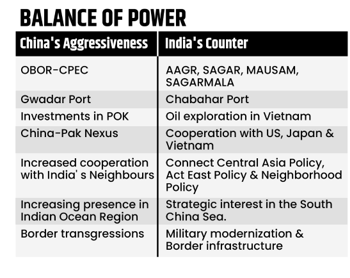
MISCELLANEOUS
One Country, Two Systems
• The One Country Two Systems policy was originally proposed by Deng Xiaoping shortly after he took the reins of the country in the late 1970s.
• It was originally proposed to unify China and Taiwan but rejected by Taiwan. The idea resurfaced when China started talks with Britain and Portugal, who were governing Hong Kong and Macau, respectively, as colonies.
• Under this, China proposed that Hong Kong, and Macau, can have different economic and political systems from that of mainland China, while being part of China.
• Both regions became Special Administrative Regions of China with their own currencies, economic and legal systems. However, defence and foreign affairs would be decided by China.
• Also, Hong Kong has freedom of assembly and speech, and some democratic rights, which are not available in mainland China.
• These freedoms are protected by the Basic Law, a mini constitution that guides relationship between Hong Kong and China. Basic law is valid for 50 years, till 2047 for Hong Kong and 2049 for Macau. But it is unclear what will happen after this term.