Areas of Cooperation Between India and Japan
AREAS OF COOPERATION BETWEEN INDIA AND JAPAN
1. DEFENSE RELATIONS
• Our exchanges have strengthened due to growing convergence on strategic matters; and its significance is growing from the common outlook on issues of peace, security and stability of the Indo-Pacific Region.
• The Tri-Service Exchanges between Japan and India have been institutionalized completing the triad. Coast Guards have regular annual exchanges since 2006.
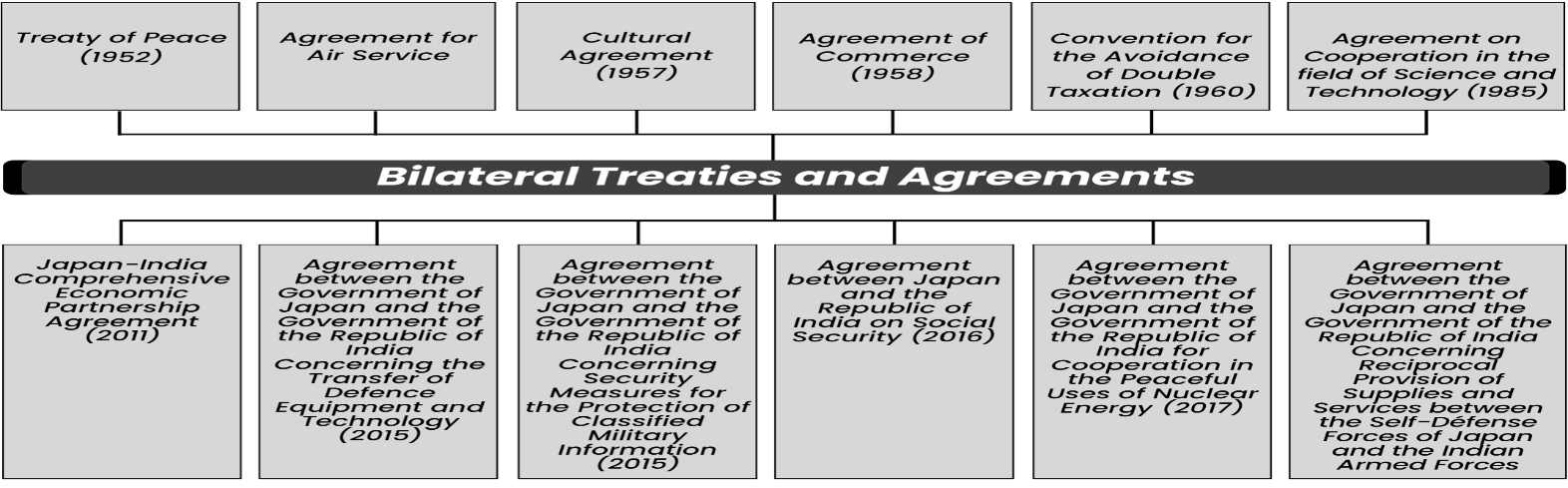
• India and Japan recently concluded their Acquisition and Cross-Servicing Agreement (ACSA). Like the Logistics Exchange Memorandum of Agreement (LEMOA) with the United States and ACSA agreements that New Delhi maintains with five other countries, the bilateral arrangement will allow the armed forces of both countries to “exchange supplies and services” on a reciprocal basis during exercises in which both participate.
• India and Japan defence forces organize a series of bilateral exercises namely, JIMEX, SHINYUU Maitri, and Dharma Guardian. Both the countries also participate in Malabar exercise with USA.
2. ECONOMIC AND COMMERCIAL RELATIONS
• Japan is regarded as a key partner in India’s economic transformation. In the recent past, the India-Japan relationship has transformed to a partnership of great substance and purpose. Japan’s interest in India is increasing due to a variety of reasons including India’s large and growing market and its resources, especially the human resources.
• Japan’s bilateral trade with India totaled US$ 27.47 billion during FY 2025-26. Exports from Japan to India during this period were US$ 21.43 billion and imports were US$ 6.04 billion.
• Today, India ranks 14th in Japan’s total trade with 1.75% share while, Japan ranks 10th in India’s total trade with 2.26% share
• India’s primary exports to Japan have been petroleum products, chemicals, elements, compounds, nonmetallic mineral ware, fish & fish preparations, metalliferous ores & scrap, clothing & accessories, iron & steel products, textile yarn, fabrics and machinery etc..
• India’s primary imports from Japan are machinery, electrical machinery, iron and steel products, plastic materials, nonferrous metals, parts of motor vehicles, organic chemicals, manufactures of metals, etc.
• In 2018, India and Japan signed a $75 billion bilateral currency swap agreement, which is expected to bring stability to the foreign exchange and capital markets in the country.
3. INVESTMENT
Japanese outward FDI to India in 2023-24 and 2024-25 stood at USD 3.1 billion and USD 2.48 billion respectively, with USD 3.2 billion in 2025-26 (upto December 2025).
Cumulatively, from 2000 until June 2025, the investments to India have been around US$ 44.97 billion ranking Japan fifth among source countries for FDI.
4. OFFICIAL DEVELOPMENT ASSISTANCE (ODA):
• Japan has been extending bilateral loan and grant assistance to India since 1958 and is the largest bilateral donor for India.
• Japanese ODA supports India’s efforts for accelerated economic development particularly in priority areas like power, transportation, environmental projects and projects related to basic human needs.
• The Mumbai-Ahmedabad High Speed Rail, the Western Dedicated Freight Corridor (DFC), the Delhi-Mumbai Industrial Corridor with twelve industrial townships, the Chennai-Bengaluru Industrial Corridor (CBIC) are all mega projects on the anvil which will transform India in the next decade.
• Disaster Risk Reduction: Jointly organizing a series of workshops to exchange information on policy and measures on disaster risk reduction, and to enhance cooperation between Japan and India.
• Skill Development: Japanese companies have established 12 Japan India Institute of Manufacturing (JIM) in India and 4 Japanese Endowed Courses (JEC) in Indian Engineering Colleges.
• Healthcare: In view of the similarities and synergies between the goals and objectives India’s AYUSHMAN Bharat Programme and Japan’s AHWIN, both sides had been consulting with each other to identify projects to build the narrative of AHWIN for AYUSHMAN Bharat.
• Sister-State and Sister-City Cooperation: There are growing links between Japan’s Prefectures and States in India. As of now 7 Indian states (currently active 6 MoUs) and 3 cities/regions in India have partnered with the Prefectures and Cities of Japan through MoUs to cooperate under diverse sectors.
• Indian Community in Japan: In recent years, there has been a change in the composition of the Indian community with the arrival of a large number of professionals, including IT professionals and engineers working for Indian and Japanese firms as well as professionals in management, finance, education, and S&T research. Approximately 38,000 Indians live in Japan.
• Cultural Relations: Various cultural events took place both in Japan and in India to promote mutual understanding between the two countries, under the theme of “Resurgent Japan, Vibrant India: New Perspectives, New Exchanges.” During the visit of Prime Minister Modi to Japan in November 2016, the two Prime Ministers declared the year 2017 the Year of Japan-India Friendly Exchanges to further enhance people-to-people exchanges between Japan and India
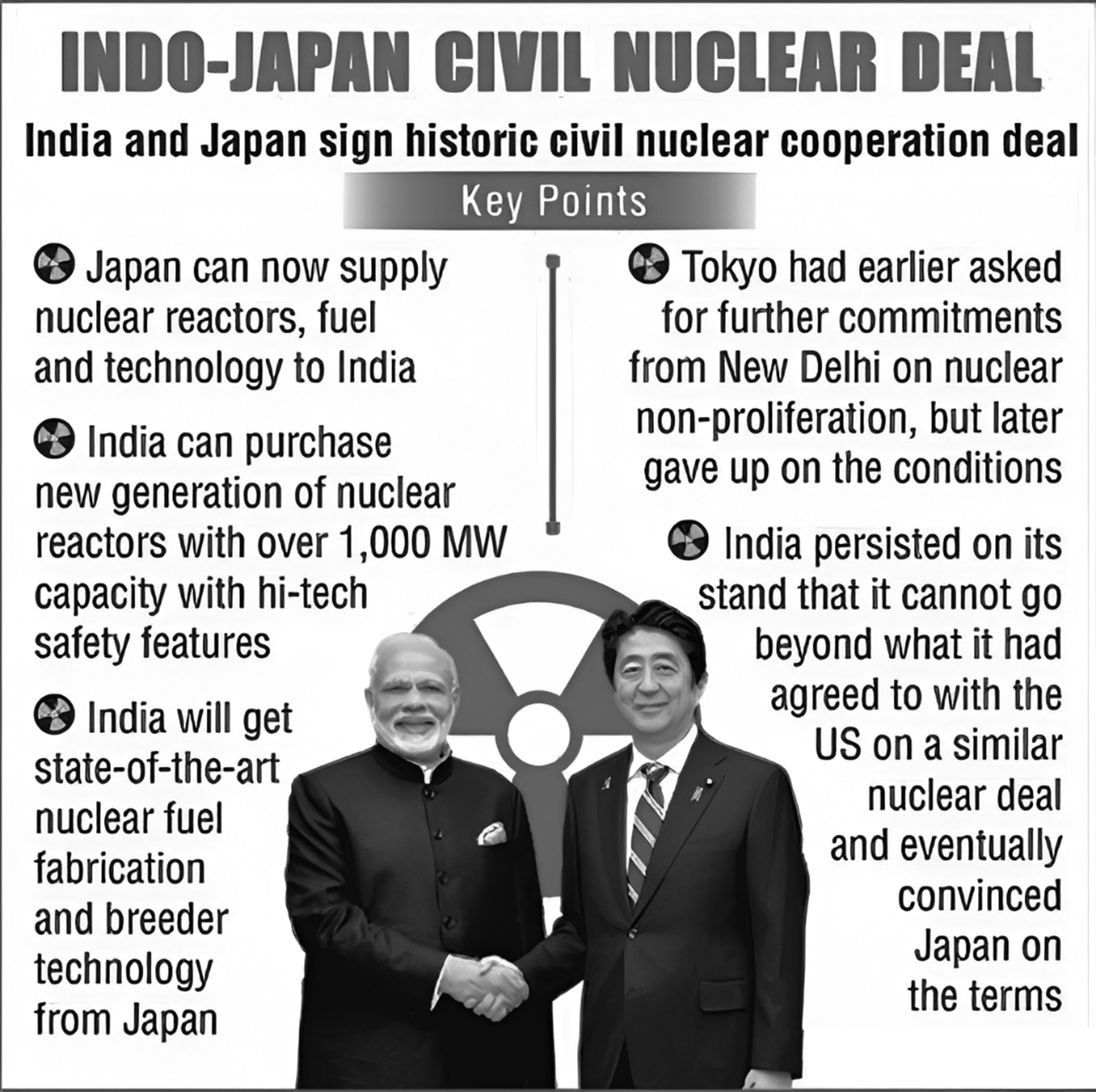
| India-Japan Nuclear Deal A civil nuclear partnership deal between India and Japan entered into force July 2017. The deal paves the way for an ambitious expansion of India’s civilian nuclear power program through purchases of material and technologies from Japan. The deal marks the first agreement between Japan and a state that has not ratified the nuclear Non-proliferation Treaty (NPT). Multiple measures have been put in place under the deal to ensure nuclear transfers are channelled to peaceful purposes. New Delhi’s nuclear material and technology purchases will be subjected to International Atomic Energy Agency safeguards, and the deal can be nullified if India were to conduct a nuclear test. Further, in the event of such a test, Tokyo can require that any material or technology sales resulting from the deal be returned. |
.Significance
• This deal will help guarantee Japan’s continued support to India’s civil nuclear programme for generation of clean and cheap power.
• This deal will mainly help Japan for economic reasons as companies like Mitsubishi and Hitachi are also in the nuclear energy field, and they are running in loss ever since the Fukushima disaster.
Introduction to India Japan Relation
INTRODUCTION
In the context of 21st Century, among all the bilateral relations, Indo-Japan relations have all the potential to transcend this era into an ‘Asian century’. This relationship, which incorporates no dispute- ideological, cultural or territorial, was embarked upon in 6th century A.D., when Buddhism was introduced in Japan.
Direct exchange in modern times commenced only in Meiji era (1868-1912), when Japan set off the process of modernization. Japanese support and assistance to Netaji and INA continue to persist in popular imagination.
Meiji era: an era of Japanese history that extended from October 23, 1868 to July 30, 1912. The Meiji era was the first half of the Empire of Japan, when the Japanese people moved from being an isolated feudal society at risk of colonization by Western powers to the new paradigm of a modern, industrialized nation state and emergent great power, influenced by Western scientific, technological, philosophical, political, legal, and aesthetic ideas. As a result of such wholesale adoption of radically different ideas, the changes to Japan were profound, and affected its social structure, internal politics, economy, military, and foreign relations. The period corresponded to the reign of Emperor Meiji. It was preceded by the Keiō era and was succeeded by the Taishō era, upon the accession of Emperor Taishō.
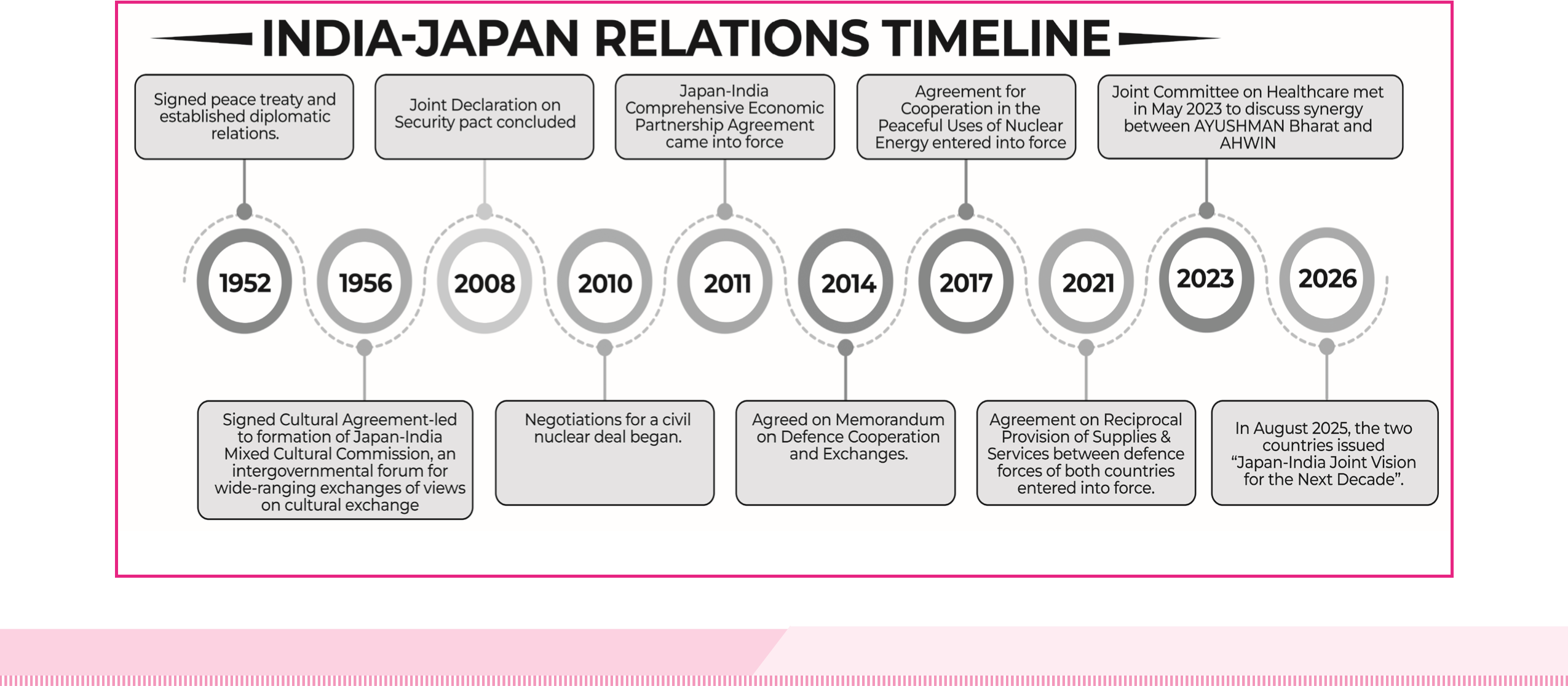
India and Japan established diplomatic relations on 28 April 1952. Yet through the Cold War, the relationship remained chilly. After all, Japan was allied with the United States in a global effort at halting the spread of Communism, while India, postWorld War II, had tilted towards Soviet Russia. With the fall of the USSR, the US still had to provide a defensive shield toJapan against North Korea and China — two nations with whom Japan have historically unresolved issues, while the Japanese role in the alliance was negligible. The shift back towards closer relationships with India started in the post-Cold War era.
Economic ties between the two nations have blossomed since the economic liberalization that was ushered in in 1991, with most major Japanese companies setting up offices in the country. As a matter of fact, the first major push for the Indian automobile industry came with the partnership between Suzuki and Maruti, a partnership which was fostered on a governmental level by both nations.
The visit to India of the Japanese Prime Minister Yoshiro Mori in 2000 led to a significant and qualitative shift in India Japan relations with the establishment of the ‘Global Partnership’ between the two sides.
Annual Summits between the Prime Ministers commenced in 2006 when both sides established ‘Strategic and Global Partnership’. PM Narendra Modi’s official visit to Japan in 2014 for the Annual Summit meeting upgraded bilateral relations to ‘Special Strategic and Global Partnership’. The India-Japan Annual Summits are being held regularly.
HOW THE TWO COUNTRIES COMPLEMENT EACH OTHER?
Japan’s aging population (23% over 65 years) contrasts with India’s youthful energy (over 50% under 25 years);
India’s abundant natural and human resources complement Japan’s cutting-edge technology;
India excels in services while Japan leads in manufacturing;
Japan’s investment capital meets India’s vast, expanding markets and growing middle class.
The historic India-Japan Comprehensive Economic Partnership Agreement (CEPA), effective from August 2011, is set to boost trade, economic, and commercial ties between the two nations.
Japan has been a key provider of bilateral loans and grants to India since 1958, remaining the largest bilateral donor to India.
Asia Africa Growth Corridor
Asia Africa Growth Corridor
Indian and Japanese governments unveiled a vision document for the Asia Africa Growth Corridor.
It is an attempt to create a “free and open Indo-Pacific region” by rediscovering ancient sea-routes and creating new sea corridors that will link the African continent with India and countries in South-Asia and South-East Asia.
Japan’s contribution to the project will be its stateof-the-art technology and ability to build quality infrastructure, while India will bring in its expertise of working in Africa.
Unlike China’s OBOR project Asia Africa Growth Corridor is conceived as a more open and inclusive programme that will be based on more consultations and keep people as the centre piece rather than just trade and economic ties.
Quad and 2+2 Meeting
QUAD Grouping
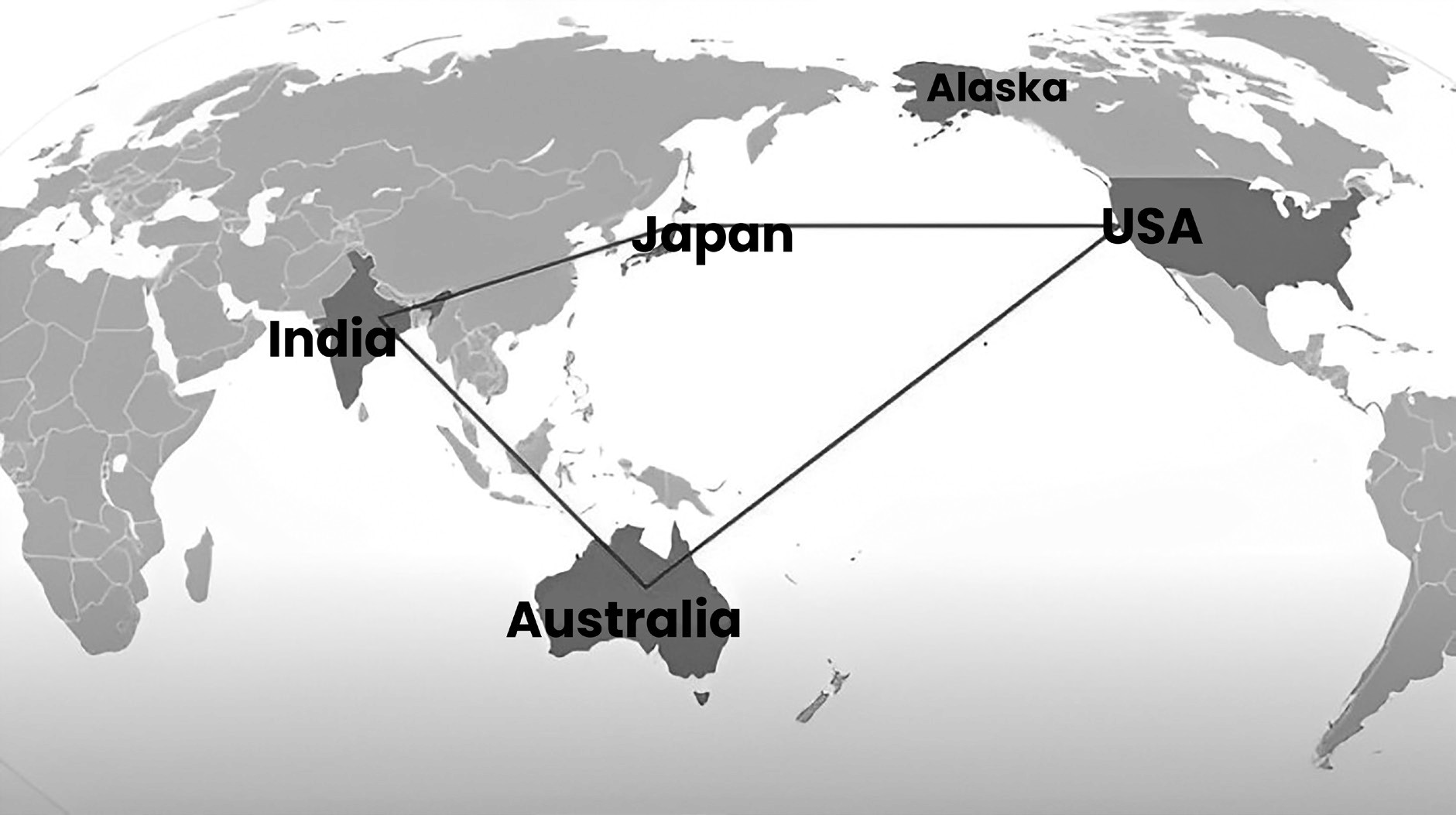
The Quad is diplomatic partnership between Australia, India, Japan, and the United States- four countries with a shared vision “for a region that is governed by accepted rules and norms.”
The origins of Quad 1.0, as it came to be known, lie in the devastating 2004 Indian Ocean tsunami, when the four countries formed the “Tsunami Core Group” to coordinate the emergency response and humanitarian assistance.
In the subsequent years, there were efforts to institutionalize the Quad, spearheaded by Abe Shinzo during his first term as prime minister of Japan from 2006 to 2007. Abe’s rationale for the Quad was to defend the international rules-based order, implying that China had become a threat to that order.
By 2017, with the rise of China and Beijing’s assertive military behaviour in the East and South China Seas, as well as along the border with India, a returned Abe resurrected the idea of the Quad.
2+2 Foreign and Defence Ministerial Meeting
India and Japan conducted its second 2+2 Foreign and Defence Ministerial Meeting.
The Ministers confirmed that they will cooperate toward the common goal of realizing a “Free and Open IndoPacific (FOIP).”
India’s 2+2 Mechanism
Japan is the second country with which India has 2+2 ministerial dialogue (USA being the other one)
India and Australia also have the 2+2 at the official level.
With this, India has 2+2 mechanism with all the Quad countries at some level
Areas of Concern Between India and Japan
AREAS OF CONCERN BETWEEN INDIA AND JAPAN
Trade between the two countries
Today, India-Japan trade languishes at around $15 billion, while Japan-China trade is around $300 billion.
An important factor affecting Indo-Japan trade is the tariff and non- tariff barriers imposed by both countries.
Japan has placed import prohibitions and quantitative restrictions on imports from India, for example, on fish and silk items.
Japan’s Sanitary and Phytosanitary Measures (SPS) are major barriers to Indian exports of poultry, meat, shrimps and fruits like mangoes and grapes.
Focused on countering China
Both countries have border and hegemonic issues with China, so their policy stance hinges generally on China, rather than growing comprehensively.
Security ties
In matters of security realm, Indo-Japanese relationship has remained below potential, and that Japan does not accord due importance to India in its security calculus.
Japan has offered neither military hardware nor technology to India. There seems to be a difference in perceptions about China; Japan, while highlighting its own security concerns in the East and South China Seas, is seen to play down the multiple threats that India faces from China.
What Should Be the Focus of India
WHAT SHOULD BE THE FOCUS OF INDIA- JAPAN RELATIONSHIP?
The Indo-Japan relations is to countering China Influence in Indian Ocean and South China Sea but now countries should go beyond countering China. India is the member of SCO and BRICS and Shinzo Abe promised for the “new era” of relations during his China visit. After the visit, Japanese leadership has stated that they are looking forward to participating in the Chinese Belt and Road Initiative (BRI) and India is also working to improve the relationship with China as was evident during the Wuhan Summit earlier this year.
Hence, there is no need to see the Japan-China and IndiaJapan bilateral relationships in zero-sum frameworks.
Bilateral Ties
There is scope in many areas for the improving trade and fourth industrial revolution can be a landmark in this regard.
For instance, defying global protectionism trend, Japan has entered into agreements with EU, viz. EU – Japan Economic Partnership Agreement (EJEPA), and the
Comprehensive and Progressive Agreement for TransPacific Partnership (CPTPP), which entered into force on February 1st 2019 and January 14th 2019 respectively. This shows that in the growing era of protectionism Japan can be hope for India.
At the time of trade war when Trump is regularly attacking India, its relationship with Japan should be focused on the coalition.
Last year, Japan gave a signal for the reviving of TransPacific Partnership. This can be an opportunity for India in the boosting of its relations with Indo-Pacific countries.
There are many other areas which are providing opportunities such as Africa continent, although IndiaJapan presented a joint venture namely Asia-Africa Growth Corridor to grab the African opportunities.
On security paradigm
India and Japan are victims of China’s influence in their regions have many issues with their securities setup.
Both countries can be the best partner in their relative field. Although, India and Japan are the members of Quad and India invited Japan in Malabar Naval Exercise these are multi-country level ventures. Both counties should focus on their own security setup in their respective regions.
India as a significant naval power with a dominant peninsular location astride shipping-lanes plays a major role in ensuring maritime security in the Indian Ocean and its environs.
Close cooperation with a democratic India, located midway along trade-routes connecting East Asia with the Middle East and Africa, would be advantageous to Japan.
At the same time, a technologically deficient India has much to gain from a relationship with a country like Japan.
CONCLUSION
In a world where protectionism is becoming the new normal and tit-for-tat escalation is on the rise, Japan carves out a different path. As a reluctant globalist turned free trade champion, it is evident that Japan’s trade policy agenda will be an important tool to provide economic stability, growth and development in the foreseeable future.
At a critical juncture when India is leaping to further greatness coinciding with the 75th anniversary of Independence in 2022, Japan and India have so many potential areas to tap jointly. Test