Recent Dynamics Between India Nepal
RECENT DYNAMICS BETWEEN INDIA NEPAL
India was seen interfering in the internal political matters of Nepal by brokering its first steps towards achieving democracy with the ousting of the autocratic Rana regime and restoring the monarchy.
Nepal was also questioned, for establishing defence ties with its northern neighbour China.
Relationship took a beating in 2015, when India first got blamed for interfering in the Constitution drafting in Nepal.
Matters only got worse during a stiff economic blockade between India and Nepal due to the agitation by the Madhesi population there over Nepal’s Constitution promulgated in 2015.
India was also blamed for an “unofficial blockade” in the Madhesis issue, this generated widespread resentment against the country.
The blockade led to the restriction of food and essential supplies from India to Nepal and New Delhi was blamed for steering the agitation.
Nepal is dependent on India for transit to the Seas. It is completely dependent on India for transit rights.
The misunderstanding created during the constitution framing / Madhesi agitation changed the entire gamut of relations between India and Nepal.
The politicians in Nepal exploited Nepali Nationalism and anti-Indianism successfully
Introduction and Overview of Nepal
Introduction
Nepal takes pride in its history of never having been colonized and has an important geostrategic position, with India and China on either side. However, contrary to conventional notions of a harmonious diplomatic relationship, there is a sharp difference in the way Nepal and India view each other.
HISTORICAL BACKGROUND
The relationship goes back to the times during the rule of the Sakya clan and Gautama Buddha. Initially, Nepal was under tribal rule and only with the coming of Licchavi rule in Nepal did its feudal era truly begin.
From 750 to 1750 AD period saw a shift from Buddhism to Hinduism in Nepal and witnessed widespread cultural diffusion.
The early 1700s witnessed a change in the Nepalese power structure. The subsequent period witnesses both monarchical and prime ministerial rule. There established a dynastic rule for the Prime Minister, known as the “Rana”.The Rana rule took hold and continued in Nepal till 1951.
In the 1920s, as the Indian freedom struggle progressed, many educated Nepalese people came to India and partook in the struggle. This gave the Nepalese elite an insight into nonviolent struggle.
The Nepali elite subsequently launched a movement in Nepal and succeeded in ousting the Rana rule.
The most instrumental role in this movement was played by the Nepali Congress (NC).
OVERVIEW
Nepal holds significant importance as a neighboring country of India, playing a key role in India’s foreign policy due to deep-rooted geographic, historical, cultural, and economic connections that have developed over centuries. The two nations share strong ties through their common practices of Hinduism and Buddhism, with Lumbini, the birthplace of Buddha, located in present-day Nepal.
Beyond their shared spiritual heritage, India and Nepal enjoy a unique relationship marked by an open border and the free movement of people. Their connection is further strengthened by familial and marital ties, often referred to as the "Roti-Beti ka Rishta."
At the core of this special relationship is the India-Nepal Treaty of Peace and Friendship, signed in 1950, which serves as the foundation for the enduring partnership between the two countries.

Demographics of Nepal
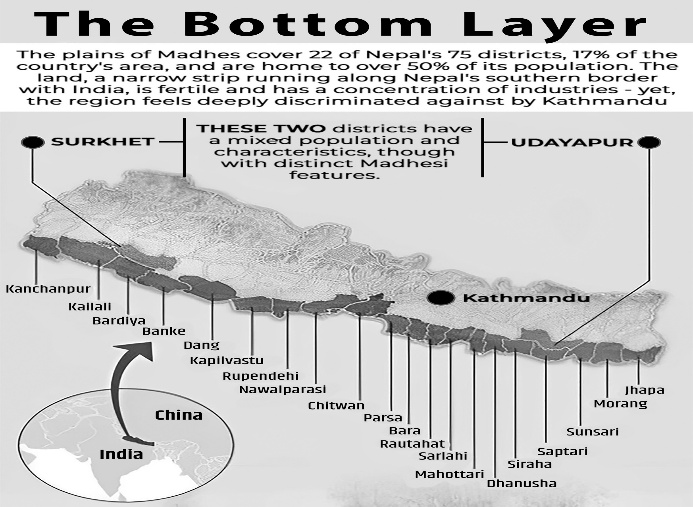
Madhesis are people living in South of Nepal in the region of Terai. They are people living close to the border of India. ¾ The Madhesis have always been discriminated against by Pahadis or the people living in the upper reaches of Nepal.
In fact, the discrimination against Madhesis at one point of time, was so intense by Pahadis that if a Madhesi citizen wanted to visit Kathmandu, they had to apply for a permit.
The Madhesis, through their representation, demanded rights in the new constitution.
Importance of Nepal for India
IMPORTANCE OF NEPAL FOR INDIA
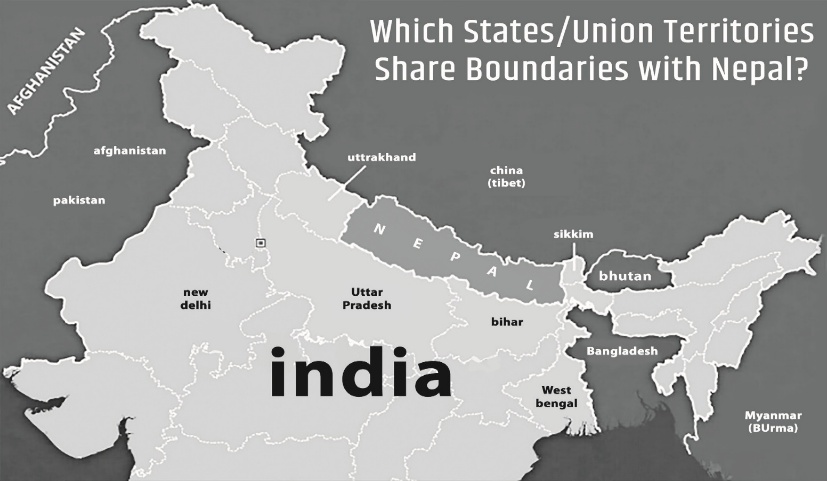
Nepal shares borders with five Indian states— Uttarakhand, Uttar Pradesh, West Bengal, Sikkim, and Bihar—making it a crucial point for cultural and economic exchange between the two nations.
Nepal’s significance for India can be understood from two perspectives: its strategic importance for India’s national security, and its role in shaping India’s influence in international politics. Positioned at the heart of India’s ‘Himalayan frontiers,’ Nepal, along with Bhutan, acts as a vital buffer state against potential threats, particularly from China.
The rivers that originate in Nepal contribute to the perennial river systems of India, providing essential ecological benefits and hydropower potential. Additionally, Nepal is home to several prominent Hindu and Buddhist pilgrimage sites, making it an important destination for millions of Indian devotees.
Treaty of Peace and Friendship of 1950
TREATY OF PEACE AND FRIENDSHIP OF 1950
India and Nepal signed a Treaty of Friendship and Peace on 31st July 1950. It forms the bedrock of bilateral relationship.
FEATURES OF THE TREATY
The treaty extends mutual peace, friendship and sovereignty to each other while it accepts non-interference in each other’s territory.
As per the treaty, Nepal would consult India whenever they undertake any arms imports from any nation other than India. It also gives Nepal access to weaponry from India.
The treaty lets the nations extend national treatment to each other.
The national treatment clause also extends for industrial and economic development.
Citizens are empowered to the same privileges for property, trade and residence and movement in both countries. That means, a Nepali Citizen can buy property in India while and Indian citizen can do so in Nepal.
An Indian citizen can reside anywhere in Nepal and a Nepali citizen too enjoys the right to residence in India under national treatment.
Another important point of the treaty is open borders. As per this point, Indian citizens can move to Nepal without the need of a visa and vice versa.
As per the treaty, either party can ask for a change in the treaty whenever deemed fit.
CRITICAL ISSUES IN INDO–NEPAL TREATY
The Treaty favours Nepal more than India, but Nepal still has certain issues with it.
Nepal initially complained about the treaty as it was made with Ranas who was not popular at that time.
Certain sections in Nepal also alleged that the way treaty was signed signified that India considered Nepal as a small state and not an equal state.
As it was signed on India’s behalf by someone who was in lesser designation compared to the Prime Minister of Nepal.
Besides, Nepal has always had reservations with Articles 2, 6 and 7 of the treaty.
Article 2 states that both governments should “inform each other of any serious friction or misunderstanding with any neighbouring State likely to cause any breach in the friendly relations subsisting between the two Governments”.
Articles 6 and 7 stipulate India and Nepal will give the same privileges of economic activity, employment, resident and ownership of property to each other’s nationals in their territory.
Many times, Nepali political parties have demanded a change in the treaty.
Whenever Nepal has asked for a change in the treaty, India has accepted the Nepali request, but absence of consensus in Nepal on issues that need revision prevents any meaningful engagement about the issue.
The Nepal-India Eminent Persons’ Group (EPG) is revisiting all bilateral agreements to submit a comprehensive report to both governments on how to reset bilateral relations.
Seven decades later, clamour is now growing louder in Nepal to “revise” the pact to reflect “new changes and realities”. This came nearly seven years after both sides agreed to “review, adjust and update” the Treaty of Peace and Friendship of 1950, during Prime Minister first visit to Nepal in 2014.
Areas of Cooperation Between India Nepal
AREAS OF COOPERATION
Trade
About 64.1% of Nepal's entire trade, or $8.53 billion USD, is with India (Indian FY 24-25). This comprises $1.20 million USD in exports from Nepal to India and $7.33 billion USD in exports from India to Nepal.
With 35% of Nepal's total FDI stock, valued at around USD 777 million, Indian companies are among the country's biggest investors. Nepal rose from 28th place in 2014 to 14th place as India's top export destination in 2024–2025. Nearly 16% of Nepal's GDP comes from exports from India
India and Nepal have also signed the Double Taxation Avoidance Agreement (DTAA) in November 2011. The bilateral remittance flow is estimated at approximately US$ 3 billion (Nepal to India) and US$ 1 billion (India to Nepal)
Apart from that, India provides transit from almost entire third-country trade of Nepal via Kolkata port. A revised Treaty of Transit signed in 2023, will enable Nepal to use Indian ports such as Haldia, Kolkata, Paradip and Visakhapatnam for its third-country trade. It will reduce transportation costs and time for Nepalese exporters and importers.
The ‘New Partnership in Agriculture’: It was announced in April 2018, which focuses on collaborative projects in Agriculture, Education and R&D.
Connectivity and Development Partnership
India provides financial and technical aid to Nepal’s developmental activities.
India has been assisting Nepal in the development of border infrastructure through the upgradation of 10 roads in the Terai area; development of cross-border rail links at Jogbani-Biratnagar, Jaynagar-Bardibas; and the establishment of Integrated Check Posts at Birgunj, Biratnagar, Bhairahawa, and Nepalgunj.
The total economic assistance earmarked under the ‘Aid to Nepal’ budget in FY 2019-20 was INR 1200 crore.
Besides, a plan to extend South Asia’s first cross-border petroleum pipeline from Motihari (Bihar) in India to Amlekhgunj in Nepal, by another 69 km up to Chitwan in Nepal has been proposed.
Also, a second cross-border petroleum pipeline from Siliguri in India to Jhapa in eastern Nepal will be constructed.
India is also linking Sagarmatha-Sagar, a waterway that will provide Nepal access to sea, through Kosi route.
India-Nepal Rail Services Agreement (RSA): India and
Nepal signed a Letter of Exchange (LoE) to the IndiaNepal Rail Services Agreement (RSA), which enabled all authorised cargo train operators including private container train operators to carry Nepal’s container and other freight.
Mahakali River bridge: Recently, a MoU was signed between India and Nepal for the construction of a motorable bridge across the Mahakali River connecting Dharchula (India) with Darchula (Nepal), under Indian grant assistance.
Various projects have been implemented in the areas of infrastructure, health, water resources, education and rural & community development.
India has built several hydroelectric projects in Nepal like Pokhra (1 MW), Trisuli (21 MW), Western Gandak (15 MW), Devighat (14.1 MW) etc.
Nepal has also extended an invitation to Indian businesses to invest in the West Seti Hydropower Project.
Cultural, Educational and People to People Ties
The most striking feature of India-Nepal relations is the deep cultural link and people to people contact. Nearly eight million Nepalese citizens live and work in India and around 6,00,000 Indians reside in Nepal.
Both the neighbours have signed three sister city agreements for the twinning of Kathmandu-Varanasi, Lumbini-Bodhgaya and Janakpur-Ayodhya.
Besides, The Swami Vivekananda Centre for Indian Culture was set up in Kathmandu in August 2007 to showcase the best of Indian culture.
Also in 2022, PM Modi inaugurated the construction of India International Centre for Buddhist Culture and Heritage in the Lumbini Monastic Zone, Lumbini, Nepal.
GoI provides around 3000 scholarships/seats annually to Nepalese nationals for various courses.
The B.P. Koirala India-Nepal Foundation was set up in 1991 to foster educational, cultural, scientific and technical cooperation and to promote mutual understanding and cooperation through sharing of knowledge and professional talents in academic pursuits and technical specialization.
The Nepal-Bharat Library was founded in 1951 in Kathmandu. It is regarded as the first foreign library in Nepal.
An Indian Citizens’ Association (ICA) of Nepal was formed on 14 September 1990.
ICA is the only association of resident Indian citizens in Nepal and provides a platform for discussion on matters pertaining to the legitimate interest of resident Indians in Nepal and works for the protection of such interests.
Humanitarian Aid
In 2015, India has provided 1.54 billion Nepalese Rupees (INR nearly 96 crore) to Nepal as part of its commitment towards assistance and rehabilitation after the 2015 earthquake.
As part of COVID-19 assistance, India had supplied more than 23 tonnes of medicines and medical equipment to Nepal on Grant basis and total COVID-19 assistance provided to Nepal is more than US$ 7 million.
In Nov 2023, another earthquake of 6.4 magnitude hit Nepal. India was again quick to respond with 9 tonnes of relief material, and much more over period of time.
Energy Cooperation
India and Nepal have had a Power Exchange Agreement in place since 1971, aimed at meeting the power needs of border regions in both countries by leveraging each other's transmission infrastructure.
There are over twenty transmission interconnections (132 kV, 33 kV, and 11 kV lines) that facilitate both power exchange and trade between the two nations along their border areas.
To further enhance electricity transmission, the first highcapacity 400 kV cross-border transmission line from Muzaffarpur (India) to Dhalkebar (Nepal), funded by the Government of India (GoI) with a loan of US$ 13.2 million for the Nepal section, was completed in 2016. Additionally, two more 132 kV cross-border transmission lines between Kataiya (India) and Kusaha (Nepal), as well as Raxaul (India) and Parwanipur (Nepal), were completed in 2017 with GoI grant assistance.
India currently supplies about 600 MW of electricity to Nepal.
On October 21, 2014, an Agreement on ‘Electric Power Trade, Cross-border Transmission Interconnection, and Grid Connectivity’ was signed between the two countries to strengthen cross-border electricity transmission, grid connectivity, and power trade. This agreement lays the foundation for power trade, with Nepal importing power from India until it becomes power surplus, and future potential for India to import power from Nepal under mutually agreed terms.
The agreement also established two key mechanisms: the Joint Working Group (JWG) and the Joint Steering Committee (JSC). Furthermore, a Joint Technical Team (JTT) was formed to develop a long-term integrated transmission plan, which includes projects extending to 2035.
In addition, South Asia’s first cross-border petroleum products pipeline, built and funded by Indian Oil Corporation Ltd., connects Motihari (India) to Amlekhgunj (Nepal) and was remotely inaugurated by the two Prime Ministers on September 10, 2019.
an MoU was signed in 2024, between Nepal Electricity Authority and PowerGrid Corporation to jointly develop two new 400 kV cross border transmission lines viz., the Dododhara-Bareilly and Inaruwa-Purnea lines
Defence Cooperation
Bilateral defense cooperation between India and Nepal includes supporting the modernization of the Nepalese Army through the provision of equipment and training.
The Gorkha Regiments of the Indian Army are partially staffed by recruits from the hill districts of Nepal.

Since 2011, India has conducted an annual joint military exercise with Nepal, called Surya Kiran. This exercise features an aerobatic demonstration by the Indian Air Force (IAF).
Multilateral Partnership
India and Nepal are active participants in several multilateral forums, including BBIN (Bangladesh, Bhutan, India, and Nepal), BIMSTEC (Bay of Bengal Initiative for Multi-Sectoral Technical and Economic Cooperation),
NAM (Non-Aligned Movement), and SAARC (South Asian Association for Regional Cooperation), among others.
The India-nepal Petroleum Pipeline
THE INDIA-NEPAL PETROLEUM PIPELINE
The pipeline will transport fuel from Barauni refinery in Bihar’s Begusarai district to Amalekhgunj in southeastern Nepal, situated across the border from Raxaul in East Champaran district. The 69-km pipeline will drastically reduce the cost of transporting fuel to landlocked Nepal from India. The Amalekhgunj fuel depot will have the capacity to store up to 16,000 kilolitres of petroleum products.
The Motihari-Amalekhgunj pipeline will help in tackling the oil storage problem in Nepal and doing away with transportation of petroleum products through tankers. It will ensure smooth, cost-effective and environment-friendly supply of petroleum products to Nepal.
Recent Developments in Indo Nepalrelation
RECENT DEVELOPMENTS (INDIA-NEPAL)
Visit of Nepali PM Dahal to India (May 2023): Focus on improving ties, addressing outstanding issues, and strengthening cooperation in areas like trade, hydropower, and connectivity.
Progress on Kalapani issue: Both sides agreed to hold talks on the disputed territory.
Cooperation on flood management: Joint mechanism established to address border area flooding concerns.
Continued tensions over Agnipath Scheme: No resolution, potentially hindering Gorkha recruitment.
Nepal’s growing relations with China: Concerns in India about possible strategic shift in Nepal’s foreign policy.