India Pakistan Wars
INDIA PAKISTAN WARS
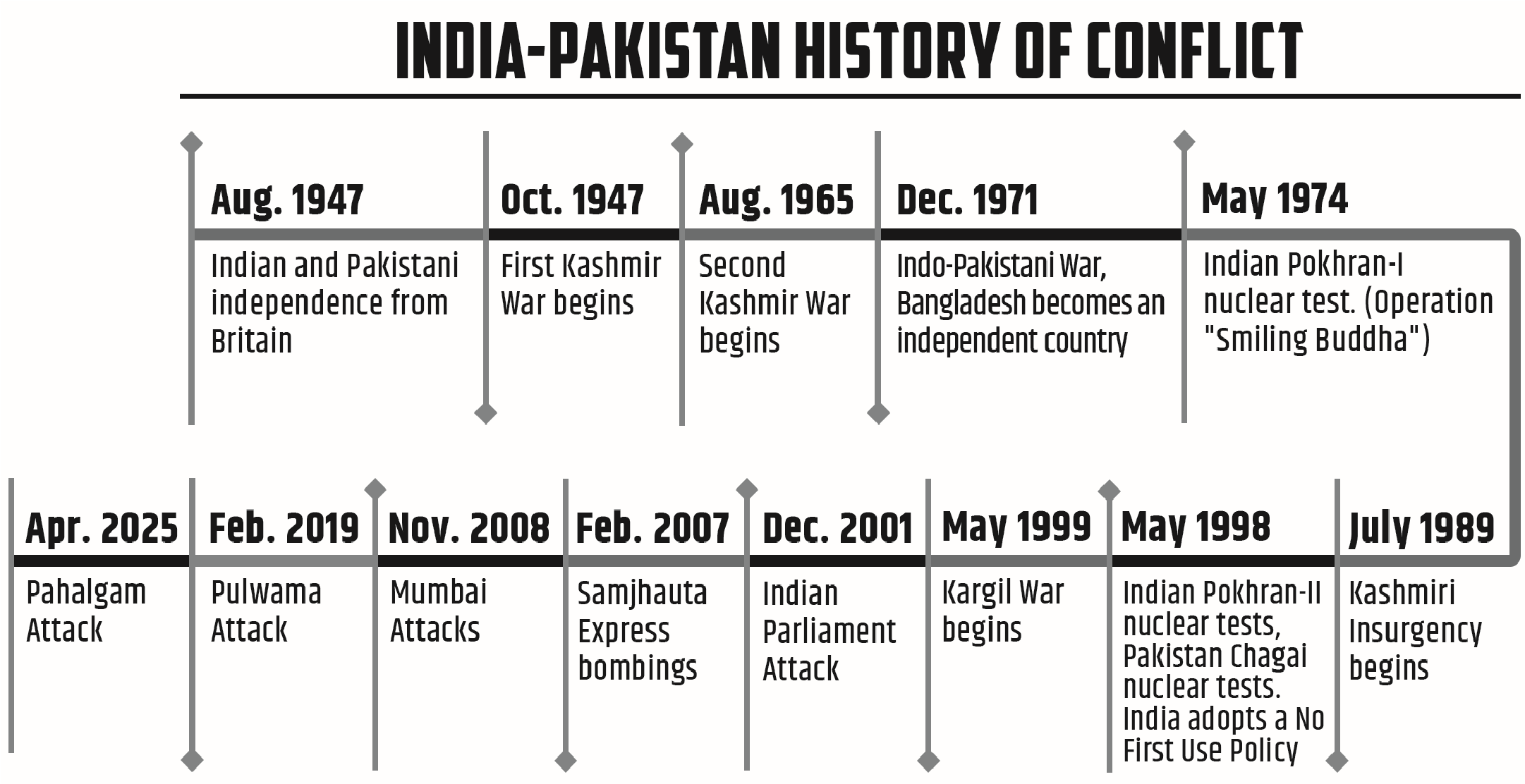
1965 India-Pakistan War
In 1965, India-Pakistan relations worsened to the point of armed conflict. The countries engaged in battle with one another “because of their conflicting claims over the Rann of Kutch at the southern end of the international boundary. War was a consequence of Operation Gibraltar by Pakistan to infiltrate forces into J&K to incite [begin] an insurgency against Indian state. The situation steadily deteriorated during the summer of 1965, and, in August, military hostilities between India and Pakistan erupted on a large scale along the ceasefire line in Kashmir.
On January of 1966, the leaders of India and Pakistan met to discuss the cease-fire to the ongoing conflict. Both sides returned from the meetings saying that they would retreat their troops to positions before August 5th, 1965, and that this should be recognized by February 25th, 1966. The military leaders met again, and confirmed an agreement on both sides to remove troops, which they both executed on the 26th of February, 1966.
The UN mandated a ceasefire and Soviet Union (USSR) got involved which subsequently led to the Tashkent declaration. On January 10, 1966, Indian Prime Minister Lal Bahadur Shastri and Pakistani President Ayyub Khan signed an agreement at Tashkent (now in Uzbekistan), agreeing to withdraw to pre-August locations and that economic and diplomatic ties between the warring sides would be restored.
1971 India-Pakistan War
India and Pakistan go to war a third time, this time over East Pakistan (now Bangladesh). The conflict began when the central Pakistani government in West Pakistan, led by Zulfiqar Ali Bhutto, refuses to allow Awami League leader Sheikh Mujibur Rahman, a Bengali whose party won the majority of seats in the 1970 parliamentary elections, to assume the premiership.
A Pakistani military crackdown on Dhaka begins in March, but India becomes involved in the conflict in December, after the Pakistani air force launches a pre-emptive attack on airfields in India’s northwest.
India then launches a coordinated land, air and sea assault on East Pakistan. The Pakistani army surrendered at Dhaka, and its army of more than 90,000 armed soldiers became prisoners of war. Hostilities lasted 13 days, making this one of the shortest wars in history of armed combat.
This led to birth of an independent country, Bangladesh (erstwhile East Pakistan), on December 6, 1971. The Instrument of Surrender signed by Pakistan marked the end of the 1971 war.
1972 - Pakistani Prime Minister Zulfikar Ali Bhutto and Indian Prime Minister Indira Gandhi signed an agreement in the Indian town of Shimla, which came to be known as Shimla Agreement.
The Shimla Agreement designates the ceasefire line of December 17, 1971, as being the new “Line-of-Control (LoC)” between the two countries.
Shimla Agreement: Main Features
• India and Pakistan resolved to put an end to the conflict and confrontation that had strained their relations in the past and work to promote a friendly and harmonious relationship to establish durable peace in the subcontinent.
• Both India and Pakistan agreed that the relations between the two will be governed by the principles of the United Nations charter.
• The two countries resolved to solve their differences by peaceful means, through bilateral dialogue or any other means mutually agreed upon by them.
• Both India and Pakistan agreed to respect the line of control in Jammu and Kashmir without any prejudice to the recognized position of either side. They also agreed that neither will seek to alter it unilaterally, irrespective of mutual differences and legal interpretations.
• Further, the two nations also agreed to refrain from the use of threat or force in violation of this Line.
1974 - The Kashmiri state government affirmed that the state "is a constituent unit of the Union of India". Pakistan rejected the accord with the Indian government. On May 18, India detonated a nuclear device at Pokhran, in an operation codenamed “Smiling Buddha”. India referred to this device as a “peaceful nuclear explosive”.
1999 Kargil War
After the debacle of 1971 war, Pakistani army never tried to fight with Indian army directly & started the proxy war by infiltrating the terrorists trained by their intelligence agencies to create havoc and panic in India, especially in J&K.
In 1999, so called Mujahideens along with Pakistani forces occupied several strategic Himalayan peaks and areas on the Indian side of LOC in the Mashkoh, Dras, Kaksar, Batalik.
Suspecting Pakistan’s sinister design behind such activities, Indian forces immediately began retaliating to such proxy war which came to be known as “Kargil conflict” (1999).
There was a huge controversy surrounding the Kargil conflict, the then PM of Pakistan was kept in the dark of such moves by Pakistani Army backed Mujahideens. Later, the then Pakistani Army Chief General Parvez Musharraf took over as its President.
This conflict got worldwide attention because of the nuclear capabilities attained by both countries in 1998, which could be used by either side, however nuclear weapons were not used in war, and Indian troops regained their peaks.
| Ceasefire violations | |
| • | Ceasefire is a situation where countries mutually agree to not fire at towards each other’s territory so as to ensure peace and tranquillity on borders. |
| • | Even after the 2003 Ceasefire Agreement, the post-Kargil Conflict came into effect, Pakistan has been engaged in regular ceasefire violations. This violence has led to multiple casualties of civilians and the army on both sides. |
The Kargil conflict ended with Operation Vijay being declared a success, which confirmed complete withdrawal of Pakistani forces and Mujahideens from Indian territory.

History of India Pak Relation J&k Conflict
HISTORY OF INDIA-PAKISTAN RELATIONS
India and Pakistan bilateral relations are a tale of miscalculation, antagonism and mutual paranoia [suspicion] of elites. Both neighbours have a history of tensions between them. Since the partition of India and Pakistan, the two states have been at odds over various issues such as terrorism, Kashmir, Indus Water treaty, Sir Creek dispute among others. India and Pakistan are also referred as “Conjugal twins”, and often known as “Brother Enemy”.
India-Pakistan Conflict on Jammu and Kashmir
Kashmir is a territory between Pakistan and India, and has been a major point of contention between the two nations. As India was fighting Britain for self-rule, in the 1930s, a Kashmiri identity was also being established. Then, as Britain left the Indian subcontinent, both India and Pakistan became independent. However, there were questions about what would be done with the territory known as Jammu and Kashmir. Hindu, Muslim, and other secular and religious groups all pushed for their own political interests with regards to the future of Jammu & Kashmir. Also, what separated Jammu & Kashmir from many other areas and princely states in India and Pakistan was the fact that it is geographically located between both the nations and accessible from both sides. So, there were calls for Kashmir to choose its political affiliation at earliest.

Thus, in order to relieve any hostilities over the future Kashmir, the area was able to choose which country that they would be a part of. At the time, the ruler of Kashmir was Maharaja Hari Singh, who was a Hindu. Meanwhile the population
of Kashmir was primarily Muslim. So, instead of making a politically divisive choice, he initially chose neutrality. On 15th August, Hari Singh offered standstill agreement with both countries which allowed for the free movement of people & goods. Pakistan signed the agreement but India didn’t. Pakistan became impatient & started violating standstill agreement. In October 1947, Pakistan sent in Muslim tribesmen who were knocking at the gates of the capital Srinagar. On 24th October, Hari Singh demanded military assistance from India. Mountbatten pointed out that under international law India can send its troops only after state signs a formal “Instrument of Accession” – on 26th Oct-1947, Maharaja signed instrument of accession.
This move of giving Kashmir to India was not without a great amount of controversy. India had to fight a war against Pakistan in 1947 and into 1948 over Kashmir issue. India took the issue to United Nations (UN) for its peaceful resolution so the UN got involved, as India looked to the international organization for aid in stopping the conflict. For example, “In January 1948, the UN Security Council adopted resolution 39 (1948), establishing the United Nations Commission for India and Pakistan (UNCIP) to investigate and mediate the dispute. In April 1948, by its resolution 47 (1948), the Council decided to enlarge the membership of UNCIP and to recommend various measures including the use of observers to stop the armed conflict” (United Nations, ND).
While the United Nations looked to stop the war, they also prepared for a vote in Kashmir to decide its future. However, in the meantime, “India, having taken the issue to the UN, was confident of winning a plebiscite, since the most influential Kashmiri mass leader, Sheikh Abdullah, was firmly on its side. An emergency government was formed on October 30, 1948 with Sheikh Abdullah as the Prime Minister. Pakistan ignored the UN mandate and continued fighting, holding on to the portion of Kashmir territory under its control. On January 1, 1949, a ceasefire was agreed, with 65 per cent of the territory under Indian control and the remainder with Pakistan”. This “Line of Control” thus became the line that divides India and Pakistan.
Then, “In July 1949, India and Pakistan signed the Karachi Agreement establishing a ceasefire line to be supervised by the military observers. These observers, under the command of the Military Adviser, formed the nucleus of the United Nations Military Observer Group in India and Pakistan (UNMOGIP). On 30 March 1951, following the termination of UNCIP, the UN Security Council, by its resolution 91 (1951) decided that UNMOGIP should continue to supervise the ceasefire in Kashmir. UNMOGIP’s functions were to observe, report and investigate complaints of ceasefire violations and submit its finding to each party and to the Secretary-General of United Nations”.
Pakistan controls roughly one-third of the state of Jammu & Kashmir, referring to it as Azad (free) Kashmir. It is semiautonomous. A larger area, including the former kingdoms of Hunza and Nagar, is controlled directly by the central Pakistani government.
In the following years, a constituent assembly for Jammu and Kashmir was convened to frame a new constitution for the state of J&K in October 1951, after an election in which all the seats were won by the Jammu & Kashmir National Conference party of Sheikh Abdullah.
| Agreement” with Jawaharlal Nehru, the then Prime Minister of India, on 24 July 1952. It extended provisions of the Constitution of India regarding citizenship, jurisdiction of the Supreme Court of India and fundamental rights to the state. Agreements were also reached on issues of abolishing the monarchy, as well as the state being allowed a separate flag and official language. |
Abdullah reached an agreement termed as the “Delhi Kashmir During the 1980s and 1990s
While the two decades prior to the late 1980s saw a more stabilized “status quo” position, the 1980s witnessed Kashmiri calls for determining their own political future.
However, the Indian government opposed these calls. Furthermore, hostilities increased manifold when the 1987 election was perceived to have been rigged. This turned many in Kashmir away from elections, and towards violence. Following the 1987 elections, the region saw an increase in jihadist groups.
For example, a number of Pakistani based organizations began using violence and terrorism so that the Hindu population (majorly consisting of Kashmiri Pandits) deserts the Indian Kashmir valley. This led to a military response by the Indian government against sinister design by external forces. All this while, Pakistani army was involved in frequent ceasefire violations which were being retaliated by Indian army.
In 1990s, armed resistance to Indian rule in Kashmir begins. India accuses Pakistan of giving weapons and training to the militants. Pakistan says it offers only “moral and diplomatic” support.
Indian establishment considers that the Pakistani military has encouraged the activity of these groups and has often viewed the Pakistan’s actions as a major problem. India has also frequently and openly called Pakistan a “terrorist state”.
Given that both India and Pakistan have nuclear weapons, any heightened conflict between these two countries may be a cause for even greater alarm; there have been genuine fears that these two states would possibly fight a nuclear conflict.
Issue of Kashmiri Pandits
Kashmiri Pandits began to leave in much greater numbers in the 1990s during the eruption of militancy, following persecution and threats by radical Islamists and militants.
The events of 19 January 1990 were particularly vicious. On that day, mosques issued declarations that the Kashmiri Pandits were Kafirs and that the males had to leave Kashmir, convert to Islam or be killed. Those who chose to leave Kashmir were told to leave their wives, daughter, sisters behind.
The Kashmiri Muslims were instructed to identify Pandit homes so they could be systematically targeted for conversion or killing.
The issue remains unresolved with Kashmiri Pandits living as refugees in their own country.
Developments Around Article 370 (article 370 and 35(a) Revoked)
Developments Around Article 370 (Article 370 and 35(A) Revoked)
• On 5th of August 2019, the President of India promulgated the Constitution (Application to Jammu and Kashmir) Order, 2019.
• The order effectively abrogates the special status accorded to Jammu and Kashmir under the provision of Article 370 - whereby provisions of the Constitution which were applicable to other states were not applicable to Jammu and Kashmir (J&K).
• According to the Order, all the provisions of the Indian Constitution are now applicable in J&K.
• This Order comes into force “at once”, and shall “supersede the Constitution (Application to Jammu and Kashmir) Order, 1954.”
| A separate Bill - the Jammu and Kashmir Reorganisation Bill 2019 - was introduced to bifurcate the State into two separate union territories of Jammu and Kashmir (with legislature), and Ladakh (without legislature). Jammu and Kashmir Reservation (Second Amendment) Bill, 2019 was also introduced to extend the reservation for Economically Weaker Sections (EWS) in educational institutions and government jobs in Jammu and Kashmir. |
Constitutional Position and Article
Article 370 of the Indian Constitution provided that only Articles 1 and 370 itself would apply to J&K. The application of other Articles was to be determined by the President in consultation with the government of the state.
• The Constitution Order of 1950 specified the matters on which the Union Parliament would be competent to make laws for J&K, in concurrence with the Instrument of Accession - 38 Subjects from the Union List were added.
The Constitution (Application to Jammu and Kashmir) Order,
1954 settled the constitutional relationship of J&K and the Union of India. It made the following provisions -
• Indian citizenship and all related benefits (fundamental rights) were extended to the ‘permanent residents’ of Jammu and Kashmir.
• Article 35A was added to the Constitution (empowering the state legislature to legislate on the privileges of permanent residents with regard to immovable property, settlement in the state and employment)
• The jurisdiction of the Supreme Court of India was extended to the State.
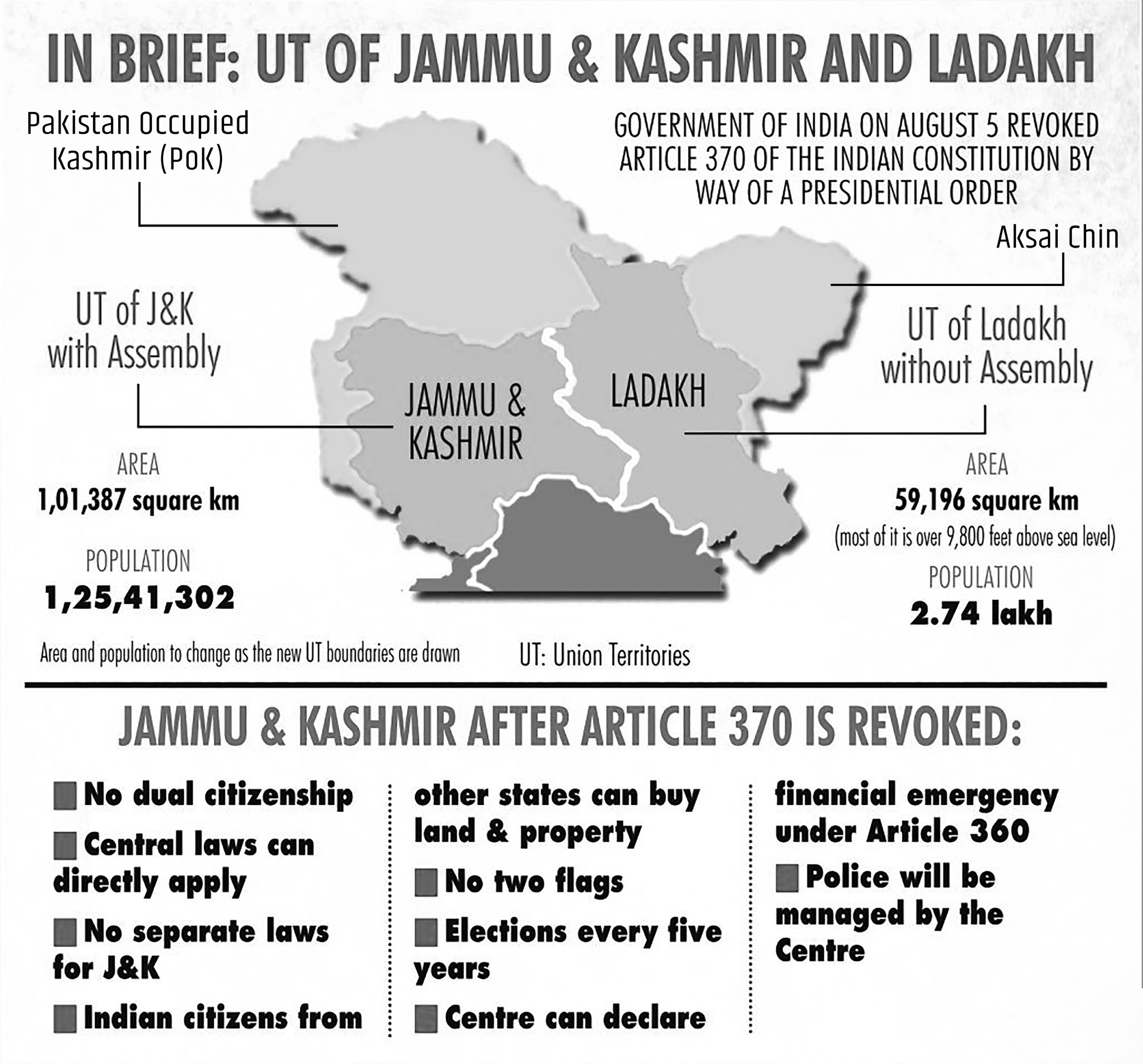
• Central Government was given the power to declare a national emergency in the event of external aggression. The power in case of internal disturbances could be exercised only with the concurrence of the State Government.
• Normalized the financial relations between the Centre and J&K
Article 370 - Features and Provisions
• Present in part XXI of the Indian Constitution which comprises of Temporary, Transitional and Special Provisions with rest to various states of India.
• Forms the basis of the “Special Status” of J&K.
• Provided for a separate Constitution of J&K.
• Limits the Union Parliament’s power to make laws for J&K to those subjects mentioned in the Instrument of Accession (defence, foreign affairs, and communications) and others as and when declared by the Presidential Orders with the concurrence of the Government of the State.
• Specified the mechanism by which the Article shall cease to be operative. That is, on the recommendation of the Constituent Assembly of the State before the President issues such a notification. However, this provision has been amended by the Constitution (Application to Jammu and Kashmir) Order, 2019.
WAS IT TEMPORARY?
• The Article was introduced to accommodate the apprehensions of Maharaja Hari Singh who would not have acceded to India without certain concessions.
• Territorial integrity was of paramount importance to India post-independence; thus, such a special provision was inducted in the constitution.
• The provision, however, is part of the “Temporary, Transitional and Special Provisions” of our constitution.
• Moreover, Article 370 could be interpreted as temporary in the sense that the J&K Constituent Assembly had a right to modify/delete/retain it; it decided to retain it.
• Another interpretation was that accession was temporary until a plebiscite.
Issues in Revoking
• Article 370 is the bedrock of the constitutional relationship between Jammu and Kashmir and the rest of India.
• It has been described as a tunnel through which the Constitution is applied to J&K.
• India has used Article 370 at least 45 times to extend provisions of the Indian Constitution to J&K. This is the only way through which, by mere Presidential Orders, India has almost nullified the effect of J&K’s special status.
• By the 1954 order, almost the entire Constitution was extended to J&K including most Constitutional amendments.
• It will also clear the path for abrogating Article 35A which would allow Indian citizens to purchase land and settle permanently in J&K.
• Thus, the move is bound to have a significant impact on the demography, culture, and politics of J&K.
• Pakistan has been trying to raise the issue in international forums which Indian side has been countering at global level. These are efforts to internationalise a domestic issue of India.
Changed Ground Realities After Revoking Article 370
Changed ground realities after revoking Article 370
People from outside J&K can buy land there. However, the amendment did not allow transfer of agricultural land to non-agriculturists except in few cases.
Non-local spouses of J&K women get domicile status.
The move will allow them to buy land or property in the Union territory, or apply for government jobs.
All people who have resided in the UT for 15 years, or have studied for seven years and appeared in Class 10 or 12 examination in an educational institution in the region, and their children, are eligible for grant of domicile status.
Separate flag of Jammu and Kashmir became defunct.
No security clearance for passport to stone pelters. The CID wing of Jammu and Kashmir Police has ordered the denial of security clearance required for passport and other government services to all those involved in stonepelting or subversive [disruptive] activities.
Data shown by Union Home ministry reveals that there has been drastic reduction in terror incidents since the abrogation of article 370.
District Development Council (DDC) elections were held peacefully which shows the faith of Kashmiri public in Jamuriyat (democracy).
Government highlighted about thousands of Kashmiri Youth returned back to J&K and taken up jobs under Prime Minister rehabilitation package.
Centre has approved new industrial development scheme for J&K with an outlay of more than Rs.28,000 crore to give boost to job creation.
Agra Summit 2001
Agra Summit 2001
The Agra summit was a two-day meeting between India and Pakistan that lasted from 14–16 July 2001. It was organized to resolve long-standing issues between the two nations. At this meeting, various proposals were proposed, like reducing nuclear arsenals, resolving the J&K dispute, and cross-border terrorism. However, the negotiations broke down. Thus, the Agra treaty was never signed.
Conflict Zones
CONFLICT ZONES
Sir Creek Dispute
Sir Creek is a 96-kilometer tidal estuary located along the border between India and Pakistan, opening into the Arabian Sea. It serves as a natural boundary, separating India’s Gujarat state from Pakistan’s Sindh province.
Pakistan asserts ownership of the entire Sir Creek, claiming that its eastern bank, marked by the "green line" on a 1914 map, falls under its jurisdiction. If India were to accept this claim, it would lose approximately 250 square miles of its Exclusive Economic Zone.
India, in turn, justifies its position by referring to the Thalweg doctrine of international law. This principle holds that boundaries along rivers can be defined by the mid-channel, provided both countries agree. India cites a map from 1925 to support this argument.
| Sir Creek itself has little value. It is a marshy wasteland. But where the boundary line runs through it will determine how much Exclusive Economic Zone (EEZ) one country will lose or gain. Much of the region is rich in oil and gas below the sea bed, and control over the creek would have a huge bearing on the energy potential of each nation. |
While Pakistan acknowledges the 1925 map, it argues that the Thalweg doctrine is not applicable to Sir Creek, as it is a tidal estuary rather than a non-tidal river, where the doctrine is typically used.

Challenges due to unresolved Sir Creek Issue
Due to lack of proper maritime boundary, inadvertent crossing over of fishermen of both nations
Main route to smuggle drugs, arms and petroleum product to India – exploited by drug syndicate
Terrorists are using disputed area to cross over Indian side. In 26/11 terror attack, terrorists captured an Indian fishing vessel, Kuber, off Sir Creek, and used it to attack
Mumbai.
Designating the non-delineated area of Sir Creek and its approaches-as a zone of disengagement or a jointly administered maritime park is the best way forward.
Siachen Dispute
Siachen is a triangular section of glacier located in the eastern Karakoram range of the Himalayas, just northeast of NJ9842, where the Line of Control (LoC) between India and Pakistan ends. This area holds the unfortunate distinction of being the highest battlefield in the world. The Siachen dispute stems directly from the ambiguity in the Karachi ceasefire agreement of July 1949. While the agreement established the ceasefire line and the positions of the two militaries following the 19471948 war, it did not define the area beyond grid reference NJ9842, which is south of the Siachen glacier. Instead, it simply described the line as extending “Chalunka (on the Shyok River), Khor, thence North to the glaciers.”
Since then, both India and Pakistan have interpreted the phrase “thence North to the glaciers” in conflicting ways:
Pakistan argues that the line should extend from NJ9842 directly to the Karakoram Pass on the Sino-Indian border.
India, on the other hand, insists that the line should follow the Saltoro Range north from NJ9842 up to the border with China.
Siachen holds immense strategic importance, lying between Pakistan and China. Pakistan reinterpreted the phrase to claim the territory beyond the Saltoro Ridge, including Siachen, as its own. This would give Pakistan direct access to China and provide strategic oversight over the Ladakh region and the crucial Leh-Srinagar highway, posing a significant threat to India.
In 1983, Pakistan's military leadership decided to stake its claim by deploying troops to the Siachen glacier. In response, India launched Operation Meghdoot in April 1984, seizing the high points of the glacier and triggering the Siachen conflict.
Siachen sits at a very strategic location with Pakistan and China on either side. So Pakistan re-interpreted it as NorthEastwards to claim the area beyond the Saltoro Ridge and beyond Siachen as its own.

.
This would give Pakistan direct connectivity to China as well as a strategic oversight over the Ladakh region and on to the crucial Leh-Srinagar highway posing a serious threat to India.
In 1983, Pakistani generals decided to stake their claim through troop deployments to the Siachen glacier. To preempt Pakistan, India launched Operation Meghdoot in April 1984 and occupied the high points of the glacier and thus precipitating the Siachen conflict.
Why Siachen is such a difficult area to defend?
Besides the twin military threats from Pakistan and China, the climate condition is the biggest challenge for the armed forces. Temperature in Siachen glacier during winters drops to below -50 degrees Celsius.
There are also constant threats of avalanches, crevasses on the glacier, high-speed winds. Soldiers stationed in the area are affected by a range of fatal altitude related ailments like frost bites, hypoxia, hypothermia and white outs.
Cost of military deployment in such inhospitable territory
Both India and Pakistan have deployed around 5,000 troops.
For India, costs of maintenance in the region are about Rs 5 crore a day. India has spent over Rs 7,500 crore for procurement of clothing and mountaineering equipment for soldiers.
In terms of human cost, as many 869 Indian soldiers have lost their lives in Siachen since 1984 due to climatic conditions, in comparison to around 2000 Pakistani soldiers.
In one of the worst-known incidents, 140 Pakistani soldiers were killed after an avalanche slammed into their army camp in Gyari region of Siachen in the year 2012.
Environmental Concerns:
Both India and Pakistan are extremely vulnerable to climate change and face similar food and water security issues. Meanwhile, Siachen has turned into the world’s highest waste dump as none of the supplies, food, oil, equipment returns back and leads to garbage accumulation on peaks of Siachen.
Tonnes of garbage that is inevitably produced such as war material in the form of artillery, small arms, guns, shells, ammunition, wreckage of helicopters, discarded tents and parachutes, evil smelling kerosene, boots, apparel of all sorts, waste food. There is also the tonnes of human waste, packed and thrown down crevasses.
Way Forward for Siachen Dispute?
Science For Peace:
Creating a zone of scientific research. Visiting glacier from both sides of the border to the Siachen region, for scientists and mountaineers and equally sharing any economic revenues from such activity would be a means of operationalizing the resolution of the conflict.
Similar to the Antarctic treaty, neither side would relinquish their claims of sovereignty to the area but would place all such claims in abeyance for the higher purpose of science
Peace Park:
It would mean turning the “entire Siachen region into a peace park as suggested by Prime Minister Manmohan Singh during a visit to the Siachen base camp in June 2005”.
Siachen would lend itself particularly well to such a solution as it would blend well with the 170 transboundary parks in the world today. Siachen has no resident population; it has no mineral or oil wealth which others may cherish; it is an area of almost ethereal beauty which should be a World Heritage Site.
The symbolic value of establishing a peace park would be immense. It would not only give a boost to peace between two nations but also in whole of South Asian region.
Indus Waters Treaty
Indus Waters Treaty
The Indus Waters Treaty, brokered by World Bank, was signed by the then-Indian Prime Minister Jawaharlal Nehru and Pakistani President Ayub Khan in 1960.
• It administers how Indus River and its tributaries would be utilized.
• The Treaty allocates the Western Rivers (Indus, Jhelum, Chenab) to Pakistan and the Eastern Rivers (Ravi, Beas, Sutlej) to India. At the same time, the Treaty allows each country certain uses on the rivers allocated to the other.
• However, India is allowed to use 20% of western river waters for irrigation, navigation, non-consumptive power-generation, and transportation.
• Exchange of information about the rivers through Permanent Indus Commission – comprising of representatives from both India and Pakistan.
• Disputes have to be referred to seven-member arbitral tribunal called “Court of Arbitration”.

Drawbacks of Indus Water Treaty
• Division of water during the periods of shortage in river water flow.
• The treaty gives more waters to lower riparian state (Pakistan) and less waters to India.
• Treaty is criticised being highly technical which leads to far ranging and contradictory interpretations.
• The domestic political situation between India and Pakistan is affecting the performance of treaty.
Issues in the Indus Water Treaty
• The validity of the Indus water treaty was questioned by some critics as at the time of the signing of treaty India was a republic and the constitutional head was the President but the treaty was signed by the then Prime Minister Jawaharlal Nehru.
• The biggest dissatisfaction from the Indus Water Treaty is that it prevents India to build storage systems on western rivers. Even though the treaty has provisions that under certain exceptional circumstances storage systems can be built, India complains that Pakistan deliberately stops any such effort due to the politicostrategic rivalry between the two. The matter is further complicated by the fact that the western rivers lie in the region of Jammu and Kashmir, which has been a subject of the tussle between the two countries since partition.
• There are disputes on various projects such as Salal hydroelectric project, Tulbul Project, the Kishenganga project and Ratle project. Pakistan has asked to set up Court of arbitration for addressing its concerns regarding designs of hydroelectric project, which delays project implementation for India and causes cost and time overruns.
Options For India
It has been suggested by some geo-strategic experts that India should either revisit or abrogate the treaty as it would be the easiest way to punish Pakistan which refuses to control terrorism emanating from its soil. However, this suggestion is fraught with dangers, according to experts.
Many political commentators in India claim that the treaty is too one-sided, hence it requires introspection. Brahma Chellaney, a geo-strategist says that the Indus Waters Treaty is the most generous treaty ever signed.
Abrogation of the Treaty
• A devastating militant assault in Pahalgam on April 2025, Kashmir, killed 26 civilians, primarily tourists. India attributed it to cross-border terrorism and held Pakistan responsible.
• The Cabinet Committee on Security (CCS), chaired by PM Modi, announced that the 1960 Indus Waters Treaty would be held “in abeyance with immediate effect,” pending Pakistan’s "credible and irrevocable" renunciation of terrorism
• In a firm escalation, Home Minister Amit Shah stated in June 2025 that India would never restore the Indus Waters Treaty, instead diverting treaty-allocated flows to its own state of Rajasthan via new canal projects.
• Following the treaty’s suspension, India undertook steps like halting Chenab River flows via the Baglihar Dam and off-season reservoir flushing at Salal and Baglihar projects—actions done without Pakistan’s notification in violation of treaty norms.
Stoppage of Waters
• India may face environmental damage as most of the tributaries of the river flow through earthquake-prone region.
• It would take years of work to build huge dams or reservoirs or canals to change the flow of water. This can also lead to floods and related disasters in the Indian territory.
Other Effects of Abrogating the Treaty
• This decision may further enrage the terrorist elements in Pakistan, making them intensify their attacks against India. Even the construction works for diverting the flow of water would be prone to terror attacks.
• Water has become a new rallying cry for jihadist elements in Pakistan to inflame opinion against India.
• Abrogating the treaty will harm India’s global image and we can lose moral high ground vis a vis Pakistan.
• Convincing China for water sharing agreements and data sharing can be an uphill task, given Pakistan-China [friendliness].
Modification of Indus Water Treaty
New Delhi has formally issued a notice to Islamabad requesting changes to the more than sixty-year-old Indus Waters Treaty (IWT). The Indian government stated that the notice comes after Pakistan's ongoing "intransigence" in enforcing the treaty, particularly regarding repeated objections to India's hydropower projects on its side of the border.
The notice cites Article XII(3) of the treaty, which allows for modifications to the treaty through a duly ratified agreement between the two countries.
Dispute redressal mechanism laid down under the Treaty
The dispute redressal mechanism provided under Article IX of the IWT is a graded mechanism. It’s a 3-level mechanism. So, whenever India plans to start a project, under the Indus Water Treaty, it has to inform Pakistan that it is planning to build a project.
Pakistan might oppose it and ask for more details. That would mean there is a question — and in case there is a question, that question has to be clarified between the two sides at the level of the Indus Commissioners.
If that difference is not resolved by them, then the level is raised. The question then becomes a difference. That difference is to be resolved by another set mechanism, which is the Neutral Expert. It is at this stage that the World Bank comes into the picture.
In case the Neutral Expert says that they are not able to resolve the difference, or that the issue needs an interpretation of the Treaty, then that difference becomes a dispute. It then goes to the third stage — the Court of Arbitration.
To sum up, it’s a very graded and sequential mechanism — first Commissioner, then Neutral Expert, and only then the Court of Arbitration.
Way forward
Indus water treaty is a perfect example to showcase the world about righteous [moral] nature of Indian state as it accepted for lower share of water under the treaty even while being an upper riparian state.
To resolve the water dispute political will from both the countries is important.
The technical aspects of the treaty should be answered through bilateral meetings and discussion involving experts from both the countries.
The global warming and climate change are melting the glaciers. Melting of Himalayan peaks will adversely impact Indus River system in the future. Therefore, both the countries should aim to reduce water wastage and develop sustainable river development plans.
Kulbhushan Jadhav Case
KULBHUSHAN JADHAV CASE
Kulbhushan Jadhav was allegedly arrested in the Chaman area of Balochistan on the Pakistan-Afganistan border. India believed that Kulbhushan Jadhav was kidnapped from Iran and his subsequent presence in Pakistan has never been explained credibly. Kulbhushan Jadhav was sentenced to death in a Field General Court Martial after he was found guilty on charges of espionage.
India had dragged Pakistan to the International Court of Justice (ICJ) for refusing consular access to Jadhav and for violating the Vienna Convention on consular relations.
India accused Pakistan of violating the Vienna Convention and conducting a “farcical trial” for convicting Jadhav without a “shred of evidence”.
India’s argument at ICJ
• Kulbhushan Jadhav has not got the right to get proper legal assistance and the right to consular access.
• The execution of the death sentence cannot be done while this court is hearing the appeal. Else, it will be a violation of the Vienna Convention.
• Jadhav was kidnapped from Iran where he was involved in business activities after retiring prematurely from the Indian Navy.
Pakistan’s argument at the ICJ
There is no “urgency” in this case as the date on which Jadhav will be executed has not yet been fixed
Pakistan argued that Vienna Convention provisions are not intended to apply to a ‘spy’ involved in terror activities.
India has achieved its immediate objective in approaching the ICJ i.e. to ensure that Mr. Jadhav is not executed pending adjudication of the matter. As an immediate consequence, Pakistan is now under an obligation to grant consular access to Mr. Jadhav. However, this is a preliminary ruling and all issues are open for adjudication at the final stage.
Cross Border Terrorism Affecting India Pakistan Relations
CROSS BORDER TERRORISM AFFECTING INDIA PAKISTAN RELATIONS
The term ‘cross-border’ implies a movement or an activity across a border between the two countries.
Cross-Border Terrorism is a form in which soil of one country is used to create terror in bordering countries.
Cross border terrorism includes unconventional tactics like cyberattacks, political warfare, perception war, sponsorship of armed proxy fighters etc.
As a grey zone conflict, it is an undeclared war and considered to be a crucial form of strategy to bleed a nation for prolonged period by small efforts.
Pakistan’s focus on terror is a part of its strategy to bleed India by a thousand cuts.
Terrorism remains our core concern in the relationship with Pakistan and has been repeatedly raised with Pakistan, including at the highest level, whereby India has consistently urged Pakistan to fulfil its repeated assurances, to not allow the territory under its control to be used for supporting terrorism directed against India’s interests.
More recently, during the meeting of the Indian PM with Pakistan PM, PM underlined our concerns regarding terrorism and stressed that it was imperative to bring the perpetrators of the Mumbai terrorist attack to justice.
However, internationally sanctioned entities such as Lashkar-e-Taiba (LeT) continue to function in Pakistan. LeT’s leader Hafiz Saeed and his followers also continue to incite violence against India.
India also moved UN 1267 Sanctions Committee to put Masood Azhar on the UN list of proscribed terrorists. But India’s attempts were thwarted by China which put a technical hold on this designation
Recent Terror Attacks Faced by India
RECENT TERROR ATTACKS FACED BY INDIA
Pahalgam attack: On 22 April 2025, India suffered a terror strike at “Baisaran Meadows” in Pahalgam, popularly called ‘mini-Switzerland,’ which claimed the lives of 26 civilians and left many others injured. The Resistance Front, a proxy group of Lashkar-e-Taiba and a banned terrorist organisation under the UAPA, claimed responsibility for the assault. In retaliation, the Cabinet Committee on Security, led by Prime Minister Narendra Modi, endorsed a five-point action plan targeting Pakistan.
Pathankot Airbase Attack (Jan, 2016): Around six terrorists in army attire tried to storm the base located 35 kms from the international border. The terrorists were linked to Jaish-e-Mohammed (JeM), as is the case with the Uri attack.
Uri Attack: Terrorists killed 19 Army soldiers and injured 30 in a suicide attack on an Army camp in Kashmir. Four terrorists struck the camp close to the headquarter of the 12th Brigade at Uri in Baramulla District of J&K.
Pulwama attack: Suicide bombing attack by militant on convoy of vehicles carrying CRPF personnel, which led to martyrdom of of 40 CRPF soldiers
India’s Response to Cross Border Terrorism
INDIA’S RESPONSE TO CROSS BORDER TERRORISM
Initially, India was focussed on solving the issue through convincing Pakistan and conveying its concerns through dialogue and talks.
India since 1996 is trying to push a global intergovernmental convention i.e. Comprehensive Convention on International Terrorism (CCIT) to tackle terrorism.
India has been supportive of all efforts, particularly in the UN to combat terrorism and has played a leading and has played a leading.
role in shaping international opinion to prioritise the fight against terror.
• Government of India has created National Investigation Agency (NIA) in 2008 after Mumbai attacks which acts as a federal agency to combat terror.
• Multi Agency Centre (MAC) revamped after the 26/11 attacks, acts as a multi-agency intelligence coordination mechanism for counter terrorism.
• Combating Financing of Terrorism Cell (CFT- Cell) is also created to deal with the policy matters on combating terrorist financing and Fake Indian Currency.
• The military should also look at alternative means to strike at the terror camps across the LoC (Line of
Control) through mechanisms like Precision Engagement Capability.
• The Indian Government’s massive armed retaliation in the surgical strikes of 2016 and the Balakot airstrikes of 2019 has given a strong message to Pakistan that terror attacks will no longer be tolerated.
• However, recent terrorist encounters in Kashmir show that the complete elimination of terrorism is still elusive. War against terrorism is a low-intensity conflict and cannot be waged without the full support of the society.
| Drug Trafficking across Indian borde | |
| • | Drug trafficking is a global illicit trade involving the cultivation, manufacture, distribution, and sale of substances that are prohibited by laws in India. |
| • | Trafficking routes are also used by criminal networks to transport other illicit products and infiltrating terrorists into India. |
| • | India is situated between the world’s two largest areas of illicit opium production, the Golden Crescent (Pakistan, Afghanistan, Iraq) and the Golden Triangle (Myanmar, Thailand, Laos). |
| • | This proximity to opium producing areas has traditionally been viewed as a source of vulnerability since it has made India both a destination and a transit route for drugs produced in these regions. |
| • | The proceeds from trafficking of drugs are used to finance terror outfits and procure weapons for antiIndia activities. |
| • | To tackle drug trafficking and its harmful effects, India has taken steps such as setting up of Narco Coordination Centre (NCORD), Narcotics Drugs and Psychotropic Substance (NDPS) Act, 1985, signed bilateral agreements with 27 countries, a Memorandum of Understanding (MoU) with 15 countries for preventing illicit trafficking. |
:
India-pakistan Relations Amid Nuclear Arms Race
INDIA-PAKISTAN RELATIONS AMID NUCLEAR ARMS RACE
India became a nuclear power in 1974, and Pakistan became a nuclear power in 1998. Neither country has used nuclear weapons in conflict, but many experts fear that the ongoing crisis could escalate beyond conventional weapons use.
SIPRI year book 2026:
As of January 2026, India's nuclear arsenal was estimated at 190 warheads, compared to China's 620 warheads and Pakistan's 170 warheads.
As per the report, for the first time in history India deploys 12 nuclear warheads in ready to attack mode after seeing the close military interlink between China and Pakistan during Operation Sindoor
The state had declared No First Use policy, which means they have vowed to never use nuclear weapons first in a conflict. However, as of August 2019, India said they are reconsidering this policy.
Unlike India, Pakistan has not declared a No First Use policy, and instead has opted to emphasize smaller battlefield or “tactical” nuclear weapons as a counter to India’s larger and superior conventional forces.
Developed nations led by the USA have expressed their concern over the dangerous arms race going on in the Indian subcontinent. Pakistan continues to increase its nuclear arsenal whereas India aims to have nukes for deterrence and intends to follow No-First Use policy.
Remedy for Indo Pak Nuclear Arms Race
REMEDY FOR INDO-PAK NUCLEAR ARMS RACE
Both countries should acknowledge that nuclear weapons are not weapons of war. So flaunting their nuclear arsenal is the best way ahead for challenges that they face.
There is scope to cooperate for common challenges such as poverty, malnutrition, unemployment.
Political will for cooperation and enhancing mutual interdependence to ensure shared growth in South Asian region.
India Pakistan Trade Conflict
INDIA PAKISTAN TRADE CONFLICT
• Until 1965, India was Pakistan’s largest trading partner.
But due to the deterioration in relations, trade volume reached a minuscule level.
• Tensions between the two countries in 2019 have reduced the already abyssal volumes of bilateral trade to near zero. After the Pulwama terrorist attack in February, India withdrew Pakistan’s Most Favoured Nation (MFN) status and raised customs duty on Pakistani imports to 200%.
Most Favoured Nation (MFN)
Most Favoured Nation is a treatment accorded to a trade partner to ensure non-discriminatory trade between two countries vis-a-vis other trade partners.
Under World Trade Organisation (WTO) rules, a member country cannot discriminate between its trade partners. If a special status is granted to a trade partner, it must be extended to all members of the WTO.
MFN status means non-discriminatory trade that ensures that the country receiving MFN status will not be in a disadvantageous situation compared to the granter nation’s other trade partners.
What Is Soft Power or Soft Diplomacy
WHAT IS SOFT POWER OR SOFT DIPLOMACY?
• Power in international relations has traditionally been understood in the context of military and economic might. It is known as Hard power (which is quantifiable). Hard power is deployed in the form of coercion: using force, the threat of force, economic sanctions etc.
• In contrast to the coercive nature of Hard power, Joseph Nye suggested concept of soft power in post-cold war world. Soft power is the ability to shape the preferences of others through appeal and attraction. It refers to a nation's ability to influence others through non-coercive means, such as culture, education, diplomacy, and economic influence.
• India has a rich history of soft power that includes its cultural heritage, democratic values, and global contributions in various fields.
The five pillars of this soft power, used in a strategic sense are Samman (dignity), Samvaad (dialouge), Samriddhi (shared prosperity), Suruksha (regional and global security), and Sanskriti evam Sabhayata (Cultural and civilizational links).
Nye argues that successful states need combination of both hard and soft power, the ability to coerce others as well as the ability to shape their long-term attitudes and preferences.
For Instance, The United States can dominate others, but it has also excelled in projecting soft power, with the help of its companies, foundations, universities, churches, and other institutions of civil society.
What are India’s Dimensions of Soft Power?

How soft power can change India-Pakistan equation?
Soft power can be a potent tool for bringing harmonious relations and peace between two Nuclear Powers of Asian Region.
Use of soft power can lead to increased people to people ties in historical enemy nations
It can ensure that differences and enmity does not take root in hearts and minds of common citizens
Certain Dimensions of Soft-power
CERTAIN DIMENSIONS OF SOFT-POWER WHICH CAN BE ENGAGED ARE :
By using Hydro Diplomacy
• Indus water treaty can be used as the tool of hydro diplomacy where India is entitled to unrestrictive use of eastern rivers namely Sutlej, Beas and Ravi and nonconsumptive use (mainly for irrigation, storage and hydroelectricity production) of western rivers namely Jhelum, Chenab and Indus.
• Even without violating the terms of the treaty India can use its rights of non-consumptive use of the water of western river, and can send signals to Pakistan to depart from its coercive measure and shift to peaceful means for bringing more stability in bilateral relations.
• Construction of Water Grid between two nations can also be a viable solution to the water problems of the region.
By using Cultural Diplomacy
• Cultural diplomacy is a course of action based on the exchange of ideas, values, traditions and other aspects of culture or identity to strengthen relationships, enhance socio- cultural cooperation to promote the national interest.
• Cultural similarities between both the nations in terms of similar food habits can be translated into deepening diplomatic engagements (like Halwa Puri, Daal Chawal, Chicken Karahi, Biryani and the drink of Lassi are not only famous in Pakistan they are equally liked in India as well. Sweet dishes are common, with Kheer and Mithai being the most famous sweet dishes).
• By organizing events like food fairs, festivals and cooking competitions, between two nations it would be easier to strengthen the bond of love and prosperity between two nations.
• Broad spectrum of cultural diplomacy includes bilateral exchanges of art, music, dance, theatre and artists and even organization of sports events at bilateral level like cricket will definitely ease out the political anxiety and will bring more stability and cooperation in Indo-Pak relations.
• For example, Urdu poetry and ghazals from Pakistan and shows like Coke studio, MTV unplugged has wider range of fan following in both the countries.“Model of drama” for conflict transformation can be applied between India and Pakistan as a part of cultural diplomacy. The main connecting agents according to the model are people and their personal relationship is vital to diffuse confrontations. Therefore, the citizen’s diplomacy or people to people contact between India and Pakistan are significant in building peace between the two nations.
Cricket Diplomacy
Cricket diplomacy implies using Cricket as one of the strategic diplomatic political tools for transcending the ethnic and social divide while dispelling historical stereotypes and age-old prejudices between the two countries by bringing more engagements between the cricket teams, fans and authorities of both the nations.
For instance, in past also, cricket diplomacy has been used for bringing normalcy to India Pakistan relations like in 1999 when Chennai gave a standing ovation to Wasim Akram’s men after they had just beaten India and after six months the two countries met again in a world cup match against the hostile backdrop of the Kargil war.
As a result of Pakistani PM’s visit in 2005 to India for watching a cricket match between India and Pakistan had effectively turned into the summit and the both countries agreed to open up the militarized frontier dividing the disputed Kashmir region.
Expanding IPL to include cities from Pakistan and more teams for states such as J&K could lay a strong foundation for a peaceful relationship between the two nations.
The Asia Cup trophy controversy 2025: The controversy surrounding the Asia Cup trophy began when the Indian cricket team refused to collect the trophy after defeating Pakistan in Dubai in retaliation for the terrorist assault in Pahalgam. Mohsin Naqvi, the head of the Asian Cricket Council (ACC) and Pakistan's interior minister, offered it to the players, but they refused.
Economic Diplomacy
Economic Interdependence between two nations can be used as one of the dimensions of soft power
Economic interdependence through bilateral trade will help in easing out the cross-border tensions arising out of the unemployment, poverty and low standard of living conditions, as bilateral trade brings more employment opportunities and prosperity in the region.
Trade will help in dismantling the predominance of military institutions and their coercive means to capture the power in Pakistan that are aimed at anti India agenda and are generally responsible for ceasefire violations in India. In turn this can bring focus on democratic institutions which will have peaceful coexistence as their DNA.
India can deepen its economic ties with Pakistan by reducing the import tariffs which is presently 200% and by invoking its Most Favoured Nation status at time when Pakistan’s economy is in its worst phase.
ASEAN region can be used as the example where many territorial disputes have been resolved by increasing the economic interdependence between the nations.
But Soft Power is not the only Solution
Soft power cannot be the only solution for dealing with the bilateral engagements between India and Pakistan as in past few instances of soft power diplomacy has failed to fulfil its intended objectives and it’s the hard policy that has to come in picture like:
Soft power projects such as ‘Destination Pakistan’ that were implemented back in 2007 failed to yield the required results.
National day receptions are one of the best available forums for diplomats to project their country’s clout in a capital as well as present its soft power and renew contacts. Unfortunately, the lack of resources in most Pakistani diplomatic missions abroad has made these celebrations redundant and unfruitful.
Lahore declaration in February 1999 that intends to end the nuclear race between both the nations lost its relevance with the outbreak of Kargil war in May 1999.
Mumbai terror attacks of 2008 stalled the whole process of composite dialogue between India and Pakistan and India also cancelled its cricket team’s tour of Pakistan that was scheduled for January-February 2009.
Efforts under Neighbourhood first policy made by hon’ble PM, like inviting his Pakistani counterpart for swearing in ceremony, unscheduled visit to Lahore, at residence of Pakistani PM, has been diluted with incidence of attack on Indian Air force base in January 2016 (Pathankot attack), that ended with complete suspension of all types of talks and bilateral engagements between the two nations.
After the Uri attacks, our PM made statement that ‘talks and terrorism’ cannot go hand in hand.
Post Pulwama attack (attack on CRPF personnel’s bus in Jammu and Kashmir) on February 14, 2019, the Pakistan government has banned the airing of Indian content on television and also screening of Indian films in cinema halls. On Pakistan governments directives, they also blocked all Indian sports channels in the country.
WAY FORWARD
In order to strengthen the bilateral engagements between India and Pakistan need of the hour is to employ delicate balance of soft and hard power diplomacy.
International Organizations can be used for building pressure over Pakistan for carrying out anti-terrorist activities. Actions like Pakistan’s inclusion on the FATF Grey list makes it harder for its government to access international markets and funding at a time when its economy is in crisis.
UN’s designation of Masood Azhar as Global terrorist will built pressure on Pakistan to freeze his assets and dilute the existence of its Jaish e Mohammed based organization which is responsible for carrying out many attacks on Indian soil.
Initiation of bilateral dialogue between India and Pakistan based on the 'UFA' agreement aimed at combating terrorism, freeing fishermen, meeting of military personnel, encouraging religious tourism will bring new dimensions to the diplomatic engagements.
India’s diplomatic outreach with other South Asian countries and Western powers like USA will help India in creating pressure over Pakistan, for curbing its funding to terrorist activities and bringing an end to the influence of non-state actors in its politics, as both countries being nuclear powers cannot afford to take route of militarised way of dispute settlement and war like situation
Recent Updates and Cooperation
RECENT UPDATES (CURRENT AFFAIRS)
Chronological events between India and Pakistan
• 2014 - As a goodwill gesture all leaders of SAARC countries were invited in swearing-in ceremony of Prime Minister of India.
• 2014 - Both countries in New Delhi held talks expressing willingness to begin a new era of bilateral relations.
• 2015 - PM Modi makes a surprise visit to the Pakistani eastern city of Lahore.
• 2016 - In January, JeM terrorists dressed as soldiers launch a fatal attack on the Pathankot airfield in Punjab, India. The strike comes a week after Prime Minister Modi paid an unannounced visit to his Pakistani counterpart, Nawaz Sharif, in an attempt to restart bilateral talks. In September, JeM militants stormed an army base in Uri, Indian Administered Jammu and Kashmir, killing 17 Indian soldiers. On September 29, India launched its first direct military reaction to the Uri attack, conducting 'surgical strikes' on suspected terrorists across the LoC in Pakistanadministered Jammu and Kashmir. After that India held that it will not engage with Pakistan diplomatically and that terror and talks cannot go together.
• 2017 - The Indian Army bombed Pakistani Army check posts in Nowshera in May to prevent terrorist infiltration into Jammu & Kashmir. In July, terrorists attacked Hindu pilgrims in Jammu & Kashmir, killing at least seven and injuring 16, the worst attack since 2000. In December, Indian Army commandos killed three Pakistani soldiers in the LoC, two days after four Indian Army men were killed in an ambush.
• 2018 - The Indian Army claims to have killed 138 Pakistan Army personnel in 2017 due to tactical operations and retaliatory cross-border firings along the LoC in Jammu & Kashmir. In May, India and Pakistan agreed to implement the 2003 ceasefire pact. In June, the UN Office for the High Commissioner for Human Rights issued the first-ever report detailing human rights abuses in Kashmir, displaying a pro-Pakistan bias and categorizing terrorist organizations as armed groups and leaders.
• 2019 - On 14 February, 40 Indian Central Reserve Police Force members were killed in a suicide bombing in Pulwama, Jammu & Kashmir. Pakistan-based terrorist group JeM claimed the attack and released a video identifying the bomber. India hiked tariffs on Pakistani imports to 200% two days later. Two terrorists, including a JeM commander, were killed in an exchange of gunfire with the Indian Army. Pakistani Prime Minister Imran Khan expressed willingness to negotiate with India, while Indian Prime Minister Narendra Modi pledged a strong response. On 26 February, the Indian government carried out non-military pre-emptive strikes targeting JeM's training camp near Balakot. Pakistan warned against response to India's aerial bombings.
• 2020 - India reiterates its "Neighborhood First Policy" and seeks normal relations with Pakistan in an environment free of terror and bloodshed.
• 2021 - India and Pakistan reaffirmed their commitment to a cease-fire along the Line of Control in Jammu & Kashmir on 25 February, with top officials agreeing to strictly observe the truce and continue communication through a hotline. Despite Pakistan breaching the ceasefire agreement in May, the region's stability remains active.
• 2022 - Financial Action Task Force (FATF) has removed Pakistan from the list of countries under “increased monitoring” (Grey List)
• 2023 - India and Pakistan's foreign ministers clashed over Kashmir at the Shanghai Cooperation Organization summit, causing potential tensions and affecting peace efforts.
• 2025 - At the 2025 Shanghai Cooperation Organization (SCO) Defense Ministers' conference in China, India declined to sign a joint declaration. Because the proposed statement included occurrences in Pakistan but did not mention the Pahalgam terror assault in Jammu and Kashmir, the conclave concluded without a joint communique
Non-nuclear Aggression Agreement
• Both India and Pakistan have exchanged their list of nuclear installations.
• The exchange was in accordance with the Agreement on Prohibition of Attacks against Nuclear Installations and Facilities between Pakistan and India.
• The exchange is done each year on January 1, under the Agreement on the Prohibition of Attack against Nuclear Installations and Facilities, also referred to as the Non Nuclear Aggression Agreement.
• It was signed on December 31, 1988, and entered into force on January 27, 1991, provides that the two countries inform each other of nuclear installations and facilities to be covered under the pact on the first of January of every calendar year
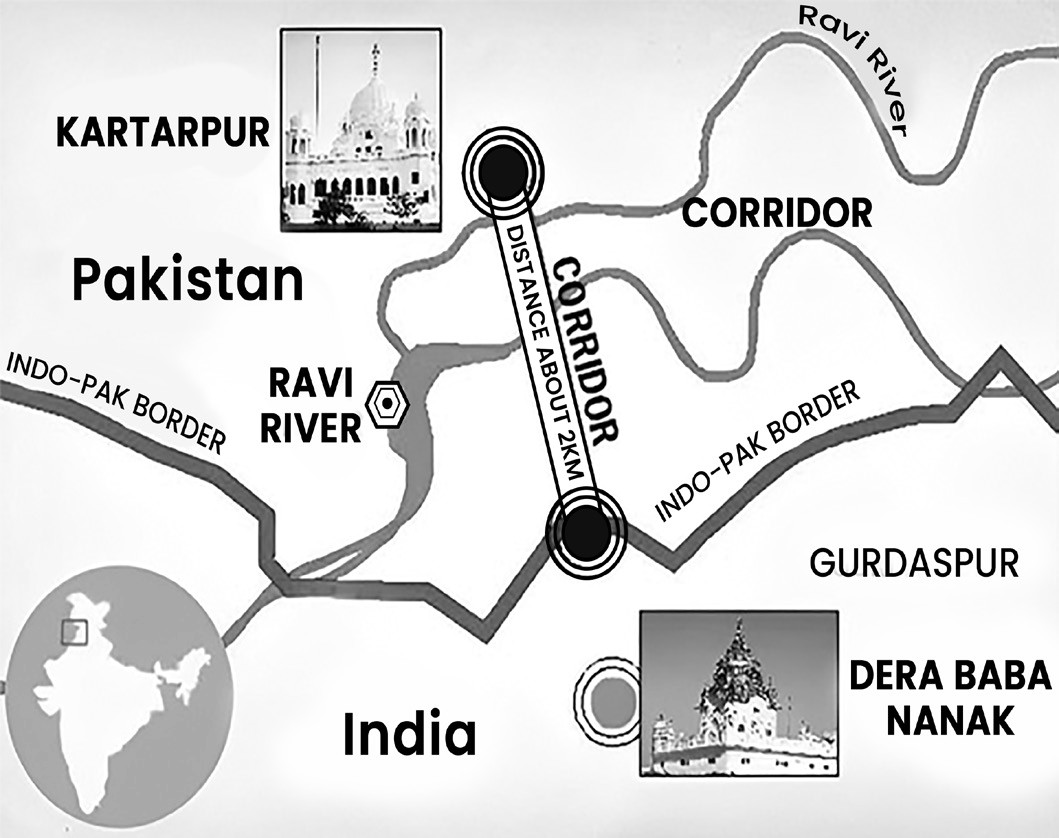
| SCOPE OF COOPERATION BETWEEN INDIA AND PAKISTAN A bilateral protocol signed in 1974 between Pakistan and India regarding visits to places of worship. This convention controls visits to religious shrines between the two countries. The arrangement allows three Hindu pilgrimages and four Sikh pilgrimages to visit 15 shrines in Pakistan each year, while five Pakistani pilgrims to visit 7 shrines in India. The Kartarpur Corridor project, which connects India and Pakistan, became operational in November 2019. The Kartarpur corridor connects the Darbar Sahib Gurdwara in Narowal district of Pakistan with the Dera Baba Nanak shrine in Gurdaspur district in India’s Punjab province. The agreement will facilitate visa-free movement of Indian pilgrims who would just need a permit to cross over to Pakistan. The talks continued through one of the most difficult years in the relationship is equally remarkable; there were three rounds of technical-level meetings to ensure both sides complete the infrastructure needed before November 2019, the 550th anniversary of Sikhism’s founder Guru Nanak. |
About Gurudwara Darbar Sahib
It is 16th century Gurdwara located on the banks of the river Ravi in Shakargarh in Narowal district of Punjab province of Pakistan.This gurudwara was established by the first Sikh Guru in 1522. It is located about 3 to 4 km from Indo Pak border in Pakistan in Punjab.
It is important for Sikhs as Guru Nanak Dev, the founder of Sikhism and its first guru had assembled Sikh community and lived for 18 years until his death in 1539.
SOME IRRITANTS SURROUNDING KARTARPUR CORRIDOR
The Kartarpur corridor project is an issue that has been raised by India for several decades. However, in the case of Pakistan, these have not been as transparent, with the military establishment’s surprise backing only raised doubts on whether Islamabad has an ulterior motive. 1. Allowing Separatist groups to function
In a dossier handed over during the last round of talks on Kartarpur, India spelt out its apprehensions over Pakistan allowing separatist Khalistani groups to try and influence pilgrims.
One of the of specific concern is the ‘Referendum 2020’ plan by the Sikhs for Justice group (banned by India).
2. Drugs and Arms Supply
• The other irritant is the possible use of the corridor for drugs and arms movement; there are many routes and tunnels at the border between the two nations across the Punjab border.
• The terror threat by Pakistani Punjab-based anti-India groups such as the Lashkar-e-Taiba and the Jaish-eMohammad is also a constant concern.
With such strictures in place, New Delhi’s decision to embark on a course that will need regular and repeated India-Pakistan meetings is nothing short of a breach of its otherwise firm “no talks without terror ending” policy.
A RANGE OF POSSIBILITIES
• Other faith-based corridors – The obvious extension from this would be for having other faith-based “corridors” for Hindu, Muslim and Sikh pilgrims in both countries; this would be in addition to the list of 20 shrines (15 in Pakistan, five in India) that were negotiated under the 1974 Protocol on visits to Religious Shrines.
• Template for bilateral negotiations – The template that Kartarpur has given both sides is also worth considering for the format of other bilateral negotiations given that the talks have been immunised from both terror attacks and election rhetoric.

• T he venue of the talks, at the Attari-Wagah zero point, lends itself to more successful outcomes too, away from the glare of the media, without much focus on arrangements for both parties. The two sides can cross over, meet for the duration of talks and return after issuing a joint statement.
WAY AHEAD FOR INDIA PAKISTAN RELATIONS
• For any meaningful engagement between India and Pakistan, cross-border terrorism has to come to an end. So, India must continue to press that “Talks and terrorism can’t go hand in hand.”
• To deal with terrorism emanating from Pakistan, India should keep on mounting international pressure on Pakistan through International as well as regional organizations. For example – Ensure that strict vigilance of Financial Action Task Force (FATF) is kept on Pakistan, which will ensure difficulty in funding of terrorist organisation.
• However, both countries can keep engaging at international forums like SCO and SAARC and continue with Track 2 diplomacy. This will ensure that the window for frontline engagement is always open.
• Initiatives such as the Kartarpur Corridor can improve the relationship between India and Pakistan, so the two countries must explore other avenues.
• India already has military and economic superiority over Pakistan. To increase it further, India must focus on rapid economic development and modernization of its armed forces.
• To prevent any Pakistani propaganda from creating fissures in Indian society, Indian intelligence must keep a vigil on various platforms, and the Indian Government must keep its house in order.
• Since we can choose our friends but not chose our neighbours, India must try to forge a dialogue with Pakistan. This will also uphold our “neighbourhood first policy”.
• India should focus on using soft power and people to people relations to find a solution for a ‘basket case’ [unique] country like Pakistan.
• India Pakistan relations have been and will continue to be tense, at least in the foreseeable future. These tensions can be resolved through negotiations and discussions once a conducive environment for talks is created.
• Tackling ‘Hydra headed’ Pakistan will need creative diplomacy outside the traditional mode.