Battle of Tarain
BATTLE OF TARAIN
The Battle of Tarain stands as a significant turning point in Indian history, marking clashes between Muizzuddin Muhammad and Prithviraj Chauhan. The conflict began over rival claims for Tabarhinda (Bhatinda).
First Battle of Tarain (1191)
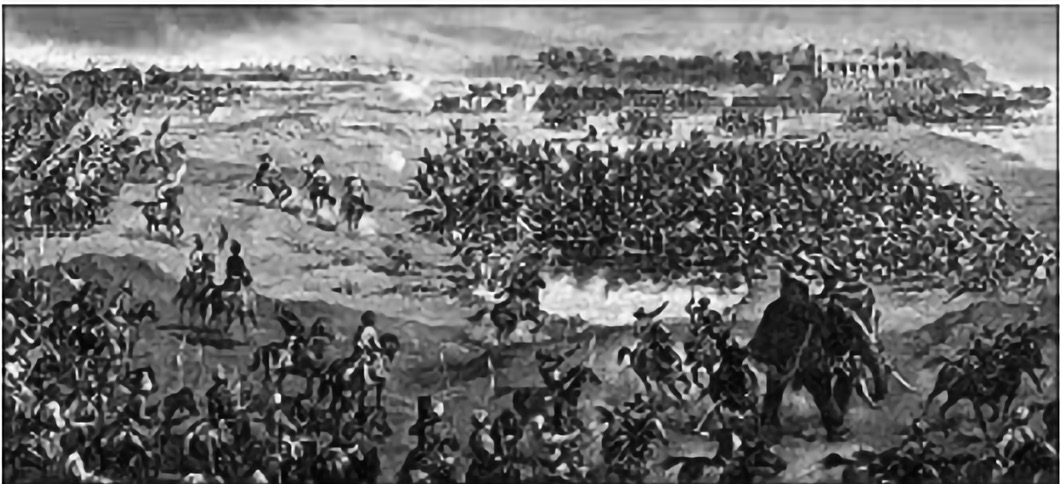
At the Battle of Tarain in 1191, Prithviraj Chauhan’s forces defeated Muizzuddin Muhammad’s Ghurid forces.
Muizzuddin Muhammad’s life was saved by a young Khalji equestrian.
• Prithviraj subsequently conquered Tabarhinda but made little effort to expel the Ghurids from the Punjab.
This gave Muizzuddin time to regroup his forces for another attempt the following year.
RIVALRY BETWEEN PRITHVIRAJ & JAICHANDRA (RULER OF KANAUJ)
He appealed to all the rajas of northern India for help. Many rajas sent contingents to help him, but Jaichandra, the ruler of Kanauj, stayed away. The legend that this was because Prithviraj had abducted Jaichandra’s daughter, Sanyogita, who was in love with him, is not accepted by many historians. The story was written much later as a romance by the poet, Chand Bardai, and includes many improbable events. Certainly, there had been an old outstanding rivalry between the two states.
Reasons for Rajput Defeat
The defeat of the Rajputs by the Turkish armies wasn’t due to superior weaponry but rather social and organizational weaknesses.
The feudalistic structure in Indian states weakened the administrative and military organization, relying on scattered chiefs without coordination.
In contrast, the Turks had a structured tribal system and military organization, enabling them to maintain large armies efficiently.
The Turks’ iqta system facilitated revenue collection and troop maintenance, allowing for a centralized armed force.
Slave officers, trained for warfare, were instrumental in the Sultan’s service.
Despite the Rajputs’ bravery and larger armies, their lack of strategic vision and failure to focus on the outer territories, notably Kabul and Lahore, contributed to their defeat.
A CRITICAL ACCOUNT OF THE ROLE OF RELIGION AND CASTE IN THE MILITARY ORGANIZATION
The Role of religion and caste on military organization should not be overly emphasized or exaggerated. These factors played a role but might not have been as decisive as sometimes portrayed.
The Turks were motivated by a spirit called ‘ghazi,’ which is associated with religious warrior ethos. In contrast, the Rajputs considered retreating from a battle as dishonorable.
This implies that the Turks had a religious motivation, while the Rajputs were guided by a sense of honor.
The caste system did not hinder individuals from non- Rajput or lower castes (kuvarna) from participating in battles alongside the Rajputs. As a result, Rajput armies had more soldiers in terms of numbers compared to the armies led by the Turks (Inclusive nature of Rajput armies).
Contextualizing the Defeat
The defeat at Tarain must be seen within the broader context of centuries of Rajput resistance against Turkish incursions.
While the Rajputs displayed valour and resistance, their failure to counter external threats beyond India, particularly in Central Asia, limited their strategic outlook.
This myopic focus contributed to the Turks’ eventual consolidation of power in North India.
The defeat was not solely due to military prowess but rather a culmination of social, organizational, and strategic shortcomings in the face of the well-structured and strategically adept Turkish armies
Rise of the Turks and the Decline of the Abbasid Caliphate
Rise of the Turks and the Decline of the Abbasid Caliphate
By the end of the 9th century, the Abbasid Caliphate’s decline paved the way for Islamized Turkish rulers to emerge as king-makers. The Turks, initially palace guards, grew powerful as provincial governors assumed autonomy. The decline led to strife between Muslim sects and regions, creating restlessness and rapid changes.
Turkish Tribes and their Warfare Tactics
• Turkish tribesmen were known for their ruthless plunder and swift cavalry. They introduced rapid advance and retreat warfare.
• Their outstanding horsemanship allowed them to cover great distances swiftly, employing lightning raids and attacking stragglers effectively.
GHAZNAVIDS: EMERGENCE AND MAHMUD’S REIGN
• The Ghaznavids, led by Alp-Tegin, established an independent kingdom centered at Ghazni.
• Mahmud, known as a hero of Islam, defended Islamic lands against Central Asian Turkish invaders.
• Mahmud’s reign witnessed the Ghazi spirit’s rise, emphasizing defence against the heathen Turks and promoting Iranian culture and language.
Mahmud’s Indian Campaigns
• Mahmud’s seventeen raids into India targeted the Hindu Shahi rulers in the Punjab.
• Despite initial setbacks, Mahmud succeeded in ravaging Shahi capitals, extending
Ghaznavid territories to Lahore and the Jhelum River.
• His expeditions aimed to plunder temples and wealthy towns, expanding his resources and suppressing Central Asian foes.
• In 1025/26 AD, during the reign of Bhima I (a Chaulukya king who
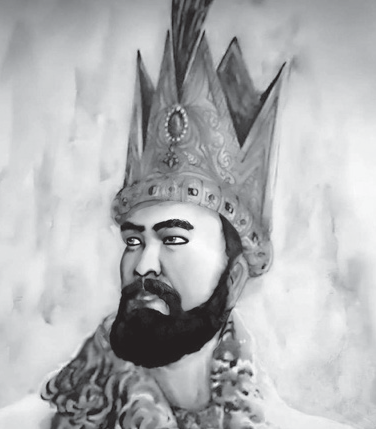
ruled parts of present-day Gujarat), Mahmud raided and plundered the Somnath temple, broke its jyotirlinga. He took away a booty of 20 million dinars.
Impact of Mahmud’s Raids on North India
Mahmud’s invasions disrupted the political landscape of North India, allowing Turkish incursions beyond the northwest mountain defences.
However, Central Asian and Indian transformations prevented their deeper incursion into the Gangetic heartland for about 150 years.
Post-Mahmud Era and Shrinkage of the Ghaznavid Empire
Following Mahmud’s death, the Seljuk Empire emerged, challenging the Ghaznavids.
Masud’s defeat led to the shrinkage of Ghaznavid territories to Ghazni and Punjab.
While they continued plundering raids, new states in North India counterbalanced their military threats.
AL-BIRUNI AND KITAB-UL-HIND
Al-Biruni, born in 973 in the vibrant centre of Khwarizmi, modern-day Uzbekistan, was nurtured in a scholarly environment, benefiting from the finest education available at the time. Proficient in numerous languages—Syriac,Arabic, Persian, Hebrew, and Sanskrit— his linguistic proficiency expanded his access to a wide array of philosophical and scientific knowledge. Despite his
unfamiliarity with Greek, he engaged deeply with Greek philosophical ideas, exploring translated Arabic versions of Plato’s works and other Greek philosophers.
It was during his time in Ghazni that Al-Biruni’s fascination with India blossomed. The region’s incorporation of Punjab into the Ghaznavid empire facilitated interactions between Al-Biruni and the local populace. These connections led him to delve into Sanskrit texts on astronomy, mathematics, and medicine that had been translated into Arabic since the eighth century. Immersing himself in the company of Brahmana scholars, he devoted years to learning Sanskrit and delving into India’s religious, philosophical, and cultural corpus. While specific details of his travels remain somewhat elusive, it is believed he extensively journeyed through Punjab and various northern Indian regions.
Al-Biruni’s seminal work, the Kitab-ul-Hind, composed in Arabic, stands as a testament to his intellectual prowess. This comprehensive text spans 80 chapters encompassing diverse subjects—ranging from religion, philosophy, and festivals to astronomy, alchemy, social customs, laws, and metrology. His exceptional command of languages enabled him to draw comparisons between different tongues and translate texts across cultural boundaries. Among his notable achievements, he translated key Sanskrit works, such as Patanjali’s grammar, into Arabic. Additionally, he translated the mathematical writings of the renowned Greek mathematician Euclid into Sanskrit for his Brahmana peers highlighting his commitment to bridging intellectual frontiers and fostering cultural exchange.
The Rajput States
THE RAJPUT STATES
Emergence of Rajput Dynasties
• Following the decline of the Pratihara Empire, several Rajput states emerged in North India.
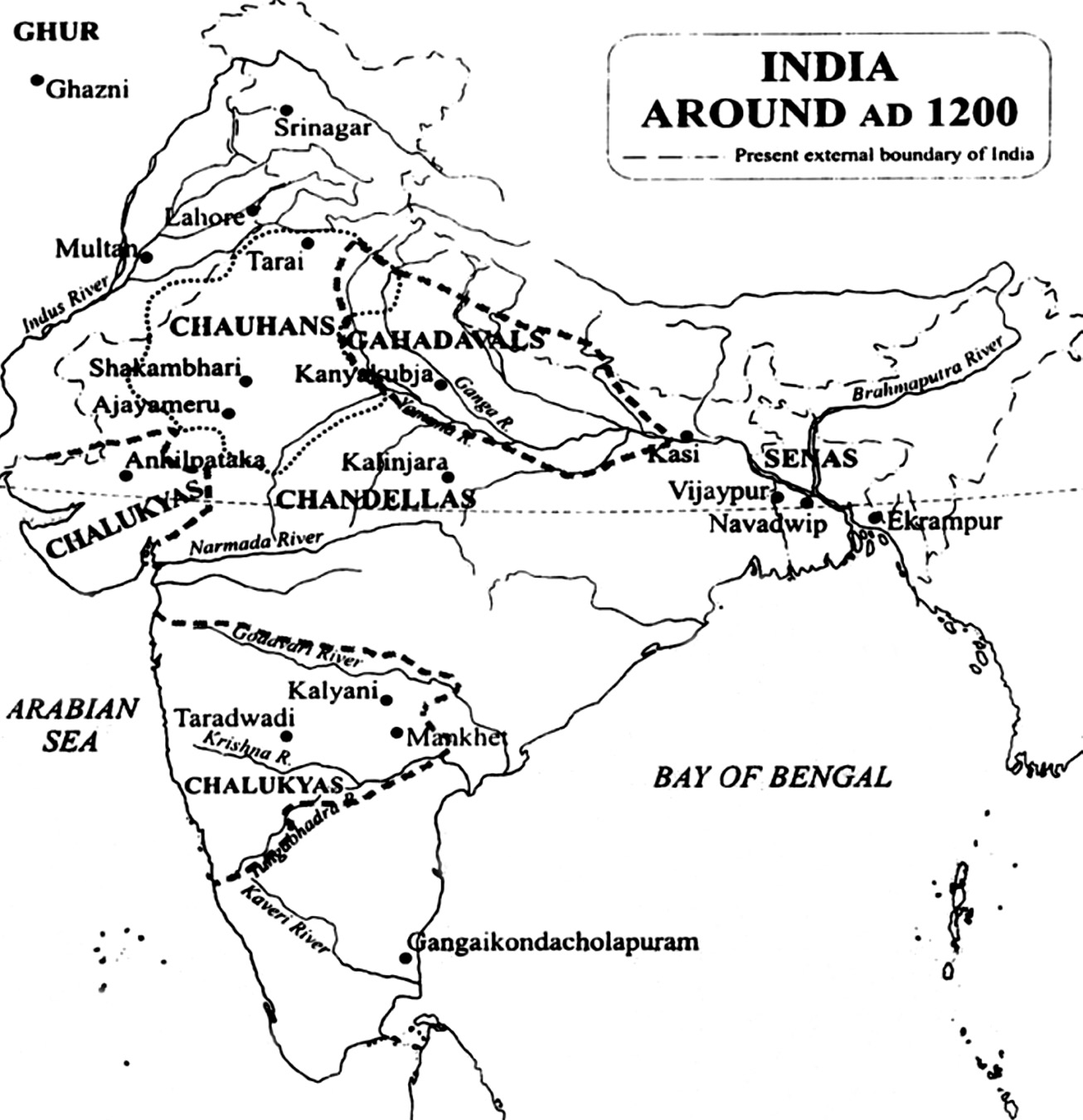
• Notable among these were the Gahadavalas of Kanauj, the Paramaras of Malwa, and the Chauhans of Ajmer.
• Smaller dynasties like the Kalachuris, Chandellas, Chalukyas, and Tomars also held territories across the region. Bengal, on the other hand, was under the Palas and later the Senas.
Gahadavalas of Kanauj and Chauhans of Ajmer
• The Gahadavala kingdom reached its peak under Govind Chandra, extending from Mongyr in Bihar to Delhi.
• Govind Chandra, recognized as the greatest ruler by Persian sources, fiercely defended against Ghaznavid raids.
• However, Jai Chandra faced challenges from the rising
Chauhans.
• The Chauhans, who originated from serving Gujarat rulers, established their capital at Nadol and later captured Chittor, establishing Ajmer as their capital.
• They resisted Ghaznavid raids and expanded their influence, even clashing with the Paramars of Malwa, particularly notable ruler Bhoja.
Prithviraj III and Rajput Society
• Prithviraj III, a prominent Chauhan ruler, ascended the throne at a young age and embarked on an expansion policy, bringing smaller Rajput states under his sway.
• His struggles against Gujarat’s Chalukyan ruler and an expedition in Bundelkhand led to significant events and losses.
Rajput Society and Organization
• Rajput society was clan-based, with each clan tracing its
lineage to a common ancestor.
• Clans often controlled compact territories divided into village units.
• Rajputs were attached to land, family, and honour, forming an egalitarian brotherhood. However, internal feuds and a sense of superiority among clans weakened their unity.
Rajput Weaknesses and Cultural Practices
• The Rajputs had advantages like brotherhood but struggled with maintaining discipline due to ongoing feuds.
• Their tendency to form exclusive groups led to a gap between rulers and non-Rajputs.
• Continuous warfare for land and cattle impacted the populace negatively.
• Most Rajput rulers were patrons of Hinduism, with some supporting Jainism.
• They donated land to temples and Brahmins, protecting Brahmin privileges and the caste system.
• Brahmins recognized Rajputs as descendants of old Kshatriya families.
• The Rajputs treated warfare as a sport, perpetuating continuous conflicts among various states and causing suffering to the common people.
Temple Building and Architecture
• Between the tenth and twelfth centuries, temple building reached its pinnacle in North India.
• The prominent architectural style was the Nagara style, notable for its tall curved spiral roofs over the deity room (garbhagriha or deul).
• Mainly concentrated in North India and the Deccan, this style featured square-shaped main rooms, often with anterooms (mandapa) and enclosing walls.
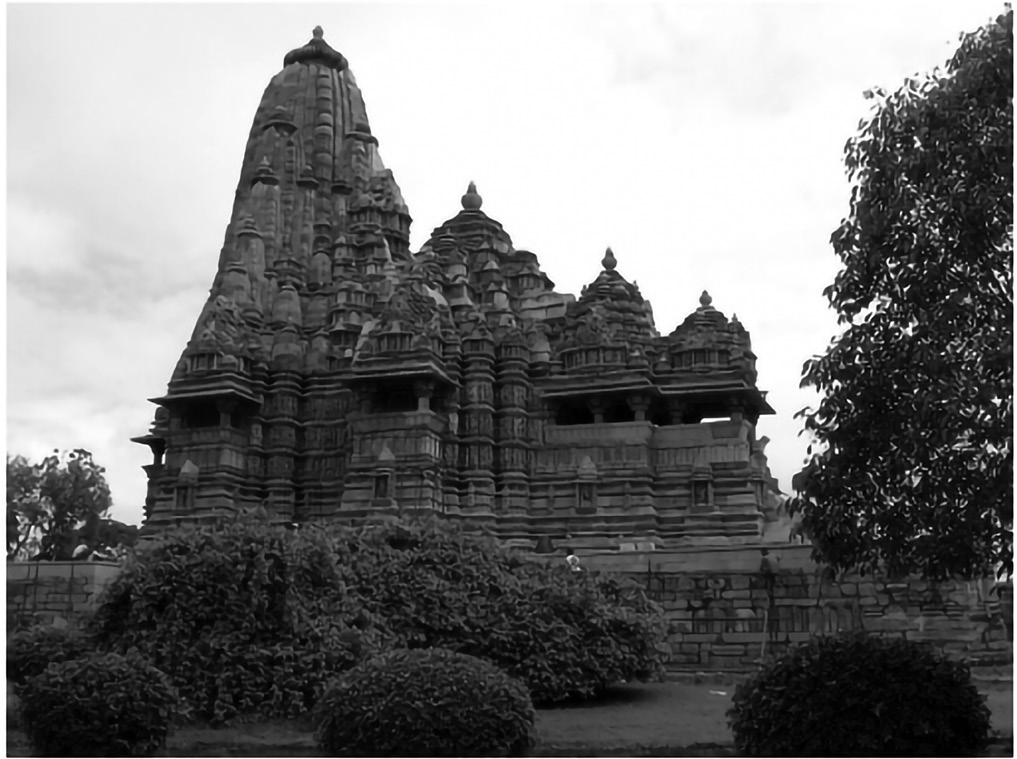
Some of the most representative temples in this style include those at Khajuraho in Madhya Pradesh and Bhubaneswar in Odisha.
• The Khajuraho temples, notably the Parsvanatha, Visvanatha, and Kandariya Mahadeo temples, exemplify intricate carvings, showcasing the zenith of sculptural art.
• Most of these temples were constructed by the Chandelas, who ruled the area from the ninth to the thirteenth century.
• Orissa also boasts magnificent temple architecture, such as the Lingaraja temple (eleventh century) and the Sun temple of Konark (thirteenth century).
• The Jaganatha temple at Puri also belongs to this period.
• Numerous temples were built in places like Mathura, Varanasi, Dilwara (Mount Abu), and others, displaying increasing intricacy.
• These temples served as social and cultural centres, some accumulating immense wealth, ruling over villages, and engaging in commercial activities.
• Alongside temples, Rajput rulers also constructed impressive palaces, robust forts, and public works like stepped wells (baolis) and embankments.
Cultural Patronage by Rajput Rulers
• Rajput rulers supported the arts and literature, fostering a significant literary output in Sanskrit, Apabhramsha, and Prakrit.
Vastupala, a renowned minister of the Chalukyan ruler Bhima in Gujarat, was a notable writer and patron of scholars, responsible for building the beautiful Jain temple at Mount Abu.
Ujjain and Dhara, capitals of the Paramara rulers, were renowned centres for Sanskrit learning.
• Jain scholars like Hemachandra made notable
contributions during this era.
• Sanskrit gained prominence with the revival of Brahmanism, gradually replacing Apabhramsha and Prakrit among the upper classes.
• However, literature in these regional languages continued.
• The modern North Indian languages like Hindi, Bengali, and Marathi began to evolve from these popular languages during this period.
Turkish Conquest of North India
TURKISH CONQUEST OF NORTH INDIA
After Ghaznavid conquests in the Punjab, two distinct interactions between Muslims and Hindus emerged. On one hand, the lure for plunder
led to Ghaznavid successors’ raids into the Gangetic Valley and Rajputana. Rajput rulers offered resistance, winning victories but growing complacent due to Ghaznavid decline. At another level, Muslim traders facilitated trade, attracting Sufi preachers who preached love, faith, and dedication to one God,
influencing both Muslims and some Hindus.
However, Central Asian political changes shook the scenario. Turkish tribesmen from Ghur in Afghanistan, expanded their power. Muizzuddin Muhammad, ascending the Ghazni throne, aimed to establish a base in the Punjab for further Indian conquests. Meanwhile, the growing power of the Chauhans in Rajasthan brought them into conflict with the Ghaznavids.
The intricate architectural marvels and cultural achievements of the time coexisted with the looming spectre of invasions and shifting political dynamics in the region.
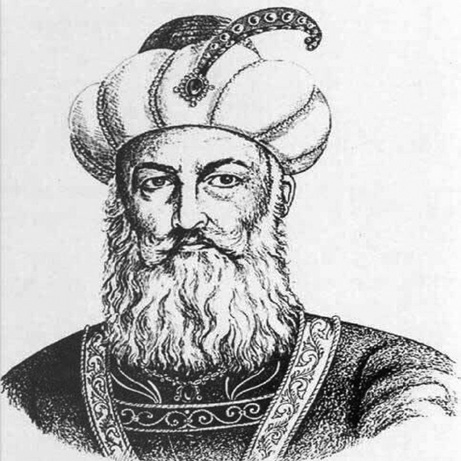
BATTLE OF TARAIN
The Battle of Tarain stands as a significant turning point in Indian history, marking clashes between Muizzuddin Muhammad and Prithviraj Chauhan. The conflict began over rival claims for Tabarhinda (Bhatinda).