Administration, Society, and Cultural Contributions
ADMINISTRATION, SOCIETY, AND CULTURAL CONTRIBUTIONS IN THE RASHTRAKUTA EMPIRE
Rashtrakuta Administrative Structure
Divisions: Rashtra (provinces), Visaya (districts), and Bhukti (subunits)
Head of Rashtra: Rashtrapati, akin to the role of an Uparika in other empires, managed provinces. He had both civil and military authority over the Rashtra. He was in charge of maintaining law and order, collecting taxes, and keeping accounting records.
Visaya & Bhukti: Visaya functioned like a modern district, while Bhukti served as a smaller unit.
Revenue Payment: All the officials were paid via rent- free land grants, blurring the distinction between local officials, hereditary chiefs, and vassals.
Rashtrapati’s Status: Sometimes Rashtrapati or governor held status and title comparable to that of a vassal king.
Society and Religion
Vaishnavism, Saivism, Jainism, and Buddhism thrived during the Rashtrakuta period, maintaining harmony among various religions. Nearly one-third of the Deccan population followed Jainism, while some prosperous Buddhist settlements existed at locations like Kanheri, Sholapur, and Dharwar. Education centres like Salatogi facilitated learning, supported by endowments and contributions.
Economy and Trade
The economy flourished with active trade between the Deccan and the Arabs, promoted by the Rashtrakuta kings’ friendly relations with Arab traders. The Rashtrakutas had a well-developed coin system. Drama, Suvarna, Godhyanka, Kalanju and Kasu were 5 types of coins under their rule. They also issued a number of gold coins. The South Indian and the Deccan regions were not as fertile as the Ganges valley, but the Malabar Coast and other pockets of fertile lands were able to meet the demand of the population. Because the Kannada states were rich in mineral resources and the Rashtrakutas controlled the coastal areas, they also controlled the export of Indian silk, and cotton to Arabia, Persia, etc.
Cultural Contributions

A Stanza from Kavirajamarga which praises the people for their literary skills
The Rashtrakutas patronized Sanskrit, Jain, and Kannada literature. Scholars like Trivikrama, Halayudha, Jinasena, Gunabhadra, and Sakatayana enriched Jain literature. Kannada literature saw its genesis during this period, with Amogavarsha’s Kavirajamarga as the first poetic work in Kannada.
Pampa, Ponna and Ranna (Regarded as the three gems of Kannada poetry) were prominent Kannada poets, contributing significant literary works. Many theories in maths were formulated by Mahaviracharya in his work Ganitasarasangraha and Shakatayana Amoghavritti (Sanskrit grammar). Virasena and Jinasena wrote two commentaries Dhavala and Jayadhavala.
Art and Architecture
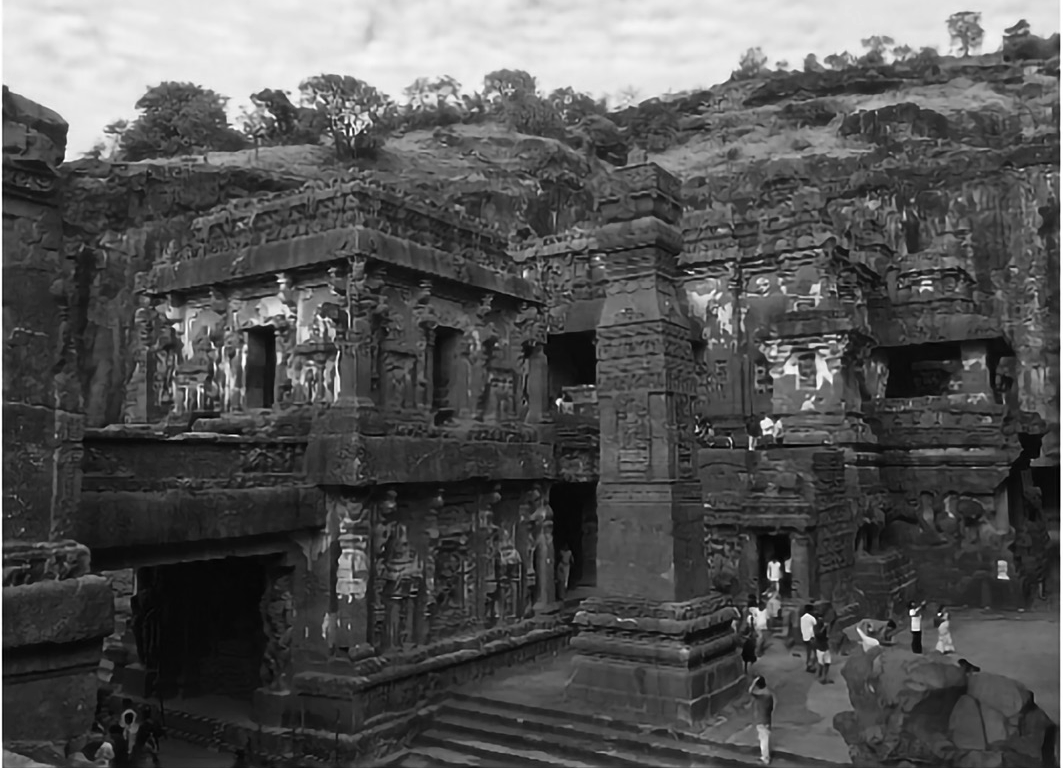
Kailasa Temple, Ellora
The Rashtrakuta legacy in art and architecture was remarkable, visible in sites like Ellora and Elephanta.
The Kailasa temple at Ellora (CAVE NO. 16), excavated during Krishna I’s reign, stands out with its architectural brilliance. Carved out of a massive rock block, the temple features intricate sculptures depicting various mythological scenes, including figures of Goddess Durga and scenes from the Ramayana.
Similarly, Elephanta Island showcases spectacular sculptural artistry, notably a six-meter sculpture representing the three
aspects of Shiva as Creator, Preserver, and Destroyer.
The Rashtrakuta Empire left an indelible mark in administration, religion, literature, and architectural marvels, contributingsignificantly to India’s cultural heritage
The Struggle for Domination in North India the Palas
During the period between 800 and 1000 AD in Northern India, after the decline of Harsha’s empire, multiple significant states emerged. While none could unify the entire Ganga valley as Gupta and Harsha did, regions like Gujarat, Malwa, and Rajasthan became pivotal links between different territories. In the South, the Cholas asserted dominance over key deltas, establishing their supremacy.
Three major empires dominated th is era: the Pala, Pratihara, and Rashtrakuta empires. Despit e their conflicts, these empires brought stability, expanded agriculture, developed infrastructure like ponds and canals, and supported arts and temples.
THE STRUGGLE FOR DOMINATION IN NORTH INDIA: THE PALAS
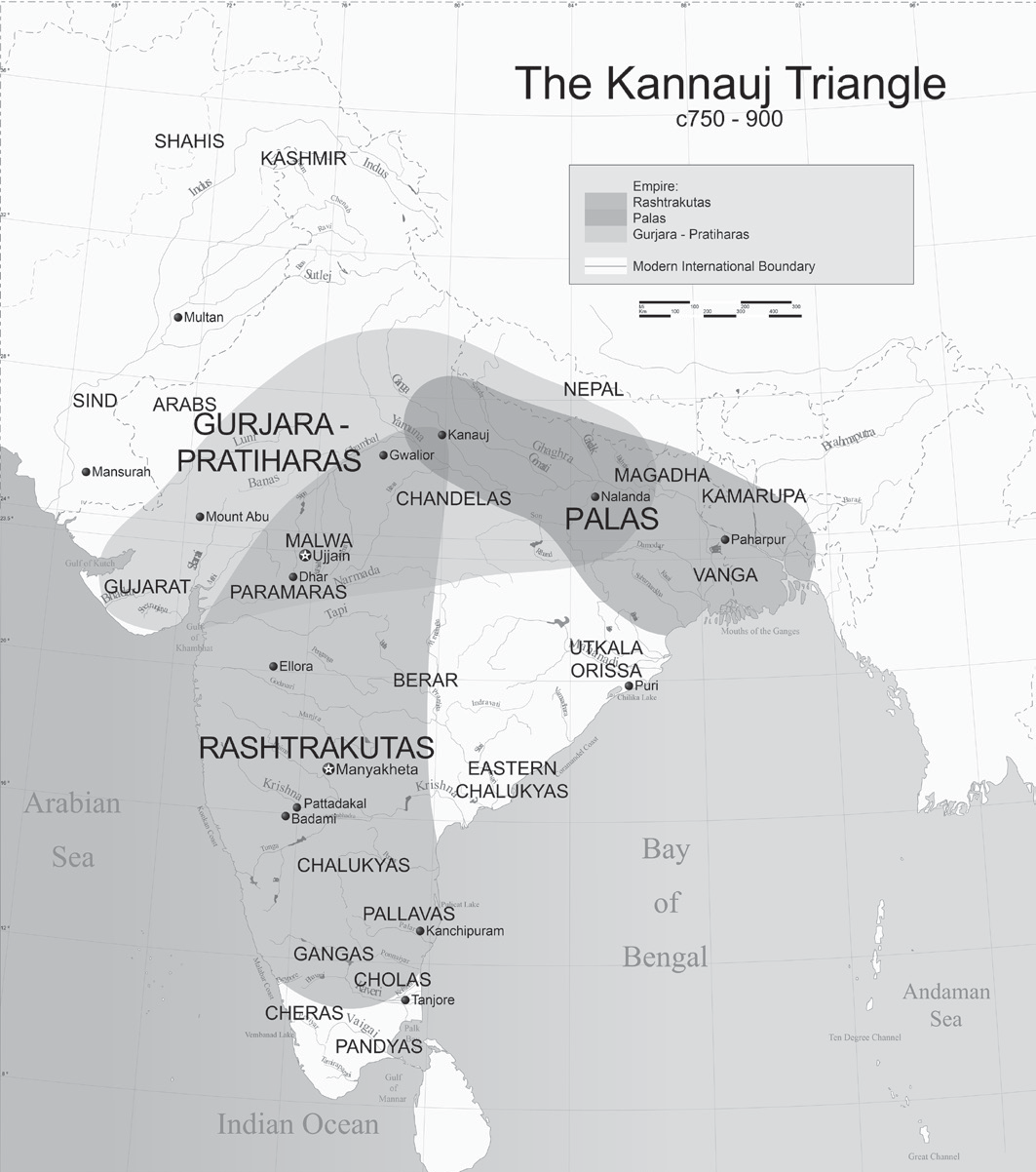
The struggle for control in North India unfolded between the Palas, Pratiharas, and Rashtrakutas. The Pala Empire, initiated by Gopala around 750 AD, unified Bengal and expanded into Magadha (Bihar). His successor, Dharamapala, engaged in conflicts for dominance, with control shifting between the Palas and Pratiharas over regions like Kanauj, Bihar, and modern-day Uttar Pradesh. Although the Palas held sway over Bengal and Bihar for the most part, their power in the north wavered. Eventually, the Palas came to be associated with dominating the present-day Bengal and Bihar (see map).
Devapala, Dharamapala’s successor, expanded the Pala influence into Assam, parts of Orissa, and potentially modern- day Nepal. Arab merchant Suleiman’s accounts describe the Pala Kingdom’s might, citing a large army with thousands of elephants and a substantial force employed in various tasks, even if exaggerated.
Note: of these, the Rashtrakutas lasted the longest and served as a crucial bridge between North and South India, economically and culturally.
The Pratiharas Gurjara Pratihara Dynasty
THE PRATIHARAS: GURJARA-PRATIHARA DYNASTY
The Pratiharas, also known as the Gurjara-Pratiharas, ruled over Kanauj for an extensive period and were believed to have originated from the Gurjaras, a group akin to pastoralists and fighters like the Jats. They established principalities in central and eastern Rajasthan and clashed with the Rashtrakutas for control over regions like Malwa, Gujarat, and ultimately Kanauj, which symbolized dominance over the upper Ganga valley.
Early Expansion and Resistance to Arab Incursions
The Pratiharas initially had their capital at Bhinmal and gained prominence under Nagabhatta I. Nagabhatta I fiercely resisted Arab rulers from Sind who attempted encroachments on Rajasthan, Gujarat, and the Punjab. In 738, the Arabs made a significant push towards Gujarat but suffered a decisive defeat by the Chalukyan ruler of Gujarat. Despite intermittent incursions, the Arab threat diminished thereafter
Tamralipti was the chief Indian port for sailing to Java and Sumatra in South East Asia.
Successors and Al-Masudi’s Accounts
Bhoja was succeeded by his son Mahendrapala I, who extended the empire over Magadha and north Bengal. Al- Masudi, a Baghdad native who visited Gujarat in 915–16, testified to the immense power and vastness of the Pratihara rulers’ empire. He mentioned the ruler Baura, likely a mispronunciation of Adivaraha, though Bhoja had passed away by then. According to Al-Masudi, the empire had 180,000 villages, cities, and rural areas, with a massive army and extensive territories.
The Pratiharas were patrons of learning and literature. The great Sanskrit poet and dramatist, Rajashekhar, lived at the
court of Mahipala, a grandson of Bhoja. The Pratihara also embellished Kanauj with many fine buildings and temples.
Rajshekhar was a prominent Sanskrit poet in the court of Mahendrapala I and his son Mahipala I. Notable works of Rajshekhar include:
Karpuramanjari: This play was written in Suraseni Prakrit which describes about Avantisundari.
Kavya Mimansa
Viddha Shalabhanjika
Brinjhika
Bala Ramayanam
Prapanch Pandav
Balbharata
Decline and Dissolution
However, in 915–918, Rashtrakuta king Indra III attacked Kanauj, weakening the Pratihara empire. Gujarat likely passed into the Rashtrakuta hands, impacting the Pratihara’s access to the sea and overseas trade. The Pratiharas faced further invasions from the Rashtrakutas, leading to the rapid dissolution of their empire around 963.
The Rashtrakutas Deccan Dynasty of Warriors and Administrators
THE RASHTRAKUTAS: DECCAN DYNASTY OF WARRIORS AND ADMINISTRATORS
Establishment and Territorial Dominance
The Rashtrakutas, an illustrious dynasty renowned for their line of warriors and skilled administrators, ruled the Deccan while the Palas and Pratiharas held sway in North India. The dynasty’s inception was under Dantidurga, who established his capital at Manyakhet or Malkhed near present-day Sholapur. Swiftly, they controlled northern Maharashtra and contended with the Pratiharas for supremacy over Gujarat and Malwa.
Military Engagements and Greatest Rulers
Notable Rashtrakuta rulers included Govinda III (793–814) and Amoghavarsha (814–878). Govinda III led successful expeditions against Nagabhatta of Kanauj and annexed Malwa. His campaigns extended southward, subduing Kerala, Pandya, and Chola kings, and displaying their dominance by capturing the king of Lanka and erecting victory statues.
Amoghavarsha, ruling for 64 years, leaned more towards religious and literary pursuits than warfare. He was a proficient author and constructed the capital city of Manyakhet, aspiring to surpass the city of Indra. However, his reign faced numerous rebellions across the vast empire, escalating further after his death. He is also known as the ‘Ashoka of the South’ and is compared to Vikramaditya (Gupta King).
Rise and fall under Indra III and Krishna III
Grandson of Amoghavarsha, Indra III (915–927), reinstated the empire after Mahipala’s defeat and the sack of Kanauj. Al-Masudi, a visitor at that time, praised the Rashtrakuta king, Balhara or Vallabharaja, as the greatest Indian ruler, commanding respect and allegiance from numerous Indian rulers.
Krishna III (934–963) engaged in conflicts against the Paramaras of Malwa, the Eastern Chalukyas of Vengi, and the Chola ruler of Tanjore. He triumphed over the Chola king, annexing the northern part of the Chola empire. However, after Krishna III’s demise, opposition forces united against his successor, resulting in the sack and burning of Malkhed, marking the empire’s end in 972.
Legacy of Tolerance and Cultural Patronage
Spanning nearly two hundred years till the end of the tenth century, the Rashtrakuta rule showcased religious tolerance, patronizing Saivism, Vaishnavism, and Jainism. They sponsored significant architectural endeavours like the rock- cut temple of Siva at Ellora and encouraged Islamic settlement and preaching in their dominions, fostering foreign trade.
The Rashtrakuta courts were hubs of cultural diversity, attracting Sanskrit scholars, poets, and writers in Prakrit and apabhramsha (precursors of modern Indian languages). Notable poets like Svayambhu and his son likely thrived at the Rashtrakuta court, showcasing the dynasty’s vibrant cultural milieu.
Political Ideas and Administration
POLITICAL IDEAS AND ADMINISTRATION
Pala and Pratihara kingdoms
The system of administration in these empires was based on the ideas and practices of the Gupta empire, Harsha’s kingdom in the north, and the Chalukyas in the Deccan.
The king’s position was generally hereditary.
Vassal rulers and autonomous chiefs often limited the area of the direct administration of the king, although the kings adopted high-sounding titles such as Maharajadhiraja, param-bhattaraka etc., and claimed to be chakravartin, or supreme.
The rules about succession were not rigidly fixed; while the eldest son often ascended, conflicts between siblings were common, sometimes resulting in younger brothers claiming the throne.
Occasionally, rulers appointed a favored son as the successor or a Yuvaraj, assisting in administrative tasks. Younger sons could also serve as provincial governors.
Kings were generally advised by a number of ministers.
In almost every kingdom, there was a minister of correspondence which included foreign affairs, a revenue minister, a treasurer, the chief of the armed forces (Senapati), a chief justice, and the purohit.
Administrative Structure in Pala and Pratihara Empires:
We also hear of officials of the royal household (antahpur).
• Territorial Divisions: Bhukti (provinces) and Mandala/ Visaya (districts) were the primary divisions.
• In the Pala and Pratihara empires, the unit below the visaya was called pattala.
• Provincial Governor: Uparika oversaw provinces, responsible for revenue collection and maintaining law and order with army assistance.
• District Head: Visayapati managed districts, mirroring the roles of the Uparika within their jurisdictions.
• Rise of Smaller Chieftains: Samantas or Bhogapatis emerged, controlling multiple villages.
• Merger of Roles: Visayapatis and smaller chiefs blended roles, leading to the interchangeable use of the term “Samanta” for both positions.
Minor Dynasties During This Period
Minor Dynasties during this Period
