Raziya
Raziya (1236-1240)
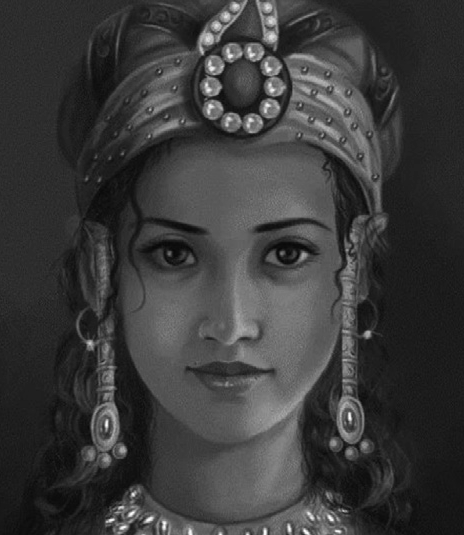
Raziya, daughter of Iltutmish, ascended the throne in 1236, a rare instance of a woman taking charge amidst a male-dominated era. Nominated by her father due to her perceived merit over his surviving sons, her rule of three years faced considerable challenges.
• Her leadership sparked a power struggle between the monarchy and the Turkish nobles, also known as the ‘forty’ or the Chahalgani. These nobles, accustomed to wielding significant influence during Iltutmish’s rule, sought a puppet ruler they could control.
• However, Raziya shattered their expectations. She discarded traditional female attire, held court unveiled, participated in activities typically reserved for men like hunting, and even led the army in warfare.
• Opposition arose from various quarters. Nizam-ul-Mulk Junaidi, Iltutmish’s wazir, who initially opposed her ascent to power, backed a rebellion among the nobles against her.
• Despite these challenges, Raziya aimed to establish law and order across her kingdom, launching an expedition against Ranthambhore to control the Rajputs successfully.
• Her attempts to consolidate her rule faced criticism, especially for promoting non-Turkish officials and her alleged closeness to Abyssinian noble Yaqut Khan, appointed as the Superintendent of the Royal Stable.
• Though contemporary accounts refute any claims of personal intimacy, these allegations tarnished her reputation. Rebellions erupted in Lahore and Sirhind, leading to Raziya’s imprisonment in Tabarhinda after Yaqut Khan’s death during internal strife.
• Remarkably, Raziya turned the situation to her advantage by winning over her captor, Altunia, whom she married. She made a bold attempt to reclaim Delhi but faced defeat and tragic demise in a forest at the hands of bandits while fleeing, concluding a tumultuous but pioneering chapter in the history of female rulership in medieval India.
• Minhaj-us-Siraj, the contemporary chronicler, recognized her superior abilities and qualifications compared to her brothers. Nevertheless, he was uncomfortable with the notion of a queen holding power, and the nobles were also displeased with her attempts to rule on her own.
The Mamluk or the Slave Dynasty Qutubuddin Aibak (1206-1210)
The Muslim invasions of India led to the establishment of the Delhi Sultanate, which lasted from A.D. 1206 to 1526. During this period, five distinct dynasties— the Slave, Khalji, Tughluq, Sayyid, and Lodi dynasties—held power. These rulers not only expanded their dominion over northern India but also made inroads into the Deccan and southern regions. Their reign brought about profound changes in Indian society, administration, and cultural life.
THE MAMLUK OR THE SLAVE DYNASTY (1206-1287)
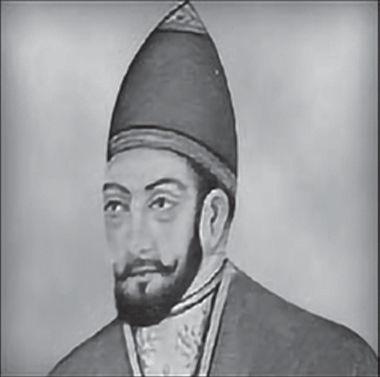
Qutubuddin Aibak (1206-1210)
He was a slave of Muizzuddin (Muhammad of Ghur) and had played an important part in the expansion of the Turkish Sultanate in India after the battle of Tarain.
He was left in charge by Muhammed of Ghur as the Governor of Lahore.
Established the Mamluk Dynasty in India.
The term "Mamluk" comes from Arabic, meaning "owned." It referred specifically to Turkish slaves who were brought to serve in military roles, distinguishing them from those enslaved for domestic or labor- related work.
During his rule, the Sultanate severed its links with Ghazni. This proved advantageous, as it shielded India frombecoming
entangled in Central Asian politics. It also allowed the Delhi Sultanate to grow independently, without reliance on foreign powers.
Aibak took the title of Sultan and reigned for four years. Muslim historians often referred to him as Lakh Baksh, meaning "giver of lakhs," due to his generous donations to them.
He was a patron of the renowned scholar Hasan Nizami and initiated the construction of the Qutb Minar, named after the revered Sufi saint Khwaja Qutbuddin Bakhtiyar.
Aibak's life came to an unexpected end in 1210 while he was playing Chaugan, a traditional game of horse polo
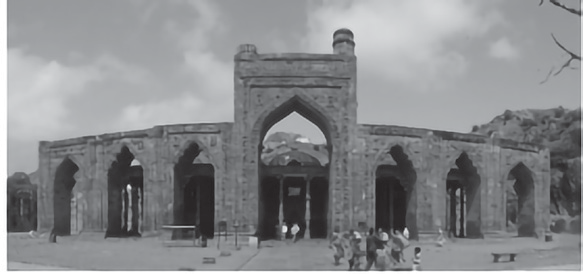
Shamsuddin Iltutmish
Shamsuddin Iltutmish (1210-1236)

• Iltutmish, reigning from 1210 to 1236, emerged from the Ilbari tribe, earning his dynasty the name Ilbari.
• Initially sold as a slave to Aibak, who later established familial ties by marrying Iltutmish to his daughter, he ascended to power after vanquishing Aram Baksh in 1211, relocating
the capital from Lahore to Delhi.
• In his early rule, Iltutmish focused on securing his position amidst rival claims.
• Concurrently, Central Asia faced the incursions of Temujin, famously known as Chengiz Khan. When the Mongol leader defeated Jalaluddin Mangabarni of Kwarizam and sought refuge with Iltutmish, the Sultan declined, aiming to safeguard his empire. Fortunately, Chengiz Khan retreated without entering India, partly due to Iltutmish’s astute diplomacy.
• Expanding his dominion, Iltutmish re-established control over Bengal and Bihar, annexing Sind and Multan into the Delhi Sultanate. He quelled Rajput uprisings and reclaimed territories like Ranthambore, Jalore, Ajmer, and Gwalior. While an expedition against the Paramaras of Malwa met setbacks, Iltutmish’s diplomacy gained recognition when he received the “mansur” from the Abbasid Caliph, affirming his sovereignty in India in 1229.
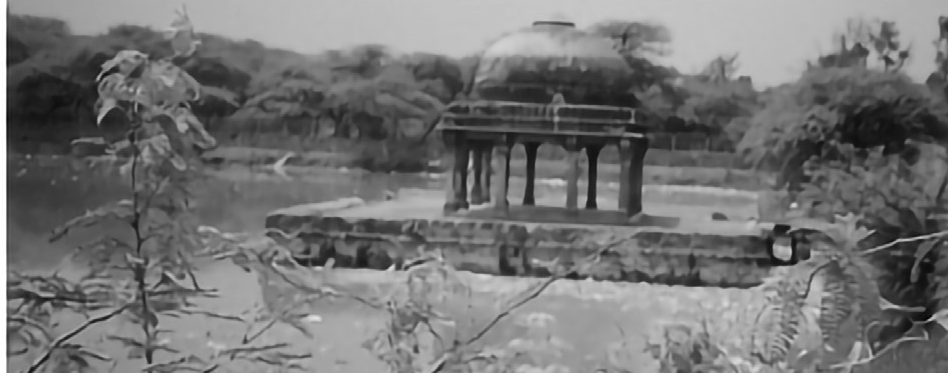
FIGURE: Hauz-i-Shamsi: It is a water storage reservoir or tank built by Iltutmish in 1230 CE, at a location revealed to him in a dream by the Islamic prophet Muhammad
His legacy extended beyond military feats; Iltutmish was a patron of scholars and Sufi saints. Eminently, his court hosted prominent figures like Minhaj-us-Siraj, Taj-ud-din, Nizam-ul-Mulk Muhammad Janaidi, Malik Qutb-ud-din Hasan, and Fakhrul-Mulk Isami, adding intellectual splendour.
He completed the Qutb Minar in Delhi, a monumental stone tower, and erected a splendid mosque in Ajmer.
Iltutmish revolutionized Indian coinage, introducing the Arabic silver tanka, a 175-gram coin that became the standard medieval currency and a precursor to the modern rupee.
Moreover, he established a cadre of forty influential military leaders known as the “Forty” (Dal Chalisa or Turkan-e-Chahalgani) creating a new ruling elite within the administration. With these multifaceted achievements, Iltutmish shaped the Delhi Sultanate through diplomatic acumen, cultural patronage, and administrative innovation.
Ghiyasuddin Balban
Ghiyasuddin Balban (1266-1287)
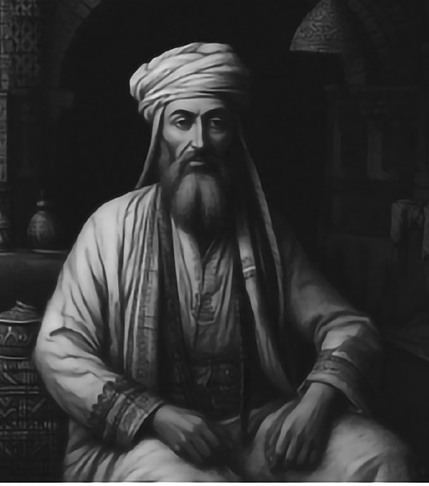
Early Years and Ascent to Power
• GhiyasuddinBalban ,also
known as Ulugh Khan, served as the regent or Naib to Sultan Nasiruddin Mahmud.
• He solidified his position by marrying his daughter to the Sultan and became the de facto ruler.
• In 1266, Nasiruddin Mahmud
passed away without leaving an heir, and Balban took the throne.
Administrative Reforms andStrengthening of the Monarchy
• Balban’s experience as the regent provided him with a deep understanding of the challenges facing the Delhi Sultanate.
• He recognized that the real threat to the monarchy came from the Forty or the chalisa, a group of powerful nobles.
• To consolidate power and authority in the monarchy, he introduced the concept of the Sultan as God’s representative on earth (Zil-i-Ilahi) and the recipient of divine favour.
• He tried to strengthen his claim to the throne by declaring that he was the descendant of the legendary Iranian king Afrasiab.
• He also implemented strict court protocols and new customs, such as sijada (prostration) and paibos (kissing Sultan’s feet), to assert his dominance over the nobles.
Policies towards Turkish and Indian Nobles
• Balban favoured Turkish nobles while excluding other nobles from positions of power.
• He employed spies to monitor the activities of the nobles.
• He was determined to dismantle the power of the Forty and managed to get rid of many of them through various means, both fair and foul.
• Indian Muslims were marginalized and barred from holding key positions in the government.
Focus on Law and Order and Military Strengthening
• Instead of expanding his territory, Balban prioritized restoring law and order within the kingdom.
• He established a separate military department, diwan-i- arz, and restructured the army.
• He took severe measures against the Mewatis, who frequently raided the outskirts of Delhi, and effectively curbed their plundering activities.
• As a result, travelling along the roads became safer.
Suppression of Rebellions and the Mongol Threat
• In 1279, Tughril Khan, the governor of Bengal, rose in revolt against Balban's rule. The rebellion was quickly suppressed, and Tughril Khan was executed. Meanwhile, in the northwest, the Mongols resurfaced, prompting Balban to send his son, Prince Mahmud, to lead the defense. Unfortunately, the prince was killed in battle, striking a heavy blow to Balban's morale.
Legacy and Succession
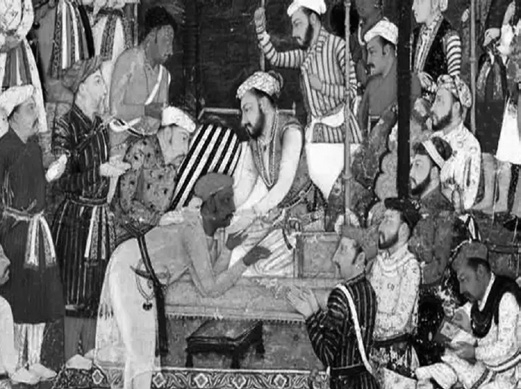
• Balban passed away in 1287.
• He is unequivocally recognized as one of the principal architects of the Delhi Sultanate.
• He bolstered the monarchy’s power but was unable to fully protect India from the Mongol invasions.
• Following his death, one of his grandsons, Kaiqubad, was appointed Sultan of Delhi. However, Jalaluddin Khalji seized the throne in 1290 after a period of inept rule.
The Khalji Dynasty Jalaluddin Khalji (1290-1296)
THE KHALJI DYNASTY (1290-1320)
Jalaluddin Khalji (1290-1296)
After the death of Balban, the Khalji rebellion against his successors was welcomed by the non-Turkish elements of the nobility. The Khaljis were of a mixed Turkish-Afghan origin and ended the Turkish monopoly of the high offices.
Jalaluddin Khalji, the brief ruler of the Delhi Sultanate for six years, sought to soften the harsh governance established by Balban.
He advocated for a state founded on the support of the populace, recognizing that India’s predominantly Hindu population could not entirely conform to Islamic governance.
His approach emphasized tolerance and avoided severe punishments to win over the nobility’s favour. However, this leniency was perceived as weakness amid the numerous internal and external threats faced by the Sultanate.
As the founder of the Khalji dynasty, Jalaluddin, at seventy years of age, exhibited generosity and leniency. Despite allowing certain rebellions and showing clemency towards robbers, his forgiving nature was misinterpreted as weakness.
When his leniency was tested by his nephew, Malik Chhajju’s revolt, Jalaluddin suppressed it but chose to pardon him. However, in a treacherous turn of events in 1296 during an expedition to Devagiri, Jalaluddin was murdered by his son-in-law, Alauddin Khalji, who then seized power and the throne of Delhi.
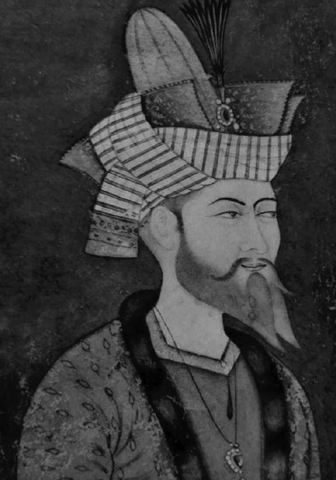
This betrayal marked the end of Jalaluddin Khalji’s reign and the beginning of a drastic shift in governance under Alauddin Khalji’s rule.
Alauddin Khalji
Alauddin Khalji (1296-1316)
Introduction
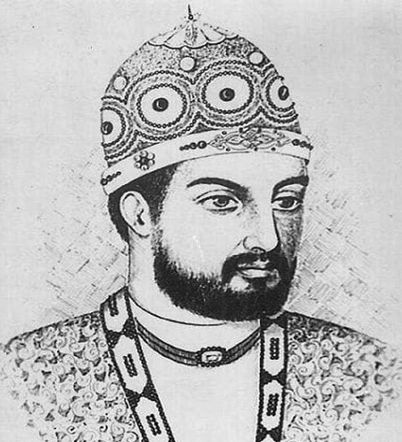
Alauddin Khalji, known for his ruthlessness and strategic governance, embarked on significant reforms and expansions during his reign.
To assert his authority over the nobility, he resorted to severe measures, confiscating their properties, reorganizing intelligence systems, and prohibiting public
sale of liquor and drugs. He curtailed noble gatherings and marriages without his consent, establishing strict regulations to maintain control and prevent conspiracies against him.
While Alauddin Khalji’s expansions and reforms bolstered his power, his methods of governance—ruthless suppression of dissent and destruction of the old nobility—had long-term consequences detrimental to the dynasty. His legacy includes a centralized authority, military prowess, and significant territorial expansions, yet the methods employed sowed seeds of future instability. Although the Sultan was illiterate, he patronized poets like Amir Khusrau and Amir Hasan. He gave the title of Tuti-i-Hind (Parrot of India) to Khusrau. He also built a famous gateway known as Alai Darwaza and constructed a new capital at Siri. He established the Diwan- i-Mustakhraj or the Department of Revenue Administration.
Military Campaigns
Conquest of Gujarat (1299): Alauddin sent Nusrat Khan and Ulugh Khan to capture Gujarat. While the king escaped, the queen was captured and sent to Delhi, extending Khalji’s control over the region.
Siege of Ranthambore (1301): Following a three-month siege, Ranthambore fell after valiant resistance. The Rajput women performed jauhar, solidifying Khalji’s dominance in the region.
Storming of Chittor (1303): Despite fierce opposition, Alauddin successfully stormed the powerful state of Chittor. The Rajputs, including Rani Padmini, performed jauhar, cementing Khalji’s control over the region.
Conquest of the Deccan and Southern Dynasties: Malik Kafur’s campaigns against Devagiri, Warangal, Dwarasamudra, and Madurai were marked by victories, enormous booty, and submission of rulers, extending Khalji’s influence deep into the Deccan and southern regions. However, Alauddin was not in favour of directly administering these territories
Reforms by Alauddin Khalji
REFORMS BY ALAUDDIN KHALJI
Market Regulation
Alauddin established three distinct markets in Delhi
– one for food grains, another for costly cloth, and the third for horses, slaves, and cattle.
Each market was closely supervised by high-ranking officers (shahna or shahna-i-mandi) who maintained merchant registers and strictly controlled prices.
These measures were implemented to fix the costs of all commodities, from food essentials to horses and even slaves.
A separate department called Diwani Riyasat was created under an officer called Naib-i-Riyasat.
There were secret agents called Munhiyans who sent reports to the Sultan regarding the functioning of these markets.
Foodgrain Control
Alauddin focused on regulating food prices to ensure a consistent and affordable supply to the towns. To achieve this, he initiated several measures, including direct collection of land revenue in the doab region and raising the land revenue to half of the produce.
He also mandated that the lands in the doab region could not be assigned as Iqta to any noble or soldiers.
Peasants were compelled to sell their produce at low prices to registered traders (banjaras), enabling towns to obtain grain at state-fixed prices.
He was the first sultan to introduce a land revenue system that relied on measuring the area of cultivated land.
Additionally, he decreed that local landlords, or khuts and muqaddams, should pay the same taxes as other landowners.
Preventing Hoarding
Alauddin monitored banjaras rigorously, holding their agents and families collectively responsible for any violations.
Additionally, state-controlled warehouses were established to stock food grains, released during shortages or famine. To prevent hoarding, Alauddin ensured constant vigilance and imposed harsh penalties on shopkeepers who inflated prices or used deceptive measures.
Regulation of Horses
Controlling horse prices was vital for maintaining an efficient army. Prices for different grades of horses were strictly set – a first-grade horse cost 100 to 120 tankas, while a less capable pony was priced between 10 to 25 tankas.
This regulation ensured that only good-quality horses were sold to the state, enhancing the army’s effectiveness
Further, Alauddin introduced the practice of dagh or the branding of quality horses for identification and efficiency of the military.
Control of Other Commodities
Alauddin extended price regulation to cattle, slaves, and costly cloth.
This broader control might have been aimed at stabilizing general prices or pleasing the nobility.
The prices of these items were fixed to prevent significant price fluctuations, ensuring stability in the market.
Cash Payments and Salary Control
Realizing land revenue in cash enabled Alauddin to pay his soldiers in cash, a unique approach during his rule.
He set a salary of 238 tankas a year for cavalrymen, maintaining a low but reasonable wage, especially considering the expectations of a soldier’s lifestyle.
He also introduced huliya- a descriptive list of soldiers for better control over his army.
Strict Control of Bureaucracy
These policies depended heavily on their implementation by officials such as the amils and other local officials.
Alauddin addressed adherence to his rules by paying them sufficient salaries to enable them to live in comfort. He also insisted strict auditing of their accounts and punished them for the slightest discrepancies.
Tughluq Dynasty Ghiyasuddin Tughluq (1320-1324)
TUGHLUQ DYNASTY (1320-1414)
Ghiyasuddin Tughluq established a new ruling line that persisted until 1412. Within the Tughluq dynasty, three capable rulers emerged: Ghiyasuddin, his son Muhammad bin Tughluq (1324—51), and his nephew Firoz Shah Tughluq (1351—88). The initial two sultans governed over an empire that encompassed nearly the entire country. Although Firoz’s realm was smaller, it still rivalled the vastness of Alauddin Khalji’s rule. Following Firoz’s demise, the Delhi Sultanate fragmented, leading to the division of north India into multiple small states. Despite the Tughluqs’ continued rule until 1412, the incursion of Timur into Delhi in 1398 is often considered the culmination of the Tughluq empire.
Ghiyasuddin Tughluq (1320-1324)
The founder of the Tughlaq dynasty was Ghiyasuddin Tughlaq. Ghiyasuddin Tughlaq sent his son Juna Khan to fight against Warangal. He defeated Prataparudra and returned with rich booty. Ghiyasuddin laid the foundation for Tughlaqabad near Delhi. Ulugh Khan was said to have treacherously killed his father and ascended the throne with the title Muhammad bin Tughlaq in 1324
Muhammad Bin Tughluq
Muhammad Bin Tughluq (1324-1351)
Muhammad bin Tughlaq emerged as a remarkable ruler in his era, deeply knowledgeable in religion and philosophy, displaying an open and critical mindset. He engaged not just with Muslim mystics but also with Hindu yogis and Jain
saints like Jinaprabha Suri. However, this diverse interaction wasn’t favoured by many orthodox theologians, who labelled him a ‘rationalist’ for his reluctance to blindly accept religious beliefs. He was also willing to appoint individuals to high positions based on merit rather than noble lineage. However, his tendency towards impatience and hastiness proved to be a downside.He was a compelling figure in medieval Indian history due to his ambitious pursuits and ground-breaking experiments, although their advanced nature led to significant failures. Demonstrating remarkable religious tolerance, he nurtured diplomatic relations with distant nations like Egypt, China, and Iran. Despite introducing progressive reforms, none succeeded. Isami, Badauni, and Ibn Battuta, contemporaneous chroniclers, failed to capture his full essence accurately. Nonetheless, Muhammad bin Tughlaq distinguished himself as the only Delhi Sultan to receive an extensive education covering literature, religion, and philosophy.
• This decision to transfer the capital was controversial. Devagiri had served as a vital base for the expansion of Turkish rule in South India, and Muhammad Tughlaq had spent considerable time there during his princely days.
• The motive behind this relocation was to exert better control over South India by establishing a secondary capital.
• To facilitate this shift, Tughlaq pressured officers, influential figures, and Sufi saints to move to Daulatabad, providing incentives and accommodations.
• However, this initiative led to discontent and a sense of longing among those who had generations-long ties to Delhi.
Despite efforts to create infrastructure and ease travel, including constructing a road and rest houses between Delhi and Daulatabad, the relocation caused significant casualties due to the strenuous journey and scorching heat of the summer.
Ultimately, Muhammad bin Tughlaq abandoned Daulatabad after realizing that controlling North India from there was as futile as controlling the South from Delhi, acknowledging the failure of this ambitious endeavour.
The endeavour to establish Devagiri as a second capital may have faltered, yet it had lasting positive effects. It facilitated improved communication between North and South India, fostering cultural and religious exchange. Those who settled in Daulatabad contributed to disseminating Turkic cultural and social concepts in the Deccan, initiating a fresh phase of cultural interaction within and between the regions.
TOKEN CURRENCY
There was a shortage of silver in the world at the time and the sultan attempted to solve this problem by introducing a token currency. Money, after all, is a medium of exchange and all countries today use token currencies- so they do not have to depend on the supply of arbitrary fixation of state shares without consideration for actual yields.
A prolonged famine exacerbated the situation, with relief efforts arriving too late, leading to numerous deaths in Delhi and the sultan left the capital for a period.
The measures he initiated to revamp agriculture had long-term implications but catastrophically failed during his rule, perhaps due to flawed planning or inexperienced implementation by officials
AGRICULTURAL REFORMS
Upon returning to Delhi, Muhammad Tughlaq aimed to enhance cultivation in the doab. He had recognized that effective relief and agricultural development were crucial.
He initiated a scheme offering takkavi loans to farmers for purchasing seeds and expanding cultivation.
The diwan-i-amir-i-kohi department was established, dividing the area into development blocs led by officials tasked with extending cultivation through loans and encouraging the cultivation of better crops like wheat instead of barley, sugarcane instead of wheat, grapes, and dates instead of sugarcane.
However, the scheme faltered due to the incompetence and dishonesty of those chosen, who misused funds for personal gain. The significant sums invested couldn’t be recovered. Fortunately, Muhammad Tughlaq passed
away, and Firoz pardoned the loans.
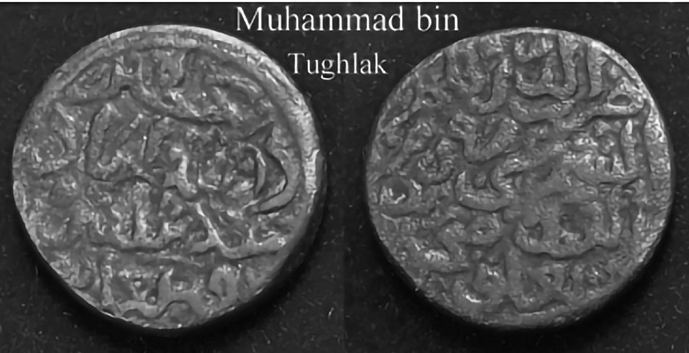
Muhammad Tughlaq decided to introduce a bronze coin which was to have the same value as the silver tanka.
However, this idea at the time was very advanced for its time. It was completely novel in India and it was difficult to get the traders and the common man to accept it.
It would have been successful if the government found a way to prevent the people from forging the coins. The government failed and as a result, the new coins were devalued greatly.
Muhammad Tughlaq decided to recall the token currency and offered to exchange silver coins for the bronze ones. As a result, many people swapped their new coins. However, counterfeit coins, which could be identified through specific tests, were not accepted in the exchange.
TAXATION IN THE DOAB
The failure of these experiments led to a loss of the Sultan’s standing and a significant waste of resources.
To offset financial woes, Muhammad bin Tughlaq increased land revenue in the Doab region, burdening the farmers excessively amid a severe famine, resulting in significant peasant revolts.
This uprising stemmed from over-assessment and
Nonetheless, the cultivation extension policy persisted
and gained momentum under Firoz and later, Akbar.
Beginning of the end: Dissatisfied nobles and rebellions
Muhammad Tughlaq grappled with the issue of the nobility, expanding its composition beyond old noble families to include individuals from various backgrounds like barbers, cooks, and weavers, including converts, which fueled resentment among the traditional aristocracy.
This diverse nobility lacked cohesion or loyalty to the sultan, while the vast empire created opportunities for rebellions and the pursuit of independent authority.
The reign also witnessed a surge in rebellions by nobles and provincial governors.
Hasan Shah’s rebellion led to the Madurai Sultanate, and the establishment of the Vijayanagar and Bahmani kingdoms followed in 1336 and 1347, respectively.
Governors in Oudh, Multan, and Sind revolted, while Taghi rebelled in Gujarat, leading to a three-year pursuit by the Sultan.
As Muhammad Tughlaq’s health deteriorated, he passed away in 1351, leading to varying opinions about his
reign– according to Baduani, the Sultan was freed from his people and the people from the Sultan. According to Barani, Muhammad bin Tughlaq was a mixture of opposites
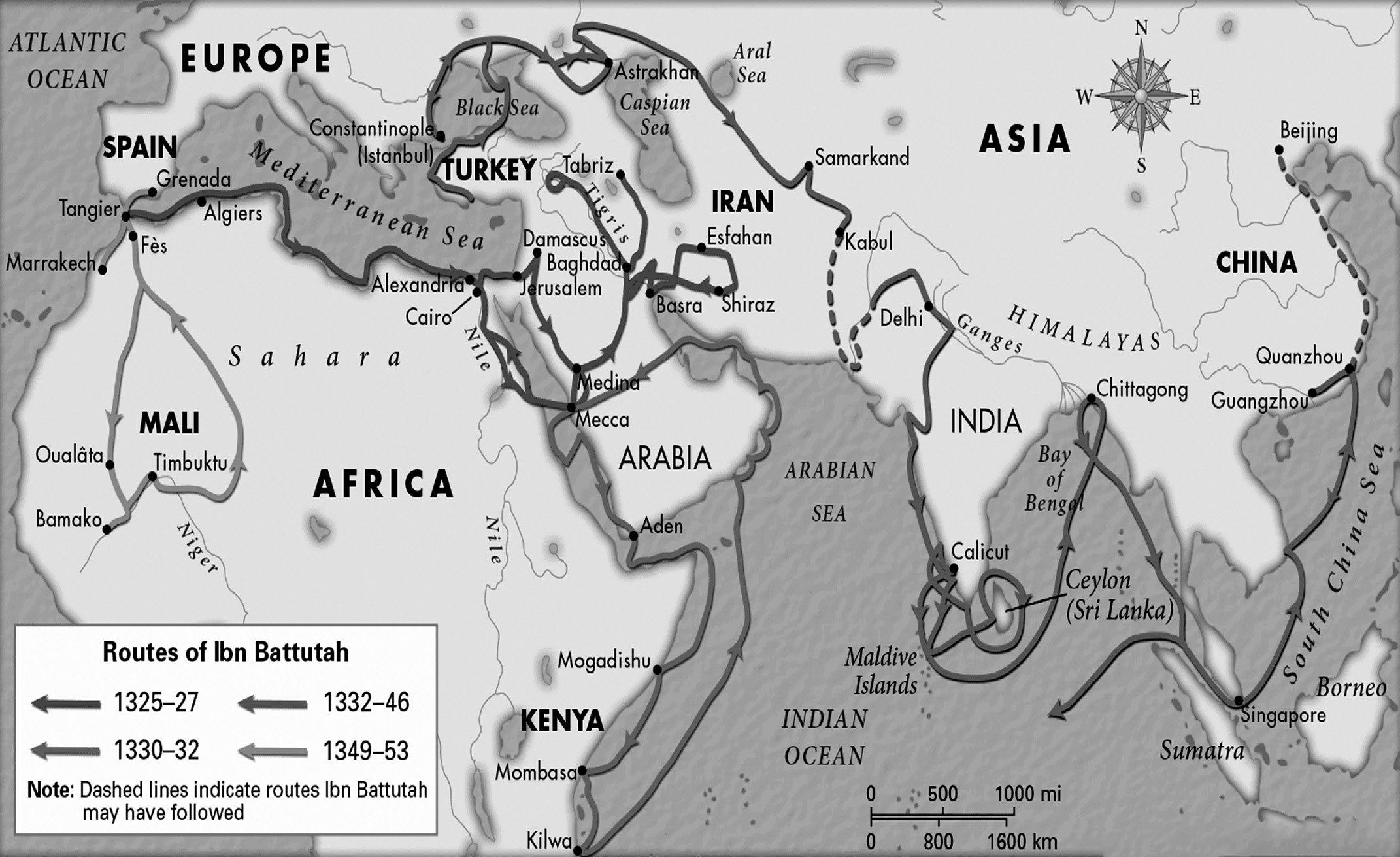
Ibn Battuta’s Rihla, written in Arabic, serves as a treasure trove of detailed insights into the social and cultural tapestry of the fourteenth-century subcontinent. Hailing from Tangier, Ibn Battuta belonged to a revered and erudite family renowned for their expertise in Islamic religious law, or sharia. His innate love for exploration and an insatiable curiosity for distant lands led him on remarkable journeys that opened up new worlds and introduced him to diverse peoples.
Before embarking on his Indian venture in 1332-33, Ibn Battuta had already undertaken pilgrimage trips to Mecca and had traversed vast regions, exploring the landscapes of Syria, Iraq, Persia, Yemen, Oman, and certain trading ports along East Africa’s coast. His travels were not merely geographical; they were windows into the rich cultural and societal panoramas of each region.
Fascinated by the fame of Sultan Muhammad bin Tughlaq, the ruler of Delhi renowned for his patronage of arts and scholarship, Ibn Battuta set his sights on Delhi. His journey took him through Multan and Uch before arriving in Delhi, where the Sultan, impressed by his erudition, appointed him as the qazi, or judge, of Delhi. His tenure in this prestigious position lasted for several years until a falling-out led to his imprisonment. However, upon clarification of the misunderstanding with the Sultan, Ibn Battuta was reinstated in imperial service. His remarkable journey continued, as he was tasked in 1342 to embark on an envoy mission to China, representing the Sultan to the Mongol ruler.
Ibn Battuta’s travelogue often draws comparisons with the accounts of Marco Polo, the Venetian explorer who traversed China and India in the late thirteenth century. However, Ibn Battuta’s travels were marked by significant dangers; he encountered numerous instances of bandit attacks, facing perilous situations that threatened his life. Despite his preference for traveling in caravans with companions, even this did not guarantee safety, as he and his fellow travelers were brutally attacked while journeying from Multan to Delhi, resulting in severe injuries and fatalities among his companions
Firoz Shah Tughluq
Firoz Shah Tughluq (1351-1388)
• Firoz Tughlaq, ascending to power after Muhammad bin Tughlaq died in 1351, stood out for being chosen by the nobles as the Sultan.
• Firoz, though not a notable military leader, governed during a peaceful phase marked by gradual progress. He implemented measures that pleased the nobility, allowing inheritance of positions and iqta upon their deaths. Additionally, he abolished the practice of torturing nobles and officials found with deficits during audits, further enhancing nobles’ contentment and minimizing rebellions, except for minor uprisings in Gujarat and Thatta.
• However, the policy of hereditary appointments, including offices and military roles, had drawbacks. While initially advantageous, it limited the recruitment of competent individuals and created dependency on a small group, leading to potential long-term harm.
• The extension of heredity to the military also had adverse effects. Soldiers were allowed to replace themselves with their sons or relatives, and paid through assignments on village revenues instead of direct cash payments. This arrangement encouraged inefficiency within the military, as soldiers had to either collect their salaries from villages, neglecting their duties, or involve intermediaries, diminishing their overall benefit. The lax military administration further deteriorated as soldiers bribed clerks to pass sub-par horses during muster checks. Even Firuz himself, in a misguided act of generosity, once gave money to a soldier to bribe a clerk.
• Overall, Firoz attempted to gain favour with religious leaders and attempted to strike a balance between various groups within the kingdom.
• His reign emphasized administration and military pursuits. Though he aimed to reinforce control over North India, his campaigns in Bengal faced failure, resulting in Bengal’s independence. His expeditions against Jajnagar, Nagarkot, and Thatta were marked by acquiring treasures and manuscripts from temples, including translating Sanskrit texts into Persian.
• Firoz instituted substantial administrative reforms, reinstating and making the iqta system hereditary.
• He levied Islamic taxes, strictly enforcing jiziya on non- Muslims and introducing irrigation taxes while creating irrigation systems like canals and wells.
• Firozabad, a prominent town near Delhi’s Red Fort, and several royal factories (karkhanas) were established.
• He initiated social welfare with hospitals for the poor and marriage bureaus, yet his rule was characterized by intolerance toward Shia Muslims and Sufis. He treated Hindus as inferior citizens (imposed jiziya), similar to later rulers like Sikandar Lodi and Aurangzeb.
• His reign also saw an increase in slaves, totaling around 180,000 upon his death in 1388. His demise marked a power struggle between the Sultan and nobles, leading to further disintegration of the Delhi Sultanate.
• Subsequent years witnessed provinces like Malwa and Gujarat declaring independence.
The invasion by Timur in 1398 exacerbated the chaos, resulting in widespread destruction and looting of Delhi. Timur’s assault dealt a severe blow to the Tughlaq dynasty
The Sayyid Dynasty
THE SAYYID DYNASTY (1414-1451)
Before leaving India, Timur appointed Khizr Khan as Multan’s governor. Khizr Khan later captured Delhi in 1414, establishing the Sayyid dynasty. Despite attempts to consolidate the Delhi Sultanate, his efforts were futile. Khizr Khan passed away in 1421, succeeded by Mubarak Shah, followed by Muhammad Shah, who struggled against conspiracies and eventually lost control over his nobles. Bahlul Khan Lodi emerged as a dominant figure. Muhammad Shah passed away in 1445, succeeded by Alam Shah (1445-1451), the weakest of the Sayyid princes. Alam Shah ceded the throne to Bahlul Lodi and retired to Badaun
The Lodi Dynasty
THE LODI DYNASTY (1451-1526)
The Lodis, an Afghan dynasty, succeeded the Sayyids. Bahlul Lodi became the first Afghan ruler, diverging from the Turk lineage of his predecessors. After his death in 1489, his son Sikandar Lodi took over.
Sikandar Lodi, ruling from 1489 to 1517, was the most significant of the three Lodi sovereigns. He expanded his empire from Punjab to Bihar, subduing Rajput chiefs andsigning a treaty with Bengal. Despite his administrative achievements like infrastructure development, he demonstrated bigotry by destroying Hindu temples and imposing restrictions on Hindus. Nonetheless, he strengthened the sultanate significantly. Sikandar Lodi’s eldest son, Ibrahim Lodi, who succeeded him, was haughty and openly insulted and executed rebellious nobles. Discontentment grew, leading his own uncle and the Punjab governor, Daulat Khan Lodi, to invite Babur to invade India. Babur defeated and killed Ibrahim Lodi in the first battle of Panipat in 1526, marking the end of the Afghan kingdom after a span of seventy-five years.
Government, Economic and Social Structure
GOVERNMENT, ECONOMIC & SOCIAL STRUCTURE OF INDIA DURING THE DELHI SULTANATE
The Sultan
• Despite many Turkish sultans in India declaring themselves as the ‘lieutenant of the faithful’—essentially representing the Abbasid caliphate in Baghdad and including the caliph’s name in the Friday prayers, this act didn’t confer legal authority upon the caliph.
• The Sultan’s office was the most important and had political, military and even legal authority vested in him. He was responsible for administration and was also the commander in chief of the military forces.
• While the sultans did appoint judges but he acted as the court of appeal from the judges.
• No clear law of succession developed during this time. All the sons of the ruler were considered to have an equal claim to the throne. The idea of primogeniture was not accepted by the rulers or the nobles of the time.
Central Administration
• By the late thirteenth century, a structured administrative system had emerged. The wazir became the central figure in this system. Initially, the wazir served primarily as a military leader, but by the fourteenth century, his role shifted towards overseeing revenue matters, managing a vast department responsible for both income and expenditure.
• The second most important department after the wazir’s was the Diwani-arz, or the military department. The head of this department was called the Ariz-i-mumalik. Unlike a traditional commander-in-chief, the Ariz did not directly command the army, as the sultan himself held that authority. The Ariz’s role focused on recruitment, equipment, and the payment of soldiers.
• Another key department was the Diwan-i-Risalat, which handled religious affairs, charitable endowments, and stipends for scholars and pious individuals. It was led by the chief sadr, typically a prominent qazi, who also served as the chief qazi. The chief qazi oversaw the justice department, with qazis appointed across the empire to enforce civil law based on Islamic principles (sharia) in regions with significant Muslim populations. Hindus were governed by their own personal laws, which were administered by village panchayats or caste leaders in urban areas. Criminal law was regulated by specific codes enacted by the rulers.
• The Diwan-i-Insha was responsible for all state correspondence, handling both official and confidential communications between the ruler, foreign sovereigns, and other officials within the empire.
• Additionally, several other departments supported the state. Intelligence agents, known as barids, were posted across the empire to gather information. The chief barid was always a trusted noble, selected for his loyalty to the ruler.
• The ruler's household also represented a significant administrative branch, overseeing various karkhanas (workshops or departments) that stored or produced goods needed by the king and royal family. Some items were manufactured under the supervision of the royal court, ensuring the efficient functioning of the state.
• Firoz Tughlaq established a distinct department for slaves, known as the Diwan-i-Bandagan. Many of these slaves were employed in the royal workshops. The officer overseeing these activities was called the Wakil-i-Dar. In addition to managing the slaves, he was responsible for maintaining proper decorum at the court, ensuring that nobles were arranged in the correct order of precedence during formal gatherings and receptions.
Local Administration
• The country under the Sultanate was divided into a number of tracts called iqtas (provinces). The holders of these offices were called muqtis or walis. Later these iqtas became subahs. Muqtis were expected to maintain law and order in their lands, collect land revenue from it as well as maintain their quota of troops and pay their salaries due to the soldiers.
• Below the iqtas (provinces) were the shiqs and below them pargana.
• The villagers were grouped into units of 100 to 84 (traditionally called chaurasi). This must have been the basis of the parganas. The pargana was headed by the amil and the shiqs by the shiqdar. The most important persons in the village were the khut (landowners) and muqaddam or chaudhari (headman). Another official was the patwari or the village accountant.
Economy
After securing their rule in India, the Delhi Sultans implemented reforms in land revenue administration, dividing land into three categories:
• Iqta land: These lands were allocated to officials as iqtas, which served as payment for their services.
• Khalisa land: This land was directly controlled by the Sultan, with the revenues generated used to support the royal court and household.
• Inam land: Land granted to religious leaders or institutions.
• The taxation system included three types of taxes: (1) Kharaj, a tax on cultivation, which amounted to about 50% of the peasant's produce, (2) taxes on cattle, and (3) taxes on houses.
• Under the Delhi Sultanate, the peasantry faced heavy taxation, often giving up one-third or even half of their harvest as land revenue, in addition to other taxes. This created a precarious existence for farmers, further compounded by frequent famines.
• Sultans such as Muhammad bin Tughlaq and Firoz Tughlaq made efforts to boost agricultural productivity by introducing measures like irrigation systems, providing takkavi loans, and encouraging the cultivation of high-yield crops such as wheat.
• Urbanization flourished during this period, with cities like Lahore, Multan, Broach, Daulatabad, Delhi, and Jaunpur growing significantly. Among these, Delhi stood as the largest city in the East.
Taxes Levied during the Sultanate Period
| Taxes | Purpose |
| Ush | Land Revenue paid by Muslims only |
| Kharaj | Land Revenue paid by non- Muslims only |
| Zakat | Paid by rich Muslims as a religious tax |
| Khams | 1/5th of the property looted during wars |
| Jaziyah | Personal and yearly tax on non-Muslims |
• Trade and commerce flourished, with India exporting various goods to Persian Gulf and West Asian countries, overseen by Multanis and Afghan Muslims in overseas trade and Gujarat Marwari and Muslim Bohra merchants dominating inland trade. Well-maintained roads and rest houses facilitated smooth transportation and communication.
• The textile and silk industries thrived, with sericulture reducing India’s dependence on imported raw silk. The paper industry expanded, witnessing widespread use from the 14th and 15th centuries. Other crafts such as leather-making, metalwork, and carpet weaving also flourished due to growing demand, with royal workshops supplying goods to the Sultan and his household. Nobles adopted a luxurious lifestyle, amassing considerable wealth through generous compensation.
• Coinage evolved during this period, with various types of silver tankas and gold dinars introduced under different rulers’ reigns. Alauddin Khalji popularized gold coins after South Indian conquests, while copper coins were fewer in number and often undated. Muhammad bin Tughlaq experimented with token currency and issued numerous types of gold and silver coins from eight different minting places, issuing at least twenty-five varieties of gold coins.
Social Life
• There was little change in the structure of the Hindu society during this period. The traditional caste system with the Brahmins on the upper strata of the society was prevalent. The subservientposition of women also continued and the practice of sati was widely prevalent. The Arabs and Turks introduced the purdah system in India, which eventually became widespread among upper-class Hindu women in northern India.
• During the Sultanate era, Muslim society was marked by significant divisions based on ethnicity and race, with distinct groups such as the Turks, Iranians, Afghans, and Indian Muslims developing separately. There was no intermarriage between these groups, and Hindu converts, especially those from lower castes, were not treated equally. Muslim nobles dominated high-ranking government positions, with Hindu nobles rarely attaining similar roles. Hindus were categorized as zimmis (protected subjects) and were required to pay the jizya tax. Initially, this tax was included with land revenue, but under Firoz Tughlaq, it was collected separately. Occasionally, Brahmins were granted exemptions from the jizya tax.
ART AND ARCHITECTURE
• During the Delhi Sultanate, art and architecture took on a distinct style, distinct from traditional Indian design. The Turks introduced architectural elements like arches, domes,tall towers (minarets), and incorporated decorative features using the Arabic script. They employed the expertise of Indian stone cutters and added vibrant colours to their buildings using marble, red and yellow sandstones.
• Initially, they repurposed demolished structures like temples into mosques, as seen in the Quwwat- ul-Islam Mosque near the Qutub Minar in Delhi, constructed using materials from razed Hindu and Jain temples . However, over time, they shifted to building entirely new structures. Among the notable constructions of the 13th century was the Qutub Minar, initiated by Aibak and completed by Iltutmish.
• Standing at 71 meters, the Qutub Minar was erected to honor the Sufi saint Qutbuddin Bakhtiyar Kaki, displaying remarkable architectural skill through its projecting balconies. Later, Alauddin Khalji enhanced the structure by adding the Alai Darwaza entrance, featuring a dome designed
• The buildings duringthe Tughlaq period amalgamated arches and domes, employing the use of more affordable and readily availableg rey stones. Ghiyasuddin Tughlaq oversaw the construction of the Tughlaqabad Palace complex, renowned for its beautiful lake. Muhammad bin
Tughlaq erected Ghiyasuddin’s tomb on an elevated platform. Firoz Tughlaq was responsible for the creation of the Kotla Fort in Delhi, while the Lodi Gardens in Delhi exemplified the architectural style of the Lodis.
Music and Literature
• During the Delhi Sultanate era, music and literature flourished, witnessing the introduction of new instruments like the sarangi and rabab. Amir Khusrau, a significant figure, not only introduced fresh ragas such as ghora and Sanam but also pioneered a new style of light music, qawwalis, blending Hindu and Iranian musical systems. He is also credited with the invention of the sitar.
Pir Bhodan, a Sufi saint, was another esteemed musician of this time, while Raja Man Singh of Gwalior actively encouraged the composition of the esteemed musical piece, Man Kautuhal.
Literary pursuits were highly valued by the Delhi Sultans, fostering an environment where Arabic and Persian literature thrived. Scholars from Persia contributed significantly to the development of the Persian language and literature. The Sultans also supported the writing of history, with some rulers appointing court historians. Prominent historians from this period include Hasan Nizami, Minhaj-us-Siraj, Ziauddin Barani, and Shams-Siraj Afif. Barani’s Tarikhi-Firoz Shahi chronicles the history of the Tughlaq dynasty, while Minhaj-us-Siraj authored Tabaqat-i- Nasari, an extensive history of Muslim dynasties up to the year 1260.
Amir Khusrau, a distinguished Persian writer, explored various poetic forms and created a distinctive style of Persian poetry known as Sabaq-i-Hind, or the Indian style. In addition to his Persian works, he composed Hindi verses and wrote Khazain-ul-Futuh, which chronicles Alauddin’s conquests, and Tughlaq Nama, detailing the rise of Ghiyasuddin Tughlaq.
• During the Sultanate period, both Sanskrit and Persian played crucial roles as bridge languages. Zia Nakshabi translated Sanskrit stories into Persian, including Tutu Nama, which became widely popular and was later translated into Turkish and several European languages. The famous Rajatarangini by Kalhana was preserved under the patronage of Zain-ul-Abidin in Kashmir. Medical and musical texts in Sanskrit were also translated into Persian.
• In Arabic, Al-Biruni’s Kitab-ul-Hind stood out as a major scholarly work. Regional languages flourished as well, with Chand Baradi becoming a prominent Hindi poet. Bengali literature saw growth, especially under the patronage of Nusrat Shah, who supported the translation of the Mahabharata. The Bhakti movement played a key role in the development of Gujarati and Marathi, while the Vijayanagar Empire fostered the growth of Telugu and Kannada literature.
Caste, Social Manners and Customs
• During the Delhi Sultanate period, the structure of Hindu society remained largely unchanged. The Smriti texts upheld the elevated status of Brahmans while condemning unworthy members of the order. Some suggested that Brahmans could engage in agriculture during the Kali Age, as their priestly duties did not ensure sustenance.
• Kshatriyas were identified as protectors of the people, emphasizing their duty to punish the wicked. Shudras were allowed various occupations except dealing in liquor and meat. They were mainly designated for service to other castes, with restrictions on Vedic study and living arrangements.
• Strict barriers existed against mingling with the Chandalas and other ‘outcastes’. The position of women saw minimal change—early marriage for girls and devotion to husbands continued. Widows’ property rights seemed to improve slightly, yet widow remarriage was prohibited for the upper castes. Sati was a contentious practice, with some writers advocating for it and others allowing it under specific conditions.
• The period saw the widespread adoption of purdah among upper-class women, largely influenced by Arab and Turkish customs. The seclusion of women was symbolic of higher societal standing but further restricted women’s independence.
• In Muslim society, divisions persisted among ethnic and racial groups. Turks, Iranians, Afghans, and Indian Muslims rarely intermarried. Converts from lower Hindu sections faced discrimination, and social interaction between Hindu and Muslim upper classes was limited due to religious and superiority complexities.
• Despite this separation, Hindu soldiers served in Muslim armies, and Hindus managed the estates of Muslim nobles. Mutual interactions occurred within administrative roles, although tensions stemmed from conflicting interests and cultural differences, slowing down assimilation between the communities.
THE INDIAN POSTAL SYSTEM
Ibn Battuta vividly illustrates the dual postal system in India, comprising the horse-post and foot-post. The horse- post, termed uluq, relies on royal horses stationed every four miles, facilitating swift transportation. In contrast, the foot-post, known as dawa, operates with three stations per mile, covering shorter distances more densely.
In this foot-post system, a network of well-populated villages exists at intervals of every third of a mile. Outside these villages stand three pavilions where individuals, ready for action with girded loins, await the courier’s arrival. Each pavilion harbors men equipped with rods, adorned with copper bells atop, measuring two cubits in length.
As the courier sets off from the city, he holds the letter in one hand and the rod with its jingling bells in the other, sprinting at his utmost speed. The bell-ringing alerts the men in the pavilions, prompting them to prepare for the letter’s handover. Upon the courier’s arrival, one of the awaiting men swiftly retrieves the letter and, with relentless pace, dashes to the next station, continuously shaking the rod with its resonating bells.
This relay of messengers passing the letter continues until it reaches its intended destination. Contrary to expectations, Ibn Battuta notes that this foot-post method proves faster than the horse-post. Furthermore, he remarks that it is occasionally utilized to transport highly sought-after Khurasani fruits into India
Technology During the Delhi Sultanate
TECHNOLOGY DURING THE DELHI SULTANATE
During the Delhi Sultanate, India underwent a transformative era marked by technological advancements across various domains. Agriculture, textile production, construction techniques, and military equipment witnessed significant developments, reflecting a synthesis of indigenous practices and innovations introduced by incoming cultures, notably the Islamic society.
Agricultural Technology
• Plough Technology
The shift from hoeing to ploughing was a significant agricultural advancement.
Initially made of wood, the plough’s share or coulter evolved to include an iron tip, aiding in tilling harder soils.
While India didn’t develop horse-drawn wheeled- ploughs due to its lightweight plough design suited for softer soils, it effectively utilized oxen-drawn ploughs.
• Sowing Methods
Broadcasting seeds manually using cloth bags slung over shoulders was the prevalent method.
Evidence for the seed drill’s use exists, with disputed origins, potentially tracing back to the Vedic Age.
Portuguese accounts in the 16th century note its use in wet rice cultivation on the western coast of India
• Harvesting, Threshing, and Winnowing
Harvesting was conducted with sickles, while threshing involved oxen treading over the ears placed on threshing floors.
Winnowing used wind power to separate grain from chaff.
• Irrigation Devices
Various water sources like rain, ponds, tanks, and wells were utilized for irrigation. Wells, particularly masonry ones with raised walls and platforms, were crucial. Five main water- lifting techniques existed:
Hand-operated rope and bucket for smaller fields.
Pulleys added to the rope-bucket system, reducing human effort.
Oxen-powered rope-bucket-pulley system known as charasa, specifically for irrigation.
A semi-mechanical system using the first-class lever principle, named shaduf or tula in Sanskrit.
Saqiya or ‘Persian Wheel,’ a water machine utilizing gears, animal power, and pitchers or pots. This was also called as ‘araghatta’ in Sanskrit.
Textile Technology
In cotton cultivation, ginning (seed extraction), carding (fiber loosening), and spinning (yarn making) were crucial stages.
The spinning-wheel (charkha) introduced by Muslims significantly increased yarn production.
Construction Technology
Lime mortar and true arches were contributions of the Muslim era. Lime mortar enhanced brick buildings’ durability, enabling true arch construction and vaulted roofing.
Stirrup, Horseshoe, and Gunpowder
Stirrups, essential for combat, were introduced by Muslims, significantly impacting mounted warfare.
Horseshoes, not found in Indian archaeological sites, were also brought in by Muslims. Gunpowder, originating in China, was introduced to India by the Turks, but fire-arms use began later, notably by the Portuguese and Babur.
Tin coating, Glass Manufacture, and Other Craft
Tin coating of copper utensils was a craft introduced during this period, offering protection against chemical reactions.
Glass manufacturing had ancient roots, primarily producing beads and bangles, with pharmaceutical vessels imported from Islamic countries.
These technological advancements during the Delhi Sultanate had a profound impact on agriculture, textiles, warfare, construction, and craftsmanship, leaving a lasting legacy on India’s technological evolution.