Foundation and Geographical Setting
We will explore the Vijayanagar and the Bahmani Empires which had been lost to historians for quite a while. We will talk about various rulers of these empires, their respective contributions, and other socio-economic, technological, cultural, arts, architectural, and the importance of the lost city of Hampi the memories of priests of the Virupaksha temple and the shrine of Pampadevi.
Foundation and Geographical Setting
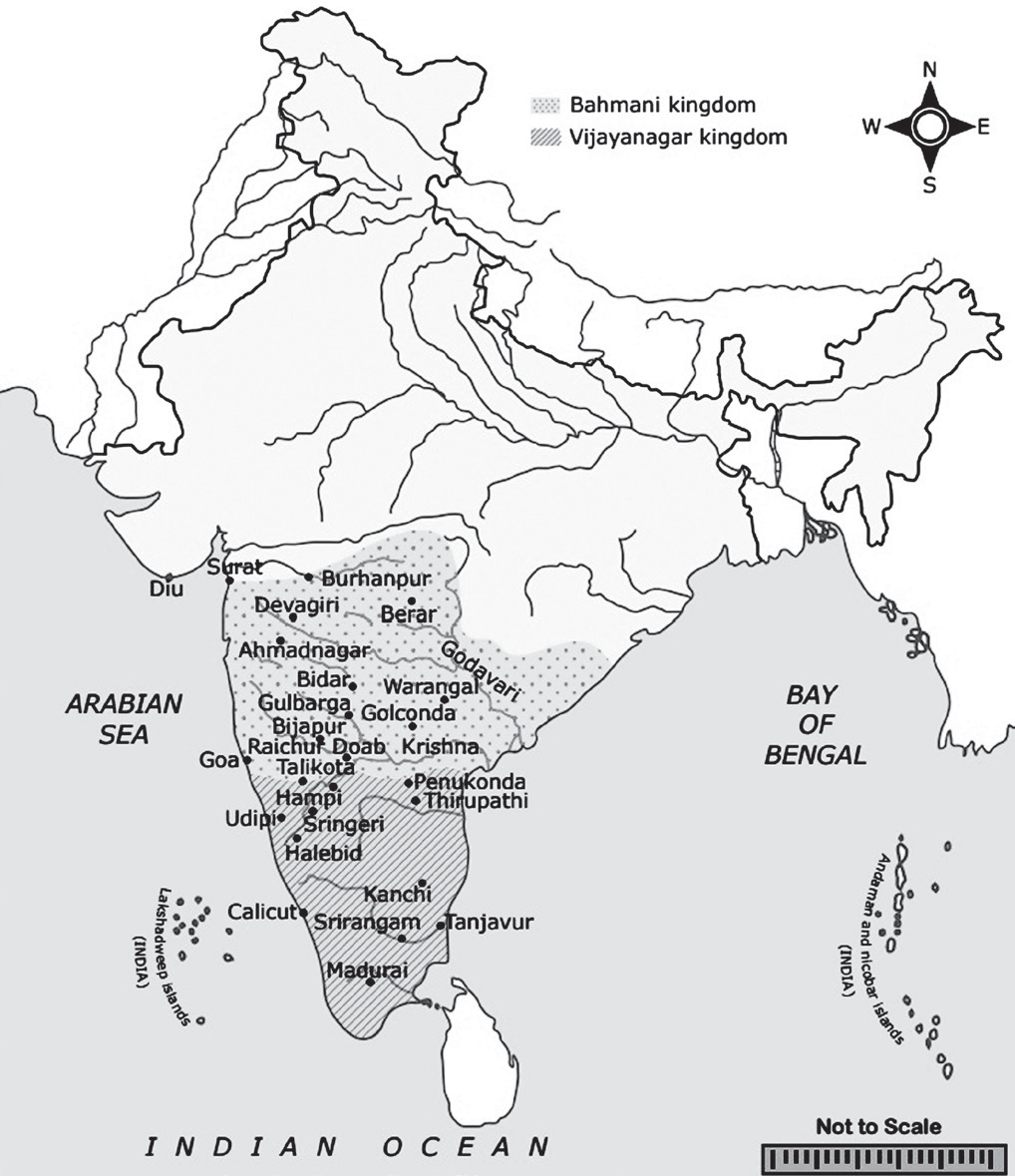
The Vijayanagara Empire was established in 1336 CE along the southern banks of the Tungabhadra River, situated in what is now Karnataka, India.
Vijayanagara or “city of victory” was the name of both a city and an empire.
• The city of Hampi served as its capital, strategically located within South India’s Deccan Plateau. This geographical positioning facilitated control over significant trade routes, contributing to the empire’s economic prosperity and political dominance.
The ruins at Hampi were brought to light in 1800 by an engineer and antiquarian named Colonel Colin Mackenzie. An employee of the English East India Company, he prepared the first survey map of the site. Much of the initial information he received was based on the memories of priests of the Virupaksha temple and the shrine of Pampadevi.
Founders and Historical Context
FOUNDERS AND HISTORICAL CONTEXT
Harihara and Bukka, two brothers from a cowherd background, were instrumental in founding the empire. Having served under Vira Ballala III, the Hoysala King, they
declared independence from the Delhi Sultanate in 1336.
• Influenced by the sage Vidyaranya, they revived Hindu traditions after a period of serving in Muhammad-bin- Tughlaq’s army and being imprisoned and converted to Islam.
• It is believed that Vidyaranya inspired the brothers Harihara and Bukka to build a temple over the Samadhi of his guru, Vidyathirtha. This temple is known as the Vidyashankara Temple, located in Sringeri, Karnataka

Dynastic Evolution
Dynastic Evolution
| SANGAMA DYNASTY | |
| Rulers | Ruling Period |
| Harihara Raya I | 1336-1356 |
| Bukka Raya I | 1356-1377 |
| Harihara Raya II | 1377-1404 |
| Virupaksha Raya | 1404-1405 |
| Bukka Raya II | 1405-1406 |
| Deva Raya I | 1406-1422 |
| Ramachandra Raya | 1422 |
| Vira Vijaya Bukka Raya | 1422-1424 |
| Deva Raya II | 1424-1446 |
| Mallikarjuna Raya | 1446-1465 |
| Virupaksha Raya II | 1465-1485 |
| Praudha Raya | 1485 |
The Vijayanagara Empire witnessed the rule of four major dynasties:
• Sangama Dynasty
Key Rulers: Harihara Raya I, Bukka Raya, Deva Raya, and others.
Contributions: Early rulers, such as Harihara and Bukka, laid the foundation and consolidated power within the empire.
Saluva Dynasty
| SALUVA DYNASTY | |
| Saluva Narsimha Deva Raya | 1485-1491 |
| Thimma Bhupala | 1491 |
| Narsimha Raya II | 1491-1505 |
Notable Figures: Narasimhadeva Raya and Narasimha Raya II.
Contributions: The dynasty’s reign saw considerable expansion and consolidation efforts.
• Tuluva Dynasty
| TULUVA DYNASTY | |
| Rulers | Ruling Period |
| Tuluva Narasa Nayaka | 1491-1503 |
| Viranarasimha Raya | 1503-1509 |
| Krishna Deva Raya | 1509-1529 |
| Achyuta Deva Raya | 1529-1542 |
| Sadashiva Raya | 1542-1570 |
Prominent Rulers: Krishnadeva Raya, an influential and powerful emperor.
Pinnacle of Empire: Under Krishnadeva Raya, the empire reached its zenith, marked by cultural and territorial accomplishments.
• Aravidu Dynasty
| ARAVIDU DYNASTY | |
| Rulers | Ruling Period |
| Aliya Rama Raya | 1542-1565 |
| Tirumala Deva Raya | 1565-1572 |
| Sriranga I | 1572-1586 |
| Venkata II | 1586-1614 |
| Sriranga II | 1614-1614 |
| Ramadeva | 1617-1632 |
| Venkata III | 1632-1642 |
| Sriranga III | 1642-1646 |
Aftermath of Decline: Emerged post the empire’s decline, following the Battle of Talikota, signifying a weakening phase.
Transition Period: Witnessed a shift in power dynamics, with Muslim states like Bijapur rising to prominence.
Deva Raya I
Deva Raya II (1423-16)
• Deva Raya II, the grandson of Deva Raya I, faced an invasion by Ahmad Shah I of the Bahamani dynasty, who imposed a war indemnity on Vijayanagar.
• Deva Raya II continued the practice initiated by his grandfather of employing Muslim cavalrymen and archers in his army, significantly expanding their role. In inscriptions, he was referred to as Prauda Deva Raya and held the title of Gajabetekara, meaning "elephant hunter." Sri Lanka also paid regular tribute to his kingdom.
• Though a follower of Virashaivism, Deva Raya II was tolerant of other religions. His court featured Dindima as the poet laureate and bestowed the title of "Kavisarvabhauma" on Srinath. During his reign, the envoy Abdur Razzak, sent by Shah Rukh, visited Vijayanagar.
• Deva Raya II's rule marked a significant period in Kannada literature, characterized by intense rivalry between Vaishnava and Veerashaiva writers, leading to frequent literary disputes. His court was home to notable 15th-century Kannada poets, including Chamarasa and Kumara Vyasa. Other prominent figures included Chandrashekara (Chrakavi), who wrote on secular topics, and his ardent Veerashaiva ministers and poets.
• Lakkana Dandesa and Jakkanarya, who supported poets like Kumarabankanatha and Mahalingadeva, were also part of his literary circle. Additionally, Deva Raya II authored renowned works in both Kannada (e.g., Sobagina Sone and Amaruka) and Sanskrit (e.g., Mahanataka Sudhanidhi).
Deva Raya Ii
Deva Raya II (1423-16)
• Deva Raya II, the grandson of Deva Raya I, faced an invasion by Ahmad Shah I of the Bahamani dynasty, who imposed a war indemnity on Vijayanagar.
• Deva Raya II continued the practice initiated by his grandfather of employing Muslim cavalrymen and archers in his army, significantly expanding their role. In inscriptions, he was referred to as Prauda Deva Raya and held the title of Gajabetekara, meaning "elephant hunter." Sri Lanka also paid regular tribute to his kingdom.
• Though a follower of Virashaivism, Deva Raya II was tolerant of other religions. His court featured Dindima as the poet laureate and bestowed the title of "Kavisarvabhauma" on Srinath. During his reign, the envoy Abdur Razzak, sent by Shah Rukh, visited Vijayanagar.
• Deva Raya II's rule marked a significant period in Kannada literature, characterized by intense rivalry between Vaishnava and Veerashaiva writers, leading to frequent literary disputes. His court was home to notable 15th-century Kannada poets, including Chamarasa and Kumara Vyasa. Other prominent figures included Chandrashekara (Chrakavi), who wrote on secular topics, and his ardent Veerashaiva ministers and poets.
• Lakkana Dandesa and Jakkanarya, who supported poets like Kumarabankanatha and Mahalingadeva, were also part of his literary circle. Additionally, Deva Raya II authored renowned works in both Kannada (e.g., Sobagina Sone and Amaruka) and Sanskrit (e.g., Mahanataka Sudhanidhi).
Krishna Deva Raya
KRISHNA DEVA RAYA
• Saluva Timma (Appaji), the chief minister of Vira Narsimha, was instrumental in placing Krishna Deva Raya, the brother of Vira
Narsimha, on the throne.
• Krishnadeva Raya's reign was marked by both territorial expansion and consolidation. During his rule, significant territorial gains were made, including the acquisition
of the land between the Tungabhadra and Krishna rivers (the Raichur Doab) in 1512, the subjugation of the rulers of Orissa in 1514, and decisive victories over the Sultan of Bijapur in 1520.
• Despite maintaining a state of constant military readiness, the kingdom prospered in an era of unmatched peace and economic growth.
• He built the Vijaya Mahal (House of Victory), the Krishna Deva Raya fostered cordial relations with Albuquerque, the Portuguese governor, and welcomed his ambassador, Friar Luis, who stayed in Vijayanagara. During his reign, Krishna Deva Raya successfully annexed the Gajapati kingdom of Orissa, strengthening Vijayanagara and solidifying its position as the most powerful kingdom of the time.
He build the Hazara Rama Temple and the Vithal Swami Temple.
Krishnadeva Raya took on several prestigious titles, including Yavanaraja Sthapnachrya (restorer of the Yavana kingdom, specifically the Bidar kingdom) and Abhinava Bhoja. He is also referred to as Andhra Bhoj and Andhra Pitamaha.
A highly accomplished scholar in both Telugu and Sanskrit, Krishnadeva Raya's literary legacy includes two extant works: the Telugu text Amuktamalyada, which deals with polity, and the Sanskrit drama Jambavati Kalyanam.
He is credited with constructing several magnificent temples and enhancing many key South Indian temples with grand gopurams. Additionally, Krishnadeva Raya established a suburban town near Vijayanagara, naming it Nagalapuram in honor of his mother.
Some of the most detailed accounts of Vijayanagara’s grandeur come from his reign or shortly thereafter.
• Ashtadiggajas: Comprised of eight scholars in Krishnadeva Raya’s court. They were:
• Allasani Peddana – the author of Manucharitram, he was also known as Andhra Kavitapitamaha
• Nandi Thimmana – the author of Parijathapaharanam
• Madayagari Mallana
• Dhurjati
• Ayyalaraju Ramabhadra Kavi
• Pingali Surana
• Ramaraja Bhushana
• Tenali Ramakrishna
The Aravidu Dynasty
The Aravidu Dynasty: 1570-1650 AD
Tirumala Raya, the brother of Rama Raja, ruled on behalf of Sadasiva Raya. When his efforts to repopulate Vijayanagara failed, he moved the capital to Penugonda and reorganized the empire into three largely linguistic regions.
Over time, the empire began to decline, and the Aravidu dynasty came to an end in 1646.
Two distinctive systems of administration were implemented during his reign: the Nayankara System, which governed provincial affairs, and the Ayangar System, which handled village administration. Under the Ayangar System, a group of 12 officials, known as ayangars, managed village matters. These officials were granted tax-free lands, known as Manyams, which they were allowed to hold permanently.
The Vijayanagara rulers issued gold coins called Varahas or Pagodas, with the Perta being half a Varaha, and the Fanam being one-tenth of a Perta, all made of gold mixed with alloy. In addition, silver Tar coins and copper Jital coins were also in circulation.
Administrative Structure
ADMINISTRATIVE STRUCTURE
Central Governance
The Vijayanagara Empire was led by a centralized administrative system where the King held ultimate authority, serving as the paramount decision-maker across all aspects of governance. The Vijayanagara kings called themselves Raya
Provincial Administration
Governance was divided into six provinces, each overseen by a Governor known as a ‘Nayakas.’ These provinces were further organized into districts and villages, with hereditary officers responsible for day-to-day management.
The Amara-Nayaka system
Many Nayakas acknowledged the authority of the Vijayanagara kings, but they frequently revolted, requiring military intervention to suppress their uprisings.
A significant political development during the Vijayanagara Empire was the introduction of the amara- nayaka system. This system likely drew influence from the iqta system of the Delhi Sultanate.
The amara-nayakas were military commanders entrusted with governing specific territories by the king (raya). They were responsible for collecting taxes and other dues from peasants, artisans, and traders within their regions. A portion of the revenue was retained for their personal use and to maintain a designated force of horses and elephants.
These contingents formed the backbone of Vijayanagara's military, which enabled the empire to bring the entire southern peninsula under its control. Additionally, some of the revenue was allocated for the upkeep of temples and irrigation infrastructure.
To demonstrate their allegiance, the amara-nayakas paid tribute to the king annually and personally visited the royal court bearing gifts as a sign of loyalty.
Revenue System
Land revenue formed the backbone of the empire’s economic resources.
Taxation was based on extensive land surveys, determining rates according to the fertility of the soil.
Agricultural expansion was a priority, achieved through the construction of dams and canals.
Vijayanagara rulers followed an oppressive taxation policy.
The prosperity of the empire can be explained through their taxation principles in the following lines.
They collected variety of taxes ranging on the nature of lands.
The villages were classified into eight types for tax purpose. They were:
• The brahmadeya villages
• The devadana villages
• The mathapura villages
• The sarvamanya villages
• The kodagi lands
• Rakta-kodagal lands
• Guttagi lands
• The rest of the villages or lands.
The first four types prevailed prior to the Vijayanagar times.
Private owners also paid industries taxes. Merchant guilds were empowered to levy taxes on goods manufactured, sold, or transported
Judicial Framework
The King served as the central judicial authority, presiding over the top court. Legal penalties were strict, with punitive measures, including fines, employed for lawbreakers.
Military Organization
The military comprised infantry, cavalry, and elephantry units, all coordinated under a Commander-in-Chief’s leadership.
Administration’s Limitations
Governance Challenges- Provincial governors held significant power, which sometimes led to instability and contributed to the empire’s eventual downfall.
Military Weaknesses- Inefficient army organization and a lack of competent forces hindered the empire’s defence, particularly against the Bahmani Sultans.
Diplomatic and Commercial Ties
• Allowing Portuguese settlement on the western coast brought unforeseen consequences, while the empire’s attempts at sustained commercial ventures despite abundant resources were largely unsuccessful.
• Local communities of merchants known as kudirai chettis or horse merchants used to participate in the import of horses from the Middle east
• Vijayanagara was also noted for its markets dealing in spices, textiles and precious stones.
• Trade was often regarded as a status symbol for such cities, which boasted of a wealthy population that demanded high-value exotic goods, especially precious stones and jewellery.
Travellers to the City
TRAVELLERS TO THE CITY
Several travellers visited the city and wrote about it. Notable among their accounts are those of an Italian trader named Nicolo de Conti, an ambassador named Abdur Razzaq sent by the ruler of Persia, a merchant named Afanasii Nikitin from Russia, all of whom visited the city in the fifteenth century, and those of Duarte Barbosa, Domingo Paes and Fernao Nuniz from Portugal, who came in the sixteenth century.
Abu Abdullah/Ibn Batuta: A Moroccan explorer who extensively travelled across Asia, Ibn Battuta documented Harihara I’s reign in his book “Rihala,” providing insights into Vijayanagara.
Nicolo Conti: An Italian traveller who visited Vijayanagara around 1420 during
Devaraya I’s rule, noting the city’s fortifications and the substantial military force employed by the rulers.
Althanasius Nikitin: A Russian merchant who visited the Bahamani kingdoms from 1470 to 1474 during Muhammad Shah III’s reign, providing comprehensive details about India’s social, economic, and political aspects.
Abdul Razzaq: A Persian Timurid chronicler and scholar, Razzaq, visited Vijayanagara as an envoy of Shah Rukh, offering insights into the city’s fortifications, royal ceremonies, and the Mahanavami festival.
Duarte Barbosa: A Portuguese
explorer who provided vivid descriptions of Vijayanagara’s governance under Krishna Deva Raya in his book, detailing the city’s structures and the Mahanavami festival.
Domingo Paes: Another Portuguese visitorwhowasinVijayanagaraduring Krishnadevaraya’s reign (1520-22), offering valuable information about the city’s architecture, temples, markets, and elaborate details about the Mahanavami festival.
Fernao Nuniz: A Portuguese horse-trader who composed his account around 1536-37, providing insights into Vijayanagara’s history, dynasties, battles with Deccan sultans, and the Mahanavami festival.
Cesare Frederici: An Italian traveler who visited Vijayanagara in 1567, two years post the city’s sack. Frederici suggested that the capital was partly destroyed, and there was an attempt to re-establish it by Tirumala of the Aravidu dynasty.
The City
THE CITY
Water Resources
The geographical setting of Vijayanagara, nestled within the basin formed by the Tungabhadra River, is accentuated by surrounding granite hills that encircle the city.
Numerous streams stemming from these rocky formations feed into the river, and embankments were strategically constructed along these streams to create reservoirs of varying sizes.
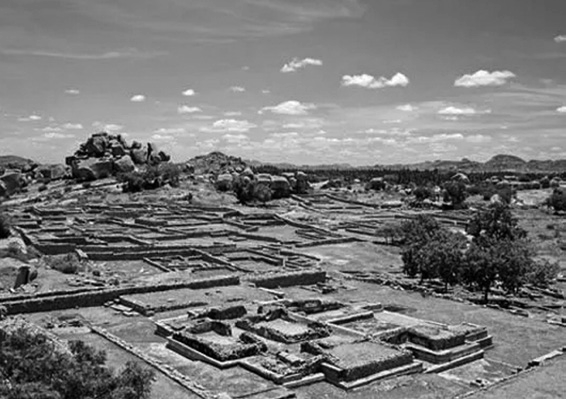
Due to the region’s arid nature, elaborate systems were developed to collect and store rainwater.
• Among these initiative, the construction of the Kamalapuram tank stands out, which was commissioned by Vijayanagara king Devaraya II. Stands out. This significant tank, dating back to the early 15th century,served the dual purpose of irrigating nearby fields and channeling water through a system that reached the “royal center” of the city, ensuring a consistent water supply.
• Another remarkable water management structure, the Hiriya canal, is a prominent feature among the ruins of Vijayanagara. This canal was designed to draw water from a dam built across the Tungabhadra River. Its primary function was to irrigate the cultivated valley that separated the “sacred center” from the “urban core” of the city. Historically attributed to the Sangama dynasty kings, this canal was a testament to the sophisticated water management systems of the empire.
Fortifications and Roads
• The Vijayanagara Empire’s fortifications were an awe- inspiring series of structures that enclosed not just the city but also its agricultural regions and forests.
• Impressively, Abdur Razzaq, a Persian ambassador in the 15th century, noted the existence of seven lines of forts, symbolizing a formidable defensive network.
• These massive walls were constructed with massive masonry, slightly tapered, and incredibly sturdy without the use of any mortar or cement. They consisted of wedge- shaped stone blocks held in place by their own weight. The walls’ inner sections were made of earth packed with rubble, with square or rectangular bastions projecting outward.
• What made these fortifications remarkable was their inclusion of agricultural lands within their boundaries. This was an unconventional strategy considering medieval sieges often aimed to starve defenders into submission by cutting off their food supplies. Abdur Razzaq observed cultivated fields, gardens, and houses between the first, second, and third walls, indicating a purposeful inclusion of agricultural tracts within the fortified area.
• The empire’s rulers opted for an elaborate and costly strategy by safeguarding the agricultural belt itself instead of merely storing provisions within the fortified areas. Evidence of an agricultural tract serviced by an intricate canal system supported by the Tungabhadra river was discovered between the sacred center and the urban core, reinforcing this strategic approach.
• The fortifications had multiple lines of defense encircling different sections of the city. A second line surrounded the inner core of the urban complex, while a third encircled the royal center, wherein each major building had its own high walls.
• The fortified city was accessible through well-guarded gates that connected to major roads. These gateways were not only points of entry but also distinctive architectural structures. The arches and domes on these gateways showcased elements of Indo-Islamic architecture, showcasing the influence of Turkish Sultanate styles blended with local building practices.
• Archaeologists have also identified roads within the city and leading outwards. These roads were traced through gateways and identified by remnants of pavements. Interestingly, some major roads extended from temple gateways and were accompanied by bustling bazaars, indicating a linkage between religious centers and commercial activities.
Cultural and Social Fabric
CULTURAL AND SOCIAL FABRIC
Social Life
• In his Manucharitam, Allasani Peddanna mentions the presence of four primary castes—Brahmins, Kshatriyas, Vaisyas, and Sudras—in the society of Vijayanagara.
• Foreign travellers offered detailed descriptions of the grandeur of Vijayanagara's buildings and the opulent lifestyle of its citizens.
• Silk and cotton fabrics were commonly worn, and people adorned themselves with perfumes, flowers, and ornaments.
• Paes highlighted the exquisite homes of the wealthy, as well as the large number of servants they employed.
• Nicolo Conti observed the widespread practice of slavery.
• Popular pastimes included dancing, music, wrestling, gambling, and cockfighting.
• The Sangama rulers were predominantly followers of Shaivism, with Virupaksha being their family deity, although other dynasties leaned towards Vaishnavism. The teachings of Ramanuja and Srivaishnavism were especially popular during this time.
• The rulers of Vijayanagara were generally tolerant of other religions. Borbosa, a foreign observer, noted the religious freedom enjoyed by all, with Muslims holding administrative roles and freely constructing mosques for worship.
• Numerous temples were constructed during this period, and a wide variety of festivals were celebrated. The Epics and Puranas held a strong influence among the common people, further shaping the cultural and religious life of the empire.
Cultural Contributions
• During the Vijayanagar rule, temple construction became a hallmark of their architectural legacy. Notable features included the tall Raya Gopurams or gateways and the Kalyanamandapam, adorned with intricately carved pillars. These pillars often showcased sculptures, predominantly featuring horses.
• Large mandapams, housing up to a thousand pillars, were used for ceremonial purposes, particularly during festivals. The period also witnessed the addition of Amman shrines to existing temples, enriching the architectural landscape.
• The prominent temples built in the Vijayanagara style were primarily found in the ruins of Hampi, the erstwhile capital. Temples like Vittalaswamy and Hazara Ramaswamy epitomized this architectural style. Additionally, examples of this style were evident in temples like Varadharaja and Ekamparanatha in Kanchipuram, along with the Raya Gopurams at Thiruvannamalai and Chidambaram, showcasing the grandeur of Vijayanagara architecture. These styles were continued by the later Nayak rulers.
Metal images of Krishna Deva Raya and his queens at Tirupati were also notable, exemplifying the art of casting metal images. The rulers of Vijayanagar significantly patronized music and dance, contributing to the cultural vibrancy of the era.
• In terms of literature, diverse languages such as Sanskrit, Telugu, Kannada, and Tamil flourished in the region. There was a substantial development in Sanskrit and Telugu literature, reaching its pinnacle during Krishna Deva Raya’s reign. The king himself was a scholar in both Sanskrit and Telugu, and his court poet, Allasani Peddanna, was renowned for his contributions to Telugu literature.
Hampi
HAMPI: THE LOST CITY
Hampi, also known as Pampa Kshetra, Kishkindha Kshetra, and Bhaskara Kshetra, is a UNESCO World Heritage Site located in Ballari district, Karnataka, India.
It served as the capital of the Vijayanagara Empire from 1336 to 1565, until it was abandoned.
The city is situated on the banks of the Tungabhadra River, and its ruins showcase the grandeur of architectural design from that era.
Hampi's rulers were devoted patrons of religion and art, contributing to the construction of magnificent structures.
The city flourished under the rule of Krishna Deva Raya, who reigned from 1509 to 1529.
From 1336 to 1565, Hampi was governed by four different dynasties: the Sangama Dynasty, Saluva Dynasty, Tuluva Dynasty, and Aravidu Dynasty.
The Vijayanagara Empire, the last Hindu kingdom in India, reached its zenith during the height of Hampi’s prominence.
At its peak, Hampi was one of the richest cities in the world.
The Group of Monuments at Hampi is recognized as a UNESCO World Heritage Site.
Hampi continues to attract visitors from across the globe, who come to explore its stunning monuments and rich historical significance
Architecture at Hampi
Virupaksha Temple: The temple stands as a testament to the Vijayanagara Empire’s architectural prowess. Its impressive inscriptions date back to the 9th century, showcasing the history of devotion to Lord Shiva. The temple complex includes the Virupaksha-Pampa retreat,
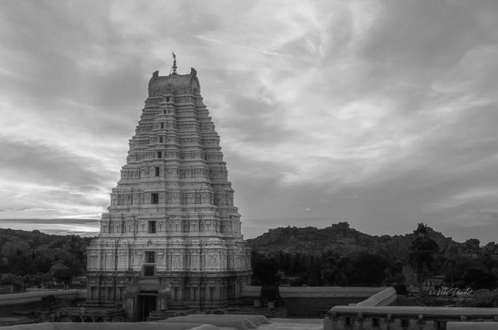
an evolution from a modest shrine to a revered religious site. The architecture features numerous halls for worship, antechambers, courtyards, and a pillared monastery, exemplifying the grandeur of South Indian temple architecture.
Vijaya-Vittala Temple: Renowned for its colossal structure and intricate design, this temple dedicated to Lord Vittala, an incarnation of Lord Vishnu, exemplifies the Dravidian style of architecture. Constructed initially by King Devaraya II and expanded under Krishnadevaraya, it houses enclosed and open Mandapas
showcasing remarkable musical pillars that produce melodic sounds when tapped. The stone chariot, a symbol synonymous with Hampi’s grandeur, resides
within this temple complex, captivating visitors with its detailed carvings.
Monolithic Bull: Positioned opposite the Virupaksha Temple, this Nandi Bull, representing Lord Shiva’s mount, remains an impressive spectacle despite its weathered state. Carved using
a primitive technique, it stands surrounded by colossal pillars, attracting tourists with its ancient craftsmanship and religious significance.
Elephant Stables: Providing insight into the royal lifestyle, these stables housed royal elephants during the empire’s reign. The structure, featuring Islamic-inspired domes amidst temple-like
architecture, showcases the amalgamation of cultural influences during that era.
Lotus Mahal: Nested within the Zanana enclosure, this architectural marvel, resembling a lotus, served as a leisure retreat for the women of the
Vijayanagara Dynasty. Its serene ambiance and intricate design showcase a blend of functional and aesthetic elements, reflecting the lifestyle of the royals.
Pushkarani: These sacred tanks represent the ancient town planning of Hampi
and served as venues for annual boating festivals. Surrounded by ornate pillars and arcades, these tanks were
significant in religious ceremonies and the ceremonial rides of deities during festivals.
Palace of Vira Harihara: Despite its current state of ruins, the remnants of this colossal palace testify to the grandeur of the Vijayanagara kings. Elaborate carvings and remnants of structures, including a
stage for royal elephants and a royal hall, provide glimpses into the opulent lifestyle of the era.
Hazara Rama Temple: This temple, translating to “a thousand Rama temple,” isadorned with intricately carved relicsdepicting the Ramayana and Dasara festival celebrations.
The extensive carvings on its walls narrate stories of royal processions and festivities, making it a treasure trove of historical and cultural significance.
Achyutaraya Temple: Originally dedicated to Lord Tiruvengalanatha, an incarnation of Lord Vishnu, this temple showcases sagas through its massive carved pillars and sculptures. The remnants, including carvings depicting Lord Vishnu’s blessings and celestial celebrations, provide glimpses into ancient Hindu mythology.
Hampi Bazaar: Hampi Bazaar, also known as Virupaksha Bazaar, is a well-known market place that used to be a thriving market during the Vijayanagara Empire. It stretches for more than one kilometre and is located in front of the Virupaksha Temple. The market has a series of old pavilions on both sides of the road, which were once used to sell exotic items like precious stones, jewellery, silk clothes, etc. Today, the market still operates, offering local items and crafts to visitors. The Hampi Bazaar is also a place where one can enjoy a local shopping experience
The cultural contributions of the Vijayanagara rulers were multifaceted and significant, encompassing architectural marvels, literary advancements, and the patronage of arts like music and dance, leaving a lasting legacy in South Indian history.
Position of Women
POSITION OF WOMEN
The position of women was both advanced for its age and yet suffered from many impediments. In Vijayanagara society, women held notable positions, actively participating in various aspects of life, not just confined to domestic roles. Their involvement in politics, society, and literature was not uncommon. Besides their diverse roles, women received education in various fields, engaging in wrestling, wielding weapons, music, and literary pursuits.
Nuniz’s account highlights the multifaceted roles women held in Vijayanagara. Women engaged in diverse professions, including wrestling, astrology, accounting, governance, and music. They managed the kingdom’s financial records, comparing them with external records, showcasing their administrative abilities. Additionally, women participated in music, playing instruments, and singing, displaying their artistic talents.
• Even within the royal sphere, women played significant roles. The wives of the king were well-versed in music, showcasing their cultural expertise. Furthermore, the presence of female judges, bailiffs, and watchmen, responsible for guarding the palace at night, emphasized the diverse roles women held in governance and security.
• This multifaceted involvement of women in various professions and responsibilities in Vijayanagara society demonstrates their elevated status and active participation beyond traditional gender roles, contributing significantly to the kingdom’s administration, culture, and societal fabric.
• Gangadevi, wife of Kumarakampana authored the famous work Maduravijayam.
• Hannamma and Thirumalamma were famous poets of this period.
• The attachment of dancing girls to temples was in practice. Paes refers to the flourishing devadasi system.
• Polygamy was prevalent among the royal families. Sati was honoured and Nuniz gives a description of it
The Bahmani Kingdom
THE BAHMANI KINGDOM
Establishment and Expansion
Founded in 1347 by Alauddin Bahman Shah (Hasan Gangu), the Bahmani Kingdom’s capital was initially Gulbarga.
Over its rule, fourteen Sultans led the kingdom, notable among them being Alauddin Bahman Shah, Muhammad Shah I, and Firoz Shah.
The kingdom reached its apex under Muhammad Shah III, extending its dominion from the Arabian Sea to the Bay of Bengal, covering vast territories from Goa to Bombay in the west and from Kakinada to the mouth of the river Krishna in the east.
Mahmud Gawan

Mahmud Gawan, a Persian merchant who joined the Bahmani kingdom’s services, emerged as a pivotal figure in its peak.
Rising to the rank of chief minister due to his loyalty, virtues, and strategic expertise, Gawan contributed significantly to military conquests.
He expanded the kingdom’s territory by capturing regions such as Konkan, Goa, and the Krishna-Godavari delta.
Administrative Reforms and Downfall
Gawan’s administrative reforms aimed at centralizing control by appointing royal officers in provinces and fortresses, which led to discontent among the nobles.
Despite his immense contributions, Gawan became the victim of a plot by discontented Deccani nobles.
They manipulated the Sultan into sentencing Gawan to death, marking the beginning of the kingdom’s decline.
Successive weak Sultans further exacerbated the situation, leading to the kingdom’s fragmentation by 1526 into five independent sultanates—Ahmadnagar, Bijapur, Berar, Golkonda, and Bidar.
These sultanates collectively formed what came to be known as the Deccan Sultanates, as provincial governors declared independence amidst the turmoil.
Conflict Between the Vijayanagara and the Bahmani Kingdoms
CONFLICT BETWEEN THE VIJAYANAGARA AND THE BAHMANI KINGDOMS
The conflict between the Vijayanagara and Bahmani kingdoms, spanning over two centuries, primarily revolved around territorial control and economic dominance, notably focused on the fertile Raichur doab region.
Causes of Conflict
Raichur Doab Control- The fertile Raichur doab, situated between the Krishna and Tungabhadra rivers, was a coveted territory for both kingdoms due to its natural resources and fertility, including the renowned Golconda diamond mines.
Geographical Constraints- The limited expansion options in the Deccan’s Tungabhadra region intensified competition for control over productive land and significant ports like Goa, crucial for trade with other nations.
Marathwada and Krishna-Godavari Delta- These regions held productive land and influential ports facilitating trade, including the import of horses from Iran and Iraq, amplifying the conflict between the two kingdoms.
Hindu-Muslim Conflict- Though not the primary reason, religious differences and conflicts between Hindu and Muslim influences played a role in the broader tensions between the Bahmani and Vijayanagara states.
Events
Continuous Wars- Despite intermittent periods of cooperation, conflicts remained consistent, with neither side decisively winning. Both kingdoms enjoyed advantages at different times, leading to a sustained stalemate.
Depletion of Resources- Prolonged hostilities drained the resources of both states, weakening their positions and inadvertently neglecting the growing influence of the Portuguese along the South Indian coast.
Battle of Talikota (1565)- A significant turning point occurred at the Battle of Talikota, where a confederacy of four Muslim kingdoms engaged and decisively defeated
the Vijayanagara empire. This battle marked the end of Vijayanagara’s prominence.
Significance of the Battle of Talikota
The Battle of Talikota, a significant confrontation in 1565, brought about a pivotal change in the Deccan region’s power dynamics. This clash unfolded between the forces of the Vijayanagar Empire, led by the Hindu raja, and a coalition of four Muslim sultans from Bijapur, Bidar, Ahmadnagar, and Golconda.
Taking place on January 23, 1565, southeast of Bijapur in present-day northern Karnataka, the battle saw massive armies, each numbering several hundred thousand soldiers, including substantial elephant contingents. Troops had been amassing since late December 1564, setting the stage for a monumental clash.
Crucially, the Muslim forces’ advantage lay in their formidable artillery, which played a decisive role in the battle’s outcome. Additionally, the capture and subsequent execution of the ruling Hindu minister, Rama Raya, further shifted the tide in favour of the Muslim coalition.
Following this pivotal battle, the capital city of Vijayanagar fell, enduring destruction over a five-month period and never being reoccupied. The raja, along with Rama Raya’s brother Tirumala, retreated to Penukonda. Eventually, Tirumala seized power in 1570, effectively usurping the throne.
The consequences of the Battle of Talikota were far-reaching. It marked the fragmentation of the Vijayanagar Empire, which had been characterized by the dominance of Telugu speakers over the Tamil- and Kannada-speaking regions in the south. Moreover, this battle initiated the final phase of Muslim influence and control in southern India, persisting until the late 18th century.