The Decline of the Mughal Empire
THE DECLINE OF THE MUGHAL EMPIRE
During the first half of the 18th century, the vast Mughal Empire, which had been the envy of its peers for nearly two centuries, began to wane and fall apart.
The Mughal emperors' dominion dwindled to a few square kilometers surrounding Delhi as they lost their strength and splendor. Ultimately, in 1803, the British army took control of Delhi, and the once-proud Mughal Emperor was relegated to the position of a foreign power's pensioner.
Aurangzeb's lengthy and powerful reign had shattered the Empire's unity and stability, yet despite his numerous detrimental policies, the Mughal government remained highly effective and the Mughal army was still powerful at the time of his death in 1707.
CAUSES OF THE DECLINE OF THE MUGHAL EMPIRE
When a mighty empire like that of the Great Mughals decays and falls it is because many factors and forces have been at work. The fall of the Mughal Empire started under Aurangzeb's rule, but it didn't really get going until after his passing in 1707. Conditions at the time of his death were not such that the decline process could not be stopped. None of the chiefs and kings who opposed Mughal control were able to declare their independence from the imperial power. The Rajputs, Marathas, and Sikhs just fought against Mughal rule to establish and maintain their independence in their individual empires; they lacked the ability to topple it. Following Aurangzeb, the majority of emperors turned out to be weak, incompetent, and licentious rulers who accelerated the empire's decline and eventual fall.
The major factors which contributed to the downfall of the Mughal Empire are discussed below:
Aurangzeb’s Responsibility
Rajputs and Religious Policy ➤ Alliance with the Rajput Rajas was one of the main pillars of Mughal strength in the past. Mughal empire in the days of Akbar, Jahangir and Shah Jahan was basically a secular state. Its stability was founded on the principles of: Non-interference with the religious beliefs and customs of people Fostering friendly relations between Hindus and Muslims Opening the doors of highest offices of the Empire to nobles and chiefs belonging to different regions and belonging to different religions Marital alliances with the Rajputs further solidified these ideals ➤ Aurangzeb made an effort to reverse this policy by imposing the jizyah, destroying several Hindu temples and placing other restrictions on the Hindus. This led to widening of the gulf between upper class Hindus and Muslims.
Poor Statesmanship ➤ He was not willing to accept the Maratha's demand for regional autonomy and failed to realise that Shivaji and the Maratha sardars were not easy enemies he could crush. ➤ His futile and arduous campaign against the Marathas extended for many years and it not only drained the resources of his empire but also brought ruination to the trade and industry of the Deccan. ➤ His absence from the North for a period of nearly 25 years led to: Deterioration of administration in his empire Undermining of the Mughal prestige Neglect of the vital North-Western frontier
Ruinous Wars of Succession
A new element entered Mughal politics by this time. Previously, the contest for the throne of Delhi was fought among the princes with the nobles acting as aids to their aspirations for the throne.
After the death of Aurangzeb, the ambitious nobles became active contenders for the throne and used the princes as mere pawns to capture the power.
These wars of succession became extremely fierce and destructive in the 18th Century and resulted in great loss of life and property.
Many important generals and thousands of able soldiers were killed. Moreover, these wars loosened the administrative fabric of the Empire.
Incompetent Later Mughals and the degeneration of the nobility
If able, visionary, and capable leaders had taken the throne, Aurangzeb's shortcomings and the horrors of the Wars of Succession might have been defeated. Unfortunately, a lengthy period of completely worthless, weak-willed, and luxury-loving kings followed Bahadur Shah's brief rule.
One of the key features of the Mughal Empire at its zenith was the organisation and character of its nobility. The weaknesses of the later Mughals would not have mattered if an alert, efficient and loyal nobility kept things in check. But the character of the nobility, too, had derogated: ➤ They had become ease loving and fond of luxury ➤ Their selfishness and lack of devotion to the empire bred corruption in administration and mutual bickering ➤ They were often poorly educated and lacked the art of fighting ➤ High offices had also been monopolised by a few noble families
Shifting Allegiance of Zamindars
During the Middle Ages, the emperor and two classes— the zamindars and the nobles—shared authority in the state.
The zamindars, also known as rais, rajas, thakurs, khuts, or deshmukhs, were the inherited proprietors of their estates who also held certain privileges.
They held a significant position in the empire since they supported local government and revenue collection, both of which required the maintenance of troops.
The Mughals attempted to keep direct contact with the peasants and limit the authority of the zamindars, but they were not entirely successful.
The authority and sway of the zamindars significantly increased during Aurangzeb's own rule. The primary consequence of this was the encouragement of regional allegiances.
The nobility, the other dominant class in the empire, was able to exploit the empire's weakness and establish autonomous kingdoms for themselves with the aid of numerous local zamindars.
Jagirdari Crisis
At a time when the number of nobles and their expenditure was going up, there was both a paucity of jagirs and the reduced incomes from jagirs in the Mughal Empire.
Because all nobles and their demands could not be satisfied (due to limited jagirs), there was an intense rivalry among the nobles for possession of existing jagirs.
Aurangzeb tried to solve the problem of acute shortage of jagirs by showing enhanced income from the jagirs on record.
But this was a short- sighted measure as the amirs tried to recover the recorded income from their jagirs by pressurising the peasantry.
The nobles, therefore, tried to: ➤ Extract the maximum income from their jagirs at the cost of the peasantry ➤ Appropriated khalisa lands for jagirs ➤ Transform existing jagirs and offices into hereditary ones ➤ Reduce their expenditure by not maintaining their full quota of troops and weakened the military strength as well
The nobility comprised people who were either assigned large jagirs and mansabs or appointed subahdars of Mughal subas and given the responsibility of maintaining these.
To this class belonged many Rajput rulers, subahdars and mansabdars. Mughal rule has often been defined as “the rule of the nobility”, because these nobles played a central role in administering the empire.
Although Akbar had provided a well-knit organisation for them, there was divisiveness among the nobility on the basis of religion, homeland and tribe, and each category formed a group of its own.
Mutual rivalry, jealousy and contest for power among the various groups during the rule of the later Mughals (in the absence of a strong central leadership) not only reduced the prestige of the emperor, but also contributed to the decline of the empire.
Ijarah system and the Peasant Revolts
The ijarah system instituted by the Later Mughals which led to farming out of the land revenue collection rights to the highest bidder contributed heavily to the ruination of the Indian peasantry and ultimately led to peasant revolts such as the Jats and the Satnamis. These eroded the strength and stability of the empire.
Rise of Regional Aspirations
Aurangzeb’s reign itself witnessed emergence of powerful regional groups like the Jats, Sikhs and Marathas defying the authority of the Mughal state in their bid to create kingdoms of their own.
They did not succeed in their efforts, but they influenced the future course of political events in their respective regions. Their continuous struggle against the empire for political ascendancy weakened the empire considerably.
Aurangzeb, and after him Bahadur Shah I, by attempting to suppress the Rajputs, spurred them to battle against the Mughals.
The later Mughals made an effort to follow a policy of reconciliation with the Rajputs, but by then it was already too late: the Rajputs no longer trusted the Mughals enough to ally with them for the welfare of the empire.
The Marathas too were becoming a formidable enemy. Their aim was at first limited only to regaining control over the region of Maharashtra; but it soon went on to include getting legal sanction from the Mughal emperor for collecting 'Sardeshmukhi' and 'Chauth' throughout India.
They forged northwards and, by 1740, succeeded in spreading their influence over the provinces of Gujarat, Malwa and Bundelkhand.
The Rajput struggle against the empire and the growing ambition and power of the Marathas, thus, adversely affected the Mughal might.
Economic and Administrative Problems
The number of amirs and their ranks or mansabs had increased sharply over time; there was little land left to be distributed among them as jagirs.
So, both the amirs and the peasantry were antagonised. Then there were the wars, the luxurious lifestyles of the emperors and amirs alike, the reduction in khalisa land, all of which burdened the state.
The result was that the expenditure of the state exceeded its income. There was, moreover, no significant scientific and technological advance that could have improved a stagnant economy.
These economic and administrative problems only multiplied following the death of Aurangzeb. The empire had become too vast to be efficiently administered by a centralised system when the rulers were weak and incompetent.
Socio and Political Causes
An important socio-political cause of the downfall of the Mughal Empire was the absence of the spirit of political nationalism among the people.
This was because India at the time lacked the elements which constitute a modern nation. The people of India did not feel that they were all Indians, nor were they conscious of oneness or of having common interests, even though elements of cultural unity had existed in the country for centuries.
No group or class in the country was deeply interested in maintaining the unity of the country or the Empire. Such unity as did exist was imposed from above by strong rulers.
The peasants' allegiance was limited to their caste and village. Furthermore, they did not link the Empire's interests with their own, nor did they show any interest in its politics. They came to the realization that they had no interest in it and that they weren't particularly concerned about protecting it from outside threats. When a central authority shown evidence of weakness, the zamindars had a tendency to rebel against them. They rejected a powerful, centralized government that limited their independence and authority.
Decline of Administration
By the 18th century, the Empire's administrative effectiveness rapidly declined.
In many regions of the nation, law and order collapsed and administration was disregarded.
Central authority was openly defied by unruly zamindars. Even the royal camp and marching Mughal armies were frequently destroyed by adversaries.
There was widespread corruption and bribery, inefficiency and lack of discipline, and disobedience and treachery among officials at all levels.
The Central Government was frequently in danger of going bankrupt. While the current sources of income were reduced, the old accumulated wealth was depleted. Numerous provinces neglected to provide their provincial taxes to the central government.
Emperors attempted to appease sympathetic nobles by awarding jagirs from the "khalisa lands," which steadily shrank in size. Revenue was frequently withheld by the dissident zamindars. Popular response resulted from attempts to suppress the peasantry in order to increase money.
Decline of Military Strength
In the end, this impacted the Empire's military might. The Mughal army lacked fighting spirit and discipline throughout the eighteenth century.
Maintaining a sizable army was challenging due to a lack of funding. Because they were only mercenaries, its officers and soldiers were frequently on the verge of revolt and were frequently unpaid for months.
Once more, the noblemen-turned-commanders' personal financial difficulties prevented them from maintaining their entire allotment of armed contingents.
Many courageous and seasoned warriors as well as skilled leaders lost their lives in the civil wars. As a result, the Great Mughals' pride and the army's ultimate sanction were so weak that they were unable to stop the ambitious chiefs and nobles or protect the Empire from outside threats.
Foreign Invasions
A string of foreign invasions dealt the Mughal Empire its fatal blow. Nadir Shah and Ahmad Shah Abdali's attacks, which were also the result of the Empire's weakness, drained its money, decimated its industry and trade in the North, and nearly destroyed its military might.
Ultimately, the British challenge eliminated any last hope for the crisis-plagued Empire to recover. Since they were powerful enough to overthrow the Empire but not enough to bring it together or establish anything new in its stead, none of the Indian nations rose to claim the Grand Mughals' legacy. They were unable to establish a new social structure that would be able to withstand the new Western adversary. They all reflected the same decaying social structure that the Mughals had established, and they were all afflicted by the same flaws that had brought down the powerful Mughal Empire. However, the Europeans who were pounding on India's doors had the advantage of hailing from cultures that had developed better economic structures and more developed scientific and technological systems. The Mughal Empire's downfall was tragic because it was overthrown by a foreign power that destroyed its own interests, the nation's centuries-old political, social, and economic system, and replaced it with a colonial one.
Later Mughals
BAHADUR SHAH (1707-1712)
Bahadur Shah, also known as Shah-I-Bekhabar, emerged victorious in a power struggle after Aurangzeb’s death. He was learned, dignified, and pursued a policy of compromise, reversing some of Aurangzeb’s strict measures. Notably, he showed tolerance towards Hindu chiefs, refraining from temple destruction. Initially, he attempted control over Rajput states, Amber and Marwar, facing resistance. Eventually, he settled but denied high positions to their rulers. His approach to Maratha chiefs lacked full satisfaction, as he granted partial concessions (granted the Sardeshmukhi but not the Chauth) and didn’t recognize Shahu as the rightful Maratha King. Bahadur Shah sought peace with the Sikhs, granting high rank to Guru Gobind Singh, yet faced rebellion under Banda Bahadur. He led campaigns but couldn’t fully suppress the Sikhs, who regained strongholds even after initial successes. Despite conciliating some chiefs like Chhatrasal and Churaman, his reign suffered administrative decline due to lavish grants and promotions, leading to financial strain. He aimed to revive the Empire’s fortunes but was executed by Farrukhsiyar in 1712, plunging the Empire into civil war once again.
JAHANDAR SHAH (1712-1713)
Bahadur Shah’s passing led to his less capable son, Jahandar Shah, assuming power, supported by the influential Zulfiqar Khan. Jahandar Shah, more inclined toward pleasure than governance, lacked the dignity and decency expected of a ruler.
During Jahandar Shah’s reign, Zulfiqar Khan , an able administrator, took charge of the administration. He sought to reverse Aurangzeb’s policies, notably abolishing the despised jizyah tax and making efforts to appease Hindu chiefs like Jai Singh and Ajit Singh, granting them titles and pivotal positions within the empire. Zulfiqar Khan’s diplomatic manoeuvres extended to negotiations with Maratha King Shahu, granting him concessions in the Deccan, albeit under Mughal supervision. He also fostered alliances with leaders like Churaman Jat and Chhatrasal Bundela, while maintaining a firm stance against Banda and the Sikhs. Despite attempts to stabilize the Empire’s finances by curbing excessive land grants and enforcing noble
obligations for troop provision, Zulfiqar Khan introduced the ijarah system of revenue farming, inadvertently intensifying the oppression faced by the peasants. Internal discord brewed as jealousy among nobles grew, and Jahandar Shah, swayed by unscrupulous favourites, began distrusting Zulfiqar Khan’s rising influence. This suspicion led to secret machinations against the powerful minister. Jahandar Shah’s weak rule met its end in 1713 when he faced defeat at Agra by Farrukh Siyar, concluding his inglorious reign and marking a tumultuous chapter in the Mughal Empire’s history.
FARRUKH SIYAR AND THE SAYYID BROTHERS (1713-1719)
Farrukh Siyar’s ascent to power was owed to the support of the Sayyid brothers, Abdullah Khan and Husain Ali Khan Barahow, who, in return, were appointed as the wazir and mir bakshi respectively, wielding significant influence in the empire’s affairs. Despite their influence, Farrukh Siyar was deemed inept for rulership—described as cowardly, cruel, and easily swayed by undeserving favourites. The power struggle brewed as Farrukh Siyar sought personal authority while the Sayyid brothers aimed for substantial control over administration, believing it essential for the empire’s stability and their own security. This conflict escalated, culminating in the Sayyid brothers dethroning and eventually killing Farrukh Siyar in 1719. They elevated two young princes who succumbed to illness. It was during his reign that the ‘farman’ was signed giving the East India Company diwani collection rights of Bengal, Bihar as well as Odisha in perpetuity. This farman was also called as the Magna Carta of Company’s trading privileges in India. The Sayyid brothers then placed Muhammad Shah, aged 18, on the throne, effectively controlling the successive rulers as mere puppets. Their rule emphasized religious tolerance and sought alliances with various factions, including Rajputs, Marathas, and Jats, securing their loyalty through influential positions and policy changes like abolishing the Jizyah and pilgrim tax. Despite their efforts to stabilize the empire, constant court rivalries and conspiracies hindered their governance. Their conciliatory approach to nobles couldn’t avert hostility, notably from figures like Nizam-ul-Mulk and Muhammad Amin Khan, backed by Emperor Muhammad Shah, seeking liberation from the Sayyid brothers’ control. In 1720, the anti-Sayyid Brothers nobles orchestrated a treacherous assassination of Husain Ali Khan, and Abdullah Khan’s subsequent defeat near Agra marked the end of the Sayyid brothers’ dominance over the Mughal Empire. Their era, recognized as “king makers” in Indian history, concluded amidst internal strife and political conspiracies within the imperial court.
MUHAMMAD SHAH “RANGEELA” (1719-1748)
Muhammad Shah’s lengthy reign from 1719 to 1748 marked a crucial period for the declining Mughal Empire, yet his rule failed to salvage its fate. Described as weak-minded and indulgent in luxury, Muhammad Shah neglected state affairs, falling under the sway of corrupt advisors and often undermining his own able ministers such as Nizam-ul-Mulk. Amidst the court’s constant quarrels and Muhammad Shah’s erratic behaviour, Nizam-ul-Mulk, a powerful noble, attempted administrative reforms after assuming the position of wazir in 1722. Disenchanted with the state of affairs, he eventually abandoned the Emperor and the Empire in 1724, departing to establish the independent state of Hyderabad in the Deccan. Following Nizam-ul-Mulk’s departure, other ambitious nobles seized the opportunity to carve semi-independent states across the realm, leading to the rise of hereditary nawabs in regions like Bengal, Hyderabad, Awadh, and Punjab. Meanwhile, the Maratha sardars initiated their northern expansion, capturing territories like Malwa, Gujarat, and Bundelkhand. The opulent lifestyle of Muhammad Shah, influenced by the Sayyid brothers, contributed to the Empire’s continued decline. Furthermore, the Empire faced disintegration and external threats: Murshid Quli Khan in Bengal (1717) and Saadat Khan in Awadh (1722) established their own successor states. Maratha invasions under Baji Rao, who raided Delhi in 1737 and Nadir Shah’s decisive victory over the Mughals in the Battle of Karnal in 1739 reduced Mughal authority, army and administration to scraps. Nadir Shah also plundered the Royal treasury, seizing treasures like the peacock throne and Kohinoor diamond and also annexed the territories west of the Indus into the Persian Empire.
ARRIVAL OF NADIR SHAH AND AHMAD SHAH ABDALI
The arrival of Nadir Shah in 1738-1739 marked a devastating blow to the weakened Mughal Empire, lured by India’s immense riches and the visible decay of Mughal authority. Meeting minimal resistance, Nadir Shah’s forces clashed with the Mughal army at Karnal in 1739, resulting in a resounding defeat for the Mughals. Emperor Muhammad Shah was captured, and Nadir Shah proceeded to Delhi, plundering its treasures, including the Koh-i-nur diamond and Shahjahan’s Peacock Throne. Nadir Shah’s invasion had dire consequences, stripping the Empire of its wealth and compelling Muhammad Shah to cede territories west of the Indus. The loss of crucial territories, including Kabul, left the Empire vulnerable to repeated invasions from the Northwest, notably by Ahmad Shah Abdali, Nadir Shah’s adept general. Ahmad Shah Abdali’s incursions, occurring between 1748 and 1767, ravaged northern India up to Delhi and Mathura. The Third Battle of Panipat in 1761 witnessed Maratha's defeat by Abdali, quashing their aspirations of dominating the Mughal Emperor and the country. The cumulative effects of Nadir Shah and Abdali’s invasions, coupled with internal strife among power-hungry nobles,
eroded the Mughal Empire. By 1761, it had practically ceased to exist as an all-India Empire, with the descendants of the Grand Mughals relegated to nominal roles in the power struggle. Shah Alam II’s ascension in 1759 was marred by fear of his own wazir, leading to his nomadic existence away from the capital. His involvement in a failed war against the British East India Company at the Battle of Buxar in 1764 resulted in his residence as a Company pensioner in Allahabad. In 1772, Shah Alam II sought refuge with the Marathas after leaving British protection. The British occupation of Delhi in 1803 reduced the Mughal Emperors to mere figureheads, serving as a political facade for British authority until the dynasty’s definitive end in 1857.
PANIPAT
Numerous conflicts have taken place at Panipat and the surrounding area, which are situated in modern-day Haryana between the lush plains of the Ganga and Indus rivers and on the banks of the Yamuna. At various moments in time, these conflicts altered the trajectory of Indian history. Babur and Ibrahim Lodi engaged in the first Battle of Panipat in 1526. By bringing an end to the Delhi Sultanate's control, the battle's outcome established the framework for the Mughal Empire. Akbar and Hemu engaged in the Second Battle of Panipat in 1556, which resulted in a decision in favor of maintaining Mughal control. The Maratha ambition to rule over India was ended in 1761 by Ahmad Shah Abdali and the Marathas in the Third Battle of Panipat. Why was Panipat a favourite Battlefield?

1. Strategic Location: Situated between the fertile plains of the Ganga and Indus rivers, Panipat was a strategic gateway to Delhi, the political capital of northern India. It provided a crucial passage for invading forces coming from the northwest through the Khyber Pass. 2. Accessibility and Proximity to Delhi: Being relatively close to Delhi made it convenient for rulers to transport troops, weapons, and supplies while keeping the capital somewhat insulated from the direct conflict. 3. Geographic Terrain: The flat terrain around Panipat was suitable for cavalry movement, which was a dominant mode of warfare during those times. This terrain was ideal for large-scale battles and manoeuvres. 4. Accessibility via Grand Trunk Road: The construction of the Grand Trunk Road by Sher Shah Suri facilitated easier access to Panipat, making it a more accessible location for conquerors and armies. 5. Climate Advantage: The region experienced shorter durations of monsoon rainfall compared to other areas, making it favourable for battle as the weather conditions were often more conducive for fighting. 6. Skilled Artisans: The presence of skilled artisans and smiths in the region who were adept at producing warfare-related materials made it easier for opposing forces to replenish their war supplies during extended conflicts. The Third Battle of Panipat, 1761 The Battle was fought between the Marathas and Mughals on one side and the Afghan invaders (Ahmed Shah Abdali), Shuja-ud-Daulah of Awadh and the Nawab of Rohillakhand on the other. The balance of power between the British and the Marathas was even until this point. By fighting and losing the Battle, Marathas were severely weakened and demoralised. By not having to participate in the Battle, the British remained ever strong. In this way, the battle decided who is not going to be the next pan Indian ruler. After the battle, a slow shift of the balance of power began to occur in the favour of the British.
Why did the Marathas lose?
The Maratha loss at the 3rd Battle of Panipat can be attributed to two main reasons. First, the Marathas were largely concerned with the collection of taxes- the Sardeshmukhi and the Chauth in the regions they conquered. They did not maintain direct administrative presence out of their core areas. This led to the remote areas of the Maratha empire being disconnected and inefficient when compared to their core areas. The battle fought at Panipat was far from their comfort zone. Their supply lines were stretched and their soldiers were not at ease. Second and more importantly, the Maratha military strategy was of guerrilla warfare whereas the Afghan invaders were cavalry specialists. The Panipat ground was flat and better suited to the latter’s fighting style and temperament.
LAST OF THE MUGHALS
Ahmad Shah Bahadur inherited a fragile empire in 1748. During his reign, the Queen Mother Udham Bai, known as Qibla-i-Alam, wielded considerable influence. Abdali’s invasions posed threats, invading twice during Ahmad Shah’s rule. However, his reign was short-lived, as he was assassinated by Imad-ul-Mulk in 1754, leading to the ascension of Alamgir II.
Alamgir II, reigning from 1754 to 1759, faced the looming specter of Abdali’s advance, with Abdali reaching Delhi in 1757. The Battle of Plassey in the same year, marking a turning point, saw the East India Company’s victory, altering the political landscape in India.
Shah Alam II succeeded Alamgir II, ruling from 1760 to 1806, witnessing significant events like the 3rd Battle of Panipat in 1761 and the Battle of Buxar in 1764. The Treaty of Allahabad in 1765 secured East India Company protection for Shah Alam II, who became an EIC pensioner, residing in Allahabad. His issuance of a farman granting the Company perpetual diwani rights in Bengal consolidated their authority.
Shah Alam II was labelled a ‘fugitive emperor’ as he presided over a diminished realm, comprising Bengal, Odisha, Bihar, and Bangladesh.
Akbar Shah II, ruling from 1806 to 1837, continued to witness the Mughal Empire’s decline. His reign witnessed notable interactions, such as granting Rammohan Roy the title ‘Raja’ and dispatching him to England, and the cessation of coin issuance in the Mughal Emperor’s name by the East India Company.
Bahadur Shah ‘Zafar’, reigning from 1837 to 1857, was the last Mughal Emperor, known for his pen name ‘Zafar’. He held an honorary position as Emperor of India during the 1857 revolt. His interests in poetry and calligraphy earned him fame, with renowned poets like Ghalib, Zauq, Dagh, and Momin Khan as contemporaries.
The 1857 revolt marked a poignant chapter in Zafar’s reign, as he was declared Emperor of India. However, this marked the conclusive decline of Mughal authority. Zafar’s legacy endures as a prolific Urdu poet and calligrapher, remembered amidst the tumultuous end of the Mughal Empire and the shift in India’s history.
Indian Regional States and Society in the 18th Century
INDIAN REGIONAL STATES AND SOCIETY IN THE 18TH CENTURY
The following three major categories can be used to group the states that arose as a result of the fall of the Mughal Empire: 1. Successor States - The Mughal provinces that became successor states after seceding from the empire were known as successor states. The development of essentially independent and hereditary authority by their governors demonstrated the emergence of autonomous polity in these territories, even though they did not contest the Mughal ruler's sovereignty. Hyderabad, Bengal, and Awadh are a few instances. 2. Independent Kingdoms - Mysore and the Rajput states are two instances of nations that emerged mainly as a result of the Mughal authority over the provinces being unstable. 3. The New States - the Maratha, Sikh, and Jat republics, for instance—were established by the rebels against the Mughal empire.
HYDERABAD AND THE CARNATIC
Nizam-ul-Mulk Asaf Jah founded the state of Hyderabad in 1724. He was one of the leading nobles of the post-Aurangzeb era. He won the Battle of Shakr Kheda.
He played a leading role in the overthrow of the Sayyid brothers and was rewarded with the viceroyalty of Deccan.
From 1722 to 1724 he was the wazir of the Empire. However, since Emperor Muhammad Shah thwarted all of his attempts to restructure the government, he quickly became disenchanted with that position. He therefore made the decision to return to the Deccan, where he could continue to rule with safety.
He established the foundation for the state of Hyderabad, which he firmly controlled. In actuality, he behaved like an independent monarch even though he never publicly announced his independence from the Central Government.
He was tolerant of Hindus; for instance, Puran Chand, a Hindu, served as his dewan. He established a stable government in the Deccan to solidify his hold on power.
He kept the strong Marathas out of his territories and made the large, unruly zamindars accept his authority. He also tried to purge corruption from the income system. But the same destabilizing forces that were at work in Delhi also affected Hyderabad after his death in 1748.
The Nizam of Hyderabad had jurisdiction over the Carnatic because it was one of the subahs of the Mughal Deccan.
However, the Deputy Governor of the Carnatic, also known as the Nawab of Carnatic, had liberated himself from the Viceroy of the Deccan's authority and made his position hereditary, just as the Nizam had actually been independent of Delhi.
Without the Nizam's consent, Nawab Saadutullah Khan of Carnatic appointed his nephew Dost Ali as his heir. The ongoing conflicts over the Carnatic's Nawabship later caused its issues to worsen after 1740, giving European trading corporations the chance to meddle in Indian politics.
BENGAL
Two very talented men, Alivardi Khan and Murshid Quli Khan, took advantage of the central authority's deteriorating power and effectively established Bengal's independence.
Murshid Quli Khan had been Bengal's effective ruler since 1700, when he was named its Dewan, although only being designated Governor of Bengal in 1717. Even though he often paid tribute to the emperor, he quickly broke away from central authority.
By relieving Bengal of both external and internal threats, he brought about calm. Bengal was also comparatively free of zamindar upheavals at this point.
During his reign, there were only three significant uprisings: Shujat Khan, Najat Khan, and Sitaram Ray, Udai Narayan, and Ghulam Muhammad. Murshid Quli Khan awarded his favorite, Ramjivan, their zamindaris after defeating them.
Bengal was ruled by his son-in-law Shuja-ud-din till 1739 after Murshid Quli Khan passed away in 1727. Alivardi Khan became the Nawab in that year after overthrowing and murdering Sarfaraz Khan, the son of Shuja-ud-din.
Through the implementation of a new revenue settlement and the introduction of the revenue-farming system, Murshid Quli Khan reorganized Bengal's finances and made significant transfers from jagir holdings to khalisa lands.
Additionally, he provided agricultural loans (taccavi) to impoverished farmers in order to alleviate their hardship and allow them to promptly pay land revenue.
Murshid Quli Khan and the succeeding Nawabs gave equal opportunities for employment to Hindus and Muslims. They filled the highest civil posts and many of the military posts with Bengalis, most of whom were Hindus. In choosing revenue farmers Murshid Quli Khan gave preference to local zamindars and mahajans (money-lenders) who were mainly Hindus. He thus laid the foundations of a new landed aristocracy in Bengal.
All the three Nawabs recognised that expansion of trade benefited the people and the Government, and, therefore, gave encouragement to all merchants, Indian or foreign.
They provided for the safety of roads and rivers from thieves and robbers by establishing regular thanas and chowkies. They checked private trade by officials.
At the same time, they made it a point to maintain strict control over the foreign trading companies and their servants and prevented them from abusing their privileges. They compelled the servants of the English
AWADH
East India Company to obey the laws of the land and to pay the same customs duties as were being paid by other merchants.
Alivardi Khan did not permit the English and the French to fortify their factories in Calcutta and Chandranagar.
The Bengal Nawabs proved, however, to be short-sighted and negligent in one respect. They did not firmly put down the increasing tendency of the English East India Company after 1707 to use military force, or to threaten its use, to get its demands accepted.
They failed to see that the English Company was no mere company of traders but was the representative of the most aggressive and expansionist colonialism of the time.
The Nawabs of Bengal neglected to build a strong army and paid a heavy price for it.
In 1756-57, when the English East India Company declared war on Siraj-ud-Daulah, the successor of Alivardi, the absence of a strong army contributed much to the victory of the foreigner.
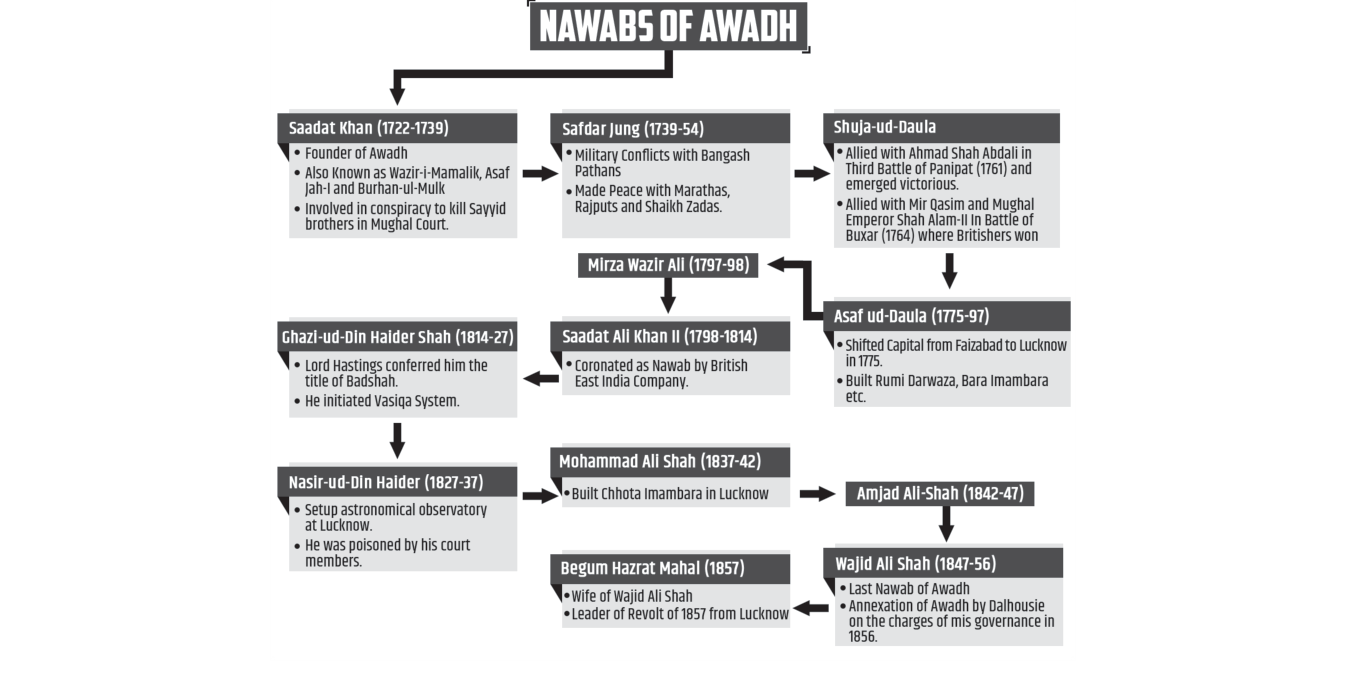
The founder of the autonomous kingdom of Awadh was of Awadh in 1722. Saadat Khan Burhan-ul- Mulk who was appointed as Governor
At the time of his appointment, rebellious zamindars had raised their heads everywhere in the province. Saadat Khan had to fight them for years. He was able to discipline the powerful zamindars and put an end to lawlessness, which increased his government's financial resources. In 1723, Saadat Khan also implemented a new revenue settlement. He is credited with improving the life of the peasants
by enforcing fair land taxes and shielding them from the big zamindars' persecution.
He did not discriminate between Muslims and Hindus, much like the Bengal Nawabs did. He suppressed dissident zamindars, chiefs, and nobles regardless of their faith, and many of his commanders and high officials were Hindus.
He had established the province as a hereditary domain and achieved near-independence prior to his death in 1739. In 1748, he was replaced by his nephew Safdar Jang, who was also given the province of Allahabad and named the wazir of the Empire.
Before his death in 1754, Safdar Jang brought peace to the people of Allahabad and Awadh for a considerable amount of time. To prevent the Maratha Sardars from invading his territory, he formed an alliance with them and put down dissident zamindars.
He carried on warfare against the Rohillas and the Bangash Pathans.
Safdar Jang also organised an equitable system of justice. He too adopted a policy of impartiality in the employment of Hindus and Muslims. The highest post in his government was held by a Hindu, Maharaja Nawab Rai.
Safdar Jang maintained a very high standard of personal morality. As a matter of fact, all the founders of the three autonomous kingdoms of Hyderabad, Bengal, and Awadh, namely, Nizam-uI-Mulk, Murshid Quli Khan and Alivardi Khan, and, Saadat Khan and Safdar Jang, were men of high personal morality. Nearly all of them led austere and simple lives.
KERALA
At the beginning of the 18th century Kerala was divided up among a large number of feudal chiefs and rajas. The four most important were those of Calicut under the Zamorin, Chirakkal, Cochin and Travancore.
Following 1729, the kingdom of Travancore gained prominence under King Martanda Varma, one of the most important leaders of the 18th century. He paired courage and daring with uncommon foresight and unwavering resolve.
He defeated the Dutch and put an end to their political dominance in Kerala by subduing the feudatories, taking Quilon and Elayadam, and defeating them. With the assistance of European officers, he assembled a powerful army according to the western model and equipped it with cutting-edge weaponry.
He built a contemporary arsenal as well. With the help of his new army, Martanda Varma quickly expanded Travancore's borders from Kanyakumari to Cochin. He constructed roads and canals for communication, carried out several irrigation projects, and actively promoted international trade.
By 1763, the three large states of Calicut, Travancore, and Cochin had absorbed or subjugated all of
In 1766, Haidar Ali launched his invasion of Kerala, eventually annexing the northern part of the state up to Cochin, including the Calicut Zamorin territory.
Malayalam literature saw a notable renaissance in the 18th century. The Keralan chiefs and rajas, who were avid readers, were partly to blame for this.
The capital of Travancore, Trivandrum, rose to prominence as a center of Sanskrit knowledge in the latter half of the 18th century. Martanda Varma's successor, Rama Varma, was a well-known actor, musician, scholar, poet, and culturally significant individual.
He read newspapers and magazines from London, Calcutta, and Madras on a regular basis, spoke English fluently, and had a strong interest in European events.
AREAS AROUND DELHI The Rajput States
The principal Rajput states took advantage of the growing weakness of Mughal power to virtually free themselves from central control while at the same time increasing their influence in the rest of the Empire.
In the reigns of Farrukh Siyar and Muhammad Shah the rulers of Amber and Marwar were appointed governors of important Mughal provinces such as Agra, Gujarat, and Malwa.
The Rajputana states continued to be as divided as before. The bigger among them expanded at the cost of their weaker neighbours, Rajput and non-Rajput.
Most of the larger Rajput states were constantly involved in petty quarrels and civil wars. The internal politics of these states were often characterised by the same type of corruption, intrigue, and treachery as prevailed at the Mughal court. Thus, Ajit Singh of Marwar was killed by his own son.
The most outstanding Rajput ruler of the 18th century was Raja Sawai Jai Singh of Amber (1681-1743). He was a distinguished statesman, law-maker, and reformer. But most of all he shone as a man of science in an age when Indians were oblivious to scientific progress.
He founded the city of Jaipur in the territory taken from the Jats and made it a great seat of science and art. Jaipur was built upon strictly scientific principles and according to a regular plan. Its broad streets are intersected at right angles. Above all, Jai Singh was a great astronomer. He built observatories in Delhi, Jaipur, Ujjain, Varanasi, and Mathura with precise and cutting-edge equipment, some of which he invented himself.
He made exceptionally accurate astronomical observations. To facilitate astronomical observations, he created a set of tables known as Zij Muhammadshahi.
He had various publications on trigonometry, including Napier's work on the creation and application of logarithms, and Euclid's "Elements of Geometry" translated into Sanskrit.
Jai Singh advocated for social improvement as well. He attempted to enact legislation to lessen the extravagant costs that a Rajput had to pay for a daughter's wedding. Infanticide was a terrible behavior that resulted from this. From 1699 to 1743, this extraordinary ruler governed Jaipur for almost 44 years.
The Jats
An agricultural caste known as the Jats resided in the areas surrounding Delhi, Agra, and Mathura. Jat peasants in the Mathura region revolted due to oppression by Mughal authorities. In 1669 and 1688, they revolted under the direction of their Jat zamindars.
These revolts were crushed but the area remained disturbed. After the death of Aurangzeb, they created disturbances all around Delhi. Though originally a peasant uprising, the Jat revolt, led by zamindars, soon became predatory
They pillaged everyone, including the wealthy and the impoverished, the peasants and the jagirdars, the Muslims and the Hindus. They actively participated in the court intrigues in Delhi, frequently switching sides to further their own interests.
It was Churaman and Badan Singh that established the Jat state of Bharatpur. Suraj Mal, who ruled from 1756 to 1763 and was a very capable administrator, military, and statesman, was the head of the Jat empire at its height.
From the Ganga in the east to Chambal in the south, the Subah of Agra in the west to the Subah of Delhi in the north, he expanded his sphere of influence. His state comprised the districts of Aligarh, Mathura, Meerut, and Agra, among others. By implementing the Mughal revenue system, he attempted to establish the framework for a long-lasting state.
The Jat state declined after his death in 1763 and was divided among minor zamindars, the majority of whom subsisted on loot.
Bangash Pathans and Rohillas
During the reigns of Farrukh Siyar and Muhammad Shah, the Afghan explorer Muhammad Khan Bangash established his dominion over the region surrounding Farrukhabad, between what is now Aligarh and Kanpur.
Similar to this, Ali Muhammad Khan established a distinct principality, known as Rohilkhand, at the foothills of the Himalayas between the Ganga in the south and the Kumaon hills in the north during the breakdown of government that followed Nadir Shah's invasion. The capital of Rohilkhand was initially located at Aonla in Bareilly and then moved to Rampur. The Rohillas and the Jats, Delhi, and Awadh were at odds all the time.
The Sikhs
Guru Nanak established it toward the end of the fifteenth century. The Sikh faith expanded among Punjab's poorer classes, including the Jat peasantry.
Guru Hargobind initiated the Sikhs' transition into a combative, militant group (1606-1645). However, the Sikhs became a political and military force under the direction of Guru Gobind Singh (1664–1708), their tenth and final Guru.
Guru Gobind Singh fought continuously against the Aurangzeb and hill raja troops starting in 1699.
During the reign of Bahadur Shah, a group of Sikhs led by Banda Bahadur rebelled against the Mughals following the assassination of the last Sikh guru, Guru Gobind Singh.
Farrukhsiyar defeated Banda Bahadur in 1715, and he was executed in 1716. As a result, the Sikh polity lost its leader once more and split between the liberal Bandai and the (Orthodox )Tat Khalsa.
Bhai Mani Singh's leadership caused this division among the disciples to cease in 1721. Kapur Singh Faizullapuria organized the Sikhs under the Dal Khalsa later in 1784 with the intention of bringing Sikhism adherents together politically, culturally, and economically.
The entire Khalsa was divided into two groups: the army of the young, known as Taruna Dal, and the army of the veterans, known as Budha Dal.
General chaos and uncertainty were brought about in Punjab by the Mughals' weakness and the invasions of Nadir Shah and Ahmad Shah Abdali.
Following the invasion, they amassed wealth and military might by plundering everything in their path. Following Abdali's departure from Punjab, they started to occupy the political void. Between 1765 and 1800, they seized control of Jammu and Punjab.
The Sikhs were divided into twelve confederacies, or misls, that functioned throughout the province. These misls collaborated with one another completely.
Originally founded on the idea of equality, they gave each member a say in choosing the chief and other officers as well as in deciding on a misl's affairs. The misls' democratic and plebeian nature gradually vanished, and they came to be ruled by strong feudal rulers and zamindars.
As these chiefs fought among themselves and established themselves as autonomous leaders, the Khalsa's sense of fraternity and unity also vanished.
From Saharanpur in the east to Attock in the west, from the northern hilly regions to Multan in the south, several misls began to control the Punjab region under Sikh chieftains between 1763 and 1773.
The Punjab under Ranjit Singh
When Ranjit Singh was born on November 2, 1780, there were twelve significant misls: Shaheed, Ramgarhiya, Phulakiya, Bhangi, Dalewalia, Faizullapuria, Kanhaiya, Krorasinghia, Nakkai, Nishaniya, and Ahluwaliya.
The Gurumatta Sangh, which was primarily a political, social, and economic structure, served as the foundation for a misl's central government.
Mahan Singh, the head of the Sukarchakiya misl, was the father of Ranjit Singh. Ranjit Singh was just 12 years old when Mahan Singh passed away. However, Ranjit Singh shown political savvy early on.
With the exception of Sukarchakiya, all of the major misls were in a condition of dissolution by the end of the 18th century. In addition, Afghanistan was plunged into a civil war over a power struggle that lasted for the following thirty years.
Ranjit Singh took full advantage of these developments in the surrounding areas, establishing a brutal "blood and iron" policy and establishing a kingdom in central Punjab.
Afghanistan's king, Zaman Shah, named Ranjit Singh as the governor of Lahore in 1799.
In 1799, Ranjit Singh took control of Lahore, and in 1802, he established Amritsar as Punjab's religious capital and Lahore as its political capital. Additionally, he recruited Dogras and Nepalese into his army and kept cordial ties with both groups.
He quickly consolidated his rule over all Sikh leaders west of the Sutlej and founded his own empire in Punjab. He went on to subjugate Multan, Peshawar, and Kashmir. The traditional Sikh chiefs were changed into large jagirdars and zamindars.
He did not alter the land revenue structure that the Mughals had previously established. 50% of the gross yield served as the foundation for calculating the amount of land revenue.
In collaboration with European instructors, Ranjit Singh developed a strong, well-trained, and well-equipped army along European lines. He did not limit his new army to Sikhs. The Gurkhas, Biharis, Oriyas, Pathans, Dogras, and Punjabi Muslims were also recruited by him.
In order to produce cannon, he established contemporary foundries in Lahore and hired Muslim gunners to staff them. He reportedly had the second-best force in Asia, only surpassed by the English East India Company's army.
Ranjit Singh was very good at selecting his staff and ministers. His court was full of exceptional men. In terms of religion, he was liberal and accommodating. He supported holy persons who were Sikh, Muslim and Hindu.
A large number of his key commanders and ministers were Hindus and Muslims. Fakir Azizuddin was his most well-known and dependable minister and Dewan Dina Nath was his finance minister.
Punjab, which was governed by Ranjit Singh, was actually a Sikh state in every way. There was no exclusive Sikh gain to political power. However, Sikh peasants faced the same level of oppression from Sikh chiefs as did Muslim or Hindu peasants.
Ranjit Singh and the English
The English were concerned about the possibility of a combined Franco-Russian invasion of India over land. In 1807, Lord Minto dispatched Charles Metcalfe to Lahore.
Ranjit Singh consented to Metcalfe's offer of an offensive and defensive alliance in exchange for the English maintaining their neutrality in the event of a Sikh-Afghan conflict and acknowledging Ranjit Singh as the ruler of all of Punjab, including the Malwa (cis-Sutlej) lands. Nevertheless, the talks were unsuccessful.
In the altered political landscape, where the English gained assertiveness and the Napoleonic threat diminished, Ranjit Singh consented to sign the Treaty of Amritsar (April 25, 1809) with the Company.
Treaty of Amritsar
Both the immediate and possible consequences of the Treaty of Amritsar made it noteworthy. By recognizing the Sutlej as the border between his and the Company's territories, it put a stop to one of Ranjit Singh's most treasured goals: to expand his authority over the whole Sikh nation. He now focused his efforts on the west, taking Peshawar (1834), Kashmir(1819), and Multan (1818).
Political pressure forced Ranjit Singh to sign the Tripartite Treaty with the English in June 1838, but he refused to allow the British army to enter his territory in order to combat Dost Mohammad, the Afghan Amir.
From 1809 to 1839, Raja Ranjit Singh's interactions with the Company make it abundantly evident how weak the former was. Despite being aware of his vulnerability, he did nothing to establish a coalition with other Indian princes or preserve the balance of power.
The decline of Ranjit Singh's kingdom started after he passed away in June 1839.
PUNJAB AFTER RANJIT SINGH Beginning of Court Factions
Kharak Singh, the sole legitimate son and heir of Ranjit Singh, was ineffective, and factions within the court emerged during his brief rule.
Punjab descended into chaos following Kharak Singh's untimely death in 1839 and the unintentional killing of his son, Prince Nav Nihal Singh, as he was returning from his father's funeral.
Various parties' intentions and counterplans to seize the Lahore crown gave the English the chance to act decisively.
The Sikh state's main force, the army, was far weaker than it seemed. The capable generals of Ranjit Singh, Mohkam Chand, Dewan Chand, Hari Singh Nalwa and Ram Dayal, had already passed away.
Due to payment irregularities, troops' dissatisfaction was already on the rise. Unworthy officials were appointed, which resulted in a lack of discipline.
Following the English company's policy of friendship, the Lahore government allowed the British troops to cross its territory twice: first during their escape from Afghanistan and again during their march back to Afghanistan to exact revenge for their defeat. Punja had economic disruption and chaos as a result of these marches.
Rani Jindan and Daleep Singh
Sher Singh, another son of Ranjit Singh, replaced Nav Nihal Singh after his death, but he was assassinated in late 1843. Shortly after, Rani Jindan was named regent and Hira Singh Dogra was named wazir, and Daleep Singh, a little son of Ranjit Singh, was crowned Maharaja.
Hira Singh was killed in 1844 after becoming a victim of a court conspiracy. The troops quickly became displeased with the new wazir, Jawahar Singh, Rani Jindan's brother, who was overthrown and executed in 1845.
Lal Singh, a lover of Rani Jindan, won over the army to his side and became the wazir in the same year, and Teja Singh was appointed as the commander of the forces
The Rise and Fall of the Maratha Power
THE RISE AND FALL OF THE MARATHA POWER
The most potent of the succession states, the Maratha Kingdom, posed the biggest threat to the waning Mughal empire.
Shivaji's grandson Shahu had been held captive by Aurangzeb since 1689. In an attempt to reach a political understanding with Shahu, Aurangzeb had shown him and his mother the utmost respect, decency, and compassion while attending to their caste, religion, and other necessities.
In 1707, Shahu was set free following the passing of Aurangzeb.A civil war quickly erupted between Shahu at Satara and his aunt Tara Bai at Kolhapur, who had been fighting against the Mughals since 1700 on behalf of her son Shivaji II following the passing of her husband Raja Ram.
A new Maratha political structure emerged as a result of the battle between Shahu and his opponent at Kolhapur, led by King Shahu's Peshwa, Balaji Vishwanath.
The second period of Peshwa dominance in Maratha history, during which the Maratha state became an empire, started with this shift.
Brahmin Balaji Vishwanath began his career as a small revenue official before gradually becoming an official. He provided Shahu with devoted and beneficial assistance in putting down his adversaries.
He became Shahu's Peshwa or the mukh Pradhan (chief minister) in 1713.
Balaji Vishwanath increased Maratha authority by fully exploiting the internal strife among the Mughal officials. He had persuaded Zulfiqar Khan to provide the Deccan's Chauth and Sardeshmukhi money. He ultimately made a deal with the Saiyid brothers.
Through patronage, the Chauth and Sardeshmukhi assignment system also allowed the Peshwa to expand his own authority. A growing number of aspirational sardars started to join him. This was going to be a significant source of vulnerability for the Maratha Empire in the long run. Already, the Maratha Sardars were powerful, independent, and envious of central authority due to the system of watans and saranjams (jagirs).
In 1720, Balaji Vishwanath passed away. Baji Rao I, his 20-year-old son, succeeded him as Peshwa. Despite his youth, Baji Rao was an astute and ambitious ruler as well as a fearless and skilled commander. He has been referred to as "Shivaji's greatest exponent of guerrilla tactics."
Baji Rao began a lengthy battle against the Janjira Sidis in 1733, ultimately leading to their expulsion from the mainland. A campaign against the Portuguese was launched at the same time. Ultimately, Bassein and Salsette were apprehended. On the west coast, however, the Portuguese still controlled their other holdings.
The Marathas had taken over Malwa, Gujarat, and portions of Bundelkhand by the time of Baji Rao's death in 1740. During this time, the Maratha families of Gaekwad, Holkar, Sindhia, and Bonsle gained notoriety.
From 1740 until 1761, Baji Rao's 18-year-old son Balaji Baji Rao—better known as Nana Saheb—served as the Peshwa. Despite having less energy, he was just as capable as his father. He moved the government to his headquarters in Poona as a sign that he was now the official head of the administration.
Following in his father's footsteps, Balaji Baji Rao expanded the Empire in new areas, bringing Maratha supremacy to its zenith. India as a whole was now ruled by Maratha armies. Malwa, Gujarat and Bundelkhand were all under Maratha rule. The Bengal Nawab was forced to give up Orissa in 1751 as a result of the frequent invasions of Bengal. The state of Mysore and other small princes in the South were compelled to make tribute payments.
Chauth
The Marathas quickly emerged as the force 25 per cent of the land revenue behind the Mughal claimed by zamindars. In the throne in the North.Deccan this was collected by
They marched across the Marathas. Rajputana and the Sardeshmukhi
Gangetic Doab to Delhi, 9-10 per cent of the land where they assisted Imad-ul-Mulk in revenue paid to the head wazirrevenue collector in the becoming the in Deccan. 1752.
They moved to the Punjab from Delhi and quickly brought it under control after driving out Ahmad Shah Abdali's representative. The Afghan warrior-king, who once again marched into India to collect scores with the Maratha force, came into battle with them as a result.
The two armies clashed on January 14, 1761, near Panipat. The Maratha army suffered a total defeat. Along with around 28,000 men, the Peshwas' sons, Vishwas Rao, Sadashiv Rao Bhau, and several more Maratha commanders lost their lives in combat.
For the Maratha, the loss at Panipat was disastrous. They lost their main objective, and their political standing took a serious hit. The English East India Company was able to increase its influence in Bengal and South India as a result of their defeat.
In 1761, Madhav Rao, just 17 years old, assumed the role of Peshwa. He was a great Soldier and statesman. In just 11 years, he turned around the Maratha Empire's declining finances.
By defeating the Rohillas, subduing the Rajput states and Jat rulers, and forcing Haidar Ali of Mysore to pay tribute, he regained dominance over North India. He also vanquished the Nizam. Emperor Shah Alam was taken back to Delhi by the Marathas in 1771 and became their pensioner.
However, the Marathas suffered another setback when Madhav Rao passed away in 1772 after a case of cholera. At this point, the Maratha Empire was confused. Raghunath Rao, the younger brother of Balaji Baji Rao, and Narayan Rao, the younger brother of Madhav Rao, engaged in a power war at Poona.
In 1773, Narayan Rao was assassinated. Sawai Madhav Rao, his posthumous son, succeeded him. Frustrated, Raghunath Rao turned to the British and attempted to seize power with their assistance. The First Anglo-Maratha War was the outcome of this.
At this point, the Peshwa's influence was declining. The supporters of Sawai Madhav Rao, led by Nana Phadnis, and the partisans of Raghunath Rao were constantly at odds in Poona.
Meanwhile, in the North, the large Maratha Sardars had been establishing semi-independent republics that were rarely able to work together. The most significant were Gaekwad in Baroda, Bhonsle in Nagpur, Holkar in Indore, and Sindhia in Gwalior.
Mahadji Sindhia was the most significant of the Maratha kings in the North. With the aid of French officers, he assembled a strong army and took control of Emperor Shah Alam in 1784.
He obtained from the Emperor the appointment of the Peshwa as Naib-i-Munaib, the Emperor's Deputy, provided that Mahadji would represent the Peshwa.
He devoted his time to scheming against Nana Phadnis. Moreover, he was a fierce foe of Holkar of Indore. 1794 saw his death. The final two great warriors and statesmen who had brought the Maratha empire to its zenith in the 18th century were him and Nana Phadnis, who passed away in 1800.
After Sawai Madhav Rao passed away in 1795, Raghunath Rao's son, the completely ineffective Baji Rao II, took over.
By this point, the British had made the decision to end the Maratha resistance to their rule over India. Through shrewd diplomacy, the British split the warring Maratha Sardars and subsequently defeated them in separate conflicts during the Second Maratha War (1803–1805) and the Third Maratha War (1816–1819). The Peshwas' house was eradicated, while other Maratha states were allowed to continue as satellite states.
As a result, the Marathas' ambition to subjugate the Mughal Empire and establish their own empire over a sizable portion of the nation was never fulfilled.
Social and Economic Conditions of the people
During the 18th century, India did not advance economically, socially, or culturally at a rate that would have prevented the nation's downfall.
People's lives were made extremely miserable by the state's growing demands for revenue, the oppression of officials, the greed and rapacity of nobles, revenue-farmers, and zamindars, the marches and counter-marches of the opposing armies, and the plunder of the many intrepid people who roamed the land in the first half of the 18th century.
In the 18th century, Indian agriculture was stagnating and technically outdated. For centuries, industrial methods had stayed constant.
Despite the fact that Indian communities were mostly self-sufficient, imported few goods from abroad, and had primitive communication systems, the Mughals allowed for substantial trade both inside India and with other Asian and European nations.
The Persian Gulf region supplied India with pearls, raw silk, wool, dates, dried fruits, and rose water; Arabia supplied coffee, gold, drugs, and honey; China supplied tea, sugar, porcelain, and silk; Tibet supplied goid, musk, and woolen cloth; Singapore supplied tin; Indonesia supplied spices, perfumes, arrack, and sugar; Africa supplied ivory and drugs; and Europe supplied paper, woolen cloth, metals like copper, iron, and lead, and paper.
The most significant export from India was cotton textiles, which were in high demand worldwide and renowned for their quality. India also exported hardware, indigo, raw silk, and silk textiles. Rice, wheat, sugar, pepper, saltpetre, opium and other spices, as well as valuable stones and medications.
India did not import a lot of items from other countries because it was mostly self-sufficient in agricultural and handicrafts. Nevertheless, its agricultural and industrial goods found a stable market overseas. As a result, it imported gold and silver to balance its commerce, and it exported more than it imported. India was actually regarded as a drain for precious metals.
The 18th century saw ongoing conflict and widespread disruptions to law and order, which hurt the nation's internal trade and, to some degree, damaged its overseas trade. Internal trade was further harmed by the nobility's impoverishment, as they were the biggest buyers of luxury goods in which trade took place.
Education
It was outdated and out of step with the West's quick changes.
It was outdated and out of step with the West's quick changes.
The knowledge it taught was limited to the study of literature, law, religion, philosophy, and logic; it did not cover geography, technology, or the physical and natural sciences.
Higher education institutions were dispersed throughout the nation and were typically funded by wealthy zamindars, nawabs, and rajas.
Higher education was primarily restricted to Brahmins and was founded on Sanskrit studies. Both Muslims and Hindus found Persian education, which was based on the official language of the day, to be equally appealing. There were two centers for higher education: Chatuspathis and Tols.
There was a lot of elementary schooling. Muslims received it from the Maulvis in maktabs located in mosques, whereas Hindus received it from town and rural schools.
Back then, one of the nicest things about school was that the instructors were well respected in the community.
One of its negative aspects was that, although some women from upper social levels were an exception, females were rarely granted an education.
Social and Cultural Life
In the 18th century, social life and culture were characterized by stagnation and reliance on the past.
Furthermore, there were never two separate societies formed by all Muslims and all Hindus. Religion, geography, tribe, language, and caste were the factors that separated people.
Furthermore, despite making up a very small portion of the population, the social life and culture of the higher classes differed greatly from those of the lower classes.
In Hindu social life, caste was the most important aspect. In addition to the four varnas, Hindus were separated into a large number of castes, or Jatis, which varied depending on the location.
All social status and benefits were monopolized by the higher castes, led by the Brahmins.
The caste system was very strict. Marriages between castes were prohibited. Members of various castes were not allowed to eat together. Higher caste members occasionally refused to eat food that had been touched by members of lower castes.
Although there were occasional exceptions, castes frequently influenced career choice.
Through fines, penances (prayaschitya), and expulsion from the caste, caste councils, panchayats, and caste leaders strictly enforced caste laws.
Even though Muslims were supposed to be socially equal, caste, race, tribe, and rank nonetheless caused division among them. Sometimes, the religious disagreements between the Sunni and Shia aristocrats caused them to clash.
While Keralan families were matrilineal, the majority of Indian families in the 18th century were patriarchal, meaning that the elder male member dominated the family and that inheritance was passed down through the male line.
In the North, the purdah was largely practiced by the upper classes. In the South, it wasn't used.
It was forbidden for boys and females to interact. The heads of the families arranged every marriage. Although men were allowed to take many wives, most of them had just one, with the exception of wealthy men. However, it was believed that a woman should only get married once in her lifetime.
In the higher classes, evil traditions of paying high wedding costs and providing the bride with a dowry were prevalent. In Bengal and Rajputana, the prevalence of dowry corruption was particularly high.
Aside from the caste structure, two major social ills in 18th-century India were the sati custom and the widow's situation.
In the Sati ritual, a Hindu widow would burn herself and her deceased husband's body together. Bengal, Rajputana, and other northern Indian regions were where it was most common. It was unusual in the South, and the Marathas discouraged it.
Despite the fact that widows from higher castes and classes were prohibited from being married again, widow remarriage was rather prevalent among non-Brahmins in Maharashtra, Jats, and people from the northern hill regions, for instance.
India began to show signs of cultural weariness in the 18th century. The majority of the time's cultural events were funded by the monarchs, the Royal Court, and the nobles and chiefs whose poverty caused them to gradually neglect
The most rapid decline occurred precisely in those branches of arts which depended on the patronage of kings, princes, and nobles. This was true most of all of Mughal architecture and painting.
After migrating to the provincial courts, many Mughal school painters thrived in Hyderabad, Lucknow, Kashmir, and Patna. At the same period, new painting schools emerged and became distinguished.
In terms of architecture, the Imambara in Lucknow exhibits technical mastery combined with opulent architectural design. However, the city of Jaipur and its structures serve as an illustration of enduring resilience.
Music continued to evolve and flourish throughout the 18th century. Significant progress was accomplished in this field in the reign of Muhammad Shah
The expansion of the Urdu language and the thriving development of Urdu poetry were two significant aspects of the 18th-century literary scene. Over time, Urdu emerged as the primary language of social interaction among northern India's upper castes.
Similar to this, Malayalam literature had a resurgence, particularly because to the support of Rama and Martanda Varma, the monarchs of Travancore.
During this period, one of Kerala's greatest poets, Kunchan Nambiar, composed popular poetry in daily usage vernacular.
Among Tamil's finest practitioners of sittar poetry was Tayaumanavar (1706-44). Like other Sittar poets, he voiced his opposition to the caste system and the excesses of temple control.
The Ahom rulers supported the development of literature in Assam.
During the latter part of the 18th century, Dayaram, one of Gujarat's greatest lyricists, penned. Warris Shah wrote the well-known Punjabi romantic epic Heer Ranjha during this period.
The 18th century saw tremendous advancements in Sindhi literature. Risalo is a well-known collection of poems written by Shah Abdul Latif. The other notable Sindhi poets of the century were Sachal and Sami.
Indian culture's primary shortcoming was its scientific foundation; during the 18th century, India lagged much behind the West in terms of both science and technology.
An very positive aspect of life in the 18th century was the cordial relationship between Muslims and Hindus. Although there was constant conflict between the chiefs and nobles of the day, religious differences were rarely the basis of their alliances or conflicts.
Even in the religious sphere, the mutual influence and respect that had been developing in the last few centuries as a result of the spread of the Bhakti movement among Hindus and Sufism among Muslims, continued to grow. A large number of Hindus worshipped Muslim saints and many Muslims showed equal veneration for Hindu gods and saints.