Discontinuities Inside the Earth
DISCONTINUITIES INSIDE THE EARTH
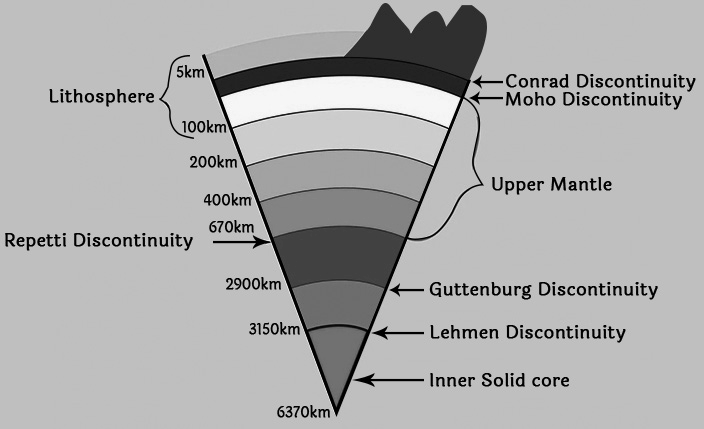
Earth’s interior is made of different kinds of materials. Each of those materials are different from each other by their physical and chemical properties, such as temperature, density etc. Unique layers are there according to their characteristics inside the earth. All those layers are separated from each other through a transition zone. These transition zones are called discontinuities. There are five discontinuities inside the earth
• Conrad Discontinuity: Transition zone between SIAL and SIMA.
• Mohorovicic Discontinuity: Transition zone between the Crust and Mantle.
• Repiti Discontinuity: Transition zone between Outer mantle and Inner mantle.
• Gutenberg Discontinuity: Transition zone between Mantle and Core.
• Lehman Discontinuity: Transition zone between Outer core and Inner core.
Conrad Discontinuity
The Conrad discontinuity marks the transition zone between the upper and lower parts of the lithosphere. Named after Austrian geophysicist Victor Conrad, it was initially thought to represent a clear boundary between different types of rock layers: felsic rocks like granite in the upper crust and more magnesium-rich mafic rocks like basalt in the lower crust. Seismologists of the mid-20th century believed that this boundary should create a distinct change in the speed of seismic waves passing through it, with longitudinal waves increasing abruptly from about 6 to 6.5 kilometers per second.
Mohorovicic Discontinuity
Mohorovicic discontinuity, or Moho for short, was discovered by Croatian seismologist Andrija Mohorovicic in the early 1900s. He noticed that during earthquakes, seismic waves arrived at different times at seismic stations. He realized that waves traveling through the Earth’s mantle and then bending upward into the crust reached stations first because they traveled faster through the mantle rock. This boundary between the Earth’s crust and the mantle is known as the Mohorovicic discontinuity or Moho.
Gutenberg Discontinuity
The Gutenberg discontinuity is a zone about 2900 kilometers below the Earth’s surface, where the mantle transitions to the core. Discovered in 1912 by Weichert Gutenberg, it is where seismic waves change speed suddenly. P waves slow down, and S waves vanish completely at this depth. This suggests that the material below this zone is in a liquid or molten state because S waves cannot pass through liquids. This molten section is hotter and denser than the mantle above it, likely due to a higher iron content.
The Gutenberg discontinuity is not a uniform boundary; it’s uneven and can vary in width from 5 to 8 kilometers. These variations are influenced by the heat-driven movements in the mantle above it and the swirling currents in the iron-rich fluids of the outer core below it. These movements also play a role in generating Earth’s magnetic field. Importantly, the position of the mantle-core boundary is not fixed. As Earth’s interior loses heat over time, the molten core gradually solidifies and contracts, causing the boundary between the core and mantle to shift deeper into the Earth.
Repiti Discontinuity
The Repiti Discontinuity marks the transition zone between the outer mantle and the inner mantle of the Earth.
Lehmann Discontinuity
The Lehmann Discontinuity is a sudden change in the speed of seismic waves at a depth of about 220 kilometers below the Earth’s surface. It was discovered by seismologist Inge Lehmann. This discontinuity is found mainly beneath continents and not often beneath oceans. Scientists have suggested various reasons for its existence, such as the lower boundary of the pliable asthenosphere or changes in the properties of rock at that depth.
Isostasy
The mantle’s ability to convect, or flow slowly over long periods of time due to its plasticity, is important for a process called isostasy. Isostasy means that Earth’s crust floats on the mantle, much like a raft floats on water, rather than being fixed in place on the mantle like a raft sitting on solid ground.
Interior of the Earth
INTERIOR OF THE EARTH
Earth is made up of different layers, like a boiled egg with its shell, white, and yolk. We have the crust, which is the outer hard and thin layer, similar to the eggshell. Then there’s the mantle, which is like the middle layer of the egg. Finally, we have the core, which is like the inner part of the egg, the yolk. Seismology, which studies earthquakes and seismic waves, is the main way through which we learn about Earth’s interior.
The rock cycle is the continuous process of forming, breaking down, and reforming different types of rocks found on Earth’s surface (Lithosphere). Igneous rocks form when magma or lava cools down. This material comes from deep inside the Earth, called the mantle, through volcanic eruptions. Once formed, igneous rocks are exposed to weathering and erosion on the Earth’s surface, which breaks them into smaller pieces.
Wind and water then transport these small rock particles to seas and oceans, a process called denudation.
SOURCES FOR INFORMATION ABOUT THE EARTH’S INTERIOR
There are two types of sources for information about the Earth’s interior:
a. Direct Sources and
b. Indirect Sources Direct Sources
Direct sources of information about the Earth’s interior include activities like mining, drilling, and volcanic eruptions. Mining and drilling involve extracting rocks and minerals from the Earth’s crust, revealing its layers. This helps us understand that the crust is made up of different types of rocks and minerals.
Volcanic eruptions indicate that there is a hot, liquid zone deep inside the Earth.
However, direct sources have limitations because mining and drilling can only reach a certain depth.
Seismic waves are generated by sudden movements of materials within the Earth, like when there’s a slip along a fault during an earthquake. They can also be caused by volcanic eruptions, explosions, landslides, avalanches, or even the movement of rushing rivers.
These waves travel through and around the Earth and can be detected and recorded using instruments called seismometers.
Indirect Sources
Indirect sources of information about the Earth’s interior include seismic waves, gravitational fields, magnetic fields, and falling meteors. These sources are crucial for understanding the Earth’s interior.
Seismic waves, which are vibrations caused by earthquakes, are particularly important. They indicate that the Earth has three layers, each with different densities, and that density increases towards the center of the Earth.
Note: There are two main categories of seismic waves: body waves and surface waves. Body waves travel through the Earth’s interior, and there are two types: primary waves (P-waves) and secondary waves (S-waves). Surface waves, on the other hand, move along the Earth’s surface, and there are two types: Rayleigh waves and Love waves.
Body Waves
Body waves are seismic waves that travel through the Earth’s interior. There are two types of body waves: P-waves and S-waves.
• P-waves, also called primary waves or pressure waves, travel fastest through the Earth. When they move through air, they behave like sound waves, traveling at the speed of sound (about 330 meters per second), but they can travel much faster, up to 5000 meters per second, in materials like granite. P-waves are the first waves recorded during an earthquake because of their high speed.
• Unlike S-waves, P-waves compress and expand the material they travel through, similar to how a slinky compresses and expands when pushed and released. This motion is parallel to the direction of wave propagation.
• S-waves, also called secondary waves or shear waves, move slower than P-waves. Unlike P-waves, S-waves cause particles to move perpendicular to the direction of wave propagation.
Imagine a slinky that’s partially stretched out. When you lift and release a section of it, a transverse wave moves along the length of the slinky, causing a shaking motion perpendicular to the direction of the wave. This is similar to how S-waves move through the Earth’s interior.
Surface Waves
Surface waves are a type of seismic wave that causes complex motion on the ground surface during an earthquake. They make everything on the surface, such as buildings, bridges, and man-made objects, move. There are two types of surface waves:
• Rayleigh waves: These waves cause up and down motions, similar to how an elevator moves in a multi-story building.
• Love waves: These waves cause side-to-side motion, resembling the movement of water in a fast-flowing river. Rayleigh waves are considered more dangerous than Love waves, because they have the potential to damage the base of man-made structures.
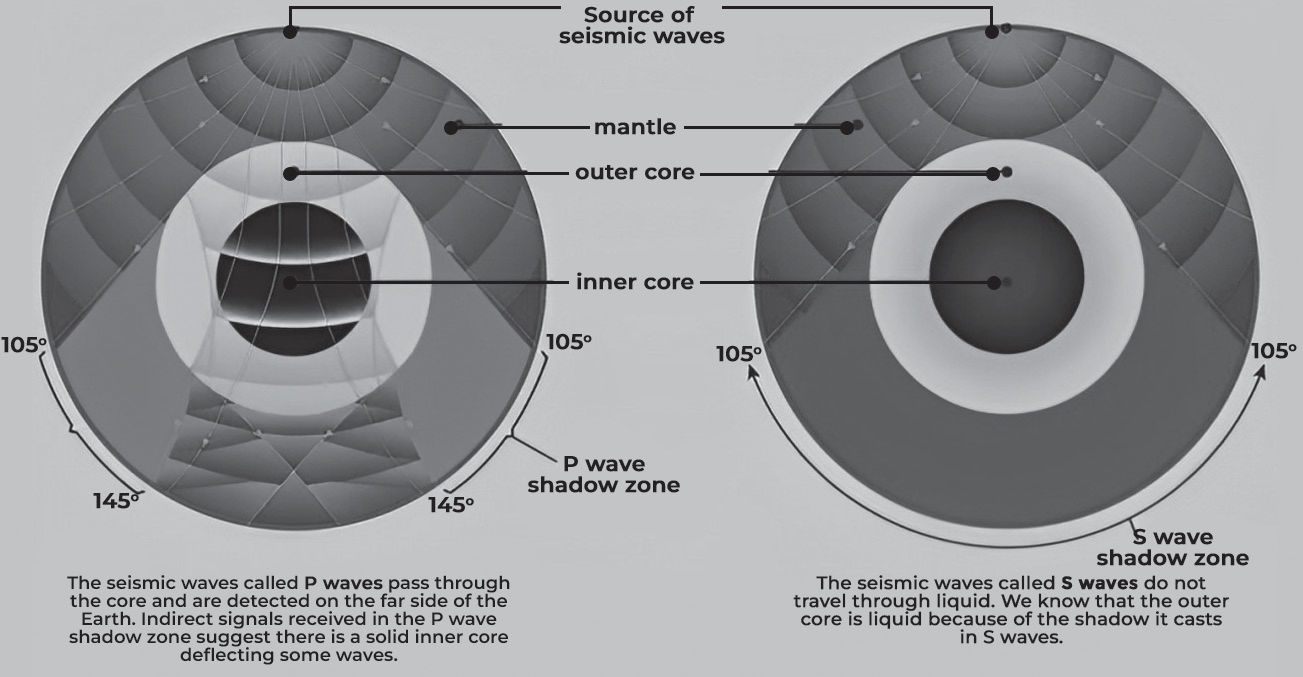
Fig: Propagation of P and S waves in the earth’s interior
Seismic waves are created by different natural events like earthquakes, volcanic eruptions, tidal impacts, and landslides. These events cause motion along faults or sudden movements at crater zones, generating seismic waves. Additionally, human activities can also produce seismic waves, such as mining activities, building reservoirs, and nuclear blasts. During these events, various types of seismic waves are produced, and their strength and frequency depend on the specific event and its depth.
• For exploration purposes, controlled seismic waves are created using methods like hammering, explosives, air- guns, sparkers, and surface vibrators.
Scientists have been using accurate seismometers since the late 1800s to study earthquakes, and they began systematically analyzing seismic data to understand the Earth’s interior in the early 1900s.
Through analyzing seismic signals from earthquakes worldwide, they’ve discovered several key findings
• Seismic waves travel faster in the Earth’s mantle than in the crust.
• Velocities generally increase with pressure and depth.
• There’s a region between 100 km and 250 km depth called the “low-velocity zone” where velocities slow down, known as the asthenosphere.
• At around 660 km depth, there’s a dramatic increase in velocities due to a mineralogical transition.
• Velocities slowdown in the area just above the core- mantle boundary, known as the D layer or “ultra-low- velocity zone.”
• S-waves cannot pass through the outer part of the Earth’s core.
• P-wave velocities increase significantly at the boundary between the liquid outer core and the solid inner core.
The Composition and Structure of Earth
THE COMPOSITION AND STRUCTURE OF EARTH
The Earth’s interior can be divided into three main layers based on their composition: the crust, mantle, and core.
• Crust: The crust is the outermost layer of the Earth, making up less than 1% of the Earth’s total mass. It consists of oceanic crust, found beneath the oceans, and continental crust, which forms the continents. Continental crust is typically made of lighter, more felsic rocks.
• Mantle: The mantle is the layer beneath the crust and represents about 68% of Earth’s total mass. It is very hot and mainly composed of solid rock, although it can flow over long periods of time due to high temperatures and pressure.
• Core: The core is the innermost layer and is primarily made of iron metal. It makes up about 31% of the Earth’s mass and is divided into the outer core, which is molten, and the inner core, which is solid.
• The upper layer of the Earth’s crust is known as the lithosphere, and it can be divided into two parts:
• The upper part, called SiAl, is made up of granitic rocks and forms the continents. It mainly consists of silica and aluminum, giving it a density of 2.7 g/cm3 This part of the lithosphere is lighter.
• The lower part, called SiMa, is denser and contains silica, iron, and magnesium. Because SiAl is lighter than SiMa, the continents are said to “float” on the denser SiMa layer.
• The thickness of the Earth’s crust is about 30 miles.
Underneath the Earth’s crust is the mantle, which is about 1800 miles thick. It’s composed of a dense layer containing a lot of olivine, a type of mineral. Deeper inside the Earth is the core, with a radius of about 2100 miles. This layer is known as the NiFe layer because it’s mainly made up of Nickel and Ferrous, which is another word for iron. The inner part of the core is solid.
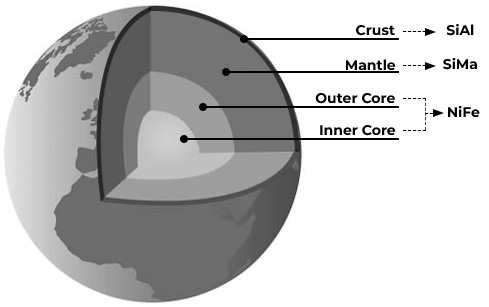
(Fig: The Earth’s layer)
Crust
The Earth’s outer layer is called the crust, and it’s a cold, thin, and brittle shell made of rock. The crust is relatively thin compared to the size of the Earth. There are two main types of crust, each with its own characteristics. Oceanic crust forms beneath the oceans and is made of magma that erupts on the seafloor, creating basalt lava flows or cooling deeper down to form a type of rock called gabbro. Sediments, like mud and shells from small sea creatures, cover the ocean floor, especially near the shore where they wash off the continents.
Continental crust is composed of various types of rocks, including igneous, metamorphic, and sedimentary rocks. It’s mainly made of granite, which is less dense than the rocks found in oceanic crust.
Because of its thickness and lower density, continental crust sits higher on the mantle compared to oceanic crust, which sinks deeper into the mantle, forming ocean basins.
The lithosphere has two layers: the outer part and the inner part. The outer part is immediately below the newer sedimentary formations, which is the crust. This outer layer of the lithosphere is mainly found under continents, while the inner layer is mostly found under oceans.
The inner layer of the lithosphere is further divided into three layers
SIAL: This layer is made of silica and aluminum, with an average thickness of 8 to 100 km.
SIMA: This layer is made of silica and magnesium, with an average thickness of 100 to 2900 km.
NIFE: The innermost layer is made up of nickel and ferrous materials, with a density ranging from 5.1 to 13.
Mantle
The mantle has two important characteristics:
• It is made of solid rock, not liquid or gas.
• It is very hot.
Scientists have determined that the mantle is composed of solid rock based on evidence from seismic waves, heat flow, and meteorites. The type of rock that best matches the mantle’s properties is ultramafic rock called peridotite, which contains iron- and magnesium-rich silicate minerals. Peridotite is rarely found on Earth’s surface.
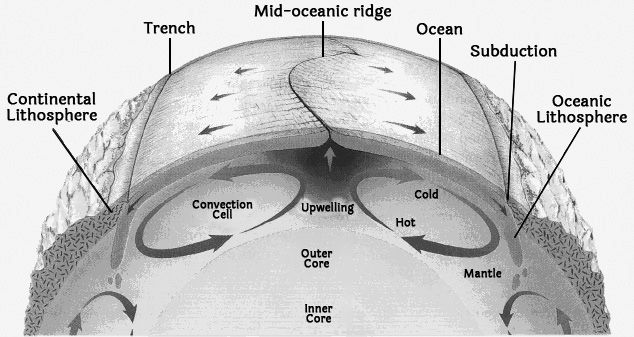
Note: The mantle’s extreme heat is evident from the outward flow of heat and its physical properties. Heat is transferred within the Earth through conduction and convection. Conduction occurs through rapid collisions of atoms, which can only happen in solids. Heat naturally moves from warmer areas to cooler ones until they reach the same temperature. The mantle’s heat mostly comes from the core through conduction.
Core
At the center of the Earth, there’s a dense metallic core. Scientists believe it’s metal for a few reasons. First, the overall density of the Earth, as calculated from its rotation, suggests that the core must be denser than the surface layers. Second, calculations indicate that the core is mostly iron metal, with some nickel. Also, metallic meteorites resemble the core. If the core weren’t metal, Earth wouldn’t have a magnetic field.
Metals like iron can be magnetic, unlike the rocks that form the mantle and crust. Scientists understand that the outer core is liquid and the inner core is solid because certain seismic waves (S-WAVES) stop at the inner core.
The strong magnetic field around Earth is generated by convection currents in the liquid outer core. These currents are driven, by the heat from the even hotter inner core. This heat, which prevents the outer core from solidifying, comes from the breakdown of radioactive elements in the inner core.
Earth Magnetic Fields
EARTH’S MAGNETIC FIELD
Earth’s magnetic field (and the surface magnetic field) is approximately a magnetic dipole, with the magnetic field S pole near the Earth’s geographic north pole (see Magnetic North Pole) and the other magnetic field N pole near the Earth’s geographic south pole (see Magnetic South Pole). This makes the compass usable for navigation. The cause of the field can be explained by dynamo theory. A magnetic field extends infinitely, though it weakens with distance from its source. The Earth’s magnetic field, also called the geomagnetic field, which effectively extends several tens of thousands of kilometres into space, forms the Earth’s magnetosphere. A paleomagnetic study of Australian red dacite and pillow basalt has estimated the magnetic field to be at least 3.5 billion years old.
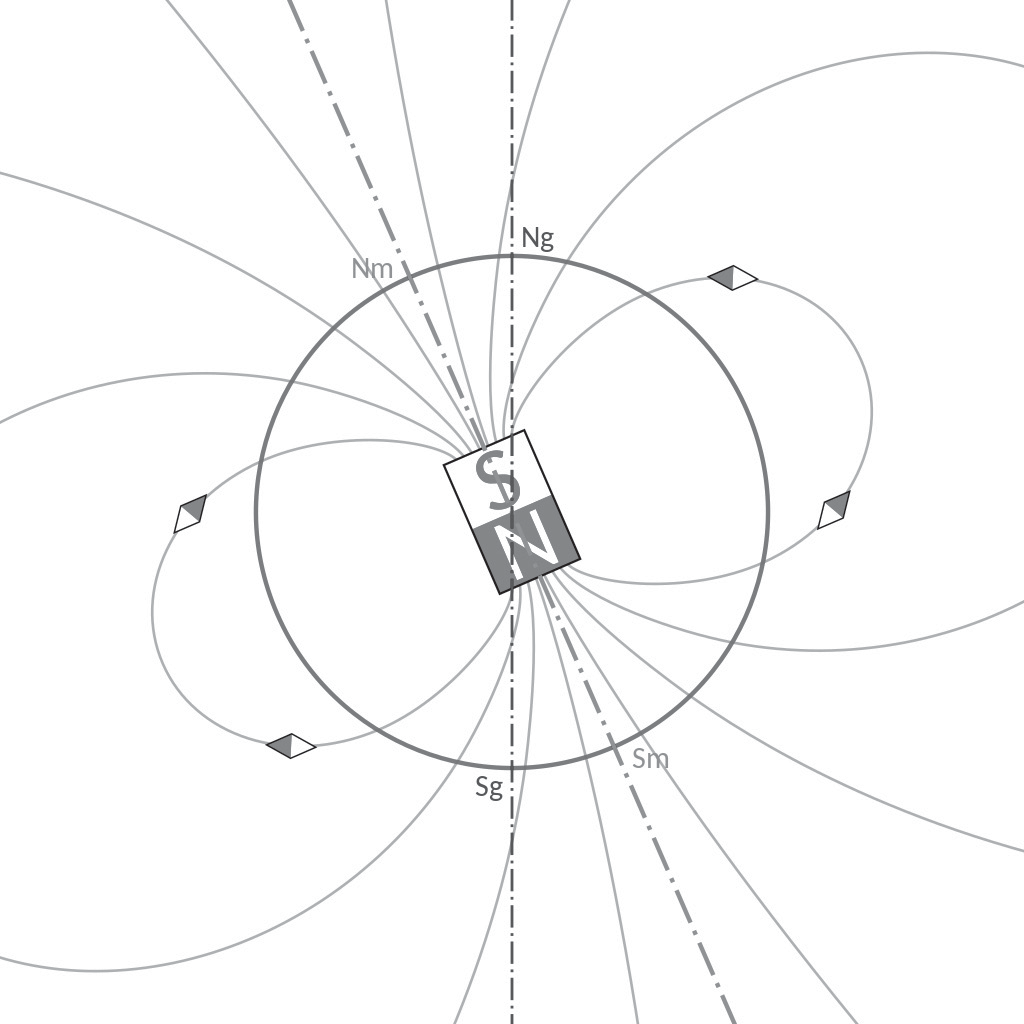
Fig: The variation between magnetic north and “true” north.
Importance of earth’s magnetic field
1. Earth’s magnetic field shields it from the solar wind, which is a flow of charged particles from the Sun. The magnetic field acts like a barrier, deflecting and redirecting most of these charged particles away from Earth.
2. A portion of the charged particles from the solar wind gets caught and held within the Van Allen radiation belts.
3. A small number of particles from the solar wind travel to Earth’s upper atmosphere and ionosphere in the auroral zones.
4. The solar wind becomes visible on Earth when it is strong enough to create phenomena like auroras and geomagnetic storms. These bright auroras heat up the ionosphere, causing it to expand into the magnetosphere and allowing some atmospheric matter to escape into space.
5. Geomagnetic storms occur when the pressure of plasmas inside the magnetosphere becomes high enough to stretch and distort Earth’s magnetic field.
6. The solar wind shapes Earth’s magnetosphere, and changes in its speed, density, and direction affect our local space environment. This can cause fluctuations in ionizing radiation, radio interference, and the position of the magnetopause. These changes can impact satellites and are known as space weather.
7. The gas from Earth’s atmosphere gets trapped in magnetic bubbles and is carried away by solar winds.
8. Changes in the strength of Earth’s magnetic field have been linked to changes in rainfall patterns in tropical regions.
Magnetic poles and magnetic dipole
Often, a magnetic (dip) pole is viewed as a point on the Earth’s surface where the magnetic field is entirely vertical. Another way of saying this is that the inclination of the Earth’s field is 90 at the North Magnetic Pole and -90 at the South Magnetic Pole. At a magnetic pole, a compass held in the horizontal plane points randomly, while otherwise it points nearly to the North Magnetic Pole or away from the South Magnetic Pole, though local deviations exist. The two poles wander independently of each other and are not at directly opposite positions on the globe. Magnetic dip pole can migrate rapidly, observation of up to 40 km per year have been made for the North Magnetic Pole.
The Earth’s magnetic field can be closely approximated by the field of a magnetic dipole positioned near the centre of the Earth. A dipole’s orientation is defined by an axis. The two positions where the axis of the dipole that best fits the geomagnetic field intersect the Earth’s surface are called the North and South geomagnetic poles. For best fit the dipole representing the geomagnetic field should be placed about 500 km off the centre of the Earth. This causes the inner radiation belt to skim lower in Southern Atlantic ocean, where the surface field is the weakest, creating what is called the South Atlantic Anomaly.
If the Earth’s magnetic field were perfectly dipolar, the geomagnetic and magnetic dip poles would coincide. However, significant non-dipolar terms in an accurate description of the geomagnetic field cause the position of the two pole types to be in different places. Magnetic poles are located where the magnetic lines of attraction enter Earth.
The Magnetic North Pole is also known as the North Dip Pole and is currently found on Ellesmere Island in Northern Canada. When a magnetic compass points north, it align itself with Earth’s magnetic field and points to the Magnetic North Pole, not the Geographic North Pole, which is actually about 310 miles (500 kilometres) away.
Magnetic field characteristics
The Earth’s magnetic field is akin to that of a bar magnet. It’s mainly created by electric currents in the liquid outer core. The core’s temperature surpasses 1043 K, which is the Curie point temperature for iron. Beyond this temperature, the alignment of iron’s atomic spins becomes random, leading to a loss of magnetization in the substance.
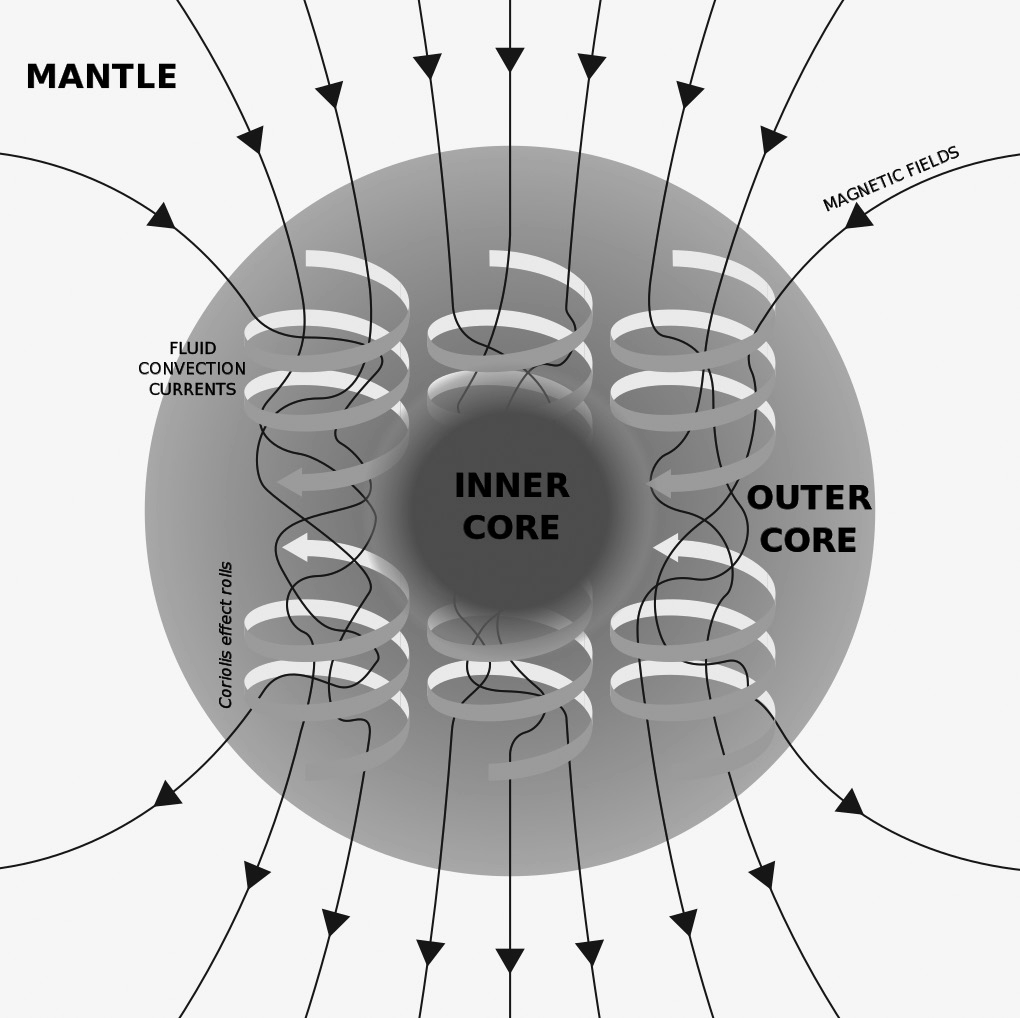
Another important aspect that sets Earth’s magnetic field apart from that of a bar magnet is its magnetosphere. At significant distances from the planet, the magnetosphere plays a major role in shaping the surface magnetic field. Additionally, electric currents generated in the ionosphere produce their own magnetic fields. This magnetic field is particularly prominent near areas where the atmosphere is closest to the Sun, leading to daily changes that can shift surface magnetic fields by up to one degree.
Magnetic field variations
Magnetometers are tools that can sense tiny changes in the Earth’s magnetic field. These changes can happen because of things like iron objects, ovens, certain types of stone buildings, or even holes and garbage dumps in archaeological studies.
• Scientists use special instruments based on technology from World War II to find these changes. Originally used to spot submarines, they’ve been adapted to study the magnetic differences on the ocean floor.
• So basically, magnetometers help scientists find hidden stuff underground or underwater by sensing changes in the Earth’s magnetic field.
The ocean floor is mostly made of basalt, a type of rock rich in iron. Inside basalt, there’s a mineral called magnetite, which is very magnetic. This magnetism can distort compass readings, which Icelandic sailors noticed a long time ago.
But this magnetic property of basalt is useful for scientists. When new basalt forms from volcanic activity and then cools down, it “locks in” the Earth’s magnetic field at that time. This helps scientists study the ocean floor by looking at these magnetic variations.
Sometimes, the Earth’s magnetic field gets hit by solar flares from the sun. When this happens, it can cause geomagnetic storms, which lead to beautiful displays of auroras in the sky.
Scientists measure how unstable the magnetic field is during these storms using something called the K-index. It’s like a scale from 0 to 9, where 0 means everything’s calm and 5 or higher means there’s a geomagnetic storm happening. So, the higher the number on the K-index, the more disturbed the Earth’s magnetic field is.