Rotation and Revolution
ROTATION AND REVOLUTION
“Rotation” refers to an object’s spinning motion about its own axis. “Revolution” refers the object’s orbital motion around another object. For example, Earth rotates on its own axis, producing the 24-hour day. Earth revolves about the Sun, producing the 365-days year. A satellite revolves around a planet.
Earth’s Rotation
The Earth rotates on its axis relative to the sun every 24 hours mean solar time, with an inclination of 23.45 degrees from the plane of its orbit around the sun.
(Fig- Earth’s rotation on its axis)
Effect of the Earth’s Rotation
The earth rotates on its axis taking approximately 24 hours to complete one rotation. This has important environmental consequences.
1. Rotation creates a diurnal cycle of light and darkness, temperature, and humidity changes.
2. Rotation requires the creation of standardized time zones. There are 24, one for each hour of the earth’s rotation.
3. Rotation causes the tides‐ the twice daily rise and fall of sea level. Tides are complicated because they are the result of both the gravity of the moon and the gravity of the sun. Sometimes the sun and the moon are lined up with the earth, but most of the time they are not. Tides are highest when the earth, sun and moon are in a straight line.
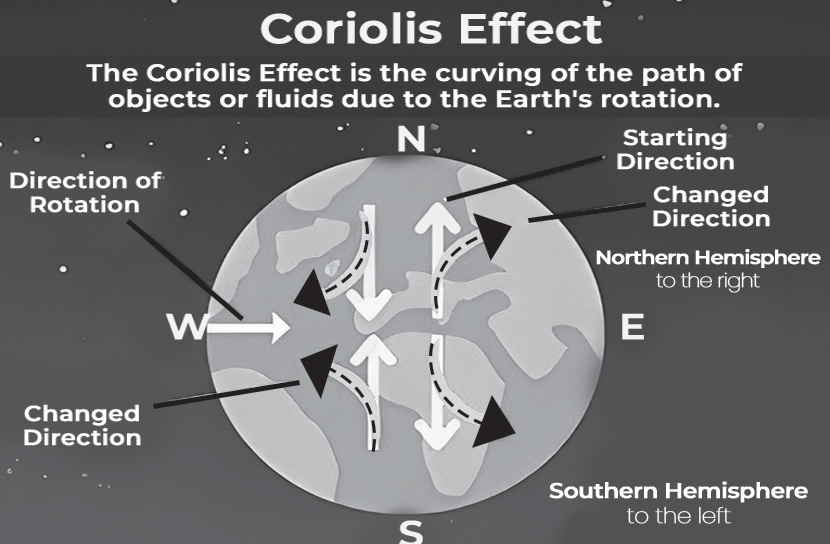
4. The Coriolis Force: Rotation causes a deflection of ocean and air currents. The earth rotates much faster than the winds or currents move. This causes a large deflection in the direction of the winds move and ultimately results in rotation around low-pressure cells and high-pressure cells. It also causes large rotating pools of water in the oceans called gyres. The Coriolis force only operates on large features. Impact of Coriolis force causes deflection of wind in both the hemisphere
• In Northern Hemisphere- Right
• In Southern Hemisphere- Left
Revolution of the Earth
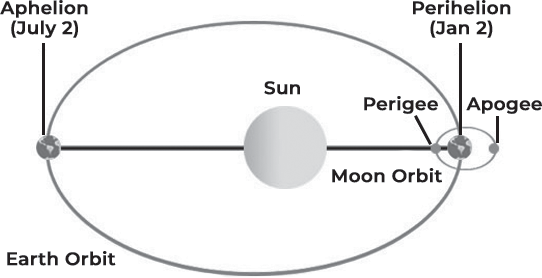
The earth also revolves around the Sun in an elliptical path called an Orbit. On the Orbit, the earth is closest to the sun on January 3rd (called Perihelion). During the course of its revolution, the Earth is farthest away from the Sun on July 4th. This position is called Aphelion. Earth revolves in an orbit around the sun in 365 days, 6 hours, 9 minutes with reference to the stars, at a speed ranging from 29.29 to 30.29 km/s. The 6 hours, 9 minutes adds up to about an extra day every fourth year, which is designated as a leap year, with the extra day added as February 29th. Earth’s orbit is elliptical and reaches its closest approach to the sun, a perihelion of 147,090,000 km, on about January fourth of each year. Aphelion comes six months later at 152,100,000 km.
• Throughout its revolution around the sun, the earth moves through a plane called the Plane of Ecliptic.
• The earth’s axis maintains a constant relationship to the plane at an inclined angle of 23.50 The inclination of the axis during the revolution results in three changes
1. Different positions of the noon sun in the sky
2. Different position of sun rise and sun set
3. Different lengths of day and night in the year.
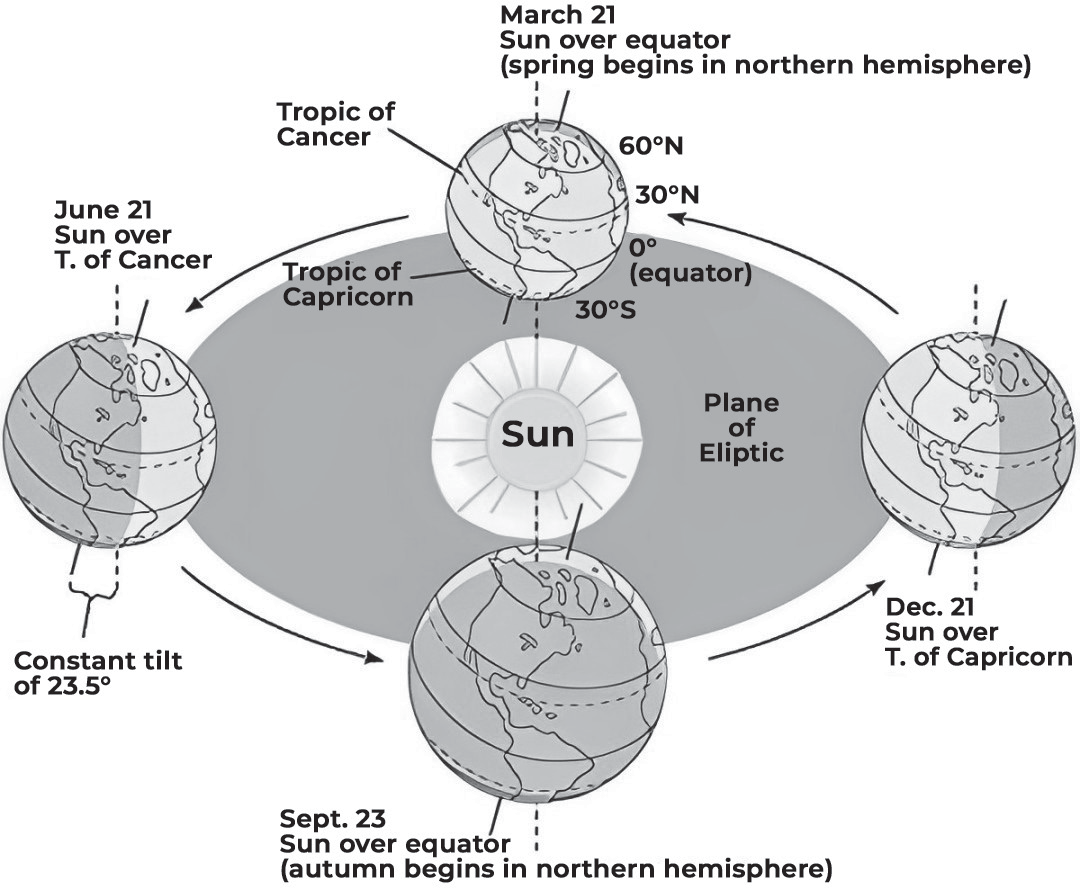
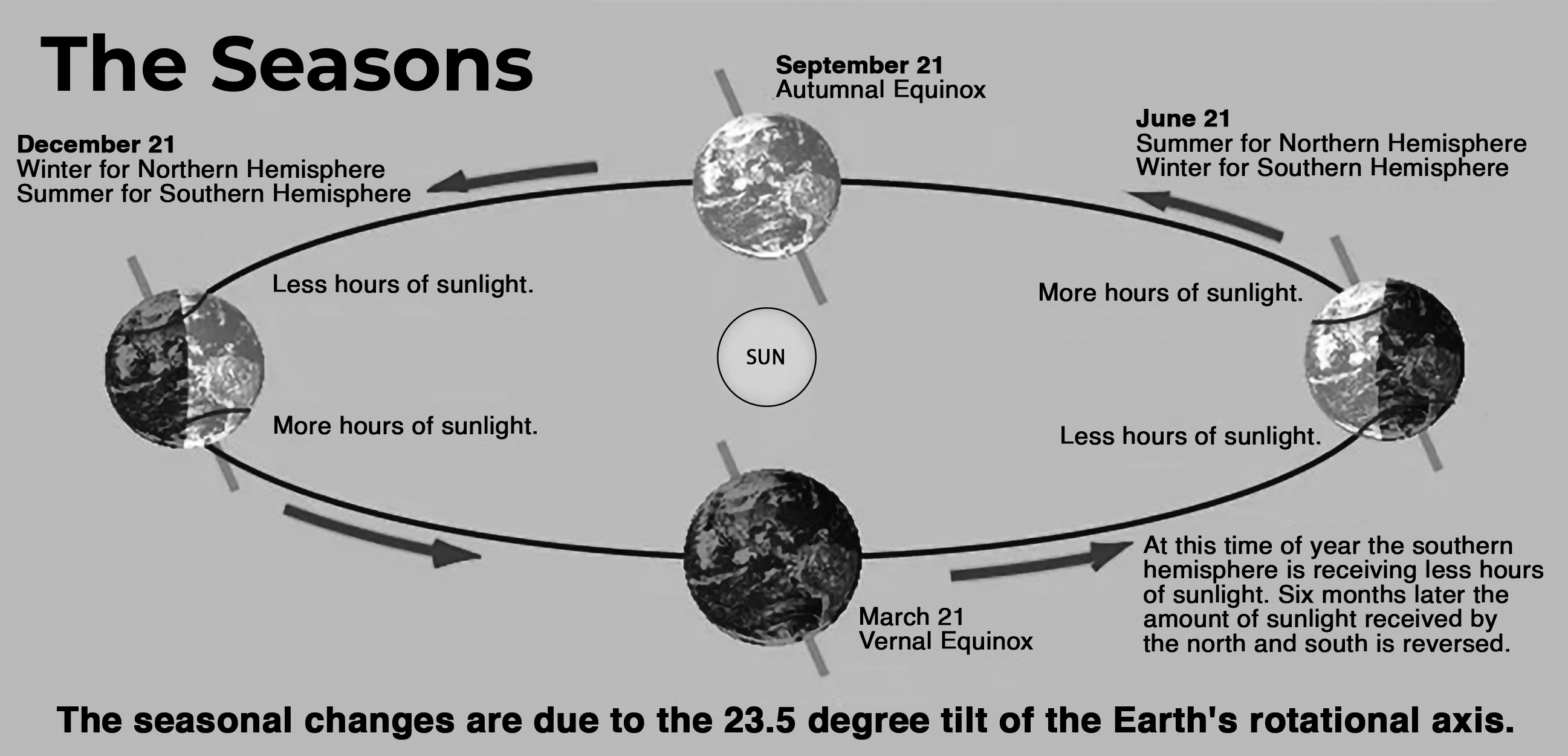
(Fig- Revolution of earth around the sun throughout the year)
• Equinox: March 21 is Spring Equinox and September 21 is Autumnal Equinox. On these two days of the year, all places on the earth receive approximately 12 hours of daylight and 12 hours of darkness.
• June 21st (Summer Solstice): On this day, the earth is at a position in its orbit where the North Pole is most directly pointed toward the sun. Places in the Northern Hemisphere receive more sunlight (causing Northern Summer) and the Southern Hemisphere has less Sunlight (Winter).
•December 21st (Winter Solstice): On this day, the Sun moves into the Southern Hemisphere (causing summer there). The Northern Hemisphere receives less sunlight (causing winter).
Effects of the Earth’s revolution and tilt
The Earth’s revolution has several effects including the seasons and the variable duration of days/ nights. Also, the Earth’s tilt and axis relative to its orbital plane have a significant effect as well. This results in one hemisphere tilting toward the sun and the contralateral hemisphere tilting away.
1.The hemisphere tilted towards the sun will experience warmer weather and longer daytime hours.
2.Whereas the hemisphere titled away from the sun will experience cooler temperatures and shorter daytime hours.
3. This variation in daytime hours and average temperature are cases by revolution and tilt, results in the different seasons of the year. If the Earth, were exactly perpendicular to its orbital plane, the seasons would not occur. It would also cause both hemispheres to experience approximately 12 hours of daylight and darkness during a 24-hour period.
4.The Earth’s current axis is 23.5 degrees, if it were to be tilted more, this would result in warmer summers and colder winters.
Lunar Eclipses and Solar Eclipses
Lunar Eclipses and Solar Eclipses
An eclipse happens when a planet or a moon gets in the way of the Sun’s light. Here on Earth, we can experience two kinds of eclipses: solar eclipses and lunar eclipses.
Solar Eclipse
A solar eclipse happens when the Moon gets in the way of the Sun’s light and casts its shadow on Earth. That means during the day, the Moon moves over the Sun and it gets dark.
This total eclipse happens about every year and a half somewhere on Earth. A partial eclipse, when the Moon doesn’t completely cover the Sun, happens at least twice a year somewhere on Earth.
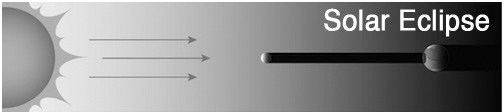
But not everyone experiences every solar eclipse. Getting a chance to see a total solar eclipse is rare. The Moon’s shadow on Earth isn’t very big, so only a small portion of places on Earth will see it. You have to be on the sunny side of the planet when it happens. You also have to be in the path of the Moon’s shadow. On an average, the same spot on Earth only gets to see a solar eclipse for a few minutes about every 375 years!
Lunar Eclipse
During a lunar eclipse, Earth gets in the way of the Sun’s light hitting the Moon. That means that during the night, a full moon fades away as Earth’s shadow covers it up. The Moon can also look reddish because Earth’s atmosphere absorbs the other colours while it bends some sunlight toward the Moon.
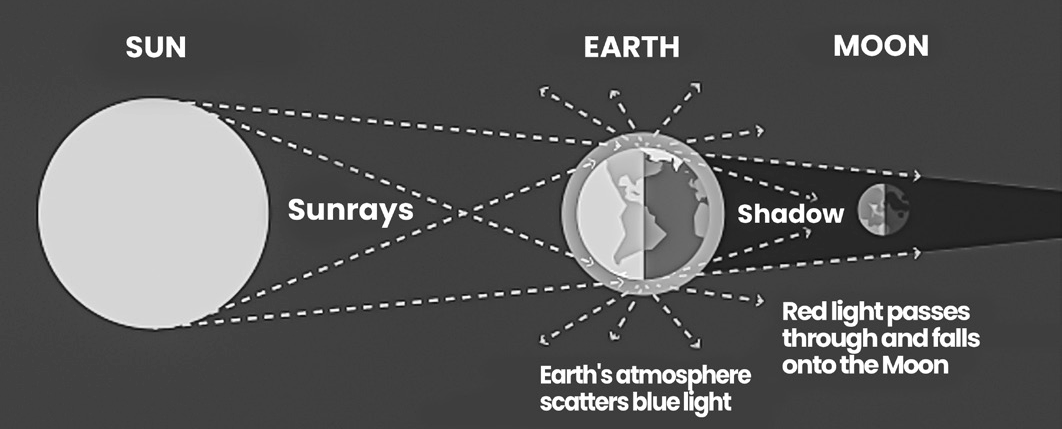
Sunlight bending through the atmosphere and absorbing other colours is also why sunsets are orange and red. During a total lunar eclipse, the Moon is shining from all the sunrises and sunsets occurring on Earth.
Why don’t we have a lunar eclipse every month?
You might be wondering why we don’t have a lunar eclipse every month as the Moon orbits Earth. It’s true that the Moon goes around Earth every month, but it doesn’t always get in Earth’s shadow. The Moon’s path around Earth is tilted compared to Earth’s orbit around the Sun. The Moon can be behind Earth but still get hit by light from the Sun.
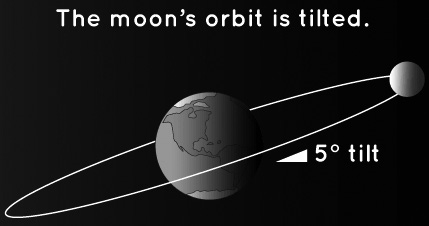
(Fig- Moon’s orbit around Earth is at a tilt)
That's why they don’t happen every month, a lunar eclipse is a special event. Unlike solar eclipses, lots of people get to see each lunar eclipse. If you live on the nighttime half of Earth when the eclipse happens, you’ll be able to see it.