Impacts of Regionalism in India
Impacts of Regionalism in India
Positive Impacts:
• Preservation of Culture and Tradition: Regionalism has helped preserve the rich cultural diversity of India. Different regions have their own languages, art forms, cuisines, traditions, and regionalism has contributed to the safeguarding of these cultural elements.
• Empowerment of Marginalized Communities: Regional political movements often focus on the rights and interests of marginalized communities within specific regions. This has led to policies and initiatives aimed at improving the socio-economic conditions of these communities.
• Linguistic and Cultural Revival: The linguistic and cultural revival movements in various states have led to
the promotion and development of regional languages, literature, and arts. This has enriched the overall cultural tapestry of India.
• Decentralization of Power: Regionalism has advocated for decentralization of political power, leading to the establishment of state governments with significant autonomy. This has facilitated better governance and decision-making at the regional level.
• Development and Infrastructure: Competition among regions has often resulted in improved infrastructure, development projects, and investments in different parts of the country as state governments seek to outperform each other.
Negative Impacts
Regional Disparities: While regionalism has led to development in some regions, it has also exacerbated regional disparities. Some economically weaker states and regions have struggled to keep pace with more prosperous ones.
Ethnic and Linguistic Tensions: In some cases, regionalism has led to ethnic and linguistic tensions. Conflicts between linguistic groups or indigenous communities have arisen in various parts of the country.
Political Fragmentation: The proliferation of regional parties and movements has sometimes resulted in political fragmentation at the national level, making it challenging to form stable central governments.
Secessionist Movements: In certain regions, regionalism has taken the form of secessionist movements seeking independence from India. This has led to long-standing conflicts and security challenges.
Interstate Water Disputes: Water-sharing disputes between neighboring states are a common consequence of regionalism. These disputes can hinder the equitable distribution of resources and lead to tensions between states.
Resource Allocation Issues: Competition among regions for resources and central government funds can sometimes lead to political wrangling and disputes over resource allocation.
In conclusion, regionalism in India is a complex phenomenon with both positive and negative impacts. While it has contributed to the preservation of diverse cultures and empowerment of marginalized communities, it has also posed challenges related to regional disparities, ethnic tensions, and political fragmentation. Effective governance and policies that balance regional aspirations with national unity are essential to manage the impacts of regionalism in India.
Accommodation of Regional Aspirations and National Integration
• As observed from the discussion of the movements involving demands of autonomy and secession described above it is evident that that regional aspirations are part of democratic politics. Expression of such aspirations can be found across the globe. In the UK, there are regional aspirations in Scotland, Wales and Northern Ireland. Spain faces such issues in Basques and Sri Lanka in the Northern Province of the country.
• Significantly, it can be argued that suppression of regional aspirations is not the best way out, rather deliberative consultation and negotiated solution within democratic norms is always possible.
• India adopted a democratic approach to the question of diversity. Democracy allows the political expressions of regional aspirations and does not look upon them as anti- national. Besides, democratic politics allows parties and groups to address the people on the basis of their regional identity, aspiration and specific regional problems.
• India’s past experience in overcoming disruptive forces may be instructive for the future. The quality and wisdom of the leaders, their understanding of India’s diversity, their rejection of secessionist demands, while respecting those within the constitutional framework, and the democratic political structure, and their acceptance of the need for a strong national government within a federal structure have all contributed to promoting Indian unity.
• What distinguishes India from many other countries that face similar challenges is that the constitutional framework in India is much more flexible and accommodative. Therefore, regional aspirations are not encouraged to espouse separatism. Thus, politics in India has succeeded in accepting regionalism as part and parcel of democratic politics.
Points To Remember
Regionalism is an ideology and political movement that seeks to advance the causes of regions.
Economic Imbalances & Regionalism:
Economic inequality among different states and regions could be a potential source of trouble. Major instruments in the government’s hand in bringing development are:
• Finance Commission, a constitutional body.
• Planning Commission, a statutory body.
• Government incentives.
• Public investment by the central government.
Sons of Soil Doctrine:
Particular state belonging to the majority linguistic group who are inhabiting it or constitutes an exclusive “homeland” for regional language speakers
• Mulki rule” provided in article 371(D) of the Indian constitution safeguards the rights of local people in employment and education.
• Demand for Dravida N du:
• The social reform movement in Tamil Nadu and other southern states of India in early 20th Century. They demanded “Tamil Nadu for Tamils”
• The Dravidian movement led to the formation of Dravida Kazhagam [DK] under the leadership of Tamil social reformer ‘E.V. Ramasami ‘Periyar’.
• The DK split and the political legacy of the movement was transferred to Dravida Munnetra Kazhagam (DMK).
• Punjab Issue:
• In 1920, the Akali Dal was formed as the political wing of Sikhs, which led the movement for the formation of a “Punjabi Suba”.
• Later, the more extreme elements started advocating secession from India & demanded “Khalistan”.
• In June 1984, the government of India carried out
“Operation Blue Star”.
• In August 1985 the newly elected PM of India, Rajiv Gandhi signed an agreement “Rajiv Gandhi Longowal Accord or the Punjab Accord”.
• Problems in the north-eastern regions:
• The regional aspirations of the North-east region became more focal and prominent in the 1980s.
• The isolation, complex social character, lack of development, and weak communications led to varied demands of people inhabiting in this region. the North-East region:
• North-Eastern Council (NEC) was set up IN 1972.
Different demands emanating from different parts of:
Demand for autonomy by non-Assamese people.
Secessionist movements in Nagaland
• A.Z. Phizo, belonging to the Naga National Council (NNC), provided leadership for demanding separation from India and complete independence.
• Formation of the National Socialist Council of Nagaland (NSCN) in 1980.
• The main aim of the NSCN has been to establish a sovereign state, “Nagalim”.
• Secessionist movements in Mizoram
• Formation of the Mizo National Front (MNF), with Laldenga as president.
• In March 1966, the MNF declared independence from India.
• A settlement was arrived with Rajiv Gandhi in 1986 through Mizo accord.
• The Government of India agreed to the grant of full statehood to Mizoram, guaranteeing full autonomy in regard to culture, tradition, land laws, etc.
• Movements against outsiders:
• Migrants were seen as encroachers, to drive them away Assam movement started from 1975-1985.
• In 1979 the All-Assam Student’s Union (AASU), a student group not related to any political party, led an anti-foreigner movement.
• Assam accord was signed in 1985.
• India adopted a democratic approach to the question of diversity. Democracy allows the political expressions of regional aspirations and does not look upon them as anti national
Economic Imbalances & Regionalism
Regionalism is a political movement and ideology aimed at promoting the interests of specific regions. It stems from a sense of loyalty to a region with a homogenous population that shares common cultural, social, political, economic, or ethnic aspirations.
However, local pride and loyalty to one’s region, state, language, or culture are not synonymous with regionalism, nor do they threaten national unity. These feelings align with national patriotism and loyalty to the broader nation. One’s pride in their region doesn’t equate to regionalism, and this understanding was also reflected in the Indian national movement.
American scholar and journalist Selig Harrison, in his book India – The Most Dangerous Decades, suggested that India might face challenges to its unity due to tensions between national and state governments. However, India has managed to successfully embrace and celebrate its cultural diversity, countering such fears
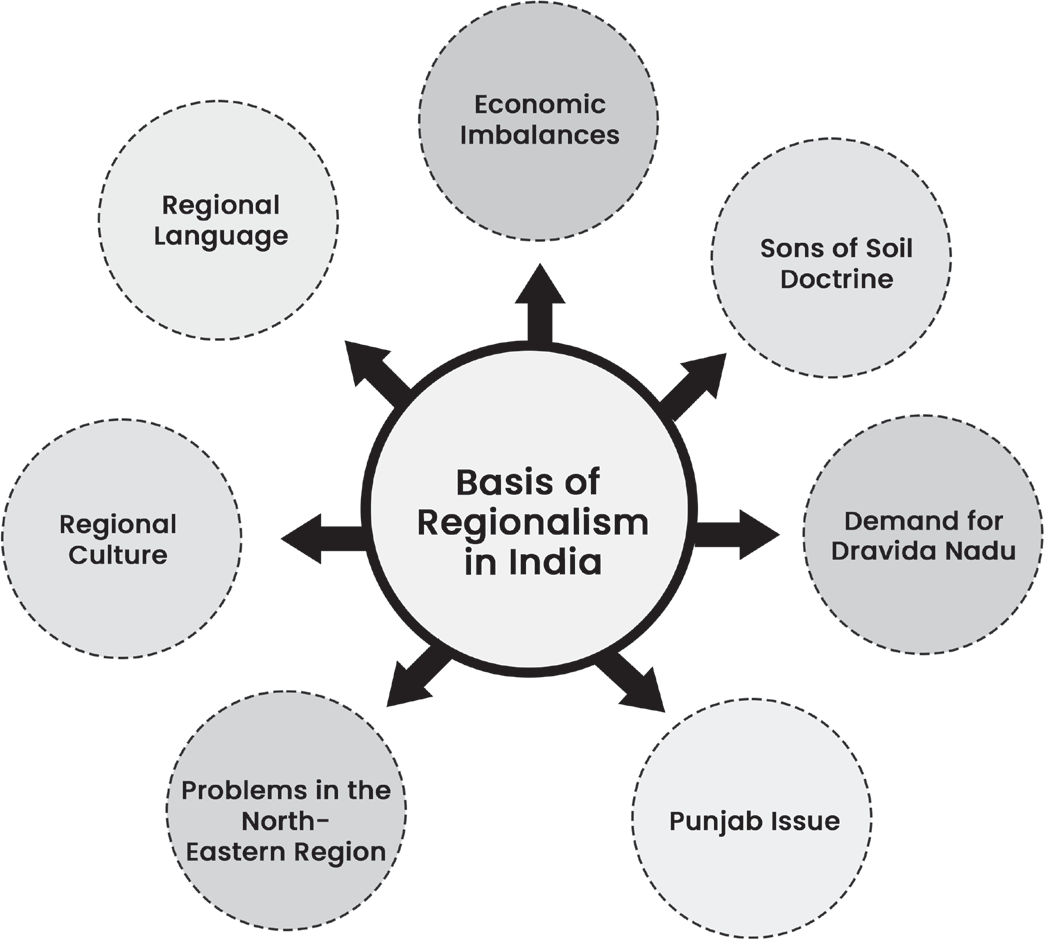
Economic Imbalances & Regionalism
Economic inequality among different states and regions could be a potential source of trouble. Hence, from the
beginning, the national government felt a responsibility to counter the imbalance in regional development. To influence the rates of growth in poorer states and regions and to reduce economic distance from richer states, the central government adopted a whole range of policies.
A major instrument in the government’s hand in bringing development to the poor state was the transfer of financial resources, which was done by the Finance Commission, a constitutional body.
Planning was also used as a powerful instrument to remove regional inequality. Planning Commission allocated greater plan assistance to the backward states. The assistance was given in both forms, grants and loans.
Public investment by the central government in major industries such as steel, fertilizers, oil refining, petrochemicals, heavy chemicals, and in power and irrigation projects have been a tool for the reduction of regional inequality.
Government incentives have been provided to the private sector to invest in backward areas through subsidies, tax concessions, concessional banking and institutional loans at subsidized rates.
In spite of the above-mentioned initiatives and programmes, the backward states have a lower level of infrastructural facilities such as power, irrigation, roads, telephones and modern markets for agricultural produce. Political and administrative failure also bolsters backwardness
Sons of Soil Doctrine
Sons of Soil Doctrine
This doctrine mentions that a particular state belongs to the majority linguistic group inhabiting it or constitutes an exclusive “homeland” for regional language speakers.
The doctrine is majorly popular in cities. In the struggle for the appropriation of economic resources and economic opportunities, recourse was often taken to communalism, casteism and nepotism.
In a similar way, language loyalty and regionalism were and are still used to systematically exclude the “outsiders”. This doctrine was profoundly utilized in big metros like Mumbai (Marathi), Bangalore (Kannada), Kolkata (Bengali), etc.
“Mulki rule” provided in article 371(D) of the Indian constitution safeguards the rights of local people in employment and education and was created after agitation in the state of Andhra Pradesh. This is an example of the Sons of soil doctrine, but this was provided only in Group C and D services.
Sons of the soil doctrine arise when there is actual or potential competition for industrial and middle-class jobs, between the migrants and locally educated middle- class youth.
The worst case of anti-migrant or implementation of the Sons of the Soil doctrine was a movement led by Shiv Sena which appealed to regional chauvinism. However, the courts approved the reservation on the grounds of residence, but maintained people’s right to migrate and their allied fundamental right regarding their movements
Demand for Dravida N Du
Demand for Dravida N du
The early 20th century saw a rise in the social reform movement in Tamil Nadu and other southern states of India.
The Justice Party and the social reform leader V. Ramaswami accused the Brahmins and the North Indians of dominating the Dravidians and forcing the Hindi language and culture.
This was one of the first regional movements in Indian politics. Though some sections of this movement had ambitions of creating a Dravida nation, the movement did not take to arms. It used democratic means like public debates and the electoral platform to achieve its ends.
The Dravidian movement led to the formation of Dravidar Kazhagam [DK] under the leadership of Tamil social reformer E.V. Ramasami ‘Periyar’.
Initially, the Dravidian movement spoke in terms of the whole of south India; however, lack of support from other states limited the movement to Tamil Nadu.
The DK split and the political legacy of the movement was transferred to Dravida Munnetra Kazhagam (DMK). The DMK made its entry into politics with a three-pronged agitation in 1953-54.
First, it demanded the restoration of the original name of Kallakudi railway station, which had been renamed Dalmiapuram, after an industrial house from the North. This demand brought out its opposition to the North Indian economic and cultural symbols.
The second agitation was for giving Tamil cultural history greater importance in school curricula.
The third agitation was against the craft education scheme of the state government, which it alleged was linked to the Brahmanical social outlook.
It also agitated against making Hindi the country’s official language. The success of the anti-Hindi agitation of 1965 added to the DMK’s popularity. Sustained political agitations brought the DMK to power in the Assembly elections of 1967. Since then, the Dravidian parties have dominated the politics of Tamil Nadu.
Though the DMK split after the death of its leader, C. Annadurai, the influence of Dravidian parties in Tamil politics increased. After the split, there were two parties
– the DMK and the All India Anna DMK (AIADMK) – that claimed Dravidian legacy. Both these parties have dominated politics in Tamil Nadu.
Initially seen as a threat to Indian nationalism, regional politics in Tamil Nadu is a good example of the compatibility of regionalism and nationalism
Punjab Issue
Punjab Issue
The social landscape of Punjab underwent significant changes, first with the partition of India and later with the creation of Haryana and Himachal Pradesh in 1966.
Long before independence, the Akali Dal, formed in 1920 as the political arm of the Sikhs, led the movement for the creation of a “Punjabi Suba.”
After partition, Sikhs became the majority in the smaller state of Punjab, prompting a section of the Akalis in the 1970s to call for greater political autonomy. They passed a resolution advocating regional autonomy and sought to redefine the relationship between the center and states. Their goal was the dominance or “bolbala” of Sikhs, but this did not imply a separation from India.
Over time, more radical voices within the Akali Dal began pushing for secession and the creation of “Khalistan.”
As the leadership of the Akali Dal shifted from moderate to militant factions, terrorism also emerged in Punjab by 1981. This violence was seen as the result of decades of communal politics since 1947. Militants, aiming for Khalistan, took control of the Golden Temple in Amritsar, turning it into an armed stronghold.
In June 1984, the Indian government launched “Operation Blue Star,” a military operation to remove militants from the Golden Temple. While the operation was successful, it led to significant damage to the holy site, hurting the sentiments of many Sikhs and fueling the rise of extremist factions. In retaliation for the operation, Indira Gandhi’s own Sikh bodyguards assassinated her, triggering horrific anti-Sikh riots.
Road to Peace
In August 1985 the newly elected PM of India, Rajiv Gandhi signed an agreement with Harchand Singh Longowal the then President of Akali Dal which was known as the “Rajiv Gandhi-Longowal Accord or the Punjab Accord”. This was a positive step towards bringing normalcy to Punjab.
The basic feature of the Accord:
Transfer of Chandigarh to Punjab.
Sharing of water through tribunal between Rajasthan, Punjab, and Haryana.
Compensation for those who suffered from militancy.
Revocation of Armed Forces Special Powers Act (AFSPA) from Punjab.
This accord didn’t facilitate peace immediately. Militancy and counter-insurgency violence continued, which led to human rights violations. Fragmentation of Akali Dal also started. The normal political process was suspended and President’s rule was imposed. Gradually the military was eradicated by the security forces. Peace returned to Punjab by the middle of the 1990s. The alliance of BJP and Shiromani Akali Dal emerged as victorious and brought back the democratic process in the state.
Problems in the North-eastern Regions
Problems in the North-Eastern Regions
The regional aspirations of the North-East gained significant attention in the 1980s, following a series of changes since 1947. Princely states such as Manipur, Tripura, and the Khasi Hills of Meghalaya had merged with India after independence. The entire Northeast underwent numerous political reorganizations, each reshaping the region’s identity.
The partition of India had a major impact on the North-East, turning it into a landlocked region that suffered economically. This geographical isolation from mainstream India contributed to the region’s underdevelopment across various sectors.
Nagaland was formed as a state in 1960, followed by Meghalaya, Manipur, and Tripura in 1972, while Arunachal Pradesh and Mizoram became separate states in 1987.
The region’s isolation, compounded by its complex social fabric consisting of diverse ethnic tribes and cultures coupled with a lack of development and weak communication links with the rest of India, contributed to rising discontent. This strained relationship between the region and the center led to demands for autonomy, secessionist movements, and resistance to outsiders.
In response to these challenges, and following the large- scale reorganization of the region in 1972, the North- Eastern Council (NEC) was established. The NEC aimed to facilitate inter-state coordination, regional planning, and integrated development to address intra-regional disparities and promote unity within the region.
Different demands emanating from different parts of the North-East Region:
Demands for autonomy
After the independence, except Manipur and Tripura,
the entire northeast region comprised the state of Assam. Due to the presence of different cultures and tribes, non- Assamese felt alienated from the Assamese and Bengali residents of the plain.
In addition to this, the Assam Government imposed the Assamese language on them. These non-Assamese people protested against this move violently, tribal leaders started demanding separation from Assam. To consolidate their voice for the separation, the tribal leaders formed the Eastern Indian Tribal Union which later transformed into a comprehensive All-Party Hill Leaders Conference in 1960. Their demands were fulfilled later and several states were carved out of one Assam.
However, the fulfilment of these demands couldn’t stop aspirations of a separate state among some tribes like Bodos, Karbi and Dimasas. They mobilised public opinion through popular movements and insurgency. It was not possible for the centre to fulfil all the regional aspirations, and create smaller and smaller states. So, the centre devised some other alternative to fix this demand, such as the granting of an Autonomous District for such tribes.
Secessionist Movements
Secessionist Movements
The demands of autonomy can be fulfilled with the constitutional provisions, but the demands of separatism are complicated to deal with. This has been true in the case of the North-East region as well, as can be seen from the following cases:
Nagaland
The Nagas, indigenous to the Naga hills along the Assam- Burma border, were largely isolated by the British, who allowed Christian missionary work but left the region undisturbed, leading to the growth of a small educated class.
After independence, the Government of India pursued a policy of integrating the Naga areas into Assam and the broader Indian state. However, a faction of Naga leadership, led by A.Z. Phizo of the Naga National Council (NNC), opposed this integration, demanding complete independence and separation from India.
In 1951, after a referendum called by the NNC, Phizo formed the underground Naga Federal Government (NFG) and the Naga Federal Army (NFA) in 1956, beginning an armed insurgency against India. The Indian government responded by deploying the Army and enacting the Armed Forces (Special Powers) Act in 1958 to suppress the uprising.
The government adopted a two-pronged strategy aligned with Jawaharlal Nehru’s approach towards tribal areas.
On one hand, India firmly opposed the Naga secessionist movement and the use of violence.
On the other hand, Nehru understood that while military
force could control the insurgency, total suppression was neither feasible nor desirable. The goal was to reconcile and win over the Naga people.
Moderate Naga leaders, led by Dr. Imkongliba Ao, emerged, negotiating for the creation of a state within India. The Indian government accepted their demands, leading to the formation of Nagaland in 1963.
In 1975, some NNC leaders signed the Shillong Accord with the Indian government, agreeing to lay down arms.
However, a faction led by Thuingaleng Muivah, who was in China at the time, refused to accept the accord and formed the National Socialist Council of Nagaland (NSCN) in 1980. The group split in 1988 into NSCN (IM) and NSCN (K) after a violent clash. As the NNC diminished and Phizo died in 1991, NSCN (IM) gained prominence.
The NSCN’s primary goal has been to establish a sovereign state, “Nagalim,” encompassing Naga-inhabited areas in Northeast India and Burma. However, a ceasefire between the Indian government and NSCN (IM) and later NSCN (K) reduced violence. In August 2015, after multiple rounds of negotiations, the NSCN (IM) and the Indian government signed a “Framework Agreement” to address long-standing issues.
Mizoram
A situation similar to Nagaland’s emerged a few years later in the autonomous Mizo district of Northeast India. Although secessionist demands supported by some British officials arose in 1947, they failed to gain traction with the youthful Mizo leadership, which focused more on democratizing Mizo society, economic development, and securing adequate representation in the Assam legislature.
Dissatisfaction grew with the Assam government’s handling of the 1959 famine and the passing of the 1961 Act that made Assamese the official language of the state. This frustration led to the formation of the Mizo National Front (MNF), with Laldenga as president.
While engaging in electoral politics, the MNF also formed a military wing that received arms, ammunition, and training from East Pakistan and China. In March 1966, the MNF declared independence from India, launched a military uprising, and attacked both military and civilian targets. The Indian government responded with large- scale counter-insurgency operations, and within weeks, the insurrection was suppressed, restoring government control.
In 1973, after more moderate Mizo leaders reduced their demand to the creation of a separate Mizoram state within India, the Mizo district was separated from Assam and made a Union Territory.
A final settlement came in 1986 when Prime Minister Rajiv Gandhi and Laldenga reached the Mizo Accord.
Under the agreement, the MNF agreed to end violent activities, surrender their weapons, and rejoin the political mainstream. In return, the Government of India granted Mizoram full statehood, ensuring autonomy over culture, traditions, land laws, and more.
Movements Against Outsiders
Movements against outsiders
The migration of people from other parts of the country to the north-east region has created lots of problems and increased the tension between ‘locals’ and ‘outsiders.
The migrant people were seen as encroachers, who would snatch away their scarce resources like land, employment opportunities and political power and render the local population without their legitimate due.
To drive away the outsiders from the region was the main aim of the Assam Movement from 1975 to 1985. The main targets were Bengali Muslim settlers from Bangladesh.
In 1979 the All-Assam Student’s Union (AASU), a student group not related to any political party, led an anti-foreigner movement. Their area of focus was illegal migration, domination of Bengali and other outsiders, against faulty voter registration of lakhs of immigrants. AASU members used both non-violent and violent methods. Their violent agitation took human lives and damaged lots of properties.
After 6 years of violent turmoil, the then PM, Rajiv Gandhi negotiated with AASU leaders. Both sides (Union Govt and AASU) signed the Assam Accord in 1985. According to this accord, the foreigners who migrated into Assam during and after the Bangladesh war were to be identified and deported.
With the success of signing this accord, the AASU and Assam Gana Sangram Parishad came together, formed their political party. Assam Gana Parishad, won the Assembly elections in 1985 with the promise of resolving the foreign national problem and making Assam a “Golden Assam”. However, the problem of immigration hasn’t been resolved yet, but it brought peace to some extent.