Relations with Pakistan
Relations with Pakistan
The challenge of dealing with Pakistan remained a deeply complex issue for India. Despite the ongoing conflict over Kashmir, Nehru and the Indian government pursued a policy of fairness and conciliation, aiming to reduce tensions and promote peaceful relations with Pakistan.
In January 1948, following Gandhiji’s fast, India paid Pakistan Rs 550 million as part of the Partition settlement, even though there were concerns the funds could be used to finance military action in Kashmir.
Alongside Kashmir, another ongoing source of friction was the growing sense of insecurity among Hindus in East Bengal, primarily due to Pakistan’s political system, which was perceived as communal. This insecurity triggered a steady flow of refugees from East Bengal to West Bengal, and in response, retaliatory violence against Muslims led to their migration.
To address the protection of minorities, the leaders of both nations signed the Nehru–Liaqat Pact on April 8, 1950. The agreement aimed to protect the rights of minorities in both countries but faced strong opposition from communalists. Two Bengal-based ministers, Syama Prasad Mookerjee and K.C. Neogi, resigned in protest.
Overall, India’s policy remained focused on improving relations with Pakistan, preventing hostility, and ensuring the country’s secular fabric was preserved
Points To Remember
4 basic features of colonial structure: Capitalistic system, mercantilism, drain of wealth, denial of state support
Challenges before India after independence:
Immediate challenges: Integration of princely states, partition and rehabilitation.
Long term challenges: To build a representative democracy, implementation of land reforms, national integration, curbing communal riots and others.
Radcliffe commission:
After the 3rd June plan of Mountbatten, a British jurist Sir Cyril Radcliffe was invited to fix the problem and to form two boundary commissions: one for Bengal and one for Punjab.
Limitations of Radcliffe commission: Sir Cyril Radcliffe had no specialized knowledge, no advisors. He had never visited India. Dispute surrounding Chittagong Hill Tracts , Gurdaspur district, Malda, Khulna, and Murshidabad in Bengal and sub division of Karim Ganj of Assam.
Consequences of partition: Communal holocaust, nearly 6 million refugees entered India, minorities led too refugee camps, Lahore, Amritsar, and Kolkata became communal zones.
Relief and rehabilitation: The largest of the nearly 200 camps in Kurukshetra, offering employment, housing and emotional stability, farmers being given 4 hectares of land, Sardar Tarlok Singh’s innovation for successful settlement of refugees.
Other major events: Assassination of Gandhi, Kashmir issue, Nehru-Liaqat pact (8 April 1950).
The Colonial Legacy
The Colonial Legacy
India’s colonial history has had a profound impact on its development since 1947. British rule radically reshaped India in various ways, but these changes, while often positive in nature, have been described by A. Gunder Frank as the ‘development of underdevelopment.’ The economic shifts brought about by colonial rule were intertwined with a system that entrenched poverty and dependence on Britain, despite some of the advances, such as the development of railways.
Key sectors like agriculture, industry, transport, communication, finance, administration, and education were transformed during this period. While the improvements were notable, they were also deeply embedded in a colonial framework that ultimately contributed to India’s economic subordination. This resulted in a colonial structure that perpetuated inequality and hindered true development.
There were four main characteristics of this colonial structure:
Colonialism fully integrated India into the global capitalist system, but always in a subordinate position, with India’s economic interests serving Britain’s needs since the 1750s.
A system of production and international trade was imposed on India that suited British industry, forcing India to export raw materials like cotton, jute, and oilseeds, while importing manufactured goods from Britain.
India’s economic surplus, crucial for development, was largely diverted away from productive use. Much of the country’s savings were either misused by the colonial state or appropriated by landlords and moneylenders.
The state played a key role in maintaining this structure, with policies and priorities set in Britain, serving British interests rather than those of India. Industry and agriculture were denied the support they needed to grow.
When India gained independence on August 15, 1947, there was a sense of great joy and accomplishment, celebrating the
sacrifices of countless patriots. However, the celebration was tempered by the pain of partition, which divided the country and brought with it numerous challenges.
The immediate obstacles India faced at independence included:
The territorial and administrative integration of princely states,
The communal violence that accompanied Partition, which displaced nearly six million refugees from Pakistan, and the need to protect Muslims facing violence in India.
India faced the task of creating a united nation that could embrace its diversity. With its vast geographical spread, varied cultures, religions, and languages, many believed that such a diverse country would struggle to remain unified
In addition to the immediate challenges, India faced significant medium-term tasks, such as framing a constitution and establishing a democratic political system that respected civil liberties. This required organizing elections to implement a system of representative government at both the central and state levels. Another crucial challenge was dismantling the semi-feudal agrarian structure through land reforms.
Looking at the long term, the newly independent government had to focus on several key objectives. National integration was essential, as was furthering the process of nation-building. The government also had to prioritize rapid economic development, tackle widespread poverty, and lay the foundations for a planned economy.
At the same time, the government worked to meet the high expectations of the masses, fuelled by the freedom struggle, by addressing centuries of social injustice and oppression. Additionally, it aimed to craft a foreign policy that would protect India’s independence while fostering peace in a world increasingly divided by the Cold War and its rival power blocs.
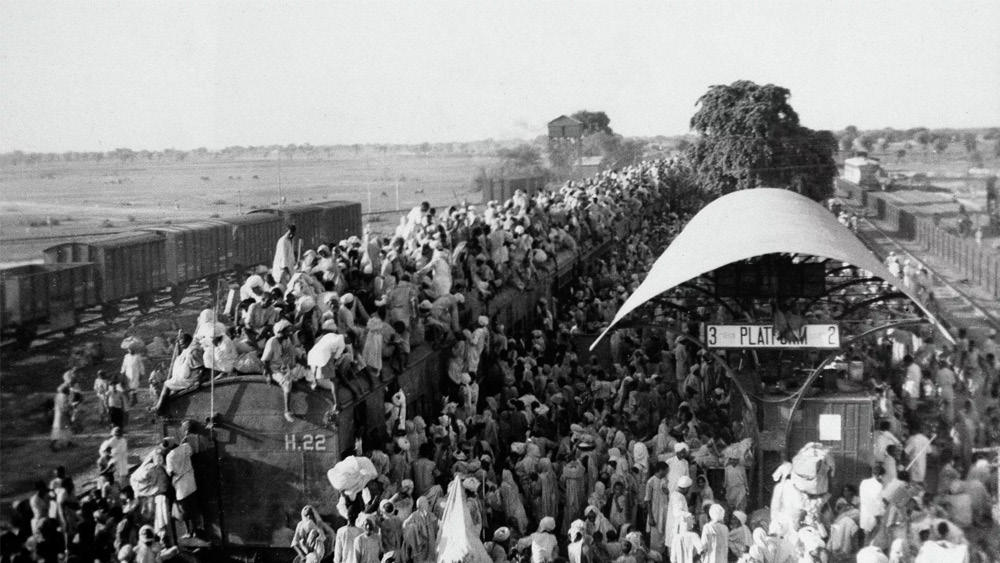
Partition and Communal Riots
Partition and Communal Riots
India was accompanied by Pakistan in independence. Thus, two nation-states came into existence because of the ‘partition’ of British India. Pakistan was the culmination of the communal politics engendered by British rule and championed by the Muslim League as a “two nation theory” which implied India consisted of two ‘People’ Hindus and Muslims.
At the very outset, the people and the government faced the gravest of crises. The great danger was that the atmosphere and the mentality generated by Partition and the riots might persist and strengthen communal tendencies in Indian politics.
The situation was brought under control within a few months through decisive political and administrative measures. For example, the back of communal violence in Delhi was broken by bringing the army onto the streets and ordering the police to shoot at communal mobs, indulging in looting and killing.
Radcliffe Commission and Demarcation of Boundaries
Radcliffe Commission and Demarcation of Boundaries
A very important task at hand was the demarcation of boundaries. After the 3rd June plan of Mountbatten, a British jurist Sir Cyril Radcliffe was invited to fix the problem and to form two boundary commissions: one for Bengal and one for Punjab. Four other members were also there in commission, but there was a deadlock between Congress and the Muslim league. On 17th August 1947, he announced his award.
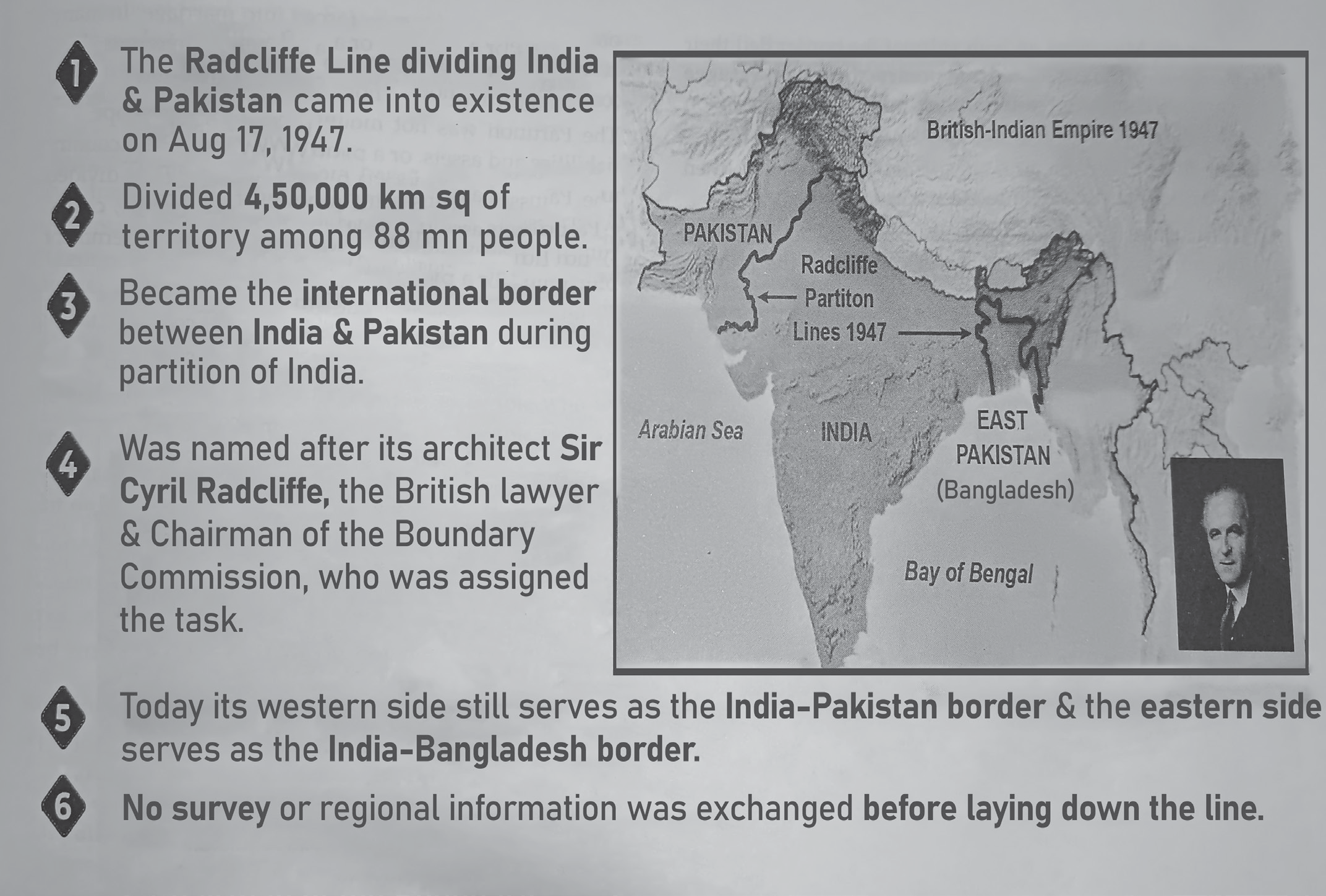
Implications of the Radcliffe Award
It was decided to follow the principle of religious majorities, which means that areas, where the Muslims were in the majority, would make up the territory of Pakistan. The remaining was to stay with India.
There were two areas of concentration with a Muslim majority, In the West and East parts of India. Hence, it was decided that the new country will comprise two territories, West and East Pakistan.
Not all Muslims were in favour of joining Pakistan. Khan Abdul Ghaffar Khan, also called Frontier Gandhi, was the undisputed leader of the North-West Frontier Province and he staunchly opposed the two-nation theory. But as Khudai Khidmatgar of Abdul Ghaffar Khan boycotted the Plebiscite due to the provision of limited franchise rights in that, the lone contender in the fray, the Muslim League, won the vote by default and in the end, NWFP was made to merge with Pakistan.
Two Muslim-majority concentrated provinces of British India, Punjab and Bengal had very large areas with a non- Muslim population in the majority. Eventually, it was decided that these two provinces would be bifurcated according to the religious majority at the district or even lower level. The partition of these two provinces caused prolonged trauma.
The last difficult position was of “minorities” on both sides of the border. Minorities then on either side lived in fear and fled from their homes to save their lives from the brutal violence unleashed during the partition.
Limitation of this award
Sir Cyril Radcliffe had never been to India or anywhere else in Asia and was not familiar with the demographics of India.
He had no specialised knowledge needed for the task as well. He had no advisors and experts.
Six-week deadline that Radcliffe had was also a limitation of this award.
The loss of Lahore, the erstwhile capital of the Sikh Empire, which had a Muslim majority, to Pakistan, was a particularly hard blow to the Sikh community.
There were disputes regarding the Radcliffe Line’s award of the Chittagong Hill Tracts and the Gurdaspur district. Disputes also evolved around the districts of Malda, Khulna, and Murshidabad in Bengal and the sub- division of Karim Ganj of Assam.
Consequences of Partition
Consequences of Partition
The year 1947 was the year of one of the largest, most abrupt, unplanned, and tragic transfers of the population that human history has known.
India was in the midst of a communal holocaust. There was senseless communal slaughter and a fratricidal war of unprecedented proportions. Unspeakable atrocities were perpetrated on minorities in both India and Pakistan.
Partition and the violence which accompanied led to nearly six million refugees pouring into India having lost their all. Minorities on both sides of the border fled their home and often secured temporary shelter in ‘refugee camps’. They often found unhelpful local administration and police in what was till recently their own country.
The cities like Lahore, Amritsar, and Kolkata (then Calcutta) got divided into “Communal Zones”.
Thousands of women were abducted on both sides of the border. They were made to convert to the religion of the abductor and were forced into marriage. In many cases, women were killed by their own family members to preserve the ‘family honour’.
The Partition was not merely a division of properties, liabilities and assets, or a political division of the country and the administrative apparatus. What also got divided were the financial assets, and things like tables, chairs, typewriters, paper clips and books to government officials.
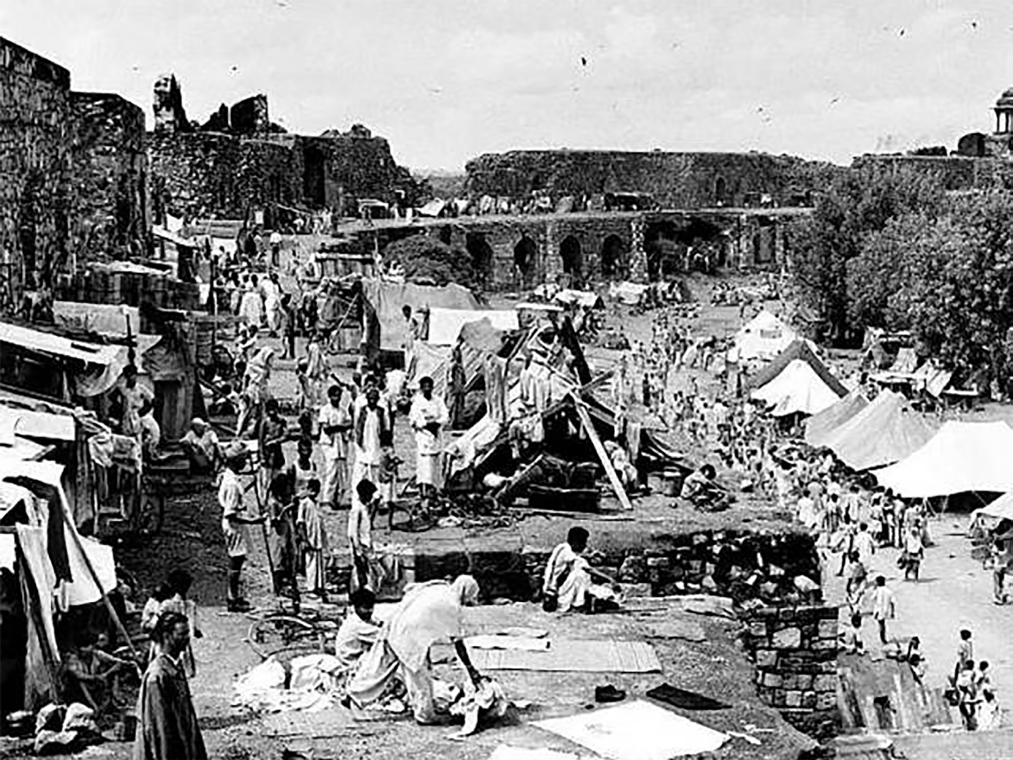
Relief and Rehabilitation of Refugees
Relief and rehabilitation of Refugees
• The government faced an immense challenge in providing relief and resettling nearly six million refugees from Pakistan, whose lives had been completely uprooted. Many Hindus and Sikhs fleeing West Punjab were sent to a refugee camp in Kurukshetra, the largest of nearly 200 camps set up for refugees from the region. There were also five camps in Mumbai for those from Sindh.
• Providing housing, employment, and emotional support to these refugees was an ongoing struggle. Unlike in Bengal, most refugees from West Punjab were able to occupy the large properties and land left behind by Muslim migrants to Pakistan. This made resettlement easier for them, but this was not the case for refugees in West Bengal.
• Due to linguistic similarities, it was easier for Punjabi and Sindhi refugees to settle in places like Himachal Pradesh, Haryana, western Uttar Pradesh, Rajasthan, and Delhi. However, the resettlement of refugees from East Bengal was confined to Bengal, and to a lesser extent, Assam and Tripura.
Initially, each refugee family was allotted four hectares of land, regardless of their prior holdings in Pakistan. They were also provided loans for seeds and tools. As cultivation began on these temporary plots, applications for permanent land allotments were also processed.
• Sardar Tarlok Singh, the director general of rehabilitation, led these efforts. A graduate of the London School of Economics, Singh applied his training to introduce key innovations that were instrumental in the successful resettlement of refugees.
• By 1951, the rehabilitation of refugees from West Pakistan had largely been completed. However, the situation with refugees from East Bengal remained challenging, as the exodus continued due to ongoing communal riots. This stream of refugees persisted until 1971
The Assassination of Gandhiji
The Assassination of Gandhiji
The communal violence that erupted before and after independence had a profound impact on Gandhiji. While the rest of the nation celebrated the hard-won freedom in August 1947, the man who had led the struggle since 1919, advocating nonviolence and love, was traveling through the hate-filled lands of Bengal and Bihar. His mission was to quell the flames of communal violence and offer solace to those suffering the brutal consequences of a freedom marred by senseless bloodshed.
Just as the celebrations of independence were fading, tragedy struck. On January 30, 1948, Nathuram Godse, a Hindu fanatic, assassinated Gandhiji, the Father of the Nation. The entire country was left in shock and mourning. In the wake of his death, the grip of communalism loosened, as the nation confronted the devastating loss of its moral leader.