Tribals in the Northeast
Tribals in the Northeast
• The tribes of northeastern India, comprising over a hundred distinct groups, each with its own language, lived predominantly in the hilly regions of Assam. While they shared many challenges common to tribal populations across India, their situation differed in several key ways.
• For one, the tribes in this region were the majority in most of the areas they inhabited, unlike many other parts of India where they were minorities. Additionally, these areas had seen little penetration by non-tribals, though economic interactions between tribal and non-tribal regions had been increasing.
• Another notable difference was the lack of significant political or cultural interaction between the tribes of the Northeast and the rest of India. While much of the rest of the country was deeply influenced by the anti-colonial struggle, its impact on the Northeast tribes was minimal. For many, their primary contact with outsiders had been through British officials and Christian missionaries.
• This unique situation made the government’s tribal policies, especially those advocated by Jawaharlal Nehru, particularly significant for the Northeast. Nehru, along with Verrier Elwin, championed policies aimed at protecting tribal cultures and promoting their welfare. These policies were most successfully implemented in the North-East Frontier Agency (NEFA), established in 1948 from the border regions of Assam. NEFA was placed under a special administration and later became the state of Arunachal Pradesh in 1987
Points To Remember
Integration of Princely States:
British India was divided into what was called the British India Provinces and the Princely States. They were under paramountcy or suzerainty of the British crown.
The rulers of most of the states signed a document called the ‘Instrument of Accession’
However, Princely states of Travancore, Bhopal, and Hyderabad publicly announced their desire to claim independent status.
25th July speech of Mountbatten to the Chamber of Princes finally persuaded the princes except that of 3 states Travancore, Jodhpur, Bhopal which were later integrated by pressure and persuasion.
The accession of the princely states of Junagadh, Hyderabad, Kashmir and Manipur however, proved more difficult than the rest
Junagarh: A plebiscite was held in the state on 20 February 1948, which favoured joining India
Kashmir: 15th August, Hari Singh offered a standstill agreement with both countries, however, after infiltration by Pakistan, Maharaj appealed to India for military assistance. The Kashmir issue was left as an unfinished agenda of the partition after the enforcement of ceasefire by UNSC
Hyderabad: Indian army moved into Hyderabad on 13 September 1948. The police operation was code-named Operation Polo.
Manipur: Maharaja of Manipur Bodh Chandra Singh signed the Instrument of Accession with the Indian government on the assurance that the internal autonomy of Manipur would be maintained.
Two other trouble spots that remained on the Indian body politics were French and Portuguese settlements. They handed over the settlements (Pondicherry and Goa) in 1954 and 1961 respectively.
The Language problem:
The challenges posed to national consolidation by linguistic diversity manifested in two ways
• Official Language Debate:
• Conflict between Hindi-speaking and non-Hindi speaking regions of the country was resolved when the constitution-makers virtually accepted all the major languages as “languages of India”.
• The constitution provided that Hindi in the Devanagari script with international numerals would be India’s official language. As for English, it was to be used for all official purposes until 1965.
• Official language act came in 1963 for continuation of English even after 1965.
• Linguistic Reorganisation of the States
• Appointed in 1948, the Linguistic Provinces Commission, headed by Justice S.K. Dhar, enquired into the desirability of linguistic provinces.
• In December 1948, JVP committee was formed consisting of Jawaharlal Nehru, Sardar Patel and Pattabhi Sitaramayya. The committee advised against the creation of linguistic states for the time being.
• A separate Andhra state was formed in December 1952 due to unrest created after the death of Potti Sriramulu, who fasted until death for the creation of Andhra state.
• Setting up of State Reorganisation Commission:
• “States Reorganization Commission” (SRC) headed by Justice Fazl Ali in India. This commission was established in 1953 to recommend the reorganization of Indian states on a linguistic basis.
• On the basis of its report, the States Reorganisation Act was passed in 1956. This led to the creation of 14 states and six union territories.
• Recent Reorganisation of States
• Chhattisgarh in 1st November 2000
• Uttarakhand in 9th November 2000
• Jharkhand in 15th November2000
• Telangana in 2nd June 2014
• Jammu and Kashmir, Ladakh in 2019 (union territories).
Tribal integration:
Impact of colonial policies on Tribals: Colonialism eroded the isolation of tribals through penetration of market forces, increasing debt, transforming their relation with the forest, forest laws.
Roots of India’s Tribal Policy: There were two major approaches regarding the place to be accorded to tribals in Indian society, isolationism and assimilation. Nehru, however rejected both these approaches. Instead, Nehru favoured the policy of integrating the tribal people into Indian society.
Nehru’s tribal Panchsheel:
• People should develop along the lines of their own genius, and the imposition of alien values should be avoided.
• Tribal rights in land and forest should be respected.
• Teams of tribals should be trained in the work of administration and development.
• Tribal areas should not be over-administered or overwhelmed with a multiplicity of schemes.
• Results should be judged not by statistics, or the amount of money spent, but by the human character that has evolved.
Impact of the tribal policy: Despite the constitutional safeguards (article 46, 244(1)) the welfare has been dismal.
• Except in the Northeast, the tribals continue to be poor, indebted, landless and often unemployed.
• Weak execution of well-intentioned measures.
• Insufficient nature of fund allocation.
• Administrative personnel are ill-trained or even prejudiced against tribals.
Positive impact: various legislations to protect tribal rights, Panchayati raj, and tribal advisory council in all states
Integration of Princely States
A major problem, perhaps the most serious one, that India has faced since 1947 has been that of national unity or consolidation of the nation. The problem is also sometimes referred to as national integration or the integration of Indian people as a political community.
Integration of Princely States
British India was made up of two distinct regions: the British Indian Provinces, which were directly controlled by the British government, and the Princely States, where numerous rulers governed large and small territories with a degree of autonomy, as long as they acknowledged British supremacy. This arrangement was known as British paramountcy or suzerainty.
With British rule coming to an end in 1947, the future of these princely states became a pressing concern. Many of the 565 princely states began to entertain the idea of independence, arguing that the principle of paramountcy should not automatically transfer to the newly formed nations of India and Pakistan.
Their aspirations were further fueled by a statement from British Prime Minister Clement Attlee, who clarified that Britain did not intend to transfer its powers under paramountcy to any Indian government. Adding to this,
M.A. Jinnah, on June 18, 1947, declared that the princely states could choose to remain independent if they wished, once paramountcy was ended.
However, Indian nationalists could not accept the idea of hundreds of independent states jeopardizing the unity of a free India. The people of these states had long participated in the Indian freedom movement and had developed a strong sense of nationalism. Leaders from both the British provinces and the princely states rejected any notion of independence for these territories, insisting that the only choice for these states was to join either India or Pakistan, based on geographic proximity and the will of the people.
On June 27, 1947, Sardar Patel took charge of the newly created States Department, with V. P. Menon as its Secretary. Through a blend of diplomacy and persuasion, Patel managed to integrate the princely states into the Indian Union. While some princely states joined the Constituent Assembly with a sense of realism, others, such as Travancore, Bhopal, and Hyderabad, publicly declared their desire for independence. Most of the states, however, eventually signed the ‘Instrument of Accession,’ formalizing their agreement to join the Union of India
The Government’s Approach Was Guided by Three Considerations
The government’s approach was guided by three considerations
• Most people in the princely states were eager to join the Indian Union.
• The government, in turn, was willing to grant autonomy to certain regions, aiming to accommodate India’s diversity and take a flexible approach toward regional demands.
• In the wake of Partition, the priority was to solidify the territorial integrity of the nation.
Sardar Patel hosted several meetings with the princely guests, urging them to support the Congress in drafting India’s new constitution. His first move was to ask the princes whose states were within India’s boundaries to accede to the Union, particularly in areas vital to the nation’s unity—foreign relations, defense, and communications.
He made it clear that, after August 15, 1947, he would not be able to hold back the frustration of the people, subtly implying that failure to accede could lead to chaos.
Patel’s next step was to convince Lord Mountbatten to back India’s cause. On July 25, Mountbatten’s speech to the Chamber of Princes became a turning point. This speech is considered one of Mountbatten’s most important acts in India. Following it, almost all the princely states, except for three, signed the Instrument of Accession.
Travancore: One was Travancore under the Maharaja of Travancore Chithira Thirunal, but the actual ruler was Diwan C. P. Ramaswamy Iyer. There was an attack on C.
P. Iyer, and after that, it was the Maharaja of Travancore who wired the government that they are ready for accession.
Jodhpur: Its accession was a serious issue due to its proximity to the border. The young king was also being wooed by Jinnah, but after tremendous pressure from Patel, finally he signed the Instrument of accession to India.
Bhopal: Mainly had a Hindu population and its ruler was Habibullah Khan, who was supported by Jinnah. There was a mass revolt against the Bhopal ruler. He faced pressure from Patel and the common population and finally; he signed the Instrument of Accession.
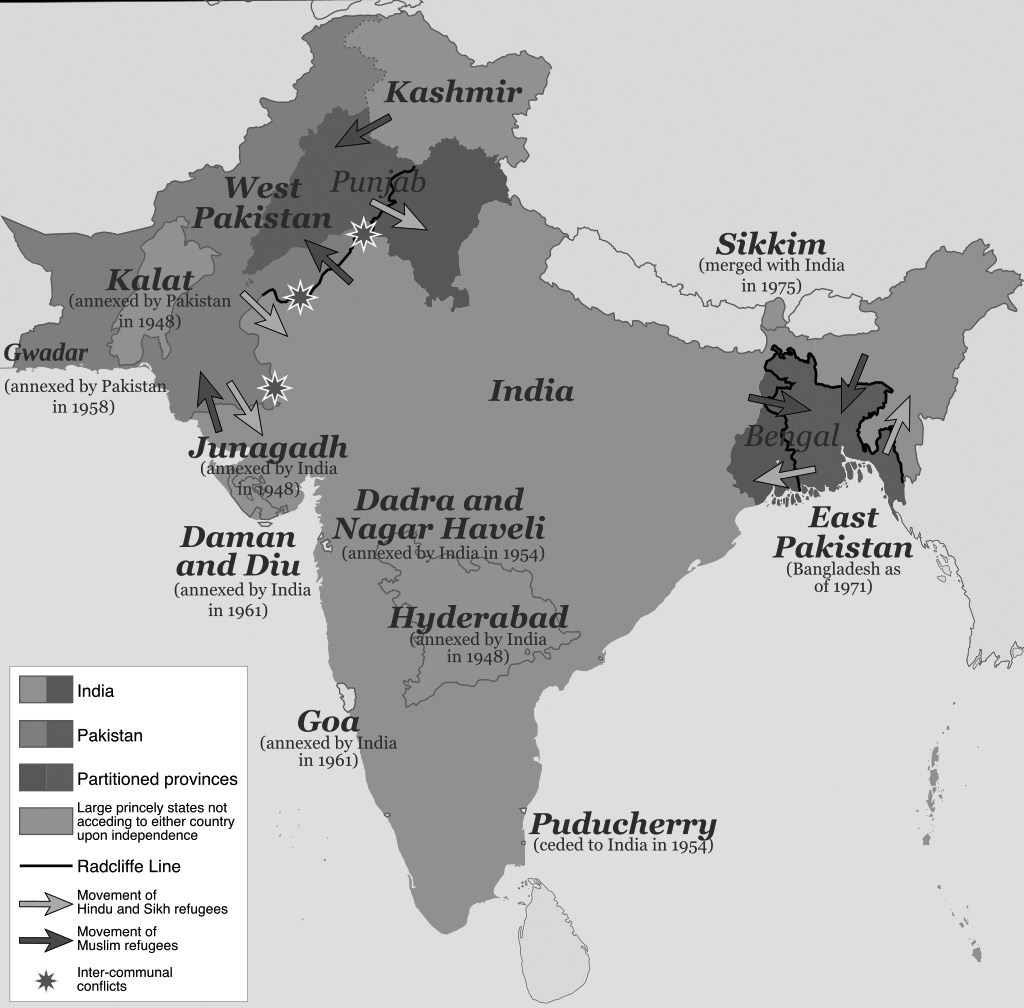
Thus, before August 15, 1947, peaceful negotiations had brought almost all states whose territories were contiguous to the new boundaries of India, into the Indian Union. However, the accession of the princely states of Junagadh, Hyderabad, Kashmir and Manipur proved more difficult than the rest.
Junagadh:
• Junagadh was a small state on the coast of Saurashtra, surrounded by Indian territory and, therefore, without any geographical contiguity with Pakistan. Yet, Nawab Mohabbat Khan announced the accession of his state to
Pakistan on 15 August 1947, even though the people of the state, overwhelmingly Hindu, desired to join India.
• The Indian nationalist leaders had for decades stood for the sovereignty of the people against the claims of the princes. It was, therefore, not surprising that in Junagadh’s case, Nehru and Patel agreed that the final voice should be that of the people as ascertained through a plebiscite.
• People of the state organised a popular movement and a group of Junagarh people forced the Nawab to flee and formed Aarze Hukumat (Provisional government). It was led by Samal Das Gandhi. The Dewan of Junagadh, Shah
Nawaz Bhutto, the father of the more famous Zulfiqar Ali Bhutto now decided to invite the Government of India to intervene. Indian troops marched into the state. Later, a plebiscite was held in the state on 20 February 1948, which favoured joining India.
Kashmir:
• Kashmir, a region bordering both India and Pakistan, had a Hindu ruler, Maharaja Hari Singh, while nearly 75 percent of its population was Muslim. Hari Singh was reluctant to accede to either India or Pakistan, hoping to remain independent due to his fear of the communal tensions in Pakistan and the democracy in India. His aim was to retain power as an independent ruler.
• However, the political forces led by Sheikh Abdullah and the National Conference in Kashmir were in favor of joining India. Indian leaders, consistent with their approach, wanted the people of Kashmir to decide their future by linking their fate to either India or Pakistan.
• On August 15, Hari Singh proposed a standstill agreement with both India and Pakistan, allowing the free movement of people and goods. Pakistan agreed, but India chose to wait and observe, refraining from signing the agreement. Pakistan, growing impatient, began violating the terms of the agreement.
• Mehar Chand Mahajan, the then Prime Minister of Kashmir, raised concerns with the British government about the economic blockade and the violation of the standstill agreement. Reports of atrocities committed by the Maharaja’s forces against the Muslim population in Poonch only intensified the civil unrest.
• On October 22, a group of Pathan tribesmen, unofficially led by a Pakistani army officer, invaded Kashmir from the north, advancing up to Baramulla, and pushing further towards Srinagar.
• In a state of panic, Hari Singh appealed to India for military help on October 24. Mountbatten, the Governor- General of India, pointed out that under international law, India could only send troops after Kashmir’s formal accession. Sheikh Abdullah and Sardar Patel also insisted on the need for accession. On October 26, Hari Singh formally acceded to India and agreed to make Abdullah the head of Kashmir’s administration.
• On October 27, around 100 Indian planes airlifted troops and weapons to Srinagar. While Pakistan’s army withdrew from the main valley, they continued occupying large parts of Gilgit and Baltistan. Indian soldiers, alongside National Conference volunteers, worked together to drive out the Pakistani infiltrators. Sheikh Abdullah became the Prime Minister of Kashmir.
• In November 1947, Mountbatten travelled to Lahore for a peace mission and met with Jinnah. However, no agreement could be reached. Jinnah claimed that Kashmir’s accession had been based on fraud and
violence. Nehru, in response, wrote to Hari Singh, emphasizing the need for a final resolution on Kashmir’s status.
Kashmir issue in UNSC:
• Worried about the potential for a full-scale war between India and Pakistan, the Government of India agreed on December 30, 1947, following Mountbatten’s suggestion, to bring the Kashmir issue before the United Nations Security Council (UNSC), requesting the withdrawal of Pakistani forces from the region.
• At the Security Council, the focus of the issue shifted from being solely about Kashmir to a broader “India- Pakistan question.” This shift was partly due to the efforts of Pakistan’s representative, Sir Zafarullah Khan, who framed the issue as a result of the partition violence in northern India. Consequently, Kashmir’s status became an unresolved legacy of partition.
• Nehru would later regret this decision, as instead of addressing Pakistan’s aggression, the Security Council— backed by Britain and the United States—leaned toward supporting Pakistan’s stance.
• On April 21, 1948, the Security Council passed Resolution 47, calling for a ceasefire between India and Pakistan. In 1951, Kashmir’s constituent assembly met in Srinagar to draft a constitution, formally ratifying the state’s accession to India in 1954.
• That same year, the UN proposed a resolution for a referendum under its supervision, contingent on Pakistan withdrawing its troops. However, this resolution failed as Pakistan never pulled back its forces from what is known as Azad Kashmir or Pakistan-occupied Kashmir.
Since then, Kashmir has remained a significant barrier to improving relations between India and Pakistan. India views the region’s accession as final and non-negotiable, while Pakistan disputes this claim. Over time, Kashmir has come to symbolize and test India’s commitment to secularism, as Nehru once put it as essential to the triumph of secularism over communalism in India.
Hyderabad
• Hyderabad was the largest princely state in India, entirely surrounded by Indian territory. Today, parts of the old Hyderabad state are now in Maharashtra, Karnataka, and Andhra Pradesh. The ruler, known as the Nizam, was one of the wealthiest individuals in the world.
• The Nizam was the third Indian ruler to refuse to accede to India before August 15, 1947. Instead, he declared Hyderabad’s independence, and with encouragement from Pakistan, began to expand his military forces. However, Sardar Patel was not in a rush to force a resolution, especially since Mountbatten was eager to act as a mediator and reach a negotiated settlement with him.
In November 1947, the Indian government signed a standstill agreement with the Nizam, hoping that during the ongoing negotiations, he would establish a more representative government, making the merger smoother.
• But the Nizam had different plans. He enlisted the help of Sir Walter Monckton, a prominent British lawyer and Mountbatten’s friend, to negotiate on his behalf. The Nizam hoped to delay the negotiations, strengthen his military position, and force India to recognize his sovereignty. Alternatively, he considered the possibility of acceding to Pakistan, particularly given the rising tensions between India and Pakistan over Kashmir.
Meanwhile, three other political developments took place within the state:
• The growth of the militant Muslim communal group, Majlis-e-Ittehad-ul Muslimeen (MIM), and its paramilitary wing, the Razakars, was rapid, with support from official channels.
• On August 7, 1947, the Hyderabad State Congress launched a powerful satyagraha movement to push the Nizam towards democratization. This led to attacks by the Razakars and harsh repression by state authorities, causing thousands of people to flee the state and seek refuge in temporary camps in Indian territory.
• In the Telangana region, a strong Communist-led peasant movement had been growing since mid-1946. Though it had faced significant repression by the end of 1946, the movement gained momentum again when peasant squads organized to defend against Razakars attacks. These groups targeted large landlords, redistributing their land to the peasants and landless.
• By June 1948, Sardar Patel, frustrated with the prolonged negotiations with the Nizam, wrote to Nehru from his sickbed in Dehradun, expressing that it was time to demand unqualified acceptance of accession and the introduction of a fully responsible government.
• After a prolonged period of restraint, despite provocations from the Nizam’s administration, including arms imports and Razakars atrocities, the Indian Army entered Hyderabad on September 13, 1948. This operation, known as Operation Polo, led to the Nizam’s surrender within three days. He formally acceded to the Indian Union in November 1948. In a gesture of generosity, the government allowed him to retain his title as Rajpramukh and granted him a privy purse of Rs 5 million.
The accession of Hyderabad completed the process of accession of princely states to India. Its significance also lies in the fact that it marked the triumph of Indian secularism as a large number of Muslims in Hyderabad joined in the anti- Nizam struggle along with Muslims throughout the country supporting the government.
Manipur
• Maharaja Bodh Chandra Singh of Manipur signed the Instrument of Accession with the Indian government,
with the assurance that the state’s internal autonomy would be preserved.
• Under pressure from public opinion, the Maharaja held elections in June 1948, making Manipur the first part of India to conduct elections based on universal adult franchise. This also led to the formation of a constitutional monarchy in the state.
• Despite this progress, there was some opposition to Manipur’s merger with India. While the state Congress supported it, other political parties in the region were against the idea.
• The Indian government eventually succeeded in pressuring the Maharaja to sign a Merger Agreement in September 1949, without consulting Manipur’s popularly elected Legislative Assembly. This move sparked widespread anger and resentment in the state, the effects of which continue to be felt today
Other States
Smaller states were either merged with the neighbouring states or merged to ‘form centrally administered areas. A large number of states were consolidated into five new unions, forming Madhya Bharat, Rajasthan, Patiala and East Punjab States Union [PEPSU], Saurashtra and Travancore- Cochin. However, Mysore, Hyderabad and Jammu and Kashmir retained their original form as separate states of the Union.
In return for their surrender of all power and authority, the rulers of major states were given privy purses in perpetuity, free of all taxes. The rulers were allowed succession to the gaddi and retained certain privileges such as keeping their titles, flying their personal flags and gun salutes on ceremonial occasions.
French and Portuguese Settlement
French and Portuguese settlement
Two significant trouble spots remained in the Indian political landscape—French and Portuguese-controlled settlements along the east and west coasts, particularly Pondicherry and Goa. The people living in these areas were eager to join the newly independent India.
The French authorities, after lengthy negotiations, agreed to transfer Pondicherry and their other possessions to India in 1954. Their approach was more cooperative and pragmatic.
On the other hand, the Portuguese were resolute in their decision to hold on to their territories, supported by NATO allies like Britain and the US, who backed Portugal’s stance.
While the Government of India remained committed to resolving international disputes through peaceful means, it initially refrained from using military force to liberate Goa and other Portuguese-held territories.
The people of Goa, however, took matters into their own hands and launched a movement for freedom, which was met with severe repression, including the brutal suppression of nonviolent protests from India aimed at marching into Goa.
Finally, after waiting for international pressure on Portugal to mount, Nehru decided to take military action. On the night of 17 December 1961, Indian troops marched into Goa under Operation Vijay. The Portuguese Governor- General of Goa surrendered without a fight, and India completed its territorial and political integration, a process that had taken over fourteen years.
The Language Problem
The Language Problem
The language problem was the most divisive issue in the first twenty years of independent India, and it created apprehension among many that the political and cultural unity of the country was in danger. People love their language as it is an integral part of the culture. Consequently, linguistic identity has been a strong force in all societies. This is even more true of a multilingual society like India’s.
Linguistic diversity would inevitably give birth to strong political currents around issues linked to languages, such as educational and economic development, job and other economic opportunities, and access to political power. The challenges posed to national consolidation by linguistic diversity manifested in two ways
Official Language Debate
• Official Language Debate
The controversy over the language issue became especially intense when it evolved into opposition against Hindi, creating a rift between Hindi-speaking and non- Hindi-speaking regions of the country.
The dispute wasn’t about choosing a national language— one common language that all Indians would eventually adopt since the idea that a single national language was crucial to India’s identity had already been largely rejected by the secular majority of the national leadership. India was a multilingual country and it needed to remain that way.
The question of a national language was settled when the constitution recognized all major languages as “languages of India.”
Gandhi, considering English a foreign language, opposed the idea of it being the sole medium of communication in free India.
The time frame for transitioning from English to Hindi also sparked tension. Proponents of Hindi wanted an immediate shift, while those from non-Hindi areas favoured retaining English for a longer, if not indefinite, period.
Nehru supported Hindi as the official language but also advocated for the continued use of English as an additional official language.
The case for Hindi was based on the fact that it was spoken by the largest number of people, though not a majority, and was understood in many urban areas across northern India, from Bengal to Punjab, and in Maharashtra and Gujarat.
However, one major flaw in the Hindi movement was its attempt to Sanskritize the language—replacing common, widely understood words with newly coined, often cumbersome terms. This effort to ‘purify’ the language made it harder for both non-Hindi speakers and even Hindi speakers to understand or learn.
Critics of Hindi argued that it was underdeveloped as a literary language especially in fields like science and politics. However, their primary concern was that making Hindi the official language would disadvantage non-Hindi regions, especially South India, in areas like education and employment, particularly in securing government and public sector jobs.
Language provisions in the constitution
The constitution designated Hindi, written in the Devanagari script with international numerals, as India’s official language.
English was to be used for all official purposes until 1965, after which it would gradually be replaced by Hindi. However, Parliament could allow English to be used for specific purposes even after 1965.
The government was tasked with promoting the spread and development of Hindi. To monitor progress, a commission and a Joint Parliamentary Committee were to be set up.
State legislatures were given the authority to decide the official language at the state level, but the official language of the Union would be used for communication between the states and the Centre, as well as between the states themselves.
The constitution’s framers hoped that by 1965, Hindi would have overcome its weaknesses and gained acceptance in non-Hindi areas. They also anticipated that with the rapid spread of education, Hindi would gradually become more widely spoken and resistance to it would fade. Unfortunately, the spread of education was slower than expected, and the impact was not significant.
In 1956, the Official Language Commission, which was set up in 1955, recommended that Hindi should progressively replace English in central government functions, with the change becoming effective in 1965. However, two members of the commission, one from West Bengal and one from Tamil Nadu, dissented, accusing the rest of the commission of a pro-Hindi bias.
The commission’s report was reviewed by a Joint Parliamentary Committee, and in April 1960, the President issued an order that after 1965, Hindi would become the principal official language, with English continuing as an
associate official language without restrictions on its use.
Following the President’s directive, the central government took several steps to promote Hindi, including establishing the Central Hindi Directorate, publishing standard works in Hindi, making Hindi training mandatory for central government employees, and translating major legal texts into Hindi for use in the courts.
These measures raised concerns in non-Hindi areas. To ease these fears, Nehru assured Parliament in 1959 that English would continue as an alternative language for as long as people needed it.
Official Language Act
In 1963, the Official Languages Act was passed.
The objective of the Act was to remove a restriction that had been placed by the constitution on the use of English after a certain date namely 1965.
The Act laid down that ‘the English language “may “continue to be used in addition to Hindi’.
Non-Hindi groups raised concerns over the use of the word “may” instead of “shall,” arguing that it left too much room for ambiguity.
In response, many non-Hindi leaders, who had previously called for a slower transition away from English, now shifted their stance and demanded the complete removal of a deadline for the language shift. Leaders like C. Rajagopalachari and the Dravida Munnetra Kazhagam (DMK) called for an amendment to the constitution, proposing that English be made India’s sole official language.
Protests in Tamil Nadu escalated, with students even setting themselves on fire. Two Tamil ministers, C. Subramaniam and Alagesan, resigned in protest. The unrest led to tragic consequences, with 60 people killed in police shootings during the agitation.
In 1967, the Indira Gandhi government amended the Official Languages Act of 1963. The key provisions of the amended Act included:
It clarified Nehru’s 1959 assurance by ensuring English continued as an associate language alongside Hindi for official work at the Centre. Additionally, Hindi would remain an official language in non-Hindi states as long as those states desired it.
The Act introduced an indefinite policy of bilingualism.
The states were to adopt a three-language formula, which included the study of one modern Indian language (preferably from the South) alongside Hindi and English in Hindi-speaking regions, and Hindi, the regional languages, and English in non-Hindi areas.
A resolution was passed in Parliament that public service exams would be conducted in both Hindi and English, as well as in regional languages, with the requirement
that candidates have a working knowledge of Hindi or English.
In July 1967, another important step was taken regarding the language issue. Based on the 1966 Education Commission’s report, the government declared that Indian languages would eventually be used as the medium of instruction at the university level. However, each university would determine its own timeline for implementing this change.
The Linguistic Reorganisation of the States
The Linguistic Reorganisation of the States
• The idea of reorganizing states based on language, an important step toward national consolidation, became a significant issue soon after India gained independence.
• Under British rule, state boundaries were drawn for administrative ease or simply reflected territories annexed by the British or controlled by princely rulers.
• The argument for linguistic states was compelling. Language is deeply tied to culture and the traditions of people, and promoting mass literacy and education is best achieved through the mother tongue.
• This connection between language and identity led Congress to embrace linguistic mobilization after 1919, when it began organizing its regional branches along linguistic lines. In 1921, Congress amended its constitution to reflect this approach, committing itself to redrawing provincial boundaries based on language.
• The issue of linguistic reorganization was brought up early in the Constituent Assembly. In 1948, the Linguistic Provinces Commission, led by Justice S.K. Dar, was tasked with assessing the feasibility of such an idea.
• However, the Dar Commission advised against it, citing potential risks to national unity and administrative challenges. As a result, the Constituent Assembly chose not to include linguistic boundaries in the Constitution. Nevertheless, public discontent, especially in southern India, ensured that the issue remained alive in the political discourse.
JVP committee
• In December 1948, in response to the growing demand for linguistic states, Congress formed a committee called the JVP, made up of Jawaharlal Nehru, Sardar Patel, and Pattabhi Sitaramayya, the Congress president, to reassess the situation.
• The committee recommended against the creation of linguistic states at that time, emphasizing the importance of unity, national security, and economic development as immediate priorities.
• Despite the committee’s stance, the issue of states’ reorganization sparked widespread movements across the country. These protests continued with varying intensity, particularly in the Telugu-speaking regions of the former Madras province, which now includes Tamil Nadu, parts of Andhra Pradesh, Kerala, and Karnataka.
Creation of Andhra Pradesh
• The Vishalandhra movement demanded that the Telugu- speaking areas should be separated from the Madras province of which they were part and be made into a separate Andhra province.
• Potti Sriramulu, a Congress leader and a veteran Gandhian, went on an indefinite fast that led to his death after 56 days. This caused great unrest and resulted in violent outbursts in the Andhra region. People in large numbers took to the streets. Many were injured or lost their lives in police firing.
• Finally, the Prime Minister announced the formation of a separate Andhra state in December 1952.
• The success of the Andhra struggle encouraged other linguistic groups to agitate for their own state or the rectification of their boundaries on a linguistic basis.
Setting up of State Reorganisation Commission
The “States Reorganization Commission” (SRC), chaired by Justice Fazal Ali, was established in 1953 to address the issue of reorganizing Indian states along linguistic lines. The commission submitted its report in 1955, which significantly influenced the restructuring of states based on language. Here are some of its key recommendations:
• Linguistic Basis: The commission proposed that states’ boundaries be drawn based on the majority language spoken in each region.
• Creation of New States: It recommended the formation of new states based on linguistic communities to better address cultural and administrative needs.
• Multilingual States: In areas with diverse linguistic groups, the commission suggested creating multilingual states to represent all communities fairly.
• State Size: The commission emphasized that states should be of a manageable size to ensure effective governance.
• National Capital: It proposed that Delhi become a separate union territory, designated as the national capital.
• Special Status: The commission recommended granting special status to tribal and culturally distinct regions to preserve their unique identities.
• Boundary Adjustments: The report also suggested realigning the borders of some states to better reflect linguistic and administrative needs.
• Language Promotion: It emphasized the importance of promoting regional languages in education, administration, and public life.
Thus, the States Reorganization Commission concluded that states should align with linguistic boundaries. Based on the SRC’s recommendations, the States Reorganization Act was passed in 1956, creating 14 states and 6 union territories.
Initially, there were concerns that forming linguistic states might threaten national unity and lead to separatism.
However, history has shown that linguistic loyalty has been more complementary to national unity than a divisive force. By reorganizing states along linguistic lines, the government addressed a significant source of discontent, preventing potential divisions. This reorganization is often seen as a crucial step towards national integration.
As political scientist Rajni Kothari stated, "despite initial concerns, the reorganization successfully rationalized India’s political map. It helped resolve deep-seated grievances and created more cohesive units, governed in a language understood by the majority. In this way, language became a unifying rather than a divisive force."
The formation of linguistic states strengthened the cause of Indian unity
The formation of linguistic states in India, primarily carried out in the 1950s and 1960s, was driven by considerations of language and culture. Its impact on Indian unity has been both positive and complex, shaped by various factors and viewpoints:
Positive Aspects
Promotion of Cultural and Linguistic Identity: By creating states based on language, communities have been able to preserve and promote their unique linguistic and cultural identities. This has instilled a sense of pride and belonging, contributing to India’s rich cultural diversity.
Efficient Governance: Linguistic boundaries often align with shared communication and cultural practices, making governance more efficient. It allows for smoother administration and better service delivery, as people speak the same language and understand local issues more intimately.
Reduced Regional Disparities: Reorganizing states along linguistic lines has sometimes reduced regional inequalities. States with a shared language can tailor their development policies more effectively to meet the needs of their populations, leading to targeted growth.
Encouragement of National Integration: Respecting linguistic diversity in state formation promotes inclusivity and national unity. It signals that India values and accommodates its diverse cultures, reinforcing the idea of a united but pluralistic nation.
Complex Aspects
Linguistic Diversity: India’s vast linguistic landscape, with hundreds of languages spoken, can lead to some smaller groups feeling left out. The creation of linguistic states risks marginalizing minority languages, potentially fostering fragmentation rather than unity.
Ethnic and Regional Tensions: Linguistic reorganization has sometimes sparked ethnic or regional conflicts. Movements like the demand for Telangana and Gorkhaland highlight how linguistic divisions can also fuel disputes over autonomy and representation.
Need for Balance: Balancing the recognition of linguistic and cultural identities with the need for national unity is a delicate task. India’s cohesion depends on maintaining a sense of national identity while respecting regional aspirations.
Interstate Disputes: The formation of linguistic states has occasionally led to disputes between states over resources, borders, and water-sharing arrangements, which can strain national unity and lead to conflicts.
Conclusion
The creation of linguistic states in India has had a significant impact on the country’s unity. While it has fostered cultural pride, improved governance, and reduced disparities, it has also brought challenges related to linguistic diversity, regional
tensions, and the balancing of local identities with national cohesion. The success of this approach lies in how well the country manages these complexities and ensures that the unity of India is preserved alongside its rich diversity.
Recent Reorganisation of States
Recent Reorganisation of States Chhattisgarh:
Chhattisgarh, now the 26th state of India, was formed on 1 November 2000 after being carved out of Madhya Pradesh.
The idea of a separate Chhattisgarh state has a long history, dating back to the 1920s during the pre-independence era. The State Reorganization Commission, set up in 1955, also considered the demand but ultimately rejected it.
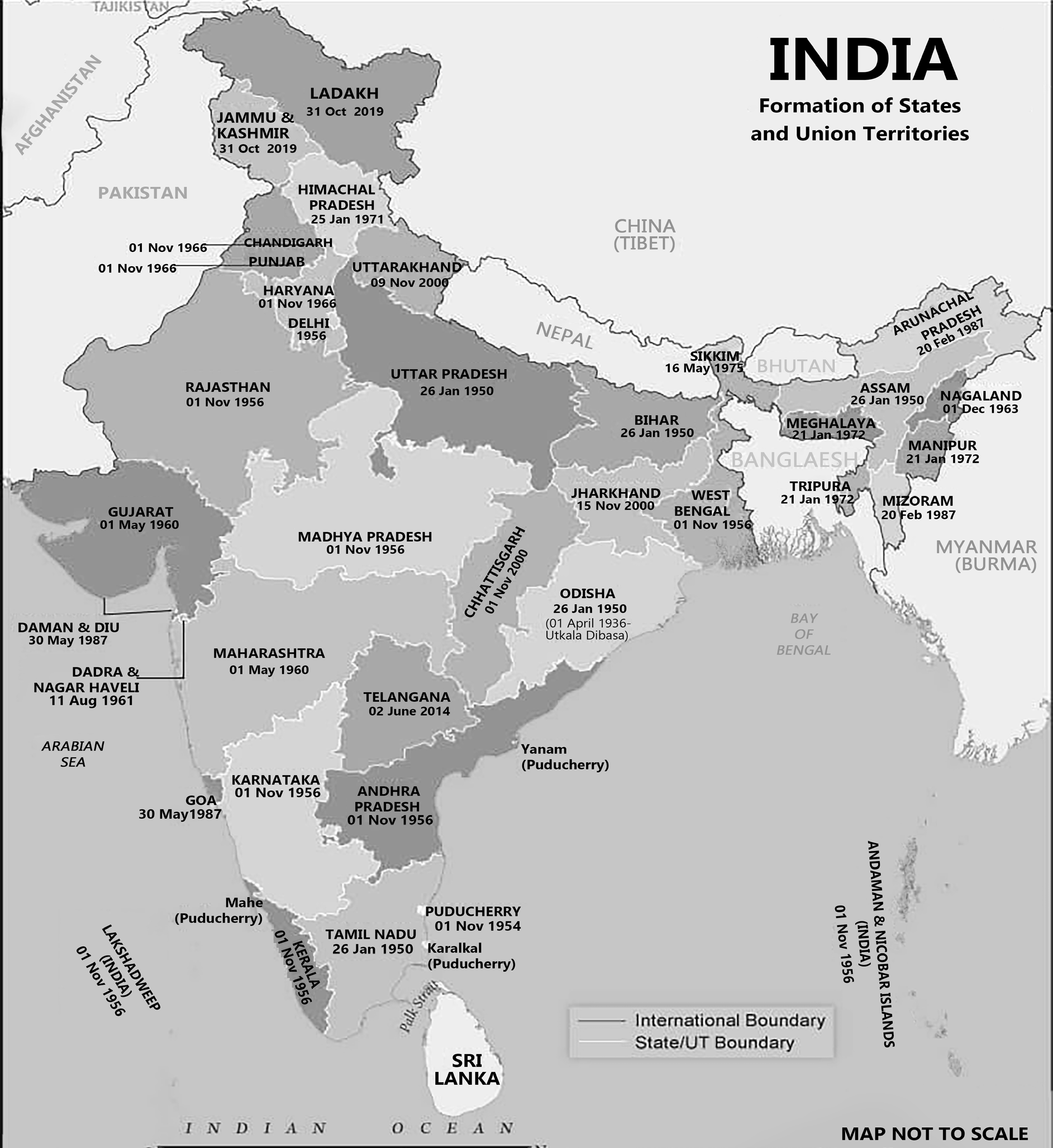
However, in the 1990s, the demand for a separate state gained renewed momentum. The key factors driving this movement included a strong sense of Chhattisgarhi identity, a large tribal population, and the region’s persistent underdevelopment despite its resource-rich status.
The Chhattisgarh Rajya Nirman Manch, led by Chandulal Chandrakar, organized numerous strikes and rallies across the region, garnering support from both the Congress and BJP.
Finally, in 2000, the NDA government recognized the demand and formally carved out Chhattisgarh, making it the 26th state of India.
Uttarakhand:
Uttarakhand, earlier known as Uttaranchal was carved out of Uttar Pradesh on 9th November 2000, as the 27th state of India.
It was the successful culmination of the 70-year-old struggle of the people of the hilly region for a separate state.
Lack of development in geographically unique region (comprising of hills and forest) and rising unemployment gave impetus to the age-old demand for a separate state.
It all started in 1930 when residents of the hill region had moved a resolution by majority vote claiming for a separate Uttarakhand.
Later in 1973, the Uttarakhand Rajya Parishad formed and became a platform for the statehood struggle. This got transformed into Uttaranchal Kranti Dal in 1979.
Later in 1994, the then CM Mulayam Singh Yadav set up a committee for evaluating the demands of Uttarakhand. The committee favoured the formation of the state. Uttaranchal, later to be renamed Uttarakhand in 2006-07, became the 27th state of the union on 9 November 2000.
Jharkhand
Jharkhand, which constituted the tribal areas of Bihar consisting of Chhota Nagpur and the Santhal Pargana, remained subject to the demands for autonomy.
The region has a concentration of several major traditional tribes, like Santhal, HO, Oraon and Munda etc.
With the spread of education & modern activity in the tribal area a movement for a separate state started in the late 1930s & 1940s.
Jharkhand Party was founded in 1950, under the leadership of Jaipal Singh. However, their demand for a separate state got rejected by SRC in 1955.
Later many tribal parties and movements developed to further the demand for a separate state, one of them was Jharkhand Mukti Morcha led by Shibu Soren.
Finally, after a prolonged struggle for their separate state demand, the central government made Jharkhand-28th state of India on November 15th 2000.
Telangana
On 17 September 1948, the Hyderabad state, which included the region of Telangana, was officially merged into the Indian Union. The States Reorganization Commission (SRC) had initially opposed the merger of Telangana with Andhra Pradesh, offering several safeguards to protect the interests of Telangana’s people in the years ahead.
Despite this, in 1956, Telangana was merged with Andhra to create the new state of Andhra Pradesh. However, discontent simmered, and in 1969, agitation erupted under the leadership of Marri Channa Reddy and the Telangana Praja Samiti, though the movement achieved little success for many years.
In 2001, the Telangana Rashtra Samiti (TRS) revived the demand for a separate Telangana state. The movement gained significant momentum, and on November 29, 2009, the TRS launched an indefinite hunger strike. On 9 December 2009, the Indian government announced the beginning of the process for the creation of Telangana. Finally, in 2014, Telangana was granted statehood, becoming the 29th state of India.
Jammu and Kashmir and Ladakh
Article 370 formed the foundation for Jammu and Kashmir’s accession to the Indian Union. Drafted by Prime Minister Sheikh Abdullah, it was included in the Constitution under Part XXI, which addresses Temporary, Transitional, and Special provisions. This article granted Jammu and Kashmir a special status within India.
Sheikh Abdullah had intended for this provision to be permanent, but the central government deemed it unreasonable, classifying Article 370 as a temporary arrangement. Under this article, Jammu and Kashmir was exempted from many provisions of the Indian Constitution and operated under its own separate constitution.
Derived from Article 370, Article 35A granted the Jammu and Kashmir Assembly the authority to define “permanent residents” of the state and specify their unique rights and privileges.
Abrogation of Article 370
Article 370 has created an emotional and psychological barrier of separatism between the people of Kashmir and the rest of India.
Even the businessmen, bureaucracy, judiciary and politicians have misused this article for their despicable purposes.
The poor and down-trodden people have been exploited. The rich have used article 370 to ensure that no financial legislation is passed because if that happens these people would become accountable for all the loots.
Article 370 has also been used to deny the fair share of the economic pie to Ladakh and Jammu region.
But most importantly this special status has been granted to Kashmir at the cost of India’s safety. However, since independence terrorist groups and terrorism have seen a great boom in Kashmir.
It was included in the constitution to develop the state but the misuse of this special status has made the state underdeveloped. Therefore article 370 and article 35(a) were abrogated on 5th August 2019.
With the new reforms, Ladakh has been formulated into a separate Union Territory without a legislative assembly while Jammu and Kashmir will become a Union Territory with an assembly.
There are still long pending demands for state formation on different basis viz. ethnicity, lack of development and administrative inconvenience. Some of the prominent demands for separate statehood are:
Gorkhaland (WB),
Kamatpur state for Koch Rajbangsi (Assam), Bodoland (Assam),
Vidharbha (MH),
Saurashtra (Gujarat),
Fourfold division of Uttar Pradesh in the form of Harit Pradesh, Awadh Pradesh, Purvanchal and Bundelkhand (some parts of UP and MP).
Demands for separate statehood on various grounds show that language is not the sole glue that can bind people together. Now some people are aspiring for the preservation of their ethnic culture in the form of a separate state and on the other hand some people are aspiring for better development after prolonged apathy and backwardness.
The political and administrative reorganization of states and territories in India has indeed been a continuous and evolving process since the mid-nineteenth century. This reorganization has been driven by various factors, including administrative efficiency, linguistic and cultural considerations, political demands, and the need to address regional disparities. Below, mentioned are from different phases of Indian history:
British Colonial Era (Pre-Independence):
The British colonial administration made several administrative and territorial changes for reasons of governance and revenue collection. For instance, the establishment of the Province of Assam in 1874 involved the reorganization of territories in the northeastern region.
Similarly, the creation of the Central Provinces and Berar in 1861 involved the amalgamation of different regions for better administrative control.
Post-Independence Phase (1947-1956):
India underwent significant political and territorial changes after gaining independence in 1947. The most notable reorganization was the partition of India into two independent nations, India and Pakistan, in 1947.
The first major initiative to reorganize states within the Indian Union came with the appointment of the States Reorganization Commission (SRC) in 1953. The SRC’s recommendations led to the reorganization of states on linguistic lines, which was a significant departure from the colonial-era boundaries.
Andhra Pradesh was the first state to be formed on linguistic lines in 1953, followed by several other linguistic reorganizations, such as the creation of Kerala (1956), Karnataka (1956), and Gujarat (1960).
The reorganization process aimed to promote linguistic and cultural homogeneity and foster a sense of identity among the people.
Post-1960s Reorganizations:
Subsequent to the initial linguistic reorganization, there were further state formations and adjustments. For example, in 1966, the state of Punjab was divided into Punjab and Haryana, with the union territory of Chandigarh serving as their common capital.
In 2000, the state of Bihar was bifurcated to create the new state of Jharkhand, which aimed to address the aspirations of the tribal population and promote their development.
Recent Reorganizations:
In 2019, the state of Jammu and Kashmir was reorganized into two separate union territories—Jammu and Kashmir, and Ladakh. This move had significant political and administrative implications.
Demand-Driven Reorganizations:
Some state reorganizations have been driven by political and public demands. For instance, the formation of Telangana in 2014 was a result of long-standing demands for a separate state by the people of the Telangana region.
In summary, the reorganization of states and territories in India has been a continuous and evolving process influenced by a combination of historical, linguistic, cultural, political, and administrative factors. The aim has been to promote good governance, linguistic and cultural homogeneity, and regional development while addressing the demands and aspirations of different communities and regions within the country.
Impacts of formation of new states
The formation of new states in recent times in India has been a subject of debate and discussion, particularly regarding its impact on the economy. It’s important to note that the creation of new states is a complex process influenced by a variety of factors, and its economic implications can vary depending on several circumstances. Here are some key points to consider
when discussing whether the formation of new states is beneficial or not for the economy of India:
Pros of Creating New States
• Regional Development: One of the primary arguments in favor of creating new states is to promote regional development. Smaller states may have a better chance of focusing on local issues, infrastructure development, and targeted economic growth strategies.
• Administrative Efficiency: Smaller states can potentially lead to more efficient governance and administration. Decision-making may be faster, and resources can be allocated more effectively to address local needs.
• Resource Allocation: New states may receive a fairer share of resources and funds from the central government, leading to more equitable development across regions. This can help reduce economic disparities.
• Job Opportunities: Smaller states may attract investments and industries, creating job opportunities and stimulating economic growth. They can have the flexibility to tailor policies to attract specific industries.
• Local Entrepreneurship: The formation of new states can encourage local entrepreneurship and a sense of ownership over development initiatives, which can contribute to economic vitality.
Cons of Creating New States
Administrative Costs: The process of creating new states can be costly, involving the establishment of new administrative structures, government offices, and infrastructure. These initial costs can strain the economy.
Division of Resources: The division of assets, liabilities, and resources among the new states and the parent state can lead to disputes and challenges in resource allocation.
Economic Disruption: The transition period during the creation of new states can lead to economic disruption, affecting trade, businesses, and livelihoods.
Fragmentation: Excessive division can lead to fragmentation, making it difficult to maintain a cohesive economic policy and strategy at the national level.
Potential for Conflict: In some cases, the creation of new states has been accompanied by ethnic, linguistic, or regional tensions, which can disrupt economic activities and stability.
In conclusion, whether the formation of new states is beneficial or not for the economy of India depends on various factors, including the specific circumstances, the size of the new states, their governance capabilities, and their economic strategies. While creating new states may offer opportunities for regional development and efficient governance, it also presents challenges related to administrative costs, resource allocation, and economic disruption. The impact of such decisions should be carefully assessed and managed to ensure
that they contribute positively to India’s overall economic development and regional equity.
Tribal Integration
Tribal Integration:
Integrating tribal communities into the mainstream was a complex challenge, given the diverse conditions they lived under across the country, their distinct languages, and unique cultures.
While tribal groups are scattered throughout India, their largest concentrations are in states like Madhya Pradesh, Bihar, Orissa, West Bengal, Maharashtra, Gujarat, Rajasthan, and northeastern India. Outside of the Northeast, they are often minorities in their home states.
Tribal people typically reside in hilly and forested regions. During colonial rule, they lived in relative isolation, with traditions, habits, and ways of life that were quite different from those of their non-tribal neighbors. However, except in the Northeast, these groups had engaged with each other socially, culturally, economically, and politically for centuries.
Impact of Colonial Policies on Tribals
Impact of colonial policies on Tribals
Colonial rule dramatically altered the lives of tribal communities, breaking their relative isolation as they were drawn into the broader economy through market forces and the reach of British and princely administrations.
A wave of moneylenders, traders, revenue farmers, middlemen, and petty officials entered tribal areas, disrupting their traditional lifestyles. As a result, many tribals fell deeper into debt and lost their lands to outsiders, often becoming agricultural laborers, sharecroppers, or rack-rented tenants. This led some to retreat further into the hills.
Colonialism also reshaped the tribals’ relationship with the forests. Dependent on them for food, fuel, cattle feed, and raw materials for crafts, tribals found their access to these resources increasingly restricted. The influx of immigrant peasants from the plains, driven by a hunger for land, resulted in widespread deforestation, depriving tribals of their traditional means of survival.
Additionally, the colonial authorities imposed forest laws, bringing large tracts of land under control, which banned shifting cultivation and severely limited tribal access to the forest and its products
Roots of India Tribal Policy
Roots of India’s Tribal Policy
The preservation of the tribal people’s rich social and cultural heritage lay at the heart of the government’s policy of tribal integration.
Prime Minister Nehru was the main influence in shaping the government’s attitude towards the tribals.
Nehru stood for the economic and social development of the tribal people in multifarious ways, especially in the fields of communications, modern medical facilities, agriculture and education.
There were two major approaches regarding the place to be accorded to tribals in Indian society:
One approach was to leave the tribal people alone, uncontaminated by modern influences operating outside their world and to let them stay more or less as they were.
The second approach was that of assimilating them completely and as quickly as possible into the Indian society all around them. The disappearance of the tribal way of life was not to be regretted; it was to be welcomed for that would represent their ‘upliftment’.
Jawaharlal Nehru rejected both of these approaches. Instead Nehru favoured the policy of integrating the tribal people into Indian society, making them an integral part of the Indian nation, even while maintaining their distinct identity and culture.
There were two basic parameters of the Nehruvian approach: ‘the tribal areas have to progress’ and ‘they have to progress in their own way’.
Nehru’s approach was in turn based on the nationalist policy towards tribals since the 1920s when Gandhiji set up ashrams in the tribal areas and promoted constructive work.
There were certain broad guidelines laid down by Nehru, with the help of Verrier Elwin [British Anthropologist] which was called “Tribal Panchsheel”. They are:
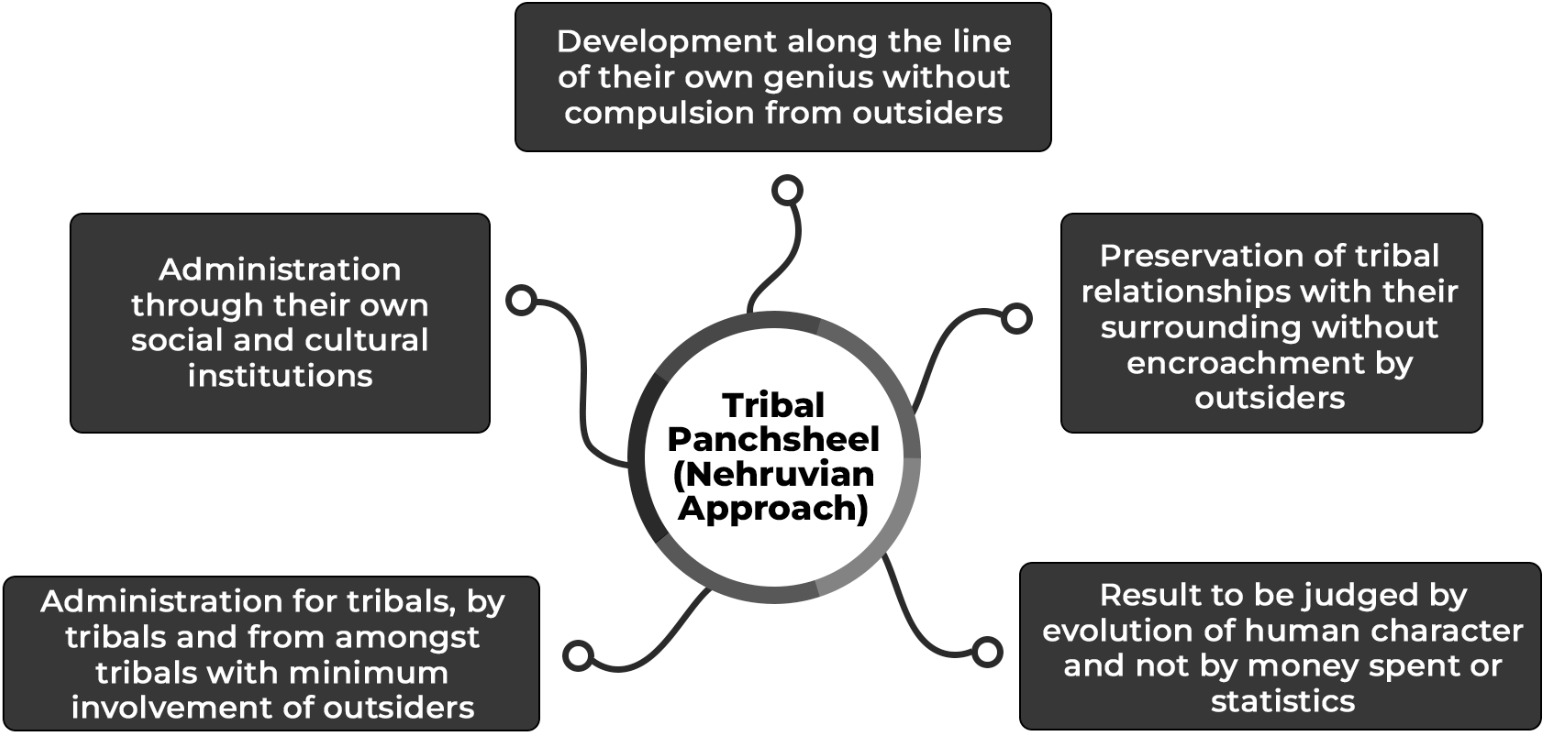
To give shape to the government’s policy, a beginning was made in the constitution itself:
Article 46 of the Indian Constitution mandates that the state must prioritize the educational and economic welfare of tribal communities, offering special care and protection against social injustice and exploitation through dedicated legislation.
Governors of states with tribal areas were given the responsibility to safeguard the interests of tribal people. They had the authority to modify both central and state laws in these areas, ensuring that regulations protected tribal rights, particularly land rights, and shielded them from exploitation by moneylenders.
The Constitution also granted full political rights to tribal communities, including reservations for them in legislative bodies and administrative positions, similar to the provisions made for Scheduled Castes.
Additionally, it called for the establishment of Tribal Advisory Councils in states with significant tribal populations to provide guidance on tribal welfare issues. A Commissioner for Scheduled Castes and Scheduled Tribes was appointed by the President to monitor the enforcement of these protective measures.
Evaluation of the Tribal Policy and Its Impact
Evaluation of the tribal policy and its impact
Despite the constitutional safeguards and the efforts of the central and state governments, the tribals’ progress and welfare have been very slow, and even dismal. Except in the Northeast, the tribals continue to be poor, indebted, landless and often unemployed.
The problem often lies in the weak execution of even well- intentioned measures. Quite often there is a divergence between central and state government policies, the latter being less in tune with tribal interests.
In particular, state governments have been relatively ineffective in administering the positive policies and laws laid down by the central government or by the state governments themselves.
Quite often the funds allocated for tribal welfare are not spent or are spent without corresponding results, or are even misappropriated.
One of the watchdogs of tribal interests, the Tribal Advisory Councils, has not functioned effectively.
Often the administrative personnel are ill-trained or even prejudiced against tribals. But sympathetic officials are also known to be quickly transferred out of tribal areas under the pressure of traders, moneylenders, forest contractors and land-grabbers.
A major handicap from which tribals suffer is the denial of justice, often because of their unfamiliarity with the laws and the legal system. Laws preventing the transfer of land to outsiders have continued to be evaded, leading to the alienation of land and eviction of tribals.
Forest laws and regulations are also used by unsympathetic and often corrupt forest officials to harass and exploit the tribal people.
As a result of the loss of land, deforestation and restrictions on access to the forest, the tribal people have been facing growing unemployment and have been increasingly driven into more inaccessible stretches of hills and jungles.
The progress of education among the tribal people has been disappointingly slow.
Tribal society almost everywhere has also been gradually developing class differences and a class structure with those belonging to the upper crust often joining forces with the upper crust of the outsiders. Further, the major gains of whatever development takes place in the fields of education, employment in administration, economy and political patronage are reaped by the small segment of the tribal elites, which has slowly emerged and grown.
Certain Positive Developments Due to the State
Certain positive developments due to the state’s initiative
Legislation to protect tribal rights & interests, activities of the tribal welfare departments, Panchayati Raj, and Tribal Advisory Councils in all states containing tribal areas to advise on matters concerning the welfare of tribals.
Spread of literacy and education, reservations in government services and Parliament, state assemblies, reservations in higher education institutions, and repeated elections have led to increasing confidence among the tribal people & greater political participation by them.
Even though there are some regions where the benefits of positive discrimination by the states have reached, certain tribal regions are still lagging behind. Protest movements have sprung up among tribals out of their frustration with the lack of development & welfare. Some of the protest movements have taken to violence, leading to strong state action against them.