India’s Relations with Neighbours
India’s Relations with Neighbours
India’s relations with it's neighbours were a central concern and fortunately, till 1962, apart from Pakistan, it was on good terms with all her neighbours.
With Nepal, India signed a Treaty of Peace and Friendship in 1950, which gave Nepal unrestricted access to commercial transit through India, and secured Nepal’s total sovereignty while making both countries responsible for each other’s security.
With Burma, too, the problem of Indian settlers and a long uncharted border were settled amicably. The issue of Tamil settlers in Sri Lanka was not as easy of a solution, and tensions remained, but these did not flare up in this period, and otherwise, amicable ties were maintained.
With Pakistan, however, and in later years with China, serious problems were faced, and the relations with them are discussed at length below
Evolution of India Foreign Policy
Evolution of India’s Foreign Policy
At the time of India’s independence, the global landscape was in turmoil. The world had just endured the devastation of World War II, the United Nations had been established in an effort to create a new international order, and many countries were emerging from colonial rule, seeking to assert their sovereignty on the global stage.
For India, the legacy of British rule presented numerous challenges. The country sought to assert its voice in the world, reflecting its size and rich civilization, while also focusing on ensuring economic progress. These priorities shaped India’s foreign policy in its early years.
India’s pursuit of an independent foreign policy became a key feature of post-1947 politics. Rooted in its history and recent experiences, this policy exhibited significant consistency and continuity over time.
Jawaharlal Nehru is widely regarded as the architect of India’s foreign policy. Serving as both Prime Minister and Foreign Minister, Nehru had a profound influence on shaping and implementing India’s foreign relations from 1947 to 1964.
Nehruvian Consensus
The Nehruvian Consensus was rooted in the ideals and principles shaped by India’s struggle for independence. Anti-racism, anti-apartheid, and anti-imperialism were core values derived from the Gandhian worldview. For Mahatma Gandhi, the fight for political freedom went beyond just the quest for independence; it was a means to achieve moral and cultural freedom, and to regenerate Indian society and civilization.
Nehru absorbed these Gandhian values and aspirations, blending them with his vision for a modern India. He envisioned a sovereign, independent nation focused on rapid economic development to lift its people out of poverty and hunger, and a country that would take its rightful place among the world’s nations.
India’s foreign policy under Nehru was guided by principles such as strengthening multilateral institutions, upholding international law, promoting collective security, and favoring diplomacy and dialogue over war and coercion. The peaceful settlement of disputes, disarmament, non-intervention, and respect for national sovereignty and territorial integrity were key tenets shaping India’s international relations.
The five major objectives of Nehru’s foreign policy were
To preserve hard-earned sovereignty.
Protect territorial integrity.
Promote rapid economic development.
Strengthen Afro-Asian Unity
Promote international peace and security
During Nehru’s era, a basic objective of India’s foreign policy was extending support to colonised and newly de-colonised countries in their struggle against colonialism.
Another objective was that of promoting peace. Nehru constantly emphasized that the peaceful co-existence of countries with different ideologies and differing systems was a necessity and believed that nobody had a monopoly on the truth and that pluralism was a fact of life.
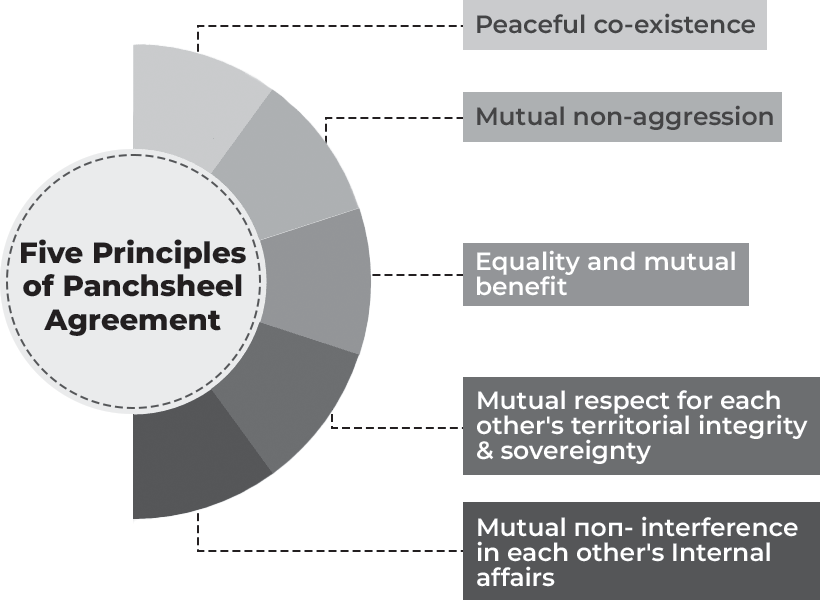
In this context, he outlined what was called “Panchsheel” of India’s Foreign Policy; these were:
Background to the Non-Alignment Policy
The Indian National Movement was part of the global fight against colonialism and imperialism, and India’s struggle inspired liberation movements in many Asian and African nations. These countries maintained communication, united in their shared battle for independence.
Given its size, strategic location, and potential power, Nehru saw India playing a central role in global affairs, especially in Asia.
Throughout the 1940s and 50s, Nehru was a strong proponent of Asian unity. Under his leadership, India hosted the Asian Relations Conference in New Delhi in March 1947. India also backed Indonesia’s fight for freedom from Dutch colonial rule by organizing an international conference in 1949.
India was a passionate supporter of decolonization and took a firm stand against racism, particularly apartheid in South Africa. The Afro-Asian Bandung Conference
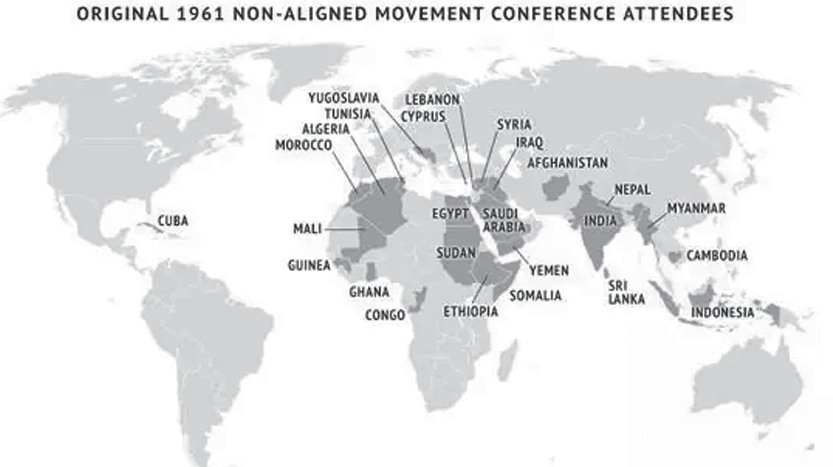
in 1955 marked the height of India’s involvement with newly independent Asian and African nations. The conference eventually led to the formation of the Non- Aligned Movement (NAM), with its first summit held in Belgrade in September 1961.
Non-alignment Policy
Non-Alignment Policy
A nation’s foreign policy is shaped by both domestic and external factors, and India’s foreign policy was deeply influenced by the noble ideals that fuelled its struggle for independence.
However, India’s independence coincided with the onset of the Cold War, a period defined by political, economic, and military rivalry between two superpower-led blocs: the United States and the USSR. Nehru argued that the newly independent nations of Asia and Africa had little to gain by aligning with either of the military blocs. This vision eventually led to the formation of the Non-Aligned Movement (NAM).
Salient features of the Idea of Non-alignment
The leaders of the Non-Aligned Movement (NAM) were committed to expanding the “area of peace” rather than promoting hostility. As a result, India, along with countries like Egypt and Indonesia, opposed joining military alliances such as the Baghdad Pact, the Manila Treaty, SEATO, and CENTO.
Non-alignment came to represent the struggle of India and other newly independent nations to maintain and strengthen their independence from colonialism and imperialism.
In pursuit of a peaceful world, India championed a non-alignment policy aimed at reducing Cold War tensions and contributing personnel to UN peacekeeping operations.
The adoption of non-alignment gave many nations a
stronger voice at the United Nations. The principle of “one country, one vote” allowed the non-aligned bloc to prevent domination by the Western powers, helping democratize international relations.
John Foster Dulles, the former U.S. Secretary of State, criticized the movement as an “immoral neutrality,” but Nehru countered, asserting that non-alignment meant the freedom to evaluate each issue on its merits, to discern right from wrong, and then take a stand for what was right.
By not aligning with any bloc, non-alignment allowed India to build economic ties with countries on both sides of the Cold War divide. India could obtain capital, technology, machinery, and food from Western nations, while also relying on the Soviet Union, after 1954, to help build heavy industries in the public sector when the United States was unwilling to provide assistance.
Relation with Pakistan
Relation with Pakistan
Strained relations with Pakistan owing to the bitter experience of partition further spilled into the international realm on the issue of Kashmir. Pakistan supported tribal invasion of Kashmir and the resultant conflict drew international attention. India had accepted the UN resolution on a ceasefire in spite of its advantageous position and agreed to a plebiscite in Kashmir, on two conditions:
• Pakistan should withdraw its forces from the state of J&K.
• The authority of the Srinagar administration should be restored over the whole state.
Above mentioned first conditions were never fulfilled, so there was no plebiscite there. Meanwhile, J&K participated in India’s general elections and then the talk of a plebiscite remained irrelevant.
However, Kashmir remained a in the bilateral relationship, especially for Pakistan. The issue was used to needle India in the UN as Pakistan became an integral part of the US-led Western alliance as a member of the Central Treaty Organization (CENTO) and South East Asia Treaty Organization (SEATO), the Baghdad Pact and a military act with the US in 1954.
The Kashmir conflict however didn’t prevent cooperation between the government of India and Pakistan. Both the government worked together to restore the abducted women to their original families. Also, a long-term dispute over river water sharing was resolved with World Bank’s mediation and India-Pakistan Indus Water Treaty was signed by Nehru and General Ayub Khan in 1960.
Indus Water Treaty (IWT)
The Indus Water Treaty (IWT) stands out as a rare example of cooperation amidst the long-standing hostility between India and Pakistan. Brokered by the World Bank, the treaty allocates the waters of the Indus River system, defining the rights and responsibilities of both nations.
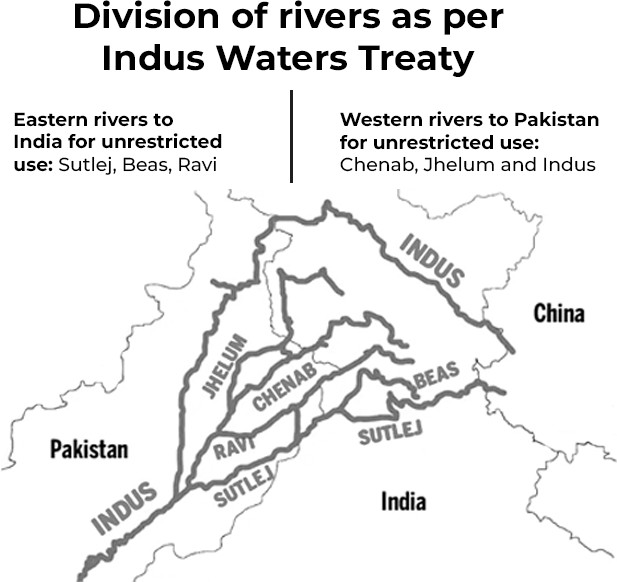
The Indus River originates in the southwestern Tibet Autonomous Region of China, flows through the Kashmir region, and then enters Pakistan, eventually emptying into the Arabian Sea. It is fed by several tributaries, most notably the Jhelum, Chenab, Ravi, Beas, and Sutlej rivers, which flow through the eastern Punjab Plain. The partition of India and the creation of Pakistan resulted in a unique situation: India controlled the headworks, while the canals carrying the water ran through Pakistan.
In 1951, David Lilienthal, former head of the U.S. Atomic Energy Commission, visited the region and proposed that India and Pakistan should work together to jointly develop and manage the Indus River System, with support from the World Bank. The World Bank agreed to facilitate the process, and a solution benefiting both sides was reached.
The Indus Water Treaty was signed on September 19, 1960, by Prime Minister Jawaharlal Nehru and President Ayub Khan. Under the treaty, Pakistan was allocated the waters of the western rivers—the Indus, Jhelum, and Chenab—while India received the waters of the eastern rivers—the Ravi, Beas, and Sutlej.
A Permanent Indus Commission was established, with
one commissioner from each country, to oversee the implementation of the treaty. Additionally, a dispute
settlement mechanism was included to address any issues that might arise.
1965 War
Pakistan continued to seek the accession of Kashmir, even after its defeat by Indian forces in 1947. The first Kashmir war in 1948 convinced Pakistani strategists that they could only engage in asymmetrical warfare against India.
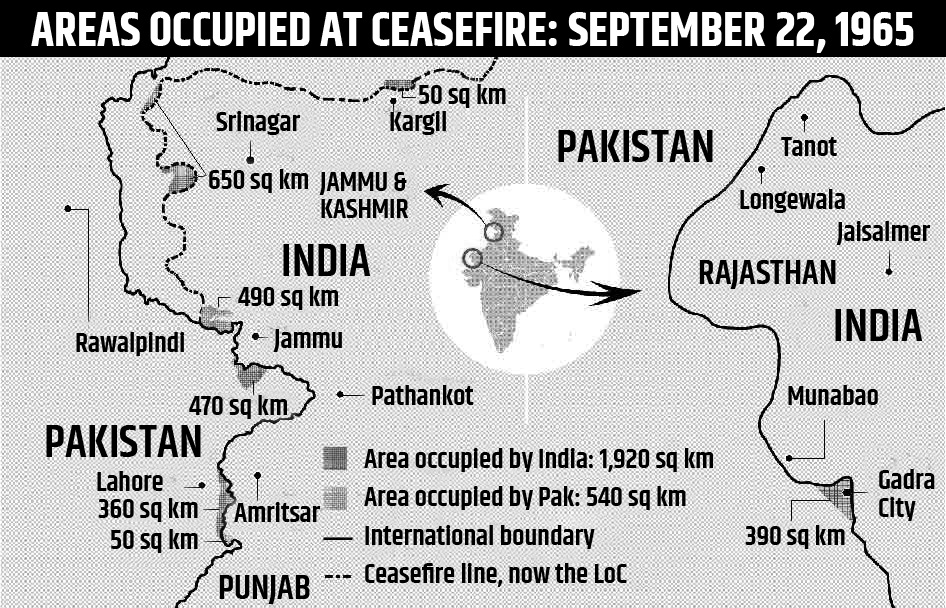
In April 1965, Pakistan initiated an armed incursion in the Rann of Kutch area of Gujarat. Later, in August and September of the same year, Pakistan launched a larger offensive under “Operation Gibraltar” in Jammu and Kashmir, expecting local support for their cause. However, the plan failed as the local population did not back Pakistan.
Pakistan’s strategy was to fuel sabotage and guerrilla activities in Jammu and Kashmir, sending around 30,000 trained infiltrators with the aim of inciting a popular uprising and sabotaging infrastructure.
In response, to relieve pressure on the Kashmir front, Prime Minister Shastri ordered Indian forces to carry out a counter-offensive along the Punjab border. India emerged victorious once again, and hostilities were brought to a halt with the intervention of the United Nations.
Following Soviet mediation, Prime Minister Shastri and Pakistan’s General Ayub Khan signed the Tashkent Agreement in January 1966. Although India won the war, it placed a heavy strain on India’s economy.
Tashkent Agreement
Under the Tashkent Agreement, India and Pakistan agreed to withdraw their forces to pre-conflict positions (as of August 5, 1965) by February 25, 1966.
Both sides also pledged not to interfere in each other’s internal affairs, to discourage propaganda, and to promote friendly dialogue.
The two governments committed to upholding the Vienna Convention of 1961 on diplomatic relations and agreed to restore their respective High Commissions.
They also decided to resume economic cooperation and trade, aiming to foster friendly and peaceful relations. While the agreement was seen as a success at the time, the underlying Indo-Pakistani tensions continued.
The Tashkent Declaration faced criticism in India, particularly for the absence of a no-war pact.
After signing the agreement, Prime Minister Shastri mysteriously died in Tashkent. Officially, his death was attributed to a heart attack, but various conspiracy theories suggest he may have been assassinated.
1971 war
Pakistan was a geographically divided nation, with its two main parts—West Pakistan and East Pakistan— separated by 1,600 kilometres of Indian territory.
East Pakistan, home to a predominantly Bengali-speaking population, represented 60 percent of Pakistan’s total population.
However, the region’s economy was largely controlled by businessmen from West Pakistan.
Though Pakistan could have been a bilingual nation with Urdu and Bengali as official languages, Urdu was declared the sole official language, and the Bengali language was initially rejected. It was only after large-scale protests that Bengali was officially recognized in 1954.
These linguistic and ethnic tensions, compounded by economic disparities, sowed the seeds of unrest in East Pakistan. By the 1970s, resentment against the dominance of West Pakistan was widespread.
The internal crisis intensified following the 1970 elections. Zulfikar Bhutto’s party won in West Pakistan, while Sheikh Mujib-Ur Rahman’s Awami League triumphed in the East. Despite the League’s significant victory, the ruling West Pakistani establishment ignored the democratic outcome, refused to accept the League’s demand for a federal structure, and responded with violence, arresting Rahman and suppressing dissent.
In response, the people of East Pakistan launched a liberation struggle, demanding the creation of Bangladesh. As ethnic nationalism surged, the Mukti Bahini (Liberation Army) took up arms against the Pakistani military.
With a large influx of refugees into India, the Indian government deliberated and eventually extended both material and moral support to the Bengali cause, which was viewed by West Pakistan as an Indian conspiracy to dismantle Pakistan.
The U.S. and China supported West Pakistan in quelling the movement, while India, seeking protection from the American and Chinese-backed Pakistani forces, signed a 20-year Treaty of Peace and Friendship with the Soviet Union.
Despite diplomatic efforts, the situation deteriorated, leading to a full-scale war in December 1971. India entered the conflict on December 3, after East Pakistan requested military assistance. India employed a combination of air strikes, naval blockades, and ground offensives to meet its objectives.
India’s strategy focused on holding Pakistani forces in the West through defensive action, while launching a rapid and decisive campaign in the East.
The U.S. proposed two resolutions in the UN Security Council calling for a ceasefire and mutual withdrawal of troops, but both were vetoed by the Soviet Union.
With the support of the local Mukti Bahini, the Indian military made swift advances and forced the Pakistani forces to surrender in just 10 days.
Following Bangladesh’s emergence as an independent nation, India declared a unilateral ceasefire. The Shimla Agreement, signed in 1972 by Indira Gandhi and Zulfikar Bhutto, restored peace between the two countries. Under the agreement, India agreed to release all 93,000 Pakistani prisoners of war.
The Shimla agreement had three important principles
Mutual commitment to the peaceful resolution of all issues through direct bilateral approaches.
To build the foundation of a cooperative relationship with a focus on people-to-people contacts.
To uphold the inviolability of LOC in Jammu and Kashmir.
Kargil War of 1999
After the debacle of the 1971 war, Pakistan adopted the tactics of proxy war by sending the terrorists trained by their secret agencies to create havoc and panic in J& K and India.
The two countries had also gone nuclear in 1999 which added a new strategic dimension to their bilateral ties. Kargil was the first conventional war between two countries with nuclear weapons. For this reason, the conflict received worldwide attention.
In 1999, the so-called Mujahideens occupied several points on the Indian side of LOC in the Mashkoh, Dras, Kaksar, and Batalik. Suspecting Pak’s hand behind such activities, Indian forces immediately started reach to such proxy war which is known as the “Kargil conflict”.
Operation Vijay saw a mobilization of around 2 lakh Indian troops. Fighting was carried out in very difficult terrain and extremely harsh weather conditions. After two months of conflict, Indian troops had slowly retaken some 70 to 80 per cent of the ridges that were encroached upon by the infiltrators.
By the end of the war, Pakistan had to withdraw under international pressure. Kargil was a fiasco for Pakistan ‘s armed forces and its political leaders. The infiltration had come within months of a successful peace process when the Indian Prime Minister took a bus to travel to Lahore for a dialogue with his Pakistani counterpart Prime Minister Nawaz Sharif. India saw it as the betrayal of the trust Prime Minister Atal Bihari Vajpayee had reposed in Pakistani leadership
Relations with China
Relations with China
From the outset, India adopted a friendly stance towards China. The Congress had long been sympathetic to China’s struggle against imperialism, even sending a medical mission to the country in the 1930s and calling for a boycott of Japanese goods in protest against Japan’s occupation of China. India was the first nation to recognize the newly established People’s Republic of China on January 1, 1950.
Jawaharlal Nehru envisioned a ‘resurgent Asia,’ based on strong friendship between India and China. He believed that, united by their shared history of suffering under colonial powers and common challenges like poverty and underdevelopment, both nations could work together to elevate Asia’s position on the global stage.
Nehru also supported China’s representation in the United Nations Security Council. In 1954, when Nehru and Chinese Premier Zhou Enlai signed the Panchsheel Treaty, India recognized China’s sovereignty over Tibet, accepting Chinese control over the region.
However, tensions began to rise in 1959 after a major revolt in Tibet led to the Dalai Lama fleeing the region, bringing with him thousands of refugees. India granted asylum to the Dalai Lama but refrained from allowing him to establish a government-in-exile or engage in political activities. This moves displeased China, and by October 1959, the Chinese forces fired on an Indian patrol near Kongka Pass in Ladakh, killing five Indian policemen and capturing a dozen others.
1962 War
The relationship took a sharp turn in 1962, when Chinese forces attacked Thagla Ridge, dislodging Indian troops and setting off a series of events that escalated into a full-scale conflict. In October, China launched a major offensive, capturing Indian posts in the eastern sector of NEFA (now Arunachal Pradesh), and overwhelming the region.
In the western sector, Chinese forces seized 13 posts in the Galwan Valley and threatened the Chushul airstrip. Despite India’s attempts to seek assistance from the U.S. and Britain, the Chinese declared a unilateral withdrawal. Still, the war left deep scars, and relations between the two nations remained frosty for years.
Impact of the 1962 War
India had to divert resources meant for economic development and the Third Five-Year Plan to defense, creating a significant economic strain.
In August 1963, Nehru faced a no-confidence motion in the Lok Sabha, reflecting the domestic fallout from the war.
The defeat brought national humiliation, severely damaging India’s image both at home and abroad.
Nehru faced heavy criticism for his misjudgement of China’s intentions and India’s lack of military preparedness.
India’s foreign relations were deeply influenced by the “China factor,” with India’s approach to other nations becoming more cautious.
Relations between India and China remained cold until 1976, when diplomatic normalization began. In 1979, the
first top-level visit to China was made by then Foreign Minister A.B. Vajpayee.
India’s Nuclear Policy Doctrine
Nehru always had a firm belief in the power of science and technology to drive India’s rapid modernization. A crucial part of his industrialization strategy was the nuclear program, which began in the late 1940s, with the guidance of Homi J. Bhabha.
In August 1948, the Indian Atomic Energy Commission was established under the Department of Scientific Research, which had been set up a few months earlier in June 1948. Later, the Department of Atomic Energy (DAE) was formally created on August 3, 1954, directly overseen by the Prime Minister through a Presidential Order. In line with a government resolution from March 1, 1958, the Atomic Energy Commission (AEC) was moved into the Department of Atomic Energy.
India’s nuclear ambitions were focused on peaceful uses of atomic energy. Although Nehru was opposed to nuclear weapons, advocating instead for global nuclear disarmament, he pragmatically supported the development of nuclear technology for peaceful purposes.
In 1974, under Indira Gandhi’s leadership, India conducted its first nuclear test, which it termed a “peaceful explosion.” India maintained that it was committed to using nuclear power only for peaceful applications. This test occurred during a period of domestic economic challenges, including the oil shock of 1973, which caused inflation and economic turmoil in India.
The five permanent members of the UN Security Council—U.S., USSR, France, U.K., and China—who had already developed nuclear weapons, sought to impose the Non-Proliferation Treaty (NPT) in 1968. India rejected the NPT, seeing it as discriminatory, as it applied only to non-nuclear nations and reinforced the nuclear monopoly of the five major powers.
In 1998, India again conducted nuclear tests, asserting its ability to use nuclear technology for military purposes. Pakistan followed suit soon after with its own nuclear tests. In response, the international community-imposed sanctions on both countries, which were later lifted when India pledged to adhere to a policy of no-first-use (NFU) of nuclear weapons and reiterated its commitment to global nuclear disarmament and peaceful nuclear energy use.
In 2003, India officially adopted a Nuclear Doctrine based on the No First Use policy. Key features of this doctrine include
Nuclear weapons are maintained solely for credible minimum deterrence against nuclear attacks.
The NFU policy means India would use nuclear weapons only in retaliation against a nuclear attack.
India would not initiate a nuclear attack against non- nuclear states but retains the option to use nuclear weapons in response to a major chemical or biological attack.
In the event of a nuclear strike on India, the retaliatory second strike would be devastating and cause unacceptable damage to the aggressor.
India Relations with Superpowers During the Cold War
India’s Relations with Superpowers during the Cold War
USA:
• India’s non-alignment policy did not rule out, but in fact sought, a friendly relationship with the United States, the leading global power after World War II.
• India needed technology, machinery, food, and aid to support its development, as well as moral backing for its democratic nation-building efforts—things it believed the US could provide. However, India’s hopes for a close partnership with the US were shaken by the American stance on Kashmir. Throughout the late 1940s and early 1950s, the UN Security Council, dominated by the US and its allies, avoided addressing India’s concerns about Pakistani aggression, even after the UN Commission confirmed the presence of Pakistani troops in Kashmir.
• India’s requests for food aid were delayed, partly because Nehru did not formally ask for it during his 1949 visit to the US, despite detailing the drought crisis. Shipments only came after China and the USSR stepped in to offer assistance. Additionally, the US was displeased by India’s recognition of Communist China in early 1950 and its support for China’s seat in the UN.
• A major source of tension between India and the US stemmed from their differing views on the Cold War. The US, driven by its fear of Communism, struggled to accept that other nations could have different priorities. To Washington, the world seemed divided into two opposing blocs, but from Delhi’s perspective, the situation was more complex.
• It has been suggested that American animosity toward India actually predated its refusal to align with the US in the Cold War. The US establishment, inheriting British colonial attitudes, looked favorably on Pakistan, which had supported the British during the War, while viewing Congress leaders—who had brought down the British Empire—with disdain.
• Nonetheless, it would be misleading to characterize Indo-US relations as entirely hostile. People-to-people connections remained warm, economic ties expanded as the US became a key source of technology, and many influential Indians were sympathetic to the US. Likewise, a significant segment of informed American liberals was supportive of India.
Soviet Union
• India’s relations with the Soviet Union began on a cool note but ended up acquiring great warmth.
• Nehru had from the time of his speech as Vice-President of the interim government in 1946, struck and maintained a friendly approach towards the USSR. He admired the Soviet Union and had visited it in 1927.
• The USSR offered to give military equipment to India in 1954 after Pakistan joined CENTO and SEATO, but consistent with its policy of not accepting free military aid, India refused. In 1955, Nehru paid a highly successful visit to the Soviet Union.
• From 1955, USSR gave full support to the Indian position on Kashmir, and from 1956 used or threatened to use, its veto in the UN Security Council to stall resolutions unfavourable to India on Kashmir. The significance of this cannot be underestimated, as India was in a very awkward situation in the Security Council till the USSR started protecting India.
• The consistent support for Kashmir went far in binding Indo-Soviet friendship. Both countries also took a common stand against colonialism. In the UN, the USSR supported the integration of Goa in opposition to the US.
• The path of economic development that India chose, based on planning and a leading role for the public sector in industrialization, especially in heavy industry, brought India closer to the USSR.
• While the Western powers, especially the US, hesitated to help, the Soviets readily came forward with assistance in the building of the Bhilai steel plant in 1956. Then followed the British in Durgapur and the Germans in Rourkela.
• When relations between India and China began to deteriorate in 1959 with the Dalai Lama seeking refuge in India and military clashes on the Sino-Indian border the USSR did not automatically side with its Communist brother, but remained neutral, which itself was a great achievement at that time.
• In mid 1962, an agreement permitting India to manufacture MiG aircraft was concluded, this being the first time the Soviets had let a non-communist country manufacture sophisticated military equipment which even the Chinese had not been licensed to do.
• The Soviet Union too gained from this link. India was an important entry point to the Afro-Asian world of newly independent countries that did not want to become US satellites and were open to Soviet friendship.
• Indo-Soviet friendship thus emerged as one of the most critical elements of Indian foreign policy.
Points To Remember
• Jawaharlal Nehru is considered as the architect of India’s foreign policy.
• Nehruvian Consensus:
• Nehruvian Consensus was built around the ideals and principles that had developed in the course of India‘s struggle for freedom.
• Nehru’s Panchsheel:
• Mutual respect for each other’s territorial integrity and sovereignty,
• Mutual non-aggression
• Mutual non-interference
• Equality and mutual benefit, and
• Peaceful co-existence.
• Background to the Non-Alignment Policy:
• India was an ardent supporter of the decolonization process and in firm opposition to racism, particularly the apartheid in South Africa.
• The Afro-Asian Bandung Conference 1955, marked the Zenith of India’s engagement with the newly independent Asian and African Nationals.
• The Bandung Conference later led to the establishment of the NAM. The first Summit of the NAM was held in Belgrade in September 1961.
• Non-Alignment Policy:
• The end of the cold war was marked by political, economic, and military confrontation at the global level between the two blocs led by the superpowers, the US and the USSR.
• The leaders of NAM were firm in their view to expand the “area of peace” instead of hostility.
Hence India and other countries like Egypt, and Indonesia did not approve joining of Baghdad Pact, the Manila Treaty, SEATO and CENTO, which were military blocs
• Non-alignment meant having the freedom to decide each issue on its merits, to understand what was right or wrong, and then take a stand in favour of the right.
• Relation with Pakistan:
Kashmir issue
• Indus-water treaty and Permanent Indus Commission
• 1965 war, Operation Gibraltar and the Tashkent Agreement
• 1971 war and the Shimla agreement
• Kargil War of 1999, operation Vijay
• Relations with China:
• India was the first to recognize the new People’s Republic of China on 1 January 1950.
Nehru also supported the representation of China in the UNSC.
1962 War
• Relations between the nations remained cold till 1976. Normal relations resumed in 1976, and later the then foreign minister A.B. Vajpayee was the first top-level leader who visited China in 1979.
• India’s Nuclear Policy Doctrine
• The Indian Atomic Energy Commission was first set up in August 1948 in the Department of Scientific Research.
• The Department of Atomic Energy (DAE) was set up on August 3, 1954
• The Atomic Energy Commission (AEC) was established in the Department of Atomic Energy on March 1, 1958,
• India did not sign Non-Proliferation Treaty (NPT) of 1968.
• No first use of nuclear weapons
• Two nuclear tests- 1974,1998
• In 2003, India officially accepted a Nuclear Doctrine based on the No First Use (NFU) policy.