Political Rise of Other Backward Classes
Political Rise of other backward classes
One long-term development of this period was the rise of Other Backward Classes as a political force. You have already come across the term ‘OBC’. This refers to the administrative category ‘Other Backward Classes’. These are communities other than SC and ST that suffer from educational and social backwardness.
The support for the Congress among many sections of the ‘backward castes’ declined. This created a space for non-Congress parties that drew more support from these communities. The rise of these parties first found political expression at the national level in the form of the Janata
Party government in 1977. Many of the constituents of the Janata Party, like the Bharatiya Kranti Dal and the Samyukta Socialist Party, had a powerful rural base among some sections of the OBC.
Context of 1990s
Context of 1990s
The most crucial development of this period was the defeat of the Congress party in the elections held in 1989. The party that had won as many as 415 seats in the Lok Sabha in 1984 was reduced to only 197 in this election.
The Congress improved its performance and came back to power soon after the mid-term elections held in 1991. But the elections of 1989 marked the end of what political scientists have called the ‘Congress system’.
However, Congress remained an important party and ruled the country more than any other party, even in this period since 1989. But it lost the kind of centrality it earlier enjoyed in the party system.
Another development was the rise of the ‘Mandal issue’ in national politics. This followed the decision by the new National Front government in 1990, to implement the recommendation of the Mandal Commission that jobs in central government should be reserved for the Other Backward Classes. This led to violent ‘anti-Mandal’ protests in different parts of the country.
The economic policy followed by the various governments took a radically different turn in this period. This is known as the initiation of the structural adjustment programme or the new economic reforms. Started by Rajiv Gandhi, these changes first became very visible in 1991 and radically changed the direction that the Indian economy had pursued since Independence.
The assassination of Rajiv Gandhi in May 1991 led to a change in leadership of the Congress party. He was assassinated by a Sri Lankan Tamil linked to the LTTE when he was on an election campaign tour in Tamil Nadu. In the elections of 1991, Congress emerged as the single largest party. Following Rajiv Gandhi’s death, the party chose Narasimha Rao as the Prime Minister.
Kashmir policy of Atal Bihari Vajpayee: Vajpayee believed the ultimate solution to Kashmir and its complete integration in India lay in winning the hearts and minds of Kashmiri people. According to him, issues can be resolved if we move forward guided by the
three principles of Insaniyat (Humanism), Jamhooriyat (Democracy) and Kashmiriyat (Kashmir’s age-old legacy of Hindu-Muslim unity). His soft policy is said to have a profound impact. Faction led by Majid Dar surrendered for peace negotiations making young Kashmiris realise the futility of guns. Elections were conducted in 1996 amidst insurgency creating a democratic atmosphere among people and replacing the scars of fraudulent elections of the past.
The Era of Coalition and Alliance Politics
The Era of Coalition and Alliance Politics
Elections in 1989 led to the defeat of the Congress party but did not result in a majority of any other party. Though the Congress was the largest party in the Lok Sabha, it did not have a clear majority and therefore it decided to sit in the opposition.
The National Front (which itself was an alliance of Janata Dal and some other regional parties) received support from two diametrically opposite political groups: the BJP and the Left Front. On this basis, the National Front formed a coalition government, but the BJP and the Left Front did not join in this government.
Thus, began an era of a multi-party system. Although a large number of political parties always contested elections in our country, what happened after 1989 was the emergence of several parties in such a way that one or two parties did not get most of the votes or seats. This also meant that no single party secured a clear majority of seats in any Lok Sabha election held from 1989 to 2014.
This development initiated an era of coalition governments at the Centre, in which regional parties played a crucial role in forming ruling alliances.
The nineties also saw the emergence of powerful parties and movements that represented the Dalit and backward castes (Other Backward Classes or OBCs). Many of these parties represented powerful regional assertions as well. These parties played an important role in the United Front government that came to power in 1996.
The United Front was similar to the National Front of 1989, for it included Janata Dal and several regional parties.
This time, the BJP did not support the government. The United Front government was supported by the Congress. This shows how unstable the political equations were.
Thus, with the elections of 1989, a long phase of coalition politics began in India. Since then, there have been eleven governments at the Centre, all of which have either been coalition governments or minority governments supported by other parties, which did not join the government.
This applied to the National Front in 1989, the United Front in 1996 and 1997, the NDA in 1997, the BJP-led coalition in 1998, the NDA in 1999, and the UPA in 2004 and 2009.
Mandal Politics
Mandal politics
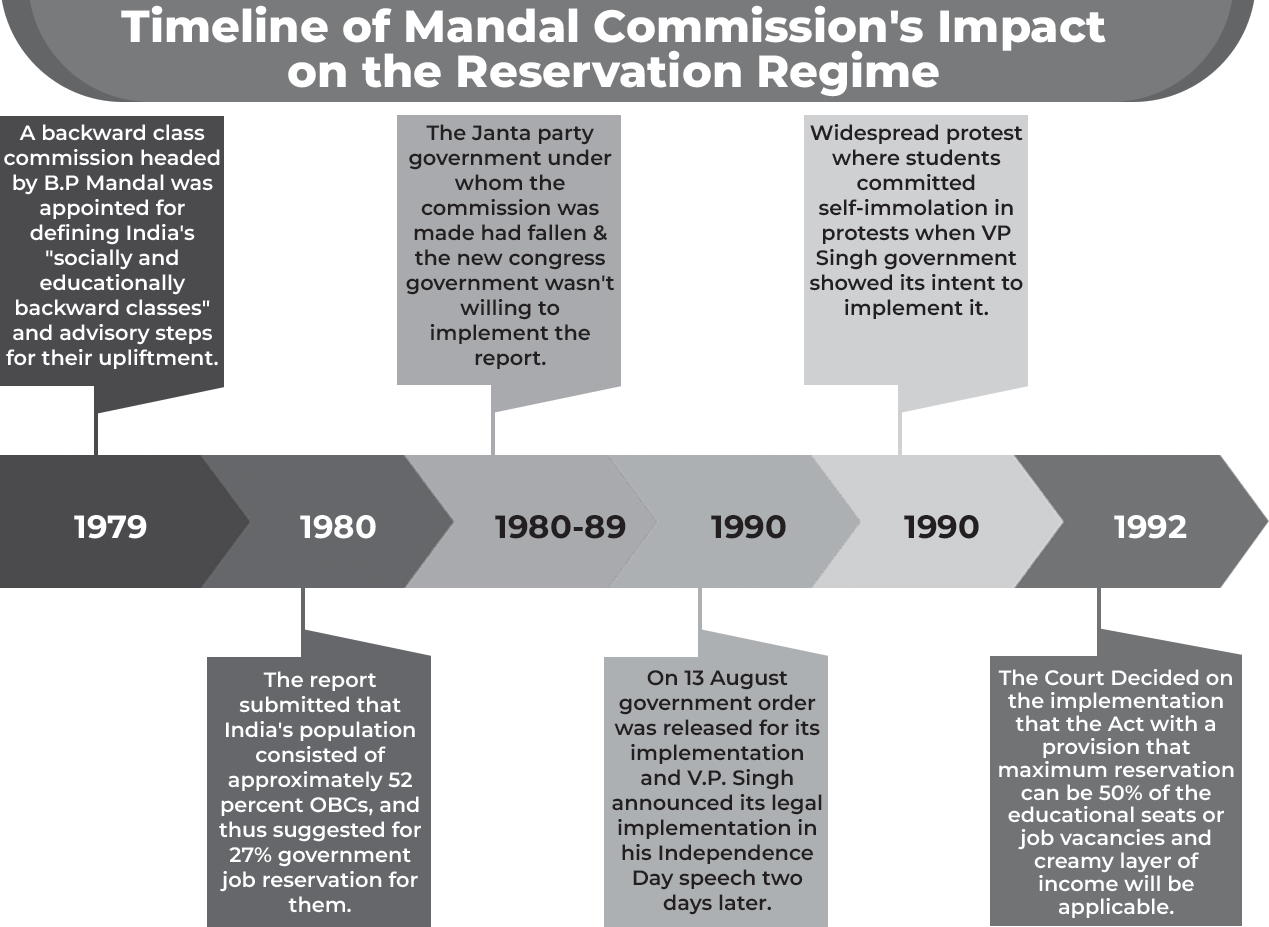
The Government of India set the Mandal Commission up in 1978 to investigate the extent of educational and social backwardness among various sections of Indian Society and recommend ways of identifying these “backward classes”.
Mandal Commission found that the backward caste had a very low presence in both educational institutions and in employment in public services. Hence, it recommended reservations of seats in educational institutions and government jobs for these groups.
The Mandal Commission also made many other recommendations, like land reforms, to improve the conditions of the OBCs.
After a decade of the report, in August 1990, the National Front Government decided to implement one of the recommendations of the Mandal Commission pertaining to reservations for OBCs in jobs in the central government and its undertakings.
This decision sparked agitations and violent protests in many cities of North India. Supreme Court in 1992 upheld the decision of the government.
New Economic Policy 1991
New Economic Policy 1991
• The evolution of the Indian economy from a public sector- dominated socialist pattern to a liberalized open market economy was a slow process.
• The convergence of peculiar circumstances such as the Gulf War, the collapse of the Soviet Union and unstable governments at the centre and the economic crisis as seen in the balance of payment issue in the early 1990s made it imperative for India to respond to the changed scenario.
• The origin of the economic crisis can be traced to the inefficient management of the Indian economy in the 1980s. In the late 1980s, government expenditure began to exceed its revenue by such large margins that it became unsustainable.
• Inflation was soaring, and imports grew in excess of the export to such a level that foreign exchange reserves declined to a level that it was not adequate to finance imports for more than two weeks. Even there was insufficient foreign exchange to pay the interest to international lenders.
• To ward off this precarious situation of the economy,
India approached the World Bank and IMF and received
$7 billion as loans to manage the crisis. In return, these institutions wanted that India should open up the economy by removing restrictions in several sectors, reducing the role of government in many areas, and removing trade restrictions.
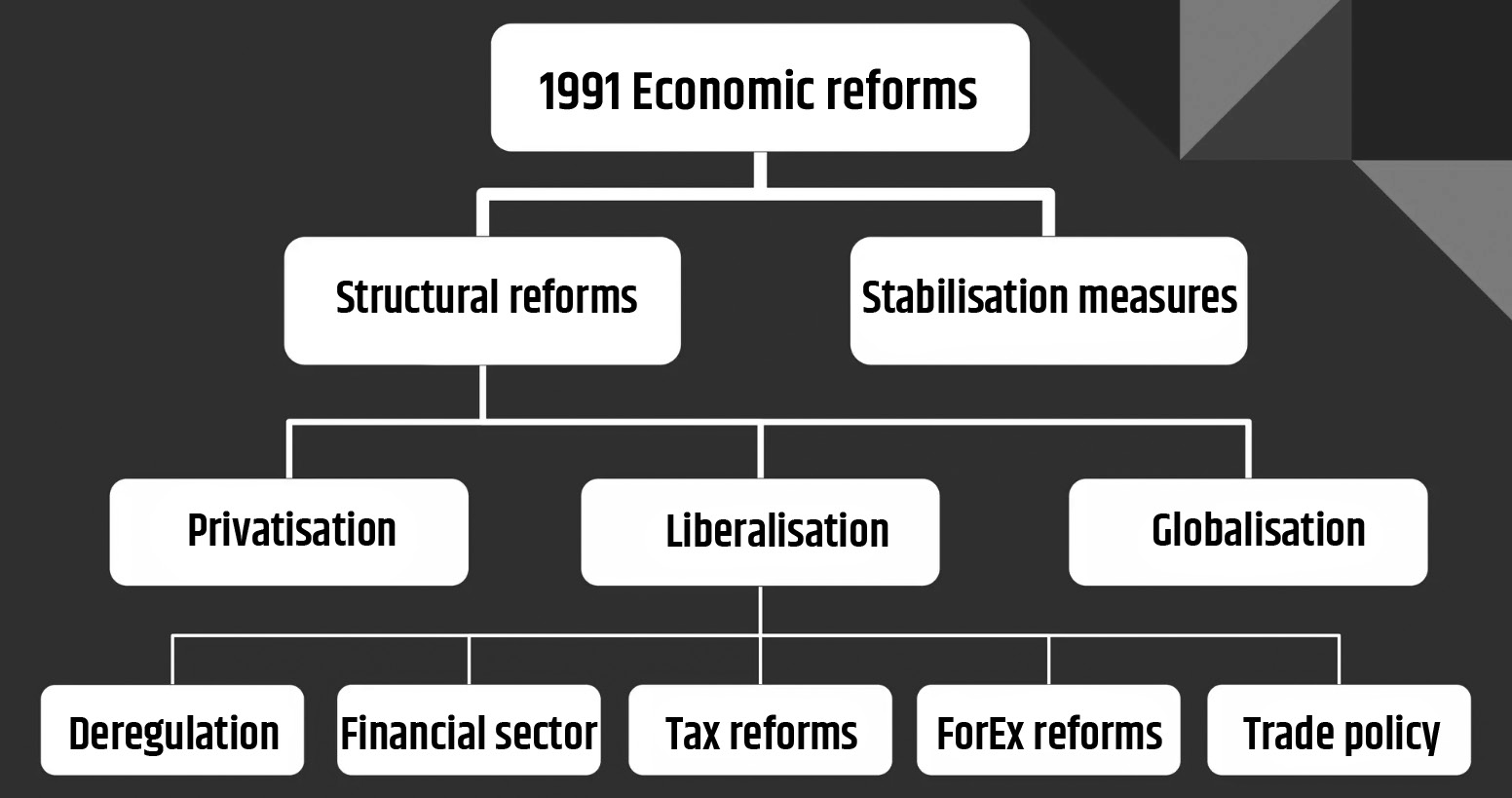
India had no choice but to accept these conditions and announced the New Economic Policy. The crux of the policy was to remove the barrier to the entry of private firms and to create a more competitive environment for the economy. These reforms can be classified into two types
The stabilisation measures (short-term)
The structural reform measures (Long term)
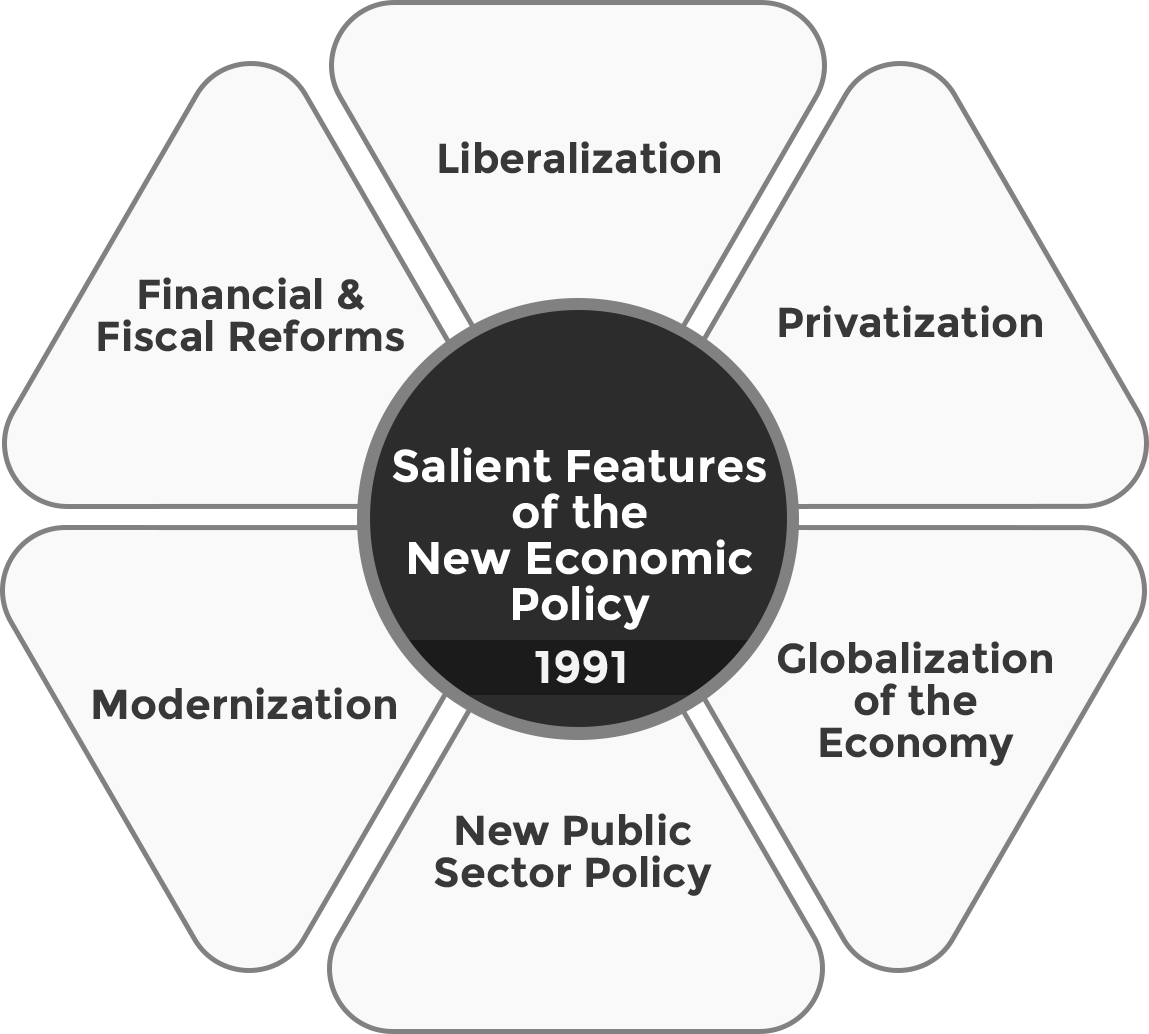
• The government initiated a variety of policies which fall under three heads viz. Liberalization, Privatization and Globalization, “LPG Policy”. The first two are policy strategies & the last one is the outcome of these strategies.
Liberalization
• 1991 reforms were more comprehensive as compared to the reforms of the 1980s. Industrial licensing was abolished for almost all but product categories – alcohol, cigarettes, hazardous chemicals industries, expensive electronics, aerospace drugs and pharmaceuticals.
• The only industries now reserved for the public sector are defence equipment, atomic energy generation and railway transport. In many industries, the market has been allowed to determine the prices.
Financial sector reforms
• The major aim of financial sector reforms was to reduce the role of RBI from regulator to facilitator of the financial sector. In a way, the financial sector may be allowed to take decisions without consulting RBI.
• These reforms led to the establishment of private sector banks, and the entry of foreign banks with certain conditions on FII, such as merchant bankers, mutual funds and pension Funds were not allowed to invest in Indian Financial Markets.
Tax Reforms
• Since 1991, there has been a continuous reduction in the taxes on individual incomes. The rate of corporation tax was reduced; It also initiated simplification of procedures to pay the income tax.
Foreign Exchange Reforms
• Initially, the rupee was devalued against foreign currencies. This led to an increase in the inflow of foreign exchange.
• Now usually, markets determine exchange rates based on the demand and supply of foreign exchange.
Trade and Investment Policy Reforms
• To support the efficiency of the local industries and foster the use of modern technologies, the competitiveness of industrial production was increased and foreign investment and technology were welcomed into the economy.
• Import licensing was abolished except in the case of hazardous and environmentally sensitive industries.
Privatisation
• The government had shed off the ownership and management of various government-owned enterprises. The government started disinvestment by selling off the equity of PSUs. The purpose behind such a move was to improve financial discipline and to facilitate modernisation.
• The government has also made attempts to improve the efficiency of PSUs by giving them autonomy in taking managerial decisions.
Globalization
• Globalization is the outcome of the policies of liberalisation and privatisation.
• Globalization implies greater interdependence and integration. It involves the creation of networks and activities transcending economic social and geographical boundaries. The best example is outsourcing. e.g., BPOs.
• Globalization is a mixed bag of results. On the one hand, it has provided greater access to global markets, imports of high technology, etc. On the other hand, developed countries expand their markets in other countries.
It has also been pointed out that market-driven Globalization has widened the economic disparities between nations and people
The Era of Ict
The Era of ICT (Information and Communication Technology)
The main objective behind any innovation in technology is to ensure that it provides comfort, leisure, productivity and a better quality of life and built environment for its citizen.
In India, the path towards technology-induced development especially associated with ICT was given a vent in 1984 by the Rajiv Gandhi government.
He adopted an effective route to development with a
massive programme of computerization launched in the public sectors as well as in commercial and public sectors undertakings and administrative departments.
By 1985, large sectors had announced computerization plans, which included railways, banking operations, schools etc.
In 1998, National Task Force on Information Technology and Software Development prepared the blueprint for making the adoption of IT a national movement by establishing a wide network of empowered task forces at all governmental & non-governmental levels.
In 1999, the Ministry of Information Technology was established by bringing together government agencies involved in different aspects of IT for creating jobs to harness opportunities provided by the convergence of communication technologies and to facilitate the use of IT in Electronic Governance.
ICT generates new possibilities to address problems of rural poverty, inequality and environmental degradation.
In India, the growth of information technology and communications is very significant in the past two decades. IT Industry in India comprises the software industry and information technology-enabled services [ITES] which also includes the BPO industry.
India is considered a pioneer in software development and a favourite destination for IT-enabled services (ITES).
Many other countries look to India as a model for global outsourcing and try to imitate elements of this in their strategies.
The Government of India and the respective state governments use ICT for the delivery of government information and services to citizens (G2C), businesses [G2B], employees [G2E], and governments [G2G].
The Government of India initiated an e-government programme during the late 1990s by adopting the Information Technology Act in 2000.
The major aims of this Act were to recognise electronic contracts, prevent computer crimes and make electronic filing possible. Later in 2006, the government approved the National E-governance Plan [NeGP) to enhance e-government initiatives in India.
Almost all state governments and UTs have also implemented their own e-government services to serve their citizens and business. Some of the prominent services include “Bhoomi” from Karnataka, “Gyandoot” from the MP, “Smart government” from Andhra Pradesh, and “SARI” from Tamil Nadu
Lok Sabha Elections 2004
Lok Sabha Elections 2004
In the 2004 elections, the Congress party significantly embraced coalition politics.
The National Democratic Alliance (NDA) was defeated,
and a new coalition government, the United Progressive Alliance (UPA), led by Congress, took power with support from the Left Front parties.
The 2004 elections also marked a partial revival for Congress, which increased its seat count for the first time since 1991. However, the difference in votes between Congress and its allies and the BJP-led alliance was minimal.
This shift indicates a dramatic change in the party system since the 1970s.
The political landscape post-1990s has seen the emergence of four broad groups: those aligned with Congress, those supporting BJP, the Left Front parties, and others not aligned with either.
This development suggests a multi-cornered political competition, implying a divergence in political ideologies.
Growing Consensus
Growing Consensus
However, on many crucial issues, a broad agreement has emerged among most parties. In the midst of severe competition and many conflicts, a consensus appears to have emerged among most parties.
This consensus consists of four elements
First is the agreement on new economic policies – while many groups are opposed to the new economic policies, most political parties are in support of the new economic policies. Most parties believe that these policies would lead the country to prosperity and a status of economic power in the world.
Second is acceptance of the political and social claims of the backward castes – political parties have recognised that the social and political claims of the backward castes need to be accepted. As a result, all political parties now support the reservation of seats for the ‘backward classes’ in education and employment.
Third is the acceptance of the role of State level parties in the governance of the country – the distinction between State level and national-level parties is fast becoming less important. State-level parties are sharing power at the national level and have played a central role in the country’s politics for the last twenty years or so.
Fourth is an emphasis on pragmatic considerations rather than ideological positions and political alliances without ideological agreement – coalition politics has shifted the focus of political parties from ideological differences to power-sharing arrangements.
Therefore, all these momentous changes are going to shape Indian politics in the near future.
Sri Lankan Tamils Issue
Sri Lankan Tamils issue
• Communal tensions between the Sinhalese and Tamil communities had been simmering since the early 1940s,
intensifying in the 1950s with the rise of Sinhalese nationalism and violent anti-Tamil riots.
• The Liberation Tigers of Tamil Eelam (LTTE) was formed in 1976, describing itself as the “national freedom movement of the people of Tamil Eelam,” and began a guerrilla war against the Sri Lankan government. This conflict officially started after the killing of 13 soldiers in 1983.
• In 1987, Indian Prime Minister Rajiv Gandhi and Sri Lankan President Jayewardene signed the Indo-Sri Lanka Peace Accord, leading to the deployment of Indian soldiers as part of the Indian Peace Keeping Force (IPKF).
• Although some insurgents agreed to a temporary truce under the IPKF, fighting resumed after the Indian forces withdrew in 1990. The LTTE was also accused of assassinating Rajiv Gandhi in 1991, allegedly in retaliation for his support of Sri Lanka.
• The island remained unstable from 1995 to 2001, with intermittent peace and ongoing violence, especially in the northern and eastern regions. In 2002, a ceasefire agreement was brokered by Norwegian mediators, but it collapsed quickly despite initial concessions from both sides. Violence escalated again after a 2004 LTTE suicide bombing in Colombo.
• In 2008, the Sri Lankan government launched a full-scale offensive against the LTTE, aiming for their complete surrender. The UN estimates that 40,000 civilians were killed during the final months of the war, which ended in May 2009 when the LTTE surrendered.
• In May 2009, the Sri Lankan government declared the LTTE defeated, with rebel leader Velupillai Prabhakaran reportedly killed in the fighting. The UN estimates that 40,000 civilians died during the final phase of the war.
India’s Concerns
• India has long been concerned about the treatment of Tamils in Sri Lanka, given its own sizable Tamil population. In February 2009, India’s foreign minister expressed concern about civilian safety in Sri Lanka and emphasized that a political solution, involving greater power devolution to Sri Lanka’s provinces, was necessary. Under the 1987 accord and the Thirteenth Amendment to Sri Lanka’s constitution, the government had agreed to provide more autonomy to provinces and recognize Tamil as an official language. However, these provisions have never been fully implemented.
Hindu Code Bill
• The Hindu Code Bill aimed to replace the existing body of Hindu personal law, which had been only marginally modified by British authorities. B.R. Ambedkar viewed the Bill as a crucial step in reforming Hindu society.
• He argued that to continue addressing economic issues while leaving untouched the deep-seated inequalities between classes and genders would render the Constitution a mockery, “a palace built on a dung heap.”
• The Bill covered several key areas, including the rights of Hindu women to property, succession, marriage, divorce, adoption, minority, and guardianship. The main proposals of the Bill were:
• Abolishing the birthright to property and the practice of inheritance by survivorship.
• Granting daughters a half-share of inheritance.
• Converting a woman’s limited estate into an absolute estate.
• Eliminating caste restrictions in marriage and adoption.
• Upholding the principle of monogamy.
• Introducing the right to divorce.
• Ambedkar stressed that the Bill would ensure equality between men and women in legal matters. However, the Bill faced strong opposition both from within the Congress party and from the opposition. It was referred to the Select Committee on April 9, 1948, and the parliamentary debates continued for over four years, marking the longest discussion on any single Bill in independent India. Disillusioned by the lack of support from the Congress government, Ambedkar resigned in protest on September 27, 1951.
• Rise of the ‘Mandal issue’ in national politics.
• Initiation of structural adjustment programme or new economic reforms.
• The assassination of Rajiv Gandhi in May 1991
• Insaniyat (Humanism), Jamhooriyat (Democracy) and Kashmiriyat (Kashmir’s age-old legacy of Hindu-Muslim unity) policy of Atal Bihari Vajpayee.
• The Era of Coalition and Alliance Politics:
The National Front formed a coalition government, but BJP and Left Front did not join this government
The emergence of powerful parties and movements representing the Dalit and backward castes (Other Backward Classes or OBCs
Mandal politics:
The Government of India set the Mandal Commission up in 1978
In August 1990, the National Front Government decided to implement recommendation of the Mandal Commission which sparked agitations.
Supreme Court in 1992 upheld the decision of the government.
New Economic Policy 1991:
• The balance of payment crisis in the early 1990s made it imperative for India to respond.
• Soaring inflation, high imports, declining forex, were the major concerns.
• India received $7 billion, as loans from World Bank and IMF to manage the crisis.
• India in return, announced the New Economic Policy or LPG reforms.
The era of ICT (Information and Communication Technology):
ICT was given a vent in 1984 by the Rajiv Gandhi government.
In 1999, the Ministry of Information Technology was established
IT Industry in India comprises the software industry and information technology-enabled services [ITES].
Information Technology Act passed in 2000.
In 2006, the government approved the National E-governance Plan [NeGP] to enhance e-government initiatives in India.
Growing Consensus:
• Consensus consists of 4 elements:
• Agreement on new economic policies
• Acceptance of the political and social claims of the backward castes
• Acceptance of the role of State level parties in the governance
• Pragmatic considerations rather than ideological positions and political alliances without ideological agreement.