Obc Movements
OBC Movements
The Other Backward Classes (OBCs) are those who are as deprived as the S.C.s but without the stigma of untouchability. Andre Beteille, says “The OBC constitute a congeries of communities of rather uncertain status”.
The Kaka Kalelkar Commission appointed by the Government of India identified more than 3000 castes or communities as OBC in 1956.
The Mandal Commission (1980) calculated that 52% of the population, including non-Hindus, constitutes OBCs.
Almost all commissions, except the Rane Commission in Gujarat (1983), used Social, educational and economic criteria for identifying ‘backwardness’.
Environmental Movements
We will explore the dynamic landscape of popular movements that have shaped the socio-political fabric of India. From environmental activism to Dalit and women's movements, we will look into a diverse array of societal change and resistance.
• According to Paul Wilkinson, the concept of Social Movements means a deliberate collective endeavour to promote change in any direction and by any means not excluding violence, illegality, revolution or withdrawal into the utopian community.
• Ghanshyam Shah classifies movements as revolt, rebellion, reforms and revolution to bring about changes
in the political system. According to Parth Mukherji, social movements are accumulative, alternative and transformative in nature.
• Some other classify movements on the basis of the participants such as peasants, tribal, Dalits, women, backwards, students, etc. Many other movements that are based on issues transcending the barriers of class have been termed New Social movements.
Environmental Movements
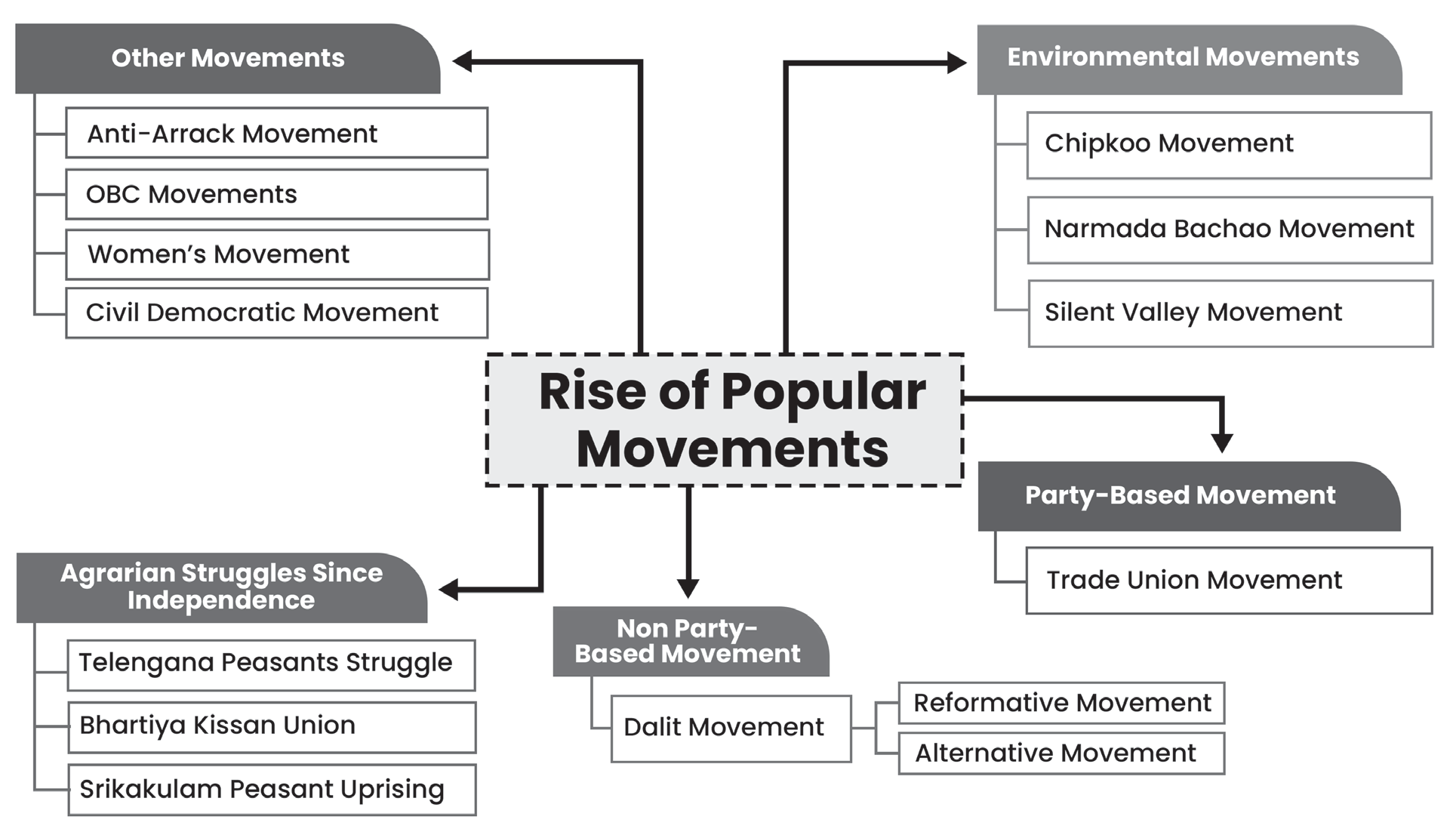
Chipko Movement:
• The Chipko movement began in a few villages in Uttarakhand when the forest department denied villagers permission to cut ash trees for making agricultural tools. Meanwhile, the same land was allotted to a sports manufacturer for commercial purposes.
• This decision angered the villagers, leading them to protest against the government’s actions. The movement quickly spread across the Uttarakhand region.
• It raised broader concerns about the ecological and economic exploitation of the area.
• The villagers demanded that forest-exploiting contracts should be reserved for locals and that local communities should have control over natural resources like land, water, and forests. They also called for government support in providing low-cost materials to small industries while ensuring regional development without disrupting the ecological balance.
• The movement highlighted economic issues, particularly
those of landless forest workers, and called for guarantees of a minimum wage.
• One of the unique aspects of the Chipko movement was the active participation of women.
• Forest contractors in the region also served as alcohol suppliers to men, and women took a strong stand against alcoholism, broadening the movement’s scope to include other social issues.
• The movement achieved success when the government imposed a 15-year ban on tree felling in the Himalayan region until the green cover was fully restored. More importantly, the Chipko movement, which began over a single issue, became a symbol of many popular movements that emerged across India in the 1970s and beyond.
Narmada Bachao Andolan:
• In the early 1980s, an ambitious developmental project was initiated in the Narmada Valley of central India. The project aimed to build 30 large dams, 135 medium- sized dams, and around 3,000 smaller dams across the Narmada and its tributaries, spanning three states: Madhya Pradesh, Gujarat, and Maharashtra.
• Among the key components of the project were the Sardar Sarovar Project in Gujarat and the Narmada Sagar Project in Madhya Pradesh. These dams were designed to provide drinking water, water for irrigation, generate electricity, and boost agricultural production.
• However, the project also required the relocation of around 250,000 people, and 245 villages were expected to be submerged. Initially, local communities demanded proper relocation and rehabilitation. By the late 1980s, this issue evolved into a major movement under the banner of the Narmada Bachao Andolan (NBA), a loose coalition of local voluntary organizations.
• The NBA called for a comprehensive cost-benefit analysis of major developmental projects across the country. It also pushed for the inclusion of social costs in these evaluations, emphasizing the displacement of people, loss of livelihoods and culture, and the depletion of ecological resources as critical factors.
• The movement’s persistent efforts led to the recognition of the right to rehabilitation by both the government and the judiciary. One notable achievement was the National Rehabilitation Policy, introduced by the government in 2003, which can be attributed to the advocacy of movements like the NBA.
• NBA employed various democratic strategies to further its demands, including protests, dharnas, gheraos, rasta roko, jail bharo movements, and hunger strikes. Medha Patkar, a prominent social activist, emerged as the most visible face of the movement.
Silent Valley Movement:
• The Silent Valley Movement was launched to protect the Silent Valley, an evergreen forest located in Kerala’s Palakkad district. In 1973, when the government proposed the construction of a dam on the Kuntipuzha River, the area was earmarked as an ideal site for hydroelectric power. This sparked the “Save Silent Valley” movement, led by the Kerala Sasthra Sahitya Parishad (K.S.S.P), which successfully mobilized public opinion to save the forest.
• In 1982, the government formed a multidisciplinary committee chaired by M.G.K. Menon, with Madhav Gadgil, Dilip K. Biswas, and others as members, to evaluate whether the hydroelectric project could proceed without significant ecological harm. In 1983, the committee’s report led to the Prime Minister’s decision to abandon the project.
• The movement culminated in 1985 when Prime Minister Rajiv Gandhi inaugurated the Silent Valley National Park, which was designated the core area of the Nilgiri Biosphere Reserve. Silent Valley is also home to the endangered lion-tailed macaque, making its conservation even more crucial.
Fisheries Movement:
• In both the eastern and western coastal regions of India, numerous families from indigenous fishing communities depend on fishing for their livelihood. Their way of life was threatened when the government allowed mechanized trawlers and practices like bottom trawling for large-scale fish harvesting in Indian waters.
• To defend their interests, these fishermen united under the National Fish Workers Forum (NFF). The NFF’s first major victory came when it successfully opposed the government’s decision to allow commercial vessels, including multinational corporations, into the deep sea for fishing.
Throughout the 1990s, the NFF waged a series of legal and public campaigns, fighting to protect the subsistence fishermen rather than those seeking profit from the sector. In July 2002, the NFF organized a nationwide strike against the government’s plan to issue licenses to foreign trawlers. The NFF also forged alliances with global organizations to safeguard both the ecology and the livelihoods of fish workers
Party-based Movements
Party-based movements
Popular movements can manifest as either social or political movements, and often, these categories overlap. For instance, the nationalist movement was primarily political in nature.
However, discussions around social and economic issues during the colonial period gave rise to independent social movements, such as the anti-caste movement, kisan
sabhas, and early 20th-century trade union movements. These movements were born out of underlying social conflicts and some continued into the post-independence period.
The trade union movement was particularly strong among industrial workers in cities like Mumbai, Kolkata, and Kanpur, with all major political parties establishing their own trade unions to mobilize these workers.
In the early years of independence, peasants in the Telangana region of Andhra Pradesh organized large- scale agitations, led by Communist parties, demanding land redistribution. Similarly, peasants and agricultural labourers in regions like Andhra Pradesh, West Bengal, and Bihar, continued their struggles under the leadership of Marxist-Leninist workers, later known as Naxalites.
These movements primarily focused on addressing economic injustice and inequality. Though they did not formally participate in elections, they maintained ties with political parties, as many of their leaders and participants were actively involved in party politics. These connections ensured that the demands of various social groups were better represented in the political sphere.
Non-party Movements
Non-Party Movements
In the 1970s and 1980s, many people became disillusioned with the way political parties were functioning. The immediate causes were the failure of the Janata experiment and the political instability that followed. However, over time, the dissatisfaction also stemmed from the state’s economic policies.
The model of planned development adopted after independence aimed for both growth and distribution. Despite impressive growth in many sectors in the first two decades, poverty and inequality persisted on a large scale. Economic growth did not reach all sections of society equally, and existing social inequalities, like caste and gender, further exacerbated the issues of poverty.
Additionally, a significant gap existed between the urban-industrial and rural agrarian sectors. This caused a sense of injustice and deprivation to grow among various groups. Many politically active individuals lost faith in democratic institutions and electoral politics, prompting them to step outside of party politics and engage in mass mobilization to express their protests.
Students and young political activists led the way in organizing marginalized groups, such as Dalits and Adivasis. Middle-class young activists also launched service organizations and initiatives focused on rural poverty. These organizations, due to their voluntary nature, became known as voluntary sector organizations. They deliberately stayed out of party politics, refraining from contesting elections or supporting any political party Although these groups were not aligned with political parties, they believed in politics and wanted to participate in it. They aimed for direct and active participation by local citizens to address local issues, believing this approach would be more effective than relying on political parties. They also hoped it would help reform the nature of democratic governance.
Today, many voluntary sector organizations continue their work in rural and urban areas, though their nature has shifted. Many now receive funding from external agencies, including international service organizations, which has weakened the original focus on local initiatives
Dalit Movement
Dalit Movement
After Independence, the Dalit Movement sought social justice and dignity and they attempted to build electoral majorities on a certain type of caste mobilization.
Effective implementation of reservations and other such policies of social justice was one of their prominent demands.
The term “Dalit” encompasses the communities known as ex-untouchables and tribals who are officially termed Scheduled Castes and Scheduled Tribes respectively.
Ghanshyam Shah classified Dalit Movement into:
• Reformative
• Alternative Movement
Reformative: It tries to reform the caste system to solve the problem of untouchability.
Alternative: it attempts to create an alternative socio- cultural structure by conversion to some other religion or by acquiring education, economic status and political power.
In almost all Dalit movements, the issue of reservations has been an overriding phenomenon and is seen as the most decisive tool of progress.
The Bhopal Declaration (2002) adopted unanimously a new 21-point Action Agenda for Dalits for the 21st century: Some of the important points are:
• Recognize SC & ST women as a distinct category of women.
• Make the reservation quota applicable in all public & private educational institutions from primary to technological, and professional levels.
• Implement effectively in letter and spirit the SC & ST (Prevention of Atrocities) Act 1989.
• Implement the policy of reservation to SC & STs at all levels of the Judiciary and the Defence forces.
• The 1980s saw the rise of the political organisation of the Dalits. In 1978, the Backward and Minority Classes Employees Federation (BAMCEF) was formed. It took a strong position in favour of
political power to the Bahujan – the SC, ST and OBC, minorities. The prominent face of this movement and its subsequent outfit Shoshit Samaj Sangharsh Samiti was Kanshi Ram.
Dalit Panthers
By the early nineteen seventies, the first-generation Dalit graduates, especially those living in city slums began to assert themselves from various platforms. Dalit Panthers, a militant organisation of the Dalit youth, was formed in Maharashtra in 1972 as a part of these assertions.
Activities of Dalit Panthers mostly centred around fighting increasing atrocities on Dalits in various parts of the State. As a result of sustained agitations on the part of Dalit Panthers along with other like-minded organisations over the issue of atrocities against Dalits, the government passed a comprehensive law in 1989 that provided for rigorous punishment for such acts.
The larger ideological agenda of the Panthers was to destroy the caste system and to build an organisation of all oppressed sections like the landless poor peasants and urban industrial workers along with Dalits.
The movement provided a platform for Dalit-educated youth to use their creativity as a protest activity. Dalit writers protested against the brutalities of the caste system in their numerous autobiographies and other literary works published during this period.
These works portraying the life experiences of the most downtrodden social sections of Indian society sent shock waves in the Marathi literary world, made literature more broad-based and representative of different social sections and initiated contestations in the cultural realm.
In the post Emergency period, Dalit Panthers got involved in electoral compromises; it also underwent many splits, which led to its decline. Organisations like the Backward and Minority Communities Employees Federation (BAMCEF) took over this space.
Agrarian Struggles Since Independence
Agrarian Struggles Since Independence
Telangana Peasant Struggle:
The peasants in Telangana faced intense feudal-like oppression from jagirdars and Deshmukhs, some of whom controlled vast tracts of land, often thousands of acres.
The actual cultivators were burdened with high rents, escalating debts, and the exploitative vetti system, which forced them to provide free labour.
Between 1946 and 1948, the Communist Party of India took up these issues as the foundation for a peasant struggle against feudalism.
The movement sought to secure land redistribution, abolish forced levies to the government, and prevent the eviction of tenants under any pretext.
The Communists organized peasants into gram sabhas and formed guerrilla bands, or dalams, to attack Razakars camps and protect villages.
The struggle escalated into violence, especially with police retaliation against the Gram Raj Committees, which were created by the peasant groups to serve as defense squads and self-governance bodies.
The government responded swiftly to the movement’s demands. In 1949, the Jagirdari Abolition Regulation was implemented, followed by the Hyderabad Tenancy and Agricultural Lands Act in 1950.
Over 600,000 tenants, covering more than a quarter of the cultivated area, were granted “protected” tenant status, which included the right to purchase land on favourable terms.
Land ceiling laws were also introduced in the mid-1950s, and it was found that land reforms were more effectively implemented due to the high political awareness of the peasants.
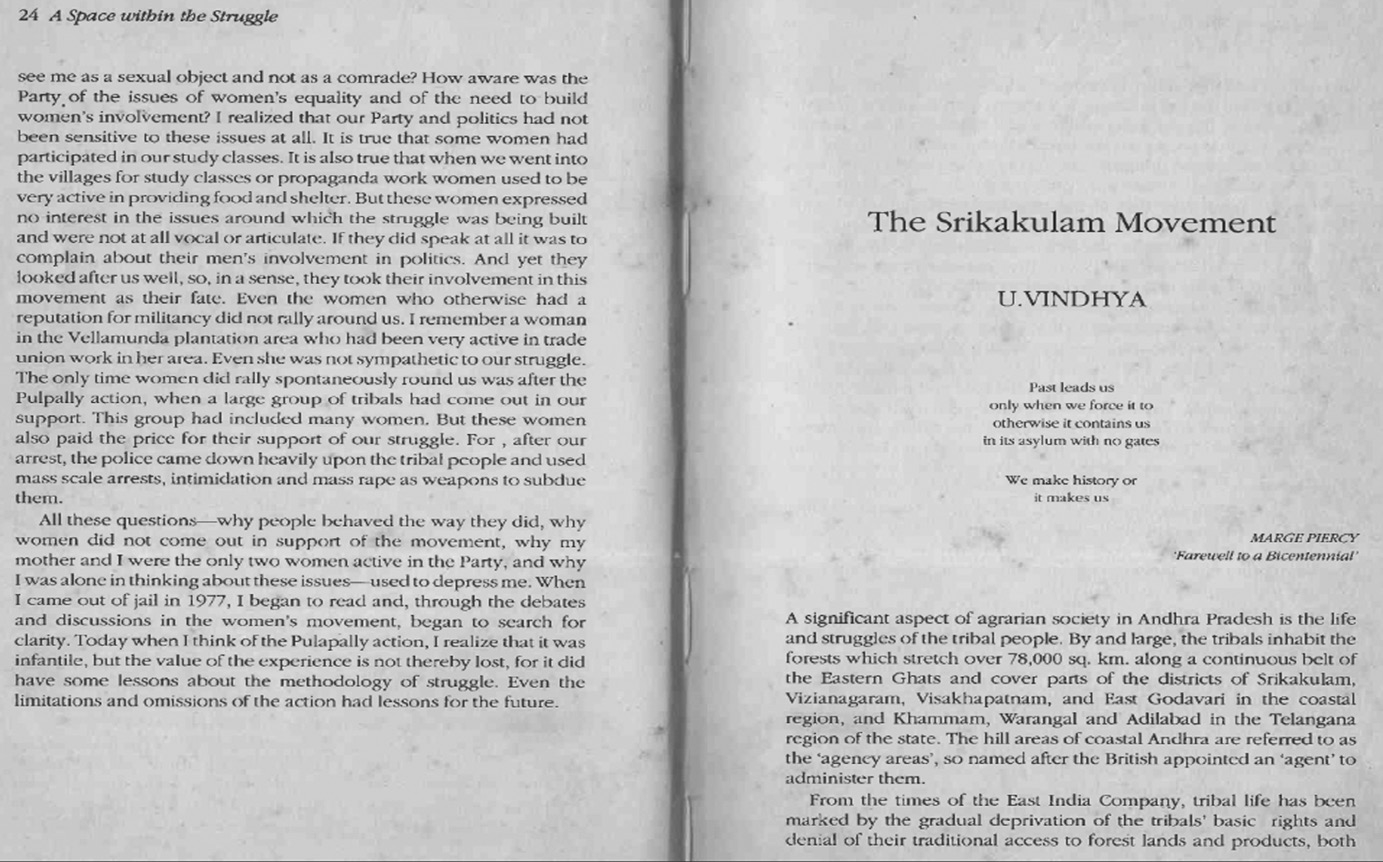
The Srikakulam Peasant Uprising
The Srikakulam peasant uprising took place between 1967 and 1970 in the Srikakulam district of Andhra Pradesh, inspired by the Naxalbari movement.
The spark for the uprising came on October 31, 1967, when two communists, Korana and Manganna, were killed by landlords in Levidi Village while en route to the Girijan Samagam Conference.
In retaliation, the Girijans began seizing land, property, and food grains from the landlords.
As the tribals faced severe repression, the leadership organized the resistance into a more structured movement, forming peasant guerrilla squads to mount systematic opposition.
By 1969, the activities of the peasant squads grew more intense.
In response, the government deployed 12,000 CRPF personnel to suppress the uprising. Fierce clashes continued for six months, resulting in the deaths of 120 CRPF officers by January 1970. However, the uprising gradually lost momentum and came to a swift decline.
Bhartiya Kisan Union (BKU)
Social discontent in India during the seventies was widespread, affecting even those who had gained some benefits from the development process. One example of this discontent was the agrarian struggles of the eighties, where even relatively better-off farmers protested against state policies.
In January 1988, about twenty thousand farmers gathered in Meerut, Uttar Pradesh, to protest against a government decision to raise electricity rates. This was a well- organized and disciplined movement, with the farmers receiving food supplies from nearby villages throughout the protest.
These farmers were members of the Bharatiya Kisan Union (BKU), an influential farmers’ organization from western Uttar Pradesh and Haryana. The BKU played a key role in the farmers’ movement of the eighties.
Farmers in Haryana, Punjab, and western Uttar Pradesh had benefited from the state’s “Green Revolution” policies in the late 1960s, with sugar and wheat emerging as major cash crops.
However, by the mid-eighties, the cash crop market was hit by a crisis, partly due to the liberalization of the Indian economy.
The BKU’s demands included higher government floor prices for sugarcane and wheat, the removal of restrictions on the interstate movement of agricultural produce, affordable electricity, loan waivers, and a pension system for farmers.
Other farmers’ organizations across India echoed similar
demands. In Maharashtra, the Shetkari Sanghatana declared the farmers’ movement as a battle between Bharat (the rural, agrarian sector) and India (the urban, industrial sector).
Characteristics of Bhartiya Kisan Union (BKU)
To pressurize the state into accepting its demands, the BKU organized a variety of activities, including rallies, demonstrations, sit-ins, and jail bharo (courting imprisonment) protests.
One distinctive feature of these mobilizations was the strategic use of caste affiliations among farmers. Most BKU members came from a single community, and the organization leveraged traditional caste panchayats to unite them over shared economic issues.
Despite lacking a formal structure, the BKU was able to sustain itself for a long time due to its reliance on clan networks among its members. Resources, funds, and activities were mobilized through these strong community ties.
Until the early nineties, the BKU remained independent of political parties, operating instead as a powerful pressure group, relying on its massive numbers. In collaboration with other farmers’ organizations across India, the BKU succeeded in having some of its economic demands accepted by the government.
In this way, the farmers’ movement became one of the most successful social movements of the 1980s, with the success largely attributed to the political bargaining power its members wielded.
Anti-Arrack Movement
While the BKU was mobilizing farmers in the north, a different kind of movement was taking root in the rural areas of Andhra Pradesh. This was a spontaneous mobilization led by women demanding a ban on the sale of alcohol in their localities.
Rural women from remote villages in the state fought against alcoholism, alcohol mafias, and even the government during this time, giving rise to what became known as the anti-arrack movement.
The movement’s central demand was straightforward
— a prohibition on the sale of arrack. However, this
seemingly simple request highlighted deeper social, economic, and political issues affecting women’s lives in the region.
A close connection between crime and politics had developed around the arrack trade. The state government collected substantial revenue through taxes on arrack sales and was thus reluctant to impose a ban.
Local women’s groups took on these interconnected issues as part of their resistance to arrack. For the first time, they openly addressed the issue of domestic violence, offering a platform for discussion of these private matters. As a result, the anti-arrack movement also became an integral part of the broader women’s movement.
New Farmers Movement
New Farmers Movement
The farmer’s movements burst onto the National political stage in 1980 with the road and rail roko agitation in Nasik, Maharashtra, led by the Shetkari Sangathana of Sharad Joshi.
Sharad Joshi articulated the ideology of the movement in terms of India V/s Bharat, industrial V/s rural.
In 1986, in Muzaffarnagar, UP Mahendra Singh Tikait, presided over a gathering of lakhs of villagers before which the CM of UP had been forced to appear in person to announce his acceptance of their demand for a reduction of electricity charges to the old level.
In the 1980s there emerged widespread grassroots mobilisation of rural dwellers such as in Tamil Nadu led by Viva Sayigal Sangam, the Rajya Ryothu Sangha, Karnataka, Bhartiya Kisan Union Punjab and Haryana; Khedut Samaj and Kisan Sangh in Gujarat and the Shetkari Sangathana in Maharashtra.
The above-mentioned New Farmers Movement, especially in the 1980s, attracted much media and political attention. They focused mainly on the demands of remunerative prices for agricultural produce and lowering or elimination of government dues such as canal water charges, electricity charges, interest rates and principal of loans, etc.
Women Movement
Women’s Movement
Immediately after two decades of independence, the overall feelings with respect to women’s issues were concerned with the required legislative reforms.
Many acts were passed to translate namesake equality into true spirits, like the Special Marriage Act of 1954, the Hindu Marriage Act (1956), Inter State Succession Act (1956) and the Dowry Prohibition Act 1961 were enacted.
There are three prominent women’s organizations, which are still working for the women’s cause. All India Women’s Conference (AIWC), National Federation of Indian Women (1954) and All India Democratic Women’s Association (AIDWA since 1981). Neither of them has direct political affiliations, but AIWC is known to have close links with Congress, the NFIW with the CPI, and AIDWA with CPM.
The mid-1970s were a watershed year in Indian Politics. A series of locally organised and intense popular struggles broke out. E.g., the united women’s Anti- Price Rise Front, which turned into a mass movement of women for consumer protection; the Chipko Movement for environment protection; Bodhgaya movement for women’s land rights.
Nationwide protests were organised around specific incidents like the Mathura Rape Case (1978), and the Jessica Lal Murder case, the latest ones were Nirbhaya Case in Delhi (2012).
There is growing demand for women’s safety, dignity, employment, and reservation in assemblies and Parliament.
Various NGOs have also contributed a lot to women’s emancipation. But there are many rape cases and violence against women happening in the country despite multiple laws.
Civil Democratic Movement
Civil Democratic Movement
• The origins of the democratic rights movement trace back to the late 1960s, a time marked by political instability, as tensions between the ruling class and the people intensified, leading to signs of widespread revolt.
• The growing arbitrary actions of the state served as the primary catalyst for the movement.
• The declaration of Emergency, which suspended the fundamental freedoms outlined in Part III of the Constitution, was a significant factor in the rise of the civil liberties movement.
• In response, two major organizations based in Delhi, the People’s Union for Civil Liberties (PUCL) and the People’s Union for Democratic Rights (PUDR), began advocating for people’s democratic rights.
These organizations continue to fight for the vulnerable and marginalized, representing their causes in the judiciary
Limitations of these Movements
• Despite their efforts, the tangible impact of these movements on public policy has been limited. One reason for this is that many contemporary movements focus on single issues, often representing just one section of society, making it easier to disregard their demands.
• Democratic politics, however, requires broad alliances of various disadvantaged groups, which these movements have struggled to form.
• While political parties should bring together diverse interests, they too have failed to address the concerns of marginalized groups, while these movements have operated in a narrow, restrictive manner.
• The disconnect between popular movements and political parties has grown over the years, leading to a political vacuum, which has become a significant issue in Indian politics.
Lessons from Popular Movements
• The history of these movements offers valuable insights into the nature of democratic politics. These movements arose to address flaws in party politics and should be seen as an essential part of India’s democracy.
• They represented new social groups whose economic and social concerns were overlooked in electoral politics.
• By ensuring the representation of diverse groups, popular movements helped reduce social conflicts and the sense of alienation that these groups felt toward democracy.
These movements introduced new forms of active participation, thereby broadening the concept of participation in Indian democracy
Points To Remember
According to Parth Mukherji, social movements are accumulative, alternative and transformative in nature.
• Environmental Movements:
• Chipko Movement, Uttarakhand. Women’s active participation in the Chipko agitation
Narmada Bachao Andolan, launched in the Narmada Valley of central India in the early 80s
• Silent Valley Movement in the Palakkad district of Kerala. In 1985 PM Rajiv Gandhi inaugurated Silent Valley National Park and the park was designated as the core area of Nilgiris Biosphere Reserve.
• Fisheries Movement: The fishermen came together on a national level platform as a National Fish workers Forum (NFF).
• Party-based movements:
• Popular movements may take form of social or political movements.
• Independent social movements like the anti-caste movement, the kisan sabhas and the trade union movement.
• Peasants and agricultural labourers in parts of Andhra Pradesh, West Bengal, Bihar and adjoining areas continued their agitations under the leadership of the Marxist-Leninist workers; who were known as the Naxalites.
• The peasants’ and the workers’ movements mainly focussed on issues of economic injustice and inequality.
• Non-Party Movements:
• Failure of the Janata experiment
• Persistence of poverty and inequalities on a large scale.
• A sense of injustice and deprivation among different groups.
• The middle-class young activists launched service organisations and constructive programmes among the rural poor.
• Most of these groups believed in politics and wanted to participate in it, but not through political parties. Hence, these organisations were called ‘non-party’ political formations.
• Dalit Movement:
• The term “Dalit” encompasses the communities known as ex-untouchables and tribals, officially termed Scheduled Castes and Scheduled Tribes respectively.
• Ghanshyam Shah classified Dalit Movement into Reformative and Alternative movement.
• The Bhopal Declaration (2002) adopted unanimously a new 21-point Action Agenda for Dalits for the 21st century:
• SC & ST (Prevention of Atrocities) Act 1989.
• Dalit panthers, a militant organisation of the Dalit youth, was formed in Maharashtra in 1972.
• Agrarian Struggles Since Independence:
• Telangana Peasant Struggle:
• The Communist Party of India took up these issues as the basis for a peasant’s struggle against feudalism in the period 1946-48.
• The Jagirdari Abolition Regulation was laid down in 1949, and the Hyderabad Tenancy and Agricultural Lands Act was passed in 1950.
• The Srikakulam Peasant Uprising:
• The uprising occurred in 1967–1970, in regions of Srikakulam district, Andhra Pradesh, India. The Naxalbari uprising inspired the upsurge.
• Bhartiya Kisan Union (BKU):
• Demand for higher government floor prices for sugarcane and wheat.
• Abolition of restrictions on the inter-state movement of farm produce.
• Guaranteed supply of electricity at reasonable rates Waiving of repayments due on loans to farmers.
• The provision of a government pension for farmers.
• Shetkari Sanghatana of Maharashtra declared the farmers’ movement as a war of Bharat (symbolising the rural, agrarian sector) against forces of India (urban industrial sector).
Anti-Arrack Movement: Prohibition on the sale of arrack in the southern state of Andhra Pradesh
• OBC Movements:
• Kaka Kalelkar Commission,1956
• Mandal Commission, 1980
• New Farmers Movement:
• Sharad Joshi articulated the ideology of the movement in terms of India V/s Bharat, industrial V/s rural.
• They focused mainly on the demands of remunerative prices for agricultural produce and lowering or elimination of government dues such as canal water charges, electricity charges, interest rates and principal of loans, etc.
• Women’s Movement:
• Three prominent women’s organizations were All India Women’s Conference (AIWC), National Federation of Indian Women (1954) and All India Democratic Women’s Association (AIDWA since 1981)
Civil Democratic Movement:
Originated In the late 1960s.
Two major Delhi-based organisations, namely the People’s Union for Civil Liberties (PUCL) & People’s Union for Democratic Rights (PUDR) started working for people’s democratic rights