Lifi Technology
LiFi Technology (Light fidelity – LiFi)
Rather than using radio frequencies to convey data, this bidirectional, fully networked wireless communication system uses visible light.
German physicist Harald Hass presented it at a TED Talk on Technology, Entertainment, and Design.
An adapted LED lightbulb is used to create a router.
It can offer more secure, faster data rates, and higher densities of wireless networks, making them more dependable and resilient than current cellular and WiFi networks.
It provides extremely rapid data connections, which are especially helpful in urban areas with crowded radio spectrum and in remote areas without access to fiber optic cables or networks.
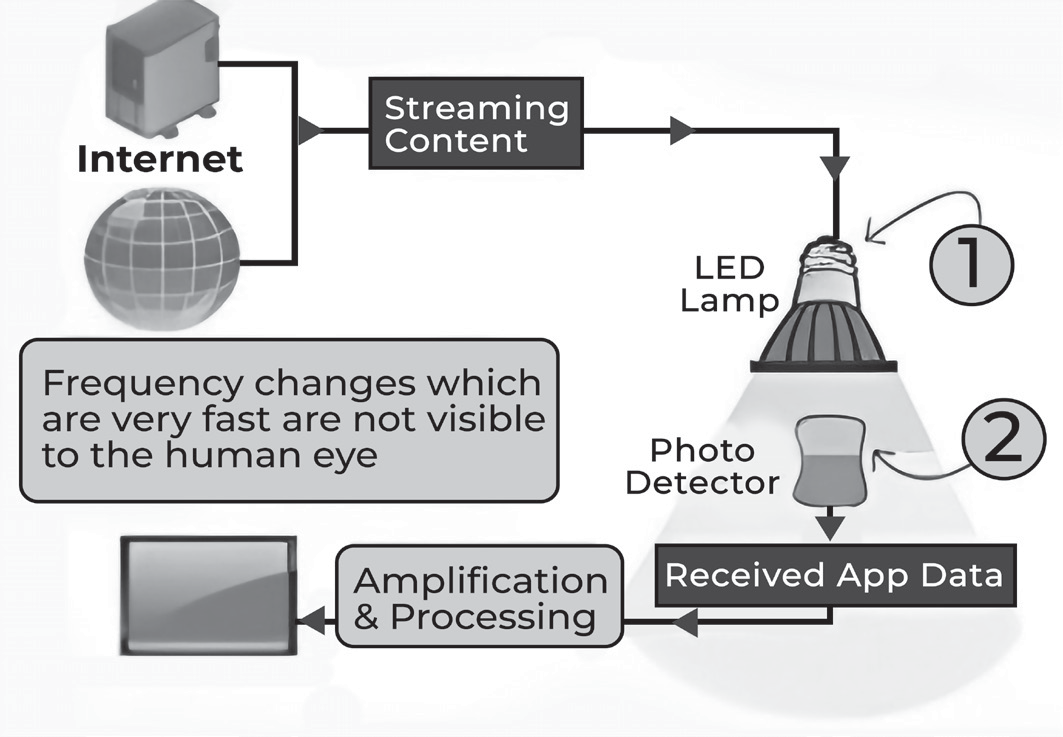
A device that is connected to the Internet is connected to a regular LED light bulb.
The device sends light waves into the bulb, where they carry Internet data.
On the other end, light waves carrying Internet data land on a receiver or a dongle that is connected to the computer.
LiFi v WiFi
| Paramete | LiFi | WiFi |
| Technology | Visible light communication | Radio Waves |
| Frequency Band | 430-770 THz | 2.4 GHz, 5 GHz |
| Max Speed | Up to 224 Gbps | Up to 54 Mbps |
| Latency | Low, less than 1ms | Medium, more than 10 ms |
| Security | High, it is confined to the area illuminated | Medium as it can penetrate walls |
| Energy Efficiency | High (uses LEDs) | Medium |
| Reliability | High, less interference | Prone to interference |
Applications
Remote connectivity: In remote locations where it is challenging to install fiber optic connections, LiFi can offer connectivity. It is also appropriate for isolated, hilly locations without network or cellphone service.
Cellular offloading: Offloading data to LiFi networks that are strategically situated can lighten the strain on cellular networks.
Vehicles: LiFi is being tested in cars for autonomous driving, collision avoidance, and vehicle-to-vehicle and vehicle-to-infrastructure communication.
Aviation: For travellers using the overhead cabin lighting, it offers high-speed in-flight internet access, minimizes the weight of aircraft wiring.
Disaster management: It supports LiFi-enabled high-speed optical wireless communication and is immune against events that could compromise cellular networks.
Significance of LiFi
High speeds: Compared to WiFi, LiFi may deliver internet speeds of over 100 Gbps. This may make high- speed apps possible.
Security: The lack of light penetration in confined areas makes data contained within them more safe.
Decentralised means of communication: Because of the way LiFi operates and the parts it consists of, it is a decentralized communication system. When paired with blockchain technology, it has the potential to completely transform communication and data transfer through a fast and secure distributed transaction system.
No electromagnetic interference: Since visible light doesn’t produce electromagnetic interference, LiFi uses it. This permits its application in delicate settings like hospitals and airplanes.
High density: The visible light spectrum does not experience “spectrum crunch,” unlike radio waves, because it has 10,000 times more bandwidth than radio waves which allows more devices that can be connected.
Limitations of LiFi
Needs line-of-sight: Only a restricted region can be used due to its reliance on line-of-sight.
• Needs unmodulated ambient light: Normal lightbulbs and sunshine might cause interference that lowers the transmission quality. It could be necessary to use filters.
• Device incompatibility: A large number of current gadgets lack the built-in functionality to connect to LiFi networks. Integrated receivers or dongles will be necessary.
• Initial high costs: Although LiFi equipment costs more than WiFi at the moment, these differences could disappear as the technology matures and economies of scale increase.
Way Forward
• Standards development: To guarantee compatibility, standards must be set for parts, networking protocols and installation procedures.
• Integration with networks: For supplementary advantages, integration with current networks such as WiFi and 5G should be strengthened.
• Cost reduction: Adoption will be fuelled by cost reductions brought forth by technological advancements and economies of scale.
• Policy support: The development of LiFi infrastructure for public services should be encouraged by government policies.
• Private sector collaboration: Academic, business, and startup partnerships will promote LiFi innovation and commercialization.
Blockchain Technology
BLOCKCHAIN TECHNOLOGY
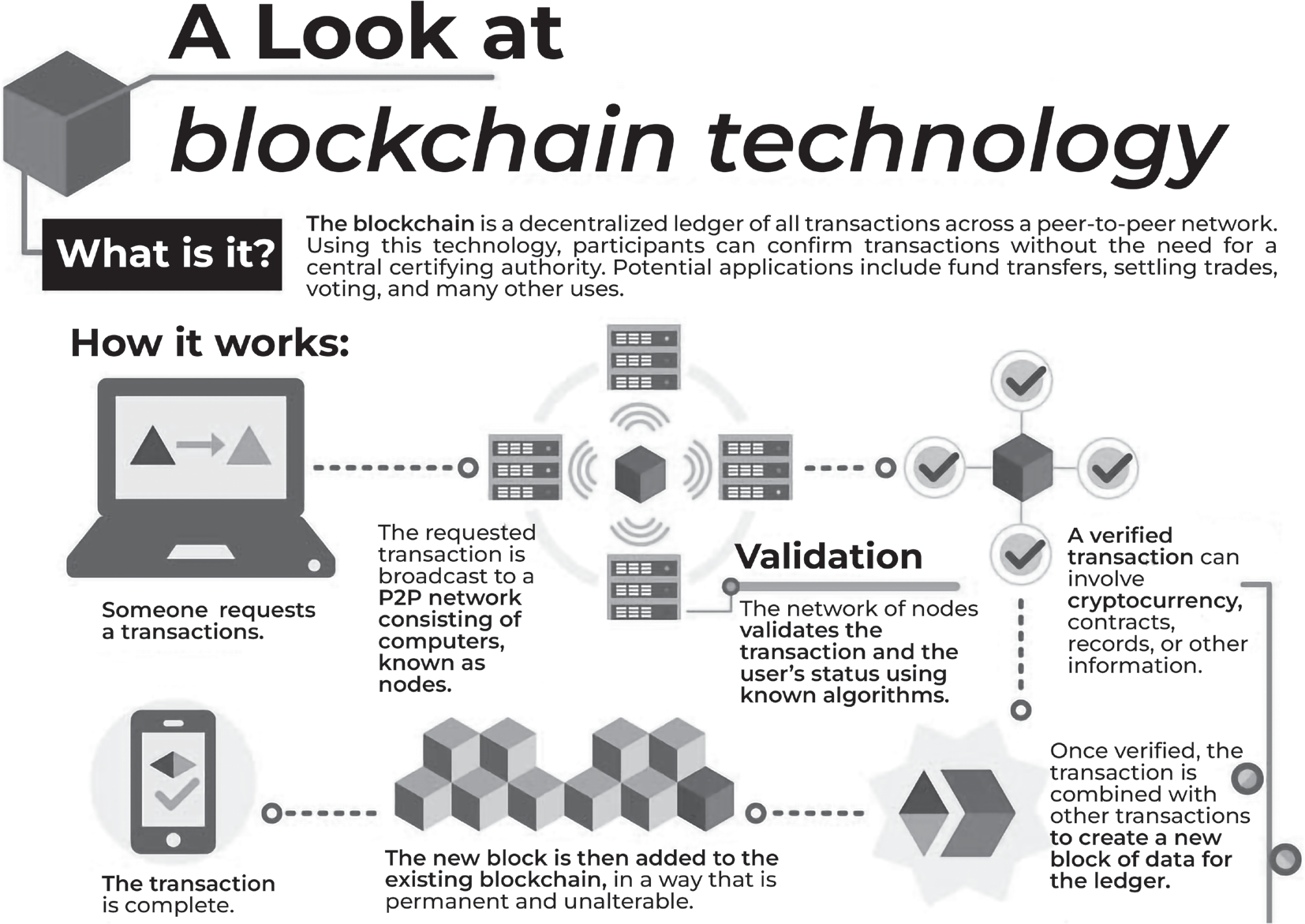
• The blockchain is a distributed database that stores records of all transactions or digital events that have been completed and shared by participating parties. The bulk of the system's participants verify each transaction.
• It holds every record of each transaction. Bitcoin is the most widely used cryptocurrency and an example of a blockchain. Blockchain technology initially became known when a person or group of people known as 'Satoshi Nakamoto' published a white paper titled "BitCoin: A peer-to-peer electronic cash system" in
2008.
•
Blockchain technology is a structure that stores transactional records (also known as block), of the public in several databases, known as the chain, in a network connected through Peer-to-peer (P2P) nodes.
• This storage is referred to as a digital ledger. Every transaction in this ledger (storage) is authorized by the digital signature of the owner, which authenticates the transaction and saves it from any tampering.
• Blockchain key characteristic features include decentralization, persistence and anonymity.
• Blockchain technology discards the need for any third-party or central authority for peer-to-peer transactions.
Importance of Blockchain
• Increased transparency: All transactions and data entries are permanently and transparently recorded in a blockchain. All transaction histories are visible to everyone on public blockchains, which are accessible to everyone.
• Third-party elimination: Blockchain technology is decentralized, in contrast to traditional databases, which are often kept on a third-party server. It is kept up to date
by a network of computers called nodes that take part in the blockchain data’s storage and validation.
Faster transactions: The speed of transactions in a blockchain network can be influenced by the consensus process employed. Certain consensus methods, such proof of work (PoW), which need a lot of processing power, cannot process transactions as quickly as proof of stake (PoS) or delegated proof of stake (DPoS).
Low transaction costs: In some circumstances, blockchain
technology may be able to lower transaction costs as compared to older systems. Blockchain eliminates the need for middlemen like banks, clearinghouses, or payment processors by enabling peer-to-peer transactions directly.
Enhanced security: The decentralization, immutability, and cryptographic methods of blockchain provide heightened security. Consensus algorithms are used to validate and add transactions to the blockchain; these techniques necessitate agreement from all participating nodes
Types of Blockchain
Public Blockchain
• The earliest kind of blockchain technology is a public blockchain. With the permissionless distributed ledger technology known as the public blockchain, anyone may sign up and start transacting. Every user maintains a copy of the ledger in this open version. It suggests that anyone with an internet connection can investigate the public blockchain.
• One of the earliest public blockchains that the general public had access to was the public blockchain. It enabled decentralized transactions to be carried out by anybody with an internet connection.
Private (or Managed) Blockchain
• A private blockchain is simplest defined as one that functions within restricted environments, such closed networks.
• It is also a blockchain that has permissions controlled by an entity. If a privately held company or organization wants to use a blockchain for private use cases, then private blockchains are great.
• It is possible to limit access to the blockchain network and make effective use of the blockchain. Additionally, the network settings that the firm can configure include accessibility permission.
Consortium Blockchain
• A consortium blockchain, often called a federated blockchain, is a creative solution for situations where an organization needs both public and private blockchain capability.
• In a consortium blockchain, some organizational features are visible to the public while others are not.
Hybrid blockchain
• It is one of the different types of blockchain technology. In particular, a hybrid blockchain could seem like a consortium blockchain, but it’s not. However, there might be some similarities between them.
• Combining a private and public blockchain is the simplest approach to define a hybrid blockchain.
How does it operate?
Peer-to-peer,instantaneous, frictionless, anonymous, and secure transactions are all made possible by the technology.
• It does this by distributing trust from powerful intermediaries to a large global network, which through a mass collaboration, clever code and cryptography, enables a tamper-proof public ledger of every transaction that’s ever happened on the network.
• A block is the “current” part of a blockchain that stores some or all of the most recent transactions. Once a transaction is finished, it becomes a permanent database
on the blockchain.
• A new block is created each time an existing block is finished. Every block contains a hash of the block before it, and they are connected to one another (like a chain) in a correct linear and chronological order.
Prospects
• The technology is being evaluated in a variety of businesses, with Bitcoin being only one of its uses.
• Areas that could benefit include banking, education, land records, healthcare and agriculture.
• Smart contracts backed by blockchain technology, which record all information, can make doing business easier.
• It will significantly lower the risk of fraud while enhancing a contract’s legitimacy, accuracy and efficiency.
• By lowering the possibility of insurance claim fraud, blockchain might be extremely important to the management of health insurance claims.
Challenges
• Blockchain technology is expensive to set up initially.
• The significant amount of energy required for blockchain to operate.
• Preserving the privacy of people and businesses, since blockchains are often public ledgers accessible to all parties.
• Not much is currently known about distributed ledger technology’s advantages.
Potential Applications of Blockchain Technology
• Asset management: Asset management is among the most popular uses of blockchain technology. Asset management is not an exception to the financial industry’s heavy reliance on blockchain. Asset management, in its broadest sense, is the administration and trading of many assets that a person may possess, including stocks, bonds, fixed income, real estate, mutual funds, commodities and other alternative investments.
• International Payments: Have you ever experimented with any Blockchain applications that facilitate cross- border payments in various currencies between nations? The money may not arrive at its destination for several days throughout this drawn-out, difficult process. By offering end-to-end remittance services without the need for middlemen, blockchain has contributed to the simplification of these cross-border transfers.
• Medical Care: Using smart contracts, blockchain can significantly impact the healthcare industry, which is one of the main uses for blockchain technology. With the help of these smart contracts two parties can enter into a contract directly from one another. Every party to the agreement is aware of its specifics, and when its requirements are fulfilled, the agreement is immediately put into effect.
• Internet of Things: The Internet of Things is a network of networked devices that can communicate with one another and gather information that can be utilized to make insightful decisions. Any connected system of “things” becomes an Internet of things. The Smart Home, where all household equipment, including lights, air conditioners, thermostats, smoke detectors and more, can be connected to one platform, is arguably the most well- known example of the Internet of Things.
National Strategy on Blockchain Technology
• It took a National plan to build a National Blockchain infrastructure in order to harness this new technology for service delivery and to guarantee social and economic advancement. This states that the Ministry of Electronics and Information Technology unveiled the National Strategy on Blockchain Technology in 2021.
• It envisioned advancing research and development, developing newer technologies, working with international partners and application development and building trusted digital platforms through a shared Blockchain infrastructure.
Objectives
• National Blockchain Infrastructure: By developing a National Blockchain infrastructure that can be utilized for the deployment and development of apps utilizing Blockchain-based technologies, it sought to establish a digital platform that could be trusted.
• Research and Development: In order to address issues with quick application development and its technological requirements, it intends to concentrate on research and development in the field of blockchain technology.
• Innovation Roadmap: The objective of this project is to develop an innovation roadmap that will enable Blockchain to become a reliable digital platform. It also seeks to overcome a number of obstacles to the implementation of blockchain technology.
•
Planning: The goal is to move toward a model of decentralized execution and centralized planning. Its scope would be broadened by the widespread use of Bitcoin technology across numerous industries.
• Diplomacy: Increasing India’s participation in international organizations,research facilities, and innovative projects involving Blockchain technology.
Global efforts towards Blockchain Technology
• As part of its plans to enhance communication and data exchange amongst its smart city infrastructure, China has devised a Blockchain-based identifying system. Additionally, China unveiled the Blockchain-based Service Network initiative, designed to assist businesses and individuals in implementing Blockchain applications more quickly and affordably.
• With the use of blockchain technology, the European Blockchain Partnership hopes to create a reliable and secure European Blockchain Services Infrastructure for rules and cyber security.
• To authenticate electronic records, the Estonian government makes use of blockchain technology through the Keyless Signature Infrastructure.
• The Smart Dubai program was introduced by the United Arab Emirates with the goal of making Dubai the first metropolis entirely powered by blockchain technology. It also seeks to use blockchain technology to improve everything from environmental sustainability and traffic management to healthcare and education.
• The United States’ Food and Drug Administration uses Blockchain technology to address the issues of security and transparency in the handling of health data. To improve food traceability, the UK also tracks the distribution of meat using blockchain technology.
Blockchain in Social sectors
• Personal Identification: Huge volumes of personal data, including information from birth and death certificates, marriage licenses, passports and census data are
managed by governments.
• Fight corruption: Enabling government transactions on the blockchain facilitates the creation of a reliable transaction history and greatly streamlines the auditing procedure. This would help increase the transparency of public procurement.
• Cut red tapism: Blockchain removes this lack of interoperability, which results in needless red tape when requesting pertinent information from a user. It also simplifies and lowers the cost of data sharing between agencies.
• Identity and Land rights: The World Identity Network
and Humanized Internet project can store identifiers such as birth certificates and university degrees on a blockchain, in the form of distributed digital lockboxes.
Way Forward
• With all of its potential, blockchain has to have its business viability and weaknesses carefully considered.
• We require a solid and informative data repository prior to integrating blockchain into the public sector data handling system.
• Linking IndiaChain with Aadhar, and therefore creating a secure personal identity for all Indians.
• Appropriate laws governing the nation’s adoption of blockchain technology.
Cryptocurrency
CRYPTOCURRENCY
Cryptocurrency is a digital payment system that doesn’t rely on banks to verify transactions. It’s a peer-to-peer system that can enable anyone anywhere to send and receive payments.
Cryptocurrency means Encrypted Currency that makes the online digital payment more robust, secure and corruption free.
In many countries, cryptocurrency is unregulated & they are not a legal tender payment system. For example, Bitcoin.
• Every transaction is linked with the public and private key of the receiver and sender. Sender has to encrypt the transaction data with the public key of the receiver and only the private key of the receiver can decrypt it. After decryption, currency will be reflected in the receiver’s accounts.
Evolution of Cryptocurrency
• There have been multiple upswings and downswings for cryptocurrency, including bubbles and market crashes in 2011, 2013–2014–2015, 2017–2018, and 2021–2023.
• The UK declared on August 6, 2014, that its Treasury has commissioned a study to see whether cryptocurrencies may have any place in the country’s economy. The study was also supposed to report on the possibility of regulation. In January 2021, it released a consultation on stablecoins and cryptoassets, and its final report was published in 2018.
• El Salvador became the first nation to recognize
Bitcoin as legal tender in June 2021.
• Cuba then adopted Resolution 215 in August 2021 to acknowledge and control cryptocurrencies like Bitcoin.
• The Chinese government, which oversees the largest cryptocurrency market, ruled that all bitcoin transactions were unlawful in September 2021. This concluded a crackdown on cryptocurrencies,
which had earlier prohibited Chinese miners and intermediaries from operating.
• A procedure known as “the Merge” saw Ethereum, the second-largest cryptocurrency in the world at the time, go from a proof-of-work (PoW) consensus method to a proof-of-stake (PoS). The Ethereum Founder claims that the update can reduce Ethereum’s energy consumption and carbon emissions by 99.9%.
Types of Cryptocurrencies
Utility tokens
• In the world of cryptocurrencies, utility tokens are special. They have a special function inside the ecosystem of a blockchain, therefore they are more than just digital currency for transactions or an investment vehicle.
• The project or platform that issued these tokens frequently uses them to grant access to particular features or services. For example, a blockchain project for cloud storage can issue utility tokens that consumers can use to purchase network storage.
Security tokens
• One kind of digital asset is a security token, which is an investment in a business and frequently has privileges like profit sharing or voting.
• They function similarly to conventional securities, but they make use of blockchain technology to simplify the purchasing, selling and ownership tracking processes. Security token offers (STOs), which resemble initial public offerings (IPOs) in the conventional financial world, are frequently used to issue these tokens.
Platform Tokens
• Platform tokens enable the delivery of decentralized applications (dapps) for various purposes by leveraging blockchain infrastructures.
• Dai, for instance, can be considered as both a platform token and a stablecoin due to its usage of the widely-used Ethereum blockchain and its soft-pegged pricing to the US dollar, which is maintained through processes incorporated into smart contracts.
Transactional Tokens
• Transactional tokens are used in commerce; they are exchanged for products and services and function as units of account. While these tokens sometimes have extra features, they frequently work similarly to conventional currencies.
• For instance, users can conduct transactions using decentralized cryptocurrencies like Dai and Bitcoin without the need for a conventional middleman or central authority like a bank or payment gateway.
Governance Tokens
• It’s imperative to improve the decision-making
procedures surrounding decentralized protocols as they spread and change.
• Blockchain-based voting systems are powered by governance tokens, which are frequently used to vote on new ideas and indicate support for suggested changes.
How Does Cryptocurrency Work?
Bitcoin transactions are recorded on a blockchain, which is an open digital ledger.
A global network of computers keeps track of this record; these computers validate and append new transactions to the blockchain.
This decentralization and use of cryptography make it a difficult task for anyone to alter the currency or the transactions recorded on the blockchain.
In order to utilize cryptocurrencies, people or organizations must first obtain a digital wallet (a software application that houses the user’s public and private keys).
These keys are utilized for blockchain transaction verification as well as for sending and receiving cryptocurrency.
A method known as “mining” allows users to get bitcoin by utilizing computer power to solve complicated mathematical equations that confirm and record transactions on the blockchain in exchange for a fixed quantity of cryptocurrency.
What is the Legal Status of Cryptocurrency?
• In India
• India’s laws pertaining to cryptocurrencies are presently being revised.
• Stating that cryptocurrencies are not legal tender and provide dangers to investors, the Reserve Bank of India (RBI) has issued multiple advisories against the usage of cryptocurrencies.
• In 2018 the Supreme Court struck down a circular of Reserve Bank of India, which bans financial institutions from dealing in digital or cryptocurrencies.
• The Indian government stated in the Union budget for 2022–2023 that any transfers of virtual currency or cryptocurrency assets will be eligible for a 30% tax.
• In addition, the government has set up a commission to look into the application of blockchain technology and the idea of launching a Central Bank Digital Currency (CBDC).
• Elsewhere:
• The Central African Republic (CAR) and El Salvador are now the only two nations in the world where Bitcoin is accepted as legal tender.
• However, many countries have taken considerable steps to recognize and regulate the use of certain type of cryptocurrencies, such as Bitcoin.
•
A number of countries have published rules pertaining to bitcoin exchanges,including South Korea and Japan.
• Countries that have accepted Bitcoin as a “legal means of payment” include Germany and Switzerland.
Advantages of Cryptocurrency
Cost Effective: Cryptocurrencies can facilitate international money transfers. With the aid of cryptocurrencies, transaction costs can be negligible or even $0. Since it does away with the necessity for third parties like VISA to validate transactions, it is insignificant.
Decentalization: The representation of a completely new decentralized money paradigm is provided by cryptocurrencies. They also aid in releasing money from governmental control and battling currency monopolies. Crypto aficionados believe that the fact that no government agency can determine the value of a coin or its flow makes cryptocurrencies safe and secure.
Accessibility: To use cryptocurrencies, investors only need an internet-connected computer or smartphone. To open a bitcoin wallet, there is no need for identity verification, credit checks, or background checks. By far, it is simpler and faster than the previous banking institutions. It also makes it simple for people to pay money to someone or conduct online transactions.
Secure And Safe: Until someone gets their hands on the private key to your cryptocurrency wallet, no one can access your money. You won’t be able to get your money back if you misplace or forget your key. Additionally, the dispersed network of computers that validates the
transactions and the blockchain technology protect the transactions.
Disadvantages
Volatility: Due to the extreme volatility of cryptocurrency prices, businesses find it challenging to accept them as payment.
Regulation: The absence of clear regulations surrounding cryptocurrencies makes it challenging for organizations and people to understand how to use them legally.
Security: Exchanges and wallets for cryptocurrencies are vulnerable to hacking attempts, which may cause money losses.
Adoption: It is challenging for people to use cryptocurrencies as a method of payment in daily life due to their low acceptance rates, despite their increasing popularity.
Way Forward
There should be a clarity on the legal status of cryptocurrencies as it is important for their widespread adoption and use. When governments provide a clear framework for cryptocurrency, it creates a more conducive and stable environment for businesses and individuals to invest in and use them. This can also encourage innovation and growth in the industry.
El Salvador and the Central African Republic are two examples of countries that have accepted cryptocurrencies as legal money, demonstrating that
it is acceptable for governments to accept this new
technology and foster an atmosphere that encourages its growth.
A pilot program for Central Bank Digital Currency (CBDC) based on blockchain has been initiated by the RBI. Since that blockchain technology is also the foundation of cryptocurrencies, the government ought to take this into account.
Launching cryptocurrency with a strong regulatory framework can ensure its proper use, prevent fraud cases and illegal activities, and increase consumer protection. On the other hand, a complete restriction on the use of cryptocurrency may stifle innovation and hinder its potential benefits to society.
Central Bank Digital Currency
CENTRAL BANK DIGITAL CURRENCY (CBDC)
• CBDC is a digital version of fiat currency that may be exchanged using blockchain-based wallets and is controlled by the central bank. It is a digital type of legal money issued by a central bank.
An official digital currency would lower the cost of currency administration while allowing real-time payments to be made without the need for interbank settlement.
Another advantage of CBDC is that, to the degree that huge amounts of cash can be replaced by CBDC, the cost of printing, transporting and keeping paper money may be significantly decreased.
• The Indian government has declared in its Budget 2022- 23 that its central bank will issue a digital currency as early as 2022
Objectives
• Reducing hazards and expenses associated with handling actual currency, phasing out soiled notes, transportation, insurance and logistics are the major goals.
• It will also gradually wean people off of using
cryptocurrency to send and receive money.
Significance of CBDC
• Cross-Border Transactions: CBDCs have special qualities that have the power to completely transform cross-border transactions. One major benefit of CBDCs is their instantaneous settlement function, which makes cross-border payments more affordable, quicker and secure.
• Both traditional and innovative: by lowering the cost of handling currency, CBDC can progressively bring about a cultural shift towards virtual currency.
• The goal of CBDC is to combine the best aspects of both worlds: The benefits of digital currency such as their security and convenience and the traditional banking system, which circulates money under strict regulation and reserve backing.
• Financial Inclusion: To promote improved tax and regulatory compliance, the informal economy might be pushed into the formal sector by exploring the expanded use of CBDC for a variety of different financial activities. Additionally, it may open the door for increased financial inclusion.
Difference between CBDC and Cryptocurrency
• Central Bank Function: Both digital currencies with a blockchain foundation are cryptocurrencies and CBDCs. Nonetheless, private businesses or people typically manage cryptocurrency. Conversely, a central bank of a nation controls and monitors a CBDC, which is equivalent to the fiat currency of that nation.
• Unpredictability: In a little amount of time, the price of bitcoin could fluctuate by hundreds or even thousands of dollars. Conversely, the ideal value of a CBDC would be equal to that of its physical counterpart.
• Investment vehicles: Purchasing Bitcoin and other cryptocurrencies in bulk with the intention of profiting from them is a common practice among investors. As CBDCs are not intended to be investment vehicles, this is absurd in their case.
Global Trends
• The first economy to introduce the Sand Dollar, a national CBDC, was Bahamas.
• Nigeria rolled out eNaira in 2020.
• In April 2020, China became the first major economy in
the world to test the use of e-CNY, a digital money.
• A number of countries have started testing their digital currencies, including Jamaica, Ukraine, Sweden and Korea. Many more may do so shortly.
Benefits
• A Combination of Traditional and Innovative: CBDC can slowly bring a cultural shift towards virtual currency by the reducing currency handling costs.
• Easier Cross-Border Payments: CBDC provides an easier way to speed up a reliable sovereign backed domestic payment and settlement system partly replacing the physical or paper currency.
• It could also be applied to cross-border payments, doing away with the requirement for a costly correspondent bank network in order to settle such transactions.
Challenges
• Privacy Concerns: The first problem to address is the increased risk to users’ privacy especially since the central bank may wind up managing a massive quantity of data about user transactions.
• Disintermediation of Banks: If sufficiently large and broad-based, the shift to CBDC can impinge upon the bank’s capability to plough back funds into credit intermediation.
Way Forward
• The utilization of CBDCs should be payment-focused in order to enhance the payment and settlement system and mitigate some of its short comings.
• Then it can steer away from serving as a store of value to avoid the risks of disintermediation and its major monetary policy implications.
• There would be serious security risks associated with the data kept by the central bank in a centralised system, necessitating the installation of strong data security measures to guard against data breaches.
• Therefore, it’s critical to use the appropriate technology to support the CBDC issue.
• To introduce CBDCs, the RBI will need to carefully select the right technology and map out the state of technology.
Wearable Technology
WEARABLE TECHNOLOGY
These are smart electronic devices designed to be worn on the user’s body. Ex: Smart jewellery, Wristbands, watches etc.
These devices detect, analyse and transmit information.
Wearable technology is evolving into an important category of the Internet of things, with life-changing applications in medicine and other fields.
Different types of Wearable Technology
• Smart Watches: A smart watch can do more than just telling time. It can provide users with notifications on their calls, messages, emails, social media updates, etc.
• Fitness Tracker: It helps the user keep a track of the number of steps the user walks on daily basis and continuously monitors the heart rate. With the use of this information, the devices is able to calculate and report accurate data on calorie burn and exercise done by the user.
• Head Mounted Display: It takes you to a different world of virtual reality. It provides virtual information directly to your eyes.
• Smart jewellery: Certain smartwatches are designed as jewelleries specially for women. These jewelries notify the users of their text messages, calls or emails when their phone is out of reach.
Challenges
• Easy Physical Access to Data
• Insecure Wireless Connectivity
• Lack of Encryption Technology
• Lack of Regulation or Compliance
• Patching and Vulnerabilities: Easy target for hackers
• Financial Loss due to cyber threats
Way Ahead
• Cyber deterrence
• Establishing cyber insurance framework for such devices
• Amendment of IT Act 2008: The regulations need to keep pace with the changing cyber scenario to ensure penalties serves as deterrence for crimes.
• Updation of cyber security policy.
Focus on international cooperation
Near-field Communication (nfc)
NEAR-FIELD COMMUNICATION (NFC)
• NFC is a short-range contactless communication technology based on a Radio Frequency (RF) field using a base frequency of 13.56 MHz
NFC-enabled devices must be either physically touching or within a few centimetres of each other for data transfer to occur
• Nowadays NFC are used in Money Transfer. Ex- Samsung Pay mini
Working of Near Field Technologies
• NFC allows two devices to communicate by sending data using electromagnetic radio signals. NFC chips are required for both devices since transactions only take place over extremely short distances.
• For data transfer to take place, NFC-enabled devices need to be in close proximity to one another, either by touching or being a few centimeters apart.
Other Applications
• It is utilized in contactless bank cards for monetary transactions and in the creation of contactless public transportation tickets.
• It can be found in home appliances, speakers, and other smartphone-controlled electronics.
• It can also be used in healthcare, where NFC-enabled wristbands can be used to track patient statistics.
Wireless charging also uses NFC.
How safe is to use NFC?
• NFC technology is designed to function between devices that are a few centimeters apart. This presents a challenge for potential attackers seeking to intercept and record device-to-device communication, as opposed to other wireless technologies that operate over several meters..
• The user of the NFC-enabled device determines by the touch gesture which entity the NFC communication should take place with, making it more difficult for the hacker or attacker to get connected.
• Compared to other wireless communication protocols, NFC communication has a greater security level by default.
• Since the receiving device reads data the moment one sends it, NFCs also brings down the possibility of human error.
Comparison with other Technologies
• The IrDa (Infrared) technology requires a line of sight between the two communication devices and is based on data exchange by infrared light. It has a short range (a few meters). These days, remote control gadgets are the major use for this technology.
• Bluetooth or WiFi connections have taken the place of this technology for bigger data transfer with computer devices.
Radio Frequency Identification
RADIO FREQUENCY IDENTIFICATION (RFID)
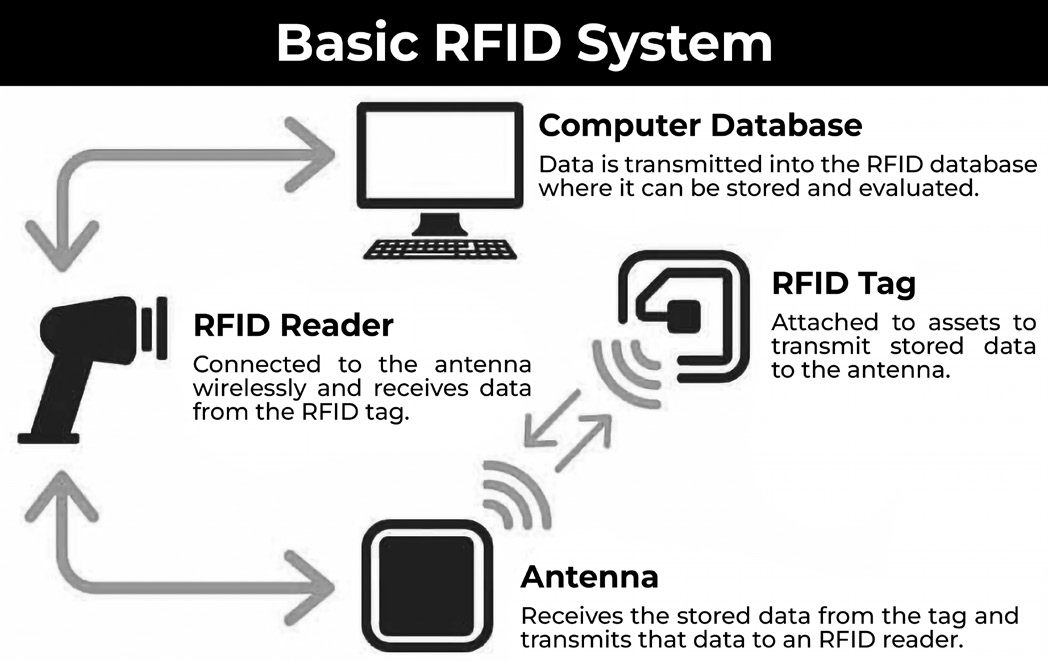
• RFID technology uses radio waves to passively identify a tagged object.
An RFID tag consists of a tiny radio transponder; a radio receiver and transmitter.
Unlike a barcode, the tag doesn’t need to be within the line of sight of the reader, so it may be embedded in the tracked object.
Functioning of RFID
In the RFID system, the RFID reader continuously transmits radio waves at a particular frequency.
When an RFID tag is attached to an object that is in the radio wave’s range, the tag sends feedback to the RFID reader, which uses the feedback to determine the object’s identity.
Types of RFID
• Passive tags: Passive tags don’t have a power source. The incoming radio waves from the readers are where they get their power. RFID tags that are passive are powered by the reader and do not require a battery.
• Semi-passive tags: Semi-passive tags comprise an internal circuit with a power source, but rely on the radio waves received from the reader to transmit the response.
• Active tags: Active tags have an internal circuit that is powered by a power source. Active RFID tags are powered by batteries. Additionally, it uses its own power source to transmit the answer to the reader.
BARCODE
• A barcode is a machine-readable representation of text and numbers made up of bars and spaces.
• Another name for it is the Universal Product Code (UPC). It is employed to effectively identify and monitor individuals and things.
Comparison with Barcode
• While RFID uses radio waves to transfer data from RFID chips to readers that do not need to be in line of sight, barcodes use light to scan the black-and-white pattern printed on the adhesive tag.
• Barcodes are simple and easy to duplicate, whereas RFID is more complicated and difficult to do so.
• RFID tags are more expensive than barcodes.
Applications
• Logistics and supply chain – RFID’s ability to provide supply chain insight can boost productivity, cut down on mistakes, and enhance quality.
• Inventory tracking – It only takes a few minutes to trace items through the supply chain to the point of scale with the help of an RFID reader.
• Tracking attendees – Long registration lineups can be avoided by using an RFID-based system for conference management.
• RFID based access – In certain locations, increased security is required. RFID control tags can be used to limit access to people who have been pre-approved.
• Real time location system – With this technology, assets and employees may be tracked in real time.
FASTAG
• The FASTag is a reloadable tag that allows tolls to be deducted automatically without the need to stop for a cash transaction.
• Once activated, the tag employs Radio Frequency Identification (RFID) technology and is attached to the vehicle’s windscreen.
• It was first used in April 2016, and on December 1, 2017, the government made it mandatory for all new automobiles and trucks to be fitted with a FASTag before being sold.
• NHAI launched two mobile Apps – MyFASTag and FASTag Partner to facilitate the availability of FASTags.
• The tag is valid for five years and comes in seven different colours — violet, orange, yellow, green, pink, blue, black. Each colour is assigned to a particular category of vehicles.
• Indian Highways Management Company Limited (IHMCL) (a company incorporated by National Highways Authority of India) and National Payment Corporation of India (NPCI) are implementing this program.
• FASTag is presently operational at both, national and state highways.
Advantages
• Ease of payment – No need to carry cash for the toll transactions, saves time.
• Near non-stop movement of vehicles leading to lower fuel cost.
• Other benefits are:
• Environmental benefit: reduced air pollution, reduced use of paper.
• Social benefit: reduced toll payment hassles, analytics for better highway management.
• Economic benefit: reduced effort in management at toll plaza, reduced effort in monitoring centrally.
Limitations
• Technical problems, such as the sensor not reading the tag correctly, could exist. Errors in technology may also result in an incorrect charge to a user.
• Some teething problems, such as people attempting to pay with cash in the FASTag lanes, have prevented them from drastically reducing the wait times at the toll booths.
• The NHAI and banks are the direct sources of FASTags. Since they are bank-neutral, any bank can recharge the ones that NHAI sells. But those that banks sell aren’t, therefore you have to recharge them from the same bank.
Way Forward
• India plans to implement satellite-based tolling systems on national highways by March 2024, according to the Road Transport and Highways Ministry. The introduction
of FASTag has already reduced waiting times at toll plazas.
• The introduction of FASTag has significantly reduced the average waiting time at toll plazas to just 47 seconds, a substantial improvement from the previous average of 714 seconds.
Internet of Things
INTERNET of THINGS (IoT)
• IoT is the interlinking of digital devices, people, machines, appliances, & other objects with one another through wireless networks.
• It allows machines & people to be connected and communicate as well.
• IoT is one of the fastest emerging technologies, providing enormous beneficial opportunities for individuals, society and governments.
• IoT Applications are many including works of daily life, Industry, Agriculture, Healthcare, Transportation, Governance etc.
Major Components of IoT
• Things or devices: These include wearable fitness trackers, smart thermostats, connected home appliances
Working of IoT
and industrial equipment with embedded sensors, processors, and communication technology to collect and transfer data. Devices for the Internet of Things can be connected to the internet via Wi-Fi, Bluetooth, cellular networks and other networks.
• Gateway: The interoperability of the linked sensors and devices is guaranteed by the gateway. It controls data flow in both directions between various protocols and networks.
• Cloud: Real-time tools for gathering, analyzing, managing and storing vast volumes of data are provided by IoT clouds. Businesses and services can quickly obtain this data remotely and use it to inform important choices when needed.
• Analytics: This is the process of turning analog data from billions of sensors and smart devices into actionable insights that can be deciphered and applied to in-depth research. It oversees and enhances the Internet of Things.
• User interface: Users can access, engage with, provide input to and respond to the visible and physical portion of the Internet of Things called the user interface.
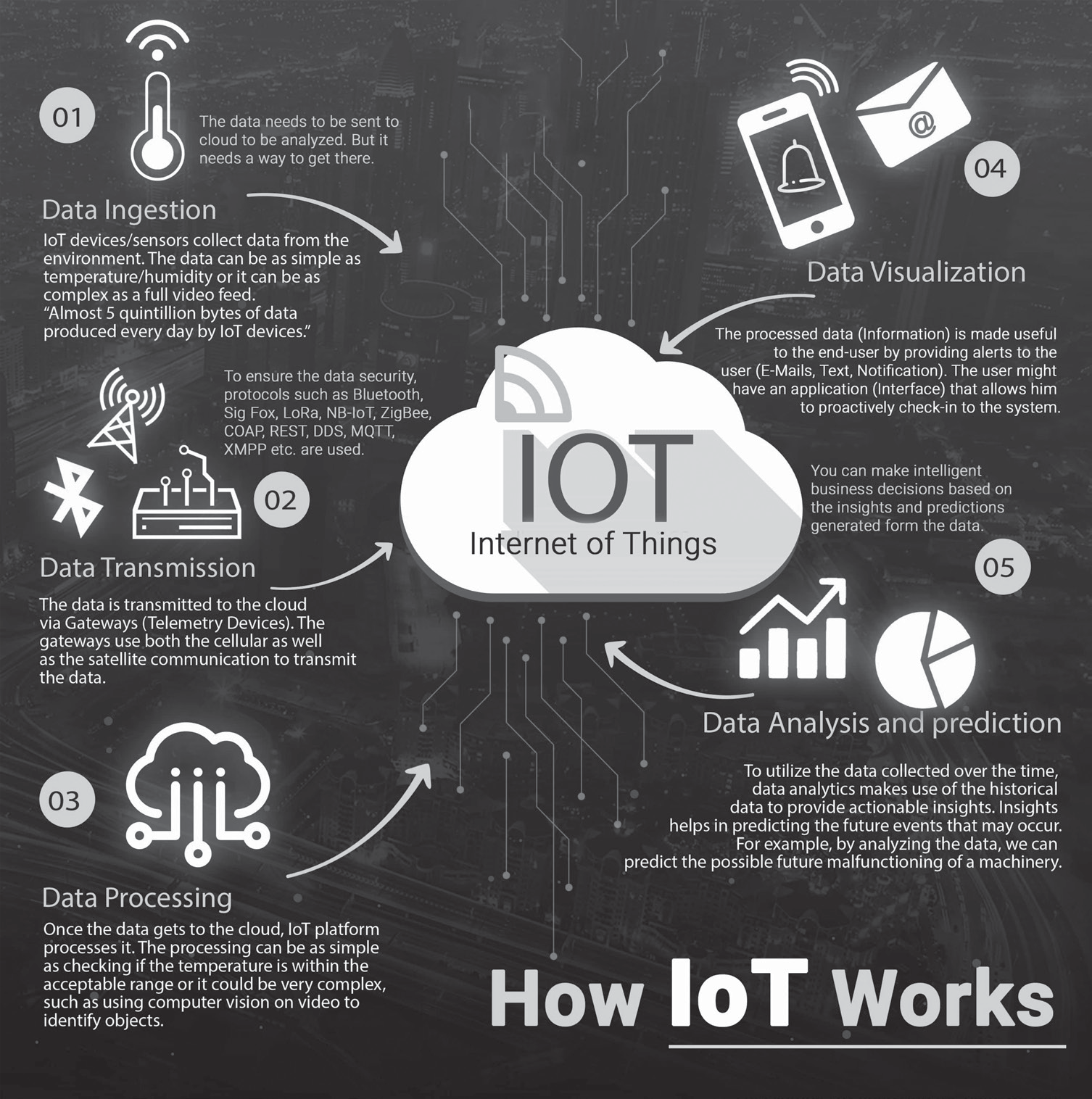
• Data Ingestion: Internet of Things (IoT) devices and sensors gather environmental data and send inputs, including temperature and humidity, to clouds for additional processing.
• Data transmission: A gateway is used to send data to the cloud.
• Gateway transmits data via satellite and cellular networks.
• Data processing: Cloud-based data processing results in the best possible response.
• To verify an air conditioner’s temperature range, for instance.
• Data visualization: This refers to displaying data and providing alerts for pre-emptive action.
• Data analysis and prediction: To produce useful information, data analytics uses data that has been gathered over time. It aids in making future event predictions.
• For instance, data analysis can be used to forecast when a machine will malfunction in the future.
Characteristics of IoT
• Scalability: Internet of Things (IoT) systems have the capacity to support a vast number of devices, which makes them appropriate for a variety of uses, from modest-scale home automation to extensive industrial
applications.
• By 2026, there will be 26.4 billion IoT devices in use worldwide, according to predictions.
• Connectivity: The foundation of the Internet of Things is connectivity.
• A variety of communication protocols, such as Wi-Fi and cellular networks, are used to connect devices.
• As a result, gadgets are able to exchange data and communicate online.
• Remotely Controlled: Internet of Things (IoT) devices can be remotely managed and controlled, enabling users to communicate with them via web apps on a variety of devices, including smartphones.
• Tailored to user needs: It offers solutions that are specifically designed to meet the requirements of a wide range of users.
• Real-time data monitoring: Data from IoT devices enables prompt replies and the making of decisions based on current knowledge. This is known as real-time monitoring.
Different network connected
Body Area Network (BAN)
• The Body Area Network (BAN) technology makes use of tiny, low-power wireless gadgets that are wearable, implantable in the body, or both. Applications include,
but are not restricted to, tracking one’s health and well- being.
These networks’ primary function is to send data generated by wearable devices outdoors to an Internet or WLAN. In certain situations wearables can also communicate directly with one another to exchange data
Local Area Network (LAN)
• A collection of devices linked together in a constrained space, like a house or workplace, is called a local area network, or LAN. Because they facilitate communication between devices and other system components, LANs are essential parts of many IoT systems.
• IoT devices need to be able to send and receive data in order to function properly and this communication makes this possible. Many Internet of Things systems would not function without LANs.
Wide Area Network (WAN)
• One major contributor to the Internet of Things’ advancement is connected cars.
• The applications cover everything from Internet- connected cars with two-way communication with other cars, mobile devices and city intersections to entertainment systems that link to the driver’s phone.
Very Wide Area Network
• IoT equipment, like lights, meters and connected sensors, are used in smart cities to gather and process data.
• The cities then make use of this data to enhance public utilities and services, infrastructure, and other areas.
Guidelines for securing consumer IoT
• Guidelines for securing IoT: Not All IoT devices should have the same default password. Instead, each device’s default password should be distinct and should prompt the user to select a password that adheres to best practices when the device is provisioned.
• Establish a mechanism for handling vulnerability reports: As part of a vulnerability disclosure policy, IoT developers ought to offer a specific public point of contact.
• Update your software: IoT devices should have securely updatable software.
• Safely store sensitive security parameters: In order to ensure the safe operation of the device, Internet of Things (IoT) devices may need to keep security parameters such keys and credentials, certificates, device identity, etc.
• Boost system resilience to disruptions: When their use or that of other dependent systems calls for it, IoT devices and services should be designed with resilience in mind.
Addressing data security concern
• Personal data privacy: Sensitive personal data, such as location, financial, and health information, can be gathered by IoT devices. Protecting this data from unwanted access and using it to protect user privacy must be developers’ top priority.
• The only data that developers should gather and keep is what is required for the IoT device to function. They ought to refrain from gathering pointless information that might be exploited for evil intent.
• Regardless of whether it is kept locally or in the cloud, data needs to be saved securely.
• Updating Device Firmware and Other Software : Firmware upgrades improve security and fix known vulnerabilities in Internet of Things devices, much like software updates do.
• Use automated updating systems to expedite the deployment procedure.
• Before releasing updates, carry out exhaustive testing and validation processes to find and fix any possible problems.
• Ensuring updating every software currently in use: Create an automated, methodical software update procedure.
Application of IoT
• Smart Homes: The purpose of home automation systems is to simplify daily tasks like lighting management, appliance control, thermostat adjustment, and so on.
• Energy management, climate adaptability, embedded systems and home automation technologies all contribute to its operation.
• Medical : The field of health and wellness,or Internet of Medical Things (IoM), encompasses wearable technology such as fitness bands and other wirelessly connected devices that are used to track and monitor various health metrics, including oxygen saturation and heartbeats, in individual individuals.
• IoT for doctors: By utilizing wearables and other home monitoring devices, among other things, data gathered from IoT devices can assist doctors in determining the optimal course of therapy for their patients.
• IoT for Hospitals: Medical equipment such as oxygen pumps, wheelchairs, defibrillators, nebulizers and other monitoring devices can be tracked in real time using IoT devices equipped with sensors.
• Smart Energy: IoT-enabled smart grid empowers consumers and governments to make better decisions regarding energy usage.
• Its advanced, seamless networking and communications enable cities to save electricity.
Industrial Internet of Things
INDUSTRIAL INTERNET OF THINGS (IIoT)
An ecosystem of gadgets, sensors, software, and related networking hardware makes up the industrial internet of things (IoT), which is used to gather, track, and analyze data from industrial processes.
Analyzing such data improves maintenance and troubleshooting capabilities and increases visibility.
It can also lower expenses, boost productivity, and enhance security and safety.
Connecting IoT sensors to manufacturing equipment to track its condition and let teams carry out predictive maintenance is an example of industrial IoT.
Industrial applications such as robotics, medical devices, and software-defined production processes are included in the IIoT.
Government Initiatives to promote IoT
• Draft IoT Policy, 2015: The first IoT policy document in India was released by the Ministry of Electronics and Information Technology in 2014 and served as a
foundation for the comprehensive implementation and administration of IoT-related policies.
• IoT-Centre of Excellence (CoE) by NASSCOM, MeitY, and ERNET: The CoE is specifically designed to help Indian IoT start-ups create market-leading products.
• CoE is India’s largest deep tech innovation ecosystem.
• National Digital Communications Policy 2018: It envisages enhancing internet and digital engagement through IoT.
• Future Skill PRIME: It is a joint initiative by NASSCOM & MeitY aiming to create a reskilling/upskilling ecosystem in ten emerging and futuristic technologies, including IoT.
• 100% FDI in Telecom sector: The government has announced that suppliers of telecom services and infrastructure may receive up to 100% FDI through an automatic approval process.
• Digital India Mission: As part of the Digital India Mission, the Indian government plans to use the Internet of Things (IoT).
• DeITY draft policy for IoT 2020: To create intelligent, safe, and interconnected Internet of Things systems for the environment, economy, society, and needs of the world. By 2020, there will be 27 billion linked gadgets worldwide, valued at USD 300 billion. It has been projected that India will account for between 5 and 6 percent of the worldwide IoT market.
National Mission on Interdiciplinary Cyber Physical System (NM-ICPS)
The NM-ICPS is a comprehensive Mission which would address technology development, application development, human resource development & skill enhancement,
entrepreneurship and start-up development in CPS and associated technologies.
Project cost and Timing: Rs.3660 crore for a duration of five years
• The mission implementation would develop and bring:
• Cyber Physical Systems (CPS) and associated technologies within reach in the country
• Adoption of CPS technologies to address India specific National / Regional issues
• Produce Next Generation skilled manpower in CPS
• Catalyse Translational Research
• This mission is now aligned with BharatGen.
• ‘Bharat Gen’ - India' s first of its kind Indigenously developed government funded AI based Multimodal LLM for Indian Languages.
• It is an indigenous Generative AI model developed by TIH (Technology Innovation Hub) at IIT-Bombay
CHALLENGES
• Security and privacy risks: Every gadget with an Internet connection is susceptible to hacking and misuse.
• There are billions of linked gadgets in the era of the Internet of Things, which someone may use to gain access to personal information, disseminate malware, or even do physical harm.
• A recent dark web leak of personally identifying information about 815 million Indians brought attention to how vulnerable internet-connected devices are.
• Data breaches also cause large financial damages for both people and governments.
• Interoperability issues: Different manufacturers’ IoT devices frequently employ unique standards and protocols, which prevents machines from interacting and communicating with one another.
• Cost and complexity: Considerable infrastructure, software and hardware investments are needed to implement an IoT system. It also calls for specific knowledge and abilities.
• Regulatory and legal challenges: There are legal and regulatory issues when IoT devices are produced and used widely across different regions.
• The context in which multinational corporations must comply with rules and regulations pertaining to cybersecurity, privacy, and data protection is complicated by national regulatory requirements.
Way Forward
• Improved legislative and regulatory frameworks are required to control and oversee Internet of Things applications.
Artificial Intelligence
ARTIFICIAL INTELLIGENCE
Artificial intelligence (AI) is the ability of a computer or a robot controlled by a computer to do tasks that are usually done by humans because they require human intelligence and discernment.
For the first time, Artificial Intelligence was introduced by John McCarthy in 1956. AI term was elaborated by Marwin Minsky
AI refers to the simulation of human intelligence in machines that are programmed to think like humans and mimic their actions.
AI is a self, adaptive learning system.
Main Properties of Artificial Intelligence
• Learning: the gathering of data and the regulations required to use it.
• Reasoning: drawing precise or approximative findings by applying the information principles.
• Self-Correction: the practice of continuously improving AI algorithms to make sure they provide the most accurate outcomes possible.
• Applications: Weather forecasting, autonomous vehicles, space research, industrial automation and the healthcare industry among others.
Types of Artificial Intelligence
• Artificial Narrow Intelligence (ANI) : Artificial narrow intelligence (ANI) is the goal-oriented form of AI that is better suited for a specific task, including playing games like chess or poker, watching weather updates or creating data science reports by evaluating unprocessed data.
• Artificial General Intelligence (AGI) : A hypothetical type of artificial intelligence known as artificial general intelligence (AGI) allows a machine to think and learn like a person. AGI would require consciousness and self- awareness in order to be able to solve issues, adjust to its environment and carry out a wider variety of jobs.
• Artificial Super Intelligence (ASI) : A fictitious software- based artificial intelligence (AI) system with cognitive capabilities beyond human intelligence is known as artificial superintelligence (ASI).
Working Mechanism of Artificial Intelligence
• The way AI functions is by fusing sophisticated processing algorithms with big data sets. By identifying trends in the data set’s behavior, AI is able to modify these algorithms.
• Realize that artificial intelligence is more than just one algorithm. Rather, it is a whole machine learning framework that can make recommendations and address issues.
• Input: Input is the first stage of AI. An engineer must gather the information required in this step for AI to function correctly.
• Data input does not always have to be text; it can instead be audio or graphics. Making sure the algorithms can read the incoming data is crucial, though.
• Clearly defining the data’s context and the intended results is also essential at this step.
• Processing: In the processing stage, artificial intelligence makes decisions about what to do with the data. Depending on the specific AI technology, during processing, AI analyzes the pre-programmed data and applies the behaviors it has learnt to identify the same or comparable behavior patterns in real-time data.
• Data Outcomes: Following data processing, artificial intelligence technology forecasts the results. This stage ascertains the success or failure of the data and the predictions made by it.
• Adjustments: AI technology can learn from mistakes and carry out the procedure in a new way if the data set results in a failure. It could be necessary to modify the algorithms’ rules in order to make them fit the data collection. During the adjustment phase, results may also change to reflect a more appropriate or desired outcome.
• Assessments: The final phase is appraisal once AI hascompleted the task it was given. The technology can evaluate the data, draw conclusions and make predictions thanks to the evaluation phase. In addition, it can offer valuable input that is required prior to repeating the algorithms.
India and AI developments
• INDIAai : Launched on May 28, 2020, it is the National
Artificial Intelligence Portal of India.
• It is a research organization, knowledge portal, and ecosystem-building project that aims to bring together and encourage partnerships with different
organizations in India’s artificial intelligence
ecosystem.
• The National e-Governance Division (NeGD), NASSCOM, and the Ministry of Electronics and IT (MeitY) are the joint initiators of this project.
• NITI Aayog – National AI Strategy: India’s artificial intelligence plan employs a multipronged approach
with the goal of establishing the nation as a leader in the field worldwide. It includes important strategies like data interoperability, AI literacy, research centers, capacity building and legislative frameworks.
• US India Artificial Intelligence Initiative
• Launched in March 2000, the Indo-US Science and Technology Forum (IUSSTF) is the organization behind the US India Artificial Intelligence (USIAI) program.
• The USIAI will concentrate on AI collaboration in crucial areas that both nations consider important.
• Manufacturing, materials, energy, healthcare, smart cities, and agriculture are a few examples.
Ethics and AI
• AI Ethics’ Risk of Unemployment: The hierarchy of labor’s primary concern is automation. Robotics and artificial intelligence companies are developing intelligent robots that can take the place of low-paid laborers in tasks like fruit picking and cashiering. Furthermore, the time will come when artificial intelligence (AI) will replace many desk jobs, such as those held by traders, accountants and middle managers.
• Increasing AI Ethics Inequalities: Businesses can employ AI to drastically reduce their dependency on human labor, which would lead to a reduction in the number of people earning an income. Therefore, the owners of AI-driven firms will be the only ones to benefit from these ventures. AI might make digital marginalization worse.
• Technology addiction is the newest manifestation of human dependence. AI is already skilled at grabbing people’s attention and starting particular tasks. If managed well, this may prove to be an opportunity to push for improved social norms. In the wrong hands, though, it might be dangerous.
• Backlash against widespread surveillance There is growing opposition to the use of mass surveillance, which is made easier by technologies like facial recognition. Human Rights Watch claims that human rights are in danger due to the backlash against surveillance, which includes the monitoring of religious Uyghurs in China’s Xinjiang province and the military takeover of
Myanmar in February.
Advantages
• Enhanced Accuracy: Large volumes of data may be precisely analyzed by AI algorithms, which lowers errors and increases accuracy in a variety of applications, including decision-making, forecasting, and diagnostics.
• Improved Decision-Making: Artificial intelligence (AI) offers data-driven insights and analysis, supporting
well-informed decision-making by spotting patterns, trends, and possible hazards that people can find difficult to recognize.
• Innovation and Discovery: AI encourages creativity by making new discoveries feasible, revealing previously undiscovered information, and expanding the realms of science, technology, and healthcare.
• Increased Productivity: Artificial intelligence (AI) technologies and tools have the potential to enhance human capabilities, resulting in higher output and productivity in a range of industries.
• Continuous Learning and Adaptability: AI systems are capable of learning from fresh information and experiences, which enables them to continuously enhance performance, adjust to changes, and keep up with changing patterns and trends.
DISADVANTAGES
• Job Displacement: AI automation has the potential to displace some professions since computers and algorithms can now carry out operations that were previously completed by people. This may lead to unemployment and necessitate workforce retraining or reskilling.
• Ethical Concerns: Concerns about privacy invasion, prejudice in algorithms, and the moral implications of autonomous decision-making systems are just a few of the ethical issues that AI brings up.
• Reliance on Data Availability and Quality: The availability and quality of data is crucial for AI systems. Incomplete or biased data might exacerbate preexisting biases in decision-making or produce erroneous outcomes.
• Security Risks: AI systems are susceptible to exploitation and cyberattacks. Security threats arise from malicious actors’ ability to tamper with AI algorithms or employ AI-powered tools for evil intent.
Way Forward
• Ethical and Responsible AI: The creation and application of AI systems that are moral, open and responsible must be given top priority. This entails eliminating prejudices, protecting privacy and data and putting in place precise rules and regulations.
• Continued Research and Innovation: AI is a rapidly developing discipline, and in order to increase its capabilities, more research and innovation are required. Improvements in performance and breakthroughs might result from investments in fundamental research, such as the creation of new models and algorithms.
• Data Quality and Accessibility: Reputable and varied datasets are necessary for efficient AI model training.
The methods of data collecting, cleaning and labeling should be improved.
• Human-AI Collaboration: AI should not be used to completely replace human capabilities, but rather to enhance them. Prioritizing human-AI collaboration can result in more efficient solutions and increase output across a range of sectors.
Deepfakes
DEEPFAKES
Deepfakes use a form of artificial intelligence called deep learning to make visual and audio content of fake events, hence the name deepfake.
The origin of the word “deepfake” can be traced back to 2017 when a Reddit user, with the username “deep fakes”, posted explicit videos of celebrities.
Deep Fakes are created by deep learning models, which use neural networks to manipulate images and videos.
A model such as this “analyses” video footage until it is able algorithmically to transpose the ‘skin’ of one human face onto the movements of another.
The usage of a technique called Generative Adversarial Networks (GAN), which employs two AI algorithms — one that creates false material and the other that assesses the system’s efforts, allowing it to improve has resulted in more accurate deep fakes.
Uses of Deepfake Technology
• Health and medical care: Deep generative models can be used to improve healthcare. These models—generative adversarial networks, or GANs—are especially helpful in overcoming data scarcity caused by privacy issues or the rarity of specific medical diseases. They may provide lifelike medical images, including brain MRI scans, which improve the AI’s learning process and enable more accurate diagnosis and therapy
• History and Art: We can better connect with and comprehend the past by using deepfake technology to reconstruct it. It can provide us the chance to encounter things that predate us and that we otherwise wouldn’t be able to understand.
• Personalization: A strong argument may be made for the appropriate commercial application of deepfakes, which would enable large-scale personalization. While personalization is a wonderful thing, many firms nowadays struggle to use it on a large scale. Thus, the business use case for deepfake technology is video personalization.
Concers Regarding Deepfake
• Deepfakes can be used for a variety of nefarious activities, including:
• Disseminating false information and propaganda;
• Swaying public opinion and elections;
• Blackmailing and extorting people or groups;
• Destroying the credibility and reputation of public
figures, politicians, activists, and journalists;
• Producing non-consensual and revenge pornography.
• Deepfakes can undermine the rule of law and human rights, as well as erode public confidence in democratic institutions, the media, and democracy itself.
• People’s privacy, dignity and reputation can be violated by deepfake technology, which can also be detrimental to victims’ mental health and general wellbeing particularly women, who are frequently the objects of such nefarious manipulation.
Global Initiatives to tackle Deepfake
• 28 major countries, including the US, China and India came to an agreement at the world’s first AI safety summit in 2023 about the necessity of taking global action to address the possible threats associated with AI.
• The summit’s Bletchley Park Declaration recognized the dangers of purposeful abuse and the loss of control over artificial intelligence (AI) technologies.
India and Deepfake regulations
• Deepfake technology is not specifically prohibited or regulated by laws or regulations in India.
• A worldwide framework for the development of “ethical” AI tools has been demanded by India.
• Deepfakes can be subject to legal action for some of their activities, including as releasing explicit content and defamation, under sections 67 and 67A of the Information Technology Act (2000).
• The Indian Penal Code (1860), Section 500, stipulates the penalties for defamation.
• Digital Personal data Protection Act 2023: According to the definition provided by the Digital Personal Data Protection Act of 2023, pictures and photos are considered sensitive personal data that can be used to identify a specific individual. Thus, deepfakes constitute a breach of personal information and an infringement on an individual’s right to privacy.
Way Forward
• Creating and putting into effect extensive legislation and rules that, while maintaining the right to free speech and expression, particularly target the production and distribution of deepfakes.
Biometrics
BIOMETRICS
• Biometrics are biological measurements — or physical characteristics — that can be used to identify individuals.
• For example, fingerprint mapping, facial recognition, and retina scans are all forms of biometric technology, but these are just the most recognized options.
Architecture of a Biometric System
• Sensor: It acts as a go-between for the system and the outside world. It gathers from the users all the necessary data. This method of acquiring images involves obtaining the specifics of the image from other sources in order to carry out additional operations.
• Data Pre-processing: The procedure started by removing noise, mistakes, and redundancies from the input data after it had received input from the sensors. To clean up the data, normalization is done
• Feature Extraction: The process of converting the raw visual data into numerical data is called feature extraction. Several actions are carried out by feature extraction techniques to eliminate the image’s redundancy. Certain distinct characteristics of the scanned image are saved in the database once the redundant elements from the input image have been eliminated.
• Template Generator: The template is created by combining all of the features that were retrieved from the image. These templates take the shape of numerical data or vectors. All of the features that were extracted
from the image are combined to produce the template. These templates are represented as vectors or numerical data.
• Database: It keeps track of how many people use it. It assists the matcher in identifying the user by storing their biometric scan.
• Matcher: In this procedure, the matcher extracts the feature from that scanned image and uses it to query the database to see if it contains a user who requests access control of any file or property. Matcher contrasts it with the different information from the scanned pictures.
• Output: The biometric system allows access if the user’s scanned photos match the data that is saved. Should the individual have no records in the database, a notification stating “NO RECORDS FOUND” or a similar one will be displayed. The input must first be pre-processed before the output can be generated.
Features
Numerous properties that biometric recognition technology possesses make it an invaluable instrument for person identification and verification. Among the essential elements are:
• Uniqueness: Since biometric attributes are intrinsically unique to each person, no two people are exactly same in their biometric characteristics.
• Universality: The biometric property under examination, like fingerprints, is universally relevant because it is possessed by the majority of people.
• Permanence: Because biometric features are comparatively stable over time, long-term recognition is guaranteed.
• Collectability: Biometric data can be collected by the technology in a convenient and non-intrusive way.
Types of Biometrics
• Physiological
•
The analysis of a person’s physical traits, such as their iris, palm, or fingerprint, is known as physiological biometrics.
• These characteristics are usually fixed; as you age, the vein patterns in your palm will not alter. In general, your face’s overall shape and features won’t change to the point where it becomes unrecognizable.
• Physiological biometrics can also be used in other contexts, such as face recognition in CCTV or physical access control. Further information regarding the distinctions between face recognition and face verification can be found here.
• Physiological biometrics examples could be: Face-to-face confirmation, Face identification using fingerprint
• Behavioural
• The study of behavioral biometrics involves detecting and quantifying patterns in human behavior, such as a person’s mouse or typing routines. Organizations typically use this as a background security measure, which explains why you may not have seen it happen firsthand.
• When a person exhibits patterns and actions that deviate from expectations, this may be a sign of fraud. Once the threat has been resolved, the system may then initiate step-up authentication or temporarily suspend the account.
• Behavioral biometrics examples could be:
• Keyboard Dynamics
• Mouse/Cursor Dynamics
• Identification of Signatures
Application of Biometric Technology
• Airport Security: Large international airports have been using biometric technology to confirm passenger IDs for a number of years and the technology is rapidly expanding to new locations worldwide.
• Biometric Attendance: Biometrics is also being used more and more in the sphere of workforce management. Employee time and attendance fraud is a widespread issue in businesses all around the world.
• Law Enforcement: For many years, agencies such as the CBI have been utilizing biometrics in their criminal investigations. These days, police enforcement organizations all around the world employ biometrics extensively to identify criminals.
• Banking: The use of biometrics in banking has grown significantly over the past several years, and banks all around the world are implementing it.
• Healthcare: The application of biometrics in healthcare presents an improved paradigm. Among the most valuable personal documents are medical records. The availability of biometrically connected information aids in the quick and accurate diagnosis of conditions as well.
Biometric Recognition Technology in India
• Aadhaar: Over a billion residents have been enrolled in the huge Aadhaar initiative, which uses biometric data for identification verification in various government services.
• Financial Inclusion: Opening bank accounts and transferring benefits directly under the Pradhan Mantri Jan Dhan Yojana are made easier by biometrics.
• E-Governance: Digital identity verification and the provision of government services are improved by biometrics.
• Security: Biometrics are used by both public and commercial institutions for safe access control and data security.
• Education: In educational institutions, biometrics simplify exam verification and attendance tracking.
Concerns associated with Biometric Technology
• Infringement of Privacy: The method puts consumers’ data privacy at risk. Without regulations, data would be vulnerable to cybercriminals. Businesses may sell biometric data that could be used improperly for political reasons since they are not subject to regulations.
• State surveillance: State monitoring is the biggest risk associated with using the device. One such instance is the alleged use of facial recognition technology in Xinjiang, China, for surveillance purposes. This is concerning because it could be abused for political ends.
• Inaccuracy: Biometric technologies are imprecise. There is evidence that the technology is not perfect. For instance, numerous studies have demonstrated that the technology is unreliable in recognizing people of color, particularly black women.
• Predatory marketing: Certain companies may utilize biometric analysis software to prey on their most vulnerable customers. One possible approach to achieve this would be to categorize strong emotions, such distress, and provide products and services specifically for these people.
Way Forward
Data is an important resource in the digital age that needs to be managed. The timing is right for India to establish a strong data protection law in this regard.
It is time for the Personal Data Protection Bill of 2019 to undergo the necessary modifications. It must be revised to make sure that user rights are prioritized along with user privacy. In order to uphold these rights, a privacy commission would need to be established.
In addition, the government would have to uphold residents’ right to privacy while advancing their access to information. The recent two to three years’ worth of technical advancements also need to be taken into consideration, as they have the potential to render the law obsolete.
Digital Signature Certificates
DIGITAL SIGNATURE CERTIFICATES (DSC)
DSC are the digital equivalent (that is electronic format) of physical or paper certificates.
Certificates serve as a proof of identity of an individual.
DSCs can be presented electronically to prove identity, to access information or services on the Internet or to sign certain
documents digitally.
Types
The type of client and the purpose for which the DSC is acquired determines the Class of DSC to be applied. The three types of DSC are:
• Type 1 Certificates: These are given to the person or private users that are used to verify that perhaps the recipient’s name and contact details from the clearly specified subject area in the certifying agency ‘s database.
• Type 2 Certificates: These are issued to the director or signatory authority of the organizations for e-filing with ROC( Registrar of Companies). Type 2 certification is mandatory for people who have had to sign manual documents when submitting ROC returns.
Type 3 Certificates: These certificates are used for online participation or bidding at online tenders & e-auctions all around India. Sellers wishing to participate in online bidding should have a Type 3 digital signature certificate
Digital Signature
DIGITAL SIGNATURE
A digital signature is a mathematical technique used to validate the authenticity and integrity of a message, software or digital document.
It’s the digital equivalent of a handwritten signature or stamped seal, but it offers far more inherent security.
A digital signature is intended to solve the problem of tampering and impersonation in digital communications.
Working of Digital Signature
Digital signatures, like handwritten signatures, are unique to each signer. Digital signature solution providers, such as DocuSign, follow a specific protocol, called PKI. PKI requires the provider to use a mathematical algorithm to generate two long numbers, called keys. One key is public, and one key is private.
When a signer electronically signs a document, the signature is created using the signer’s private key, which is always securely kept by the signer.
The mathematical algorithm acts like a cipher, creating data matching the signed document, called a hash, and encrypting that data.
The resulting encrypted data is the digital signature.
The signature is also marked with the time that the document was signed.
If the document changes after signing, the digital signature is invalidated.
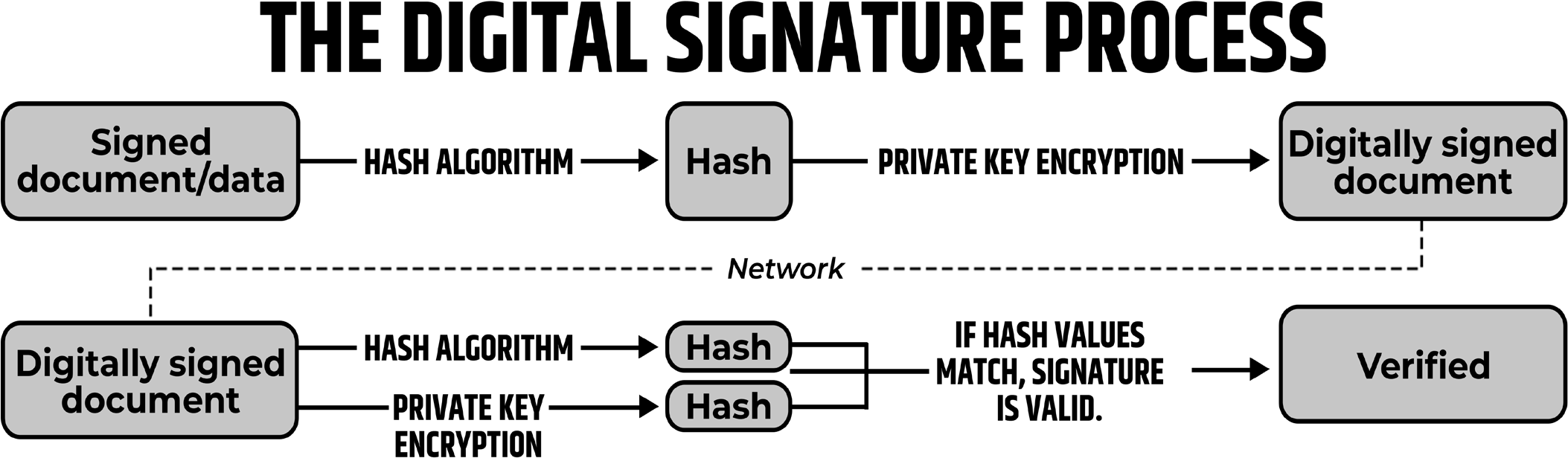
Digital Signature vs Digital Certiciate
| Feature | Digital Signature | Digital Certificate |
| Definition | A digital signature secures the integrity of a digital document in a similar way as a fingerprint or attachment. | Digital certificate is a file that ensures holder’s identity and provides security. |
| Process | Hashed value of original data is encrypted using sender’s private key to generate the digital signature. | It is generated by CA (Certifying Authority) that involves four steps: Key Generation, Registration, Verification, Creation. |
| Security Services | Authenticity of Sender, integrity of the document and non-repudiation. | Itprovidessecurityandauthenticityof certificate holder. |
Advantages of Digital Signature Certificates
It can be used to verify personal details and knowledge of an entity when doing business online.
You can sign a digital format of a PDF file and start sending it to the receiver, rather than signing and scanning a hard copy of the file to mail it. In reality, it is not mandatory for the owner of the digitally signed certificate to physically present a company for the approval.
Everywhere in India, these documents are used for online participation or bidding at e-auctions and online tenders. Vendors wishing to engage in online bidding must have a Class 3 digital certificate.
Disadvantages of Digital Signature Certificates
• Phishing attacks: Attackers can create fake websites and acquire certifications to make their websites appear real. Users might be tricked into giving sensitive data, including their login credentials, which the attacker could subsequently utilize against them.
• Weak encryption: Digital certificate systems that are older could use less secure encryption techniques that are vulnerable to hacking.
• Misconfiguration: Digital certificates must be configured properly in order to function. Incorrectly configured certificates can be a source of attack for websites and online interactions.
3d Printing
3D PRINTING
• 3D printing, also known as additive manufacturing, is a method of creating prototypes or functional models of products by layering materials such as plastic, resin, thermoplastic, metal, fibre, or ceramic.
• Compared to traditional subtractive techniques, 3D printing offers immense design flexibility, reduced waste and the ability to produce complex geometries.
• With a market share of more than 35%, the United States is the global leader in 3D printing. China controls almost half of the Asian market, followed by Japan (30%) and
South Korea (10%).
Process of 3D Printing
The process of 3D printing begins with the creation of avirtual model of the thing to be manufactured.
A 3D modelling application, such as CAD (Computer Aided Design), or 3D scanners can be used to create virtual designs.
After that, the 3D digital copy is loaded into a 3D modelling application. In order to print the model, it is next cut into hundreds or thousands of horizontal layers.
This prepared file is then sent to the 3D printer, which reads each slice in 2D format and then builds the item layer by layer, with no apparent layering and a 3-dimensional structure as a result.
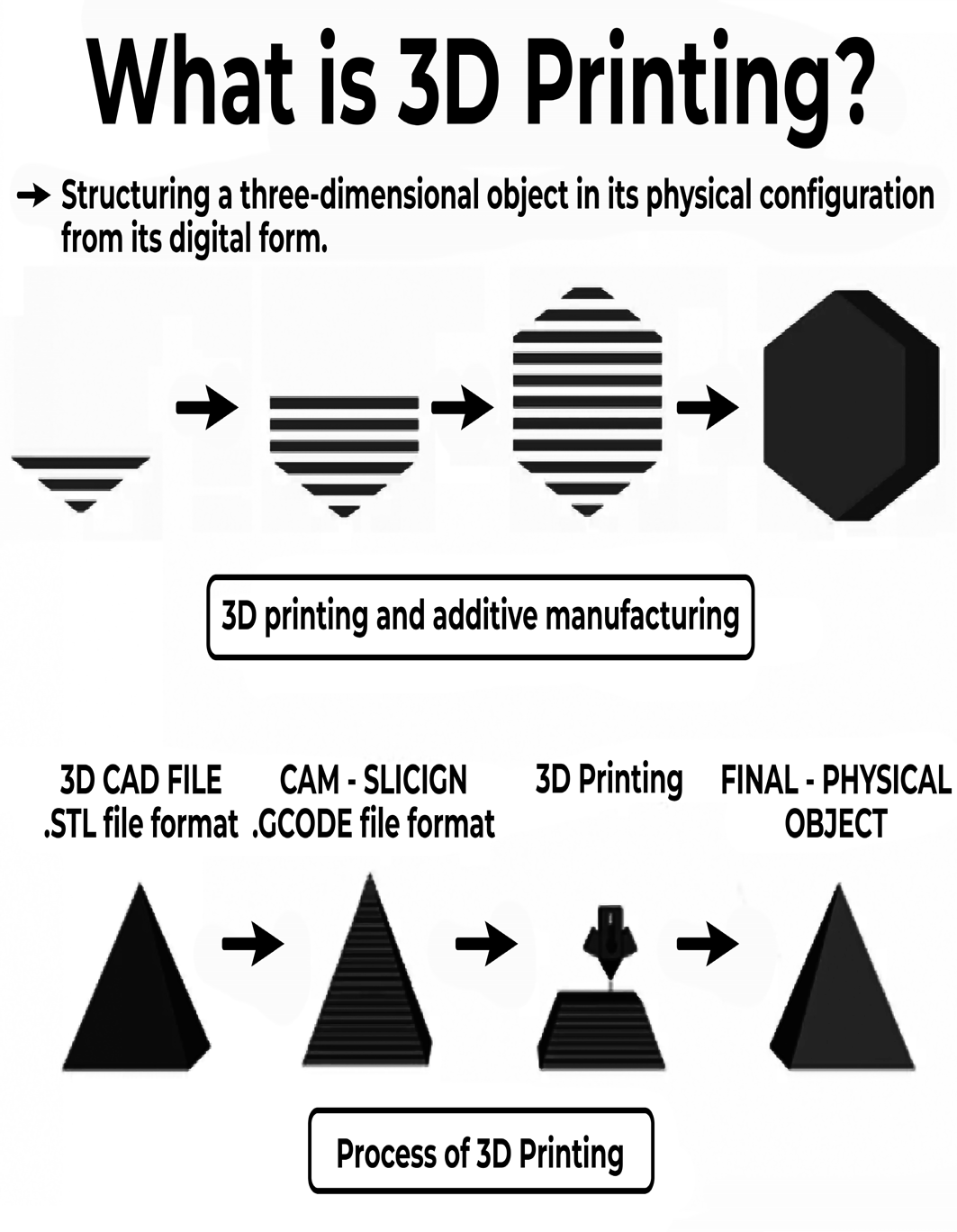
Additive Manufacturing
Through the use of materials like metals and plastics,additive manufacturing creates three-dimensional objects from computer-aided designs.
The next step in digital manufacturing is additive manufacturing, which enables the fusion of electronics, computers, images and cutting-edge fields like pattern recognition and artificial intelligence. It also generates potential for intellectual property and exports.
With its application to digital processes, communication, photography, architecture and engineering, Additive Manufacturing (AM) has great promise to transform
India’s industrial production and manufacturing scene.
Potential of India
• Removing Huge Capital Expenses: Equipment is less expensive, inventory may be kept modest and space needs are minimal. As a result, retooling and adapting traditional small and medium-sized businesses to focus on high-tech manufacturing does not provide a significant obstacle when it comes to jump-starting manufacturing.
• Using India’s IT Power: As part of “Digital India,” there are ongoing plans to enhance connectivity and support a well-established software sector in India.
• This would promote industrial development outside of big cities and enable the establishment of additive manufacturing facilities in rural villages.
• Uniform Quality Standards: Since the complete system is constructed at once and assembly is not necessary, maintaining consistent product quality is much simpler.
National Strategy on Additive Manufacturing
• In addition to removing financial and technical obstacles, the National Strategy on Additive Manufacturing (AM) will work to establish a supportive ecosystem for design, development, and implementation. This will enable global leaders in AM to establish operations in India with associated ancillaries.
• The goal is to make sure that a sustainable ecosystem is built so that the AM industry can compete on a global scale, to promote AM transformation and drive the nation’s core competency development capabilities and to establish India as a hub for global AM innovation and research.
• Its objectives are to support the development of Indian IPR and guarantee end-user functional components made in AM for both home and international markets.
• By 2025, the MeitY plans to boost India’s share of additive manufacturing to 5% globally, which could add $1 billion to the country’s GDP.
• According to the plan, by 2025, India hopes to accomplish a number of goals, including 500 new goods, 50 machine, software, and material technologies unique to the country,
100 new additive manufacturing businesses, 500 new products, and at least 1 lakh new skilled employment.
The mission might be led by an apex body made up of subject matter experts and executives from regional and international businesses.
Applications of 3D Printing
Aerospace: To save weight and material requirements, parts for aircraft and spacecraft can be made using lightweight printing instead of typical manufacturing methods. Using direct metal laser sintering (DMLS), HAL and Wipro 3D printed an air blower component for the TEJAS aircraft. Weight reduction of 50% was attained in comparison to traditional manufacturing methods.
• Automotive: 3D printing is used by the automotive sector to create specialized parts and tools quickly through fast prototyping. Printed parts can save weight and enhance design. Mahindra manufactures about
200 3D-printed polymer components a year for car prototypes. Development and design verification have accelerated as a result.
• Healthcare: With personalized prosthetics, implants, anatomical models for surgical practice and medications, 3D printing is completely changing the healthcare industry.
• Yaantra, a medical tech firm, created a 3D printed skull implant that allowed doctors to precisely visualize the shape of tumors and eliminate uncertainty during operation.
Advantages of 3D Printing
• Customised Production: Easily customized products that meet specific demands instead of mass-produced items are produced thanks to 3D printing. Tool-less production and inexpensive personalization are made possible by it.
• Complex Geometries: It is possible to 3D print intricate forms and intricate interior structures like lattices and honeycombs that improve strength and functionality. Otherwise, it would be difficult to produce these.
• On-Demand Local Production: Global supply chains are not required, and transportation expenses, delays and carbon emissions are decreased with the use of distributed 3D printing and digital inventory. On-site printing of spare parts is possible.
• Material Savings: Waste is reduced via additive 3D printing, which deposits only the material needed. Recycled scrap can be made into feedstock, powder or filament.
Concerns and Challenges of 3D Printing Technology
• Limited scalability: Comparing production volumes to traditional manufacturing, they are still low. The dimensions of the printer limit the part size.
• High equipment costs: The cost of industrial-grade metal
• printer systems remains over ₹1 crore, which hinders their wider adoption by enterprises.
• Material constraints: restricted selection of printable 3-D objects. continues to be difficult for ceramics and multi- material parts.
• Process reliability: The final construction quality and material properties are frequently impacted by defects such as micro-porosity, inadequate filling and layer delamination.
• Standards: Interoperability and reliability are hampered by the absence of established design guidelines, data formats, quality benchmarks and material specifications.
Key Initiatives in India for 3D Printing
• Recognizing 3D printing’s immense potential for economic growth and self-reliance, the Government of India has devised targeted policies and initiatives:
• National Strategy for Additive Manufacturing: Developed in 2021 by the Ministry of Electronics and Information Technology, it establishes a strategic road map for promoting worldwide collaborations, production, talent development and research into 3D printing.
• Key goals:
• Enable 100 innovative 3D printing startups.
• Develop 50 India-centric technologies by 2025
• Train 5,000 skilled workers by 2024
• Samarth Udyog: The Ministry of Heavy Industries Industry 4.0 project seeks to improve manufacturing competitiveness through the use of 3D printing.
• Make in India 2.0: Indian government intends to establish itself as a global center for 3D printing as part of its Atmanirbhar Bharat agenda.
• Partnerships with Global Institutes: The government has established state-of-the-art 3D printing research centers in partnership with companies such as Applied Materials.
• Defence Initiatives: The benefits of 3D printing for component production have been acknowledged by the defense industry. BEL and DRDO are making active use of the technology.
3d Bioprinting
3D BIOPRINTING
• The goal of 3D bioprinting is to provide 3D constructs with autonomous mechanical characteristics so that they could resemble the body’s natural tissue.
• This method enables for the customization of microstructures for disease models.
Recent Development in 3D Bioprinting
Scientists have created a 3D printing process that can replicate the complicated geometry of blood vessels, which might be used to construct prosthetic arteries and organ tissues in the future.
Hardened blood vessels are associated with cardiovascular disease and engineering a solution for viable artery and tissue replacement has historically proven challenging. To overcome these hurdles, researchers found a unique way to take advantage of oxygen’s role in setting the
final form of a 3D-printed structure.
By keeping tight control over oxygen migration and its subsequent light exposure, researchers have the freedom to control which areas of an object are solidified to be harder or softer all while keeping the overall geometry the same.
This is an encouraging first step towards the goal of creating structures that function like a healthy cell should function.
As a demonstration, the researchers printed a small Chinese warrior figure, printing it so that the outer layers remained hard while the interior remained soft.
The researchers are optimistic that future studies will help improve the capabilities even further. The findings could lead to better, more personalized treatments for those suffering from hypertension and other vascular diseases.
Future
• Promotion of R&D: To ensure that products are made to fit the needs of Indian consumers and the country’s environment, we must hasten research at our top engineering institutions on manufacturing equipment and processes and support the establishment of product design centers.
• Government Support: In order to encourage distributed manufacturing in smaller communities, the government must give incentives. Additionally, the IT sector must endeavor to develop marketplaces and platforms that seamlessly link product designers, producers and consumer desires.
Conclusion
• Although 3D printing is a cutting-edge technology with many advantages, it is not without its drawbacks. With technology developing and becoming more widely available, the Indian market may undergo major changes due to its potential applications in a variety of industries, such as manufacturing, healthcare and construction.
Drones
DRONES
A drone refers to an unpiloted aircraft or spacecraft.
Another term for it is an “unmanned aerial vehicle,” or UAV.
Componets of Drone
Unmanned aircraft (UA)
Control system (ground control station – GCS)
Control link (specilaized datalink)
Other related support equipment
Classification (As per Drone rules,2021)
Nano: <250 gm
Micro: 250 gm to 2 kg
Mini: 2 kg to 25 kg
Small: 25 kg to 150 kg
Large: >150 kg
Applications
• Defence: Drone system can be used as a symmetric weapon against terrorist attacks.
• Drones can be integrated into the national airspace system.
• Deployment of drones for combat, communication in remote areas, counter-drone solutions can be done.
• Healthcare Delivery Purposes: Recently, the Ministry of Civil Aviation has approved a project with the Telangana government for using drone technology to deliver vaccines in remote areas.
• Agriculture: In the agriculture sector, micronutrients can be spread with the help of drones.
• It can also be used for performing surveys for identifying the challenges faced by the farmers.
• Monitoring: The drone technology in the SVAMITVA scheme launched by the Government of India, within less than a year, has helped about half a million village residents to get their property cards by mapping out the abadi areas.
• Drones can be used for real-time surveillance of assets and transmission lines,theft prevention, visual inspection/maintenance, construction planning and management, etc
• They can be used for anti-poaching actions, monitoring of forests and wildlife,pollution assessment, and evidence gathering.
• Law Enforcement: Drones are also significant for the
law enforcement agencies, the fire and emergency
services wherever human intervention is not safe and the healthcare services.
India’s Counter-Drone System
• Indrajaal (India’s inaugral autonomous drone-defense dome)
• Procurement of combat-capable Heron drones from Israel
• Acquisition of MQ-9B Armed Drones from the US
• Advanced technologies including autonomous takeoff and landing, a detect and avoid system, anti- spoofing GPS, and encrypted communication lines are all standard on MQ-9B drones.
Drone v Uav
• There is no difference between the terms drone and UAV; they have the same meaning. Both are aerial vehicles that, in the most sophisticated scenarios, can fly without human assistance. One such example is the fixed wing drone below, which gets its name from its stationary, straight side wings.
• An unmanned ship or aircraft that is piloted remotely or automatically is called a drone.
• Unmanned Aerial Vehicle, or UAV, is an aircraft that can
fly without a pilot.
Drone and National Security
• Undetectability: Radar is typically employed to identify aerial vehicles, like airplanes, by short-pulse radio frequency wave emission. However, because to their narrow radar cross-section (RCS), small drones, such nano drones, are challenging to detect.
• Sizes: Drones are small enough to be difficult to shoot down, even if they are detected. While taking down a drone with live transmission capability is pointless because the controller has already received the data.
• Identification of Origin: It is impossible to determine who sent a drone, even if it is found and rendered inoperable.
• Operational Flexibility: Compared to traditional espionage techniques, drones offer more cost, safety, and efficiency. Since drones are unmanned, there is no longer any chance that users could be harmed.
Green, Yellow and Red Zone
• Green zone is the airspace upto 400 feet that has not been designated as a red or yellow zone; and upto 200 feet above the area located between 8-12 km from the perimeter of an operational airport.
• In green zones, no permission whatsoever is required for operating drones with an all-up weight upto 500 kg.
• Yellow zone is the airspace above 400 feet in a designated green zone; above 200 feet in the area located between 8-12 km from the perimeter of an operational airport and above ground in the area located between 5-8 km from the perimeter of an operational airport.
• Drone operations in yellow zone require permission from the concerned air traffic control authority – AAI, IAF, Navy, HAL etc. as the case may be.
• Yellow zone has been reduced from 45 km earlier to 12 km from the airport perimeter.
• Red zone is the ‘no-drone zone’ within which drones can be operated only after a permission from the Central Government.
India’s Initiatives
• Digital Sky Platform
• No-Permission-No Takeoff (NPNT) framework
• PLI Scheme for Drones
• Drone Shakti initiatives
• Liberalized drone rules 2021
• i-Drone initiative
• Drone import policy
Issues
• Increased Risk of Armed Attacks: Drone operations without sufficient legal support might present a number of security risks.
• Incidents of arms being dropped by drones are also there such as the recent Jammu drone attacks.
• They can be put to destructive use, to slam into critical targets, destroy infrastructure and so on.
• Paramilitary Not Exempted from the Rules: The drone
rules 2021 are not applicable to the army, navy or the airforce.
• However, it still includes paramilitary forces. BSF is suffering a lot of issues due to the drones coming across the lines.
• Cheaper cost enables a larger population to procure drones: Drones are relatively cheaper in comparison to conventional weapons and yet can achieve far more destructive results which is the primary reason for increased number of drone attacks.
• Delivery of Mass destruction weapons: What makes combat drones most dangerous is the threat of them being used to deliver weapons of mass destruction.
• Procurement of combat drones by non-state actors poses serious threats.
Way Forward
• Three-step procedure for countering drone threats: This procedure entails finding, locating, and eliminating any drone threats that are in the air. Drones entering the nation illegally must be regarded as hostile. There should be drone policies, licenses, and regulations in place for all other drones.
• Investing in Anti-Drone Technology: When it comes to anti-drone technology, the Indian government needs to take the lead. One way to encourage stakeholders to concentrate on developing anti-drone technology is by providing a budget.
Priority Areas: Although preventing drone attacks throughout India is essential, it is not yet achievable. The government ought to designate locations of paramount significance, including air bases and VIP sections of cities, and concentrate on raising awareness and establishing drone defenses in these regions