Other Generation Mobile Technologies
OTHER GENERATION MOBILE TECHNOLOGIES
• 2G: The 2G era started in the 1990s and much of this technology is still in effect today. The 2G cell phone features digital voice encoding. Examples include CDMA and GSM.
• 3G : 3G wireless networks make use of technologies like
• General Packet Radio Service (GPRS);
• Enhanced Data Rates for Global Evolution (EDGE);
• UMTS Wideband CDMA (WCDMA) and
• High Speed Downlink Packet Access.
• The maximum theoretical speed of data transfer for 3G technology is only 7.2 Mbps.
• GPRS: GPRS is a packet-based wireless communication technology that offers users of computers and mobile phones data rates ranging from 56 to 114 Kbps and a constant Internet connection. Higher data rates will enable users to use notebook computers and mobile portable devices for video conferences, as well as to interact with multimedia websites and related applications.
• GSM: GSM, a TDMA-based wireless network technology, is used to identify a user's account. GSM networks in
India use the 900MHz and 1800MHz frequency bands for operation.
CDMA: The spread-spectrum digital cellular technology is used in Code-Division Multiple Access. In contrast to rival TDMA systems like GSM, CDMA it does not allot a particular frequency to every customer. Rather, each channel makes use of the entire spectrum. Digital sequences that are pseudo-random are used to encode individual conversations.
Direct-2-Mobile: This technology enables mobile phones to receive terrestrial digital TV and is based on the convergence of broadcast and broadband.
• It would be comparable to how people listen to FM radio on their phones, where radio frequencies are picked up by a receiver inside the phone.
• Multimedia content can also be broadcast straight to phones via D2M.
• The technology’s concept is that it might be used to directly broadcast content that is citizen-centric and that can also be utilized, among other things, to provide support in crisis management, issue emergency alerts, and combat fake news.
• Live sports, news and other content can be aired on mobile devices using it.
• VoIP phones: VoIP technology allows customers to place phone calls using a broadband Internet connection rather than a traditional landline. VoIP technology changes the voice signal from analog phone lines to a digital signal that may be sent over the Internet in place of traditional phone lines.
VoLTE vs VoWiFi vs VoNR
• WiFi calling, also known as Voice over WiFi (VoWiFi), is an IP technology that connects your mobile device to a local WiFi network in order to create a connection with an ePDG (Evolved Packet Data Gateway), a mobile network entity. ePDG ensures safe communication by collaborating with IMS and the mobile core network.
• VoNR, or voice over new radio, is a packet-switched IP technology that operates on the condition that your smartphone is linked to a gNodeB, a 5G radio base station. VoNR needs a 5G mobile core network that is compatible with the IP Multimedia Subsystem (IMS), another network entity.
• VoLTE, or voice over LTE, is a packet-switched IP technology that needs an eNodeB, or 4G radio base station, to be linked to your smartphone in order to function. In order for VoLTE to function, the IP Multimedia Subsystem (IMS) must be able to communicate with the Evolutionary Packet Core (EPC), the 4G LTE mobile core network.
Future of Cell phone Technology
• Foldable phone designs, holographic projections,
sophisticated AI integration, chatty speech features and improved spam blocking are all expected characteristics of future smartphones.
• Future developments include wireless charging, novel materials and immersive experiences through augmented reality, sharper screens, and intelligent digital assistants.
• 5G and 6G connectivity will further speed up data transfer.
Information and Communications Technology
Information and Communications Technology (ICT) is the use of computing and telecommunication technologies, systems and tools to facilitate the way information is created, collected, processed, transmitted and stored. It includes computing technologies like servers, laptop computers and software applications, as well as the wired and wireless communication technologies that support telephones, the Internet, the Internet of Things (IoT) and the metaverse.
History and Evolution of ICT
The invention of the telephone and telegraph in the 19th century was when the idea of ICT originated. These two innovations transformed social interactions and workplace practices by enabling real-time or almost real-time communication between two persons who were separated by distance.
The invention of the telephone and telegraph in the 19th century was when the idea of ICT originated. These two innovations transformed social interactions and workplace practices by enabling real-time or almost real-time communication between two persons who were separated by distance.
The concept of mass communication was introduced by radio and television in the middle of the had established itself as a commonplace medium entertainment, business, and communication. In years that followed, its use grew even more quickly, completely changing both the way people interact online and how they work.
Components of Ict
Components of ICT
Hardware: The physical components of an ICT system, such as computers, printers and routers.
Software: The programs that run on hardware component, such as operating systems, applications and middleware.
Data: The information that is stored and processed by an ICT system, such as text, images and videos.
Networks: The networks, such as local area networks and the internet, that enable hardware and software to communicate with one another.
People: An ICT system’s users and administrators are in charge of operating and maintaining the system.
Infrastructure
Infrastructure
• There are numerous components that make up ICT infrastructure, such as switching, databases, signaling, transmission/transport and network access (such radio base stations).
• Certain ICT infrastructure serves a general purpose, such as the transmission infrastructure required to transport broadband data. Some elements of the ICT infrastructure, such platforms supporting Internet of Things (IoT) devices and apps, are designed with a specific network need in mind.
System
An ICT system is a configuration made up of users, data, software and hardware.
• Networking and other forms of communications technology are frequently included. Computers and ICT are not the same thing.
• Computers are the hardware component that is often part of an ICT system. ICT systems are utilized in a variety of settings, including factories, workplaces, ships and airplanes.
• They are also employed in industries including farming, medical, and communications.
Advantages of ICT
• Increased productivity: By streamlined procedures, enhancing communication and facilitating information access, ICT can assist firms in being more productive.
• Improved decision-making: ICT gives organizations access to data and analytics, which can help them make better decisions.
• Enhanced customer service: ICT can assist companies in offering better customer service by enabling online client interaction and 24/7 support.
• New business opportunities: By giving companies additional channels for client outreach and product and service sales, ICT can open up new business options.
Limitations of ICT
• Security: ICT can be a target for cyberattacks, potentially resulting in data loss or monetary damages.
• Privacy: Privacy issues arise because personal data can be collected and stored using ICT.
• Digital divide: The difference in access to ICT between those with and those without is known as the “digital divide.” Inequality in society and the economy may result from this.
Difference Between Ict and It
Difference between ICT and IT
| Features | ICT | IT |
| Acronym | ICTistheacronymforInformationand Communication Technology | IT is the acronym for Information Technology |
| Field | Associated with the field of communication | Connected to the domain of networks, software, computers, etc. |
| Function | To use technology to improve communication as well as the collection and distribution of information. | Use technology to help you come up with an effective information management strategy. |
| Place of Use | Utilized for academic purposes and in academic institutions | Utilized in corporations and other large, complex organizations. |
| Industry /extension | Extension of IT, application in a learning environment | Utilized primarily in software, networking, etc., for effective information management. |
Network
NETWORK
A network is a collection of computers, servers, mainframes, network devices, peripherals, or other devices connected to allow data sharing. An example of a network is the Internet, which connects millions of people all over the world.
Types of Network: LAN, WAN, MAN
• Local Area Network (LAN): A local area network (LAN) is an assembly of interconnected devices situated in a single physical space, like a house, workplace, or building.
• A local area network (LAN) can be modest or large, ranging from a single user network at home to an enterprise network in an office or school with thousands of users and devices.
• Wide Area Network (WAN) : The technology that links your offices, data centers, cloud storage and apps is called a wide-area network, or WAN.
• The term “wide-area network” refers to a network that extends beyond a single structure or sizable campus to encompass several places dispersed throughout a certain region, or even the entire globe.
• Metropolitan Area Network (MAN) : A computer network situated in a single geographic area that is smaller than a wide area network (WAN) but larger than a local area network (LAN) of a single building is called a metropolitan area network (MAN).
• Typically, there are many LANs connected by specialized backbone connections.
• Web refers to the World Wide Web (WWW), the internet’s core information retrieval system.
• Web 2.0 is the current version of the web with which we are all familiar, while Web 3.0 represents its next phase that will be decentralized, open and of greater utility.
• Web 3.0 is built upon the core concepts of decentralization, openness, and greater user utility.
Dark Net
DARK NET, DEEP WEB AND SURFACE WEB
Surface Web
• The area of the World Wide Web that is easily accessible to the general public and searchable using common web search engines is known as the Surface Web (also known as the Visible Web, Indexed Web, Indexable Web, or Lightnet). It is the reverse of the deep web, which is the portion of the internet that search engines have not indexed.
• There are roughly 25 petabytes of data on theSurface Web.
• Approximately 40,000 search inquiries are processed by
• Google per second, or 3.5 billion queries daily.
• Firefox and Chrome are examples of standard browsers that can be used to visit a surface web.
Advantages
• Usability and accessibility.
• It offers a plethora of easily accessible information, resources and services.
Disadvantages
• it may lack privacy and security as the information is easily accessible to anyone.
Dark Net and Dark Web
The darknet is a computer network with limited access that is mostly used for criminal operations on the internet, such as drug sales and the sale of personal information.
The darknet is part of the larger “deep web,” which is a network of encrypted Internet material that is not searchable through regular search engines.
The phrases “deep web” and “darknet” are sometimes used interchangeably. This, however, is incorrect.
Not all acts related to the deep web are illegal. Most of the time, regular search engines are unable to find these pages.
• To grant users access, the dark web uses data from individual email or social media accounts, databases, and documents.
• Additionally, standard browsers like Firefox and Chrome
• cannot be used to access the dark web.
• The only ways to access it are by using an overlay network, like the Tor browser, or an encrypted peer-to- peer network connection.
• Tor, also known as The Onion Router, uses a network of relays, many encryption layers, and a traffic-routing algorithm to sporadically bounce internet traffic between these relays, making IP addresses untraceable. This assures total anonymity on the dark web.
• The user may download and use the browser for free, and it is compatible with all major operating systems.
• By using a virtual private network (VPN) to access the dark web, users can further safeguard their identities in addition to the Tor browser.
Advantages
• Protects individual freedom of speech and provides privacy
• Makes it easy for law enforcement to identify criminal groups
• Helpful for journalists and whistleblowers to keep communications private.
Disadvantages
• Facilitates the carrying out of criminal acts
• Potential to be used to intrude upon others’ privacy
• Child Pornography – On the Dark Web, child pornography is widely available.
Metaverse
METAVERSE
Metaverse: It is a network of constantly active virtual settings where many people can communicate with digital objects and each other by using virtual avatars. An environment that blends virtual and augmented reality is called a metaverse.
Origin: Author Neal Stephenson first used the word “metaverse” in his science fiction book Snow Crash in 1992. Decades of research and development have gone into the technology that support virtual reality on the internet.
Elements of Metaverse:User interaction, blockchain technology, artificial intelligence (AI), computing vision, future mobile networks, edge and cloud computing, and the Internet of Things (IoT) are the
eight components that now make up the Metaverse.
Augmented reality (AR): The real-time usage of information in the form of text, visuals, audio, or other virtual upgrades merged with real-world objects” is how augmented reality (AR) is described.
Virtual reality (VR): It is a computer-generated simulation
in which a person may interact with an artificial three- dimensional world with the use of electronic equipment such as special eyewear with a screen or sensors-equipped gloves. The user can enjoy a realistic-feeling experience in this simulated artificial world.
• Generative AI: One of the Artificial intelligence technologies known as “generative AI” is capable of producing text, images, audio, and synthetic data, among other kinds of content.
• The Metaverse is evolving globally, and generative AI is influencing how people interact with virtual environments and one another.
• As technology develops further, more innovative,individualized and immersive digital experiences should be possible.
• The metaverse is essentially a network of interconnected virtual environments,augmented reality and virtual reality that can be accessed online.
• Users have access to a virtual world where they can make avatars, interact with others, play games, explore virtual landscapes, and even transact business or exchange virtual goods and services.
• The objective of the metaverse is to provide an immersive and seamless experience by obfuscating the distinctions between the real and virtual worlds.
• Established companies like Microsoft, Roblox and Meta (previously Facebook) are all making significant investments in the metaverse, which is anticipated to be a significant growth engine for the technology sector in the years to come.
Events related to Metaverse worldwide
• The Government of The Unitary Parliamentary Republic of Barbados has approved the establishment of World’s First Metaverse Embassy. Establishing an embassy in the metaverse – a virtual world – is an innovative move for a government.
• On November 18, 2021, Justin Bieber performed his first- ever live show as an avatar in his own virtual universe.
Importance of Metaverse
• Immersive Experiences: Experiencing immersive and captivating surroundings is one of the Metaverse’s most astonishing advantages. Users can interact with virtual objects, explore complex environments and even experience things that are not conceivable in the real world because of cutting-edge VR technology.
• Social Connection: An additional path for social engagement is provided by the Metaverse. It offers a venue where individuals may interact and meet people from all over the world in a convenient and safe setting. These online communities, which foster a sense of connection and belonging are frequently centered around interests
• Marketplace: Blockchain technology has been integrated, giving virtual assets actual value. This gives entrepreneurs enormous chances to launch virtual companies, purchase and sell digital products and even make a career in these virtual realms.
Criticisms and Challenges of Metaverse
• Privacy Concerns: The Metaverse has a lot to offer, but there are risks as well. Concerns about privacy arise from the possibility that users’ personal information will be accessible to hackers or perhaps government espionage.
• Health Risks: Long stretches of time spent in virtual environments can cause health issues such as migraines, motion sickness and eye strain. It is essential to exercise caution when using technology and to take regular pauses.
• Access Inequality: The Metaverse has the potential to worsen already-existing social and economic disparities, even though it promises equal access. There is a gap between those who can participate and those who cannot because not everyone has the necessary resources or skills.
• Social and Cultural Impacts: There may be unanticipated social and cultural effects of the Metaverse. Meetings in person may become less frequent as people spend more time in virtual communities, which could result in social isolation.
• Technical Requirements: Accessing the Metaverse necessitates sophisticated technological gear, such as fast internet and robust graphics cards. Many potential consumers may find these criteria to be an obstacle.
Potential of Metaverse
• Although the metaverse is still in its early stages, by 2035 it may provide up to US$3.6 trillion in additional GDP annually to the world economy.
• The Metaverse has the capacity to change how people and corporations perceive and utilize technology.
• Travel, entertainment, education and remote work are a few possible use cases for the metaverse.
Future
• By 2030, it’s expected that we might spend more time in the metaverse than in the actual world.
• People will use the virtual capabilities of the metaverse to apply for jobs, make a living, meet with friends, shop, and even get married.
Conclusion
• The Metaverse will provide us with new opportunities to enjoy the internet. Through the Metaverse, society can enjoy the internet in 3D. This brings new ways to interact and is creating new economies. The possibilities of the Metaverse to facilitate social interactions and to
create more affordable luxuries are endless even if there are still numerous infrastructure and technical obstacles to be addressed.
Basics of Computers
BASICS OF COMPUTERS
• Computer is a device that transforms data into meaningful information.
• The term hardware refers to the physical components of your computer such as the system unit, mouse etc.
• The software is the instructions that make the computer work. Software is held either on your computer’s hard disk or in DVD ROM.
• Data: This term refers to the unprocessed data that is entered into a computer system, coupled with the set of instructions that allow the computer to transform the unprocessed data into a meaningful information.
• Information: Data represented in useful and meaningful form is information.
• The way we live, work, and communicate has changed significantly as a result of the widespread use of computers in a variety of sectors, including education, healthcare, finance and entertainment.
• They have also brought in a new era of technological advancements, encompassing the internet, cloud computing and mobile gadgets, all of which have significantly altered our day-to-day existence.
Types of Memory
• Computer memory is of two basic types – Primary memory (RAM and ROM) and Secondary memory (hard-drive, CD, etc).
Types of Computers
• Mini and Mainframe Computers are very powerful, used by large organizations such as banks to control the entire business operation.
• Personal Computers Cheap and easy to use. Often used as stand-alone computers or in a network.
Functions of Computer
• A computer performs basically five major operations or functions irrespective of their size.
These are :
• it accepts data or instructions by way of input,
• it stores data,
• it can process data as required by the user,
• it gives results in the form of output, and
• it controls all operations inside a computer
Generations of Computer
This long period is often conveniently divided into the subsequent phases called computer generations.
First Generation Computers (1940-1956)
•
Second Generation Computers (1956-1963)
• Third Generation Computers (1964-1971)
• Fourth Generation Computers (1971-Present)
• Fifth Generation Computers (Present and Beyond)
| Generations of Compute | Time-Period | Evolving Hardware |
| First Generation | 1940s – 1950s | Vacuum Tube Based |
| Second Generation | 1950s – 1960s | Transistor Based |
| Third Generation | 1960s – 1970s | Integrated Circuit Based |
| Fourth Generation | 1970s–Present | Microprocessor Based |
| Fifth Generation | Present-Future | Future Artificial Intelligence Based |
Super Computers
SUPERCOMPUTERS
These are large systems that are specifically designed to solve complex scientific & industrial challenges.
The US government started steadily funding the development of high-performance computer technology in the late 1950s, mostly for military applications. This marked the start of the supercomputing era.
The performance of a supercomputer is measured in
Floating-Point Operations per Second (FLOPS).
Supercomputers can be utilised for basic general tasks as well as for specific purposes such as Deep Blue, Hydra and Belle for playing chess.
Supercomputers possess multiple distinctive features that set them apart from conventional computers. These are described below:
Multiple CPUs: Supercomputers incorporate more than one CPU.
Speed: These computers can support the high computation speed of CPUs.
Storage: It has a very high storage capacity. Rapid retrieval of stored data and instructions is crucial to support high computational speed.
Multi-Users: A supercomputer allows multiple users to access supercomputing simultaneously.
Presently, the IBM Summit holds the position of the world’s fastest supercomputer according to the TOP-500 supercomputer list.
• Sierra, an American supercomputer with a peak speed of 125 petaFLOPS, is closely behind.
• With five supercomputers, the United States leads the world’s top ten, followed by China with two.
India and Supercomputers
The AIRAWAT supercomputer is the fastest supercomputer in India, having been ranked 75th fastest in the world in the Top 500 supercomputer list. AIRAWAT has been installed at the Center for Development of Advanced Computing (C-DAC) in Pune.
Pratyush and Mihir are the fastest supercomputers in India; 4 supercomputers from India are among the top 500 in the world.
The Centre for Development of Advanced Computing created the first indigenous supercomputer, known as PARAM 8000, in 1991.
Features of Supercomputers
• High Processing Speed: The most defining feature of a supercomputer is its extremely high processing speed and computational power. This is achieved by combining multiple processors and configuring them to work in parallel.
• Interconnected Nodes: A supercomputer consists of multiple networked compute nodes that work together as a unified system.
• Massive Parallel Processing: Supercomputers rely on parallel processing on a massive scale to achieve their blazing speed. Instead of handling computations serially (one after another), supercomputers can divide problems into smaller parts and process many parts simultaneously.
• Specialized Software: To fully exploit their parallel architecture, supercomputers run specialized software and operating systems. Programs are written to distribute workloads across multiple processors.
• Reliability and Availability: Downtime can be disastrous for supercomputing centers relying on these mission- critical systems. So supercomputers are engineered for maximum reliability and availability.
Application of Supercomputers
• Healthcare: Supercomputers are mostly utilized for the diagnosis of different diseases and to aid in the successful treatment of strokes, brain injuries, and other disorders involving blood flow in the body.
• Military & Defence Missions: Virtual testing for nuclear explosions and weapon ballistics is made possible by supercomputing.
• Climate Patterns: Climate patterns can be studied and comprehended using supercomputer applications.
• Airlines Industry: Using a supercomputer, flight
simulators for beginning pilots were created.
• Weather Forecasting: The National Oceanic and Atmospheric Administration, or NOAA, uses supercomputers to aggregate data for weather forecasting. The NOAA system is capable of carrying out any kind of logical and basic command.
Disadvantages of Supercomputer
• Physical Size: Supercomputers are physically humongous. Hence, they need a significant space.
• Maintenance: To do this, specialized software and knowledge of the computer’s general usage are required in order to identify malfunctions.
• Storage: A supercomputer needs adequate storage space to hold all the data it produces in order to operate at its maximum capability.
• Heat Release: A supercomputer has several processors, each of which has the capacity to produce a sizable quantity of heat when in use.
NATIONAL SUPERCOMPUTING MISSION (NSM)
• It was launched in 2015
• NSM is jointly steered by the MeitY and Department of S&T (DST)
• Implemented by the Centre for Development of Advanced Computing (C-DAC), Pune & the IISc, Bengaluru.
• Objective: to connect national academic and R&D institutions with a grid of over 70 high-performance computing facilities.
• These will be networked on the ‘National Supercomputing Grid’ over the National Knowledge Network (NKN).
• It seeks to improve high-performance computing capacity and capability in each of the domains of academic and research institutions in India.
• Rudra-Server Platform the first indigenous server created by the Centre for Development of Advanced Computing (C-DAC) as part of the National Supercomputing Mission (NSM).
Achievements:
• PARAM Shivay, the first supercomputer of India that was installed in 2020 under NSM at IIT, BHU.
• Other installed supercomputers includes PARAM Pravega (IISc, Bangalore), PARAM Utkarsh (C-DAC, Bangalore), PARAM Ananta (IIT, Gandhinagar), PARAM Himalaya (IIT, Mandi), PARAM Siddhi-AI (C-DAC, Pune), and PARAM Vidya series.
Quantum Computing
QUANTUM COMPUTING
Quantum computers are machines that use the properties of quantum physics to store data and perform computations.
Instead of using electron as unit, quantum uses different positions of electron as unit, which makes the quantum computing fast and secure.
A classical computer performs operations using classical bits, which can be either 0 or 1
Quantum computer uses quantum bits or Qubits, which can be both 0 and 1 at the same time.
• ‘Qubits’ are the units of computation in quantum computers (or quantum bits). They take advantage of quantum mechanics’ characteristics, which regulate how matter behaves at the atomic level.
• The laws of quantum physics are used to achieve functioning of quantum computing.
• Superimposition: Each quantum bit (basic unit of information in a quantum computer) can represent both 1 and 0 at the same time, which is known as superposition.
• Quantum entanglement: Subatomic particles become “entangled” (connected) in quantum entanglement, which means that any change in one upsets the other, even though they are at opposite ends of the universe.
• Superfluid: Approximately one hundredth of a degree above absolute zero is the required temperature for quantum processors. To do this, we synthesize superconductors using super-cooled superfluid
NATIONAL QUANTUM MISSION (NQM)
• The National Quantum Mission (NQM), a major initiative by the Department of Science and Technology (DST) to propel the nation to the forefront of quantum technology research and development.
• Project cost and Timing: Rs.6003.65 crore for a duration of eight years from 2023–24 to 2030–31.
• Objectives: To enhance India’s capability in following domains-
• Quantum Computing
• Satellite-Based Quantum Communication
• Inter-City Quantum Key Distribution (QKD)
• Multi-Node Quantum Networks
• Advanced Quantum Sensing & Clocks
• Quantum Materials & Devices
• Four hubs will be established under this mission in IISc. Bengaluru, IIT Madras, IIT Bombay, IIT Delhi.
• Major advantages: Faster, Accurate, & Energy efficient.
• SYCAMORE: it is Google’s Quantum Computer, which recently claimed Quantum Supremacy.
• Quantum Supremacy: refers to quantum computers being able to solve a problem that a classical computer cannot.
Other advantages of Quantum Computing
• Sequential problem solving can be accomplished more effectively with quantum computers. When the new technology becomes available, the ability they provide to businesses and even consumers to make better decisions may be the deciding factor in getting corporations to invest in it.
• Quantum computers will allow for faster analysis and integration of gigantic data sets which will improve and transform our machine learning and artificial intelligence capabilities.
• Because a qubit is the traditional superposition state in quantum computing, handling a large number of calculations results in an exponential speedup.
Limitations of Quantum Computing
• Inefficiency in solving practical problems : Quantum computing face challenges to solve the most practical problems like finding the shape of an undiscovered drug,autonomously exploring space etc. Hence, they are not used more often.
• Engineering Limitations : Practical and Reliable Quantum Computers require at least 1,000 qubits. Presently, the biggest quantum processor has 433 qubits. It means presently, there is a limit on engineering.
• Expensive refrigerator: Due to their sensitive nature, quantum computers today are highly unstable and must be held in costly refrigerators that is cooled to near- absolute zero temperatures.
• Amplification of errors : Researchers are yet to build Quantum Computers that don’t amplify error when more qubits are added.
Applications of Quantum Computing
• Cybersecurity: The World Economic Forum has highlighted that “quantum computing could make today’s cybersecurity obsolete.” This is because the technology underlying modern cryptography uses combinatorics.
• Chemical engineering: Developing new useful molecules requires combinatorics because there are many possible combinations of atoms, and many possible ways that they can bond.
• Advanced manufacturing: Artificial Intelligence helps in making manufacturing more efficient by identifying the cause of rare failures in their manufacturing processes.
• Healthcare: DNA gene sequencing, such as radiotherapy
treatment optimization/brain tumour detection, could be performed in seconds instead of hours or weeks.
Need for Quantum Computing
• Quantum computing can improve research and development, supply-chain optimization, and production.
• Quantum computing will enable businesses to better optimize investment strategies, improve encryption, discover products, and much more.
• Tremendous levels of investment, private-sector competition, and mathematical and scientific talent are currently being devoted to quantum research.
Government Initiatives
• Following are some of the government initiatives regarding Quantum computing:
• National Mission to study quantum technologies: The Government of India launched a National Mission to study quantum technologies with an allocation of Rupees 8,000 crore.
• Quantum research facility: The army opened a quantum research facility in Madhya Pradesh and the Department of Science and Technology co- launched another facility in Pune.
• QuEST:The Department of Science and Technology launched the Quantum-Enabled Science and Technology (QuEST) initiative to invest rupees 80 crores for laying out infrastructure and for facilitating research in Quantum Computing field.
• Quantum Computer Simulator (QSim) Toolkit: It offers academics, businesses, professionals, students, and the scientific community in India the first quantum development environment.
Conclusion
Even though quantum computing holds the potential to completely transform how problems can be solved in the real world, there are still a lot of hindrance in engineering aspects that is yet to be to be solved, so businesses are not sure when they will be able to implement it in the workplace
Cloud Computing
CLOUD COMPUTING
• It is the supply of computer services over the Internet (“the cloud”), including servers, storage, databases, networking, software, analytics, and intelligence, in order to provide speedier innovation, more flexible resources, and economies of scale.
Types
• Public clouds: Cloud environments known as public clouds are usually built using IT infrastructure that is not end-user owned. Alibaba Cloud, Amazon Web Services (AWS), Google Cloud, IBM Cloud, and
Microsoft Azure are a few of the biggest public cloud service providers.
• Private clouds: A private cloud is, in general, a cloud environment that is exclusively used by one end user or group and is typically located behind the firewall of that user or group. When the underlying IT infrastructure is allocated to a single customer with totally segregated access, all clouds turn into private clouds.
• Hybrid clouds: A hybrid cloud is an artificial intelligence (AI) environment that appears to be a single one, but is actually made up of several environments connected by virtual private networks (VPNs),wide area networks (WANs), local area networks (LANs), and/or APIs.
• Multiclouds: Multiclouds are cloud computing strategies composed of many cloud services from multiple cloud vendors, either private or public.
SERVICE MODELS
Cloud Service Models: There are three types of cloud service models -
• Infrastructure as a Service (IaaS)
• Platform as a Service (PaaS)
• Software as a Service (SaaS)
Infrastructure as a Service (IaaS)
It’s aninternet-based computing infrastructure management system. The primary benefit of utilizing IaaS is that it relieves customers of the burden and expense associated with owning and maintaining physical servers.
Characteristics of IaaS
There are the following characteristics of IaaS –
Resources are available as a service
Services are highly scalable
Dynamic and flexible
GUI and API-based access
Automated administrative tasks
Example: DigitalOcean, Linode, Amazon Web Services (AWS), Microsoft Azure, Google Compute Engine (GCE), Rackspace, and Cisco Metacloud.
Platform as a Service (PaaS)
A platform for PaaS cloud computing was developed so that programmers may create, test, execute, and oversee applications.
Characteristics of PaaS
Following are the characteristics of PaaS -
Accessible to various users via the same development application.
Integrates with web services and databases.
Builds on virtualization technology, so resources can
easily be scaled up or down as per the organization’s need.
• Support multiple languages and frameworks.
• Provides an ability to “Auto-scale”.
Example:AWS Elastic Beanstalk, Windows Azure, Heroku, Force.com, Google App Engine, Apache Stratos, Magento Commerce Cloud, and OpenShift.
Software as a Service (SaaS)
SaaS is also known as “on-demand software”. It’s a software where a cloud service provider hosts the apps. With the help of a web browser and an internet connection, users can access these apps.
Characteristics of SaaS
There are the following characteristics of SaaS -
• Managed from a central location
• Hosted on a remote server
• Accessible over the internet
• Users are not responsible for hardware and software updates. Updates are applied automatically.
• The services are purchased on the pay-as-per-use basis
Example:BigCommerce, Google Apps, Salesforce, Dropbox, ZenDesk, Cisco WebEx, ZenDesk, Slack, and GoToMeeting.
Initiatives by Government of India
• E-Gram Panchayat
• To increase and streamline internal government activities, the Indian government launched the ePanchayat e-governance project in an effort to improve the quality of governance.
• Indian Railways on Cloud
• According to a study done by the railway ministry, just 1 million of the 17 million passengers who travel by train each day have confirmed tickets. There is a significant financial loss as a result. The Indian government made the decision to use cloud computing for Indian railways in order to prevent loss. These days, train data is kept up to date on the cloud by the central government.
• Kisan Suvidha
• The Indian government launched the Kisan Suvidha portal to provide farmers with immediate access to pertinent information. It provides farmers with comprehensive information about the climate, crop protection, market pricing, seeds, fertilizers,
pesticides, agricultural machinery, dealers, agro
advisories, and integrated pest management techniques.
• DigiLocker
• DigiLocker is a public cloud storage service made available to Indian people by the Indian government. It is much more than just an online drive where you can store and retrieve documents as needed.
• MeghRaj
In order to utilize and harness the benefits of Cloud Computing, Government of India embarked upon an ambitious initiative – “GI Cloud” which has been coined as ‘Meghraj’.
The focus of this initiative is to accelerate delivery of e-services in the country while optimizing ICT spending of the Government
Regulatory framework of Cloud computing
• Because cloud computing is multifaceted, regulators must examine it closely.
• Because of issues regarding cloud services, including data privacy, data protection, data ownership, multi- jurisdictional problems, disclosure and cross-border data transfer, legal frameworks ought to be required.
• The Information Technology (IT) Act of 2000 is more pertinent for regulating this industry than the Indian Telegraph Act of 1885, the Civil Procedure Code of 1908, and the Telecom Regulatory Authority of India Act of 1997, which all deal with it indirectly.
• The IT Act of 2000 contains measures pertaining to fines for privacy and data breaches. The Act addresses data privacy and protection as well as e-commerce and cybercrime in general.
• Although the laws listed above address some legal concerns related to cloud computing, they do not address the whole range of cloud computing services or the problems that result from them.
Advantages of Cloud Computing
• Seamless Connectivity: Using software from any device through a browser or native app is only one of the many advantages that cloud-based software provides to businesses of all sizes. Consequently, users can effortlessly transfer their files and preferences to
different devices.
• Higher Accessibility: There is much more to cloud computing than merely allowing file access across several devices. Users may utilize services like Dropbox and Google Drive to store files and check their email on any computer, all thanks to cloud computing services.
• Improved Disaster Recovery: Users of cloud computing services can also back up their files, music and pictures, which guarantees that those files will be accessible right away in the case of a hard drive failure.
•
Cost-Saving: It also has enormous potential to save costs for large businesses. Prior to the cloud becoming a practical substitute, businesses had to invest in, build, and maintain expensive infrastructure and information management technology.
Limitations of Cloud Computing
• With the speed, efficiencies and innovations that come with cloud computing, there are associated natural risks.
• Cloud security has always been an important concern, particularly when it comes to private financial and medical data.
• Although laws compel cloud computing companies to strengthen their security and compliance protocols, the problem still exists. Important data is protected by encryption, but if the encryption key is lost, the data is also lost.
Beamforming
BEAMFORMING
It is the application of multiple radiating elements transmitting the same signal at an identical wavelength and phase, which combine to create a single antenna with a longer, more targeted stream which is formed by reinforcing the waves in a specific direction.
Edge Computing
EDGE COMPUTING
Edge computing is a distributed information technology architecture in which client data is processed at the periphery of the network.
Edge are the devices which are connected with the Local Fog Nodes, only relevant data related to the Edge devices will be connected or linked with the cloud server.
• Data is analysed locally.
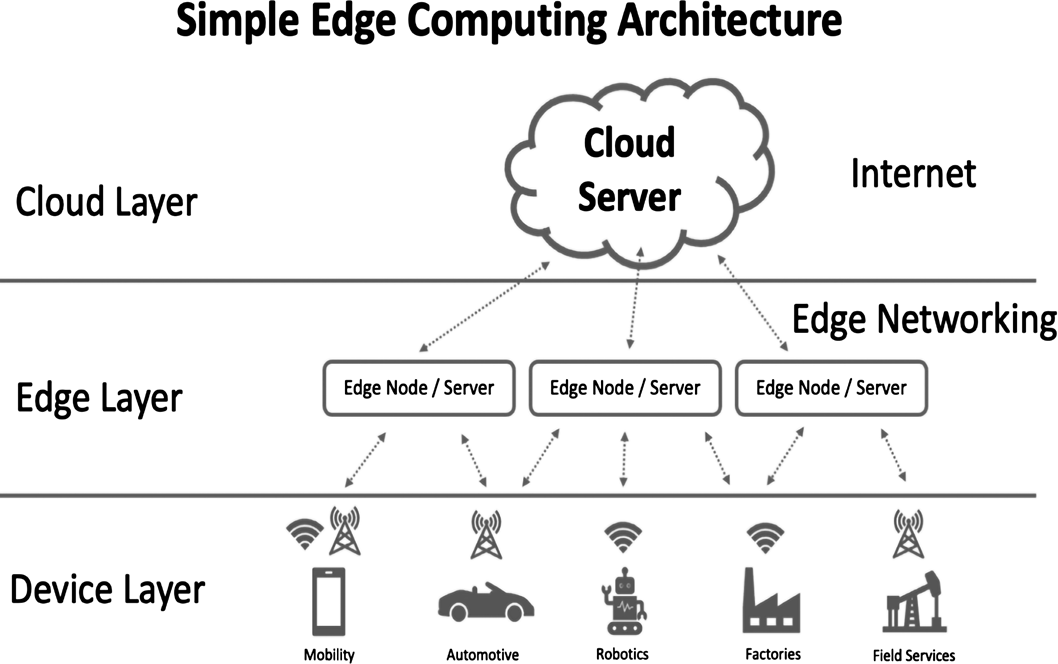
| Cloud Computing | Edge Computing |
| Computation is not done at the source | Computation is done near- source |
| Preferredtoprocess normal data | Preferredtoprocesstime- sensitive data. |
| Latency is more | Reduced latency |
| Less secure | More secure |
Application of Edge Computing
• Edge Computing in Banking and Finance Industry: It enables high-speed, large-scale distributed computing management. Among its uses in banking and finance are:
• ATM Security: By incorporating image recognition on ATMs, edge AI can be utilized to examine video feeds at the edge and enhance ATM security.
• Data Privacy: To reduce the possibility of data theft, privacy and security regulations must be adhered to while transferring data to a central place using cloud computing.
• Edge Computing in Retail Industry: The lifespan of stores is increased when it is implemented in retail. Retail operations and services are improved and enhanced by it.
• Big Data and Analytics: It allows real-time data processing and analytics at the point of data generation itself by facilitating data gathering and analysis at the edge. Thus, make it simple for the store to leverage cutting- edge technologies like big data and artificial intelligence.
Advantages of Edge Computing
• Quick: When accessing a cloud-based video game library or streaming a video on services like Netflix, edge computing enables faster data processing and content delivery.
• Future Technology Enabled: 5G wireless technology and artificial intelligence, for example, provide for reduced latency (delay), quicker reaction times and easier
computer maintenance.
• Localised solution: In remote areas with little or no connectivity to a central location, it is recommended over cloud computing. Similar to a mini data center, these places need local storage and edge computing offers the ideal option.
• Data-Efficient: Only important data needs to be transferred over a network; less data doesn’t need to be delivered as soon as it is processed. Thus, the quantity of data that flows over the network is decreased by an edge computing network.
Data Mining
DATA MINING
• Data means raw facts and figures. Mining means collecting valuable data, formatting it correctly, processing it and extracting valuable insights.
• Data mining is a process used to extract usable data from a larger set of any raw data.
Scope
• Businesses use the data generated by data mining to increase sales, understand the risks associated with investments, strengthen client relationships, and other purposes. A key component of effective business analytics in enterprises is data mining. We can evaluate both real- time and historical data with its tools. It helps forecast trends for the future and enables proactive business practices.
Behavior and trend prediction: Data mining is useful for automatically predicting information from vast databases. It is more accurate and faster than the conventional method of analysis. Data mining is helpful, for instance, in targeted marketing. It forecasts the intended client and utilizes that information for marketing correspondence.
Unknown pattern discovery: Data mining methods are useful for automatically predicting previously unidentified patterns. They search through the datasets and find hidden patterns that were previously unknown. An example of a pattern discovery analysis of retail sales data is finding unrelated products that are bought in addition to the product.
Benefits
• It helps in gathering information and reliable data for the companies.
• It is helpful in predicting the trends and behaviors
automatically.
• It is also helpful in automatically predicting the hidden unknown patterns.
• It helps in risk management and fraud detection.
• It is a cost-effective and efficient solution.
Limitations
• This complexity of data mining is one of its greatest disadvantages. Data analytics often requires technical skill sets and certain software tools.
• Data mining doesn’t always guarantee results.
• There is also a cost component to data mining.
Big Data
BIG DATA
Big Data constitutes a large volume of structured or unstructured data.
Big data is so huge that the traditional data processing system is inadequate to process.
• 90% of total data available on internet has been generated in the last one decade.
• By analysing this data, a useful decision can be made in various cases such as:
• Tracking Customer Spending Habit, Shopping Behaviour
• Smart Traffic System
• Auto Driving Car
• Virtual Personal Assistants
• Internet of Things etc.
6 V’s of Big Data
• Volume: Volume is an enormous quantity of data.
amount of the data is a critical factor in determining its worth. Data that is extremely huge in bulk is referred to as “Big Data.” This implies that the volume of data determines whether a given set of data can genuinely be categorized as a big data set or not.
• Velocity: The rapid rate at which data accumulates is referred to as velocity. Data comes in at Big Data velocity from various sources, including devices, networks, social media, mobile phones, etc.
• Variety: It refers to the characteristics of unstructured, semi-structured and structured data types.
• Veracity: It alludes to uncertainties and inconsistencies in data that is, readily available data might occasionally become jumbled and difficult to control in terms of correctness and quality. Due to the multiplicity of data dimensions arising from several dissimilar data kinds and sources, Big Data is also unpredictable.
• Value: Following the consideration of the four Vs, there is one more V: value! The majority of useless data is useless to the business unless it can be transformed into
something valuable.
• Variability: It establishes the rate at which the structure of the accessible data is changing.
Applications of Big Data
• Economy: Big data may be extremely beneficial to many different economic areas, including
• In the insurance industry, to enhance client satisfaction and guarantee their entitlement to claims
• To manage financial data in the banking sector
• To capture the production, price statistics, & calculate the resultant GDP
• Health Care: Big Data in health care has the following benefits:
• Diseases prediction,
• Medicines prescription,
• Optimizing treatment
• Digital Space:
• In the telecom arena, connecting the hinterland areas and bringing them together to the mainstream,
• On Social Media for targeting platform users,
• Artificial Intelligence – Controlling home appliances
• Agriculture:
• Seed Selection
• Geo-Tagging to keep the track record of agricultural assets in the country
• Weather Forecasting
• Irrigation & effective water management
• Governance
• Prevent cyber-attacks
•
Enhance security systems
• Detect card-related fraud cases
• Predict criminal activities, e.g – Crime and Criminal
Tracking Networks and Systems (CCTNS)
• In improving the quality of education.
Government Initiatives & Interventions
• Currently, NITI Aayog is collaborating with private partners to build a strategy to create the “National Data & Analytics Platform,” which would serve as a centralized source of sector-specific data for researchers, policymakers, and people.
• The “Big Data Management Policy,” which was created by the CAG to audit vast amounts of data produced by the states and union territories’ public sectors, is an ideal place to start.
• The Ministry of Statistics and Program Implementation has suggested creating a “National Data Warehouse on Official Statistics” to enhance the potential of macroeconomic aggregates by utilizing big data analytical methods and leveraging technology.
Significance
• With a population of around 1.4 billion, Big Data holds a significant position in the Indian context. As per the study conducted by NASSCOM, “the Indian analytics industry is predicted to reach $16 billion mark by 2025”.
• When it comes to job positions and roles, Big Data is one of the most versatile career options. As Analytics is a crucial tool used in many different fields, you get a host of job
titles to choose from including Big Data Engineer, Big Data Analyst, Big Data Analytics Architect etc.
• NITI Aayog is developing “National Data and Analytics Platform (NDAP)” with a vision to Democratize access to public Government data through a world-class user experience. Mission is to Standardize data across multiple Government sources to provide flexible analytics and make it easily accessible in formats conducive for research, innovation, policy making and public consumption.
Challenges
• Invasion of Privacy: Big data analytics brings to light the twin challenges of digitalization: data privacy and net neutrality.
• Data Security: Several Aadhaar data leak incidents have brought attention to the need for the government to improve the safety and security of the digital data it collects from its citizens.
• Technical Challenges: Big data has some inherent limitations, as its name suggests, such as
• Difficulties with computation and storage;
• Scalability and streaming issues;
• Inadequate infrastructure for organizing and collecting such vast volumes of data.
• Challenges related to Governance: To effectively utilize Big Data for policymaking, the government needs to adopt a methodical yet adaptable approach. If the necessary policy structures are adjusted flexibly and the resulting information is regularly reviewed, the advantages will eventually filter down to the lowest level.
Way Forward
• The government needs to set up properly equipped data centers so that the massive amounts of data at its disposal can be analyzed efficiently. Sorting the pertinent facts from the unimportant is crucial.
• To ensure that the vast amount of data that is accessible is almost completely safe, the government needs to improve its cybersecurity.
• The government must also create a data privacy policy and handle the moral dilemmas raised by big data analytics.
Computer Viruses
COMPUTER VIRUSES
• A computer virus is a type of malicious code or program written to alter the way a computer operates and is designed to spread from one computer to another.
• In the process, a virus has the potential to cause unexpected or damaging effects, such as harming the system software by corrupting or destroying data.
What are the different types of computer viruses?
• Boot sector virus: This type of virus can take control when you start or boot your computer. One way it can spread is by plugging an infected USB drive into your computer.
• Web scripting virus: This type of virus exploits the code of web browsers and web pages. If you access such a web page, the virus can infect your computer.
• Browser hijacker: This type of virus “hijacks” certain web browser functions, and you may be automatically directed to an unintended website.
• Resident virus: This is a general term for any virus that inserts itself in a computer system’s memory. A resident virus can execute anytime when an operating system loads.
• Direct action virus: This type of virus comes into action when you execute a file containing a virus. Otherwise, it remains dormant.
• Polymorphic virus: A polymorphic virus changes its code each time an infected file is executed. It does this to evade antivirus programs.
• File infector virus: This common virus inserts malicious code into executable files (files used to perform certain functions or operations on a system).
Multipartite virus: This kind of virus infects and spreads in multiple ways. It can infect both program files and system sectors.
Macro virus: Macro viruses are written in the same macro language used for software applications.
• Such viruses spread when you open an infected document, often through email attachments. A computer worm is malware, just like a virus, but a worm takes a copy of itself and propagates it to other users.
Effects of Computer Virus
• It can steal data or passwords and log keystrokes,
• spam user email contacts, corrupt files and erase data
• potential to permanent damage to the hard disk and sometimes can even take over your device control.
MALWARE
• Attackers use malware, often known as malicious software, to purposefully damage and infect networks and devices.
There are numerous subcategories under the general phrase, such as the following:
Viruses
• A virus is a kind of harmful program or code that is intended to change a computer’s functionality and propagate from one computer to another.
Worms
• Without human help, a computer worm can copy itself and spread to other systems. Malicious links, files, or security flaws allow this virus to infect devices. Worms search for networked devices to assault once they are inside. Users frequently fail to detect worms since they typically seem as authentic work files.
• One of the most well-known ransomware assaults is WannaCry, which is actually a type of malware. The malware exploited the Server Message Block protocol’s Eternal Blue vulnerability in out-of-date versions of Windows. 150 countries were affected by the worm’s first year of spread. It infected around 5 million devices the next year.
Ransomware
• Ransomware encrypts devices and forces the victims to pay a ransom in exchange for re-entry. Although malware and ransomware are sometimes used interchangeably, ransomware is a particular type of malware.
• There are four main types of ransomware:
• Locker locks: Ransomware known as Locker locks
victims out of their gadgets entirely.
• Crypto Ransomware : On a device, crypto ransomware encrypts all or portion of the files.
• Double extortion ransomware: It encrypts and
exports users’ files. In this way, attackers can receive payment from the ransom and/or the selling of the stolen data.
• Ransomware-as-a-Service : Affiliates and clients can rent ransomware through the use of Ransomware as a service (RaaS). The creator of the ransomware receives a portion of every ransom.
• Prominent ransomware variations include the strains employed in the Colonial Pipeline assault, REvil, and WannaCry.
Bots
• A bot is a type of malware that reproduces itself and spreads to other machines to form a network of other bots, or botnet. Devices that have been infected carry out automatic actions under the attacker’s control. DDoS assaults frequently make use of botnets. They are also capable of sending phishing emails and keylogging.
• A well-known illustration of a botnet is Mirai. This malware continues to target IoT and other devices, having launched a large DDoS attack in 2016. Studies also reveal that during the COVID-19 epidemic, botnet usage increased.
Trojan Horses
• Trojan Horses is malicious software that appears very trustworthy to users. Trojan horses infiltrate devices through social engineering methods. The Trojan’s payload, or malicious code, is loaded on a device once it has gained access to it and is what makes the exploit possible. Trojans implant viruses or worms, perform keylogging, provide attackers with a backdoor into a device and steal data.
• Remote access Trojans (RATs) : Remote Access from a distance Attackers can get control of an infected device by using Trojan horses, or RATs. Once inside, the compromised device can be used by the attackers to spread the RAT to further devices and build a botnet.
• In 2014, the Emotet banking Trojan was initially identified. Emotet was taken down globally at the start of 2021, however it was rebuilt and is still assisting threat actors in obtaining the financial details of their victims.
Keyloggers
• A keylogger is a type of malware used for surveillance that tracks keystroke patterns. Keyloggers are used by threat actors to get sensitive information such as victims’ passwords and usernames.
• Keyloggers may be software- or hardware-based. Keyboards are manually fitted with hardware keyloggers. The attacker needs to personally pick up the device after the victim uses it. Conversely, software keyloggers don’t need physical access. The victim frequently downloads them through malicious downloads or links.
Software keyloggers capture keystrokes and transmit the information to the assailant.
• In 2014, the Agent Tesla keylogger was first discovered. Even with its most recent iterations, the spyware RAT continues to annoy people by recording keystrokes and capturing screenshots of their devices.
Rootkits
• Malicious software known as a rootkit gives threat actors remote access to and control over a device. Keyloggers, viruses, and ransomware are just a few of the malware variants that are made easier to spread by rootkits.
• Because rootkits have the ability to disable antivirus and endpoint antimalware programs once they’re inside a device, they frequently go undiscovered. Usually, malware attachments and phishing emails are how rootkits infiltrate networks and devices.
• Cybersecurity teams should examine network behavior to identify rootkit assaults. Set alerts, for instance, if a user starts logging on at a different time or place every day after consistently doing so at the same time and place.
• In 1999, NT Rootkit the original rootkit was released. Released in 2003, Hacker Defender quickly became one of the most widely used rootkits of the 2000s.
Spyware
• Malware that installs itself on a device without the user’s consent is known as spyware. Users’ data is stolen and sold to outside users and advertising. Spyware can monitor user credentials and acquire private information such as bank account details. Via rogue programs, URLs, webpages, and email attachments, it infects devices.
• Mobile device spyware is especially harmful since it records a user’s position and has access to the device’s camera and microphone. It can be distributed through Short Message Service and Multimedia Messaging Service. Spyware includes Trojan horses, adware, keyloggers, and mobile spyware.
• The mobile spyware Pegasus targets Android and iOS gadgets. When it was initially found in 2016, Israeli technology provider NSO Group was connected to it. In November 2021, Apple filed legal action against the merchant for disparaging Apple consumers and goods. In 2018, Pegasus was also connected to the assassination of Saudi journalist Jamal Khashoggi.
Cryptomining Malware
• Mining -Although it takes a lot of processing power, the process of confirming transactions within a blockchain is quite profitable. For every legitimate transaction, miners receive a reward. The process by which cryptomining malware operates, known as cryptojacking, gives
threat actors the ability to verify using the resources of a compromised device.
• CISCO discovered that in 2020, 69% of its users were impacted by malware that mined cryptocurrency, which accounted for the majority of DNS traffic to malicious websites in that year.
• In 2020, XMRig emerged as the most widely used cryptocurrency mining virus, with JSEcoin, Lucifer, WannaMine, and RubyMiner trailing behind.
Adware
• Adware: “Adware” is software that displays or downloads unsolicited advertisements, typically in the form of pop-ups or banners. In order to present users with appropriate adverts, it collects browsing history and cookies.
• Adware isn’t always harmful. Software developers use legitimate adware with users’ consent to offset development costs. Malicious adware, however, has the ability to show adverts that could infect a computer when clicked.
• Threat actors insert malicious adware into already- installed applications and utilize vulnerabilities to infect PCs. Additionally, users may download programs that have already been tainted with malware. Alternatively, adware—also referred to as bloatware—may be pre- installed on a device or be part of a software bundle that is downloaded together with a genuine program.
• Programs like Fireball, Gator, Dollar Revenue, and OpenSUpdater are examples of adware.
Mobile Technology
MOBILE TECHNOLOGY/CELL PHONE TECHNOLOGY
Mobile communication involves transmitting voice or data using wireless radio transmission.
Mobile generations refer to change like mobile wireless communication network speed, technology, data capacity, frequency, latency etc.
6G TECHNOLOGY
• Sixth generation cellular technology, or 6G technology, uses cognitive technologies like artificial intelligence (AI) to enable communication several times quicker than the current 5G network. It would operate in uncharted radio frequencies. Hyper-connectivity, user-friendly interfaces, universal computing, multi-sensory data fusion, and accurate sensing would all be made possible by the development of 6G.
• Due to its ability to function at frequencies higher than those of 5G networks, it will have far greater capacity and less latency (delay).
• One of the main objectives of the 6G internet is to enable one-microsecond latency, or a one-microsecond communication delay.
• Compared to a millisecond throughput, or 1/1000 delay, this is 1,000 times faster.
• It seeks to exploit the terahertz frequency spectrum, which is presently underutilized.
Features and Working of 6G Technology
• Although 5G deployment is still in its early phases, work on 6G technology is already under way. It is anticipated that 6G will be much quicker and have less latency. The following are some of the key components of 6G technology:
• Terahertz frequencies: In order to enable 6G, engineers are trying to send data across hundreds of gigahertz (GHz) or terahertz (THz) waves.
• The 6G networks will employ radio waves with a wavelength of roughly one millimeter (frequency in THz).
• Because THz waves are shorter than those utilized by 5G, they can transport more data.
• Use of Artificial Intelligence: 6G networks will operate
better because of AI’s ability to control traffic and
guarantee dependable data reliability.
• Massive MIMO (Multiple-Input Multiple-Output): It is a technology that uses a lot of antennas for data transmission and receiving.
• 6G networks can incorporate a large number of devices and connections.
• Billions of sensors and actuators, among other devices, will be supported by 6G networks.
Significance of 6G Technology
• Sustainability: 6G will encourage sustainability by facilitating closed-loop control of multiple appliances and data collecting through quicker and less expensive per bit connectivity.
• Energy-efficient: 6G technology will be much more energy-efficient, turning off components and reducing capacity when demand is low.
• Secure: 6G networks are designed to tolerate interference from jammers.
India and 6G Technology
• India is getting ready for the commercial launch of 6G wireless technology, which is anticipated to happen by 2030.
• Patents for 6G: Over 127 patents for 6G technology have been granted to India by international organizations.
• Since this accomplishment, interest in India’s technological innovations has grown, with nations like the US expressing a strong desire to acquire India’s state-of-the-art 6G technology.
• India-US Pact: At the 2023 G20 Summit, India inked a deal with the US to further advanced research in the field of 6G, which gave its objectives even more momentum.
Bharat 6G Vision
• The Department of Telecommunications has established a Technology Innovation Group on 6G (TIG-6G) to create the Bharat 6G Vision, a strategy to develop 6G technology in India by 2030.
• Objective of this vision: To create and deploy 6G network technologies that provide secure, intelligent and pervasive connectivity, enabling people to live better lives.
• The International Telecommunication Union (ITU), a UN body that oversees the development of telecom standards and is in charge of managing spectrum and satellite orbit resources around the world, has accepted the 6G Vision Framework.
• India, through the Department of Telecommunications under the Ministry of Communications, has played an important role in the Framework’s development.
Challenges Related to 6G in India
• Complex Technology: The intricacy, resulting from a large number of parts and subsystems, could provide difficulties while developing and implementing 6G.
• Infrastructure: Significant infrastructure investments are needed for 6G. For instance, 6G networks will require new antenna designs and signal processing methods due to the difficulty of transmitting and receiving THz waves.
• Security Concerns: The enormous data volumes and extremely quick speeds of 6G networks may make them vulnerable to cyberattacks.
5G TECHNOLOGY
• 5G is the next-generation cellular technology that will provide faster and more reliable communication with ultra-low latency.
• Latency is a measure of delay. In a network, latency measures the time it takes for some data to get to its destination across the network.
• According to a government panel report, peak network data speeds with 5G are anticipated to be between 2 and 20 gigabits per second (Gbps). In comparison, 4G connectivity speeds in India average 6-7 megabits per second (Mbps), while in developed nations they reach up to 25 Mbps. The Third Generation Partnership Project (3GPP) defines and directs the standards for the use of 5G.
Advantages of 5G for communication sector
• In India, 5G is anticipated to have a $1 trillion overall economic impact by 2035, per a report from a panel created by the government.
• A different analysis from telecom equipment manufacturer Ericsson projects that India’s potential revenue from digitalization enabled by 5G will surpass
$27 billion by 2026.
• In addition, the Global System for Mobile Communications (GSMA) predicts that by 2025, India will have over 70 million 5G connections.
• 5G is anticipated to serve as the foundation for cutting- edge technologies like machine-to-machine (M2M) connectivity and the Internet of Things (IoT).
Limitations
• Frequency allocation: Compared to international operators, Indian operators have substantially less spectrum. Telecom businesses are uncertain about Return on Investment because to the high cost of investment.
• Network investment: There are problems with capital augmentation in the Indian telecom industry that need to be fixed.
• Lack of capital for investment: A large number of Indian operators are also burdened by debt.
• Telecom companies appear hesitant to take part in the auction, claiming that there is not enough spectrum available and that the reserve price of ₹490 crore per MHz is too high.
Way Forward
• Encourage design and manufacture of 5G technologies, products in India.
• Digital India must be compatible with 5G technologies.
• Idle spectrum must be freed up, at least till it generates significant revenues. Provide funding and incentives to regional telecom and technology companies so they
can grow internally, which will aid in the adoption of 5G
technology in the nation.
• Encourage 5G start-ups that make these design and production skills possible.
• Promote IPR generation that will back the above designs.
4G TECHNOLOGY
• 4G mobile technology provides wireless mobile broadband internet access in addition to voice and other services of 3G.
• Applications include improved web access, Internet Protocol (IP) telephony, Video Conferencing, Cloud Computing, Gaming Services, High-Definition Mobile
TV etc. 4G uses LTE (Long Term Evolution) technology, which allows voice & data-communication simultaneously
Net Neutrality
NET NEUTRALITY
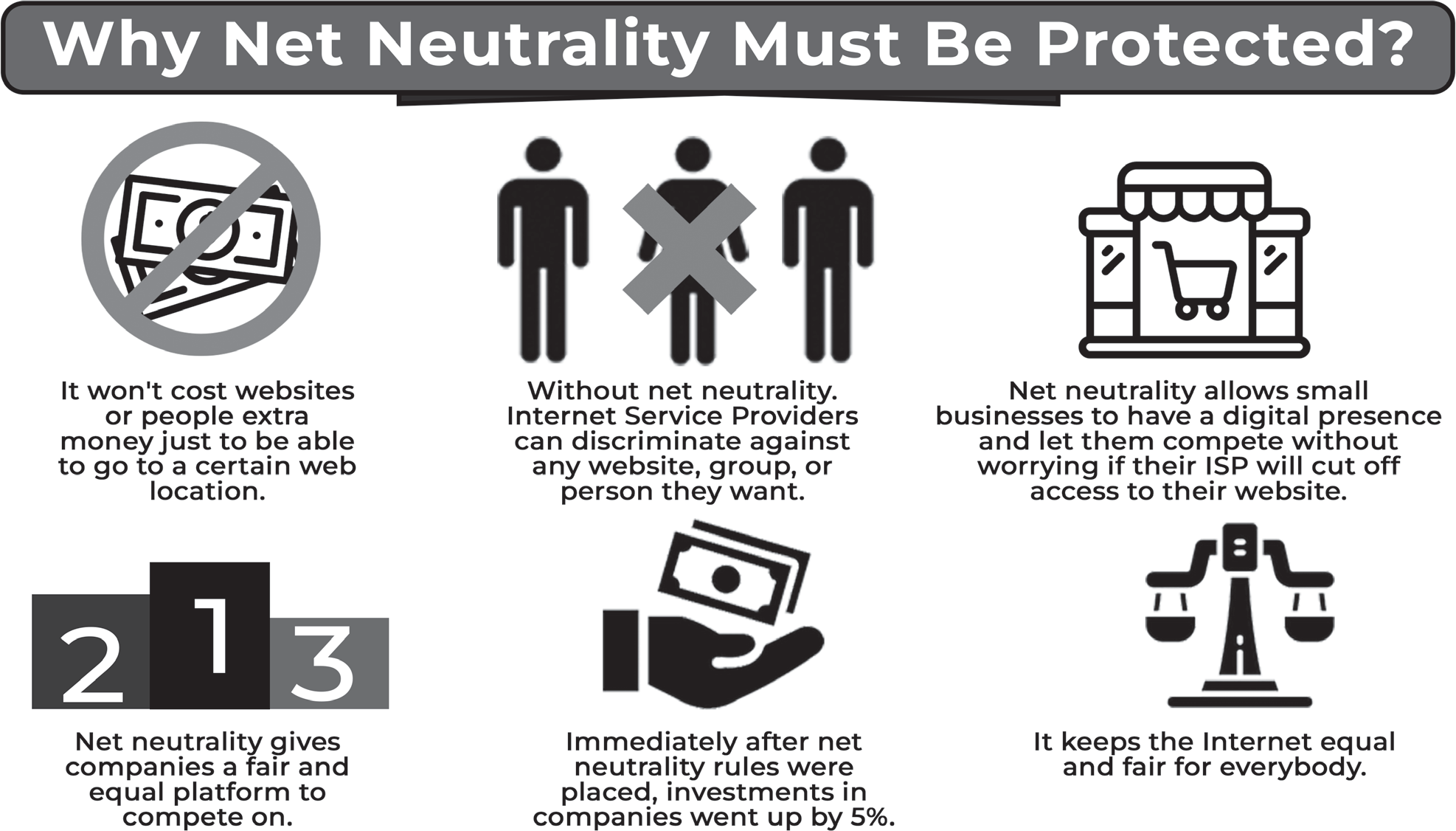
• Net neutrality refers to the fact that governments and internet service providers treat all data on the internet equally and do not charge users more for higher-quality delivery or give some websites preferential treatment.
• The Telecom Regulatory Authority of India (TRAI) recently proposed the formation of a multi-stakeholder body (MSB) to guarantee that internet service providers in the nation follow net neutrality principles.
• All Internet service providers (ISPs) must provide the same amount of data access and speed to all traffic under network neutrality and traffic to one service or website cannot be banned or downgraded.
• NET is not neutral in India in case of special services like Internet of Things, Remote Surgery etc.
Key principles of NET Neutrality include

• The following internet space stakeholders are affected
by net neutrality:
• Users of any kind of online service
• Internet service providers (ISPs), also known as telecom service providers (TSPs),
• Over-the-top (OTT) service providers, who offer internet access products including apps and webpages
• The government, which has the authority to control and define these players’ relationships
• TRAI is an independent regulator in the telecom sector, which mainly regulates TSPs and their licensing conditions, etc.
Why does Net Neutrality Matter?
• Preserves an Open Internet: Net neutrality guarantees
information, ideas, and services can be accessed freely and without limitations.
• In the absence of net neutrality, particular ISPs may restrict access to some websites or offer faster connections to others. At worst, an ISP might completely prevent users from accessing a particular piece of content.
• Promotes Consumer Choice: Customers are free to select the services, apps, and content they wish to use without any limitations thanks to net neutrality. They are not restricted to an ISP-selected pre-selected list of offerings.
Protects Freedom of Expression: Net neutrality is an essential tool for democratic engagement because it protects freedom of expression by enabling unhindered organization, communication, and mobilization of supporters.
CELLULAR OPERATORS ASSOCIATION OF INDIA
• The Cellular Operators Association of India (COAI) is an Indian non-governmental advocacy and trade association with a primary focus on the telecom sector.
• COAI was established in 1995 as a non-governmental organization .
• As of 2017, the Department of Telecommunications, Government of India, and COAI were organizing the India Mobile Congress together.
• Over a period of time COAI has become the recognized voice of the Indian telecom sector, communicating with Ministries, decision-makers, regulators, financial institutions and technical bodies directly.
• It offers a platform for dialogue and idea sharing between these organizations and the service providers, who are all interested in seeing the growth of mobile phone technology in the whole country.
• In order to give an industry consensus position to the government on important matters relevant to the growth and development of the Indian telecom industry, COAI works with other industry associations, such as CII, FICCI, ASSOCHAM, ISPAI, VSAT, IAMAI association, etc.
• The 5G India Forum (5GIF) was set up recently by the COAI.
What if there is no net neutrality?
If net neutrality is eliminated, internet service providers will have the power to (and probably will) modify internet traffic in order to increase their profits.
For example, some ISPs believe they should be able to charge businesses for services like YouTube and Netflix because they consume more bandwidth than a normal website.
These ISPs essentially want a share of the profits that Netflix and YouTube bring in.
Without net neutrality, the internet as we know it would not exist. Instead of free access, customers can be presented with package plans.
For example, websites with their headquarters in India can only be accessed by paying 500 rupees. It’s possible that visiting websites hosted overseas will cost you extra money.
Alternatively, depending on the add-on package you chose and the service fee, the rate at which you receive different kinds of content may change.
In the absence of net neutrality, we probably won’t see an open and free internet but rather a web with silos and an ISP-imposed cost to access each one.
Laws related to Net Neutrality in India
In India, net neutrality is governed and upheld in large part by the Telecom Regulatory Authority of India (TRAI). The following developments indicate how net neutrality is regulated in India:
TRAI’s Recommendations in 2017:
TRAI broadened the principles of non- discrimination to the treatment of content.
To avoid content discrimination, license agreements between the government and ISPs should be changed.
• TRAI’s Consultation Paper on 5G Digital Transformation, 2023 :
• Its objective is to pinpoint policy obstacles and create a workable framework for the quick uptake and best use of new technologies in the 5G ecosystem.
Concerns for Consumers
• Additional Costs
• Net neutrality proponents argue that charging OTT platforms more could trickle down to customers in the form of increased fees or worse service.
•
Net neutrality critics contend that maintaining open competition in internet services is essential to protecting customers’ freedom of choice and acces
Way Forward
• Regulation Clarity: The TRAI should continue to provide the regulatory clarity and guidance on net neutrality. This will include defining and enforcing net neutrality principles that prevent discriminatory practices, while also allowing for reasonable network management.
• Multi-Stakeholder Approach: Considering of a methodical strategy that takes into account the needs of both OTT service providers and telecom operators. It is critical to strike a compromise that permits telecom businesses to recover their investments while maintaining fair competition and innovation.
Transparency: Promote openness in the way ISPs run their networks and interact with OTT providers. By being transparent, we can make sure that any network management procedures are fair and inclusive