Rise of Totalitarian Regimes
Rise of Totalitarian Regimes
The immediate post-war period brought widespread challenges for nearly all European nations. Countries faced the difficult tasks of rebuilding their economies, resettling war survivors, and dealing with rising unemployment. In several nations, the working class attempted to initiate socialist revolutions modeled on the Soviet example, but these efforts were harshly crushed. In their place, powerful and anti-democratic movements emerged in Hungary, Poland, Italy, Portugal, Germany, and Spain—movements that are broadly classified as ‘Fascist’.
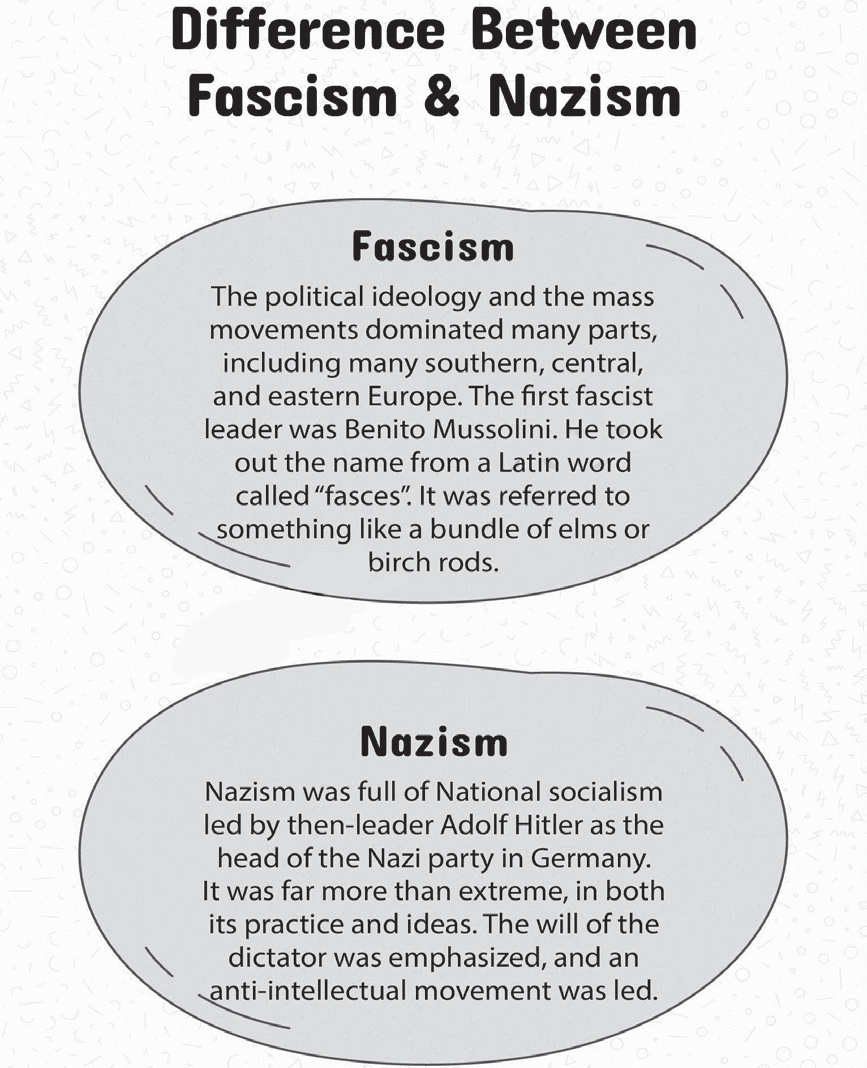
Fascism & Nazism
Fascism and Nazism, though rooted in similar ideologies, emerged in Italy and Germany during the interwar period, eventually becoming key contributors to the outbreak of the Second World War. A Fascist state was established in Italy in 1922, while the Nazis rose to power in Germany in 1933.
• Both movements, though short-lived, left a profound and lasting impact on the world.
• They emerged during the turbulent interwar years and both spread across Europe, embracing authoritarian rule and contributing to the escalation of global conflict.
• The core of their ideology was an intense nationalism, where the nation was seen as a living entity whose well- being superseded that of the individual. In this view, fulfilling duties to the nation was considered more important than individual rights.
• Fascism and Nazism both emphasized militaristic nationalism, preparing for war and territorial expansion. They were founded on racist beliefs, with the Nazis promoting a dangerous doctrine of racial superiority and fostering deep hatred for groups like the Jews, who became targets of their destructive ideologies.
Emergence of Fascism in Italy
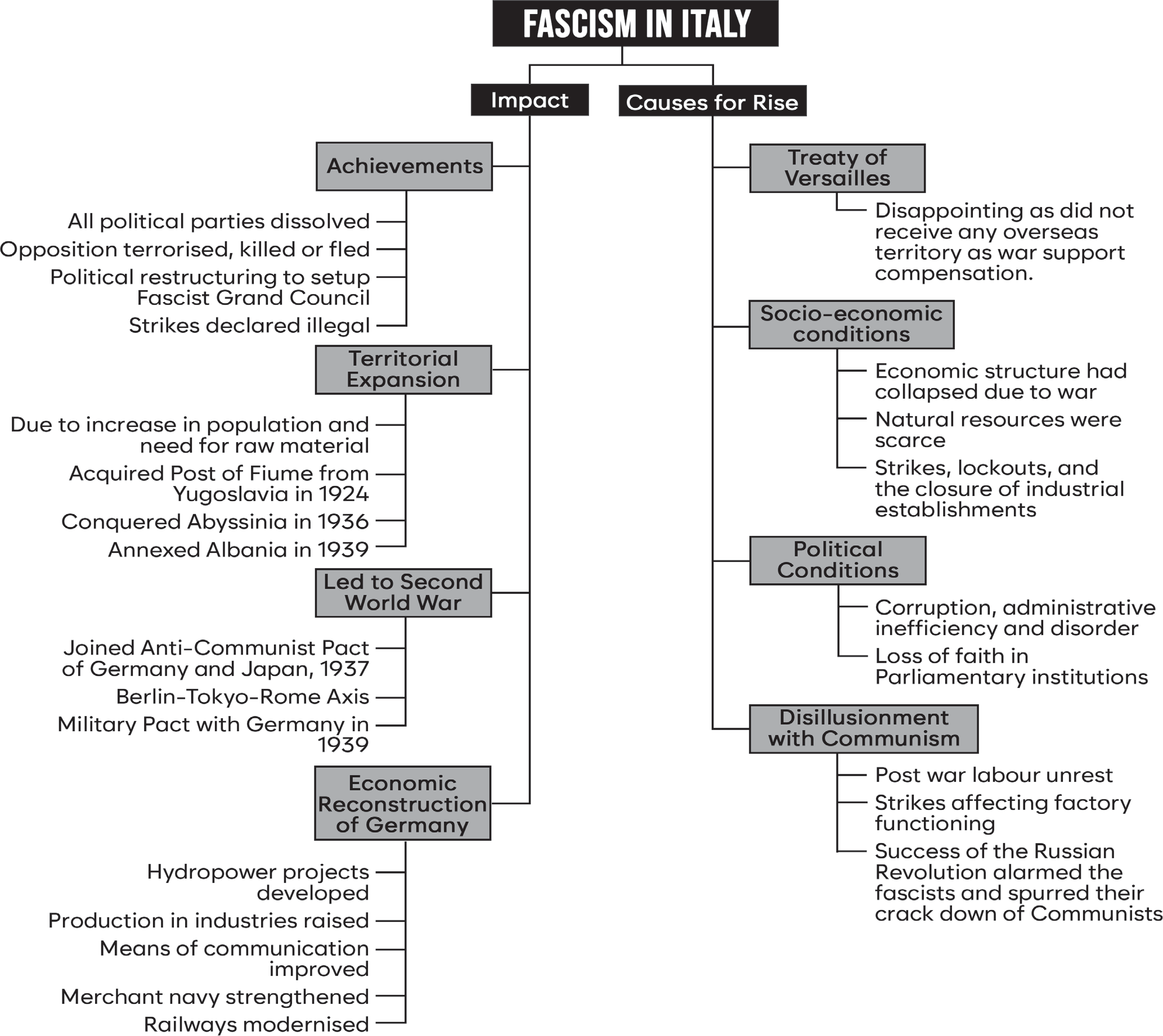
The term “Fascism” originated in Italy and was first associated with the movement led by Benito Mussolini.
• Mussolini and his followers adopted the symbol of a bundle of rods, representing the power of the state.
• The main characteristics of Fascism included a strong opposition to both democracy and socialism, the establishment of a dictatorial regime, and a focus on extreme nationalism and militarism.
• Mussolini gave passionate speeches about the greatness of ancient Rome and called for a restoration of Italy’s lost honor.
• His rhetoric attracted many former soldiers, who joined his private army known as the “Black Shirts.”
Mussolini used the Black Shirts to break up strikes and spread fear among socialists and communists. The Italian ruling class, fearing a socialist revolution, tolerated these actions.
• In 1921, Mussolini formed the National Fascist Party, and the following year, he led 30,000 Black Shirts in a march on Rome. The government capitulated without resistance, and the king appointed Mussolini as the new prime minister.
• By 1928, Mussolini had eliminated all political opposition and began ruling as a dictator, banning non-fascist parties.
• He relied on imprisonment, torture, and violence to suppress socialists and communists. Mussolini created the Fascist Grand Council and adopted the title of II Duce (The Leader), pushing for Italy’s expansion through military aggression.
Hitler and Nazi Germany
• In 1919, Germany adopted a republican form of government under a new constitution, which established a system that included a President, a Chancellor, and an elected Parliament.
Adolf Hitler, who had served as a soldier in the German Army during World War I and had fought with distinction for four years—earning the Iron Cross—was deeply disillusioned by Germany’s defeat. This prompted him to enter politics.
By 1921, Hitler’s compelling oratory and strong organizational abilities had earned him leadership of the National Socialist German Workers’ Party, commonly known as the Nazi Party. Similar to the Fascists, the Nazis had a paramilitary wing known as the "Storm Troopers" or "Brownshirts." By 1930, this force had grown to approximately 100,000 members.
Following the Fascist rise to power in Italy, Corporal Adolf Hitler attempted a similar takeover in Germany in 1923. The coup failed, and Hitler was imprisoned. During his time in jail, he wrote Mein Kampf ("My Struggle"), a book in which he outlined his vision for establishing one of the most brutal dictatorships in modern history.
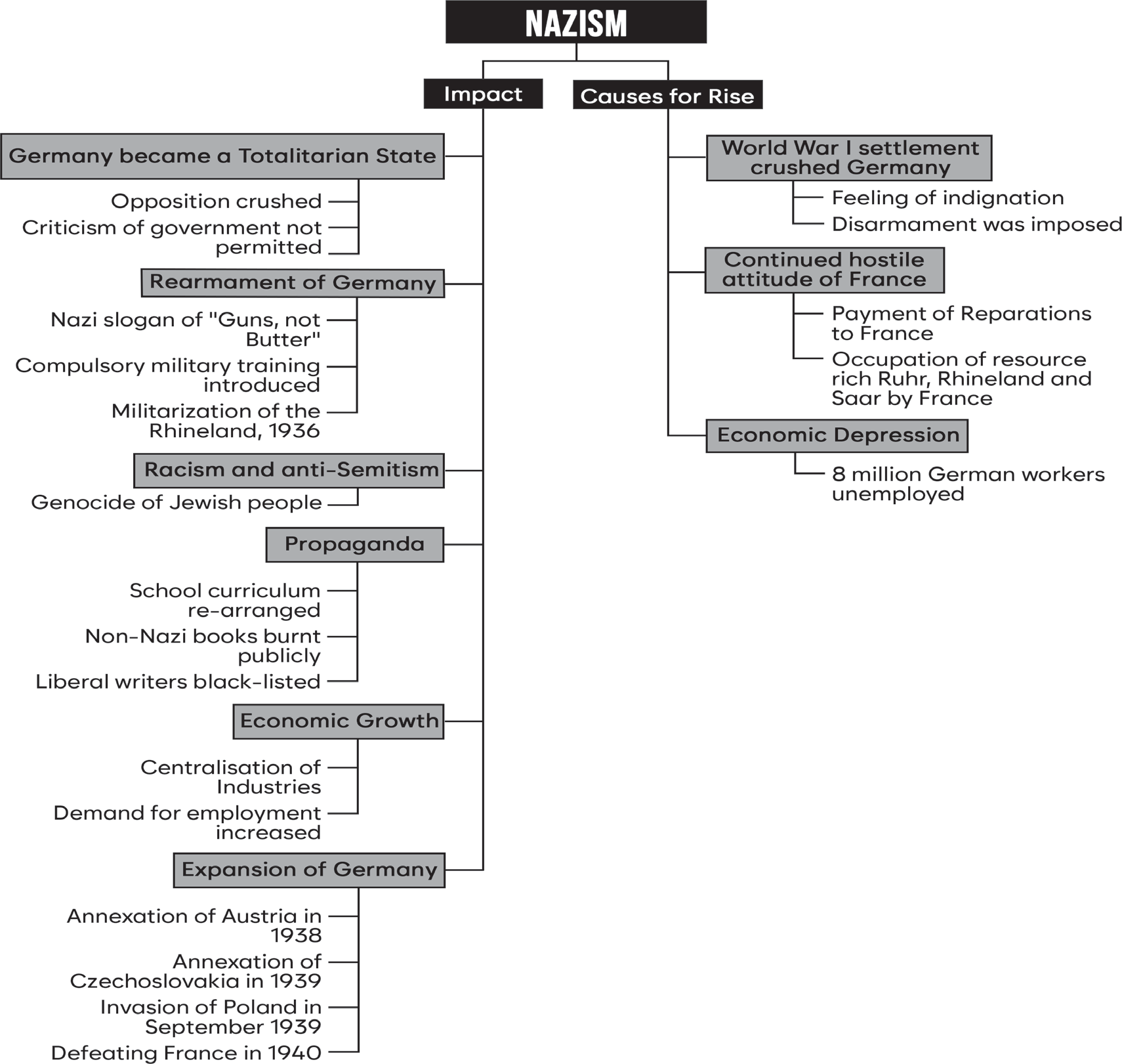
The primary goal of Nazi policies was to erase the shame of the Versailles Treaty and transform Germany into a powerful and feared nation. Like fascism, Nazism rejected democracy, civil liberties, and socialism, using brutal force to suppress any opposition.
• Hitler blamed Jews for Germany’s defeat in World War I, making their extermination a central aim of Nazi ideology.
• He promoted the idea of the superiority of the German race, calling them pure-blood Aryans, and sought to unite all Germans into a Greater Germany. Many people were drawn to this nationalist appeal, supporting Nazi policies.
• The economic crisis of the 1930s played a significant role in Hitler’s rise. The Great Depression led to widespread unemployment, leaving around 8 million Germans without work.
• The Nazi Party, once a minor political group with just 12 seats in the 1928 elections, gained significant momentum as the Communist and Socialist parties failed to unite against them. By 1932, the Nazis became the largest party in parliament. President Hindenburg appointed Hitler as Chancellor and tasked him with forming a new government.
• Once in power, Hitler swiftly established a reign of terror, discarding democratic principles.
• In February 1933, the Nazis set fire to the Reichstag (Parliament building), blaming the communists. Over 60,000 people were arrested or sent to concentration camps.
• By mid-1933, all political parties, except the Nazi Party, were outlawed. Following President Hindenburg’s death in August 1934, Hitler took on the title of President and solidified his total control. He launched a systematic campaign for the total extermination of Jews while simultaneously pushing for military expansion. The rise of Nazism brought the world dangerously close to another war.
• Hitler was so ruthless that he ordered the killings of hundreds of Storm Troopers, who had helped in his rise to power, in one night. June 30, 1934, is known as the night of Long Knives.
Military Fascism in Japan
• Japan was the only Asian country to avoid colonization. By the late 19th century, its expansionist ambitions led to a war with China, and the defeat of China allowed Japan to establish a presence there.
• In 1905, Japan achieved a significant victory over Russia, taking control of Manchuria, which had been Russia’s sphere of influence in China. This marked the first time an Asian country had defeated a major European power. Japan went on to annex Korea, further extending its empire.
• The First World War presented Japan with an opportunity to seize Germany’s possessions in China and its Pacific islands. As Japan’s military grew in influence, it began to dominate the country’s politics.
• This shift led to the collapse of democracy and the rise of extreme nationalism and militarism. Within a few decades, Japan transformed from a peaceful nation into an aggressive military power. By the 1930s, Japan aligned itself with the fascist regimes of Germany and Italy, seeking a new world order.
League of Nations
The Inter-War Period
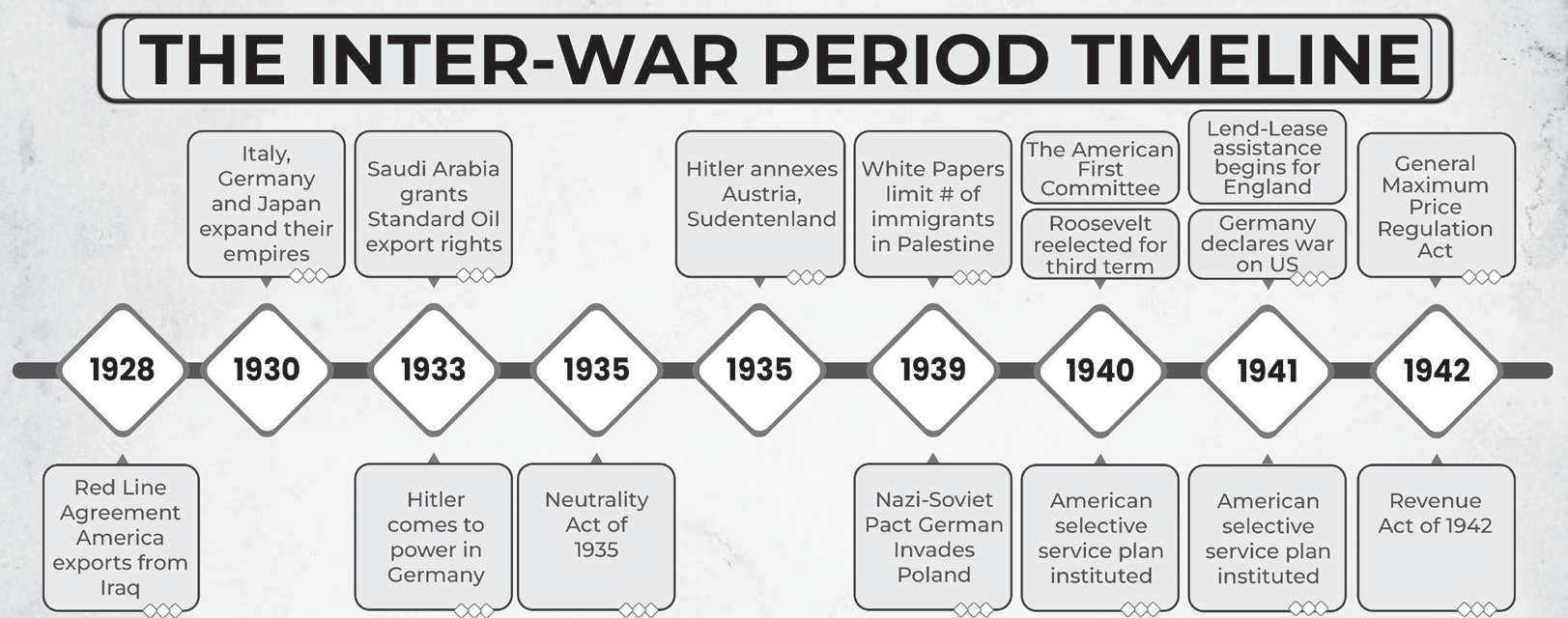
The interwar period, which spanned the two World Wars from 1919 to 1939, is a fascinating and tumultuous era in global history. Emerging from the ashes of World War I, this period was marked by significant political, economic, social, and cultural shifts as nations sought to rebuild and reconfigure their futures in the wake of unprecedented devastation. It was characterized by a delicate balance between the desire for stability and the looming specter of another conflict, ultimately culminating in the outbreak of World War II. The interwar years witnessed the reordering of empires, the redrawing of national boundaries, economic turmoil, the rise of authoritarian regimes, and the emergence of new ideologies and technologies. This era serves as a crucial bridge between the two world wars, encapsulating the aspirations, tensions, and challenges that defined the twentieth century. Exploring the interwar period provides valuable insights into the roots of the subsequent global conflict and the complexities of international relations in the modern age.
League of Nations
• The League of Nations (1920 – 1946) was the first international organization formed to foster global cooperation and maintain peace and security. It is often seen as the precursor to the United Nations.
• The League’s founding document, the Covenant of the League of Nations, was drafted during the peace talks after World War I. Comprising 26 articles, the Covenant outlined the organization’s membership conditions, the roles of its key organs, and the methods for resolving international disputes peacefully. It also laid down the core principles that underpinned the League’s existence.
• The League officially came into existence on January 10, 1920. By November 15, 1920, 41 member states gathered in Geneva for the inaugural session of the Assembly, representing a significant portion of the world’s nations and over 70% of the global population at the time.
Purpose
• The creation of the League of Nations marked a significant shift towards multilateral cooperation. Under the Covenant, Member States were committed to resolving their conflicts through peaceful means.
• By joining the League, countries pledged to abandon secret diplomacy, reduce their military armaments, and abide by international law. Each state also vowed to uphold the territorial integrity and political independence of all League members. This collective commitment laid the groundwork for what became the first real attempt at building a system of collective security. The core idea was simple: if one nation was attacked, it would be viewed as an attack on all, and the League would act in solidarity.
• Additionally, the League oversaw the Mandate System, which involved former German and Ottoman territories. These “mandated territories” were placed under the care of appointed powers until they were ready to stand as independent nations.
Main Organs of the League of Nations
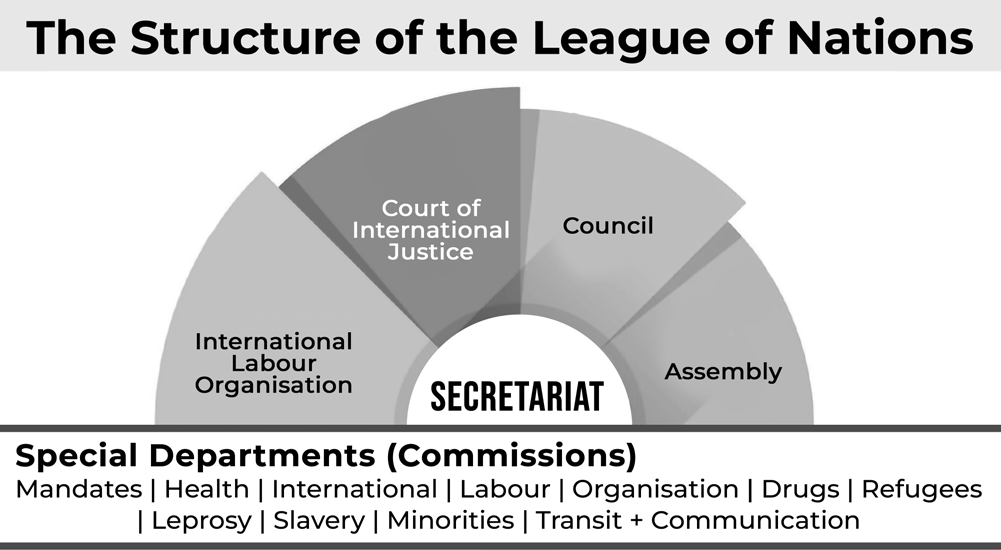
• The League of Nations was structured around three main bodies. The Assembly, where all member states had equal representation; the Council, which included both permanent and non-permanent members; and the Secretariat, responsible for handling the League’s daily operations at its headquarters in Geneva, Switzerland. Over time, several auxiliary and subsidiary bodies were also created to help the League carry out its functions.
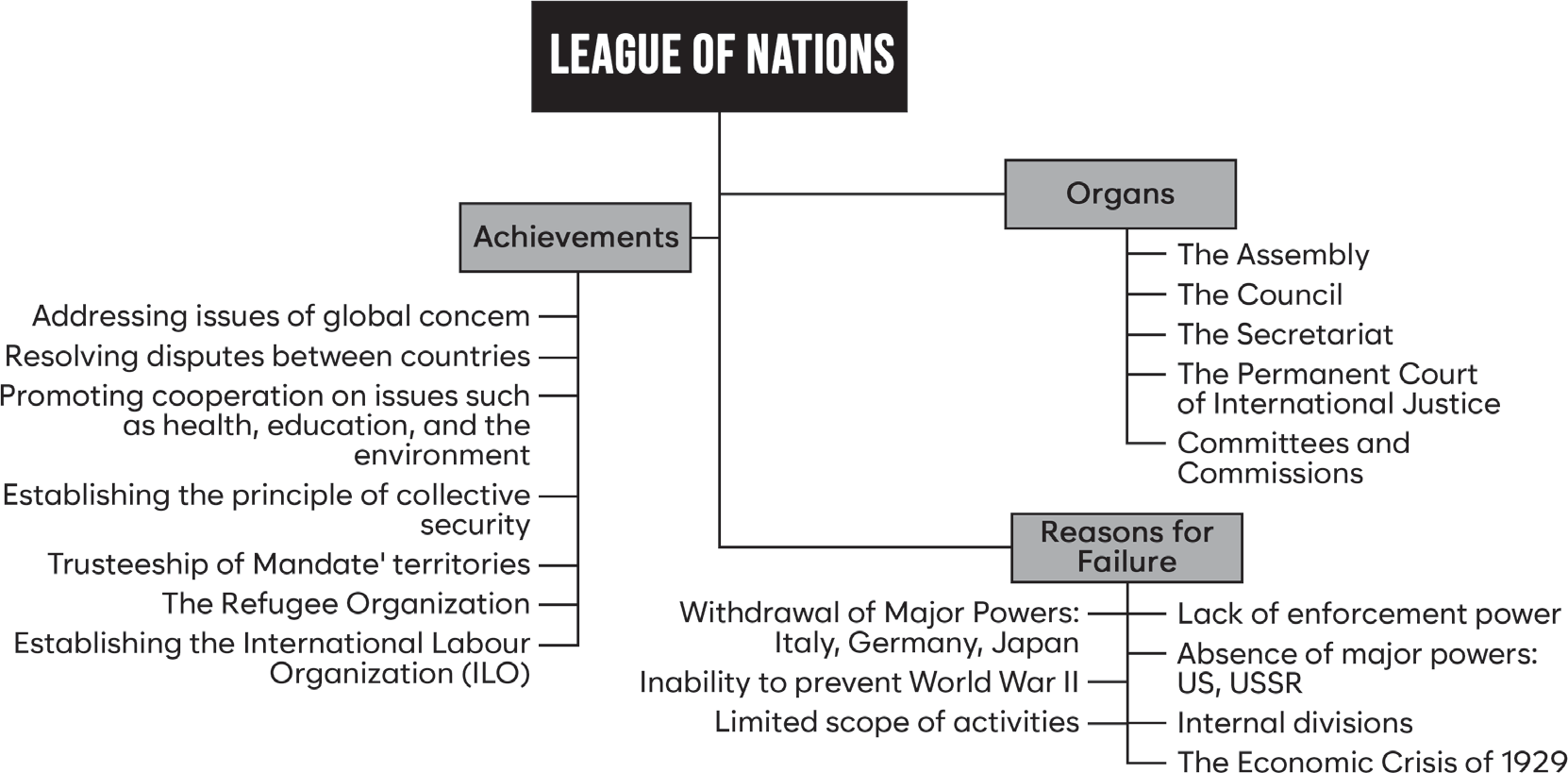
• The Assembly
• The Assembly served as the principal representative body of the League of Nations. It comprised delegates from all member states, each having equal representation with one vote apiece, regardless of their geographic size, population, or economic strength.
• Its responsibilities were wide-ranging. According to the Covenant, the Assembly could address “any matter within the sphere of action of the League affecting the peace of the world.”
• The Council
• The Council handled any issues falling within the League’s scope or affecting international peace. In this respect, its powers closely resembled those of the Assembly. Both bodies were meant to operate in parallel, following up on concerns raised by member states.
• However, the Council also had specific responsibilities. For example, it developed plans for disarmament and oversaw all matters related to territories under mandate. Additionally, certain international treaties assigned special duties to the Council, such as supervising the Free City of Danzig, managing minority treaties, and administering the Saar Territory.
• The Council was composed of both permanent and non-permanent members. This limited representation, including the presence of major powers, was designed to facilitate swift and effective decision-making.
• The Secretariat
• The Secretariat served as the administrative branch of the League of Nations. It was made up of international civil servants led by a Secretary-General.
• Its responsibilities included preparing the work for the League’s various bodies, ensuring meetings ran
smoothly, and following up on decisions made by member states. The Secretariat also compiled and published all treaties signed by member states to promote transparency in international diplomacy.
• The Permanent Court of International Justice (PCIJ)
Established by the League of Nations in 1921, the PCIJ was based in The Hague, Netherlands. It consisted of 15 judges who resolved disputes between states by issuing judgments or advisory opinions.
The Court’s compulsory jurisdiction applied only to states that accepted Article 36 of its statute.
During its existence, the PCIJ issued 32 judgments and 27 advisory opinions before officially ceasing operations in 1946.
However, the statute of the International Court of Justice (ICJ), created alongside the United Nations Charter at the 1945 San Francisco Conference, closely mirrored the PCIJ’s statute.
• Committees and Commissions
The League also included subsidiary bodies that were either established by the Covenant or set up by the Assembly and the Council. These groups—referred to as “organizations,” “commissions,” “institutes,” or “committees”—helped prepare the work of the main organs and, in some instances, offered advice on specific issues.
The structure and size of these committees and commissions varied depending on their responsibilities. For example, the Permanent Advisory Commission for Military, Naval, and Air Questions was made up of military experts appointed by the relevant governments. Meanwhile, bodies like the Permanent Mandates Commission consisted of experts selected based on their qualifications, regardless of their nationality.
Achievement of League of Nations
Despite encountering numerous challenges, the League of Nations made several notable contributions, including:
Tackling global issues: The League was the first international body to actively engage with matters of global significance, such as disarmament, the refugee crisis, and the protection of human rights.
Mediating international disputes: The League contributed to the peaceful resolution of conflicts between nations. Through its system of mandatory arbitration, it helped to defuse tensions and prevent conflicts from escalating.
• Aaland Islands Dispute (1921): The League successfully mediated a dispute between Sweden and Finland over the Aaland Islands, demonstrating its ability to peacefully resolve conflicts.
• Upper Silesia (1921): The League organized a plebiscite in Upper Silesia, allowing the population to determine whether the region should be part of Germany or Poland, thereby avoiding a potential conflict.
• Greek-Bulgarian Conflict (1925): The League successfully mediated a dispute between Greece and Bulgaria, preventing a full-scale war.
Encouraging cooperation in health, education, and environmental issues:
The League of Nations created various committees and agencies to foster international collaboration in areas like public health, education, and environmental protection.
• It made important contributions to identifying the causes of various epidemics.
• Notably, it played a key role in controlling the Typhus outbreak in Russia, which had threatened to spread across Europe.
• Introducing the principle of collective security:
• The League established the concept of collective security—the idea that an attack on one member would be treated as an attack on all. This principle later became a cornerstone of the United Nations' security framework.
The Refugee Organization:
The League helped repatriate prisoners of war from Russia to their home countries. In 1933, it also assisted Jewish refugees fleeing Nazi persecution by helping them resettle in safer nations.
Founding the International Labour Organization (ILO):
The League established the ILO, an agency now affiliated with the United Nations, dedicated to promoting workers’ rights and international labor standards. The ILO remains active and influential today.
Why did the League of Nations fail?
The League of Nations ultimately failed in its mission and was dissolved in 1946 for several key reasons:
• Lack of Enforcement Power: The League had no military or economic strength of its own and had to rely on its member countries to enforce its decisions. This made it difficult for the League to effectively address international disputes. For instance, Japan’s invasion of Manchuria in 1931, Italy’s invasion of Abyssinia in 1935, and Hitler’s annexation of Austria in 1938 all occurred without significant intervention from the League, highlighting its inability to curb military aggression.
• Withdrawal of Major Powers: Key nations, including Germany in 1933, Italy in 1937, and Japan in 1933, withdrew from the League, further weakening its influence and reducing its capacity to act on global issues.
• Absence of Major Powers: The absence of critical global players like the United States and the Soviet Union further limited the League’s ability to achieve its goals and to tackle the global challenges of the time. Without the involvement of these powers, the League’s actions lacked the necessary global backing.
• Inability to Prevent World War II: The League failed to take decisive action against Italy’s invasion of Ethiopia and Japan’s invasion of Manchuria in the 1930s. This failure to stop aggressors undermined the League’s credibility and contributed to its collapse as global tensions rose.
• Internal Divisions: The League was often divided by political disagreements among its member countries, making it hard to present a united front or effectively address international crises.
• Limited Scope of Activities: The League’s activities were limited, and it lacked the resources or authority to deal with many of the major global issues of the time. This constrained its effectiveness and ultimately contributed to its failure.
• The Economic Crisis of 1929: The global economic depression led to widespread poverty and unemployment, paving the way for the rise of right-wing governments. These governments often ignored or violated the League’s principles, further weakening its authority and making international cooperation even more difficult.
Transition to the United Nations
The League of Nations continued its operations during the Second World War, although the war greatly hindered its effectiveness. When the United Nations Charter came into force on 24 October 1945, the League was still functioning. For a brief period, both organizations existed simultaneously. In April 1946, 35 of the League's 46 member states convened in Geneva to officially approve its dissolution.
“It was not the League which failed. It was not its principles that were found wanting. It was the nations that neglected it. It was the Governments which abandoned it.”
• The United Nations is not officially linked to the League of Nations. However, some of the League’s assets—such as its headquarters in Geneva—were transferred to the UN.
• In several areas, the United Nations or its specialized agencies continued the work that had been initiated by the League.
• For example, the League’s efforts in refugee protection, public health, combating drug trafficking, promoting intellectual cooperation, and fostering social and economic development laid the groundwork for similar initiatives later carried out by the United Nations.
While the League of Nations and the United Nations share certain similarities, their methods of operation differ significantly:
• One of the key distinctions lies in decision-making: the League required unanimous agreement for action, whereas the UN operates on majority rule, and the UN Security Council has the authority to issue binding resolutions under specific conditions.
• As Robert Cecil once observed, “But for the great experiment of the League, the United Nations could never come into existence.” Though the League is often remembered for its shortcomings, its ambitious undertaking marked a pivotal moment in the evolution of modern multilateralism—one whose influence is still felt today.
• Even though the First World War ended, it did little to resolve the deep-rooted rivalries between European nations. The peace treaties, rather than fostering harmony, imposed harsh terms on the defeated countries, planting the seeds for future conflicts. These agreements also failed to address the territorial ambitions of some of the victorious powers. In many nations, strong dictators rose to power, championing nationalistic ideologies. Perhaps most importantly, imperialism—the root cause of the war—remained intact. The Russian Revolution and the rise of the Soviet Union further deepened global divisions. The world split into two camps: those who supported the revolution and those who feared its potential spread. Most Western European countries fell into the latter category, viewing socialism as a threat to their established social and economic systems. Meanwhile, Soviet Russia, with its anti-imperialist stance, backed the independence movements in the colonies of Asia and Africa
Developments in Britain and France
Developments in Britain and France
The two major European countries that managed to resist fascist movements were Britain and France, although both faced significant economic challenges
Britain:
In 1921, unemployment in Britain reached 2 million people.
By 1931, a National Government was formed, comprising the Conservative, Labour, and Liberal parties.
Although the government took measures to address the economic hardships, unemployment remained a persistent issue.
After the rise of fascism in Germany, a similar movement began to take shape in Britain, but it failed to gain much traction, and the country remained a democracy.
France:
For many years, France’s government was dominated by powerful bankers and industrialists.
After the war, France hoped to strengthen its economy by utilizing the resources of the German territories it controlled, but these hopes were never fully realized.
Political instability plagued France, worsened by the economic crisis and widespread corruption.
As fascist movements gained momentum, street violence erupted.
To counter the growing fascist and anti-democratic threat, a coalition government was formed in 1936, comprising Socialist, Radical Socialist, and Communist parties. This was known as the Popular Front Government.
During its brief existence, which lasted about two years, the government introduced several important economic reforms.
Despite facing serious challenges, both Britain and France managed to maintain their democratic systems, resisting the rise of fascism
United States and the Great Depression
United States and The Great Depression
One of the major developments following the First World War was the decline of European dominance and the emergence of the United States as a global economic power. While the war severely weakened European economies, the U.S. economy grew stronger.
Since no battles were fought on American soil, and the
U.S. continued to expand its industries by supplying arms and materials to the Allies, its economy flourished during the war. However, serious economic troubles emerged about a decade later, eventually spreading to Europe.
The U.S. operated under a capitalist system, where industrial owners pursued maximum profit. Yet, most workers lived in poverty and couldn’t afford to buy the goods being mass-produced, leading to overproduction and unequal distribution of purchasing power—two primary causes of the Great Depression that began in October 1929 and quickly spread globally.
The crisis began with a dramatic fall in stock prices, triggering the collapse of the U.S. stock market. As unsold goods piled up, countless factories shut down, leading to widespread unemployment, hunger, and hardship.
Most European nations—except the Soviet Union—were also severely affected, as their economies had grown dependent on U.S. financial institutions, particularly American banks. The impact of the crisis in these countries was similarly devastating.
The economic downturn also had political consequences. In the United States, the Democratic Party came to power with Franklin D. Roosevelt as President. He launched the New Deal, a comprehensive program of economic reform and social welfare.
In contrast, the post-war disillusionment and economic hardships in Germany and Italy helped fascist parties rise to power
Developments in the Ussr
Developments in the USSR
Russia’s involvement in World War I and the Russian Revolution led to a civil war, followed by foreign military intervention. These events caused the collapse of the Russian economy, resulting in widespread food shortages and a significant decline in industrial output.
Lenin was forced to implement harsh measures. The Soviet government confiscated surplus food from wealthier farmers (Kulaks) to feed the rest of the population, and markets were shut down—nothing could be bought or sold.
Industrial products were distributed to workers instead of wages, and people were urged, even coerced, to work for the collective good rather than personal gain. This bleak period, lasting from 1918 to 1921, became known as “War Communism.”
Faced with strong resistance, particularly from peasants and some members of his own party, Lenin introduced the New Economic Policy (NEP) in 1921. The harsh measures of War Communism were relaxed, allowing peasants to keep most of their produce after paying a one-tenth tax and sell it in the open market. While larger industries remained state-owned, smaller industries were returned to private ownership. Cash wages were reinstated.
In 1924, a new constitution created the Union of Soviet Socialist Republics (USSR), solidifying the socialist framework.
After Lenin’s death in 1924, a power struggle broke out within the Communist Party. Disagreements over policies led to Joseph Stalin’s rise. He defeated his rivals, becoming General Secretary of the Communist Party and quickly accumulating vast power.
Stalin then launched an aggressive industrialization program through a series of Five-Year Plans, starting in 1929. The first plan aimed to transform agriculture, which had been disrupted by the redistribution of land to peasants, resulting in inefficient, small-scale farming.
To address this, the government promoted the collectivization of farms. Peasants were forced to abandon private ownership and join collective farms, with land pooled for communal use. Those who resisted, particularly the Kulaks, faced brutal repression, with thousands dying during this period.
Industrialization was a key focus of the plan, and it achieved significant success. Within a few years, the USSR became a major industrial power on the global stage.
While capitalist economies faced a deep economic crisis during this period, the Soviet model of socialism proved effective and was later adopted by many newly independent colonies.
Despite this, most Western countries, including the United States, refused to recognize the Soviet Union until 1933, and it did not join the League of Nations until 1934.
Hostility towards the Soviet Union persisted. As fascist powers began to rise in the 1930s, the USSR was the only major nation to actively oppose them
Period of Aggression and Appeasement
Period of Aggression and Appeasement

The 1930s witnessed several acts of aggression by Italy, Germany and Japan. Their extreme nationalism led them to commit so many acts of violence and breaches of international agreements that in the end, the world was plunged into total war.
Japanese invasion of Manchuria
• The first major act of aggression was the Japanese invasion of Manchuria in 1931. Trouble began with an explosion on the Japanese railway line and Japanese military officers used it as an excuse to take over Manchuria.
• China appealed to the League of Nations but no action was taken. Japan quit the League of Nations and it launched another attack on China in 1937.
Italy takes over Ethiopia:
In 1935, Italy invaded Ethiopia and an appeal was made to the League. The League condemned Italy as an aggressor and put a ban on the sale of arms to Italy.
• By 1936, however, Italy completed the conquest of Ethiopia and the League, once again, failed to resist aggression.
Expansion of Nazi Germany:
• Due to the rise of power, Hitler became the Chancellor as well as the President of Germany. He then started the process of re-militarization of Germany in violation of the Treaty of Versailles.
• The German troops entered Rhineland, which had been demilitarized by the treaty. Moreover, the troops now numbered 800,000 as against the Treaty limit of 100,000.
• The absence of any retaliatory action by France and Britain gave Hitler increased confidence to build up an Air force and a Navy.
• The Saar valley was also reunited with Germany.
• In 1936, Hitler and Mussolini signed the Rome-Berlin Axis, and in 1937, they signed the Anti-Comintern Pact with Japan (ostensibly directed against the Communist International).
• Hitler’s next Plan was the annexation of Austria. The union of Austria and Germany or the Anschluss was completed in 1938.
Appeasement:
In 1938, at the Munich Conference, Britain and France signed the Munich Pact. Through this agreement, they allowed Germany to occupy the Sudetenland region of Czechoslovakia.
• The Czechoslovak government was not involved in these negotiations. Germany sought control of the Sudetenland because it had a large German-speaking population and was a center for coal, chemical, iron, and steel industries.
• Just a few months later, Germany took control of the entire country. The Munich Pact marked the final instance of appeasement by the Western powers.